Introduction
Weedy rice (Oryza sativa f. spontanea) is a troublesome weed in many rice-growing regions. The extent and type of competition imposed on cultivated rice by weedy rice depend on the structural, biological and physiological features of weedy rice, which shows a wide variability among populations (Londo et al., Reference Londo, Chiang, Hung, Chiang and Schaal2006). By definition, weedy rice is an introgressed form of wild and cultivated rice (O. sativa L.). The most common feature among extremely variable weedy rices is their ability to disseminate seeds by early shattering. In Asia, infestation of weedy rice became an emerging problem since 1980s. Its infestation was first reported in Malaysia in 1988, in the Philippines in 1990 and then in Vietnam in 1994 (Wahab and Suhaimi, Reference Wahab and Suhaimi1991), causing yield losses ranging from 16% to 74% in Asia (Chin, Reference Chin2001). In Malaysia, yield loss of about 1 Mg ha–1 was caused by infestation of 35 weedy rice panicles m–2 (Azmi et al., Reference Azmi, Muhamad and Johnson2005). In India, weedy rice is predominant in rainfed rice ecosystems of eastern Uttar Pradesh, Bihar, West Bengal, Odisha, and the hilly tracts of the northeast India (including Assam), where direct seeded rice is being practiced (Singh et al., Reference Singh, Kumar, Saharawat, Gathala, Ladha and Chauhan2013). Direct seeding creates aerobic conditions in soil, which helps germination of weedy rice seeds. Some reports suggest 5–60% infestation in different states of India (Saha et al., Reference Saha, Patra, Munda and Mohapatra2014).
Under a competitive environment, weedy rice competes well and utilises resources more efficiently than the cultivated rice varieties (Kwon et al., Reference Kwon, Smith and Talbert1992). Therefore, nutrient (NPK) removal by weedy rice is a key element to estimate the actual loss of nutrients from soil. In Asia, some weedy rice accessions have been found to have greater nitrogen-use efficiency for shoot biomass than cultivated rice (Dar et al., Reference Dar, de Janvry, Emerick, Raitzer and Sadoulet2013). However, there is very limited literature related to the weedy rice(s) of India. Researchers have given attention to the mechanism of nutrient losses in soil, particularly N, but only few studies have been made on the impact of weedy rice competition on nutrient use efficiency (Mohanty and Behura, Reference Mohanty and Behura2014) and other major nutrients as P and K. In addition, few studies have clarified on the extent to which weedy rice populations, particularly of Indian subcontinent, can compete with cultivated rice for the three major nutrients (NPK).
Effective weed management strategies are required for controlling weedy rice and to avoid economic losses, an understanding of the critical period of weed control is essential to make decisions on weed control. The critical period is a period in the crop growth cycle when weeds must be controlled to prevent economic crop yield loss due to competition. Thus, we aimed to (i) assess the extent of yield reduction of Swarna variety for different durations of competition with weedy rice to find out the optimum time of weedy rice control and (ii) to compare the relative efficiency of Swarna in recovering nutrients (NPK) when grown in the presence of weedy rice accessions collected from foothills of eastern Himalayas and coastal East India to understand the competitive ability.
Materials and Methods
Weedy rice seed collection and physical characterisation
We collected 41 accessions of weedy rice from Assam (Indian state located at the foothills of eastern Himalayas) and 82 from Ganjam district of coastal Odisha in 2012. Dominant weedy rices (in terms of population size) were collected from Swarna rice fields based on visual observation and survey. Lower Assam and coastal Odisha experience similar weather during the wet season, when the maximum air temperature ranges from 30 to 35 °C in both the regions. The total rainfall in hilly Assam ranges from 500 to 1100 mm whereas it ranges from 1000 to 1200 mm in coastal Odisha during wet season. The collected weedy rice populations were differentiated from cultivated rice by their height, long awns and early shattering character. The panicles of weedy rice were collected few days before maturity and each type collected from the farmers’ fields was referred to as an accession.
Based on substantial level of infestation in the farmers’ field, six accessions of weedy rice, three from Assam and three from Odisha, were chosen to represent weedy rice diversity in terms of origin and growth habit. These accessions were grown at the National Rice Research Institute (ICAR), Odisha, India. After the third generation, seeds harvested from these accessions were stored at room temperature until sowing. The accessions are referred by the area of collection, that is, three Assam accessions (AA) as AA1 (26°28′48″N, 92°30′36″E), AA2 (22°26′24″N, 92°27′36″E) and AA3 (26°30′36″N, 93°15′36″E) and three Odisha accessions (OA) as OA1 (20°05′31″N, 85°41′29″E), OA2 (19°40′17″N, 85°05′18″E) and OA3 (21°17′58″N, 83°55′50″E). The grain characteristics (test weight, grain length and width and awn length) were determined by randomly selecting 20 seeds of each accession. Grain length and width were measured with a digital micrometer (Mitutoyo absolute, Indosaw Industrial Products Pvt. Ltd, Ambala, India) and awn length was measured with scale in millimeter at maturity.
Experiment
As weedy rice experiments are not allowed in open experimental fields as it involves high risk of cross pollination, the experiment was carried out in screen house. Bulk soil sample (0–15 cm depth) was collected from experimental farm of ICAR-NRRI, Cuttack, (20.48 °N and 85.86 °E) and air dried, ground and passed through a 2.0 mm sieve. Soil used for the study had total C and N content (measured by organic elemental analyser, Thermo Scientific, Flash 2000) of 0.52 and 0.05% respectively, with pH 6.8. The amount of recommended dose of NPK, that is, 120:60:60 kg ha–1, was applied through urea, di-ammonium phosphate and muriate of potash. The application rates were calculated on weight basis and the calculated amount was mixed with processed soil before putting in plastic pots (internal diameter of 25 cm). Full P, K and 50% N were applied as basal dose and other 50% N was applied in two splits at maximum tillering and panicle initiation of Swarna plants.
To study the competition between rice and weedy rice, the weedy rice accessions were grown along with Swarna rice. To simulate the competition, weedy rice seeds were sown at the centre of each pot (central plant), covered with a thin layer of soil, and subsequently thinned to one plant immediately after emergence. Four rice seeds were placed equidistant from each other around the weedy rice seeds (20% weedy rice infestation). Rice seeds were placed at a distance of 10.5 cm from weedy rice at the centre. The plant-to-plant distance between rice seeds was 15 cm. To understand plant-to-plant competition, another set of pots were taken wherein five Swarna seeds were sown, one seed at centre (central plant) at the position of weedy rice. This set was treated as control. Weedy rice (central plant) and Swarna plants (central plant in control) were uprooted at 2, 4, 6 and 8 weeks after emergence (WAE) to estimate the grain yield loss at different competition periods. The four plants in the periphery of all the pots were allowed to grow until maturity (Supplementary Material Figure S1).
In one set of pots, central plant was not uprooted until maturity. This set was used for studying the yield traits of Swarna in the presence of weedy rice accessions throughout its cycle. There were 35 treatment combinations, which included six weedy rice accessions and Swarna (control) and the effect of four sequential uprooting along with one control (no uprooting) (Supplementary Material Table S1). The pots were arranged in a completely randomised block design with three replications in a screen house. The maximum and minimum temperatures were about 29–32 °C and 23–26 °C, respectively, and relative humidity inside the screen house ranged from 92 to 95%. The experiment was done for two consecutive seasons (July–November, 2014 and January–May, 2015) and pooled data are shown in the Results section.
Plant growth and yield
Plant height, number of tillers, leaf area, number of leaves and shoot biomass were recorded at 2, 4, 6 and 8 WAE. Evaluations of plant height, number of panicles per plant and panicle weight were recorded at harvest. Seed shattering percent was measured as percent of total seeds shattered by hand press per plant at maturity. Plant samples were sun dried before oven drying at 65 °C for 72 h, weighed and recorded as total biomass. Grain yield per plant was adjusted to a moisture content of 14% of fresh weight using a digital moisture tester (DMC-700, Seedburo, Chicago, IL, USA). Grains and stems were separated, and each portion was oven dried at 65 °C for 72 h before analysing the samples for nutrient content. The N content of plant materials was estimated by micro-Kjeldahl, whereas phosphorus was determined by using spectrophotometer and K by flame photometry after acid digestion and HF acid decomposition method (Prasad et al., Reference Prasad, Shivay, Kumar and Sharma2006).
Statistical analysis
The data on yield and nutrient uptake were statistically analysed by one-way ANOVA (at p ≤ 0.05) with SAS software package 9.2 using least significant difference (LSD). For assessing the growth pattern, we used regression analysis and the PROCNLIN program in SAS software package 9.2 (Chauhan and Johnson, Reference Chauhan and Johnson2010). A linear model (y = a + bx) was fitted to the plant height of weedy rice accessions. Three-parameter sigmoidal model {y = a/{1 + e[−(x − w 50)/b]}} was fitted to the tiller number, leaf number, and leaf area of weedy rice accessions, where w 50 refers to 50% of the maximum parameter estimate, a. Shoot biomass of weedy rice accessions was analysed using an exponential growth model (y = a×ebx ).
Results
Grain characteristics
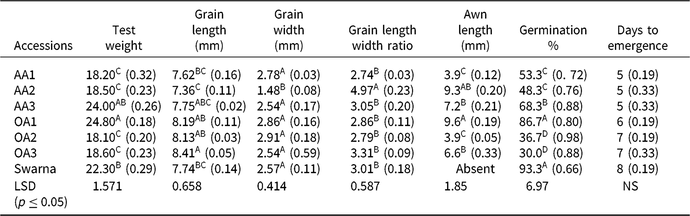
Awn length varied significantly among the weedy rice accessions, with OA1 recording the longest awn (10 mm) and AA1 and OA2 the shortest awns (4 mm) (Table 1). Significant variation was also found in grain dimensions and test weights. The OA1 seeds recorded the highest test weight (24.8 g) followed by AA3 (24.0 g) and Swarna (22.3 g). Test weights of other accessions ranged from 18.1 to 18.6 g (Table 1). The OAs had a longer grain length compared to AAs and the grain length:width ratio was highest in AA2 (4.97) as the grains were too slender (Table 1). The germination varied significantly among the weedy rice accessions and found to be significantly lower compared to Swarna (93.3%), ranging from 48.3 to 68.3% in AAs and from 30 to 86.7% in OAs (Table 1). Plumule emergence was similar in AAs and OAs and varied between 5 and 7 days. Swarna took 8 days to emerge (Table 1).
Grain characteristics of six different weedy rice accessions (Assam accessions: AA1, AA2 and AA3; Odisha accessions: OA1, OA2 and OA3) compared to cultivated rice, Swarna. Numbers in parentheses are standard errors

Means with at least one letter common are not statistically significant using least significant difference at p ≤ 0.05
Competition during vegetative stage
A sigmoid response was recorded for the tiller number, leaf number and leaf area produced by Swarna and weedy rice accessions (Table 2 and Supplementary Material Figures S2 and S3). The biomass accumulation showed exponential response in Swarna, whereas, it was sigmoidal in weedy rice indicating its fast vegetative growth compared to Swarna (Table 3). Plant height increased linearly with time (Table 3). The fitted model showed that the time taken to produce 50% of the maximum (w 50) tillers was 4.8 WAE when Swarna was grown alone (Table 2). However, Swarna took longer time (4.9–5.4 WAE) to produce w 50 tillers in competition with weedy rice accessions. The time taken to produce 50% of the maximum (w 50) leaf number and leaf area was comparable in Swarna when grown with weedy rice accessions (Table 2).
Parameter estimates of a three-parameter sigmoid model {y = a/{1 + e[−(x – w 50)/b]}} fitted to the tiller number, leaf number and leaf area of Swarna in the presence of Swarna (control) or in competition with weedy rice accessions (Assam accessions: AA1, AA2 and AA3; Odisha accessions: OA1, OA2 and OA3). w 50 is time taken (weeks) to produce 50% of the maximum number of tillers, number of leaves and leaf area. Numbers in parentheses are standard errors

Parameter estimates of an exponential growth model (y = a × ebx ) fitted to the shoot biomass and linear model (y = a + bx) fitted to the height of Swarna in the presence of Swarna (control) or in competition with weedy rice accessions (Assam accessions: AA1, AA2 and AA3; Odisha accessions: OA1, OA2 and OA3). Numbers in parentheses are standard errors

Early tillering was recorded in AAs at 2 WAE whereas tillering was delayed in OAs and Swarna. The AAs also recorded more number of leaves than OAs and Swarna at 2 WAE. The initial growth of Swarna was slow and it attained only three leaves at 2 WAE (Supplementary Material Figures S1 and S2). The weedy rice accessions AA2, AA3 and OA1 were taller than the other weedy rice accessions and affected Swarna growth as early as 2 WAE. Among the weedy rice accessions, OA3 recorded the lowest plant height and had least interference on Swarna growth, which attained a plant height of 19.7 cm similar to one in control pots. Similar trend was observed in shoot biomass at 2 WAE and OA1 recorded the highest plant biomass (1.46 g plant–1) (Supplementary Material Figure S3).
Swarna tillering was affected by OA1 during 2–4 WAE and weedy rice accessions AA1, AA2, AA3 and OA1 continued to produce more number of leaves than Swarna. On the other hand, OA2 and OA3 were found to be weak competitors as they allowed Swarna to produce higher number of tillers and leaves. Similar trend was also observed at 6 and 8 WAE. All fast growing weedy rice accessions interfered with leaf development of Swarna from 4 WAE. After 6 WAE, OA1 clearly emerged as the most competitive weedy rice accession with the highest tiller number (7.7), plant height (72.7 cm) and total biomass (6.65 g plant–1). In the presence of OA1, number of tillers, number of leaves, plant height and biomass production of Swarna were reduced by 27.5, 12.8, 4.7 and 8.7%, as compared to the control pot.
Competition during reproductive stage
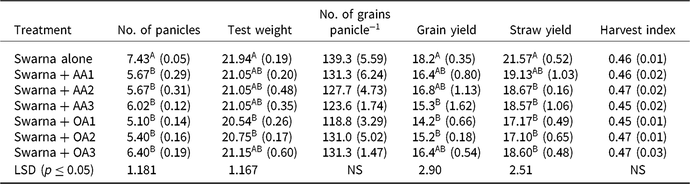
Odisha accession OA1 recorded the maximum number of panicles (6), test weight (21.7 g), number of grains panicle–1 (121.3), highest grain yield (16.2 g) and straw yield (18.2 g) among the weedy rice accessions. The number of panicles of cultivated rice Swarna ranged from five in the presence of OA1 to seven in control (Table 4). All weedy rice accessions (except OA3) were found to reduce significantly the panicle numbers in Swarna. The 1000 grain weight of Swarna in the presence of OA1 was lowest (20.5) and Swarna yields were similar when growing in competition with AA1, AA2 and OA3 (Table 4).
Number of panicles, test weight, number of grains panicle–1, grain yield (g plant–1), straw yield (g plant–1), harvest index of Swarna in treatments where both rice and weedy rice (Assam accessions: AA1, AA2 and AA3; Odisha accessions: OA1, OA2 and OA3) were grown till maturity. Numbers in parentheses are standard errors

Means with at least one letter common are not statistically significant using least significant difference at p ≤ 0.05
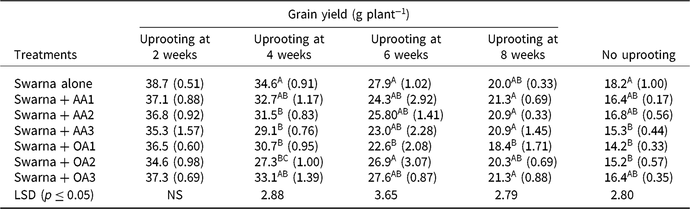
Higher yield penalty was recorded in all pots as the competition progressed from 2 WAE to maturity, regardless the weedy rice accession (Table 5). In control pot, Swarna yield was 18.2 g plant–1 when competition was allowed until maturity whereas the yield was 38.7 g plant–1 when competition was allowed only up to 2 WAE. This result indicated that there was about 52% yield reduction due to interplant competition and the highest yield loss (61%) occurred when Swarna rice interacted with OA1, the most competitive weedy rice accession tested.
Grain yield (g plant–1) of cultivated rice, Swarna as influenced by uprooting of Swarna (Control) and weedy rice (Assam accessions: AA1, AA2 and AA3; Odisha accessions: OA1, OA2 and OA3) at different stages. Numbers in parentheses are standard errors

Means with at least one letter common are not statistically significant using least significant difference at p ≤ 0.05
Among the weedy rice accessions, OA1 appeared to be highly competitive (Supplementary Material Table S2). However, AA3 recorded yield and yield attributes similar to OA1. The yield reduction of Swarna was statistically non-significant when competition with OA1 was only up to 2 WAE. On average and compared to control conditions, yield reduction of Swarna was 6.2% and 11% with uprooting of weedy rices at 2 and 4 WAE, respectively. There was significant yield reduction (18%) when competition was allowed until 6 WAE compared to weedy rice uprooting at 2 WAE. There was further yield reduction (22% less than the control) when competition with OA1 was allowed until its maturity.
Nutrient uptake
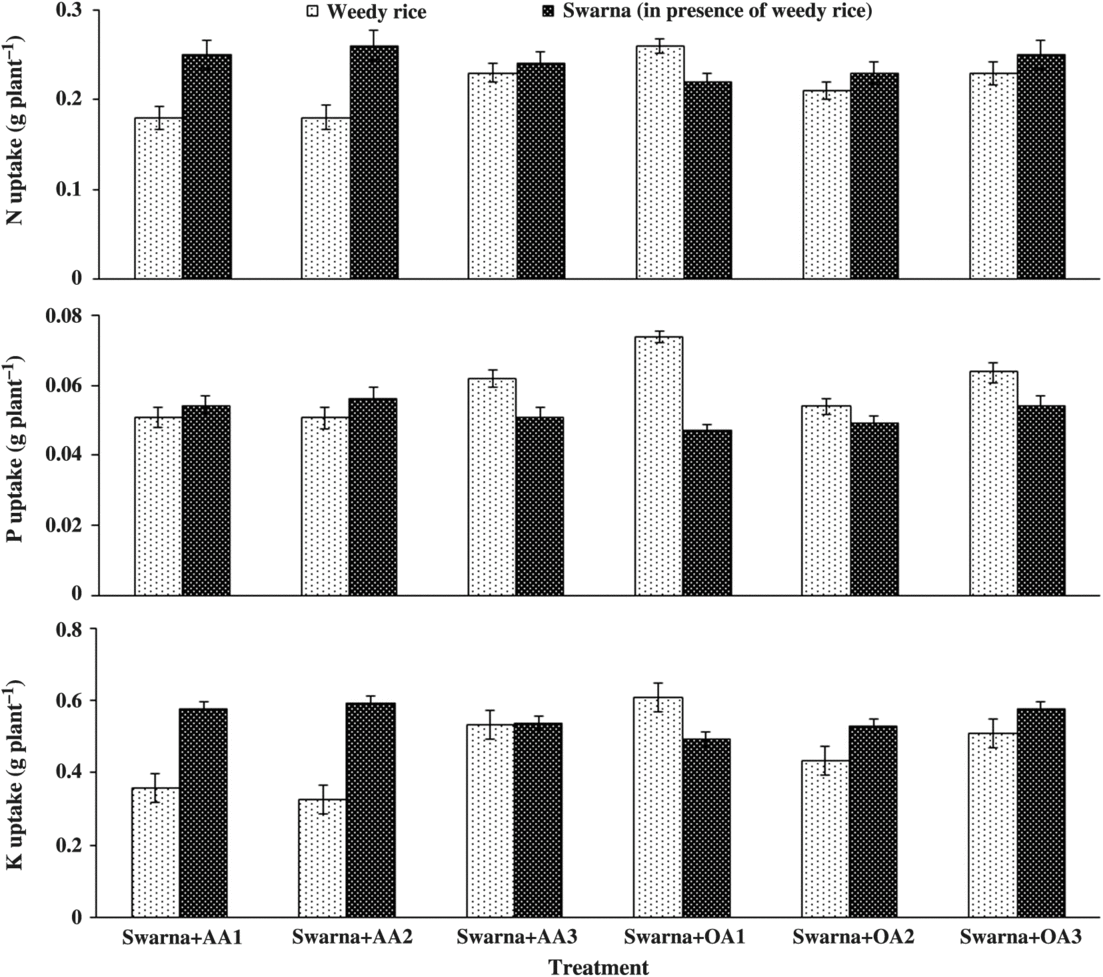
Weedy rice accessions recorded differential nutrient uptake and AA3, OA1, OA2 and OA3 presented uptakes similar to Swarna (Figure 1), indicating a substantial threat to cultivated varieties. Swarna recorded lower nutrient uptake when competing with OA1 until maturity. AA1 and AA2 recorded significantly lower NPK uptake as compared to Swarna, reflecting their poor competing ability. Further examination of data revealed that all the weedy rice accessions were more efficient in P uptake when compared to N and K uptake. Weedy rice accessions recorded high P content in grain and straw and AA3, OA1, OA2 and OA3 presented higher P uptake than Swarna (Figure 1). The highest P uptake was recorded in OA1 (0.074 g plant–1), being 57.4% higher than Swarna (0.047 g plant–1). The N and K uptake by Swarna was higher or similar when grown in the presence of weedy rice accessions, with exception of OA1. This recorded 18.2% higher N and 23.9% higher K uptake than Swarna (Figure 1).
Total N, P and K uptake (g plant–1) of Swarna and weedy rice (Assam accessions: AA1, AA2 and AA3; Odisha accessions: OA1, OA2 and OA3) in control (no uprooting). Error bars represent the standard deviation of three replications.

Discussion
The present study revealed significant variations in different traits among the weedy rice accessions and Swarna rice. Other studies on diversity of Indian weedy rice populations suggested that notable variations amongst the functional traits of weedy rices and that morphotypes do not distribute based on agro-climatic zones (Rathore et al., Reference Rathore, Singh, Kumar and Chauhan2016). This manuscript highlights the extent of Swarna yield penalty when competing with weedy rice. In fact, rice–weedy rice competition is more severe than rice–rice competition (Rathore et al., Reference Rathore, Singh, Kumar and Chauhan2016) and weedy rice is known to significantly affect cultivated rice from seedling emergence (Chauhan, Reference Chauhan2013; Chin, Reference Chin2001; Sales et al., Reference Sales, Burgos, Shivrain, Murphy and Gbur2011). The tested accessions were collected from the Indian sub-continent and therefore, we assume that such accessions are indica crossed weedy rices. It has been documented that indica crossed weedy rice accessions were highly competitive against cultivars as they germinate and grow rapidly, have high photosynthetic rates and strong tillering capacity (Chen et al., Reference Chen, Xia, Zhao, Wu and Zhang2007). Accordingly, mean germination time of weedy rice accessions was lower than cultivated indica rice (Table 1). When competing with weedy rices, cultivated rice gets shaded immediately after emergence (Azmi et al., Reference Azmi, Abdullah, Mislamah, Baki, Baki, Chin and Mortimer2000) and this interference leads to less photosynthetic activity of cultivated rice (Berger et al., Reference Berger, Piou, Schiffers and Grimm2008). Similar to these studies, all AAs and OA1 had higher leaf area than Swarna, which could have probably hindered photosynthetic rates in Swarna rice, resulting in slow growth. Thus, weedy rice establishes a competitive advantage early in the growth cycle, as the plant size and height are significant determinants of their competitive ability.
Competitive ability of plants differed due to variation in biomass accumulation and tiller number. Herein, biomass accumulation pattern of weedy rice accessions was sigmoidal (Supplementary Material Figure S3), which indicated that weedy rice accessions had a very fast vegetative growth up to 6 WAE. Based on this finding, it could be easily assumed that weedy rice was more competitive at early phenological stage as compared to Swarna, which reached its highest growth at about 8 WAE (Supplementary Material Figure S2). Our data revealed that OA1 produced more biomass and also exhibited high tillering potential than other weedy rice accessions (Supplementary Material Figure S3). Heavy tillering gives competitive advantage to weedy rice over cultivated rice as they split nutrients, light and space allocated for cultivated rice. As plant growth varies among weedy rice accessions, they affect cultivated rice growth and yield differently. Reports suggest that rice cultivars respond differently to the competition with weedy rice (Estorninos et al., Reference Estorninos, Gealy, Gbur, Talbert and McClelland2005), and, in most cases, weedy rice restricts the performance of cultivated rice (Ratnasekera et al., Reference Ratnasekera, Perera, He, Senanayake, Wijesekara, Yang and Baorong2014).
Like the vegetative growth, the reproductive stage was also affected by the rice–weedy rice competition. We observed sudden decline in yield when competition was allowed beyond 6 weeks (Table 5). Duration of competition plays a vital role in yield loss (Chauhan, Reference Chauhan2013; Noldin et al., Reference Noldin, Chandler and McCauley2006; Ratnasekera et al., Reference Ratnasekera, Perera, He, Senanayake, Wijesekara, Yang and Baorong2014) and all management practices must be done at early stages (2–4 WAE) to restrict the yield loss at about 5–10%. Likewise, Shivrain et al. (Reference Shivrain, Burgos, Scott, Gbur, Estorninos and McClelland2010) suggested that length of life cycle of weedy rice also plays a major role in impeding the growth and grain yield of cultivated rice. Depending on the cost of weed control and anticipated financial gain, 5% yield loss is accepted to determine the critical period of weed control (Knezevic et al., Reference Knezevic, Evans, Blankenship, Van Acker and Lindquist2002). The average yield reduction of Swarna was 6.2 at 2 WAE. Therefore, 2–4 WAE can be considered most crucial for weedy rice control to arrest the yield reduction at 5–10% acceptable yield loss as there was sudden drop of yield in Swarna when competition is allowed after this period.
In terms of nutrient uptake, we found a direct relationship between N uptake and grain yield in weedy rice as well as in Swarna rice (Figure 1). More the N uptake by weedy rice, lower the grain yield of Swarna. K uptake reflected the same trend and our results revealed that the weedy rice accessions were very efficient in P uptake (Figure 1). The P uptake by weedy rice accessions was consistently similar or higher than Swarna rice. By evaluating P uptake across the accessions, it can be suggested that unlike N and K, high P uptake of weedy rice did not record a direct negative effect on grain yield of Swarna rice (Figure 1). This could be due to low P requirement or high P deficiency tolerance ability of Swarna rice (Mukherjee et al., Reference Mukherjee, Sarkar, Chakraborty, Yelne, Kavishetty, Biswas, Mandal and Bhattacharyya2014), a hypothesis that requires further investigation. Another important finding related to the nutrient utilisation was the biomass accumulation. Weedy rice accessions reached their highest biomass accumulation at about 6 WAE, whereas Swarna took 8 WAE to reach its maximum values (Supplementary Material Figures S2 and S3). As a consequence and irrespective of total nutrient uptake, there was more nutrient utilisation at early stage by weedy rice as compared to Swarna rice. Earlier reports suggest that weedy rice produces more biomass per unit of absorbed N than rice cultivars (Burgos et al., Reference Burgos, Shivrain, Scott, Mauromoustakos, Kuk, Sales and Bullington2011). Similarly, weedy rice accessions from Asian countries had higher N use efficiency than cultivated rice (Chauhan and Johnson, Reference Chauhan and Johnson2011). Finer and longer roots in weedy rice and a resulting higher root surface area would have allowed weedy rice to absorb more nutrients than rice cultivar (Sales et al., Reference Sales, Burgos, Shivrain, Murphy and Gbur2011), and this advantage makes it adapt and grow better even under N-deficient conditions.
In general, all weedy rice accessions decreased the growth and yield of cultivated Swarna, regardless of the origin and morphology. The Odisha accessions had greater negative impact on yield of Swarna rice and we concluded that (i) yield reduction (11–18%) was significant when competition was allowed beyond 4–6 weeks, and therefore, specific management practices should be opted during the first month after emergence for avoiding unacceptable yield losses and (ii) high N and K uptake by weedy rice accessions were inversely related to the grain yield of cultivated rice.
Supplementary materials
For supplementary material for this article, please visit https://doi.org/10.1017/S0014479718000455
Acknowledgements
The authors are thankful to Indian Council of Agricultural Research (ICAR) for providing financial support to conduct the research work. The authors duly acknowledge the Director, ICAR–National Rice Research Institute, Cuttack, India, for his support.
Financial support
None.