Introduction
Bryozoans are among the commonest fossils found in Upper Cretaceous sedimentary rocks from Europe and Central Asia (e.g., Voigt, Reference Voigt1967, Reference Voigt and Wiedmann1979, Reference Voigt1983). In other parts of the world, however, they are usually considered rare (e.g., Frey and Larwood, Reference Frey and Larwood1971; Cuffey et al., Reference Cuffey, Feldmann and Pohlable1981), with many papers describing Late Cretaceous bryozoans from North America (e.g., Canu and Bassler, Reference Canu, Bassler and Wade1926a; Bassler, Reference Bassler1936; Stephenson, Reference Stephenson1952; Butler and Cheetham, Reference Butler and Cheetham1958; Toots and Cuttler, Reference Toots and Cuttler1962; Woollacott, Reference Woollacott1966; Shaw, Reference Shaw1967; Frey and Larwood, Reference Frey and Larwood1971; Voigt, Reference Voigt1971; Turner, Reference Turner and Pouyet1976, Reference Turner, Larwood and Abbott1979; Cuffey et al., Reference Cuffey, Feldmann and Pohlable1981; Kues, Reference Kues1983; Taylor and Cuffey, Reference Taylor and Cuffey1992, Reference Taylor, Cuffey, Gallagher and Parris1996; Taylor and McKinney, Reference Taylor and McKinney2000, Reference Taylor and McKinney2006; Ostrovsky and Taylor, Reference Ostrovsky and Taylor2005a; Taylor, Reference Taylor2008; Wilson and Taylor, Reference Wilson, Taylor, Ernst, Schäfer and Scholz2013; McKinney and Taylor, Reference McKinney and Taylor2016). Nevertheless, the rich and highly diverse bryozoan fauna from the Campanian to Maastrichtian US Atlantic and Gulf Coastal Plain described by Taylor and McKinney (Reference Taylor and McKinney2006) suggests that bryozoans are, at least locally, more common and diverse in North America than the sparse published literature might imply.
Bryozoans from the Early Cretaceous, on the other hand, are considered rare and of low diversity on a global scale (e.g., Voigt, Reference Voigt and Wiedmann1979; Ostrovsky et al., Reference Ostrovsky, Taylor, Dick, Mawatari, Okada, Mawatari, Suzuki and Gautam2008; Dick et al., Reference Dick, Komatsu, Takashima and Ostrovsky2014). From North America, only a few faunas, all from the Albian, have been described (Cheetham, Reference Cheetham1954, Reference Cheetham and Pouyet1976; Thomas and Larwood, Reference Thomas and Larwood1956; Scott, Reference Scott1970; Nye and Lemone, Reference Nye and Lemone1978; Ostrovsky and Taylor, Reference Ostrovsky, Taylor, Moyano and Wyse Jackson2005b; Cheetham et al., Reference Cheetham, Sanner, Taylor and Ostrovsky2006). Cheilostome bryozoans are the main focus of these studies.
Both calcified orders found in modern marine bryozoan assemblages, Cheilostomata and Cyclostomata, diversified rapidly during the late Albian and early Cenomanian, with many new forms and evolutionary innovations appearing in a relatively short time interval (e.g., Cheetham, Reference Cheetham1954; Voigt, Reference Voigt1974, Reference Voigt1993; Martha et al., Reference Martha, Taylor, Matsuyama, Scholz, Rosso, Wyse Jackson and Porter2014; Martha and Taylor, Reference Martha and Taylor2016, Reference Martha and Taylor2017). A locus of cheilostome evolution during the initial stages of this diversification event appears to have been the southcentral USA (Cheetham et al., Reference Cheetham, Sanner, Taylor and Ostrovsky2006), while the cyclostome fauna from this area has largely been neglected. The Glen Rose and Walnut formations of the Trinity and Fredericksburg groups, respectively, of southcentral and northcentral Texas contain abundant cyclostome and cheilostome bryozoans that predominantly encrust bivalve shells, with most of the cyclostome colonies encrusting rudists.
Here, we describe the previously unknown cyclostome fauna from the Glen Rose and Walnut formations of several localities in northcentral and southcentral Texas, USA. The gymnolaemate bryozoan fauna will be described in a separate contribution and its diversity compared with that of the cyclostomes (Martha et al., Reference Martha, Taylor and Rader2019).
Geological setting
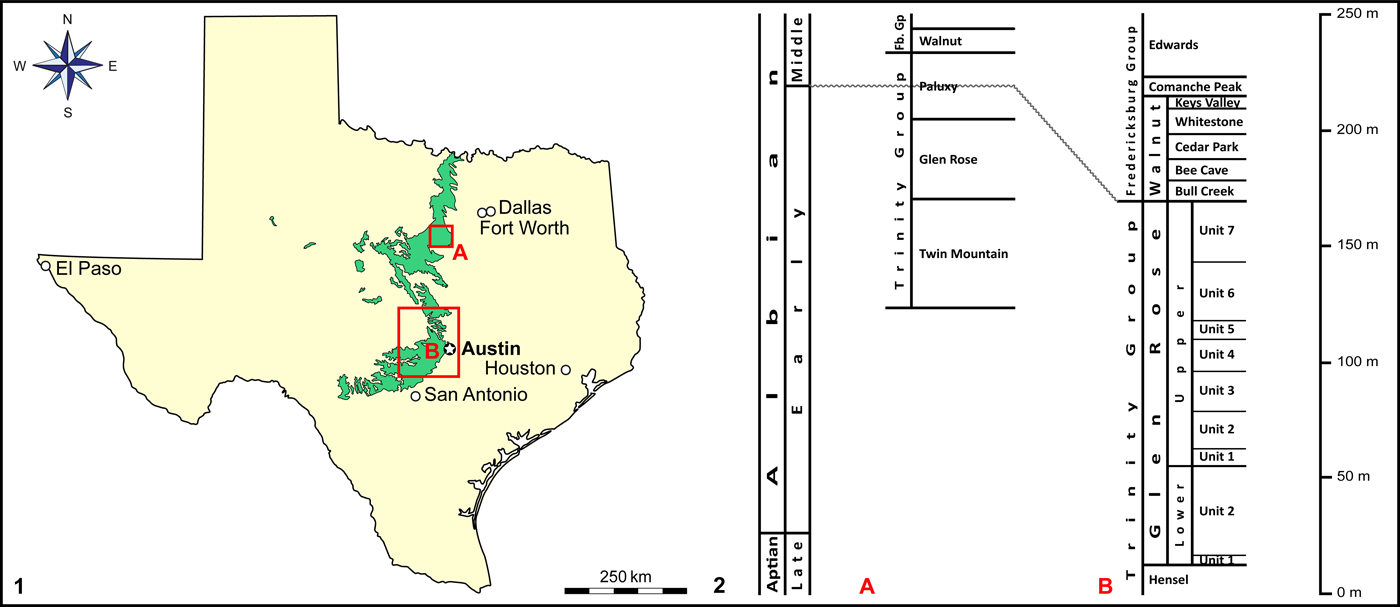
The Glen Rose Formation is the upper unit of the Lower Cretaceous Trinity Group and is of latest Aptian to early Albian age (ca. 113–108 Ma). In southcentral Texas (Fig. 1.1), it overlies the upper Aptian Hensel Sandstone of the Trinity Group and underlies either the middle Albian Walnut Formation or the Paluxy Sand of the Fredericksburg Group (Fig. 1.2). The Glen Rose Formation was deposited in the shallow water of a broad carbonate platform. Deposition occurred on the southeastern flank of the Llano Uplift and on the seaward margin to the northwest behind the Stuart City Reef Trend. Coral and rudist reefs, algal beds, dinosaur tracks, extensive ripple marks, and evaporites all indicate deposition in shallow water.
Geographical locality map of Texas and stratigraphic schemes of the upper part of the Trinity Group and the lower part of the Fredricksburg Group. (1) Distribution of the Trinity Group at outcrop (green) with red boxes indicating the region of collection sites for material used in this study from northcentral Texas (A) and southcentral Texas (B). For geographical details of the collection sites, see Supplementary Data Sets 1 and 2. (2) Stratigraphic schemes and correlation of sections for the upper part of the Trinity Group and the lower part of the Fredricksburg Group in (A) northcentral Texas (Trinity River section in Fort Worth) and (B) southcentral Texas (Colorado River section in Austin). Modified after Mancini and Scott (Reference Mancini and Scott2006) with information from Stricklin et al. (Reference Stricklin, Smith and Lozo1971).

The Glen Rose Formation is composed predominantly of limestone, dolostone, calcareous shale, and marlstone (Mancini and Scott, Reference Mancini and Scott2006). The Glen Rose Formation thickens from <50 m in the northern part of the outcrop to >300 m in the vicinity of the Balcones Fault Zone (Stricklin et al., Reference Stricklin, Smith and Lozo1971). The stratigraphy of the formation is rarely revealed in large-scale, contiguous exposures, but rather in newly excavated housing tracts, roadcuts, along and within creekbeds, in quarries, and on the weathered, stair-step hillsides typical of Glen Rose topography. The stratigraphy of the Glen Rose has been assembled by correlating distinctive marker beds that are most often recognized by their faunal content (Ward and Ward, Reference Ward and Ward2007).
The Lower Member of the Glen Rose Formation has been divided into two informal units based on differences in lithology (Stricklin et al., Reference Stricklin, Smith and Lozo1971). In southcentral Texas, the basal unit (Unit 1) crops out along rivers and creeks and occasionally roadcuts from Hays and Blanco counties southwestward into Medina County. The “Lower Reef Interval” occurs within Unit 1. Small rudist bioherms and larger, tabular coral or rudist bioherms are found within this interval. The “Upper Reef Interval” occurs within Unit 2 of the Lower Member. Small rudist bioherms, composed mostly of Monopleura marcida White, Reference White1884 and large rudist bioherms that consist of caprinids, such as Coalcomana ramosa (Boehm, Reference Boehm, Felix and Lenk1899), are found locally within this interval.
In Comal County in the vicinity of Canyon Lake, the “Upper Reef Interval” overlies the “Echinoid Marker Bed,” which is ~10 m thick and composed of Orbitolina packstone containing O. texana (Roemer, Reference Roemer1849). At least 14 species of echinoids, largely crevice-dwelling or rubble-dwelling forms, three species of asteroids and one crinoid occur within the basal meter of this bed, as do the teeth and vertebrae of teleosts and sharks. In addition, disarticulated decapod crustaceans, particularly chelae, are abundant, as are calcite septarian nodules that range from a fraction of an inch to seven inches (2.5–17.8 cm) in maximum dimension.
The “Salenia texana Bed” is located near the top of Unit 2. The bed derives its name from the regular echinoid Leptosalenia texana (Credner, Reference Credner1875), is highly fossiliferous and, unlike most of the beds in Unit 2 of the Lower Member, is laterally persistent. It represents an open-marine, subtidal environment (Ward and Ward, Reference Ward and Ward2007). Both cheilostomes and cyclostomes are found in the bed. In a bed 14–16 feet (4.3–4.9 m) below the “Salenia texana Bed,” cheilostomes are found encrusting the large oyster Liostrea camelina (Cragin, Reference Cragin1893). This appears to be the lowest bed in the entire Glen Rose Formation in which bryozoans occur.
The Upper Member and the Lower Member of the Glen Rose Formation are separated by an extensive, approximately meter-thick interval, the “Corbula Bed” (Lozo and Stricklin, Reference Lozo and Stricklin1956; Scott et al., Reference Scott, Molineux, Löser and Mancini2007), which contains one, but generally more, thin beds of the internal molds of the small, burrowing corbulid bivalve Eoursivivas harveyi (Hill, Reference Hill1893).
The Upper Member of the Glen Rose Formation consists of alternating resistant and non-resistant beds that form “stair-step” topography. This succession has been divided into seven units. Units 1 and 5 are collapse breccia zones from which gypsum has been removed subaerially (Stricklin et al., Reference Stricklin, Smith and Lozo1971). Units 3, 4, 6, and 7 include marker beds composed of packstone or marlstone that contain diverse faunas (Ward and Ward, Reference Ward and Ward2007). In Unit 3, the “Orbitolina Marker Bed,” named for the conical foraminifer O. minuta Douglass, Reference Douglass1960, is of particular interest. The echinoids Goniopygus whitneyi Smith and Rader, Reference Smith and Rader1999 and Plagiochasma texanum Smith and Rader, Reference Smith and Rader1999 make their appearance in this bed, and cheilostome and cyclostome bryozoans are both found encrusting several oyster shells. The latter is significant in that either cheilostomes or cyclostomes may occur within single beds of the Upper Member, but very rarely together.
The “Porocystis Marker Bed” crops out near the base of Unit 4. It receives its name from the dasyclad alga Porocystis globularis (Giebel, Reference Giebel1853), which occurs abundantly in the bed, as do the echinoids Loriolia rosana (Cooke, Reference Cooke1946) and Coenholectypus planatus (Roemer, Reference Roemer1852) and the low-spired gastropod Semineretina apparata (Cragin, Reference Cragin1893). The “Lower Loriolia Marker Bed” crops out at the very top of Unit 6. The small regular echinoid Loriolia rosana is found abundantly in the marlstone of this bed, thus the name. This is one of the most laterally persistent beds in the Upper Member, and cheilostome bryozoans can be found encrusting oysters wherever it crops out. Finally, the “Upper Loriolia Marker Bed” is located near the middle of Unit 7. Loriolia rosana is found frequently in this bed, as are cheilostomes.
Nagle (Reference Nagle1968) studied the cycles and facies of the Glen Rose Formation in Somervell County, northcentral Texas. Instead of dividing the Glen Rose Formation into an Upper and Lower Member as has been done in southcentral Texas, he separated the formation into three members: (1) Lower Member containing alternating terrigenous clastics and carbonates, (2) Middle Member (Thorp Spring Member) consisting of massive carbonates, and (3) Upper Member of alternating carbonates and terrigenous clastics.
From his study of the beds in the Lower Member, Nagle (Reference Nagle1968) was able to reach several important conclusions about the Glen Rose Formation in northcentral Texas. The Lower Member of the Glen Rose Formation is made up of seven cycles, which illustrate that salinity decreased upward from being hypersaline to reaching normal marine salinity, perhaps because of the inflow of fresh water from rivers and streams. The variety of facies within each cycle, along with a mixture of terrestrial, supratidal, intertidal, and subtidal flora and fauna, indicate that the lower Glen Rose Formation in Somervell County represents a lagoonal or bay depositional system. While beds in a cycle retain their thickness laterally, a change in facies can occur over a distance of only few kilometers. Finally, unlike the Glen Rose Formation in southcentral Texas, where the stratigraphy can be pieced together using marker beds, the same cannot be said for northcentral Texas because of facies variations within and between cycles.
Fossils, however, can be used to distinguish between habitats. Bivalves, such as Artica and Meretrix, which burrow shallowly in the substrate and are found in living position, indicate a subtidal habitat. A bed of abundant Eoursivivas harveyi found near the base of the Lower Member represents an intertidal habitat, whereas a cycle containing serpulid patch reefs is thought to be evidence for a serpulid reef shoal. The marsh habitat is represented by plant fragments, primarily Frenelopsis and by aggregations of the mussel Modiola branneri (Hill, Reference Hill1893).
In southcentral Texas, the Glen Rose Formation is overlain by the Walnut Formation of the Fredericksburg Group (or the Paluxy Sand in parts of Burnet, Coryell, and Lampasas counties; see Moore, Reference Moore1964). The Glen Rose-Walnut contact consists of dolomite below and nodular limestone above (Moore, Reference Moore1964). According to Mancini and Scott (Reference Mancini and Scott2006), the contact represents a change from a restricted tidal-flat regime to a transgressing marine lagoonal regime.
The Walnut Formation has been divided into six members, which from bottom to top are the Bull Creek Member, Bee Cave Member, Cedar Park Member, Whitestone Member, Keys Valley Member, and an unnamed “upper marl member.” The Bull Creek Member is made up of hard, burrowed, nodular limestone. In the western Austin area of Travis County, the Bull Creek Member varies in thickness between ~11.5 m to 13.0 m (Young, Reference Young1977), but thins to the south in Hays, Blanco, and Comal counties. In Travis County, the top of the Bull Creek is a pholad-bored, iron-stained hardground.
Unlike the Bull Creek Member below, the Bee Cave Member is a highly fossiliferous marlstone and is thought to be an open marine unit (Kirkland et al., Reference Kirkland, Banner, Moore, Hoffman, Pursell and Vasquez1996). It ranges from 10.0–15.0 m thick in the Austin area (Young, Reference Young1977), but, like the Bull Creek Member, thins to the south. The oysters Gryphaea mucronata (Gabb, Reference Gabb1869) and Ceratostreon texanum (Roemer, Reference Roemer1849) are abundant throughout the Bee Cave Member. In this member, cheilostome bryozoans are often found encrusting the oyster C. texanum. The fauna also consists of other bivalve taxa, gastropods, the dasyclad alga Porocystis, the solitary coral Parasimilia, and the engonoceratid ammonite Metengonoceras. A characteristic echinoid fauna is found within the Bee Cave Member that consists of Heteraster texanus (Roemer, Reference Roemer1849), Coenholectypus planatus (Roemer, Reference Roemer1852), Loriolia texana (Clark, Reference Clark1915), Salenia mexicana Schlüter, Reference Schlüter1887, Phymosoma texanum (Roemer, Reference Roemer1852), Pedinopsis yarboroughi Ikins, Reference Ikins1940, and an as yet unauthored Cottaldia. In addition, a bed of the small, conical forminifer Dictyoconus walnutensis (Carsey, Reference Carsey1926) is found near the top of the Bee Cave Member, as are vugs filled with calcite scalenohedra.
South of Travis County, the Bull Creek and Bee Cave are the only members of the Walnut Formation represented in outcrops. However, from western Travis County northward, the Cedar Park Member overlies the Bee Cave Member. Moore (Reference Moore1964) placed the contact at the base of the lowest nodular, fossiliferous micrite. The Cedar Park has a thickness of ~12.0 m throughout the central-Texas outcrop. Although fossiliferous, fossils are more distributed than in the Bee Cave Member and generally make up 5% or less of the rock (Moore, Reference Moore1964). Gryphaea mucronata and Ceratostreon texanum are plentiful, as are other bivalves and gastropods. Common echinoids are Heteraster texanus and Coenholectypus planatus.
The Whitestone Member of the Walnut Formation, commonly referred to as the Whitestone Lentil, is made up of ~21.0 m of fossiliferous oosparite and pelsparite, and is limited in extent and lenticular in shape. The best exposures are found in the stone quarries south of FM 1431 near the Travis-Williamson County line. The rock in these quarries has been used for decorative building stone since the 1920s and is known by the trade names Cordova Shell and Cordova Cream. The basal buff-colored Cordova Shell, or Trigonia stone, contains molds of marine bivalves and gastropods, most notably the ribbed bivalve Trigonia. The upper ooid facies, or Cordova Cream, consists of a buff-colored, crossbedded, oolite grainstone that also contains Trigonia (Kirkland et al., Reference Kirkland, Banner, Moore, Hoffman, Pursell and Vasquez1996). The upper surface of the Whitestone Member has been burrowed by pholads.
The Keys Valley Member of the Walnut Formation is a highly fossiliferous marlstone that overlies the Cedar Park Member throughout much of southcentral Texas. However, it overlaps the Whitestone Member north of Lake Travis from the vicinity of Jollyville, Williamson County to Cedar Park, Travis, and Williamson counties. The thickness of the Keys Valley Member ranges from 9.0–12.0 m in southcentral Texas. The base of the Keys Valley Member contains abundant Gryphaea mucronata and Ceratostreon texanum, as well as the multiwhorled Mesalia (formerly Turritella) seriatim-granulata (Roemer, Reference Roemer1852), and the regular echinoid Salenia mexicana Schlüter, Reference Schlüter1887.
An important marker bed, the “Oxytropidoceras Zone,” occurs ~5.5 m below the top of the Keys Valley Member. The zone consists of numerous internal molds of the ammonite Oxytropidoceras in a clayey, micritic mixture. Outcrops of this marker bed are exposed north and south of Highway 190 from Harker Heights in Bell County to Copperas Cove in Coryell County. At the top of the Keys Valley Member is a second noteworthy marker bed, the “Gryphaea biomicrite” (“Gryphaea lumachelle”). This is an ~1.5–3.0 m thick bed composed almost exclusively of the oyster Gryphaea mucronata (Gabb, Reference Gabb1869). Like the “Oxytropidoceras Zone,” the “Gryphaea biomicrite” is exposed north and south of Highway 190 in Bell and Coryell counties.
Where the Comanche Peak Formation (Comanche Peak Limestone) does not overlie the Keys Valley Member, it is overlain by the unnamed upper marl member. Information about the member is taken from Moore (Reference Moore1964). The upper marl is a fossiliferous (though in a lesser degree than the Keys Valley Member) nodular limestone and marlstone that is present from a point ~16 km southwest of Belton, Bell County, where the member is ~15.0 m thick, to Copperas Cove, Coryell County, with the best exposure occurring within the Fort Hood Military Reservation in Coryell County (no thickness given). According to Moore (Reference Moore1964), the member name has not been formalized because what few exposures exist are thought to be insufficient to determine the detailed stratigraphic relationship needed to erect a formal stratigraphic unit.
Materials and methods
The material used in this study was collected by W.L. Rader, P.D. Taylor, A.B. Smith, and M.A. Wilson over a period of a few decades. Bryozoan colonies were mostly found encrusting bivalve shells from the following levels: Unit 2 of the Lower Member and Units 1–4 and 6–7 of the Upper Member of the Glen Rose Formation in southcentral Texas; Beds 2–4 of the Lower Member, Bed 10 of the Middle Member and Bed 14 of the Upper Member of the Glen Rose Formation in northcentral Texas; and the Walnut Formation of southcentral Texas. Geographical and stratigraphical details of the collection sites of bryozoan material used in this study are summarized in Supplementary Data Sets 1 and 2. Preservation of the material varies from moderate to very good.
After ultrasonic cleaning, scanning electron microscopy (SEM) at the NHMUK was performed on selected specimens using an LEO 1455VP scanning electron microscope equipped with a low-vacuum chamber to produce back-scattered electron micrographs of uncoated specimens. For morphometry, SEM images were analyzed using the image-processing program ImageJ. Zooid measurements are given as range in μm and arithmetic mean (X̄) ± standard deviation and with coefficient of variation (CV) and number of measurements (N).
Repository and institutional abbreviation
All specimens are housed in the collections at the Natural History Museum, London (NHMUK).
Systematic paleontology
Phylum Bryozoa Ehrenberg, Reference Ehrenberg1831
Class Stenolaemata Borg, Reference Borg1926
Order Cyclostomata Busk, Reference Busk and MacGillivray1852
Suborder Tubuliporina Milne Edwards, Reference Milne Edwards1838
Family Stomatoporidae Pergens and Meunier, Reference Pergens and Meunier1886
Genus Stomatopora Bronn, Reference Bronn1825
Type species
Alecto dichotoma Lamouroux, Reference Lamouroux1821 from the late Bathonian of northern France (see Walter, Reference Walter1970); by monotypy.
Stomatopora sp.
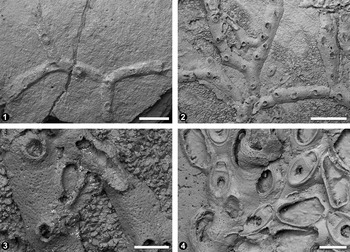
Figure 2.1–2.4
Stomatopora sp. (1−3) from Unit 6 (lower Loriolia Marker Bed) of the Upper Member of the Glen Rose Formation (early Albian) of southcentral Texas, USA and (4) from the Walnut Formation (middle Albian) of southcentral Texas USA. (1) Encrusting colony (NHMUK BZ8206). Scale bar is 500 µm. (2) Part of an encrusting colony (NHMUK BZ8205). Scale bar is 250 µm. (3) Close-up of two autozooids (NHMUK BZ8205). Scale bar is 250 µm. (4) Close-up of the colony area encrusting the cheilostome bryozoan Charixa sp. (NHMUK BZ2055). Scale bar is 250 µm.

Occurrence
Lakeway, Travis County and Spillway, Bell County, Texas.
Description
Colony encrusting, uniserial with runner-like colonies, unilaminar, typically bifurcating at angles of ~60−100° (Fig. 2.1), apertures of the two daughter zooids not always level; branch overgrowths frequent (Fig. 2.2). Ancestrula and early astogeny not observed.
Autozooids fixed-walled, large, broad, parallel-sided, 394–748 µm long (X̄ = 558 ± 81 µm; CV = 15; N = 17) by 170–416 µm wide (X̄ = 294 ± 70 µm; CV = 24; N = 17) (Fig. 2.3). Peristomes long, oriented almost perpendicular to the frontal wall, terminating in a subcircular aperture, 105–201 µm long (X̄ = 131 ± 26 µm; CV = 20; N = 17) by 101–155 µm wide (X̄ = 119 ± 15 µm; CV = 13; N = 17). Autozooidal walls containing abundant circular pseudopores (Fig. 2.4). Gonozooid and kenozooids not observed.
Morphometry measurements were performed on specimens NHMUK BZ8205 and BZ8206.
Materials
NHMUK BZ8205, BZ8206, early Albian, Glen Rose Formation, Upper Member, Unit 6 (lower Loriolia Marker Bed), cut below water tower at the intersection of FM 620 with Kollmeyer Drive, Lakeway, Travis County, Texas. BZ2055b, middle Albian, Walnut Formation, Stillhouse Hollow Dam, spillway, Belton, Bell County, Texas.
Remarks
This species is known by two colonies from the lower Loriolia Marker Bed of Unit 6 of the Glen Rose Formation (uppermost early Albian) and one colony from the overlying Walnut Formation (base of middle Albian). Stomatoporid species have a very simple colony and zooid morphology and lack gonozooids, which impedes a precise taxonomy. For this reason, many runner-like uniserial cyclostomes with bifurcating branches have been assigned to the genus Stomatopora, which therefore has an unusually long range from the Carnian (Papp, Reference Papp1900; Bizzarini and Braga, Reference Bizzarini and Braga1994) to the Recent (e.g., Packard, Reference Packard1863). Early astogenetic stages are lacking in the colonies studied, which adds to the difficulty of species identification. However, the Glen Rose species shows similarities to the Faringdon Sponge Gravel (late Aptian) species S. melvillei Pitt and Taylor, Reference Pitt and Taylor1990 from southern England, especially in the pattern of branch bifurcations in later astogeny, with the two daughter zooids having apertures at different levels (compare Fig. 2 herein with Pitt and Taylor, Reference Pitt and Taylor1990, fig. 6).
Family Oncousoeciidae Canu, Reference Canu1918
Genus Oncousoecia Canu, Reference Canu1918
Type species
Tubulipora lobulata Canu, Reference Canu1918 from the Atlantic Ocean surrounding the British Isles; by deliberate misapplication of a name (see Taylor and Zatoń, Reference Taylor and Zatoń2008).
Oncousoecia khirar new species
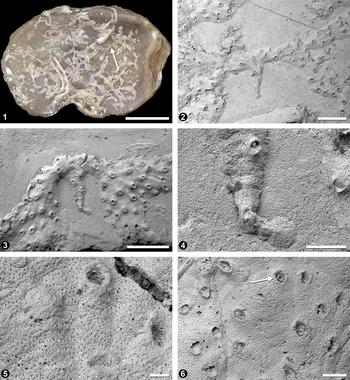
Figure 3.1–3.6
Oncousoecia khirar n. sp. from Unit 2 of the Lower Member of the Glen Rose Formation (early Albian) of southcentral Texas, USA (1, 2, 6); from Unit 3 of the Upper Member of the Glen Rose Formation (early Albian) of southcentral Texas, USA (3–5). (1) Bivalve shell encrusted by multiple colonies with the holotype colony indicated by a white arrow (NHMUK BZ8185). Scale bar is 1 cm. (2) Encrusting colony showing diverging branches (holotype, NHMUK BZ8185). Scale bar is 1 mm. (3) Encrusting colony (paratype, NHMUK BZ8189). Scale bar is 1 mm. (4) Close-up view of the ancestrula (paratype, NHMUK BZ8189). Scale bar is 250 µm. (5) Close-up of autozooid (paratype, NHMUK BZ8188). Scale bar is 100 µm. (6) Gonozooid with oeciopore marked by white arrow (holotype, NHMUK BZ8185). Scale bar is 250 µm.

Holotype
NHMUK BZ8185, early Albian, Glen Rose Formation, Lower Member, Unit 2 (Salenia texana Marker Bed), abandoned quarry east side of Singleton Bend Road, north side of Lake Travis, Travis Peak, Travis County, Texas.
Paratypes
NHMUK BZ8187, early Albian, Glen Rose Formation, Upper Member, Unit 3, Flanders Road, south of cattlepond, Legends Subdivision, Fischer, Comal County, Texas. NHMUK BZ8189, early Albian, Glen Rose Formation, Upper Member, Unit 3 (lower Orbitolina Marker Bed), Flanders Road, cattlepond, Legends Subdivision, Fischer, Comal County, Texas. NHMUK BZ8188, early Albian, Glen Rose Formation, Upper Member, Unit 3 (middle Orbitolina Marker Bed), construction site at Canyon Lake High School, RM 32 at FM 3424, Fischer, Comal County, Texas.
Diagnosis
Oncousoecia with oligoserial colonies and flabellate branches; autozooidal frontal walls with circular pseudopores; gonozooid associated with bifurcations, chamber low in profile, roof with dense circular pseudopores; ooeciopore terminal, offset the longitudinal axis, circular.
Occurrence
Known from several specimens from four localities in Unit 2 of the Lower Member and Unit 3 of the Upper Member of the Glen Rose Formation, Comal County and Travis County, southcentral Texas, USA.
Description
Colony encrusting, oligoserial, unilaminar, branches flabellate with autozooids diverging slightly from their axes, frequently bifurcating (Fig. 3.1–3.3), initially at an angle of ~180° but at lower angles subsequently. Ancestrula with circular protoecium, 161–199 µm (X̄ = 180 ± 27; CV = 15; N = 2) in diameter, with pseudopores indiscernable, budding a single autozooid (Fig. 3.4).
Autozooids fixed-walled, tubular, 383–642 µm long (X̄ = 508 ± 71; CV = 14; N = 30) by 119–200 µm wide (X̄ = 162 ± 21; CV = 13; N = 30), frontal walls slightly convex, with dense circular pseudopores (Fig. 3.5). Autozooidal apertures terminal, circular, 83–141 µm long (X̄ = 112 ± 14; CV = 12; N = 30) by 86–123 µm wide (X̄ = 106 ± 11; CV = 10; N = 30), surrounded by usually broken peristomes, some of which sealed by a terminal diaphragm. Zooidal boundaries defined by shallow grooves.
Gonozooid often located in areas of branch bifurcation, bulb-shaped, 617–840 µm long (X̄ = 692 ± 128; CV = 19; N = 3) by 306–561 µm wide (X̄ = 470 ± 143; CV = 30; N = 3), autozooidal peristomes indenting the margins but not perforating the roof, which is rather flat with poorly defined margins (Fig. 3.6); roof densely pseudoporous, the pseudopores circular; oeciopore terminal, offset the longitudinal axis of the gonozooid, circular, 130–140 µm in diameter, with broken ooeciostome (Fig. 3.6).
Morphometry measurements were performed on specimen NHMUK BZ8185 (holotype) and specimens NHMUK BZ8188 and NHMUK BZ8189 (paratypes).
Etymology
From Wichita khira :r (‘diverge’), referring to the diverging branches.
Materials
Holotype and paratypes (for details, see above). NHMUK BZ8184, BZ8186, early Albian, Glen Rose Formation, Lower Member, Unit 2 (Salenia texana Marker Bed), abandoned quarry east side of Singleton Bend Road, north side of Lake Travis, Travis Peak, Travis County, Texas. NHMUK BZ8190, early Albian, Glen Rose Formation, Upper Member, Unit 3 (lower Orbitolina Marker Bed), Flanders Road, cattle pond, Legends Subdivision, Fischer, Comal County, Texas.
Remarks
Oncousoecia khirar n. sp. is distinguished by its low-profile oligoserial branches that are flabellate, increasing in width prior to each bifurcation. The new species resembles O. coarctata (Canu and Bassler, Reference Canu and Bassler1926b) from the Faringdon Sponge Gravel of southern England, but in this late Aptian species the gonozooids are almost as wide as long and the autozooids have dart-shaped pseudopores (Pitt and Taylor, Reference Pitt and Taylor1990).
Family Multisparsidae Bassler, Reference Bassler1935
Genus Reptomultisparsa d'Orbigny, Reference d'Orbigny1853
Type species
Diastopora incrustans d'Orbigny, Reference d'Orbigny1849 from the late Bathonian of Sarthe, France; by designation under the plenary powers (International Commission on Zoological Nomenclature, 1986).
Reptomultisparsa mclemoreae new species
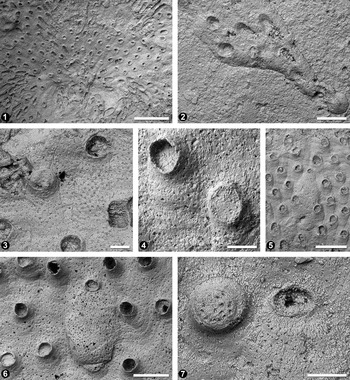
Figures 4.1–4.7, 5.1
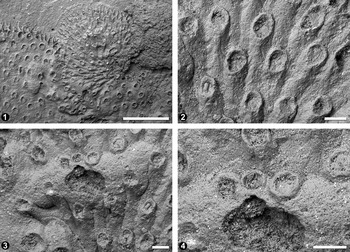
Reptomultisparsa mclemoreae n. sp. from Unit 2 of the Lower Member of the Glen Rose Formation (early Albian) of southcentral Texas, USA (3, 7); from Unit 4 of the Upper Member of the Glen Rose Formation (early Albian) of southcentral Texas, USA (4, 6); from Unit 6 (lower Loriolia Marker Bed) of the Upper Member of the Glen Rose Formation (early Albian) of southcentral Texas, USA (2, 5); from Unit 7 (upper Loriolia Marker Bed) of the Upper Member of the Glen Rose Formation (early Albian) of southcentral Texas, USA (1). (1) General view of colony (paratype, NHMUK BZ8202). Scale bar is 1 mm. (2) Ancestrula and proximal part of colony (paratype, NHMUK BZ8200). Scale bar is 500 µm. (3) Pseudoporous frontal wall of autozooids (paratype, NHMUK BZ8197). Scale bar is 100 µm. (4) Autozooid sealed by terminal diaphragms, the diaphragm in the left autozooid being sunken (paratype, NHMUK BZ8199). Scale bar is 100 µm. (5) Colony area with gonozooid (holotype, NHMUK BZ8201). Scale bar is 500 µm. (6) Close-up of the colony area with gonozooid and autozooids, some of which are closed by diaphragms (paratype, NHMUK BZ8199). Scale bar is 250 µm. (7) Ooeciopore (right) and autozooid closed by pseudoporous terminal diaphragm (right) (paratype, NHMUK BZ8197). Scale bar is 100 µm.

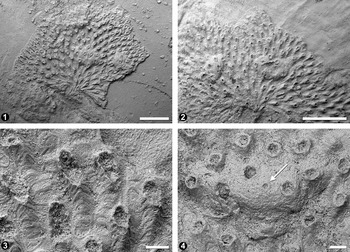
Hyporosopora keera n. sp. from Unit 6 (lower Loriolia Marker Bed) of the Upper Member of the Glen Rose Formation (earliest Albian) of southcentral Texas, USA. Holotype (NHMUK BZ8170). (1) Colony encrusting Reptomultisparsa mclemoreae n. sp. Scale bar is 1 mm. (2) Autozooids showing longitudinal ridges. Scale bar is 100 µm. (3) Gonozooid. Scale bar is 100 µm. (4) Close-up of the ooeciopore and neighboring autozooids. Scale bar is 100 µm.

Holotype
NHMUK BZ8201, early Albian, Glen Rose Formation, Upper Member, Unit 6 (lower Loriolia Marker Bed), roadcut on the north side of FM 620 northwest of Mansfield Dam, Hudson Bend, Travis County, Texas.
Paratypes
NHMUK BZ8197, early Albian, Glen Rose Formation, Lower Member, Unit 2, roadcut along River Ridge Road, Mystic Shores Subdivision, Canyon Lake, Comal County, Texas. NHMUK BZ8199, early Albian, Glen Rose Formation, Upper Member, Unit 4, small quarry near end of Destination Way, Lago Vista, Travis County, Texas. NHMUK BZ8200, early Albian, Glen Rose Formation, Upper Member, Unit 6 (lower Loriolia Marker Bed), roadcut on the north side of FM 620 northwest of Mansfield Dam, Hudson Bend, Texas. NHMUK BZ8202, early Albian, Glen Rose Formation, Upper Member, Unit 7 (upper Loriolia Marker Bed), roadcut below water tank above Ming Trail, Lago Vista, Travis County, Texas.
Diagnosis
Reptomultisparsa with large, fan-shaped colonies; autozooids with slightly convex frontal walls containing circular to transversely elliptical pseudopores and crossed by weakly developed growth bands; autozooidal apertures subcircular; terminal diaphragms high and with large, circular pseudopores, or sunken and non-pseudoporous; gonozooid peripheral, longitudinally elliptical, with large, terminal, transversely elliptical ooeciopore.
Occurrence
All studied specimens are from Unit 2 of the Lower Member of the Glen Rose Formation of Comal County, or from units 4, 6, and 7 of the Upper Member of the Glen Rose Formation of Travis County, Texas, USA.
Description
Colony encrusting, bereniciform, multiserial, unilaminar, fan-shaped, extending as flat sheet (Fig. 4.1). Ancestrula with circular, smooth protoecium; distal tube straight, short; two distal autozooids budded from ancestrula (Fig. 4.2).
Autozooids fixed-walled, tubular, 406–658 µm long (X̄ = 515 ± 63; CV = 12; N = 35) by 144–199 µm wide (X̄ = 172 ± 14; CV = 8; N = 35), with densely pseudoporous and slightly convex frontal walls crossed by weak growth bands. Pseudopores circular to transversely elliptical. Zooidal boundaries often well defined by shallow grooves, but sometimes indistinct (Fig. 4.3). Autozooidal apertures subcircular, 84–143 µm long (X̄ = 115 ± 15; CV = 13; N = 35) by 87–137 µm wide (X̄ = 109 ± 14; CV = 12; N = 35). Peristomes short, usually broken in examined material. Terminal diaphragms common, either high and with large, circular pseudopores, or sunken and non-pseudoporous (Fig. 4.4, 4.7).
Gonozooid peripheral but not terminal, longitudinally elliptical, bulbous, 712–1022 µm long (X̄ = 893 ± 161; CV = 18; N = 3) by 338–413 µm wide (X̄ = 367 ± 41; CV = 11; N = 3); roof densely pseudoporous, occasionally indented at the margins by autozooidal apertures (Figs. 4.5, 4.6, 5.1); pseudopores circular to transversely elliptical; ooeciopore terminal, transversely elliptical to slightly kidney-shaped, 75–77 µm long (X̄ = 76 ± 1; CV = 1; N = 3) by 92–115 µm wide (X̄ = 100 ± 13; CV = 13; N = 3), slightly smaller than an autozooidal aperture (Fig. 4.7).
Morphometry measurements were performed on specimen NHMUK BZ8201 (holotype) and specimens NHMUK BZ8197 and NHMUK BZ8199 (paratypes).
Etymology
Named for Doris Jean Lamar-McLemore (1927–2016), the last fluent heritage speaker of Wichita.
Materials
Holotype and paratypes (for details, see above). NHMUK BZ8198, early Albian, Glen Rose Formation, Lower Member, Unit 2, roadcut along River Ridge Road, Mystic Shores Subdivision, Canyon Lake, Comal County, Texas. NHMUK BZ8203, early Albian, Glen Rose Formation, Upper Member, Unit 7, roadcut below water tank above Ming Trail, Lago Vista, Travis County, Texas.
Remarks
Reptomultisparsa mclemoreae n. sp. is readily distinguished from the other bereniciform cyclostomes in the Glen Rose Formation of southcentral Texas by the shape of the gonozooid, which is longitudinally elliptical. Although Reptomultisparsa is widely known from the Rhaetian to Albian of Europe, this is the first report of a species from outside Europe, excluding R. borkari Chiplonkar and Ghare, Reference Chiplonkar and Ghare1976 from the Cenomanian Bagh Beds of central India, for which the gonozooid is unknown and the species is therefore better referred to the form-genus ‘Berenicea.’
The concept of Reptomultisparsa when the genus was introduced by d'Orbigny (Reference d'Orbigny1853) was for ‘Berenicea’-like cyclostomes with multilamellar colonies. This has been superseded by a definition based on gonozooid morphology, which leaves relatively few species of the genus in the Cretaceous, the majority of species of Reptomultisparsa being of Jurassic age. Indeed, Walter (Reference Walter1989) in his review of bereniciform cyclostomes from the Early Cretaceous of the French and Swiss Jura recognized no species of Reptomultisparsa. In the morphology of the autozooids and gonozooids, R. mclemoreae n. sp. resembles the European Middle Jurassic species R. harae Zatoń and Taylor, Reference Zatoń and Taylor2009, which, however, has slit-like rather than circular to transversely elliptical pseudopores. Reptomultisparsa viskovae Zatoń et al., Reference Zatoń, Hara, Taylor and Krobicki2013, from the Middle Jurassic of Poland, is also similar to R. mclemoreae n. sp., but has a subcircular rather than transversely elliptical ooeciopore.
Family Plagioeciidae Canu, Reference Canu1918
Genus Hyporosopora Canu and Bassler, Reference Canu and Bassler1929
Type species
Hyporosopora typica Canu and Bassler, Reference Canu and Bassler1929, stratigraphical and geographical provenance unspecified, but presumably from the Bathonian of Calvados, France (Walter, Reference Walter1970); by original designation.
Amended diagnosis
Colony encrusting, discoidal or fan-shaped, multiserial, unilaminar, sometimes becoming multilaminar through spiral overgrowth, with autozooids arranged in quincunx or longitudinal rows, but not forming fascicles. Autozooids fixed-walled, with pseudoporous frontal walls. Gonozooid fixed-walled, subtriangular or transversely elongate; roof pseudoporous, usually penetrated by a few autozooidal peristomes at the margins; ooeciopore terminal, along or slightly offset from the longitudinal axis of the gonozooid, slightly smaller than an autozooidal aperture, circular or transversely elliptical. Nanozooids absent.
Remarks
Canu and Bassler (Reference Canu and Bassler1929) did not provide the exact locality for the type specimen(s) they studied of the type species of Hyporosopora (Hyporosopora typica Canu and Bassler, Reference Canu and Bassler1929), but it was almost certainly somewhere in Calvados, Normandy because all other material described in this publication came from this French Department (see Walter, Reference Walter1970). Since the type material of Hyporosopora typica was destroyed during the Second World War at the University of Caen, Walter (Reference Walter1970) selected a neotype. Despite having fertile colonies of the species available, and being aware of the co-occurrence of Hyporosopora typica with Mesonopora typica Canu and Bassler, Reference Canu and Bassler1929, another bereniciform cyclostome, Walter (Reference Walter1970) designated an infertile colony as the neotype of H. typica. This is very unfortunate considering the importance of gonozooids for generic identification in bereniciform cyclostomes.
Walter (Reference Walter1970) regarded Hyporosopora as a junior synonym of Plagioecia Canu, Reference Canu1918, subsequently (Walter, Reference Walter1989) repeated this view and argued that the gonozooid in fertile colonies of Hyporosopora typica does not differ significantly from that of Plagioecia patina Lamarck, Reference Lamarck1816, the Recent type species of Plagioecia. However, Taylor and Sequeiros (Reference Taylor and Sequeiros1982) provided a scheme for distinguishing genera of cyclostomes based on gonozooid shape, which separated the two genera, and Hyporosopora has subsequently been used in several papers on Mesozoic bryozoans (e.g., Taylor and McKinney, Reference Taylor and McKinney2006; Viskova, Reference Viskova2008; Wilson et al., Reference Wilson, Bosch and Taylor2015). Here, we regard Hyporosopora as a valid genus name and base the concept of the genus on the original description and images provided by Canu and Bassler (Reference Canu and Bassler1929). These reveal that the gonozooid in the type species is transversely elongate or subtriangular, while the roof is infrequently pierced by autozooidal peristomes. The ooeciopore is always located in a terminal position along or slightly offset from the longitudinal axis of the gonozooid. In contrast, the gonozooid in Plagioecia is large and crescent-shaped, with the roof occasionally pierced by autozooidal peristomes (Harmelin, Reference Harmelin1976). The ooeciopore is found in a terminal or slightly subterminal position along or slightly offset from the longitudinal axis of the gonozooid. Although Walter (Reference Walter1970, Reference Walter1989) considered the differences in the gonozooids of Hyporosopora and Plagioecia negligible, Hyporosopora may be maintained for species with short, subtriangular or slightly transverse gonozooids.
Hyporosopora keera new species
Figure 5.1–5.4
Holotype
NHMUK BZ8170, early Albian, Glen Rose Formation, Upper Member, Unit 6 (lower Loriolia Marker Bed), roadcut on the north side of FM 620 northwest of Mansfield Dam, Hudson Bend, Travis County, Texas.
Diagnosis
Hyporosopora with irregularly fan-shaped, multiserial, encrusting colonies; autozooids short, with slightly convex frontal walls with circular pseudopores and sometimes having a prominent ridge along or slightly offset from the longitudinal axis; autozooidal apertures terminal, subcircular to longitudinally elliptical; gonozooid transversely elliptical; ooeciopore terminal, transversely elliptical, slightly smaller than an autozooidal aperture.
Occurrence
Only known from the type locality.
Description
Colony encrusting, multiserial, unilaminar, irregularly fan-shaped to somewhat discoidal, extending as a flat sheet with perimeter formed by distal fringe of basal lamina with 1–2 generations of zooids visible at budding zone (Fig. 5.1). Ancestrula and early astogeny not observed.
Autozooids fixed-walled, tubular, 321–432 µm long (X̄ = 377 ± 29; CV = 8; N = 16) by 72–103 µm wide (X̄ = 88 ± 10; CV = 11; N = 16), with slightly convex frontal walls, sometimes developing a prominent ridge along or slightly offset from the longitudinal axis (Fig. 5.2). Pseudopores circular, not well preserved in examined material. Zooidal boundaries well defined by deep furrows. Autozooidal apertures arranged in quincunx, subcircular to longitudinally elliptical, 81–143 µm long (X̄ = 95 ± 12; CV = 13; N = 16) by 67–137 µm wide (X̄ = 75 ± 6; CV = 8; N = 16), more crowded in late than early astogeny. Peristomes short, usually broken in examined material. Terminal diaphragms common, sealing the autozooidal apertures. Nanozooids not observed.
Gonozooid transversely elongate, 330 µm long (N = 1) by 836 µm wide (N = 1); roof densely pseudoporous, strongly indented at the margins by autozooidal peristomes, but not pierced by autozooidal peristomes, pseudopores circular (Fig. 5.3); ooeciopore terminal, along or slightly offset from the longitudinal axis of the gonozooid, transversely elliptical, about two-thirds the size of an autozooidal aperture, 57 µm long (N = 1) by 65 µm wide (N = 1) (Fig. 5.4).
Morphometry measurements were performed on specimen NHMUK BZ8170 (holotype).
Etymology
From Wichita ke ?e :r ?a (‘cloud’) referring to the resemblance of the shape of the gonozooid with a cloud.
Remarks
Hyporosopora keera n. sp. is known from only one colony, although it is possible that some of the infertile bereniciform cyclostome colonies from the Glen Rose Formation belong to this species. As with Reptomultisparsa, most species that have been assigned to Hyporosopora are from the Jurassic, although Pitt and Taylor (Reference Pitt and Taylor1990) described three new species from the late Aptian Faringdon Sponge Gravel of England, and Taylor and McKinney (Reference Taylor and McKinney2006) described one new species from the Maastrichtian of North Carolina and Alabama. Unlike H. keera n. sp., the lateral lobes of the gonozooid in the Aptian H. constricta Pitt and Taylor, Reference Pitt and Taylor1990 extend distally of the level of the ooeciopore, while the gonozooid of another Aptian species, H. mantelli Pitt and Taylor, Reference Pitt and Taylor1990, is rounded triangular in outline, and those of H. praecox Taylor and McKinney, Reference Taylor and McKinney2006 from the Maastrichtian are much smaller than H. keera n. sp.
Genus Mesonopora Canu and Bassler, Reference Canu and Bassler1929
Type species
Mesonopora typica Canu and Bassler, Reference Canu and Bassler1929, presumably from the Bathonian of Calvados, France (Walter, Reference Walter1970); by original designation.
Amended diagnosis
Colony encrusting, discoidal or fan-shaped, multiserial and unilaminar, with autozooids arranged in quincunx or longitudinal rows but not forming distinct fascicles. Autozooids fixed-walled, with pseudoporous frontal walls. Gonozooid fixed-walled, transversely elongate, penetrated by autozooidal peristomes; ooeciopore not terminal, along or slightly offset from the longitudinal axis of the gonozooid. Nanozooids absent.
Remarks
Mesonopora typica Canu and Bassler, Reference Canu and Bassler1929, the type species of Mesonopora, supposedly co-occurs with Hyporosopora typica, but as for the latter, Canu and Bassler (Reference Canu and Bassler1929) did not provide the exact locality of the type specimen(s). Mesonopora resembles Hyporosopora, but is distinguished by the gonozooid being densely pierced by autozooidal peristomes and the ooeciopore being located not terminally but centrally, or even in the proximal half of the gonozooid. Unlike for Hyporosopora, the validity of Mesonopora has not been challenged. Walter's (Reference Walter1970) incorrect synonymy of Mesonopora typica Canu and Bassler, Reference Canu and Bassler1929 with Berenicea concatenata Reuss, Reference Reuss1867 has resulted in misinterpretation of the genus concept by subsequent authors (e.g., Taylor and Sequeiros, Reference Taylor and Sequeiros1982). The latter has transversely elongate gonozooids not pierced by autozooidal peristomes and the transversely elliptical ooeciopore is located along or slightly offset from the longitudinal axis of the gonozooid in a terminal position (see Taylor, Reference Taylor2009 for a redescription and SEM images of the type material). In contrast to this, the transversely elongate gonozooid in Mesonopora typica is frequently pierced by autozooidal peristomes and its swollen part builds several lobes encircling the autozooidal peristomes and the ooeciopore. The orthogonal ooeciopore is therefore never located in a terminal position, but always along or slightly offset from the longitudinal axis of the gonozooid.
Mesonopora bernardwalteri new species
Figure 6.1–6.4
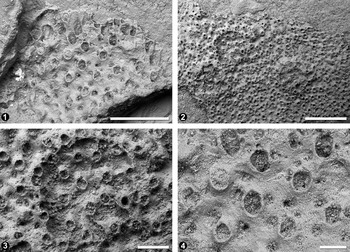
Mesonopora bernardwalteri n. sp. from Unit 2 of the Lower Member of the Glen Rose Formation (early Albian) of southcentral Texas, USA (1); from Unit 3 (lower Orbitolina Marker Bed) of the Upper Member of the Glen Rose Formation (early Albian) of southcentral Texas, USA (2, 3); from Unit 3 of the Upper Member of the Glen Rose Formation (early Albian) of southcentral Texas, USA (4). (1) Encrusting colony with two gonozooids (paratype, NHMUK BZ8180). Scale bar is 1 mm. (2) General view of the colony with two gonozooids (holotype, NHMUK BZ8181). Scale bar is 1 mm. (3) Autozooids showing pseudoporous and slightly convex frontal walls crossed by prominent growth ridges (holotype, NHMUK BZ8181). Scale bar is 100 µm. (4) Gonozooid with ooeciopore (white arrow) located centrally (paratype, NHMUK BZ8182). Scale bar is 100 µm.

Holotype
NHMUK BZ8181, early Albian, Glen Rose Formation, Upper Member, Unit 3 (lower Orbitolina Marker Bed), Flanders Road, cattlepond, Legends Subdivision, Fischer, Comal County, Texas.
Paratypes
NHMUK BZ8180, early Albian, Glen Rose Formation, Upper Member, Unit 2, roadcut along River Ridge Road, Mystic Shores Subdivision, Canyon Lake, Comal County, Texas. NHMUK BZ8182, early Albian, Glen Rose Formation, Upper Member, Unit 3, Flanders Road, south of cattlepond, Legends Subdivision, Fischer, Comal County, Texas. NHMUK BZ8183, early Albian, Glen Rose Formation, Upper Member, Unit 3 (middle Orbitolina Marker Bed), Crazy Horse Trail, Cougar Ridge Subdivision, Canyon Lake, Comal County, Texas.
Diagnosis
Mesonopora with irregularly fan-shaped colonies; autozooids with slightly convex frontal walls with circular pseudopores, crossed by irregular growth bands and sometimes developing a prominent ridge along or slightly offset from the longitudinal axis; autozooidal apertures subcircular to longitudinally elliptical; gonozooid transversely elliptical, indented marginally and pierced by autozooidal peristomes; ooeciopore small, central to subcentral, circular.
Occurrence
All specimens are from Unit 2 of the Lower Member and Unit 3 of the Upper Member of the Glen Rose Formation of several outcrops in Comal County, Texas.
Description
Colony encrusting, multiserial, unilaminar, irregularly fan-shaped, extending as flat sheet, growing edge formed by distal fringe of basal lamina with 1–2 generations of zooids visible at budding zone (Fig. 6.1, 6.2). Ancestrula and early astogeny not observed.
Autozooids fixed-walled, 358–642 µm long (X̄ = 486 ± 76 µm; CV = 16; N = 34) by 71–136 µm wide (X̄ = 104 ± 16 µm; CV = 16; N = 34), with slightly convex frontal walls crossed by irregular growth bands, sometimes developing a prominent ridge along the longitudinal axis (Fig. 6.3), pseudopores circular, not well preserved in examined material. Zooidal boundaries well defined by shallow furrows. Autozooidal apertures arranged quincuncially, subcircular to longitudinally elliptical, 78–112 µm long (X̄ = 93 ± 10 µm; CV = 10; N = 34) by 56–86 µm wide (X̄ = 70 ± 8 µm; CV = 12; N = 34), more crowded in late than early astogeny. Peristomes slightly raised. Terminal diaphragms not observed unequivocally. Nanozooids not observed.
Gonozooid transversely elliptical to subtriangular, bulbous, 434–992 µm long (X̄ = 725 ± 237 µm; CV = 33; N = 5) by 475–810 µm wide (X̄ = 660 ± 137 µm; CV = 21; N = 5), convex; roof fixed-walled, indented at the margins by autozooidal peristomes, and pierced by multiple, isolated autozooidal peristomes (Fig. 6.4); pseudopores dense, poorly preserved in examined material; ooeciopore centrally or subcentrally along or slightly offset the longitudinal axis of the gonozooid, circular, 32–51 µm (X̄ = 43 ± 9 µm; CV = 22; N = 4) in diameter, much smaller than an autozooidal aperture.
Morphometry measurements were performed on specimen NHMUK BZ8181 (holotype) and specimens NHMUK BZ8180 and NHMUK BZ8182 (paratypes).
Etymology
Named for French bryozoologist Bernard Walter in recognition of his studies on cyclostome bryozoans from the Mesozoic.
Remarks
Excluding the doubtful Mesonopora patane Taylor and McKinney, Reference Taylor and McKinney2006, M. bernardwalteri n. sp. is currently the only species assigned to this genus from the Americas and is the youngest species of this genus. Among other species assigned to Mesonopora (see Walter, Reference Walter1989), the Glen Rose species seems to resemble most closely Mesonopora laciniosa Walter, Reference Walter1989 from the Valanginian of eastern France, although Mesonopora bernardwalteri n. sp. has a considerably smaller gonozooid. Another Early Cretaceous species, Mesonopora fecunda (Vine, Reference Vine1885), as described from the Aptian Faringdon Sponge Gravel by Pitt and Taylor (Reference Pitt and Taylor1990), has thick colonies with 3–8 generations of zooidal buds visible at the growing edge compared with 1–2 generations in the new species from the Glen Rose Formation.
Suborder Rectangulata Waters, Reference Waters1887
Family Densiporidae Borg, Reference Borg1944
Genus Unicavea d'Orbigny, Reference d'Orbigny1853
Type species
Defrancia vassiacensis d'Orbigny, Reference d'Orbigny1850 from the Aptian of Wassy, Grand Est, France; by subsequent designation (Bassler, Reference Bassler1935).
?Unicavea sp.
Figure 7.1–7.4
?Unicavea sp. from Unit 6 (lower Loriolia Marker Bed) of the Upper Member of the Glen Rose Formation (early Albian) of southcentral Texas, USA. (1) Encrusting colony (NHMUK BZ8209). Scale bar is 500 µm. (2) Encrusting colony with three broken gonozooids (NHMUK BZ8207). Scale bar is 1 mm. (3) Close-up view of broken gonozooid (NHMUK BZ8207). Scale bar is 250 µm. (4) Close-up view of autozooidal and kenozooidal apertures (NHMUK BZ8209). Scale bar is 100 µm.

Occurrence
All specimens are from the early Albian of Lakeway, Texas, USA.
Description
Colony encrusting, multiserial, unilaminar, extending as flat sheet with perimeter formed by distal fringe of basal lamina and continuous zone of incipient autozooids and kenozooids (Fig. 7.1, 7.2). Ancestrula and early astogeny not observed.
Autozooids free-walled, with subcircular to longitudinally elliptical apertures, 80–127 µm long (X̄ = 100 ± 11 µm; CV = 11; N = 24) by 63–85 µm wide (X̄ = 75 ± 6 µm; CV = 7; N = 24), some sealed by a diaphragm, interspersed with kenozooids (Fig. 7.4). Kenozooids free-walled, small, with subcircular apertures, 35–58 µm (X̄ = 44 ± 6 µm; CV = 14; N = 24) in diameter, lacking diaphragms.
Gonozooid subcircular, 706–843 µm long (X̄ = 775 ± 97 µm; CV = 13; N = 2) by 705–745 µm wide (X̄ = 725 ± 28 µm; CV = 4; N = 2), traversed by multiple, isolated autozooids; roof not preserved in the material examined (Fig. 7.3); ooeciopore not observed.
Morphometry measurements were performed on specimens NHMUK BZ8207 and BZ8209.
Materials
NHMUK BZ8207–8209 (3 specimens), early Albian, Glen Rose Formation, Upper Member, Unit 6 (lower Loriolia Marker Bed), cut below water tower at the intersection of FM 620 with Kollmeyer Drive, Lakeway, Travis County, Texas.
Remarks
This species is known from six colonies encrusting three bivalve shells. Autozooids and kenozooids are free-walled. The skeletal structure of the gonozooid is of particular importance in species with a similar colony and zooid morphology because they are placed in different suborders depending on the calcification of the gonozooidal roof wall. Species with fixed-walled gonozooidal calcification are traditionally classified in Densiporidae (suborder Cerioporina), while species with free-walled gonozooids are classified in Lichenoporidae (suborder Rectangulata) (see Gordon and Taylor, Reference Gordon and Taylor2001). However, molecular trees have shown that densiporid cerioporines are more closely related to lichenoporid rectangulates than they are to other cerioporines (Waeschenbach et al., Reference Waeschenbach, Cox, Littlewood, Porter and Taylor2009). Although one colony (BZ8207) is fertile, the swollen part is broken in all three gonozooids observed. In the absence of colonies with intact gonozooid roofs, the assignment of this species to Unicavea must be considered tentative and the erection of a new species is eschewed despite the good preservation of the material.
Discussion
The cyclostome bryozoan fauna of the early to middle Albian Glen Rose and Walnut formations of Texas described here comprises six species. All of the species present are encrusters, mostly with simple, bereniciform colonies, and most were found attached to rudist shells from Unit 2 of the Lower Member of the Glen Rose Formation and units 3 and 6 of the Upper Member of the Glen Rose Formation. In contrast, oyster shells are the main substrates for the cheilostome bryozoans of the Glen Rose Formation (Martha et al., Reference Martha, Taylor and Rader2019).
Compared with cyclostome faunas of similar age from Europe, the lack of erect species in the Glen Rose and Walnut formations is notable. For example, of the 49 late Aptian cyclostome species known from the Faringdon Sponge Gravel of Oxfordshire, England, 18 have fully erect colonies (Pitt and Taylor, Reference Pitt and Taylor1990). Another Aptian fauna from Gard in France contains just nine species, but seven of these have erect colonies (Walter, Reference Walter1977). Except for the lack of erect species, the Albian Texas cyclostome fauna contains genera that are fairly typical for the Lower Cretaceous globally and none is new. Further discussion of the cyclostome fauna in the context of the Glen Rose and Walnut bryozoan fauna as a whole can be found in Martha et al. (Reference Martha, Taylor and Rader2019).
Acknowledgments
A.N. Ostrovsky (St Petersburg), an anonymous reviewer, peer review administrator J. Kastigar (Cincinnati), editor J. Jin (London, Ontario), and associate editor P.N. Wyse Jackson (Dublin) are thanked for helpful comments on the originally submitted manuscript.
Accessibility of supplemental data
Data available from the Dryad Digital Repository: https://doi.org/10.5061/dryad.5gk51p0.2