


Background and objective
Social isolation is defined as the objective state of having a small social network and infrequent social interactions (Holt-Lunstad et al. Reference Holt-Lunstad, Smith, Baker, Harris and Stephenson2015; World Health Organization 2021). While Holt-Lunstad et al. (Reference Holt-Lunstad, Smith, Baker, Harris and Stephenson2015) included lack of communication and participation in social activities in their definition, limited contacts and network size are the frequently reported markers of social isolation (Holt-Lunstad et al. Reference Holt-Lunstad, Smith, Baker, Harris and Stephenson2015; World Health Organization 2021; Wigfield et al. Reference Wigfield, Turner, Alden, Green and Karania2022). The concept of social isolation is often used interchangeably with loneliness although they represent distinct states of existence (Holt-Lunstad et al. Reference Holt-Lunstad, Smith, Baker, Harris and Stephenson2015; Wigfield et al. Reference Wigfield, Turner, Alden, Green and Karania2022). Social isolation is an ‘objective’ state resulting from a lack of actual social connections, whereas loneliness is a ‘subjective’ feeling resulting from a discrepancy between a person’s desired and their actual social connections (Perlman and Peplau Reference Perlman, Peplau, Duck and Gilmour1981; World Health Organization 2021). These differences were emphasized by Wigfield et al. (Reference Wigfield, Turner, Alden, Green and Karania2022), who highlight that social isolation is largely determined by the quantity or number of a person’s contacts, while loneliness is impacted by the quality of these contacts. As such, a person who has a small number of contacts could be classified as socially isolated. However, if a person’s interaction with their limited contacts is meaningful, this reduces their likelihood of experiencing loneliness (Wigfield et al. Reference Wigfield, Turner, Alden, Green and Karania2022). Thus, social isolation may or may not lead to feelings of loneliness and loneliness may occur with or without social isolation.
Social isolation affects people of all ages. The risk is higher among older people with a multitude of age-related factors, including widowhood, retirement, physical or functional decline, cognitive impairment and poor health status (Chen et al. Reference Chen, Cao, Wang, Zhu, Lu, Zhang and Shen2024; Wang et al. Reference Wang, Lin, Kuang, Yang, Yu and Cui2024). Worldwide, it is estimated that one in four older people experience social isolation (World Health Organization 2021), a finding supported by a systematic review reporting a prevalence of 25 per cent among community-dwelling older people (Teo et al. Reference Teo, Cheng, Cheng, Lau and Lau2023). In the United States prevalence estimates range from 19 per cent to 24 per cent (Cudjoe et al. Reference Cudjoe, Roth, Szanton, Wolff, Boyd and Thorpe2020; Kotwal et al. Reference Kotwal, Cenzer, Waite, Covinsky, Perissinotto, Boscardin, Hawkley, Dale and Smith2021).
The continued increase in global migration contributes to a growing population of older migrants, referred to as those who live outside their country of birth (International Organization for Migration 2024). For older migrants whose primary language differs from the dominant language spoken in their host country, the risk of social isolation may be further compounded by migration-related challenges. Apart from losing the ties with their old network in their country of origin, their ability to establish new networks and access essential support services is hindered by language barriers and cultural differences (Georgeou et al. Reference Georgeou, Schismenos, Wali, Mackay and Moraitakis2023; Tonui et al. Reference Tonui, Miller and Adeniji2023). Social isolation is further exacerbated by factors related to transportation, discrimination and the unavailability of culturally appropriate services (Johnson et al. Reference Johnson, Bacsu, McIntosh, Jeffery and Novik2019; Joshi et al. Reference Joshi, Finney and Hale2024). In addition, while family members are the main source of social support, living with adult children with busy schedules and being highly dependent on them for their needs and activities could contribute to the person’s social isolation (Johnson et al. Reference Johnson, Bacsu, McIntosh, Jeffery and Novik2019).
Despite the increased vulnerability among older migrants, evidence on understanding social isolation among these populations is limited. Available evidence has largely focused on social isolation in the general older population. A literature review (Cotterell et al. Reference Cotterell, Buffel and Phillipson2018) revealed risk factors for social isolation among older people at the individual, relationship, community and societal levels. However, the review did not articulate considerations related to older migrants. Likewise, reviews of interventions have highlighted the limited consideration of cultural diversity in existing approaches (Madani et al. Reference Madani, Madani, Ghogomu, Dahrouge, Hébert, Juando-Prats, Mulligan and Welch2022; Nwofe et al. Reference Nwofe, Akhtar, Parveen and Windle2024). For example, Madani et al. (Reference Madani, Madani, Ghogomu, Dahrouge, Hébert, Juando-Prats, Mulligan and Welch2022) conducted an overview of systematic reviews on interventions for mitigating social isolation and loneliness in older people. Findings show that none of the interventions were clearly described as tailored to the needs and preferences of socially disadvantaged older people (Madani et al. Reference Madani, Madani, Ghogomu, Dahrouge, Hébert, Juando-Prats, Mulligan and Welch2022). Similarly, Nwofe et al. (Reference Nwofe, Akhtar, Parveen and Windle2024) found that few interventions in the Organisation for Economic Co-operation and Development (OECD) countries were tailored for people of minority ethnic populations, raising concerns of effectiveness in these groups (Nwofe et al. Reference Nwofe, Akhtar, Parveen and Windle2024).
Recent literature reviews on older migrants have examined both social isolation and loneliness, rather than social isolation alone. A qualitative interpretive meta-synthesis of evidence explored the consequences of social isolation and loneliness among older migrants (Tonui et al. Reference Tonui, Miller and Adeniji2023). While the findings reveal a multitude of risk factors and approaches to mitigate social isolation and loneliness, only qualitative studies were included; quantitative studies, especially evaluating the effectiveness of the approaches used, may have provided additional insights. A scoping review explored the extent, range and nature of empirical studies on social isolation and loneliness among older migrants, finding that around 63 per cent of the included studies investigated loneliness, whereas only 18 per cent examined social isolation (Joshi et al. Reference Joshi, Finney and Hale2024). Findings also provided insights into various factors that contribute to social isolation and loneliness (Joshi et al. Reference Joshi, Finney and Hale2024). However, factors that specifically relate to either social isolation or loneliness were not explicitly differentiated.
While social isolation and loneliness in older people are mostly explored together, it is worth noting that the determinants and impacts of each may differ. The two concepts capture different domains of people’s lives and different vulnerabilities; as such, each requires a tailored management approach (Van Tilburg and de Jong Gierveld Reference Van Tilburg, de Jong Gierveld, Hajek, Riedel-Heller and König2023). Also, social isolation in older people is associated with distinct outcomes such as decreased physical functioning (Zhang et al. Reference Zhang, Hu and Feng2021; Lyu et al. Reference Lyu, Siu, Xu, Osman and Zhong2024), lower quality of life, mental health issues (Rohde et al. Reference Rohde, D’Ambrosio, Tang and Rao2016; de Maio Nascimento et al. Reference de Maio Nascimento, da Silva Neto, de Fátima Carreira Moreira Padovez and Neves2023) and increased risk of mortality (Lyu et al. Reference Lyu, Siu, Xu, Osman and Zhong2024). Social isolation is recognized as one of the modifiable risk factors for dementia in late life (Livingston et al. Reference Livingston, Huntley, Sommerlad, Ames, Ballard, Banerjee, Brayne, Burns, Cohen-Mansfield and Cooper2020). Considering the distinction between social isolation and loneliness and their independent impact on health outcomes, an understanding of how social isolation is experienced and affects a specific population helps strengthen the best available evidence for addressing this issue.
Taken together, there is a notable gap in evidence focused on understanding social isolation in the context of older migrants. While some interventions have shown promise, evidence tailored to the cultural, linguistic and social realities of these populations remains sparse. A synthesis of existing evidence is needed to provide comprehensive insights into older migrants’ experiences of social isolation and to inform the development of culturally appropriate, evidence-based interventions.
Objective
To address the gaps in available evidence, the objective of this scoping review is to synthesize and map research literature on social isolation among older migrants who are living in their own home or in the community. This review will answer the following questions:
1. What is the prevalence of social isolation among older migrants and how is it experienced by them?
2. What are the risk factors contributing to social isolation among older migrants?
3. What interventions have been used to address social isolation among older migrants?
Research design and methods
A scoping review was chosen owing to the broad objective of the review. A review protocol was registered in the Open Science Framework (registration DOI: 10.17605/OSF.IO/PQK9T). This scoping review was informed by Arksey and O’Malley’s five-stage framework for scoping reviews: (1) identifying the research question; (2) identifying the relevant studies; (3) selecting studies; (4) charting the data; and (5) collating, summarizing and reporting the results (Arksey and O’Malley Reference Arksey and O’Malley2005). Research questions were identified based on the participant, context and concept (PCC) framework (Peters et al. Reference Peters, Godfrey, McInerney, Khalil, Larsen, Marnie, Pollock, Tricco and Munn2022). This review is reported using the Preferred Reporting Items for Systematic Reviews and Meta-Analysis extension for Scoping Reviews (PRISMA-ScR) guidelines (Tricco et al. Reference Tricco, Lillie, Zarin, O’Brien, Colquhoun, Levac, Moher, Peters, Horsley and Weeks2018).
A search strategy was developed based on research questions and in collaboration with an academic librarian. An initial search was conducted on Medline to determine related terms and keywords. The search strategy was then adapted and applied across four databases: CINAHL, Embase, PsycINFO and Scopus. Reference lists of the articles included in the final screening process were also examined. The search was conducted up to May 2025. There was no limit applied to the publication date. Medical Subject Headings (MeSH) terms and keywords used are shown in Table 1. Supplementary Material 1 contains the search terms used for Medline.
Search terms

Figure 1 Long description
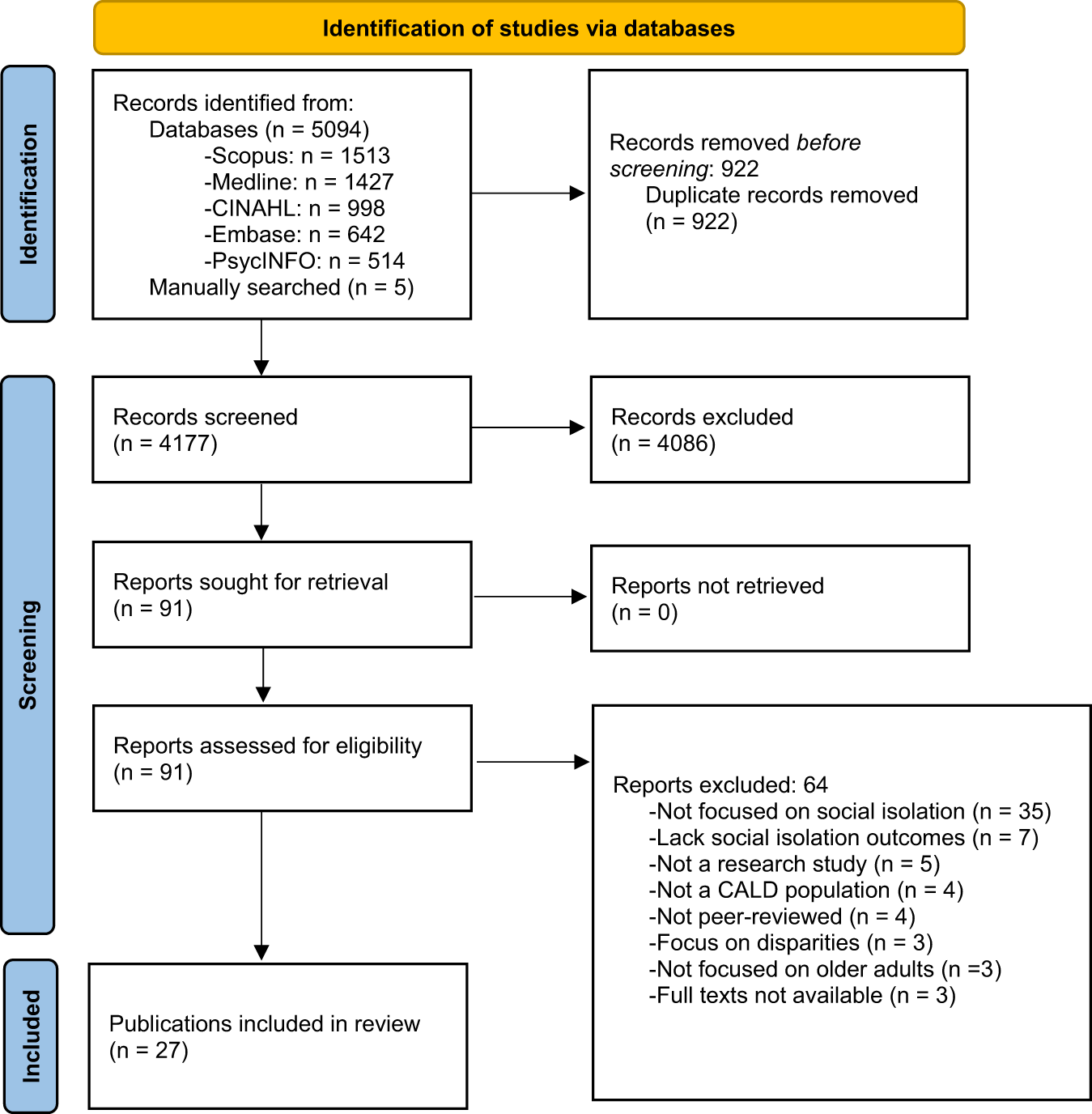
Flowchart detailing the identification and screening process of studies via databases. In the identification phase, records identified from databases total 5094, with Scopus contributing 1513, Medline 1427, CINAHL 998, Embase 642, PsycINFO 514 and 5 manually searched. Records removed before screening due to duplication total 922. In the screening phase, 4177 records were screened, with 4086 excluded. Reports sought for retrieval were 91, with none not retrieved. Reports assessed for eligibility were 91, with 64 excluded for reasons such as not focusing on social isolation (35), lacking social isolation outcomes (7), not being a research study (5), not a CALD population (4), not peer-reviewed (4), focusing on disparities (3), not focused on older adults (3) and full texts not available (3). Publications included in the review total 27.
Based on the PCC criteria, this review included peer-reviewed primary empirical studies published in English that focused on: (1) participants: people aged 60 and above as defined by the World Health Organization (World Health Organization 2025) or explicitly identified by the researchers as older people; migrants who live outside their country of birth and whose primary language is different from the dominant language spoken in their host country; (2) concept: social isolation as previously defined which encompasses limited contacts, networks and interactions; includes prevalence, perceptions, experiences, risk factors and factors or strategies that mitigate social isolation; (3) context: conducted in the community setting or among home-dwelling older people.
To ensure that the included studies primarily focused on older migrants and explored social isolation or reported outcomes specifically related to social isolation, exclusion criteria were: (1) participants: not older migrants; (2) not focused on social isolation: primarily explored loneliness, depression, anxiety and other related outcomes; (3) outcomes related to social isolation were not clearly articulated; (4) mainly focused on racial disparities or differences in characteristics between ethnic groups or their native-born counterparts; (5) conducted in institutional aged care and health-care settings. Studies that explored social isolation along with other concepts but did not have findings specific to social isolation or had findings that overlap with other concepts (eg loneliness) were excluded. Literature reviews, editorials, protocols and letters to the editor were also excluded. Three authors performed the title and abstract screening. All authors performed the full text screening. Disagreements were resolved through a discussion by the authors involved in screening or within the team.
A data charting template was developed by the first author, which included information on citation, country, study design, sample, social isolation measure and key findings. The first author extracted the data, which was cross-checked by three co-authors. The data charting process was focused on: (1) exploring the prevalence and experiences of social isolation; (2) identifying the risk and protective factors to social isolation; and (3) examining the interventions used to address social isolation. Furthermore, guided by a socio-ecological model (McLeroy et al. Reference McLeroy, Bibeau, Steckler and Glanz1988), the risk factors to social isolation were mapped according to intrapersonal (individual characteristics), interpersonal (family relationships and network) and community or public policy-related factors.
Quantitative and qualitative data were synthesized descriptively using a convergent integrated approach, allowing for a comprehensive interpretation of findings. Quantitative data were analysed using a random-effects meta-analysis (DerSimonian and Laird) in JBI SUMARI, accounting for expected clinical and methodological heterogeneity (Barker et al. Reference Barker, Migliavaca, Stein, Colpani, Falavigna, Aromataris and Munn2021). Pooled prevalence estimates with 95 per cent confidence intervals (CI) were calculated, and heterogeneity was assessed using the I2 statistic.
Qualitative data were analysed through inductive thematic synthesis (Peddie et al. Reference Peddie, Hoegh, Rice, Shetty, Ure and Cogan2025), where findings were coded and organized into descriptive and higher-order analytical themes to identify recurring patterns and contextual factors. Integration of both data types was achieved through narrative synthesis, with results organized around key themes to allow comparison and complementarity between quantitative and qualitative findings. A joint display table was used to visually link numerical trends with qualitative insights (Creswell and Inoue Reference Creswell and Inoue2025), enhancing transparency. Final results were presented narratively, supported by tables and figures to improve clarity and accessibility.
Results
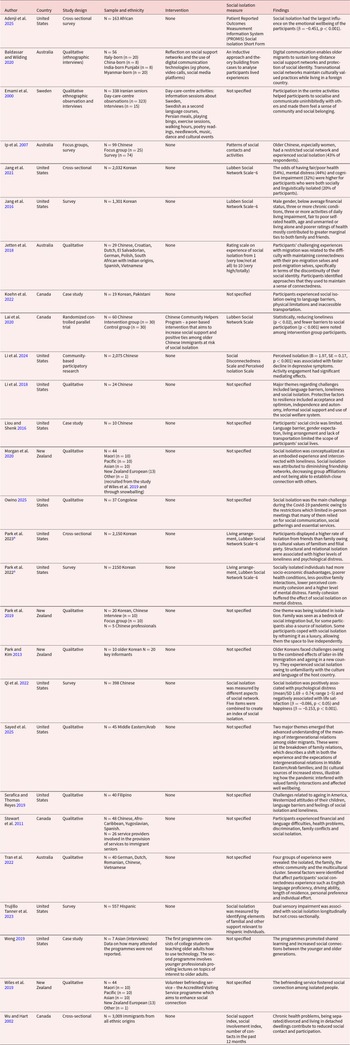
A total of 5,094 publications were retrieved from database searching, and five articles from handsearching of the reference list of included articles. After duplicates were removed, 4,177 publications were screened for titles and abstracts, of which 91 were included in the full text screening. A total of 27 publications (25 unique) published between 2000 and 2025 were included in this review. One of the 27 papers published additional results for the same group of participants from a previously published paper (Park et al. Reference Park, Jang, Oh and Chi2023). Another paper included participants who had been recruited from a separate, pre-existing study (Morgan et al. Reference Morgan, Wiles, Moeke-Maxwell, Black, Park, Dewes, Williams and Gott2020). The results of the search are presented using PRISMA (Page et al. Reference Page, McKenzie, Bossuyt, Boutron, Hoffmann, Mulrow, Shamseer, Tetzlaff, Akl and Brennan2021) in Figure 1. A summary of the study characteristics is provided in Table 2.
Preferred reporting items for systematic reviews and meta-analysis flow diagram.

Study details

Table 2 Long description
Study summaries compare how social isolation was assessed and what it was associated with among older migrants across the United States, Canada, Australia, New Zealand, Sweden, and one multi-origin immigrant sample. Designs range from qualitative interviews and case studies to surveys, cross-sectional analyses, and one randomized controlled trial, with sample sizes from 7 to just over 3,000. Measures vary widely, including PROMIS Social Isolation, Lubben Social Network Scale, social disconnectedness and perceived isolation scales, and several non-specified or study-created indices based on contacts and activities. Across multiple quantitative studies, higher isolation is linked with worse emotional well-being, more psychological distress, and poorer self-rated health; combined social and language isolation is associated with higher likelihood of mental distress and cognitive impairment. Qualitative findings repeatedly identify language barriers, transportation and mobility limits, cultural unfamiliarity, discrimination, and family conflict as drivers of isolation, while identity continuity and community belonging are described as protective. Interventions and programs that build social ties, such as peer helpers, day center activities, befriending services, and intergenerational technology learning, are reported to improve connection and reduce loneliness or participation barriers. Comparisons within studies note patterns such as greater isolation from friends than family in some Korean samples and restricted networks among older Chinese women in Australia. Interpretation is limited by inconsistent isolation measures, frequent non-specified instruments, and many cross-sectional designs that cannot establish cause and effect.
a Notes: Papers were based on data from the same larger study.
Most of the studies were conducted in the United States (n = 13) while others were conducted in Canada (n = 4), New Zealand (n = 3), Australia (n = 4) and Sweden (n = 1). The majority of the studies used qualitative methods (n = 16). Of the quantitative methods used, most were described as a cross-sectional study or survey (n = 7). Other methods used were randomized controlled trial, participatory research and mixed methods. All studies specified the ethnic group of the participating older people and included Chinese (n = 11), Korean (n = 6), African, European, Spanish/Hispanic and Middle Eastern. Sixteen studies focused on single ethnic groups, while nine studies included various ethnic groups. Social isolation was measured using the Lubben Social Network Scale (n = 4), Patient Reported Outcomes Measurement Information System (PROMIS) Social Isolation (n = 1), the Social Disconnectedness Scale and the Perceived Isolation Scale (n = 1), the Social Support Index and the Social Involvement Index (n = 1). Five studies used various measures, including objective measures of social contacts (n = 2) and researcher-developed measures (n = 3) such as rating scales, elements of social network and support, and theory-based analysis of lived experiences.
Themes
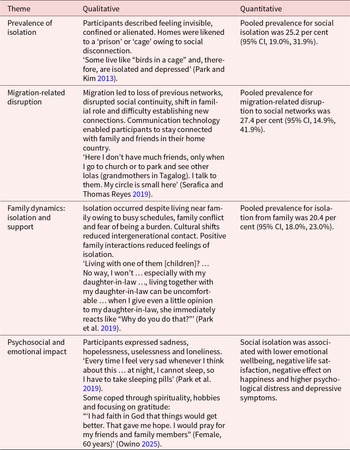
The results are presented according to the review questions. A summary of the quantitative and qualitative findings is shown in Table 3. The perceptions and experiences of social isolation among older migrants were shaped by migration-related disruptions to social networks, family relationships and support, and psychosocial and emotional outcomes.
Themes

Table 3 Long description
Themes link qualitative accounts of social disconnection with pooled quantitative prevalence estimates and related mental health outcomes. Social isolation is described as feeling invisible, confined, or alienated, with homes compared to a prison or cage; pooled prevalence is 25.2 percent with a confidence interval from 19.0 to 31.9 percent. Migration-related disruption describes loss of prior networks and difficulty rebuilding connections, sometimes eased by communication technology; pooled prevalence is 27.4 percent with a confidence interval from 14.9 to 41.9 percent, the highest estimate shown. Family dynamics highlight isolation even when living near relatives due to busy schedules, conflict, and fear of burdening others, while supportive interactions reduce isolation; pooled prevalence for isolation from family is 20.4 percent with a confidence interval from 18.0 to 23.0 percent, the lowest estimate shown. Psychosocial impact includes sadness, hopelessness, loneliness, sleep problems, and coping through spirituality or hobbies. Quantitative findings also note that social isolation is associated with poorer emotional well-being, lower life satisfaction and happiness, and higher psychological distress and depressive symptoms. Confidence intervals indicate uncertainty around the pooled prevalence estimates, especially for migration-related disruption.
Prevalence of social isolation
Pooled data (n = 3 studies) demonstrated that the prevalence of social isolation was 25.2 per cent (95% CI, 19.05%, 31.9%) (Jang et al. Reference Jang, Yoon, Park, Park, Chiriboga and Kim2021; Qi et al. Reference Qi, Zhang, Wang, Pei and Wu2022; Park et al. Reference Park, Jang, Oh and Chi2023) (Supplementary Material 2). Participants described social isolation using various terminologies, such as being ‘invisible’ (Park and Kim Reference Park and Kim2013), ‘confined at home’ (Ip et al. Reference Ip, Lui and Chui2007; Liou and Shenk Reference Liou and Shenk2016), ‘feeling trapped’ (Tran et al. Reference Tran, Liu, Gallois, Haslam, Jetten and Dane2022) and feeling ‘alienated’ or ‘disconnected’ (Serafica and Thomas Reyes Reference Serafica and Thomas Reyes2019). In some studies participants described their homes as ‘prisons’ (Ip et al. Reference Ip, Lui and Chui2007; Park and Kim Reference Park and Kim2013) and ‘cage’ (Park and Kim Reference Park and Kim2013).
Migration-related disruption to social networks
Pooled data (n = 3 studies) showed that migration-related disruption to social networks was 27.4 per cent (95% CI, 14.9%, 41.9%) (Ip et al. Reference Ip, Lui and Chui2007; Jang et al. Reference Jang, Park, Chiriboga, Yoon, Ko, Lee and Kim2016; Qi et al. Reference Qi, Zhang, Wang, Pei and Wu2022) (Supplementary Material 2).
Qualitative data from ten studies provided in-depth insights into migration-related disruption. Owing to their move to a new country, older migrants lost their established networks (Stewart et al. Reference Stewart, Shizha, Makwarimba, Spitzer, Khalema and Nsaliwa2011; Jetten et al. Reference Jetten, Dane, Williams, Liu, Haslam, Gallois and McDonald2018; Park et al. Reference Park, Morgan, Wiles and Gott2019) and experienced a dispersal of their social ties (Baldassar and Wilding Reference Baldassar and Wilding2020) and discontinuity of their social life (Jetten et al. Reference Jetten, Dane, Williams, Liu, Haslam, Gallois and McDonald2018; Baldassar and Wilding Reference Baldassar and Wilding2020). The disruption of social network was captured by a participant’s quote: ‘Here I don’t have much friends, only when I go to church or to park and see other lolas (grandmothers in Tagalog). I talk to them. My circle is small here’ (Serafica and Thomas Reyes Reference Serafica and Thomas Reyes2019). While participants acknowledged their social needs, they faced challenges in establishing new networks (Stewart et al. Reference Stewart, Shizha, Makwarimba, Spitzer, Khalema and Nsaliwa2011; Liou and Shenk Reference Liou and Shenk2016; Li et al. Reference Li, Xu and Chi2018; Serafica and Thomas Reyes Reference Serafica and Thomas Reyes2019) and integrating into the wider society (Stewart et al. Reference Stewart, Shizha, Makwarimba, Spitzer, Khalema and Nsaliwa2011; Park and Kim Reference Park and Kim2013; Liou and Shenk Reference Liou and Shenk2016; Li et al. Reference Li, Xu and Chi2018; Serafica and Thomas Reyes Reference Serafica and Thomas Reyes2019; Baldassar and Wilding Reference Baldassar and Wilding2020; Tran et al. Reference Tran, Liu, Gallois, Haslam, Jetten and Dane2022). A participant shared this unsuccessful attempt to connect with others: ‘I join many social groups [but] have nobody to talk with’ (Tran et al. Reference Tran, Liu, Gallois, Haslam, Jetten and Dane2022).
Participants expressed the desire to visit their home country in order to stay in touch with their family and friends (Jetten et al. Reference Jetten, Dane, Williams, Liu, Haslam, Gallois and McDonald2018; Li et al. Reference Li, Xu and Chi2018; Koehn et al. Reference Koehn, Ferrer and Brotman2022). However, travel was not possible for others owing to the costs (Jetten et al. Reference Jetten, Dane, Williams, Liu, Haslam, Gallois and McDonald2018) and physical limitations (Li et al. Reference Li, Xu and Chi2018). Participants valued the opportunity to stay connected with family and friends in their country of origin through alternative methods such as phone calls, mobile applications or email (Jetten et al. Reference Jetten, Dane, Williams, Liu, Haslam, Gallois and McDonald2018; Baldassar and Wilding Reference Baldassar and Wilding2020). For example, a participant from one study (Baldassar and Wilding Reference Baldassar and Wilding2020) who preferred spending time with her brother appreciated that she was still able to communicate with him on the phone or through mobile applications. In another study where communication technology was not yet advanced, participants stayed connected through regular email communication (Jetten et al. Reference Jetten, Dane, Williams, Liu, Haslam, Gallois and McDonald2018).
Family dynamics: isolation and support
Pooled data (n = 3 studies) revealed that the prevalence of isolation from family was 20.4 per cent (95% CI, 18.0%, 23.0%) (Jang et al. Reference Jang, Park, Chiriboga, Yoon, Ko, Lee and Kim2016; Qi et al. Reference Qi, Zhang, Wang, Pei and Wu2022; Park et al. Reference Park, Jang, Oh and Chi2023) (Supplementary Material 2).
While family was the main reason for most participants’ migration, qualitative data from eight studies show participants’ isolation from their own family members owing to breakdown of family relationships (Ip et al. Reference Ip, Lui and Chui2007; Stewart et al. Reference Stewart, Shizha, Makwarimba, Spitzer, Khalema and Nsaliwa2011; Park et al. Reference Park, Morgan, Wiles and Gott2019; Koehn et al. Reference Koehn, Ferrer and Brotman2022; Tran et al. Reference Tran, Liu, Gallois, Haslam, Jetten and Dane2022; Sayed et al. Reference Sayed, Alanazi and Ajrouch2025), concerns about causing inconvenience or burden to their family (Ip et al. Reference Ip, Lui and Chui2007; Park et al. Reference Park, Morgan, Wiles and Gott2019; Morgan et al. Reference Morgan, Wiles, Moeke-Maxwell, Black, Park, Dewes, Williams and Gott2020) and changing values of adult children (Ip et al. Reference Ip, Lui and Chui2007; Park and Kim Reference Park and Kim2013; Serafica and Thomas Reyes Reference Serafica and Thomas Reyes2019; Morgan et al. Reference Morgan, Wiles, Moeke-Maxwell, Black, Park, Dewes, Williams and Gott2020; Sayed et al. Reference Sayed, Alanazi and Ajrouch2025). For example, a participant from one study shared: ‘Living with one of them [children]? … No way, I won’t … especially with my daughter‐in‐law …, living together with my daughter‐in‐law can be uncomfortable … when I give even a little opinion to my daughter‐in‐law, she immediately reacts like “Why do you do that?”’ (Park et al. Reference Park, Morgan, Wiles and Gott2019). Participants from another study (Ip et al. Reference Ip, Lui and Chui2007) reported that their concern about causing financial burdens and inconveniences contributed to their reluctance to use the telephone, visit their friends and ask their friends to visit them. In other studies, participants felt that traditional values, such as regularly spending time with family members (Ip et al. Reference Ip, Lui and Chui2007; Serafica and Thomas Reyes Reference Serafica and Thomas Reyes2019; Morgan et al. Reference Morgan, Wiles, Moeke-Maxwell, Black, Park, Dewes, Williams and Gott2020; Sayed et al. Reference Sayed, Alanazi and Ajrouch2025) and looking after the older family, were no longer valued as they used to be (Park and Kim Reference Park and Kim2013; Morgan et al. Reference Morgan, Wiles, Moeke-Maxwell, Black, Park, Dewes, Williams and Gott2020).
Meanwhile, qualitative data from four studies showed that older people who had more frequent contact and a quality relationship with family members had more positive experiences and did not feel a considerable sense of isolation (Jetten et al. Reference Jetten, Dane, Williams, Liu, Haslam, Gallois and McDonald2018; Baldassar and Wilding Reference Baldassar and Wilding2020; Koehn et al. Reference Koehn, Ferrer and Brotman2022; Tran et al. Reference Tran, Liu, Gallois, Haslam, Jetten and Dane2022). As an example, participants from one study (Tran et al. Reference Tran, Liu, Gallois, Haslam, Jetten and Dane2022) felt that their family already satisfied their social needs and were no longer interested in going out or socializing with other people.
Psychosocial and emotional impact
The impact of social isolation was predominantly on the participants’ emotional and psychosocial wellbeing. Quantitative data from four studies revealed that social isolation was negatively associated with emotional wellbeing (Park et al. Reference Park, Morgan, Wiles and Gott2019; Adeniji et al. Reference Adeniji, Gentle-Genitty and Bonifas2025), life satisfaction and happiness (Qi et al. Reference Qi, Zhang, Wang, Pei and Wu2022), and positively associated with psychological distress (Qi et al. Reference Qi, Zhang, Wang, Pei and Wu2022) and a faster decline in depressive symptoms (Li et al. Reference Li, Tang, Kwon and Jiang2024).
Qualitative data from six studies provided further insights into the impact of social isolation and how some participants managed these. Participants experienced sadness, hopelessness, uselessness and loneliness. As an example, a participant expressed: ‘Every time I feel very sad whenever I think about this … at night, I cannot sleep, so I have to take sleeping pills’ (Park et al. Reference Park, Morgan, Wiles and Gott2019). Participants also felt concerned about not having anyone to be around when they needed help (Morgan et al. Reference Morgan, Wiles, Moeke-Maxwell, Black, Park, Dewes, Williams and Gott2020).
To mitigate the negative impact of social isolation, participants tried to change their perspectives on their situation through acceptance and optimism (Li et al. Reference Li, Xu and Chi2018; Park et al. Reference Park, Morgan, Wiles and Gott2019; Serafica and Thomas Reyes Reference Serafica and Thomas Reyes2019; Owino Reference Owino2025), spirituality (Park et al. Reference Park, Morgan, Wiles and Gott2019; Owino Reference Owino2025), engaging in hobbies (Park et al. Reference Park, Morgan, Wiles and Gott2019) and developing resilience (Li et al. Reference Li, Xu and Chi2018; Qi et al. Reference Qi, Zhang, Wang, Pei and Wu2022). For example, some participants felt that as they grow older, they tend to be pleased with what they have rather than asking for more support (Li et al. Reference Li, Xu and Chi2018). In another study, instead of focusing their thoughts on their isolation, older refugees focused on gratitude for the better life that they have in their host country (Owino Reference Owino2025).
Risk factors contributing to social isolation
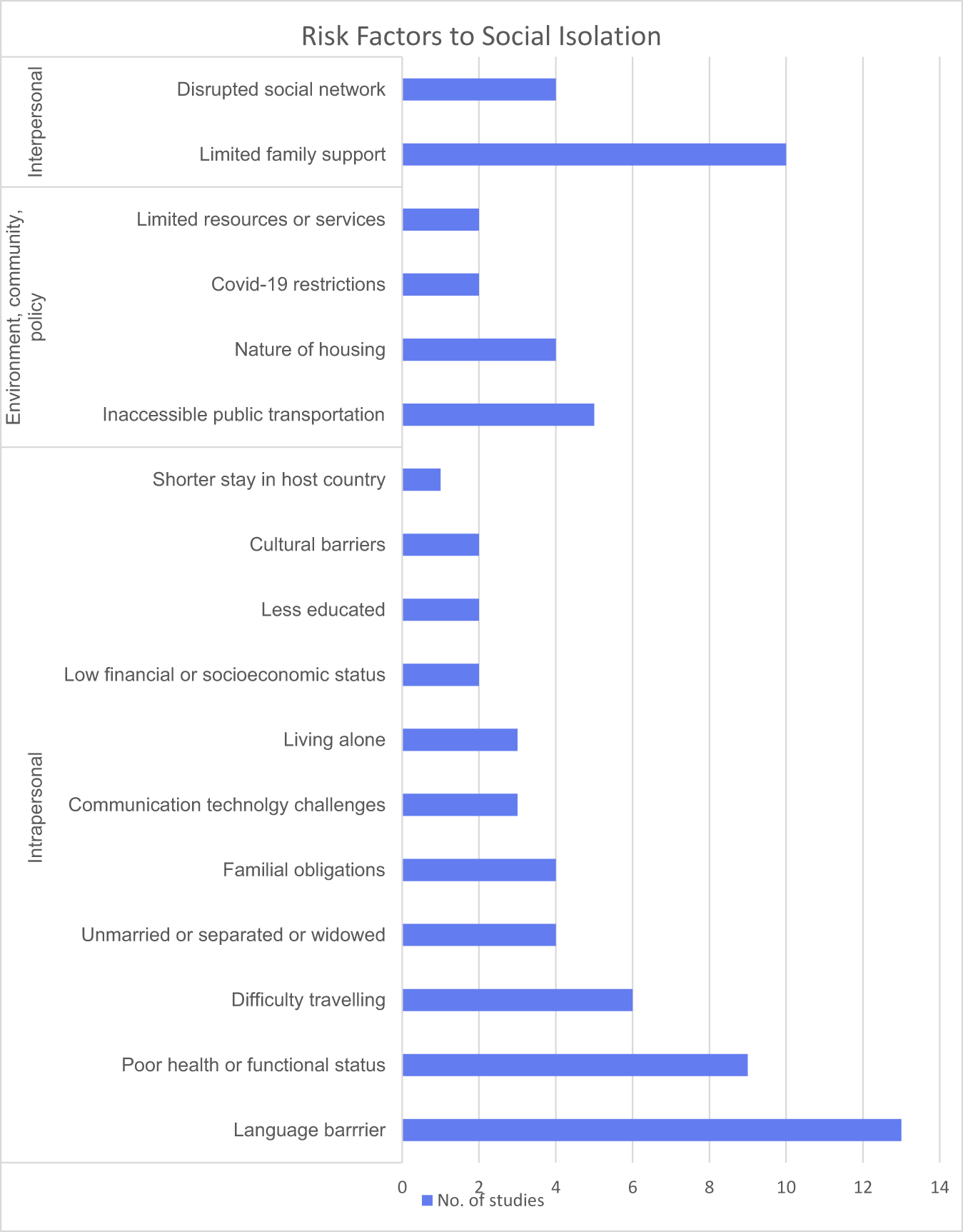
Risk factors contributing to social isolation are organized according to the socio-ecological model (McLeroy et al. Reference McLeroy, Bibeau, Steckler and Glanz1988). The number of studies reporting on a specific risk factor are summarised in Figure 2.
Risk factors of social isolation.

Figure 2 Long description
Risk Factors to Social Isolation. Horizontal axis label: No. of studies. Horizontal axis range: 0 to 14. Vertical axis categories, top to bottom, with bar values: Disrupted social network: 4. Limited family support: 10. Limited resources or services: 2. Covid-19 restrictions: 2. Nature of housing: 4. Inaccessible public transportation: 5. Shorter stay in host country: 1. Cultural barriers: 2. Less educated: 2. Low financial or socioeconomic status: 2. Living alone: 3. Communication technology challenges: 3. Familial obligations: 4. Unmarried or separated or widowed: 4. Difficulty travelling: 6. Poor health or functional status: 9. Language barrier: 13. Left-side group labels: Interpersonal; Environment, community, policy; Intrapersonal. Legend text: No. of studies.
Intrapersonal factors
Demographic
Five studies (Wu and Hart Reference Wu and Hart2002; Jang et al. Reference Jang, Park, Chiriboga, Yoon, Ko, Lee and Kim2016, Reference Jang, Yoon, Park, Park, Chiriboga and Kim2021; Park et al. Reference Park, Jang, Yoon, Chung and Chiriboga2022; Tran et al. Reference Tran, Liu, Gallois, Haslam, Jetten and Dane2022) identified key demographic and socio-economic factors associated with increased risk of social isolation. Older adults who were unmarried (Jang et al. Reference Jang, Park, Chiriboga, Yoon, Ko, Lee and Kim2016, Reference Jang, Yoon, Park, Park, Chiriboga and Kim2021), separated or widowed (Wu and Hart Reference Wu and Hart2002; Tran et al. Reference Tran, Liu, Gallois, Haslam, Jetten and Dane2022), less educated (Jang et al. Reference Jang, Yoon, Park, Park, Chiriboga and Kim2021; Park et al. Reference Park, Jang, Yoon, Chung and Chiriboga2022), living alone (Jang et al. Reference Jang, Park, Chiriboga, Yoon, Ko, Lee and Kim2016; Tran et al. Reference Tran, Liu, Gallois, Haslam, Jetten and Dane2022), had lower financial status (Jang et al. Reference Jang, Park, Chiriboga, Yoon, Ko, Lee and Kim2016; Park et al. Reference Park, Jang, Yoon, Chung and Chiriboga2022) and had a shorter stay in their host country (Jang et al. Reference Jang, Park, Chiriboga, Yoon, Ko, Lee and Kim2016) were more likely to be socially isolated.
Age and gender-related findings were mixed. One study (Jang et al. Reference Jang, Yoon, Park, Park, Chiriboga and Kim2021) showed that risk to social isolation or marginal ties was higher among those who were older while another reported that the risk was higher among those who were younger (Jang et al. Reference Jang, Park, Chiriboga, Yoon, Ko, Lee and Kim2016). Likewise, findings from one study showed that male gender was associated with higher risk of social isolation (Jang et al. Reference Jang, Park, Chiriboga, Yoon, Ko, Lee and Kim2016) while two studies reported that women experienced more restrictions in their social lives (Ip et al. Reference Ip, Lui and Chui2007; Liou and Shenk Reference Liou and Shenk2016).
Other individual characteristics
At the individual level, language barriers, poorer health conditions and inability to drive or use public transportation emerged as the commonly mentioned interrelated factors that increase an older person’s risk of social isolation. For example, language barrier contributed to the participants’ difficulty in integrating with the Western society (Li et al. Reference Li, Xu and Chi2018), establishing a social network outside of their family (Stewart et al. Reference Stewart, Shizha, Makwarimba, Spitzer, Khalema and Nsaliwa2011; Serafica and Thomas Reyes Reference Serafica and Thomas Reyes2019), using public transportation (Stewart et al. Reference Stewart, Shizha, Makwarimba, Spitzer, Khalema and Nsaliwa2011; Liou and Shenk Reference Liou and Shenk2016; Li et al. Reference Li, Xu and Chi2018), participating in social activities (Park and Kim Reference Park and Kim2013; Serafica and Thomas Reyes Reference Serafica and Thomas Reyes2019) and accessing information and services (Li et al. Reference Li, Xu and Chi2018; Serafica and Thomas Reyes Reference Serafica and Thomas Reyes2019; Baldassar and Wilding Reference Baldassar and Wilding2020). Likewise, having poor health and functional ability restricted the participants’ ability to travel (Koehn et al. Reference Koehn, Ferrer and Brotman2022), reduced their social contact and participation (Wu and Hart Reference Wu and Hart2002; Koehn et al. Reference Koehn, Ferrer and Brotman2022; Tran et al. Reference Tran, Liu, Gallois, Haslam, Jetten and Dane2022) and contributed to their difficulty in accessing social services (Li et al. Reference Li, Xu and Chi2018). In another study (Trujillo Tannner et al., Reference Trujillo Tanner, Yorgason, White, Armstrong, Cash, Case and Ehrlich2023), findings show that dual sensory impariment was associated with social isolation.
Several participants experienced significant transitions in their familial roles. For example, their move to a new country or a new place was driven by the purpose of fulfilling their responsibility as grandparents (Liou and Shenk Reference Liou and Shenk2016; Park et al. Reference Park, Morgan, Wiles and Gott2019; Serafica and Thomas Reyes Reference Serafica and Thomas Reyes2019; Baldassar and Wilding Reference Baldassar and Wilding2020). Because much of their time was devoted to supporting their adult children, taking care of their grandchildren and doing housework, their social life was significantly restricted (Liou and Shenk Reference Liou and Shenk2016).
While communication technologies (eg telephone, mobile phone, computer) provided an opportunity for continued social connection and access to services, some participants struggled to use these (Ip et al. Reference Ip, Lui and Chui2007; Li et al. Reference Li, Xu and Chi2018; Owino Reference Owino2025). Other studies mentioned culture-specific barriers, such as participants’ unfamiliarity with the culture of the host country (Park and Kim Reference Park and Kim2013) and their own cultural norms (Stewart et al. Reference Stewart, Shizha, Makwarimba, Spitzer, Khalema and Nsaliwa2011) which deterred participation in activities and access to services.
Interpersonal processes
Apart from the disruption of their social network owing to migration (Stewart et al. Reference Stewart, Shizha, Makwarimba, Spitzer, Khalema and Nsaliwa2011; Jetten et al. Reference Jetten, Dane, Williams, Liu, Haslam, Gallois and McDonald2018; Park et al. Reference Park, Morgan, Wiles and Gott2019; Baldassar and Wilding Reference Baldassar and Wilding2020), limited or lack of family support was identified as another risk factor to social isolation. Family’s busy schedule (Liou and Shenk Reference Liou and Shenk2016; Li et al. Reference Li, Xu and Chi2018; Park et al. Reference Park, Morgan, Wiles and Gott2019; Serafica and Thomas Reyes Reference Serafica and Thomas Reyes2019; Baldassar and Wilding Reference Baldassar and Wilding2020; Morgan et al. Reference Morgan, Wiles, Moeke-Maxwell, Black, Park, Dewes, Williams and Gott2020; Tran et al. Reference Tran, Liu, Gallois, Haslam, Jetten and Dane2022) and family conflicts (Stewart et al. Reference Stewart, Shizha, Makwarimba, Spitzer, Khalema and Nsaliwa2011; Park et al. Reference Park, Morgan, Wiles and Gott2019; Tran et al. Reference Tran, Liu, Gallois, Haslam, Jetten and Dane2022) contributed to participants’ limited number of contacts with family members and more time spent alone. Some participants felt that much of their family’s lives revolved around their busy work life, and spending time with them was not a priority (Serafica and Thomas Reyes Reference Serafica and Thomas Reyes2019; Morgan et al. Reference Morgan, Wiles, Moeke-Maxwell, Black, Park, Dewes, Williams and Gott2020). Participants were highly dependent on their family members in terms of using communication technology, travelling to places, attending social activities and visiting or seeing people outside of the family (Ip et al. Reference Ip, Lui and Chui2007; Liou and Shenk Reference Liou and Shenk2016; Jetten et al. Reference Jetten, Dane, Williams, Liu, Haslam, Gallois and McDonald2018). As such, without the support of their family, their social lives were highly restricted.
Environment, community and public policy
The environment where a person lives affects their social life. For example, the nature of dwellings such as detached houses and those located far from establishments and other houses tends to isolate the older person (Park et al. Reference Park, Morgan, Wiles and Gott2019; Serafica and Thomas Reyes Reference Serafica and Thomas Reyes2019; Koehn et al. Reference Koehn, Ferrer and Brotman2022). At the society level, social isolation was exacerbated by inaccessible public transportation (Stewart et al. Reference Stewart, Shizha, Makwarimba, Spitzer, Khalema and Nsaliwa2011; Liou and Shenk Reference Liou and Shenk2016; Koehn et al. Reference Koehn, Ferrer and Brotman2022) and lack of accessible or affordable culturally appropriate services (Stewart et al. Reference Stewart, Shizha, Makwarimba, Spitzer, Khalema and Nsaliwa2011; Koehn et al. Reference Koehn, Ferrer and Brotman2022). For example, in one study (Koehn et al. Reference Koehn, Ferrer and Brotman2022), participants mentioned that they need to travel two hours each way to attend community programmes and noted that, because they are only a small minority compared to other immigrants, there were only a few services tailored to their needs. During the Covid-19 pandemic, restrictions on in-person contacts were described as a ‘major hurdle’ as they significantly disrupted communication, social gatherings and services (Owino Reference Owino2025; Sayed et al. Reference Sayed, Alanazi and Ajrouch2025).
Interventions to address social isolation
In reducing social isolation, among the commonly mentioned approaches were regular social connections or activity engagement outside the home. Religious establishments and community centres provided opportunities for older people to socialize, build networks and engage in activities (Emami et al. Reference Emami, Torres, Lipson and Ekman2000; Ip et al. Reference Ip, Lui and Chui2007; Liou and Shenk Reference Liou and Shenk2016; Li et al. Reference Li, Xu and Chi2018; Baldassar and Wilding Reference Baldassar and Wilding2020). Social and activity engagement outside the home included participation in culturally based activities (Emami et al. Reference Emami, Torres, Lipson and Ekman2000; Jetten et al. Reference Jetten, Dane, Williams, Liu, Haslam, Gallois and McDonald2018), learning programmes or classes (Park et al. Reference Park, Morgan, Wiles and Gott2019; Weng Reference Weng2019; Baldassar and Wilding Reference Baldassar and Wilding2020), activities associated with their roles as members of groups or networks (Liou and Shenk Reference Liou and Shenk2016; Jetten et al. Reference Jetten, Dane, Williams, Liu, Haslam, Gallois and McDonald2018) and volunteering (Jetten et al. Reference Jetten, Dane, Williams, Liu, Haslam, Gallois and McDonald2018; Park et al. Reference Park, Morgan, Wiles and Gott2019). Findings from three qualitative studies showed that the programmes or services fostered social connection and a sense of belonging (Emami et al. Reference Emami, Torres, Lipson and Ekman2000; Weng Reference Weng2019; Wiles et al. Reference Wiles, Morgan, Moeke-Maxwell, Black, Park, Dewes, Williams and Gott2019). For people who were homebound or living alone, home visits from volunteers provided opportunities for social contact and interaction (Weng Reference Weng2019; Wiles et al. Reference Wiles, Morgan, Moeke-Maxwell, Black, Park, Dewes, Williams and Gott2019; Lai et al. Reference Lai, Li, Ou and Li2020). As an example, a quantitative study (Lai et al. Reference Lai, Li, Ou and Li2020) involved a peer support programme provided by Chinese volunteers who conducted home visits and telephone calls and helped the older person establish goals for social engagement, among other things. Findings showed significant treatment effects on the barriers to social participation among intervention group participants (95% CI).
Discussion
This scoping review synthesized evidence from 27 publications on social isolation among older migrants, mostly of East Asian ethnicity, such as Chinese and Koreans. The prevalence and experiences of social isolation were identified, including the factors that reduce or increase their risk of social isolation and interventions targeted at addressing social isolation among these populations. Findings from this review provide new insights with a specific focus on social isolation in older migrants. Integrating qualitative and quantitative data further enabled a comprehensive understanding of the depth and experience of social isolation, an approach not previously undertaken in earlier reviews.
Findings corroborate previous reviews (Tonui et al. Reference Tonui, Miller and Adeniji2023; Joshi et al. Reference Joshi, Finney and Hale2024) highlighting that social isolation among older migrants is compounded by transitions owing to ageing and migration. A new insight gained from this review is the pooled prevalence estimates on social isolation which are comparable to those of recent literature reported among the general older population (Cudjoe et al. Reference Cudjoe, Roth, Szanton, Wolff, Boyd and Thorpe2020; Kotwal et al. Reference Kotwal, Cenzer, Waite, Covinsky, Perissinotto, Boscardin, Hawkley, Dale and Smith2021; Teo et al. Reference Teo, Cheng, Cheng, Lau and Lau2023) showing that social isolation affected approximately a quarter of the participants. Additionally, the prevalence estimates include specific markers of social isolation unique to older migrants such as migration-related disruption and isolation from family. This substantiates the increased vulnerability of older migrants and the critical role of family relationships. Nevertheless, given the limited studies on prevalence among older migrants and the focus on a few groups, such as Chinese and Korean, these data may not have adequately captured the extent of social isolation in these populations.
In the assessment of social isolation, measures used varied across studies. Some of these measures, such as the Social Disconnectedness Scale and the Lubben Social Network Scale, are among the most recommended for older people. However, only the Lubben Social Network Scale has been widely validated for use among culturally diverse older populations (Chang et al. Reference Chang, Sha, Chan and Yip2018; Chan et al. Reference Chan, Wong, Huang and Fung2023). As such, the suitability of the other measures is unclear. Joshi et al. (Reference Joshi, Finney and Hale2024) similarly pointed out the paucity of studies investigating the suitability of social isolation and loneliness measures among older ethnic minorities and immigrants. Findings from this review support the need for measures that consider the cultural, familial and societal context of social isolation among older migrants (Joshi et al. Reference Joshi, Finney and Hale2024).
While extant literature explored the effects of social isolation on various health outcomes in older people (Moreno-Tamayo et al. Reference Moreno-Tamayo, Manrique-Espinoza, Ramírez-García and Sánchez-García2020; de Maio Nascimento et al. Reference de Maio Nascimento, da Silva Neto, de Fátima Carreira Moreira Padovez and Neves2023; Lyu et al. Reference Lyu, Siu, Xu, Osman and Zhong2024), the included studies predominantly reported on the emotional and psychological effects, such as decreased emotional wellbeing and mental or psychological distress. Older people’s descriptions of their experience of social isolation provided additional insights into how it impacted their day-to-day lives. Given the influence of culture on how social isolation is perceived and experienced (Burholt Reference Burholt, Hajek, Riedel-Heller and König2023), it is important to explore its multifaceted health consequences on older migrants.
Risk factors contributing to social isolation
Guided by the socio-ecological model (McLeroy et al. Reference McLeroy, Bibeau, Steckler and Glanz1988), this review illustrates the factors contributing to social isolation in terms of their occurrence at the intrapersonal, interpersonal and community or society levels. Findings from this review add to existing literature (Tonui et al. Reference Tonui, Miller and Adeniji2023; Joshi et al. Reference Joshi, Finney and Hale2024) by elucidating the nature and contextual dimensions of the factors specifically related to social isolation among older migrants. As an example, Joshi et al. (Reference Joshi, Finney and Hale2024) identified factors contributing to loneliness and social isolation across individual, relationship, community, structural and cultural dimensions, and emphasized the importance of analysing structural and cultural factors to better understand older migrants’ experience of loneliness and social isolation. By focusing on social isolation, findings from this review reveal that most of the risk factors operate at the intrapersonal or individual level and are intricately intertwined. For example, while some older migrants strive to build new networks, limited language proficiency hinders their ability or confidence to form relationships with people outside of their home, use public transportation and participate in social activities. While learning a new language can be challenging in older age (Ip et al. Reference Ip, Lui and Chui2007; Tran et al. Reference Tran, Liu, Gallois, Haslam, Jetten and Dane2022), addressing this individual barrier such as through language support and translation of relevant information into various languages may help reduce other interconnected barriers.
Timing of migration and time since migration could influence an individual’s proficiency in the language of their host country and their ability to navigate social settings. Participants in some studies migrated in their older age to help support their adult children with caring responsibilities (Liou and Shenk Reference Liou and Shenk2016; Park et al. Reference Park, Morgan, Wiles and Gott2019; Serafica and Thomas Reyes Reference Serafica and Thomas Reyes2019; Baldassar and Wilding Reference Baldassar and Wilding2020). In one study, length of stay was mentioned as one of the factors associated with social isolation (Jang et al. Reference Jang, Park, Chiriboga, Yoon, Ko, Lee and Kim2016). However, insights into the influence of migration timing and time since migration on participants’ ability to establish social connections would be valuable in determining the extent of risk and the nature of support required by those who migrated in later life compared to those who migrated earlier.
In their review, Tonui et al. (Reference Tonui, Miller and Adeniji2023) noted that loneliness was attributed to few social connections within the home. In terms of interpersonal processes, further insights from this review highlight that family members exert a significant influence on older migrants’ social lives and thus play a critical role in shaping their experiences of social isolation within and beyond the home. Consistent with the literature (Albertini and Mantovani Reference Albertini and Mantovani2022), the findings reveal culturally influenced family obligations and expectations between parents and their adult children. For example, grandparents are expected to care for their grandchildren to support their working adult children (Liou and Shenk Reference Liou and Shenk2016; Park et al. Reference Park, Morgan, Wiles and Gott2019; Serafica and Thomas Reyes Reference Serafica and Thomas Reyes2019; Baldassar and Wilding Reference Baldassar and Wilding2020). Adult children, on the other hand, are expected to reciprocate by supporting their ageing parents and ensuring that their needs are attended to (Albertini and Mantovani Reference Albertini and Mantovani2022). Nevertheless, findings show that living in a foreign country can complicate the dynamics of family relationships and result in familial conflicts and unfulfilled expectations. As family members are the primary source of older people’s meaningful contact, interaction and support (Ten Bruggencate et al. Reference Ten Bruggencate, Luijkx and Sturm2018; Albertini and Mantovani Reference Albertini and Mantovani2022), the breakdown of family relationships and lack of family support for older people’s social engagement and participation in activities outside the home significantly contribute to social isolation among older migrants.
At the community or society level, findings from a few studies provided insights into social isolation in the context of the environment where people live, such as the nature of housing, the accessibility of public transportation and the availability and affordability of services. This suggests that when identifying approaches to address social isolation, it is important to consider the provision of transportation services as well as an avenue for social connection and activities that do not involve significant costs. As the studies included those conducted during the Covid-19 pandemic, a few investigated social isolation in the context of this pandemic. Findings are consistent with existing literature (Johnson et al. Reference Johnson, Bacsu, McIntosh, Jeffery and Novik2021) showing that the restrictions during the pandemic exacerbated the experience of social isolation among these populations.
Mitigating social isolation
Several factors or approaches that help mitigate social isolation were highlighted. Findings from this review provide new insights into protective factors against social isolation which predominantly involve the older person’s inherent ability to cope with the situation and their personal drive to meet their social needs. For example, several studies reported the positive influence of acceptance, optimism and resilience (Li et al. Reference Li, Xu and Chi2018; Park et al. Reference Park, Morgan, Wiles and Gott2019; Serafica and Thomas Reyes Reference Serafica and Thomas Reyes2019; Qi et al. Reference Qi, Zhang, Wang, Pei and Wu2022; Owino Reference Owino2025). The other critical factors relate to older people’s family members, such as quality relationships with family, frequent family contacts or interactions, and availability of family support. This sheds additional light on family members’ critical role in preventing or reducing social isolation among these populations.
However, in terms of interventions targeted at addressing social isolation, existing literature has largely focused on increasing older people’s social interaction and engagement outside the home (eg in places of worship and community centres) or with people outside of the family (eg members of social groups, volunteers). Despite several individual and family-related factors, it is worth noting that there are sparse interventions focused on enhancing the older person’s coping skills and resilience and involving family members. In addition, none of the studies investigated older people or their families’ understanding of social isolation and its detrimental effects. There is a likelihood that the impact of social isolation is not widely understood or critically recognized among older migrants. As such, in addressing social isolation, there is a need to include approaches intended at providing language support, strengthening the older person’s adapting or coping strategies, improving digital communication skills, supporting independence in engaging with the wider community and increasing awareness among family members and older people, especially about the negative impacts of social isolation.
Strengths and limitations
A key contribution of this review is the convergent integrated approach, enabling comprehensive synthesis of quantitative and qualitative data. The use of a random-effects meta-analysis was appropriate given the expected between-study heterogeneity, as it accommodates variation in underlying effect sizes. Inductive thematic synthesis captured rich contextual insights. Integration through narrative synthesis and joint displays enhanced transparency, allowing meaningful comparison and strengthening the overall validity and interpretability of findings.
This review focuses on older migrants, specifically those who live outside their country of birth and whose primary language differs from the dominant language spoken in their host country. As such, these findings do not reflect the experiences of other groups who have their own unique cultural values and practices, including Indigenous populations. Given that only articles published in the English language were included, there may be studies published in other languages that may have provided valuable insights into this review.
Implications for future research
By investigating social isolation among older migrants on its own, findings highlight that social isolation is predominantly influenced by factors related to the individual’s limited language proficiency and familial support. However, there was a lack of investigation into the influence of migration timing and time since migration on these factors. Also, findings show that interventions aimed at addressing social isolation have largely focused on facilitating older migrants’ social contact and engagement outside the home. If language barriers are not addressed and older migrants are not supported by their family to socialize with people outside of their home and participate in community-based activities, their social lives will remain restricted. Findings highlight the need for further studies targeting individual and family-related factors and considering the specific impacts of migration timing and time since migration on the risk factors for social isolation.
In terms of the experience of social isolation, studies mostly investigated its impacts on older migrants’ psychosocial and emotional wellbeing. However, some older migrants demonstrated independent efforts to mitigate these impacts through coping mechanisms and resilience. None of the included studies, however, have robustly investigated the impact of social isolation, including the strategies that older migrants use to mitigate it. In establishing evidence on the impact of social isolation and the effectiveness of interventions in preventing or reducing social isolation, studies that employ robust quantitative methodologies are warranted.
In relation to the migrant groups included, there was a predominance among those of East Asian ethnicity, specifically Chinese and Koreans. Recent data on immigration by country (2025) show the top three countries with the highest number of emigrants to be India, Mexico and Russia (World Population Review 2025). This suggests the need for studies investigating social isolation among groups which comprise a large number of the migrant populations living abroad.
Conclusions
This scoping review synthesized evidence focused on social isolation among older migrants. Findings from 27 publications provided insights into the experience of social isolation, factors that contribute to social isolation and approaches that prevent or mitigate social isolation. The experience of social isolation was markedly influenced by the changes associated with ageing as well as the transitions brought about by migration. It is worth noting that most of the factors that contribute to social isolation are at the individual level, highlighting the need to tailor approaches according to the unique challenges faced by the individual. Given the critical influence of family dynamics on social isolation, it would be valuable to involve family members in the approaches or interventions for social isolation. While findings revealed the promising impact of a few interventions, further studies that employ rigorous methodology in evaluating effectiveness are needed to strengthen the available evidence.
Supplementary material
The supplementary material for this article can be found at https://doi.org/10.1017/S0144686X26100920.
Acknowledgements
The authors would like to acknowledge academic librarian Mrs Nicole Faull-Brown for support with the development of the search strategy.


 Open access

