INTRODUCTION
The pathological changes associated with Alzheimer’s disease (AD) usually begin in the mesial temporal lobe structures, such as the entorhinal cortex and hippocampus, and most often affect left sided structures more than those on the right (Janke et al., Reference Janke, de Zubicaray, Rose, Griffin, Chalk and Galloway2001; Scahill, Schott, Stevens, Rossor, & Fox, Reference Scahill, Schott, Stevens, Rossor and Fox2002; Thompson et al., Reference Thompson, Mega, Woods, Zoumalan, Lindshield and Blanton2001, Reference Thompson, Hayashi, de Zubicaray, Janke, Rose and Semple2003). This pattern of cerebral pathology results in verbal learning and memory deficits (Kohler et al., Reference Kohler, Black, Sinden, Szekely, Kidron and Parker1998; Kramer et al., Reference Kramer, Schuff, Reed, Mungas, Du and Rosen2004; Mori et al., Reference Mori, Yoneda, Yamashita, Hirono, Ikeda and Yamadori1997; Nobili et al., Reference Nobili, Brugnolo, Calvini, Copello, De Leo and Girtler2005; Remy, Mirrashed, Campbell, & Richter, Reference Remy, Mirrashed, Campbell and Richter2005; Stout et al., Reference Stout, Bondi, Jernigan, Salmon, Archibald and Delis1999). The performance of patients with AD on tests of supra-span word list-learning is characterized by decreased total immediate recall (Degenszajin, Caramelli, Caixeta, & Nitrini,2001; Incalzi, Capparella, Gemma, Marra, & Carbonin, Reference Incalzi, Capparella, Gemma, Marra and Carbonin1995; Pasquier, Grymonprez, Lebert, & Van der Linden, Reference Pasquier, Grymonprez, Lebert and Van der Linden2001), decreased delayed free recall (Chen et al., Reference Chen, Ratcliff, Belle, Cauley, DeKosky and Ganguli2000; Degenszajin et al., Reference Degenszajin, Caramelli, Caixeta and Nitrini2001; Incalzi et al., Reference Incalzi, Capparella, Gemma, Marra and Carbonin1995; Strang, Donnelly, Grohman, & Kleiner, Reference Strang, Donnelly, Grohman and Kleiner2002; Welsh, Butters, Hughes, Mohs, & Heyman, Reference Welsh, Butters, Hughes, Mohs and Heyman1992), and impaired delayed recognition (Incalzi et al., Reference Incalzi, Capparella, Gemma, Marra and Carbonin1995; Vanderploeg, Yuspeh, & Schinka, Reference Vanderploeg, Yuspeh and Schinka2001).
Learning across repeated presentations of supra-span word lists has also been extensively investigated in patients with AD, typically using either a factorial design or a statistical index of learning such as the learning slope. However, the results of these investigations have been mixed, with many of these studies finding significant interactions between group and trial number (Moulin, James, Freeman, & Jones, Reference Moulin, James, Freeman and Jones2004; Simon, Leach, Winocur, & Moscovitch, Reference Simon, Leach, Winocur and Moscovitch1994; Woodard, Dunlosky, & Salthouse, Reference Woodard, Dunlosky and Salthouse1999) and others finding no significant interactions (Martin, Brouwers, Cox, & Fedio, Reference Martin, Brouwers, Cox and Fedio1985; Pasquier et al., Reference Pasquier, Grymonprez, Lebert and Van der Linden2001). Although AD patients exhibit less learning across trials than do normal controls, they do evidence significant learning in that they appear to recall more words in later learning trials (Fox, Olin, Erblich, Ippen, & Schneider, Reference Fox, Olin, Erblich, Ippen and Schneider1998; Woodard et al., Reference Woodard, Dunlosky and Salthouse1999).
The more commonly used index of learning, the “traditional” index, analyzes the learning slope by using a subtraction score. More consistent findings have emerged using this traditional measure of learning. When compared to healthy individuals, patients with AD demonstrate a lower traditional learning score on the Hopkins Verbal Learning Test (HVLT; De Jager, Hogervorst, Combrinck, & Budge, Reference De Jager, Hogervorst, Combrinck and Budge2003; Shapiro, Benedict, Schretlen, & Brandt, Reference Shapiro, Benedict, Schretlen and Brandt1999), the Rey Auditory Verbal Learning Test (RAVLT; Estevez-Gonzalez, Kulisevsky, Boltes, Otermin, & Garcia-Sanchez, Reference Estevez-Gonzalez, Kulisevsky, Boltes, Otermin and Garcia-Sanchez2003), the Consortium to Establish a Registry for Alzheimer’s Disease (CERAD; Vanderploeg et al., Reference Vanderploeg, Yuspeh and Schinka2001), and the California Verbal Learning Test (CVLT; Deweer et al., Reference Deweer, Ergis, Fossati, Pillon, Boller, Agid and Dubois1994).
Although the patients with AD in these investigations exhibited an overall lower learning score relative to healthy individuals, they often did demonstrate learning of the word lists and in many instances their learning scores fall within the borderline to average range (De Jager et al., Reference De Jager, Hogervorst, Combrinck and Budge2003; Estevez-Gonzalez et al., Reference Estevez-Gonzalez, Kulisevsky, Boltes, Otermin and Garcia-Sanchez2003; Shapiro et al., Reference Shapiro, Benedict, Schretlen and Brandt1999; Vanderploeg et al., Reference Vanderploeg, Yuspeh and Schinka2001). Additionally, Woodard et al. (Reference Woodard, Dunlosky and Salthouse1999) reported that recall of a word list significantly increased from the first to the last trial among a sample of patients with AD. Likewise, Martin et al. (Reference Martin, Brouwers, Cox and Fedio1985) found that, although patients with AD recalled fewer words than healthy control participants, the learning slope did not significantly differ. Thus, although patients with AD might not learn as many words as healthy individuals, it is apparent that they are learning.
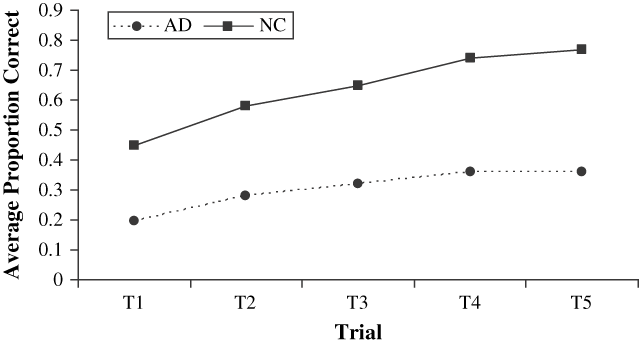
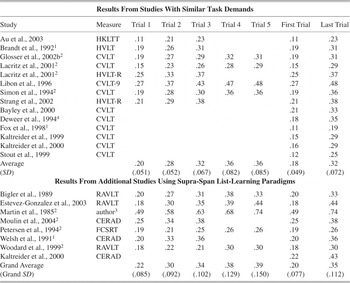
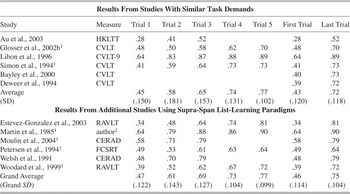
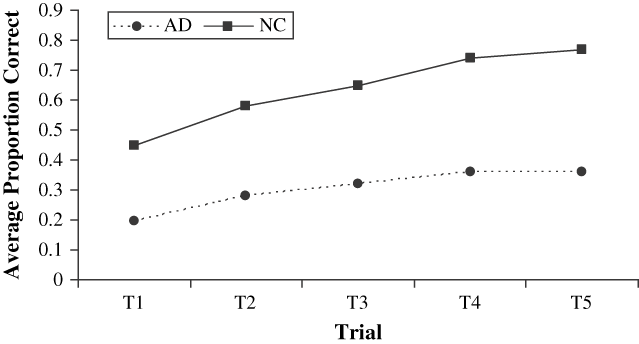
This observation that patients with AD exhibit evidence of learning on tests of supra-span word list-learning led us to conduct a review of the literature to examine learning in AD across multiple investigations. We conducted an extensive review of the relevant literature, obtaining investigations that analyzed learning in AD patients and healthy controls. To achieve a common measure of performance across investigations we converted the raw scores into percentages by dividing the number of correctly recalled words by the total number of words presented for each individual learning trial. Inspection of the data reveals that, when collapsing across tests with similar task demands (i.e., similar length and use of semantic categories), the patients with AD initially correctly recalled about 20% of the words, with their recall increasing to about 32% of the words by the third trial (or the last for some studies), and 36% by the fifth trial. The results of investigations reporting only the first and last learning trials indicate that the percentage correct recall of patients with AD improves from 18% on the first trial to 32% on the last trial. The healthy controls, in contrast, initially recalled 45% of the words and recalled about 65% by the third trial, and 77% by the fifth trial, when collapsing across tests with similar task demands. The results remain roughly similar between the AD patients and the normal controls when collapsing the data across all types of supra-span list learning tests (see Tables 1 and 2). The learning curves for the AD patients and healthy controls are plotted against each other in Figure 1. Inspection of the figure reveals that the learning curves are quite similar, with the primary difference consisting of the percentage of words correctly recalled on each individual trial.
Learning across repeated trials in AD and normal controls.
Percent recall on each individual learning trial and the first and last learning trials in AD

Note
1 Denotes studies where an average was used across groups of AD participants.
2 Denotes studies that included only graphs of the data from the learning trials. Hence, performance on individual trials was conservatively estimated from these graphs.
3 This study used its own supra-span word list, not one commercially available.
4 The data from this study included the outpatient AD group.
CVLT = California Verbal Learning Test. CVLT-9 = nine-word version of the California Verbal Learning Test. CERAD = word list from the Consortium to Establish a Registry for Alzheimer’s Disease. FCSRT is the Free and Cued Selective Reminding Test. HKLTT = Hong Kong List Learning Test. HVLT is the Hopkins Verbal Learning Test. HVLT-R = Hopkins Verbal Learning Test–Revised. RAVLT is the Rey Auditory Verbal Learning Test.
Percent recall on each individual learning trial and the first and last learning trials in normal control participants

Note
1 Denotes studies that included only graphs of the data from the learning trials. Hence, performance on individual trials was conservatively estimated from these graphs.
2 This study used its own supra-span word list, not one commercially available.
CVLT = California Verbal Learning Test. CVLT-9 = nine-word version of the California Verbal Learning Test. CERAD = word list from the Consortium to Establish a Registry for Alzheimer’s Disease. FCSRT = Free and Cued Selective Reminding Test. HKLTT = Hong Kong List Learning Test. HVLT = Hopkins Verbal Learning Test. HVLT-R = Hopkins Verbal Learning Test–Revised. RAVLT = Rey Auditory Verbal Learning Test.
The mixed findings regarding learning in AD results, at least partially, from a problem inherent in the methods used to analyze learning, that is, the confound between the learning slope and the number of words initially recalled (the y-intercept). The aforementioned investigations have focused on the slope and ignored the y-intercept in analyzing learning in AD. As indicated by the review of the literature, the major difference between AD and healthy controls is the amount of information that is learned across trials. Thus, we felt it may be beneficial to use a measure of learning that captures both of these parameters. We also felt that this single measure of learning may better discriminate patients with AD from healthy controls and perhaps also better predict severity of dementia than the traditional learning score.
We sought to investigate learning in AD using this new index of learning, the Cumulative Word Learning (CWL) score. Unlike previous indices of learning, the CWL score reflects not only the learning slope, but also the number of words recalled across learning trials. This is accomplished by calculating the interaction between the traditional learning score and the total immediate recall, that is, the total number of words correctly recalled. The CWL score has been found to be related to left posterior temporal functioning, as indexed by electroencephalography (EEG). Specifically, we have previously reported that the CWL score was significantly lower in a sample of normal college students with relatively higher delta band EEG over the T5 electrode site. However, the traditional learning score was not significantly different between groups of college students with high or low T5 delta band EEG (Foster et al., Reference Foster, Harrison, Crucian, Drago, Rhodes and Heilman2008). Consistent with previous research, we predicted that patients with AD would evidence learning on a supra-span list-learning test. Additionally, we predicted that the traditional learning score would not differ between patients with mild AD and normal controls. However, we predicted that a significant difference in the CWL score would be found between patients with mild AD and normal controls. Finally, we predicted that moderate to severe AD patients would differ from normal controls on both the traditional learning score and the CWL score.
Additionally, the reason patients with AD have a reduced immediate memory for words might be related to deficits in the systems important for working memory, such as loss of goal maintenance or distractibility. Alternatively, or in combination, patients with AD might have a reduced capacity to encode words. Studies of left hemisphere stroke patients who are aphasic with naming disorders reveal that they have a reduced word span (Heilman et al., Reference Heilman, Scholes and Watson1976). Patients with AD also have language, that is, naming, disorders (Kraybill et al., Reference Kraybill, Larson, Tsuang, Teri, McCormick and Bowen2005; Lukatela, Malloy, Jenkins, & Cohen, Reference Lukatela, Malloy, Jenkins and Cohen1998; Zahn et al., Reference Zahn, Juengling, Bubrowski, Jost, Dykierek, Talazko and Huell2004). Therefore, in our sample of patients with AD, we sought to determine the role of language disabilities in recalling and learning the word list by conducting a series of linear regressions between performance on the HVLT-R (using the traditional learning (TL) z score, the CWL score, and total immediate recall) and the Boston Naming Test (BNT) and the Controlled Oral Word Association Test (COWAT, using the letters F, A, and S).
METHODS
Participants
A total of 25 patients (2 men and 23 women) diagnosed with probable Alzheimer’s disease (AD) participated in this retrospective investigation. Patients meet criteria for probable AD based on the NINCDS-ADRDS criteria (McKhann et al., Reference McKhann, Drachman, Folstein, Katzman, Price and Stadlan1984). The patients were seen in a Memory Disorder Clinic at the University of Florida and were all diagnosed by a neurologist. The ages of the participants ranged from 54 to 85 years (M = 74.65, SD = 8.54), with an average of 13.27 years of education (SD = 3.21). Based on their Mini-Mental State Examanination (MMSE) scores, the patients with AD were divided into two groups, mild AD (miAD; 25 and up) and moderate/severe AD (mosAD; 24 and below). Following group assignment, there were 19 patients in the mosAD group and 7 patients in the miAD group. A sample of 31 control subjects was also used (4 men and 27 women), with an age range of 54 to 84 years (M = 65.68, SD = 9.27) and an average 14.63 years of education (SD = 2.94). All participants were treated in accordance with the ethical guidelines of the American Psychological Association and the University of Florida. Unfortunately, we did not obtain responses from the Clinical Dementia Rating scale and did not code for ethnicity of our patients or control subjects.
Apparatus
Hopkins Verbal Learning Test – Revised (HVLT-R)
Verbal learning was assessed using the Hopkins Verbal Learning Test – Revised (Benedict, Schretlen, Groninger, & Brandt, Reference Benedict, Schretlen, Groninger and Brandt1998). The HVLT-R consists of a 12-item word list that is orally presented three times, with the patient instructed to recall as many words as possible following each presentation. Delayed recall and recognition trials are also administered, although the data from these trials were not used in the present investigation. Six different equivalent forms of the HVLT-R are available, three of which were used in the present investigation.
Mini-Mental State Examination (MMSE)
The Mini-Mental State Examination (Folstein, Folstein, & McHugh, Reference Folstein, Folstein and McHugh1975) is a screening test used to assess general cognitive functioning. Areas of functioning assessed include orientation, registration, attention, recall, working memory, language, and construction or drawing ability. The range of scores possible is from 0 to 30.
Boston Naming Test (BNT)
The BNT is a screening measure for naming to confrontation that consists of 60 line drawings of objects. The patient is instructed to name the object that appears on the page. The range of scores possible is from 0 to 60. The dependent measure was the total number of objects that were named correctly, before the provision of cues.
Controlled Oral Word Association Test (COWAT)
The COWAT requires the subject to name as many words as possible that begin with a specified letter (F, A, and S) within 60 seconds. However, they cannot use proper nouns, they cannot use numbers to count, and they cannot simply add different endings to the stem of a word that was previously used. The dependent measure is the total number of words generated.
Procedure
The participants with AD received a comprehensive neurological evaluation in addition to a neuropsychological screening. The neuropsychological screening consisted of the HVLT-R, the MMSE, as well as the Boston Naming Test (BNT), and the Controlled Oral Word Association Test (COWAT). All tests were administered using standardized procedures. The patients with AD received Form 1 of the HVLT-R and the control participants received Forms 1, 3, and 6, with the majority receiving Form 1. The primary dependent measures from performance on the HVLT-R included the number of words recalled on each of the three learning trials, the total number of words recalled across all three trials (total immediate recall), the recognition discrimination index (total number of true positive minus the total number of false positives when testing for recognition), the z score based on the traditional index of learning, and the Cumulative Word Learning (CWL) score. The MMSE and the BNT were also administered to the control participants. The BNT and the COWAT were administered and included in the analyses to determine whether language functioning would be differentially related to learning on the HVLT-R, as indexed by total immediate recall and the two indices of the learning slope.
RESULTS
Data Reduction
The traditional learning score was calculated by first subtracting the number of words recalled on the first trial of the HVLT-R from the number of words recalled on either trial two or three, whichever was highest. Age corrected standard scores (z scores) were then calculated using the norms provided by Benedict, et al. (Reference Benedict, Schretlen, Groninger and Brandt1998). The traditional learning (TL) z score was the dependent variable for all subsequent analyses. The Cumulative Word Learning (CWL) score was calculated by multiplying the traditional learning score by the total number of words recalled across all three learning trials.
Data Analyses
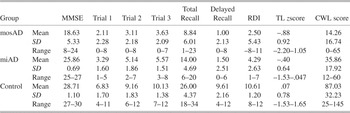
Initial analyses indicated no significant differences between the patients with AD (mosAD M = 12.74, SD = 3.12; miAD M = 14.71, SD = 3.20) and the controls (M = 14.63, SD = 2.94) in the number of years of education. However, a significant difference, F(2, 54) = 7.63, p = .001, did emerge in the ages of the participants. Multiple comparisons using a Bonferroni correction for experiment-wise error rate (p < .017) indicated that the control subjects were significantly younger (M = 65.68, SD = 9.27) than both the mosAD patients (M = 73.58, SD = 8.08) and the miAD patients (M = 77.57, SD = 9.71). Also, a significant difference, F(2, 54) = 59.06, p < .0001, was obtained for the MMSE between the controls and the AD patients. Multiple comparisons with a Bonferroni correction (p < .017) indicated that both the mosAD and miAD patients differed significantly from the controls (see Table 3).
Performance for the mosAD, miAD, and the Control groups on the HVLT-R

Note
MosAD = moderate to severe Alzheimer’s disease; miAD = mild Alzheimer’s disease. HVLT-R = Hopkins Verbal Learning Test-Revised; RDI = Recognition Discrimination Index; MMSE = Mini-Mental State Examination; TL = traditional learning; CWL = Cumulative Word Learning.
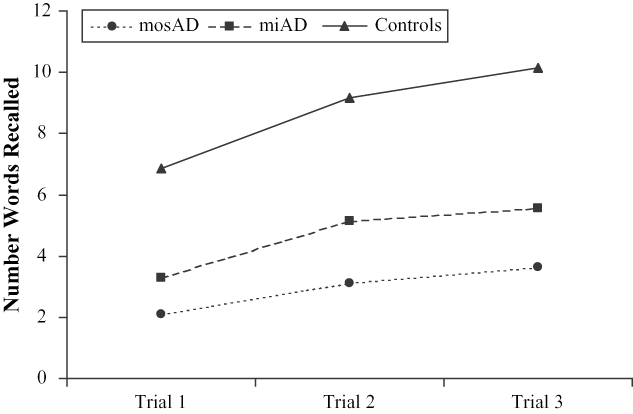
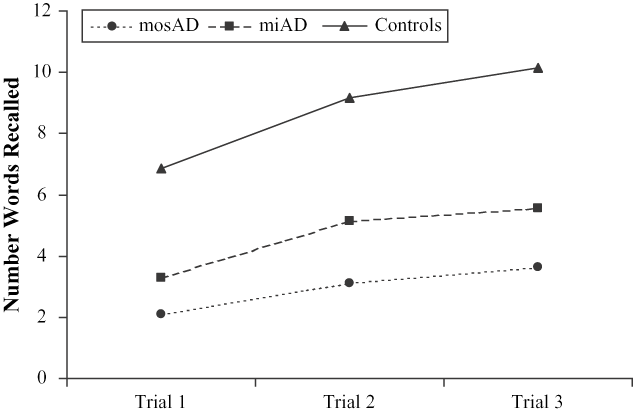
Separate one-way analyses of covariance (ANCOVAs) were performed on each trial of the HVLT-R, using age as a covariate because age was significantly different between the groups. The results indicated significant differences between the groups on Trial 1, F(2, 53) = 26.87, p < .0001, Trial 2, F(2, 53) = 43.66, p < .0001, and Trial 3, F(2, 53) = 71.97, p < .0001, of the HVLT-R. Multiple comparisons were conducted using a Bonferroni correction for experiment-wise error rate (p < .0056 for 9 comparisons) and with age as a covariate. The results indicated that the miAD and the mosAD groups differed significantly from the control group on each trial of the HVLT-R (see Table 3 for means and standard deviations). However, no differences between the miAD and mosAD groups emerged on any trial of the HVLT-R. Although the miAD and mosAD patients performed significantly lower than the normal controls on each trial of the HVLT-R, inspection of Figure 2 reveals that the patients with AD exhibited a learning curve similar to that of the normal controls, with the primary difference being the y-intercept. This pattern of differences is reflected in the results from analyzing the TL z score and the CWL score.
Learning in miAD and mosAD as compared to the normal controls.
Significant differences between the patients with AD and the normal controls were also found for total immediate recall, F(2, 53) = 54.47, p < .0001, as well as the recognition discrimination index, F(2, 50) = 27.27, p < .0001. Unfortunately, the recognition discrimination index was not recorded for three of the patients with AD. Multiple comparisons were then conducted using a Bonferroni correction (p < .008 for 6 comparisons) and using age as a covariate. The results indicated that the miAD and the mosAD groups differed significantly from the control group for both total immediate recall and recognition discrimination. However, no differences in total immediate recall or recognition discrimination was found between the mosAD and miAD groups (see Table 3 for means and standard deviations).
To analyze differences in the TL z score and the CWL score, separate one-way ANCOVAs were performed on each of these dependent variables, controlling for the ages of the subjects. The results indicated significant differences between the groups for both the TL z score, F(2, 53) = 10.81, p < .0002, and the CWL score, F(2, 53) = 39.61, p < .0001. Multiple comparisons were then conducted, again using a Bonferroni correction (p < .008 for 6 comparisons) and controlling for age. The results indicated no significant differences between the control group and the miAD group in the TL z score. However, the mosAD group was significantly different from the normal control group. Furthermore, significant differences did emerge between the control group and both the miAD group and the mosAD group for the CWL score. No significant differences emerged between the miAD and mosAD groups on either the TL z score or the CWL score (see Table 3).
To determine whether the CWL score would better predict overall cognitive functioning in the patients with AD, and hence dementia severity as indicated by the MMSE, separate linear regressions were conducted with MMSE serving as the dependent variable and the TL z score and CWL score serving as the independent variables. The results indicated that the TL z score accounted for very little of the variance in the MMSE score (R 2 = .012), which was not significant, F(1, 24) = .301, p = .588. The linear regression for the CWL score also was not significant, F(1, 24) = 3.49, p = .074, but it accounted for more of the variance in MMSE (R 2 = .127) than the TL z score.
The results of linear regressions between performance on the HVLT-R and the BNT, as well as the COWAT, indicated that the BNT did not significantly predict either the TL z score or the CWL score. However, performance on the BNT did significantly predict total immediate recall on the HVLT-R, F(1, 21) = 25.37, p < .0001, accounting for a significant amount of variance in total recall (R 2 = .547). The same pattern of findings emerged when using the COWAT to predict recall and learning. Specifically, performance on the COWAT did not significantly predict either the TL z score or the CWL score. However, the results of a linear regression indicated that the COWAT did significantly predict total immediate recall, F(1, 24) = 6.19, p = .02, although it accounted for less variance (R 2 = .205) than the BNT.
DISCUSSION
As mentioned in the introduction, the results of prior research regarding the ability of AD patients to learn has been mixed, with some investigators reporting no difference in the learning slope between controls and patients with AD, whereas others report significant deficits in learning among patients with AD. The results of the present study clearly indicate that patients with AD do, in fact, learn and their learning rate parallels that of control subjects.
An inherent problem in the investigations that have examined learning in patients with AD consists of the measures used to index learning ability. The traditional learning score used in these investigations is an index of the learning slope. As such, the overall number of words learned has not been factored into these indices of learning ability, and learning capacity might be best captured using an index that is based on the interaction between the learning slope and total initial recall, such as the CWL score. The total words recalled in the AD subjects was lower than that of the controls and thus, the total recall might be a more sensitive test for AD than the learning score. Examining only the total number of words recalled, however, provides little information on the ability to learn and the rate at which words are acquired, that is, what the individual is capable of learning. Given that the learning slopes were similar in our samples of patients with AD and normal control subjects, the argument could certainly be made that the primary difference was then the total immediate recall between the groups. Although this may be true, we feel that the CWL score represents a potentially better measure of total learning capacity, as compared to the traditional learning score and total immediate recall used in isolation. Furthermore, because of a wider range of potential scores, the CWL score is also less sensitive to floor effects, which is a problem when investigating degenerative diseases such as AD.
People with an episodic memory deficit might have intact working memory. Thus, although their learning curve may be shallow, they may nonetheless exhibit normal or near normal total recall. Hence, a memory score that does not including learning might appear normal in patients with episodic memory deficits, such as patients with early AD. For example, in our sample of patients with AD, a total of four patients exhibited a traditional learning score of 1 or 0, but scored at least within the low average range for total immediate recall (number of words correctly recalled across all three learning trials). However, the delayed free recall score was impaired for three of these patients, the other patient having average delayed free recall. This suggests that, for the three patients who exhibited impaired delayed free recall, their working memory was nonetheless able to maintain storage of the words during the immediate memory trials. Unfortunately, we did not have data on our patients regarding their working-memory capacity and cannot therefore determine whether a relationship exists between the various learning and memory indices used in this study and their working memory. Future research should be directed toward examining whether these relationships exist, and if there are differences in the relationship between working memory and the CWL score versus total immediate recall.
The results of the present study indicate that language functioning, as assessed by the BNT and the COWAT, is related to total immediate recall on the HVLT-R. However, performance on the BNT and the COWAT were not predictive of either the traditional learning score or the CWL score. Previous studies have found a significant association between verbal recall and object naming (Coughlan, Reference Coughlan1979), as well as verbal fluency (Beeson, Bayles, Rubens, & Kaszniak, Reference Beeson, Bayles, Rubens and Kaszniak1993). However, no investigations appear to have been conducted analyzing whether a relationship exists between language functioning and learning on a supra-span word list. The present findings suggest that impairments in naming and fluency can affect total immediate recall, but appear not to have significant effects on the traditional learning and CWL scores.
As mentioned previously, the CWL score may also be useful, because it is relatively insensitive to both ceiling and floor effects. The finding that the entire learning slope of our AD sample fell well below that of normal controls on the y-axis is related to the noted problem of floor effects in investigations seeking to accurately stage the disease. As noted by many investigators, floor effects, i.e. poor recall across learning trials, has limited the usefulness of learning and recall measures in distinguishing the severity of the disease (Welsh, Butters, Hughes, Mohs, & Heyman, Reference Welsh, Butters, Hughes, Mohs and Heyman1991, Reference Welsh, Butters, Hughes, Mohs and Heyman1992), even at mild to moderate levels (Fox et al., Reference Fox, Olin, Erblich, Ippen and Schneider1998; Morris et al., Reference Morris, Edland, Clark, Galasko, Koss and Mohs1993). Some investigators have noted that obtaining accurate and reliable data concerning the progression of memory and cognitive decline in AD is difficult (Morris et al., Reference Morris, Edland, Clark, Galasko, Koss and Mohs1993). Findings regarding the staging of dementia severity in AD have been rather mixed, which has been attributed, at least partially, to the floor effects in performance (Morris et al., Reference Morris, Edland, Clark, Galasko, Koss and Mohs1993). Au, Chan, & Chiu (Reference Au, Chan and Chiu2003) found that although no differences emerged between mild versus moderate cases of AD in terms of acquisition or retention, these groups were successfully differentiated in their recognition discrimination. Similarly, Welsh et al. (Reference Welsh, Butters, Hughes, Mohs and Heyman1992) reported that recognition, but not delayed free recall, discriminated between mild, moderate, and severe AD. Welsh et al. (Reference Welsh, Butters, Hughes, Mohs and Heyman1991) also found that delayed recall discriminated best between mild versus moderate AD, although no measure of learning or recall discriminated between moderate and severe cases. However, based on the results of their investigation, Fox et al. (Reference Fox, Olin, Erblich, Ippen and Schneider1998) concluded that measures of list-learning, such as the CVLT, become ineffective at distinguishing the severity of AD, even at the mild to moderate levels. Finally, others have reported that word-list recall and recognition were unaffected by the level of dementia (Morris et al., Reference Morris, Edland, Clark, Galasko, Koss and Mohs1993).
The CWL score may be more insensitive to the floor effects noted in the aforementioned investigations, and hence, may provide a better measure with which to stage dementia severity in AD. The proposed increased insensitivity of the CWL score to floor effects results from the fact that this index of learning is based on the interaction between the learning slope and total recall. As a result, a wider range of scores is possible, which would have the effect of minimizing floor effects. We should mention, though, that our sample was comprised of patients with AD with a higher level of education. Thus, the CWL score may be most useful in differentiating milder impairment from normal functioning in individuals with higher levels of education. Furthermore, our sample of more highly educated patients with AD may have had higher MMSE scores than might be expected for individuals with mild to moderate AD. This may have affected the sensitivity to identify and examine learning.
Although our results indicate that patients with AD are capable of learning and support the potential usefulness of the CWL score in staging the disease, there are several problems with this study that limit these conclusions. For example, our sample did not consist of many patients with AD that would be classified as “severe,” using the same standards of previous investigations. Many investigators have considered MMSE scores between 10 and either 18 or 19 as indicative of severe dementia (Welsh et al., Reference Welsh, Butters, Hughes, Mohs and Heyman1991, Reference Welsh, Butters, Hughes, Mohs and Heyman1992). Our sample consisted of only two patients whose MMSE score fell below 10. Thus, our results may have been somewhat different had more individuals been included whose MMSE score fell below 10. It is our hope, and intention, that this investigation will stimulate further research investigating learning in AD, particularly as indexed by the CWL score. Given the present findings, further, more prospective investigations, are warranted to control for the aforementioned limitations. Additionally, whereas the present study supports the use of the CWL score as an index of learning capacity, the clinical usefulness is presently limited. Certainly, traditional measures of learning and recall have been successful in differentiating patients with AD from normal individuals. Further studies will need to be conducted using larger samples of patients with AD with moderate to severe dementia, but also other clinical populations in order to validate the use of the CWL score. Future studies should also address any potential differences between the CWL score and the more traditional measures of learning and recall, in terms of the neuropathological and functional bases.
The CWL score may have some usefulness in examining the learning and memory effects of other neurological disorders, such as temporal lobe epilepsy. Temporal lobe epilepsy is considered by many to be a strong paradigm with which to investigate memory because of the fact that the area of dysfunction is largely restricted to the temporal lobes. Research has indicated that patients with right temporal lobe epilepsy exhibit significant deficits on measures of nonverbal memory and patients with left temporal lobe epilepsy patients evidence impairment in verbal memory (Barr, Reference Barr1997; Baxendale et al., Reference Baxendale, van Paesschen, Thompson, Connelly, Duncan, Harkness and Shorvon1998; Bohbot et al., Reference Bohbot, Kalina, Stepankova, Spackova, Petrides and Nadel1998; Bornstein, Pakalnis, & Drake, Reference Bornstein, Pakalnis and Drake1988; Glosser, Gallo, Clark, & Grossman, Reference Glosser, Cole, Khatri, DellaPietra and Kaplan2002a; Jones-Gotman et al., Reference Jones-Gotman, Brulot, McMackin, Cendes, Andermann and Olivier1993; Kim, Yi, Son, & Kim, Reference Kim, Yi, Son and Kim2003; Moscovitch & McAndrews, Reference Moscovitch and McAndrews2002; Parslow et al., Reference Parslow, Morris, Fleminger, Rahman, Abrahams and Recce2005; Smith & Milner, Reference Smith and Milner1981; Snitz, Roman, & Beniak, Reference Snitz, Roman and Beniak1996; Stepankova, Fenton, Pastalkova, Kalina, & Bohbot, Reference Stepankova, Fenton, Pastalkova, Kalina and Bohbot2004). A number of studies, though, have not supported the existence of material-specific memory impairments in epilepsy patients (Allesio et al., 2004; Barr et al., Reference Barr, Chelune, Hermann, Loring, Perrine and Strauss1997; Raspall et al., Reference Raspall, Donate, Boget, Carreno, Donaire and Agudo2005; Vingerhoets, Miatton, Vonck, Seurinck, & Boon, Reference Vingerhoets, Miatton, Vonck, Seurinck and Boon2006).
The majority of the studies examining learning and memory in epilepsy patients have used indices of total immediate and delayed free recall and recognition taken from tests of supra-span list-learning (Barr, Morrison, Zaroff, & Devinsky, Reference Barr, Morrison, Zaroff and Devinsky2004; Baxendale, 1998; Chiaravallotti & Glosser 2001; Glosser et al., Reference Glosser, Cole, Khatri, DellaPietra and Kaplan2002a; Kilpatric et al., 1997; Kim et al., Reference Kim, Yi, Son and Kim2003; Lee Loring, & Thompson, 1989; Majdan, Sziklas, & Jones-Gotman, Reference Majdan, Sziklas and Jones-Gotman1996; Owen, Sahakian, Semple, Polkey, & Robbins, Reference Owen, Sahakian, Semple, Polkey and Robbins1995; Raspall, 2005; Trenerry et al., Reference Trenerry, Jack, Ivnik, Sharbrough, Cascino and Hirschorn1993; Vingerhoets et al., Reference Vingerhoets, Miatton, Vonck, Seurinck and Boon2006). Although these investigations have used list-learning paradigms, they have not typically assessed the learning slope. Indeed, no investigation seems to have been conducted seeking to differentiate left versus right temporal lobe epilepsy in terms of the learning slope. Perhaps use of the traditional learning score or the CWL score would be more successful in investigating material-specific memory in temporal lobe epilepsy patients. Future research is certainly warranted to investigate the veracity of this possibility.
ACKNOWLEDGMENT
The authors report no conflicts of interest with this investigation, either personal, financial, or otherwise. This investigation received no outside source of funding.