Implications
The main implication of this study was suggesting that it does not exist a relationship between peripheral oxytocin and serotonin and straw provision in pigs. Some studies evidenced that straw provision in pigs increases animal welfare. Other studies suggested that oxytocin and serotonin could be used to assess a positive welfare. Thus, we wanted to see if there was some association between the provision of straw and the changes in peripheral oxytocin and/or peripheral serotonin, showing no effect in our conditions. Further research is needed to see if peripheral oxytocin and/or serotonin could be considered as indicators of animal welfare.
Introduction
The standards of welfare we provide to animals should ensure a ‘life worth living’ (Farm Animal Welfare Council, 2009), and even a good quality of life (Duncan, Reference Duncan2005). Several authors therefore emphasised the importance of ‘good welfare’ defined as not only the absence of negative experiences or negative feelings but also the presence of positives experiences or positive feelings (Boissy et al., Reference Boissy, Manteuffel, Jensen, Moe, Spruijt, Keeling, Winckler, Forkman, Dimitrov, Langbein, Bakken, Veissier and Aubert2007). Almost all physiological measures used in welfare assessment tend to measure negative rather than positive affect under the assumption that a lack of negative affect is indicative of well-being. Nevertheless, some authors proposed that some neuromodulators, such as oxytocin and serotonin, could serve as indicators to assess animal welfare (Broom and Zanella, Reference Broom and Zanella2004; Boissy et al., Reference Boissy, Manteuffel, Jensen, Moe, Spruijt, Keeling, Winckler, Forkman, Dimitrov, Langbein, Bakken, Veissier and Aubert2007), and specifically a ‘good welfare’. Also, measures of multiple physiological indicators coupled with observations of behaviour can be helpful in determining an animal’s affective state (Paul et al., Reference Paul, Harding and Mendl2005) and thus, animal welfare (Boissy et al., Reference Boissy, Manteuffel, Jensen, Moe, Spruijt, Keeling, Winckler, Forkman, Dimitrov, Langbein, Bakken, Veissier and Aubert2007).
Oxytocin is a nonapeptide hormone well-known for its role in lactation and parturition. It is particularly involved in social behaviours, such as social memory, attachment, sexual and maternal behaviours, and aggression, although it is also implicated in a variety of ‘non-social’ behaviours, such as learning, anxiety, feeding and pain perception (Lee et al., Reference Lee, Macbeth, Pagani and Scott Young2009). Oxytocin administrations have been associated with decreased blood pressure and reduced reactivity to painful stimuli (Uvnäs-Moberg, Reference Uvnäs-Moberg1998; Singer et al., Reference Singer, Snozzi, Bird, Petrovic, Silani, Heinrichs and Dolan2008). Additionally, oxytocin promotes calmness, relaxation, growth and restoration (Uvnäs-Moberg, Reference Uvnäs-Moberg1998). Ishak et al. (Reference Ishak, Kahloon and Fakhry2011) considered that oxytocin induces a general sense of well-being because it is soothing, improves social interactions, increases trust and reduces fear, as well as inducing endocrine and physiological changes. Thus, Broom and Zanella (Reference Broom and Zanella2004) suggested that all these oxytocin features may be linked to welfare and that plasma oxytocin may be used as a marker of well-being in mammals. In this regard, changes in oxytocin levels in relation to positive social experiences, associated with a decrease in sensitivity to stressful situations, have been observed (Uvnäs-Moberg, Reference Uvnäs-Moberg1997 and Reference Uvnäs-Moberg1998). Rault (Reference Rault2016) showed that positive human contact with animals led to an increase in the oxytocin concentration of cerebrospinal fluid in pigs over 120 min, and that the frequency of the positive interactions was correlated with the increase in oxytocin concentration. However, other research by Taylor et al. (Reference Taylor, Gonzaga, Klein, Hu, Greendale and Seeman2006) suggested that elevated plasma oxytocin may act as a signal for relationship distress in humans, in which case its function may be to motivate people to seek out positive social contacts. Further research is thus needed to investigate oxytocinergic system function in relation to welfare and stress states.
Some authors evidenced a link between brain oxytocin concentrations in pigs and positive interactions with humans (Rault, Reference Rault2016). A positive human–animal relationship is important in animal husbandry, and several studies have shown that a negative human–animal relationship and fear of humans may increase chronic stress and decrease performance (Zulkifli, Reference Zulkifli2013). In addition, some studies have shown that oxytocin increases trust and reduces fear in humans (Ishak et al., Reference Ishak, Kahloon and Fakhry2011).
The role of serotonin in behaviour is very complex and includes the regulation of mood and emotional states, such as fear and aggression, arousal, impulse control, sleep–wake cycle, food intake and pain (Landsberg et al., Reference Landsberg, Hunthaussen and Ackerman2013). Some authors propose that serotonin may also promote calm, prosocial interactions, such as allogrooming in vervet monkeys and positive social interaction in young adult humans, both of which are positively associated with increased serotonin activity (Insel and Winslow, Reference Insel and Winslow1998). Young and Moskowitz (Reference Young and Moskowitz2005) suggested that serotonin has a role in promoting affiliative behaviours in human adults in everyday life. This effect is probably not only a result of the ability of serotonin to inhibit aggressive responses but also a result of the ability of serotonin to facilitate prosocial behaviour.
Recently, Ursinus et al. (Reference Ursinus, Bolhuis, Zonderland, Rodenburg, de Souza, Koopmanschap, Kemp, Korte-Bouws, Korte and van Reenen2013) showed that blood and brain serotonergic measures were related to pig behaviour during a novelty test, and that blood and brain serotonin were both related to exploration after novel object drop. These results suggest a role of serotonin in biological features, such as fear, underlying the behavioural responses of pigs when confronted with a challenging situation. It may help future research to understand the development of maladaptive behavioural or physiological responses in pigs (Ursinus et al., Reference Ursinus, Bolhuis, Zonderland, Rodenburg, de Souza, Koopmanschap, Kemp, Korte-Bouws, Korte and van Reenen2013). Assessing the relationship between behavioural responses and brain and blood serotonin parameters could help to form a better understanding of the development of maladaptive responses. Ursinus et al. (Reference Ursinus, Bolhuis, Zonderland, Rodenburg, de Souza, Koopmanschap, Kemp, Korte-Bouws, Korte and van Reenen2013) also explored this line of research, using a test arena for pigs. The time spent exploring the test arena was significantly correlated with both platelet serotonin level and right hippocampal serotonin activity (turnover and concentration), leading them to conclude that the existence of an underlying biological trait may be involved in the pig’s behavioural responses toward environmental challenges, and that this was also reflected in serotonergic parameters (Ursinus et al., Reference Ursinus, Bolhuis, Zonderland, Rodenburg, de Souza, Koopmanschap, Kemp, Korte-Bouws, Korte and van Reenen2013).
Recent animal studies demonstrated that specific links exist between oxytocinergic and serotoninergic system. Mottolese et al. (Reference Mottolese, Redouté, Costes, Le and Sirigu2014) revealed a form of interaction between these two systems in the human brain, that is, the role of oxytocin in the inhibitory regulation of serotonin. Eaton et al. (Reference Eaton, Roache, Nguyen, Cushing, Troyer, Papademetriou and Raghanti2012) stated that oxytocin has an organisational effect on the serotonin system.
In the present study, authors wanted to produce a context linked with a high level of welfare in pigs, according to the literature, to analyse some physiological effects. In the case of pigs, this could involve exploratory and rooting behaviour with manipulable material, like straw, which provides an ideal context for assessing welfare combining behavioural and physiological measures (Martin and Bateson, Reference Martin and Bateson2007).
The European Union’s Commission Directive 2001/93/EC established that pigs must have permanent access to a sufficient quantity of material to enable proper investigation and manipulation activities. These materials are specified in the Council Directive 2008/120/EC, including straw, hay, wood, sawdust, mushroom compost, peat or a mixture of such, which do not compromise the health of the animals. The directive was developed with the intention of improving pig welfare by meeting the pigs’ needs for exploration through the provision of rooting materials (Studnitz et al., Reference Studnitz, Jensen and Pedersen2007). Exploratory behaviour with manipulable material could be defined as rooting, chewing, sniffing and manipulating the available rooting material (Studnitz et al., Reference Studnitz, Jensen and Pedersen2007). It appears to be a high priority behaviour in pigs, and numerous studies have shown that the provision of straw and other environmental enrichment can reduce undesirable behaviours such as aggression, tail biting (redirected behaviour consisting of biting the tail of their pen mates which could produce major injuries and a high mortality) and stereotypy (repetitive, invariant behaviour without apparent immediate function, caused by the animal’s repeated attempts to adapt to its environment or by a dysfunction of the central nervous system) (Burbidge et al., Reference Burbidge, Spoolder, Lawrence, Simmins and Edwards1994). The provision of straw in animal production systems is widely presumed to be beneficial to animal welfare. There is weak evidence that concrete flooring rather than straw is a risk factor for increased overall morbidity and mortality (Tuyttens, Reference Tuyttens2005). The purpose of providing straw is to serve as a stimulus and outlet for exploratory and manipulative behaviour involving the snout and mouth, known as rooting behaviour (Tuyttens, Reference Tuyttens2005).
The aim of this study was to investigate whether the presence of straw and exploratory behaviour in pigs was associated with peripheral oxytocin and/or serotonin changes over time. These physiological measures may be associated to a situation of positive animal welfare, according to the literature, or a physiological change during a specific context linked to animal welfare, and further research is needed to be validated. Many authors have measured the efficiency of different types of enrichment material in pigs, using physiological indicators of animal welfare, and especially of bad or negative welfare (Tuyttens, Reference Tuyttens2005; van de Weerd and Day, Reference van de Weerd and Day2009; Casal et al., Reference Casal, Manteca, Escribano, Cerón and Fàbrega2016). In our study, we wanted to study the physiological effects of a model of enrichment material in pigs (straw), focusing on the potential measures of positive welfare, instead of the negative ones. According to the studies about human–animal relationship mentioned above, we also assessed the animals’ trust in humans and the difficulty or ease of working with them in regards of the concentrations of the neuromodulators herein studied, as well as investigating the differences in human–animal relationships between animals that have enrichment material and animals that have not.
Material and methods
The housing, husbandry and use of the animals for the procedures described in this article were carried out according to French and European legislation and in compliance with the principles of replacement, reduction and refinement. The project, including this experimental procedure, was approved by IRSEA’s (Research Institute in Semiochemistry and Applied Ethology) Ethics Committee (no. 125) and the French Ministry of Research (AFCE_201602_02).
Animals and housing
The mini-pigs (Sus scrofa domesticus) (n=18: castrated males=8; females=10) involved in the study were a new strain resulting from cross-breeding of miniature breeds (Asiatic potbelly breeds: Vietnamese and Chinese) with conventional white hair breeds (Landrace and Large White). The pigs were born and reared at the centre Specipig for breeding and biomedical research, in Barcelona, Spain. They entered into the present study at 7 months of age. They all have been housed, handled and managed in the same conditions during all their life. Animals were previously socialised to humans and habituated to the contention tools, such as the sling frame, for 3 months. Two pigs of the same sex and age were housed in each pen (2.5 m²). Groups were created after weaning to avoid fighting, so pigs were used to be together. In one hall, they were four castrated males and six females, and in the other, four castrated males and four females. Pigs were housed in a controlled system in an experimental building designed for research, in two identical halls (30 m²), with monitored environment parameters: mean ambient temperature of 22°C, same ventilation by 2 artificial ventilators in each hall in the same position and 60% of humidity. Pens were cleaned daily. Pigs were fed twice a day with commercial pig diets and had continuous access to drinking water. Lights were on from 0800 until 1800 h.
Procedure
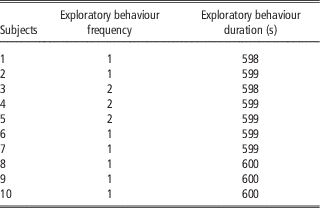
At 7 months of age, 10 mini-pigs in one of the halls (Enriched group) received manipulable material to allow exploratory and rooting behaviour (Straw from Coustenoble, 1bd DEWAVRIN-BP 60044, Auchel, France). The pigs had no previous experience with straw; 20 min before the provision of straw, blood samples were taken (T 0) using a contention tool known as a sling frame, to which the mini-pigs had already been habituated. The time necessary for operators to remove the pig, put it into the sling frame, draw the blood by venepuncture from the jugular vein and return it to its pen was between 5 and 10 min. The sample by itself was obtained 5 min after the beginning of the procedure. Pigs were accustomed to the procedure: to go into the sling frame, to the contention method used for blood sampling and to the blood sampling procedure. After blood sampling, 5 kg of straw were provided to the pen (2.5 m2), covering the entire surface of the floor, a video camera was switched on, and the exploratory session started. The exploratory session was defined as the first 10 min during which the pigs were exposed to the straw, during the 1st week. Performance of exploratory and rooting behaviour in pigs in ‘Enriched group’ was confirmed by video analysis, performing a continuous sampling by two independent observers (Table 1). A second blood sample (T 1) was drawn immediately after the exploratory session. After this, straw was continuously provided and renewed every day once for 2 weeks in each pen. In the other hall, 8 mini-pigs (Control group) were exposed to the same conditions regarding their management and the experimental methodology, but without straw. Blood samples were collected as in the Enriched group, at the same times. During the 2nd and 3rd week of the test, only one blood sample was drawn from the pigs (T 2 in the 2nd week and T 3 in the 3rd week), once a week for each pig, always in the same order, so that the interval between samples taken from each animal was always exactly 1 week. At the end of the 2 weeks, the straw was removed from the experimental pens and the test was complete.
Raw data of exploratory session during 600 s in Enriched group

Visual analogue scales
At the end of each week, one animal-keeper marked two visual analogue scales for each mini-pig regarding the difficulty/ease of work with and handle the pig (from ‘animal-keeper has a lot of difficulty to work with and handle the pig’ to ‘animal-keeper does not have any difficulty to work with and handle the pig’) and trust in humans (from ‘the pig does not trust animal-keeper at all, and attempts to escape from him’ to ‘the pig trusts animal-keeper completely, and approaches him with confidence’). The degrees of the scale were from 0 to 10, having two opposite definitions: at 0 and the other one at 10. The length of the scale was 10 cm. The animal-keeper drew a perpendicular line in the visual analogue scale, which was measured and entered as a number from 0 to 10. The line indicates the perception of the animal-keeper in relationship with the definitions on the two extremities of the scale (Srithunyarat et al., Reference Srithunyarat, Höglund, Hagman, Olsson, Stridsberg, Lagerstedt and Pettersson2016). A total of two visual analogue scales of each type were completed for each mini-pig at the end of the test.
Physiological parameters
Blood collection
Blood samples were taken from the pigs from the jugular vein while pigs were in the sling frame. Prior to the test, all the pigs were subjected to a programme of habituation to handling that involved using the sling frame and blood sampling during a period of three months. Blood was collected in pre-chilled EDTA/K3 aprotinin tubes (BD Diagnostics, Elvetec, Meyzieu, France) for oxytocin assay and in tubes with a clot activator (VACUETTE GREINER; Alcyon, Paris, France) for serotonin assay. Blood samples were kept refrigerated at 4°C during the sampling period, and were then centrifuged at 1200×g for 10 min at 4°C. Plasma or serum was recovered and stored at −18°C prior to analysis at IRSEA (Quartier Salignan, Apt, France).
Plasma oxytocin level
Oxytocin levels were measured by enzyme immunoassay according to the manufacturer’s instructions (Oxytocin EIA kit; EnzoLifeSciences, Villeurbanne, France) after a C18 solid-phase extraction (HyperSep C18 SPE Cartridges, Thermofisher, Illkirch, France) allowing for a 10-fold increase in concentration (Bienboire-Frosini et al., Reference Bienboire-Frosini, Chabaud, Cozzi, Codecasa and Pageat2017).
Serum serotonin level
Serotonin levels were measured by enzyme immunoassay (Serotonin EIA kit, EnzoLifeSciences) according to the manufacturer’s instructions. In this study on mini-pigs, the serum samples were diluted 1 : 50; this working dilution was first validated in the IRSEA laboratory by (i) confirmation of the parallelism between sample dilution curves and the standard curve, and (ii) evaluation of the mean precision and mean recovery on four validation samples, which were 9.6% and 90%, respectively. Measured values were multiplied by their dilution factor to obtain actual serum serotonin concentrations and expressed in ng/ml.
Statistical analysis
Data analysis was carried out using SAS 9.4 software Copyright© 2002-12 by SAS Institute Inc., Cary, NC, USA. The significance threshold was classically fixed at 5%. Homogeneity of the two groups at baseline (T 0 the 1st week) for oxytocin and serotonin levels was analysed according to Student’s t test using the TTEST procedure. For serotonin levels, t-test was involved because normality and homogeneity of variances were established. For oxytocin levels, and because of non-normality of this variable, the non-parametric two-sample Wilcoxon’s test was employed using the NPAR1WAY procedure.
For the analysis of short-term effects of straw provision on oxytocin concentration, because of a substantial individual variability between pigs and heterogeneity between the two groups at T 0, differences in oxytocin levels between T 1 and T 0 were computed and analysed. For serotonin, because of a substantial individual variability between pigs, differences in serotonin levels between T 1 and T 0 were computed and analysed. Differences between groups for T 1−T 0 were verified according to Student’s t test if normality and homogeneity of variances were established. If conditions were not established, a two-sample Wilcoxon’s test was performed.
The long-term effect (2 weeks) of straw provision on oxytocin was evaluated by examining the change of oxytocin levels from T 2 to T 3. For serotonin, it was evaluated by examining the change of serotonin levels between T 0, T 2 and T 3. Data were tested from the assumptions of normality using the residual diagnostics plots and the UNIVARIATE procedure. Homoscedasticity was tested by Levene test using the GLM procedure. If normality was established and variances were homogeneous: a GLM was used to evaluate effect of group, time and group×time interaction using the MIXED procedure. If normality was not verified, other distributions would be tested. If normality was verified but not homoscedasticity, the group=option (it defines an effect that specifies heterogeneity in the covariance structure of R) would be used in the mixed procedure. If normality was not verified but another distribution was identified, GLM would be used through the GLIMMIX or the GENMOD procedure depending on distribution identified.
For oxytocin level, normality was not verified. γ Distribution was identified as the one followed by oxytocin, which was consequently modelled by generalised estimating equation using the GENMOD procedure to evaluate effects of group, week, and group×week interaction. Because of heterogeneity at T 0, T 0 data were removed from main effects of the model but included it as a covariate, according to the literature (Committee for Medicinal Products for Human Use, 2015). This methodology generally improves the efficiency of analysis and avoids conditional bias from chance covariate imbalance. Repeated measures ANCOVA was used to analyse data without this bias. The best structure of variance–covariance to apply to data was chosen by minimising QIC criteria. For serotonin level, normality was verified, and GLM was used to evaluate effect of group, week and group×week interaction, with the MIXED procedure. But, as the variances between the two groups were heterogeneous (heteroscedasticity), the group=group option was added in the repeated statement to specify a heterogeneity in the covariance structure of R. The best structure of variance–covariance to apply to data was chosen by minimising AIC and BIC criteria. For oxytocin and serotonin, post hoc multiple comparisons were done using the Tukey–Kramer adjustment.
‘Difficulty/ease to work with and handle pigs’ and ‘Trust in humans’ visual analogue scales followed Poisson distribution. To evaluate effect of group, week and group×week interaction, ‘Trust in humans’ visual analogue scale was modelled by using the GLM with the GLIMMIX procedure as recommended. For the ‘Difficulty/ease to work with and handle pigs’ visual analogue scale, the generalised estimating equation with the GENMOD procedure was used because no suitable model was available using the GLIMMIX procedure. Post hoc multiple comparisons were done using the Tukey–Kramer adjustment.
Results
First, it has been confirmed by video recording that pigs performed exploratory behaviour during exploratory sessions (Table 1). Before the provision of straw, groups were heterogeneous at T 0 for oxytocin values (Z=−2.68; P=0.01). For serotonin values groups were homogeneous at T 0 (t=−0.02; P=0.99).
Short-term effect of exploratory behaviour on oxytocin and serotonin: 1st week
For Δ(T 1−T 0) model, no significant difference was found between ‘Control’ and ‘Enriched’ groups (−0.63±2.91 v. 0.63±3.73 pg/ml; Z=−0.09; P=0.93). Regarding serotonin, for Δ(T 1−T 0) model, no significant difference was found between ‘Control’ and ‘Enriched’ groups (−101.85±804.29 v. −147.35±1181.84 ng/ml; t=0.09; P=0.93).
Long-term effect (2 weeks) of exploratory behaviour on oxytocin and serotonin: 1st, 2nd and 3rd week
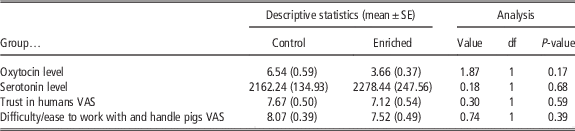
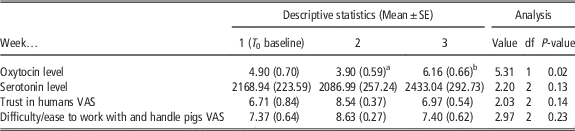
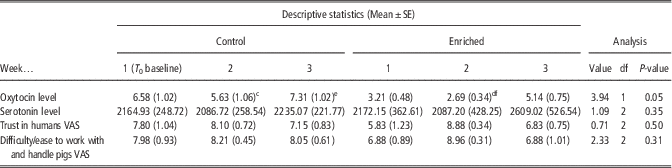
Regarding oxytocin, the difference between groups was not significant (P=0.17) (Table 2). A significant difference was observed between weeks (3.90±2.78 v. 6.16±2.72 pg/ml; P=0.02) (Table 3). More precisely, an increase of oxytocin concentration means of both groups between T 2 and T 3 was found significant (6.16±2.72 v. 3.90±2.42 pg/ml; P=0.02). The group×week interaction was significant (P=0.05) (Table 4). Even if the difference between the two groups was not significant, descriptive data showed that the increase in oxytocin concentration was more representative in the Enriched group than in the Control group (Table 4).
Comparisons between groups (Control group and Enriched group) for all the parameters

VAS=visual analogue scale.
Values are mean (SE) for oxytocin level, serotonin level, trust in humans VAS and difficulty/ease to work with and handle pigs VAS.
No significant differences were observed.
Comparisons between the different weeks for all the parameters: 1st (baseline T 0, before straw provision), 2nd and 3rd week

VAS=visual analogue scale.
Values are mean (SE) for oxytocin level, serotonin level, trust in humans VAS and difficulty/ease to work with and handle pigs VAS.
a,bValues with unlike superscript letters correspond to a significant difference (P=0.02).
Comparisons of Control group and Enriched group according to the different weeks for all parameters

VAS=visual analogue scale.
Values are mean (SE) for oxytocin level, serotonin level, trust in humans VAS and difficulty/ease to work with and handle pigs VAS.
c,d,e,fValues with unlike superscript letters correspond to significant differences (P=0.01 and P<0.0001, respectively). The multiple comparisons have been computed using the LSmeans statement using the adjustment of Tukey–Kramer.
Concerning serotonin, there was no significant difference between ‘Control’ and ‘Enriched’ groups (2162.24±661.02 v. 2278.44±1333.14 ng/ml; P=0.68 (Table 2). There was also no significant difference of serotonin values of both groups between weeks (P=0.13) (Table 3). The group×week interaction was not significant (P=0.35) (Table 4).
Visual analogue scales
There was no significant difference between ‘Control’ and ‘Enriched’ groups regarding the difficulty/ease to work with and handle the pigs (8.07±1.88 v. 7.52±2.65; P=0.39) (Table 2), or their trust in humans (7.67±2.37 v. 7.12±2.93; P=0.59) (Table 2). No differences were observed between the 3 weeks (P=0.23 and P=0.14) (Table 3) and for the group×week interaction (P=0.31 and P=0.50) for the two visual analogue scales, respectively (Table 4).
Discussion
The main aim of this study was to investigate whether straw provision in pigs, allowing them to perform exploratory behaviour, was associated with peripheral oxytocin and/or serotonin changes. We first confirmed by video analysis that pigs performed exploratory behaviour after the provision of straw. Then, we found that peripheral levels of oxytocin and serotonin in pigs were not modified by straw provision in the context of this study. Besides, human–animal relationship between groups was assessed thanks to two visual analogue scales, showing that there was no effect of the provision of straw on human–animal relationship in our test conditions.
The outcome of this study was divided into two parts: short-term effect (immediately after the first provision of straw) and long-term effect (after 2 weeks where straw was provided continuously) of the provision of straw as a model of enrichment material in pigs. Regarding the short-term effect of both oxytocin and serotonin (the difference between T 0 and T 1, so before and after the provision of straw), we did not observe any significant difference between groups nor over time; it thus appears that straw, and so the possibility to perform exploratory and rooting behaviour, does not have an impact on oxytocin and serotonin in a short-term situation.
Fries et al. (Reference Fries, Ziegler, Kurian, Jacoris and Pollak2005) stated that the half-life of oxytocin in plasma is very short (between 3 and 10 min), and Ludwig and Leng (Reference Ludwig and Leng2006) showed that, in rodents, the secretion of endogenous oxytocin triggered by the intraperitoneal injection of hypertonic saline appeared as a peak in plasma in the first 30 min. So, the little literature about this topic suggested that the time chosen to blood sample in our study was the correct one, 10 to 20 min after ‘Exploratory session’ (the first 10 min of straw). Nevertheless, we cannot be sure that our only blood sample could show a possible peak of peripheral oxytocin or serotonin due to a specific event in a particular moment, even if it was necessary to try to do it in that way, according to the literature, before starting with more invasive procedures. The next step, after obtaining a negative result using that way, would be to perform further blood samples with a catheter, to see if the same result is obtained.
A significant result regarding plasma oxytocin concentration on the long term was observed. More precisely, the mean level of oxytocin in both groups during the 3rd week was significantly higher compared with the 2nd week. That result suggested that the presence of straw (allowing exploratory and rooting behaviour) had no effect on peripheral oxytocin because the mean of the two groups showed a significant increase in plasma oxytocin between the 2nd and 3rd week but not between the ‘Control’ and ‘Enriched’ groups. This increase could be explained by an effect of handling. During the trial, all animals were indeed in contact with humans, and particularly with operators that they were accustomed to working with after a long period of socialisation and habituation. All animals had greater contact with them during the study than under normal conditions, and this could trigger an increase of plasma oxytocin levels because of a positive human–animal relationship (Rault, Reference Rault2016). The fact that the increase of oxytocin seems to be higher in Enriched group between the 2nd and the 3rd week than in Control group, even if not significant, could give rise to an interesting question: could the peripheral oxytocin keep increasing in ‘Enriched’ group if the provision of straw was longer, for example 1 or 2 more weeks? For this reason, the authors think that further studies focalised in a longer follow-up would be interesting. Finally, the results may suggest that oxytocin could be only affected by social interactions or social enrichment, and not by individual positive states, like the allowance to perform exploratory behaviour with enrichment material. Thus, other neuromodulators than oxytocin and serotonin could be explored.
Regarding peripheral serotonin, no differences were found between groups nor between group×time, so we may assume that there is no effect of the provision of straw allowing exploratory behaviour on serotonin, at least, in our test conditions. Most animal studies focusing on behavioural responses in an experimental test, measure serotonin during or directly after the behavioural test, implying that they measure a state the animal was in at that particular moment (Ursinus et al., Reference Ursinus, Bolhuis, Zonderland, Rodenburg, de Souza, Koopmanschap, Kemp, Korte-Bouws, Korte and van Reenen2013). However, for practical reasons, the same blood sampling was used to assay both oxytocin and serotonin but the sampling schedule was mainly driven by plasma oxytocin features. Thus, as explained for the short-effect of the provision of straw in oxytocin, it is difficult to know if the blood sample performed 10 to 20 min after ‘Exploratory session’ (the first 10 min of straw), could show a peak of serotonin, making very difficult to see the effect of a specific event in a particular moment. Besides, Ursinus et al. (Reference Ursinus, Bolhuis, Zonderland, Rodenburg, de Souza, Koopmanschap, Kemp, Korte-Bouws, Korte and van Reenen2013) suggest that the relations found in their study between behaviour and measures of serotonin in blood and brain indicate an underlying (personality) trait rather than states that vary in time.
This study also allows us to perform some preliminary observations about human–animal relationship, thanks to the visual analogue scales of difficulty/ease to work with and handle the pigs and their trust in humans. The observations showed that the provision of straw did not produce a significant difference regarding trust in humans nor in the ease of working with the animals. Contrarily, some studies have shown that the provision of environmental enrichment could improve human–animal relationship, so, their trust in humans (van de Weerd and Day, Reference van de Weerd and Day2009). It could also improve the ease to work with animals and handle the pigs (van de Weerd and Day, Reference van de Weerd and Day2009). Other studies showed an association between oxytocin and a positive human–animal relationship (Romero et al., Reference Romero, Nagasawa, Mogi, Hasegawa and Kikusui2014; Rault, Reference Rault2016). However, if we take into account our conditions, it is important to mention that the individual personality of each animal could influence this result (Wemelsfelder, Reference Wemelsfelder2007), and the fact that the animals were highly socialised to humans during a long period prior to the study. Thus, our study suggests that the provision of straw does not influence the human–animal relationship, when it is already very positive. Positive human×animal interactions also have been documented to play a role in sustaining the welfare and production of domestic animals (Caroprese et al., Reference Caroprese, Napolitano, Albenzio, Annicchiarico, Musto and Sevi2006; Zulkifli, Reference Zulkifli2013), hence, we consider that it is an interesting point to continue exploring.
It is also important to more carefully examine the way in which peripheral oxytocin is measured in pigs. Oxytocin is a neurohormone that, instead of favouring volume or synaptic transmission following central neuropeptide release, it follows a more dynamic concept with multiple and variable modes of release and communication. This concept considers neuropeptides in the extracellular fluid of the brain rather than those in the cerebrospinal fluid or plasma as primary signals, triggering a variety of receptor-mediated effects, including those underlying behavioural and neuroendocrine regulation and psychopathology (Landgraf and Neumann, Reference Landgraf and Neumann2004). In the current study, for practical reasons, it was decided to measure oxytocin by blood samples that were always drawn at the same time from all the animals, immediately before and following the provision of straw, and once a week for 2 more weeks during the continuous provision of straw. Paul et al. (Reference Paul, Harding and Mendl2005) stated that the interpretation of some parameters, like oxytocin, is complicated by the fact that a particular measure could reflect both a positive or negative emotional state. For example, an increase in locomotory activity or in heart rate can be both associated with escape from predation (negative) and with sexual behaviour (positive). Often the method of collection for biological samples, like blood sampling in our trial, can cause emotional reactions in animals that may confound the results (Broom and Johnson, Reference Broom and Johnson1993). Some studies in rabbits showed that certain stressful events are linked to a peripheral oxytocin increase (Noller et al., Reference Noller, Szeto, Mendez, Llabre, Gonzales, Rossetti, Schneiderman and McCabe2013). Other factors could influence the level of oxytocin, such as substantial inter-individual variations (Crockford et al., Reference Crockford, Deschner, Ziegler and Wittig2014) as well as its short half-life of ~10 min in plasma (Fries et al., Reference Fries, Ziegler, Kurian, Jacoris and Pollak2005). Hence, taking all this information into account, a single measure of peripheral oxytocin at a specific time, perhaps, may not be a very sensitive measure by itself. For future studies, it would be interesting to analyse oxytocin several times during the day and over a longer period to evaluate how levels vary over time. The feasibility of taking these measures with a catheter should be explored in further studies in pigs.
One difficulty has been found regarding the fact of obtaining higher basal oxytocin values in the Control group in week 1, compared with the Enriched group, before having the straw. To explain that fact, the following hypothesis is proposed: the existence of individual differences is proved due to many reasons, like individual personality (Olff et al., Reference Olff, Frijling, Kubzansky, Bradley, Ellenbogen, Cardoso, Bartz, Yee and van Zuiden2013) and it could influence the hormonal baseline. Apart from that, the statistical method could face this situation, as explained above, so we could measure both short-term effect and long-term effect without any bias, and that is a situation which could be frequent in physiological studies.
Studying oxytocin and other hormones in relation to straw provision and social interactions in pigs opens the door to improve the measurement of these parameters and its feasibility. As Rault et al. (Reference Rault, van den Munkhof and Buisman-Pijlman2017) state recently, it is premature to judge oxytocin’s potential as an animal welfare indicator given the few and discrepant findings and lack of standarisation in methodology, so research in that field is necessary to add information about this topic. In that respect, some of us have recently detailed and validated a method to assay plasma oxytocin in seven domesticated species, that has been used here, aiming at providing reliable and standardized measurement tools to researchers in this field (Bienboire-Frosini et al., Reference Bienboire-Frosini, Chabaud, Cozzi, Codecasa and Pageat2017). The findings of this study can serve as a foundation to further discussion about the interest of measuring these parameters, and about how best to study them in relation to the existing literature.
In conclusion, this preliminary study explores the relationship between peripheral oxytocin and serotonin and the presence of straw that allow pigs to perform exploratory behaviour, suggesting that there is no relationship between them. Nevertheless, some future studies may include crossing oxytocin and serotonin with other parameters, such as behavioural measures, to obtain more information about the true state of the animal and any possible relationship with pig welfare.
Acknowledgements
The authors thank the Sanitary Management of IRSEA for taking good care of the mini-pigs, particularly the veterinarian, Elisa Codecasa, and the animal-keeper, Hugo Tetelin. The authors also thank the entire IRSEA team for helping us to develop the project, including all the work that was done before the trial: the preparation for the arrival of the animals, the construction of the halls and pens, the habituation and socialisation period of our mini-pigs, and so on. Finally, the authors also thank IRSEA’s Board of Directors for giving us the opportunity to create and carry out this project.
Declaration of interest
The authors declare that the research was conducted in the absence of any commercial or financial relationships that could be construed as a potential conflict of interest.
Ethics statement
The project, including this experimental procedure, was approved by IRSEA’s (Research Institute in Semiochemistry and Applied Ethology) Ethics Committee (n°125) and the French Ministry of Research (AFCE_201602_02).
Software and data repository resources
None.