

Introduction
In response to the accelerating trend towards globalization, an increasing number of institutions of higher education are expanding their international activities and aspiring to establish long-term multidimensional partnerships with institutions in other countries. International joint and dual degrees are one approach that is gaining momentum. The American Council on Education’s Center for Internationalization and Global Engagement (CIGE) defines these degrees as:
-
∙ An international joint degree program is delivered by two or more partner institutions in different countries (Helms, Reference Helms2014). A student studies at both institutions and receives a single degree endorsed by each institution.
-
∙ An international dual degree program is delivered by two or more partner institutions in different countries. A student studies at both institutions and receives a degree from each of the partner institutions. Such programs are also referred to as ‘double’ degrees (Helms, Reference Helms2014).
For both programs, expectations are that participating students split their time approximately equally between the participating institutions. Joint degrees are more challenging to develop and sustain because the participating institutions must align their curricula completely and must offer students seamless transition from one institution to another. Thus they must overcome institutional and national differences in course equivalencies, teaching methodologies, and accreditation. In addition, changes to the curriculum must be approved by the governing bodies of both institutions. In contrast, dual degrees are more flexible. Although close course coordination is required and course equivalencies must also be resolved, in the end, each partner is responsible for determining and enforcing its own requirements. This makes the development of dual degrees a more straightforward process. Because of this, dual degree programs make up 78% of joint or dual degree programs offered by U.S. colleges and universities (Helms, Reference Helms2014).
Benefits to Students
The impetus for developing these programs is that they provide participating students with a significant and meaningful international exchange. Typically students will spend 18 months to two years abroad for an undergraduate program and at least one year abroad for a Master’s program. This relatively long period abroad requires students to become functionally competent in many sectors of a different society. Often these exchanges result in fluency in another language. Overall these programs empower participants to become more globally competent. Supporters of the programs also believe that it makes students who complete the programs more marketable in a globalizing economy.
The TransAtlantic Precision Agriculture Consortium
The dual degree program between the University of Georgia (UGA) and the University of Padova (UNIPD) is the result of a decade long partnership between three U.S. and three European universities dedicated to fostering the global awareness and competence of their students, faculty and staff. This partnership was formalized as the TransAtlantic Precision Agriculture Consortium (TAPAC) in 2004. Dr. George Vellidis at UGA leads the consortium (www.vellidis.org/tapac). As the name implies, TAPAC operates under the umbrella of precision agriculture – a common teaching, research, and outreach endeavor of all six universities. The foundation for TAPAC was laid through years of professional networking and long-term friendships and was championed at each institution by one or two individuals. TAPAC was formalized when its members applied for and received two student exchange/mobility grants funded concurrently by the U.S. Department of Education’s Fund for the Improvement of Post-Secondary Education (FIPSE) and the European Commission’s Multinational Partnerships for Cooperation in Higher Education (MPCHE) under their common Atlantis program. These grants required that the participating institutions sign multilateral cooperative agreements.
The goal of the TAPAC grants titled Precision Agriculture: Technology for More Sustainable Agriculture and Greater Food Safety was to provide students with the self-confidence and experience to function in the global economy through immersion in European/American academe and culture. The grants provided stipends for 22 American and 21 European university students to conduct a semester-long research internship in Europe or the U.S., respectively.
When they arrived at their host university, students became immersed in the precision agriculture research program of their host university as student assistants. Typically students were associated with projects related to their interests and their work was assigned so as to give them as much diverse experiential learning as possible within the confines of the semester-long exchange. Their work ranged from developing a GIS database for managing variable rate irrigation in the Botanical Garden of Padova (the oldest botanical garden in the world begun in 1545) to evaluating the efficacy of selective application of herbicides on peanuts. The latter project was the MSc thesis project of Katia Rizzardi, a UNIPD Master’s student hosted by UGA. Ms. Rizzardi’s experience formed the foundation for dual degree program.
Successful Exchange with a Master’s Student
Ms. Rizzardi was the lone graduate student who participated in the exchange program. She went to UGA for 6 months with the express purpose of conducting her Master’s thesis research there. She had already completed all her course work in Italy. Her research project was a component of an externally-funded research project and supervised by two UGA faculty, both of whom were placed on Ms. Rizzardi’s graduate advisory committee at UNIPD. Ms. Rizzardi’s thesis was written in English. Her work was presented as a poster at the 6th European Conference on Precision Agriculture held in Greece during 2007 (Rizzardi et al., Reference Rizzardi, Prostko, Rains, Vellidis and Morari2007) and published in a farmer-oriented magazine (Vellidis et al., Reference Vellidis, Rizzardi, Prostko and Rains2006). To make this experience possible, the UGA faculty supplemented Ms. Rizzardi’s TAPAC stipend from grant funds.
Because of this successful experience, TAPAC members established the long-term goal of developing a dual Master’s degree and decided on a framework in which participating students would complete the majority of their coursework at their home institution and conduct their thesis research at their host institution. In 2010, TAPAC members applied for and received a grant from the United States Department of Agriculture’s International Science and Education (ISE) program. The project’s goal was to validate the concepts already developed and to find ways to overcome institutional and funding constraints which stood in the way of implementing a dual degree. Three Master’s students from the U.S. institutions conducted their thesis research in Europe and four students from the European partner institutions conducted their research in the U.S. The graduate student exchanges were highly successful and fostered greater integration and interaction between TAPAC members as faculty from home and host institutions served on the committees of the graduate students. The four-year project confirmed that taking the majority of courses at the home institution and conducting the thesis research at the host institution was a viable model for a dual degree. In addition, it led to the following valuable conclusions that were used to develop the dual degree.
-
∙ A core group of committed faculty with strong interpersonal relationships is needed at each participating institution to develop and maintain a dual degree program.
-
∙ A wide variety of academic constraints make it difficult to develop multidisciplinary, multiinistutional dual degree programs. The simplest approach is to develop a dual degree between academic departments with similar teaching and research programs. By the time the ISE pilot project was completed in 2014, the participating UNIPD and UGA departments had the most similar teaching and research programs and so the decision was made to pursue a dual degree between those two departments with others to follow in the future.
-
∙ Funding mechanisms which support the students at both the home and host institution are desirable. However, funding mechanisms which support the students at the host institution are absolutely necessary for a dual degree program to succeed and for it to have a balanced exchange of students.
-
∙ Constant recruiting of qualified students, especially for the U.S. institution, is critical for the success of a dual degree program. Data from existing programs at institutions across the U.S. show that the exchanges are typically very one-sided with the majority of participants coming from the non-U.S. partner (Helms, Reference Helms2014).
-
∙ To increase multinational participation, English should be used as a common language.
Materials and Methods
For the reasons described above, the decision was made to develop a dual Master’s degree between UNIPD’s Department of Agronomy Food Natural Resources Animals and Environment (DAFNAE) and UGA’s Crop and Soil Sciences Department (CSSD). The long-term enrollment goal was to have a minimum of six students (three originating from UGA and three from UNIPD) enrolled during each academic year. One of the key decisions made at the beginning of the process was that the dual degree would be an option to existing Master’s programs at both institutions. The reasons for this decision were two-fold. The first was that adding an option to existing academic programs is simpler and requires fewer approvals by faculty governance, administrative, and accreditation bodies. The second was that most institutions or administrative bodies governing institutions (e.g. Boards of Regents), especially in the U.S., have established minimum student graduation rates for a degree to be considered sustainable. For example, at UGA, a Master’s program must graduate at least five students per academic year otherwise it is considered nonperforming and is terminated. Making the dual degree an option of an existing successful program helps to alleviate this concern.
Fundamental Decisions
The first official step in the process of developing the dual degree was a week-long meeting at UNIPD in January 2015 between the core group of UGA faculty and staff members and the core group of UNIPD faculty and staff members who were leading the dual degree effort at their respective institutions. Several times during the week, the core groups met with departmental, school, and university administrators at UNIPD. It was during this week that many of the fundamental decisions about the structure of the dual degree were made including how credits would be transferred between institutions and how participating students would be supported financially. A second critical meeting, this time at UGA, was held during November 2015 during which various remaining problems were resolved and the UNIPD core group met with UGA administrators. In addition to resolving technical issues, these meetings were vitally important in demonstrating to the various levels of administration at both institutions that both academic departments were committed to the effort of developing and sustaining a dual degree program. One of the key decisions was that theme of the dual degree would be agricultural sustainability achieved through the application of precision agriculture.
Credit Transfer
Master’s programs at UNIPD focus on in-class contact hours and the credits associated with thesis research are limited. In contrast, at UGA thesis research and thesis writing credits make up at least a third of the total credits required for graduation. In addition, a UNIPD Masters requires 120 credito formativo universitario (CFU) while a UGA Masters requires 30 credit hours (CH). The accepted conversion rate between the two systems is 1 CFU per 2 CH so after conversion, the UNIPD Masters is equivalent to 60 CH – double the CH associated with the UGA Masters. One of the key decisions was how the number of credits would be matched. The solution was a compromise which required students who began their program of study at UGA to take approximately 30% more course credits and students who began their program of study at UNIPD to take fewer courses but receive about 30% more credit for thesis research. In the end, students originating at either institution would accumulate 120 CFU and 60 CH.
Course are transferred from one institution to the other with the appropriate number of credits but neither institution transfers the grade received by the student. Since degrees at both universities are conferred with an associated grade point average (GPA), participating students are required to take at least one class for credit at the host institution. The grades from these classes are then used to calculate the host institution GPA.
Financial Support
At UGA, the vast majority of students pursuing a Master’s in the agricultural sciences are supported by a research assistantship. In addition to providing a stipend, a research assistantship reduces tuition to $25 per semester. This is significant because for the 2016–2017 academic year, tuition is $12,045 per semester for out-of-state students. Without financial support, graduate studies at UGA are prohibitively expensive for most students. In contrast to UGA, fees for Master’s programs at UNIPD are substantially lower but students are typically not supported financially. For the dual degree to be sustainable, financial support was necessary for participating students at both institutions. The decision was made that all participating students who required financial support would be supported by a research assistantship while at UGA regardless of whether this was their home or host institution. In turn, students originating at UGA would be supported by a stipend while enrolled at UNIPD.
Three UNIPD stipends and three UGA assistantships per year were offered by the UNIPD and UGA administrations, respectively, to support the dual degree program which ensured that at least six students could be enrolled simultaneously. Support for additional students will have to be generated by individual faculty members at both institutions through research grants.
Formalizing the Dual Degree
Once the fundamental decisions were made and the framework of the dual degree agreed upon, each institution pursued approvals for the degree from its various internal and external governing bodies. Concurrently, a formal cooperation agreement was developed. The cooperation agreement described in detail the fundamental decisions and framework and provided the legal structure for the dual degree. The process for developing the cooperation agreement was painstakingly slow as it required several iterations during which attorneys for both institutions would review and approve any changes.
Approvals Process at UNIPD
During the early phases of developing the dual degree, DAFNAE was in the process of developing a MSc in Sustainable Agriculture to be taught in English. Because of this, DAFNAE decided to make the dual degree an option to this new program. From beginning to end, the approval process for the dual degree at UNIPD required approximately 18 months and required the following steps: DAFNAE Academic Program Committee’s approval, approval of the cooperation agreement by DAFNAE faculty, cooperation agreement approval by the Academic Senate of UNIPD, and the signing of the cooperation agreement by the Rector of UNIPD.
Approvals Process at UGA
At UGA, the first step was to develop an area of emphasis in Sustainable Agriculture for the existing MSc in Crop and Soil Sciences. The dual degree would then be an option for this area of emphasis. Proposals for the area of emphasis and dual degree were developed and submitted for approval to the faculty of the CSSD, the College of Agricultural and Environmental Sciences (CAES) Curriculum Committee, the CAES Faculty Council, the University Council’s Curriculum Committee, and finally the University Council. This process required approximately one year. Because both proposals were modifications to an existing degree program, approvals from external governing and accreditation bodies was not necessary. All that was required was that these bodies be notified of the changes.
Results and Discussion
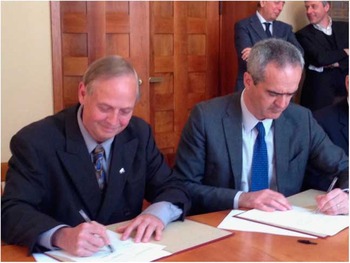
The cooperation agreement was signed during a ceremony held in the Palazzo Bo, the historical seat of UNIPD in Padova, Italy, on 03 May 2016 (Figure 1). Once the cooperation agreement was in place, the core group of faculty at UNIPD and UGA began recruiting students. At UNIPD, the incoming class for their MSc in Sustainable Agriculture contained 14 students from five different countries. These students will compete for participation in the dual degree program using metrics which are currently under development. Three will be selected to be in the inaugural class for the dual degree and after completing their first year of coursework at UNIPD will move to UGA to conduct their thesis research.
Dr. Donn Shilling (left), UGA Crop and Soil Sciences Department Head representing UGA President Jere Moorehead, and Prof. Rosario Rizzuto (right), UNIPD Rector, sign the dual degree cooperation agreement on 03 May 2016.

At UGA, three students were initially recruited to pursue the new area of emphasis in Sustainable Agriculture within the MSc in Crop and Soil Sciences. These students have also committed to participate in the dual degree. The first student enrolled at the beginning of fall semester 2016 and will be move to UNIPD to conduct his research during May 2017. The second student enrolled spring semester 2017 and the third will enroll fall semester 2017. All six of these students will be supported by the assistantships and stipends provided by UGA and UNIPD administrations.
How Participating Students Meet the Requirements
To graduate and receive Master’s degrees from UNIPD and UGA, students must apply to and be admitted by both institutions and complete all the graduation requirements of both institutions. In addition to the coursework, this requires completing and successfully defending a Master’s thesis research project. Upon complete all requirements for both institutions, the student will receive degrees from both institutions. For most students this will be a 2-year program. However the duration of the program will be a function of the individual students’ thesis research.
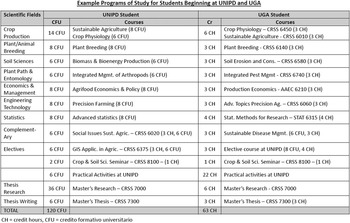
A detailed course guide and a table which present the courses available to students beginning the dual degree at UNIPD or at UGA is available at https://t.uga.edu/2Qa. In general, a student beginning at UNIPD must complete 60 CFU (30 CH) during Year 1 primarily as coursework. At the end of Year 1, the student will move to UGA and during Year 2 will earn an additional 60 CFU (30 CH). However, most of the credits will be earned from thesis research and writing. Similarly, a student beginning at UGA will complete 31 CH (62 CFU) primarily with coursework. During Year 2, the student will move to UNIPD and earn and additional 29 CH (58 CFU). Again, most of the credits earned from thesis research. Figure 2 provides an example of program of study for students originating at UNIPD or UGA.
Matrix of example programs of study for students beginning at UNIPD (left) and UGA (right).

Participating students must identify advisors/mentors at both institutions who will guide and support them during their thesis research. Practically, these advisors must be conducting similar research. To facilitate this process, CSSD and DAFNAE have developed a list of faculty who are willing to serve as thesis advisors and efforts are currently in progress to promote collaboration between these faculty members. For example, eight CSSD faculty will visit UNIPD during June 2017 to discuss and initiate collaborative research projects. In addition, these faculty have applied for and been granted adjunct status at the partner institution which confers upon them the full rights at that institution.
Each student will develop a three member graduate advisory committee at UGA led by the CSSD advisor and a five member committee at UNIPD led by the DAFNAE advisor. The advisors will serve on both committees. The remaining members of the committee will be selected to complement the expertise needed to guide the student’s thesis research. As described earlier, the thesis research will be conducted at the host institution under the guidance of the host institution advisor. A single thesis will be written but must be formatted and submitted individually to each institution. The thesis defense will be conducted jointly at the host institution. The home institution committee will participate via e-conference. Each committee will approve the thesis and defense separately.
Summary and Conclusions
The dual Master’s degree between UNIPD and UGA is a unique and challenging program for students. Unlike other dual degree programs, which focus on taking courses at the host institution, this program focuses on conducting thesis research at the host institution on agricultural sustainability achieved through the application of precision agriculture. It is anticipated that immersing student in research activities in another country will expose them to a variety of useful experiences that will not only enrich them academically but will also greatly improve their global competence.
The dual degree is also a tool with which to spur further research collaboration between UNIPD and UGA faculty on precision agriculture and related sustainability issues. It is anticipated that as individual faculty members form advisory committees for the students, these committees may evolve into long term collaborative research teams. Growth in the numbers of students who participate in the dual degree will be a function of these collaborative research teams securing and making funding available to support students with stipends and assistantships.
Developing this type of dual degree partnership requires buy-in at all levels of the academic community – from the grass-roots faculty to the leadership of the universities. This type of buy-in has made this program successful.
Acknowledgements
The authors wish to acknowledge all faculty, staff, and administrators at UNIPD and UGA whose commitment to the dual degree made this accomplishment possible. Special thanks go to the pioneering students who have enrolled in the program.