Philornis is a neotropical, monophyletic genus of Muscidae (Diptera) (Couri et al. Reference COURI, DE CARVALHO and LÖWENBERG-NETO2007) that includes many bird parasites (Skidmore Reference SKIDMORE1985). The interaction system of Philornis and birds is very peculiar: fly adults are free-living and only larvae interact with birds (Couri Reference COURI1985, Reference COURI, Guimarães and Papavero1999; Dodge Reference DODGE1963). Larval trophic habits are known for 22 of the 49 species (de Carvalho et al. Reference DE CARVALHO, COURI, PONT, PAMPLONA and LOPES2005) and are divided into three groups: coprophagous (P. aitkeni and P. rufoscutellaris), free-living haematophagous (P. falsificus) and subcutaneous (18 spp.). Philornis downsi is unusual because the first and the early second instars display a subcutaneous phase, whereas the late second and third phases show a nest-dwelling haematophagous phase (Fessl et al. Reference FESSL, SINCLAIR and KLEINDORFER2006).
Subcutaneous larvae preferentially parasitize nestling birds that depend on parental care and stay longer in the nest before fledging (Rabuffetti & Reboreda Reference RABUFFETTI and REBOREDA2007, Teixeira Reference TEIXEIRA, Guimarães and Papavero1999). After hatching, larvae burrow into the host integument and reside intradermically (Spalding et al. Reference SPALDING, MERTINS, WALSH, MORIN, DUNMORE and FORRESTER2002), where they feed on serous fluids, tissue debris and blood of the host. This parasitism affects nestling growth, development and fledging success (Arendt Reference ARENDT1985, Dudaniec & Kleindorfer Reference DUDANIEC and KLEINDORFER2006, Rabuffetti & Reboreda Reference RABUFFETTI and REBOREDA2007). Within approximately 4–8 d, larval feeding and growth are complete and larvae leave the host to pupate inside the bottom of the nest (Dodge Reference DODGE1971).
Studies concerning Philornis–bird interactions have recurrently assumed that these flies are generalists (Amat et al. Reference AMAT, OLANO, FORERO and BOTERO2007, Couri Reference COURI1985, Couri et al. Reference COURI, RABUFFETTI and REBOREDA2005). This assumption was based on one central observation and three peripheral aspects: (1) Philornis parasitize more than 100 bird species (Teixeira Reference TEIXEIRA, Guimarães and Papavero1999 and later records); (2) Philornis does not select hosts of a particular kind of nest, except for two coprophagous species that infest nest cavities with organic matter (Dudaniec & Kleindorfer Reference DUDANIEC and KLEINDORFER2006); (3) The larval period of Philornis is short and depends on the host's nestlings. This scenario would require that flies parasitize many species of bird with complementary breeding seasons (Dudaniec & Kleindorfer Reference DUDANIEC and KLEINDORFER2006, Teixeira Reference TEIXEIRA, Guimarães and Papavero1999); (4) Philornis species share hosts (Dudaniec & Kleindorfer Reference DUDANIEC and KLEINDORFER2006). Distinct species with the same interaction habit (Higgins et al. Reference HIGGINS, LOPES, SANTANA, COURI and PUJOL-LUZ2005) and different interaction habits (Teixeira Reference TEIXEIRA, Guimarães and Papavero1999) were found on the same individual host. Although it might indicate lack of specificity, this is not a straightforward argument for a generalist fly strategy.
Indeed, the main argument for generalism is related to high numbers of Philornis host species. However, this observation concerns a generic perspective: it considers the genus as the parasitic unit and neglected species information. It is possible that generalists and specialists coexist in an interaction system comprised many parasite species and many host species (Poulin Reference POULIN2007). This generic perspective fostered a bias on the interpretation of the Philornis interactions, which remains to date as an untested axiom.
The hypothesis of generalist and specialist coexistence has been corroborated in parasite–host systems (Poulin Reference POULIN2007) and the arrangement of generalists and specialists can follow a nested pattern (Vazquez et al. Reference VAZQUEZ, POULIN, KRASNOV and SHENBROT2005). A nested structure is a kind of interaction that encompasses generalists and specialists in a particular pattern: generalists interact with many host species and specialists interact with one or few hosts; however, specialists tend to parasitize the same hosts as generalists whereas hosts with low parasite richness tend to interact mainly with a few generalist species (Vazquez et al. Reference VAZQUEZ, POULIN, KRASNOV and SHENBROT2005). This structure is also seen in interactions such as animal–plant (Bascompte et al. Reference BASCOMPTE, JORDANO, MELIÁN and OLESEN2003) and animal–animal mutualistic networks (Guimarães et al. Reference GUIMARÃES, SAZIMA, REIS and SAZIMA2007).
The Philornis–bird parasite–host system is still poorly understood (Couri et al. Reference COURI, DE CARVALHO and LÖWENBERG-NETO2007) and an overall analysis of the interaction structure can reveal whether the system is based on strictly generalist parasites or not. In this study, I describe the structure of the parasite–host interaction in order to test the hypothesis of generalist and specialist coexistence.
A parasite–host database was compiled and used to construct a binary interaction matrix of Philornis vs. bird species. The matrix was used to draw a bipartite network using the software Pajek 1.20 (http://vlado.fmf.uni-lj.si/pub/networks/pajek/). The network pattern illustrated the overall structure of parasite–host interaction system. If Philornis species are strictly generalists, the expected network would be fully connected by lines, connecting many parasites to many hosts. On the other hand, if Philornis species are strictly specific, only parallel lines connecting one parasite to one host would be found.
Matrix temperature was calculated as a statistical test for nestedness. Matrix temperature is a parameter that characterizes nestedness entropy packing (Atmar & Patterson Reference ATMAR and PATTERSON1993). Zero degrees represents a perfectly nested matrix, whereas higher temperatures (maximum = 100°) represent an unstructured matrix. Temperature values were acquired in ‘Nestedness Temperature Calculator’ software (http://aics-research.com/nestedness/tempcalc) and tested against a Monte Carlo-derived probability of 3000 runs; as well as in ‘Nestedness’ software (http://www.uni.torun.pl/~ulrichw) and tested against null models under fixed-fixed (FF) and fixed-equiprobable (FE) algorithms. Under the FF algorithm, the number of observed fly interactions and the number of fly species parasitizing bird species is maintained in the simulation, whereas under the FE algorithm the number of interactions is maintained and the flies were equally likely found parasitizing bird species.
It is possible that the number of interactions could be affected by larval competition, mainly due to subcutaneous Philornis larval habits. In a system ruled by competition, one can assume that parasites do not share hosts and its structure follows a chequerboard pattern (Gotelli & Ellison Reference GOTELLI and ELLISON2002). However, nestedness and chequerboard are mutually exclusive matrix patterns because a nested structure intrinsically assumes host sharing, whereas chequerboards depends on the number of species pairs that never co-occur in any host.
In addition, the C-Score, which is the average of all possible chequerboard pairs calculated for species that occur at least once in the matrix, was acquired and tested against a null model-derived probability of 5000 runs in EcoSim 7.0 software under fixed-fixed (FF) and fixed-equiprobable (FE) algorithms (http://homepages.together.net/~gentsmin/ecosim.htm). The possible corroboration of a co-parasite pattern was assumed as nestedness strength.
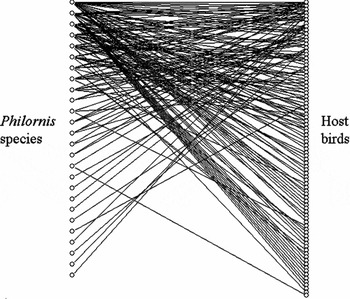
Visual analysis of the network (Figure 1) was consistent with a nested pattern: (1) On the top of the network it was possible to observe that some flies parasitize many bird species and many bird species are hosts of many fly species. (2) Diagonal lines link flies with fewer interactions to the most common hosts, and the birds that host fewer species are linked to those flies which parasitize many hosts. (3) The absence of parallel lines linking species with fewer interactions show that the structure was not based on specific–specific interactions (Guimarães et al. Reference GUIMARÃES, SAZIMA, REIS and SAZIMA2007).
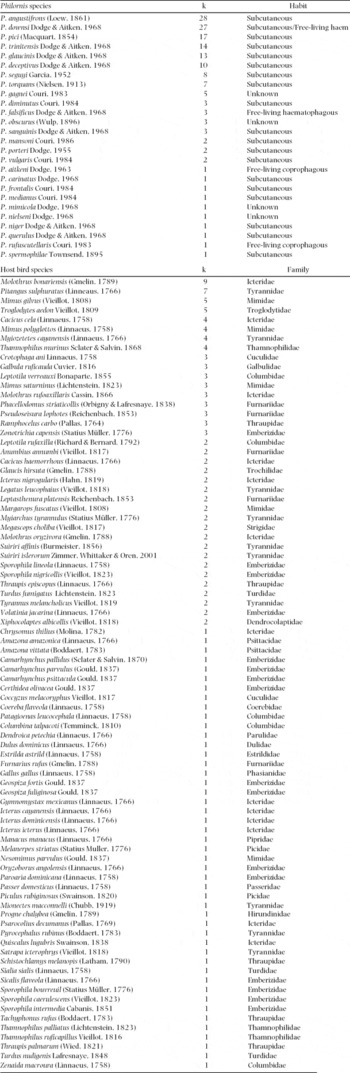
Network diagram of the Philornis-bird system ordered by decreasing number of interactions. The matrix was constructed based on the following studies: Amat et al. (Reference AMAT, OLANO, FORERO and BOTERO2007), Couri et al. (Reference COURI, RABUFFETTI and REBOREDA2005), Fessl et al. (Reference FESSL, COURI and TEBBICH2001), Higgins et al. (Reference HIGGINS, LOPES, SANTANA, COURI and PUJOL-LUZ2005), Mendonça & Couri (Reference MENDONÇA and COURI1999), Nores (Reference NORES1995), Spalding et al. (Reference SPALDING, MERTINS, WALSH, MORIN, DUNMORE and FORRESTER2002) and Teixeira (Reference TEIXEIRA, Guimarães and Papavero1999). The matrix is comprised of 26 species of Philornis and 85 species of neotropical bird.

Nestedness was statistically corroborated by matrix temperatures. Temperatures calculated in NTC (T = 6.69°) and Nestedness (T = 8.07°) were low and differed from simulated temperatures of randomized matrices (NTC, Tsim = 19.2°, SDsim = 2.1°, P(T < 6.69°) = 10−8) and (Nestedness, TFF = 10.5°, SDTFF = 1.04°, CI95% = 8.73–12.7°, TFE = 22.7°, SDTFE = 1.50°, CI95% = 20.1–25.8°). The analysis performed in Nestedness and FF algorithm generated a temperature value closed to the lower confidence limit and may not be significant. Although FF is considered the most conservative algorithm, it may not always detect nestedness when it is present (Ulrich & Gotelli Reference ULRICH and GOTELLI2007). Under this assumption, matrix nestedness was considered statistically corroborated.
Additionally, the co-occurrence analysis (C-score) supported a pattern of co-parasitism. In a competitively structured community, the C-score should be significantly larger than expected by chance (http://homepages.together.net/~gentsmin/ecosim.htm). In the current analysis, observed C-score (Cobs = 7.57) was lower than mean simulated indices under both algorithms (CsimFF = 8.01, P(obs < sim)FF = 0.0798, CsimFE = 9.51, P(obs < sim)FE = 0.012). This result did not necessarily support nestedness, yet it refuted a chequerboard pattern that is incongruent with nestedness (Almeida-Neto et al. Reference ALMEIDA-NETO, GUIMARÃES and LEWINSOHN2007).
In the present study, the nested pattern was assumed as evidence of generalist and specialist co-existence. Under this conjecture, Philornis cannot be considered a strict generalist based on high number of host species, but a genus that includes both generalists and specialists in a nested way.
A definitive test of the above-mentioned hypotheses of Philornis generalism require more information and field experimentation. Nevertheless, it is possible to speculate on its occurrence. The biological mechanisms underlying Philornis host selection are unclear regarding nest shape or kind. All shapes (cup, dome, cavity, hanging basket, stick platform) provide conditions for Philornis survival: they allow adult flies and larvae to access the nestlings and provide substrate for larvae pupation. Nevertheless, it is possible that different constitution of the nest substrate may be a factor of preference. This was observed for coprophagous species. They interact with birds that dig their nests into hard substrate, such as in cliffs (Galbula ruficauda host of P. aitkeni and P. rufoscutellaris), in the ground, sandy soil and termite tree domes (Trogon surrucura, Momotus momota and Chelidoptera tenebrosa hosts for Philornis spp.; Teixeira et al. Reference TEIXEIRA, COURI and LUIGI1990). Nests on hard substrate support organic accumulation. In the case of subcutaneous larvae, substrates may have a different effect. Different substrate composition may affect conditions of Philornis pupation phase (temperature, humidity, hardness, pH, etc).
Short larval period or the fact that many birds breed for a few months per year does not necessarily support the idea that flies must parasitize many birds with complementary breeding seasons to survive. Even though Philornis life cycle depends on birds, it is possible that Philornis species persist by parasitizing adult birds (Arendt Reference ARENDT1985) or in diapause at the pupal stage (Dodge Reference DODGE1971).
It is evident that the system is poorly understood and more information is needed on the hosts’ and parasites’ natural histories. Nevertheless, the results obtained in the present study are a fundamental step towards the clarification of the structure of the Philornis-bird interactions, mainly in relation to the Philornis generalist paradigm that permeated earlier studies. This alternative perspective may foster further studies on the dynamics and mechanisms that underlie this interaction system.
ACKNOWLEDGEMENTS
The author is grateful to Paulo Guimarães Jr, Marcio R. Pie and three referees who reviewed the article and made valuable considerations for the improvement of the manuscript. The author is also grateful to the ‘Conselho Nacional de Desenvolvimento Cientifico e Tecnológico, CNPq’ for a graduate scholarship.
Species used to construct the interaction networks and their respective number of interactions (k), trophic habit for Philornis and families for birds.