Introduction
Epidemiological, experimental and clinical data indicate that low levels of circulating lipids, cholesterol, and n-3 polyunsaturated fatty acids (PUFAs) (attained from fish and shellfish) are risk factors for impulsive and depressive behaviours (Edwards et al. Reference Edwards, Peet, Shay and Horrobin1998). For example, an association of low cholesterol with a recent act of self-harm has frequently been demonstrated (Garland et al. Reference Garland, Hickey, Corvin, Golden, Fitzpatrick, Cunningham and Walsh2000; Lester, Reference Lester2002). We previously demonstrated that individuals who self-harmed (intentional overdoses) had lower circulating plasma levels of cholesterol, low-density lipoprotein (LDL), total n-3 and n-6 PUFAs and lower plasma levels of the principal central nervous system (CNS) n-3 PUFAs, docosahexaenoic acid (DHA) and eicosapentaenoic acid (EPA) compared with individuals who had no history of self-harm (Garland et al. Reference Garland, Hallahan, McNamara, Carney, Grimes, Hibbeln, Harkin and Conroy2007). Given these findings, we performed a 12-week randomised control trial (RCT) in a different cohort of individuals who engaged in self-harm and demonstrated that individuals taking n-3 PUFAs (1.2 g EPA and 0.9 g DHA daily) displayed significant improvements in mood and stress levels, and had reduced suicidal ideation compared with individuals taking placebo (Hallahan et al. Reference Hallahan, Hibbeln, Davis and Garland2007). Indeed, meta-analytic data have demonstrated that n-3 PUFA formulations where EPA is the predominant compound have antidepressant efficacy for individuals with a clinically diagnosed major depressive disorder (Hallahan et al. Reference Hallahan, Ryan, Hibbeln, Murray, Glynn, Ramsden, San Giovanni and Davis2016). In addition, several RCTs have demonstrated that omega-3 PUFAs reduce impulsivity and/or aggression (Hamazaki et al. Reference Hamazaki, Sawazaki, Nagasawa, Nagao, Kanagawa and Yazawa1999; Itomura et al. Reference Itomura, Hamazaki, Sawazaki, Kobayashi, Terasawa, Watanabe and Hamazaki2005).
Whilst, EPA and DHA levels and their putative association with major depressive disorder (MDD) and impulsivity may be a ‘state phenomenon’, the slow turnover of DHA in the brain in particular (half-life of 2.5 years) (Umhau et al. 2009), also suggests a potential role for n-3 PUFA levels as a ‘trait phenomenon’.
It is thus possible that there is a greater risk of self-harm and psychopathology pre-disposing to self-harm in individuals with low n-3 PUFA levels. Consequently, the primary aim of this study was to examine if low baseline lipid and PUFAs level were associated with increased rates of self-harm over a 10-year period. Secondary aims were to examine if baseline low lipid and PUFA levels were associated with higher rates of depressive episodes over a 10-year period and higher rates of both depression and impulsivity when measured at 10-year follow-up.
Materials and methods
Participants
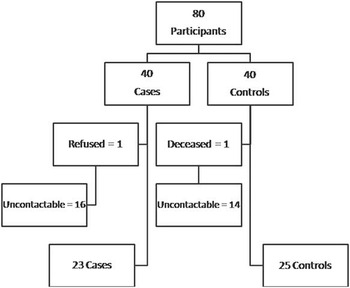
All individuals including 40 cases and 40 healthy controls aged 16–65 involved in the original study (Garland et al. Reference Garland, Hallahan, McNamara, Carney, Grimes, Hibbeln, Harkin and Conroy2007), were invited to participate in this 10-year follow-up study. None of the participants were reviewed for the purposes of this study in the interim period. Cases in our original study consisted of consecutive individuals who presented to the Emergency Department of Galway University Hospital over an 18-month period secondary to self-harm. The original exclusion criteria were consumption of fish more than once a week or supplements containing n-3 PUFAs including EPA or DHA; age <16 or >65 years; requiring resuscitation with fluids or ventilator support following self-harm; serious injury or medical complication following self-harm; current psychiatric diagnoses of addiction, psychotic disorders, or eating disorders; presence of any illness, treatment or diet known to affect plasma cholesterol; history of cardiovascular or lipid disorder; recent weight loss, regular use of or self-harm utilising psychotropic agents (as these substances would interfere with measures of platelet serotonin which was measured in the initial study). All cases were reviewed within 18 hours of arrival at the Emergency Department and before any psychiatric intervention. Controls, matched for age and gender, were recruited from the medical day ward. The same exclusion criteria were applied with the addition that they had no previous or current psychiatric history. Of the original 80 participants, 48 individuals participated in the follow-up study (23 cases and 25 controls) (see Fig. 1 – Flow diagram).
Flow diagram of participants.

Assessments
Participants (n=48) underwent a comprehensive psychiatric interview with the researcher (A.T.G., I.T.M., J.L., B.H.) (a senior psychiatrist) in relation to the presence of any major mental health disorder according to International Classification of Diseases – 10 (ICD-10) operational criteria and where doubt existed in relation to a diagnosis, participants consented for their own treating psychiatrist or clinician to be contacted for diagnostic clarification. Demographic data, fish consumption, n-3 PUFA supplement intake (a wide variety of supplements were enquired about), weekly alcohol intake and a current body mass index (BMI) was attained from each participant at follow-up. All participants (n=48) completed the following psychometric instruments:
-
∙ Suicide Intent Scale (SIS) (Beck et al. Reference Beck, Ward, Mendelson, Mock and Erbaugh1974): a 15-item self-report scale measuring suicidal ideation and intent. Each item is rated from 0 to 2, giving a total score range from 0–30, with scores of 14 or greater indicating high suicide intent. Good reliability for the scale and especially for the sub-scale assessing self-reported suicidal intent has been demonstrated (Freedenthal, Reference Freedenthal2008).
-
∙ Beck Depression Inventory (BDI) (Beck et al. Reference Beck, Herman and Schuyler1961): a 21-item self-report questionnaire measuring depressive symptoms. Each item is rated 0–3, giving a total score of 0–63. The reliability and validity of the BDI in a variety of populations has frequently been reported (McPherson & Martin, Reference McPherson and Martin2010).
-
∙ Barratt Impulsivity Scale-II (BIS) (Barratt, Reference Barratt1974): a 30-item self-report questionnaire that evaluates three sub-scales of impulsivity: attention, motor and non-planning impulsivity. Each item is measured on a four-point Likert scale ranging from ‘rarely/never’ to ‘almost always/always’, giving a total score of 0–90. Good validity and internal consistency has been demonstrated with this instrument in a variety of environments (Patton et al. Reference Patton, Stanford and Barratt1995).
-
∙ Sheehan Disability Scale (SDS) (Sheehan, Reference Sheehan1983): a brief self-report tool that evaluates on a 10-point anchored visual analogue scale, functional impairment on three inter-related domains; work/school, social and family life. It has proven validity and reliability for measuring disability in a variety of settings and for individuals with a variety of mental health difficulties (Luciano et al. Reference Luciano, Bertsch and Salvador-Carulla2010).
-
∙ Overt Aggression Scale Modified (OAS-M) (Coccaro et al. Reference Coccaro, Harvey, Kupsaw-Lawrence, Herbert and Bernstein1991): a semi-structured interview with proven reliability, validity and is sensitive to change (Coccaro et al. 1991). It assesses four clusters of aggressive behaviour: verbal assault, assault against others, assault against objects and assault against self. The three sub-scales measure aggression, irritability and suicidality. Good inter-rater reliability has been demonstrated for this instrument in a variety of settings (Endicott et al. Reference Endicott, Tracy, Burt, Olson and Coccaro2002).
Laboratory methods
Fasting ante-cubital venous blood was drawn from participants for cholesterol measures. PUFA analysis was unable to be performed on the samples, as the samples were inadvertently spoiled. Total plasma cholesterol was measured on a Beckman Synchron CX7 Analyser (Diamond Diagnostics, MA, USA) by an enzymatic timed end-point method (Allain et al. Reference Allain, Poon, Chan, Richmond and Fu1974). Baseline plasma PUFA levels were extracted as detailed in the original study (Garland et al. Reference Garland, Hallahan, McNamara, Carney, Grimes, Hibbeln, Harkin and Conroy2007).
Statistical analysis
Data were analysed utilising the Statistical Package for Social Sciences 20.0 for Windows (SPSS Inc., IBM, New York, USA). Proportions of nominal variables were compared using the χ 2-test or Fisher’s exact test where appropriate. Continuous normally distributed variables (including n-3 and n-6 PUFAs and lipid levels) were expressed as mean values with their standard errors to compare cases and controls using the independent t-test, and with analysis of co-variance, the covariate being social class, smoking (as these variables were significantly different between the two groups). Changes in psychometric measures comparing groups were analysed using paired t-tests. Logistic regression models were used to ascertain if n-3 or n-6 PUFAs were predictive of future episodes of self-harm or depression, with confounding factors including smoking status, employment status and social class. Linear regression models were also used to evaluate if baseline PUFA or lipid levels were associated with levels of impulsivity, depression, disability, aggression, irritability and suicidality.
Results
Demographic and clinical characteristics
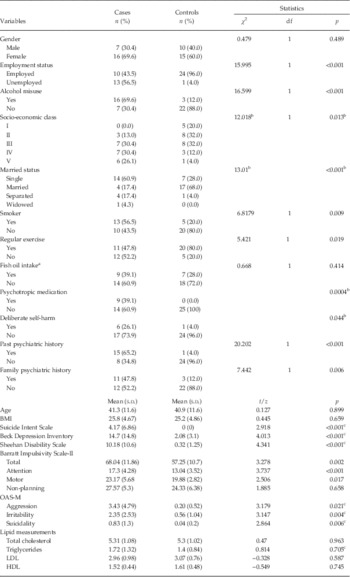
Table 1 displays the demographic characteristics of cases and controls at 10-year follow-up. Cases, similar to the original study had a higher prevalence of smoking and excess alcohol intake and were less likely to exercise regularly, and were from a lower socio-economic class. BMI and ‘fish oil’ intake (either by fish consumption or supplement use) was similar in both groups, with ‘fish oil’ intake increased in both groups over the 10-year follow-up period (none had consumed ‘fish oils’ at baseline). Of the nine cases who consumed ‘fish oils’ regularly at follow-up, five consumed fish on two or more occasions per week and four took n-3 PUFA supplements on a daily or near daily basis. Four controls consumed fish regularly at follow-up and three took n-3 PUFA supplements at follow-up. All individuals who consumed ‘fish-oil’ regularly had been doing so for a minimum of 3 years. Cases were more likely to have a past psychiatric history and have first degree family members with a psychiatric history. In total, 23 participants (48%) were ⩽26 years of age at baseline [10 cases (44%) and 13 controls (52%)], but no significant difference except for higher rates of being single were noted between those individuals ⩽26 years of age compared with those >26 years of age on any demographic or clinical measure.
Demographic and clinical data at 10-year follow-up

BMI, body mass index; HDL, high-density lipoprotein; LDL, low-density lipoprotein; OAS-M, Overt Aggression Scale Modified.
For categorical variables we employed χ 2-test (df and p) or Fisher’s exact test if <5 in any group compared. For continuous data, we utilised independent t-tests (t, p) or if not parametrically distributed, the Mann–Whitney U-test (z, p).
a Fish consumption at least twice a week or consumption of n-3 formulations from a pharmacy or health food store (including but not limited to Mor-Epa, Max-EPA, Omacor, Efamol Brain, Seven Seas Pulse, Krill oil, Flaxseed oil, Equazen and some homebrand compounds).
b Fisher’s exact test.
c Mann–Whitney U-test.
Over the 10-year period, the marital status of controls had changed significantly, with a greater percentage of individuals married (68% v. 36%, p=0.003), whereas the marital status of cases had not statistically altered (17% v. 26%, n.s.). There was an increase in the number of individuals in active employment in the control group (96% v. 64%, p=0.008) unlike cases (44% v. 44%, n.s.). Although cases exercised less frequently than controls at both baseline and at follow-up, a significant increase in the number of cases engaging in exercise was noted (48% v. 17%, p=0.005) unlike controls (80% v. 64%, n.s.). Neither group demonstrated an alteration in the proportions of individuals smoking or consuming excess alcohol over the 10-year period.
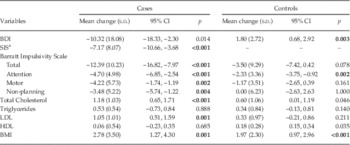
At 10-year follow-up, cases demonstrated reduced levels of depressive symptoms, suicidality, impulsivity (total and all sub-scales) and higher cholesterol, LDL and BMI scores compared with baseline (Table 2). Controls demonstrated reduced attentional impulsivity, and increased BMI scores compared with baseline (Table 2). At follow-up, cases had higher mean scores on the BDI, BIS (total and all sub-scales), OAS-M (all sub-scales) and SDS compared with controls (see Table 1).
Change in clinical variables over 10-year period

BDI, Beck Depression Inventory; BMI, body mass index; CI, confidence interval; HDL, high-density lipoprotein; LDL, low-density lipoprotein; SIS, Suicide Intent Scale.
Changes in clinical scores were attained using paired t-tests and p-values represent the change in scores over time within group (cases or controls).
a All controls scored 0.
Significance set at p<0.01.
Episodes of self-harm and depression
Of the 23 cases at baseline in this study, 10 (43%) displayed high suicide intent on interview post self-harm. At 10-year follow-up, cases were more likely to have engaged in self-harm compared with controls (26% v. 4%, p=0.04). Individuals who re-engaged in self-harm (n=6, all by overdose) had higher impulsivity (p<0.001), depression (p=0.028) and suicidal ideation (p=0.01) scores as measured by the BIS, BDI and SIS at 10-year follow-up compared with those who did not engage in further self-harm (Table 1). Four of the six cases who engaged in self-harm previously had high suicidal intent (SSI⩾14) at baseline (Fisher’s exact p=0.35) and three of these individuals also had high suicidal intent at follow-up (Fisher’s exact p=0.04). Only four individuals had high suicidal intent at follow-up. Eight cases suffered from depressive episodes (all being prescribed antidepressant medications) over the 10-year period (ranging from one to four episodes) with two having hospital admissions to acute mental health units secondary to experiencing a depressive episode. At baseline, two cases fulfilled ICD-10 criteria for MDD and a further four fulfilled criteria for an adjustment disorder. However at 10-year follow-up, five cases fulfilled ICD-10 diagnostic criteria for MDD disorder, two fulfilled criteria for bipolar affective disorder and three individuals fulfilled criteria for an adjustment disorder. None of the control group had any admissions to acute mental health units and none experienced depressive episodes or fulfilled ICD-10 diagnostic criteria for a depressive episode over the 10-year period, although one control engaged in an episode of self-harm. Although there was a mean increase in BDI scores in controls (Table 2), the mean BDI score at 10-year follow-up was only 2.1 (s.d.=3.1), with p>0.01. No member of the control group similarly fulfilled ICD-10 diagnostic criteria for any other major mental health disorder.
Plasma PUFA and lipid levels and relationship to self-harm and depressive episodes
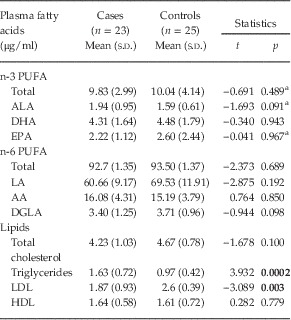
Table 3 displays mean fatty acid and lipid levels in cases and controls at baseline for the 48 individuals who participated at follow-up. Total fatty acids levels or mean levels of specific n-3 or n-6 PUFAs did not differ significantly between cases and controls. When the entire cohort (n=80) was included at baseline, mean levels of the n-6 PUFAs, linolenic acid and dihomo-γ-linolenic acid (DGLA) and the n-3 PUFAs, DHA and EPA were lower in cases than controls.(p<0.05) (Garland et al. Reference Garland, Hallahan, McNamara, Carney, Grimes, Hibbeln, Harkin and Conroy2007). Baseline total n-3 PUFA levels were not associated with any demographic factors (socio-economic class, exercise, smoking or alcohol use) at follow-up. Similar to the entire cohort, cases who participated in this study, had lower LDL (p=0.003) and higher triglyceride (p<0.001) concentrations compared with controls at baseline, however at follow-up no differences were observed between cases and controls for any lipid measure (see Table 1).
Baseline plasma concentration of fatty acids and lipids in individuals who self-harmed and controls

AA, arachidonic acid; ALA, α-linolenic acid; DGLA, dihomo-γ-linolenic acid; DHA, docosahexanoic acid; EPA, eicosapentaenoic acid; HDL, high-density lipoprotein; LA, linolenic acid; LDL, low-density lipoprotein, PUFA, polyunsaturated fatty acid.
a Mann–Whitney U-test.
Baseline levels of total fatty acids, total n-3 PUFAs, total n-6 PUFAs and EPA, DHA, arachidonic acid (AA) and DGLA were not predictive of further self-harm or depressive episodes in the 10-year follow-up period, before or after adjusting for confounders (smoking, employment status). Triglycerides levels predicted future depressive episodes; however, this finding was no longer significant, in adjusted analyses. Baseline DGLA was associated with increased motor impulsivity (B=0.144, s.e.=0.064, t=2.264, p=0.03), before controlling for multiple testing.
Correlation between clinical data and plasma lipid and PUFA levels
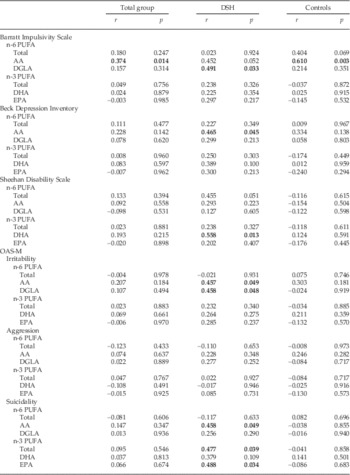
Table 4 displays the partial correlations between baseline n-3 and n-6 PUFAs and scores on the BIS, the BDI, the SDS and the OAS-M adjusting for alcohol, social class and smoking at 10-year follow-up. There were no significant correlations between impulsivity and depression scores and total n-6 and n-3 PUFAs. AA was moderately correlated with impulsivity in controls (r=0.61, p=0.003). In relation to suicidality (measured on the OAS-M), there was a modest correlation between baseline EPA levels (r=0.488, p=0.034), total n-3 PUFAs (r=0.477, p=0.039) and AA levels (r=0.458, p=0.049) and suicidal ideation for cases. Other correlations were also noted, but did not remain statistically significant after controlling for multiple testing.
Correlation between polyunsaturated fatty acids (PUFAs) and impulsivity and psychometric scales at 10-year follow-up

AA, arachidonic acid; DGLA, dihomo-γ-linolenic acid; DHA, docosahexanoic acid; DSH, deliberate self-harm; EPA, eicosapentaenoic acid; OAS-M, Overt Aggression Scale Modified; PUFA, polyunsaturated fatty acid.
Correlation data adjusted for alcohol, social class and smoking at 10-year follow-up.
In relation to lipids, a modest positive correlation was detected between mean baseline triglyceride level and total BIS score at 10-year follow-up for the entire cohort (r=0.316, p=0.03), with no other significant correlations between baseline or follow-up lipid scores and impulsivity, depression or suicidality at 10-year follow-up noted.
Fish-oil consumption and clinical associations
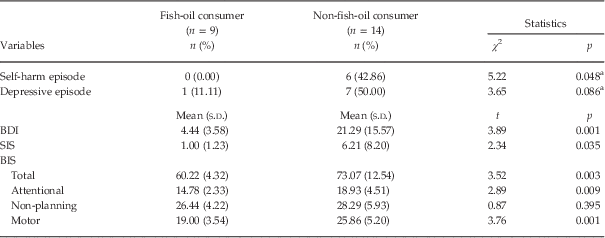
All of the cases who engaged in self-harm did not consume ‘fish oils’ on a regular basis (Fisher’s exact p=0.048). Seven of the eight cases who suffered from a depressive episode similarly did not consume ‘fish oils’ regularly (Fisher’s exact p=0.086). In addition, statistically significant lower scores on the BDI, SIS and BIS (total, attentional and motor impulsivity) were noted in ‘fish-oil’ consumers (Table 5); however caution is required in interpretation given the low numbers compared.
Fish-oil consumption and effect on clinical variables

BDI, Beck Depression Inventory; BIS, Barratt Impulsivity Schedule; SIS, Suicide Intent Scale.
a Fisher’s exact test.
Discussion
Individuals who self-harmed had lower circulating levels of cholesterol, LDL, n-6 and n-3 PUFAs (as measured at baseline) compared with healthy controls. Over a 10-year period, cases continued to engage in more self-harm and experience greater levels of depression, impulsivity and aggression/irritability compared with healthy controls. Furthermore, they continued to have lower levels of employment, be of single marital status, consume alcohol to excess, smoke and exercise less regularly.
Baseline levels of lipids, n-3 or n-6 PUFAs were not predictive of future depressive or self-harm episodes, and although EPA was associated with suicidal ideation at follow-up, this finding did not remain significant after controlling for multiple testing. Only one quarter of the cases (and no controls) engaged in self-harm and consequently even if PUFA or lipid levels were predictive of future self-harm, we may have been under-powered to detect this. The rates of self-harm (26%) in this study are consistent with those found by other groups over similar durations of time (Hawton & Harris, Reference Hawton and Harris2008; Oude Voshaar et al. Reference Oude Voshaar, Cooper, Murphy, Steeg, Kapur and Purandare2011). Although, previously we demonstrated a reduction in suicidal ideation in individuals taking n-3 PUFAs (1.2 g EPA and 0.9 g DHA daily) compared with placebo (Hallahan et al. Reference Hallahan, Hibbeln, Davis and Garland2007); no association between omega-3 PUFA ingestion and reduced suicidal ideation, self-harm or suicide has also been shown (Hakkarainen et al. 2004; Tsai et al. Reference Tsai, Lucas, Okereke, O’Reilly, Mirzaei, Kawachi, Ascheiro and Willett2014). Indeed a dearth of research studies have been undertaken to date investigating this topic; however a controlled trial investigating if n-3 PUFAs reduce suicide attempts and completed suicides is presently being conducted (Defence Medical Research Development Program 12023001).
In addition to the slow turnover of DHA in the brain, it is possible that anti-apoptotic (Mukherjee et al. Reference Mukherjee, Marcheselli, Barreiro, Hu, Bok and Baznan2007) and anti-oxidant effects of n-3 PUFAs (Farooqui et al. Reference Farooqui, Ong, Horrocks, Chen and Farooqui2007) may in populations with higher levels of n-3 PUFAs provide a sustained neuroprotective effect. The corollary may be more probable. Indeed, frequent ‘fish-oil’ consumers demonstrated reduced levels of self-harm, reduced depressive symptoms and reduced impulsivity and although the sample size is small and caution is required with interpretation, PUFAs may have greater relevance as markers of current mental health outcomes.
Baseline triglyceride concentrations were also positively associated with impulsivity measurements in this study. This finding is consistent with a previous study demonstrating in a large population that serum triglyceride concentration are associated (albeit only modestly) with greater levels of hostile acts (r=0.13, p=<0.001) (Fowkes et al. Reference Fowkes, Leng, Donnan, Deary, Riemersma and Housley1992).
There are a number of limitations with this study. The initial sample size was modest and only 60% of participants (n=48) recruited at baseline engaged in this follow-up study. However, approximately equal numbers of cases and controls were recruited and mean baseline psychometric, lipid and PUFA levels were not different between individuals who participated in this follow-up study and those who did not. Thus, it is likely that our sample is representative of the entire sample. However, data relating to re-presentations to hospitals in other localities in Ireland or in other jurisdictions were not attainable, adding to potential selection bias at follow-up. To our knowledge, no individual (including those lost to follow-up) died by suicide in the intervening time (as detected by hospital registers of deaths). Insufficient power was present to accurately measure if suicidal intent at baseline was associated with future episodes of self-harm. The lack of repeat PUFA levels meant analyses and comparisons on these levels were not possible. Individuals in both groups had (albeit modestly) increased their n-3 PUFA dietary intake which potentially could have exerted a protective effect on mood, impulsivity and self-harm, however this increase in n-3 PUFA intake was similar in both cases and healthy controls. Several psycho-social or clinical factors could also contribute to the risk of self-harm or ratings of psychopathology at 10-year follow-up. Finally, psychometric measurements at alternate time-points over the 10-year period may potentially have demonstrated different findings (i.e. an association between baseline n-3 PUFA levels and impulsivity or depression).
Conclusions
Individuals who engage in self-harm have lower circulating levels of n-3 PUFAs and lipids compared with healthy controls and over a 10-year follow-up period, continue to experience greater psychopathology compared with controls and engage in greater levels of self-harm. Neither baseline lipids nor PUFA levels predicted further episodes of self-harm, or ratings of psychopathology at 10-year follow-up. Further evaluation of the role of DGLA in individuals with increased impulsivity including in individuals who engage in self-harm is merited. Analysis of PUFA levels in individuals with mood disorders during clinical episodes of depression and when euthymic is merited to further examine the association between PUFA levels and depression.
Acknowledgements
The authors thank all the subjects for volunteering in this study.
Contributors
All authors participated in the design, data attainment and critical review of the manuscript.
Financial Support
This work was supported by a neuroscience bursary from Lundbeck Ireland (Dr Brian Hallahan) and from the intramural program of the National Institute on Alcohol Abuse and Alcoholism (Dr Joe Hibbeln).
Conflicts of Interest
None.
Ethical Standards
The authors assert that all procedures contributing to this work comply with the ethical standards of the relevant national and institutional committee on human experimentation with the Helsinki Declaration of 1975, as revised in 2008. The study protocol was approved by the institutional review board of each participating institution. Written informed consent was obtained from all participants.