Communication of disaster information is critical to the public health. The frequency and severity of natural epidemics and disasters seem to have increased since the 1970s.Reference Guha-Sapir, Hargitt and Hoyois12 Although there are varying explanations for this increase, including global warming,Reference Emanuel3Reference Keen, Mani and Freeman4 improved disaster reporting, and active case finding,5 there is little doubt that disasters are more visible than ever. Recent events such as the severe acute respiratory syndrome outbreak, Hurricane Katrina, the earthquake in Haiti,Reference Sartor and Page6 and the earthquake and tsunami in Japan received extensive media coverage. Acts of bioterrorism such as the 2001 anthrax attacks in the United StatesReference McIntyre and Bohn7 also have created a new form of public health emergency. As the world becomes more interconnected, the effects of these events are no longer isolated to specific regions, but instead reverberate throughout society.8Reference Clark and Robbins9 Furthermore, as the concentrations of people living in high-risk areas have risen, the impact of disasters has become more serious.Reference Burton, Kates and White10 It is thus increasingly important to examine the effectiveness of current strategies for quickly communicating risks and disaster information to the public during a crisis.
Public health messages do not reach all populations equally.Reference Elliott and Pais11 Cultural barriers, language barriers, socioeconomic disparities, and distrust of authority can reduce the effectiveness of health information delivered to racial and ethnic minority populations in urban areas.Reference Fallows12Reference Andrulis, Siddiqui and Gantner1314Reference Fothergill, Maestas and Darlington15Reference Cordasco, Eisenman, Glik, Golden and Asch16 This also is true for people who are mentally ill, elderly, visually impaired, economically disadvantaged, and who have low literacy levels.Reference Eisenman, Zhou, Ong, Asch, Glik and Long17 Despite these known challenges to communication, messages historically have not been tailored to reach minority groups. In addition, although new modes of communication (eg, Internet) have become popular since the turn of the century,18Reference Charny19Reference Eldon20Reference Miller21 there is evidence of a “digital divide,” with differential access to technology based on socioeconomic status, race, and language.Reference Fairlie22 For example, about half of African Americans and Hispanic Americans do not have Internet access at home, compared to about one fourth of whites.Reference Barovick, Fitzpatrick and Silver23 Because minority populations have been disproportionately affected in emergencies,Reference Messias and Lacy24 it is particularly important to understand how to communicate urgent public health messages to these groups.
In this article, we describe how patients and families at Boston Medical Center (BMC), a large urban safety net hospital, which predominantly serves Boston's indigent populations, learned about a public health message related to the Massachusetts water main break, which occurred on Saturday, May 1, 2010. The water supply to Greater Boston was compromised when a 10-ft-wide pipe broke at 10:33 AM, causing 8 million gallons of water per hour to spill.25 The broken main was shut down for repairs and untreated secondary water sources were redirected to serve approximately 2 million residents in Greater Boston. Because of possible microbial contamination, the Massachusetts Water Resources Authority issued a boil-water order to affected communities at approximately 4 PM on May 1.Reference Crimaldi26 The order remained in effect until May 4, when repairs were completed and water test results were satisfactory.Reference Crimaldi26 The boil-water order served as a natural experiment for examining the receipt of an urgent public health message by an urban population.
METHODS
To obtain a cross-section of an urban population quickly without using modes included in our outcome variables (eg, landline), we surveyed individuals in 5 clinics and emergency departments at BMC from May 7 to 11, 2010. We included those who were older than 18 years, in the Boston area during the emergency, and comfortable speaking English, Spanish, or Haitian Creole. The survey was verbally administered in the subject's preferred language. This study was considered exempt by the Boston University Medical Campus institutional review board. All of the subjects verbally assented to participate.
Survey Content
We developed a 12-item survey to assess the receipt of the public health message following the Massachusetts water main break (see Supplemental Appendix). Participants were first asked whether they were aware of the boil-water order. If they were aware, they were asked the approximate day and time at which they first received the message (eg, Saturday before dinner, Saturday after dinner) and the mode by which they first received the message (eg, landline telephone, cellular telephone, text message). Those who were contacted by someone about the boil-water order were asked who delivered the message (eg, family/friend, community group). Respondents were then asked whether they took action in response to the message (ie, whether they used boiled, unboiled, and/or bottled water). Demographic information, including race and ethnicity, was also collected because barriers exist in communicating with minorities during emergencies.Reference Andrulis, Siddiqui and Gantner1314Reference Fothergill, Maestas and Darlington15Reference Cordasco, Eisenman, Glik, Golden and Asch16 Respondents selected 1 of the National Institutes of Health's 5 racial categories (or “other”); Hispanic ethnicity was reported separately.27
Key Outcome Variables
Awareness and Potential Exposure to Contaminated Water
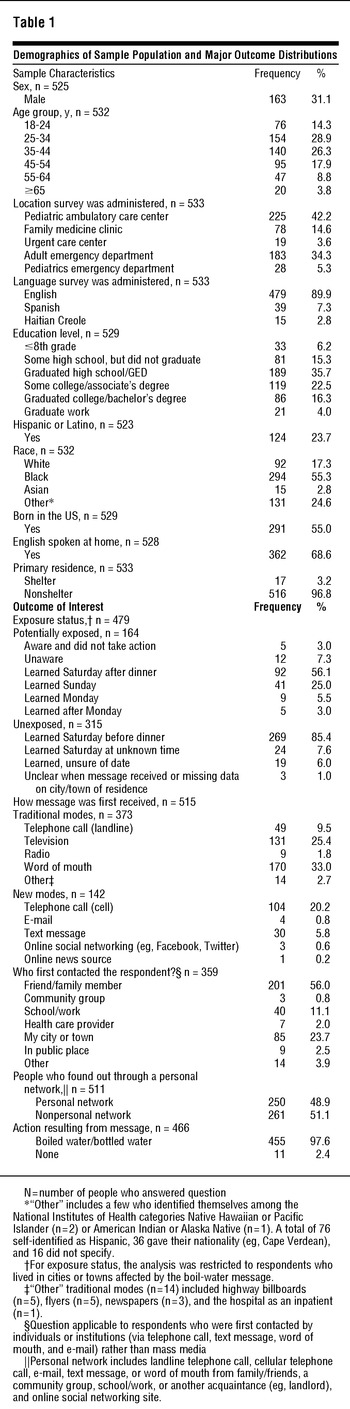
For the outcome of potential exposure to contaminated water, the analysis was restricted to respondents who lived in affected cities or towns. We classified respondents as “exposed” or “unexposed” based on 3 criteria: awareness of the order, timing of receipt of the message, and action taken upon receipt of the message (Table 1). The boil-water order was issued at approximately 4 PM on Saturday, May 1, which made it possible for people to receive the message before dinner and take precautions for cooking, eating, and drinking. Therefore, respondents who stated that they received the message “Saturday before dinner” and acted on it were classified as unexposed. To generate a conservative estimate of exposure, we also categorized those who responded “Saturday (time unknown)” and “unsure” as unexposed (Table 1 contains details of the exposed and unexposed classifications). Exposed respondents included those who were either unaware of the order, received the message “Saturday after dinner,” “Sunday,” “Monday,” or “after Monday,” or took no action after learning about the order.
Demographics of Sample Population and Major Outcome Distributions

Mode of First Message Delivery
We categorized the mode of first message delivery based on whether new technology was used. New modes included cellular telephone calls, e-mail, text message, and online social networking or news sites. We included cellular telephone calls as a new mode because although cellular telephones have been available to the public since the late 1970s, it has taken nearly 40 years for them to become commercially accessible for people in all demographic groups in the United States.Reference Agar2829 Moreover, cellular telephone use increased 10-fold (from 7% to 70%) between 1998 and 2008, whereas use of landline telephones remained constant, at around 20% during the same period.30 All of the other responses (eg, television, radio) were categorized as “traditional” modes of communication.
Receipt of First Message Through a “Personal Network”
Respondents were classified as receiving the first message through a personal network if they heard via landline telephone call, cellular telephone call, e-mail, text message, or word of mouth from family/friends, a community group, school/work, or another acquaintance (eg, landlord) or via an online social networking site. We included online social networking sites as part of the personal network because sites such as Facebook and Twitter allow direct messages between family, friends, coworkers, and other contacts. Mass media (eg, online news sources, television, radio) and public announcements by the cities affected were not considered part of the personal network because these methods do not involve conveying direct personal messages to individuals. Respondents who selected “other” methods indicated that they received the message via highway billboards, newspapers, flyers, and hospital staff; therefore, they were not classified as receiving the message through a personal network.
Action Taken Based on the Message
We classified respondents as having taken action based on the message if they perceived that their city was affected and they used only boiled and/or bottled water while the order was in effect.
Data Analysis
Only subjects who completed the survey were included in the analysis. Descriptive statistics were calculated for all of the outcome and demographic variables. Some individuals who selected a National Institutes of Health category for race were reclassified to “other” because by themselves their numbers were too small to be analyzed. We conducted bivariate and multivariate logistic regressions for 3 key outcome variables: potential exposure to contaminated water, mode of first message delivery (new vs traditional), and whether the message was received through a personal network. Two other outcome variables, awareness of the water message and whether action was taken, showed too little variation in responses for logistic regressions to be meaningful.
Demographic variables were selected for inclusion in the multivariate regressions based on the available literature and our own hypotheses about factors related to the key outcomes. The literature suggests that demographic characteristics such as sex, race, language spoken, age, and literacy may play an important role in the receipt of public health messages.Reference Fallows12Reference Andrulis, Siddiqui and Gantner13Reference Eisenman, Zhou, Ong, Asch, Glik and Long17Reference Spence, Lachlan and Griffin31Reference DuBard and Gizlice32 When 2 demographic variables were known to be collinear (eg, survey language, length of time in the United States), only 1 was included in the multivariate model.
Based on the available literature and our own hypotheses, we believed that the predictor variables potentially associated with each outcome were not necessarily the same. Therefore, different predictor variables were included in each model. For example, we used an age cutoff of 65 years in the multivariate models for 2 outcomes: potential exposure to contaminated water and receipt of the first message via a personal network because elderly adults are known to be at risk for both delayed receipt of public health messagesReference Eisenman, Zhou, Ong, Asch, Glik and Long17 and social isolation.Reference Wenger, Davies, Shahtahmasebi and Scott33 For the outcome “mode of first message delivery,” we used an age cutoff of 35 years in the multivariate model because differences in the use of technology have been documented among those older than age 35 as compared with younger individuals.34 Data were analyzed using Stata 10 (StataCorp, College Station, TX).
RESULTS
Among those who met the eligibility criteria and agreed to participate (n = 553), 20 participants were called to their appointment before completing the survey. For the 533 respondents who finished the survey, <1% of the data was missing.
Characteristics of Respondents
A total of 89.9% of the surveys were conducted in English (Table 1). Most respondents were female (68.9%), which is consistent with mothers accompanying children to health care visits. Less than half (42.8%) had more than a high school education, and more than half were African American (55.3%). Slightly more than half of the sample was born in the United States (55.0%). Among foreign-born respondents, 10.5% had lived in the United States for ≤2 years, 22.3% for ≤5 years, 45.0% for ≤10 years, and 64.3% for ≤15 years (data not shown).
Awareness and Potential Exposure to Contaminated Water
The vast majority of respondents (97.5%) stated that they were aware of the boil-water order. Of those who were aware, 88.5% said their city was affected by the order, 9.2% said their city was unaffected, and 2.3% were unsure (data not shown). Using our definition of exposure (see Methods), 34.2% of respondents who lived in affected cities or towns were likely exposed to contaminated water. Even if we calculated exposure as those who received the message on or after Sunday, 72 respondents who lived in affected cities or towns (15%) would be considered exposed Table 1).
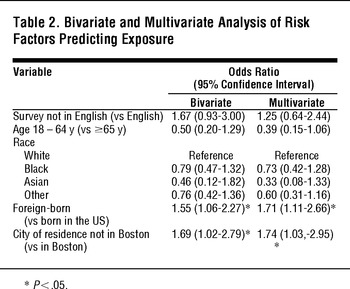
In the bivariate analyses, respondents who were foreign-born or resided outside Boston were more likely to be exposed. A multivariate model, which included the predictor variables survey language, age (18–64 years vs ≥65 years), race, foreign-born status, and city of residence, showed that foreign-born respondents were more likely than US-born respondents to be exposed (odds ratio [OR] 1.71, 95% confidence interval [CI] 1.11–2.66). Similarly, respondents who lived outside Boston were more likely to be exposed than residents of Boston (OR 1.69, 95% CI 1.02–2.79; Table 2).
Bivariate and Multivariate Analysis of Risk Factors Predicting Exposure

Mode of Delivery of First Message
The 3 most common modes for learning about the message were word of mouth (33.0%), television (25.4%), and telephone calls (29.7%: 9.5% landline, 20.2% cell [Table 1]). A total of 27.6% of respondents received the initial message via a new mode. Of those who received the message via a new mode, 73.2% heard via cellular telephone and 21.2% received it via text message. Only 8 respondents (5.6%) heard through e-mail, online social networking sites, or an online news source.
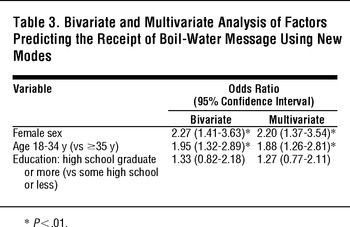
In the bivariate analyses, females and those aged 18 to 34 years (vs ≥35) were more likely to have received the boil-water message via a new mode. In a multivariate model that controlled for education, the use of new modes remained significantly associated with those who were girls or women (OR 2.20; 95% CI 1.37–3.54) and younger (18 to 34 years vs 35 years or older; OR 1.88; 95% CI 1.26–2.81). Models using other demographic variables showed no significant association (Table 3).
Bivariate and Multivariate Analysis of Factors Predicting the Receipt of Boil-Water Message Using New Modes

Receipt of First Message Through a Personal Network
Nearly half (49%) of the respondents received the message through their personal network (vs mass media or city) (Table 1). Of those, 80.4% learned about the boil-water order from family or friends, 16% heard at school or work, 1.2% heard from community groups, 1.2% heard from another acquaintance (eg, landlord), and 1.2% heard via an online social networking site (data not shown).
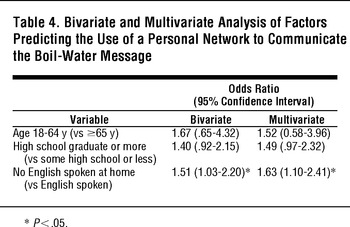
In bivariate analyses, people who did not speak English at home were significantly more likely to receive the message via a personal network. This association remained significant (OR 1.63; 95% CI 1.10–2.41) in the multivariate analysis, after controlling for age and education (Table 4).
Bivariate and Multivariate Analysis of Factors Predicting the Use of a Personal Network to Communicate the Boil-Water Message

Action Taken Based on the Message
Of those who were aware of the boil-water order and perceived that their city was affected, 47.0% reported using a combination of boiled tap water and bottled water, 41.0% used bottled water exclusively, and 9.6% used boiled tap water exclusively. Only 2.4% reported consuming unboiled tap water between May 1 and May 4 (data not shown).
COMMENT
This study provides a snapshot of how a public health message was communicated during the Massachusetts water main break. Many of our respondents received the message in a timely manner and were able to take recommended preventive measures; however, approximately one-third of respondents in affected cities were potentially exposed to contaminated water because they were unaware of the message, received the message late, or did not take action. Timely communication of public health messages can save lives.Reference Reynolds and W Seeger35 For example, during the 2001 anthrax attacks, antibiotic treatment could have averted some deaths.36 Our results suggest that efforts to make the delivery of public health messages more efficient are needed and offer important insights into how best to accomplish this in an urban population.
More than one-fourth of our respondents received the message through new modes of communication. This was more common among female respondents and those aged 18 to 34 years (vs 35 years or older). Our findings are consistent with previous studies showing that younger female respondents are more likely to be on the Internet and send/receive more e-mail than males respondentsReference Fallows12 and suggest that this association also may hold true for the receipt of public health messages. Although e-mail and online resources are becoming more popular, only 5.6% of our respondents received the message via these modes. This may be because of the well-documented “digital divide” in access to technology among minorities and people of low socioeconomic status.Reference Fairlie22 In the study population, cellular telephones were the most prevalent new mode for receiving the boil-water message. Public health departments may want to consider allowing residents to register for emergency updates via cellular telephone or other new modes, as is mandated on many college campuses.
Our results also suggest a need to develop tailored strategies to reach immigrant and minority populations in a timely manner. Foreign-born respondents were more likely to be exposed than US-born individuals. It is known that the duration of stay for immigrants in the US predicts health care utilizationReference Leclere, Jensen and Biddlecom37; it is possible that it also may influence the receipt of public health messages, perhaps because of issues of language or acculturation. We found that individuals who reported not speaking English at home were somewhat more likely to receive the boil-water message through their personal networks (vs the mass media). Personal networks are known to be minorities' preferred avenues of informal communication,Reference Perry and Nelson38 perhaps because of a lack of trust of the network media.Reference Meredith, Eisenman, Rhodes, Ryan and Long39 Research indicates that minorities are more likely than whites to contact relatives and community or religious organizations for public health information.Reference Taylor, Chatters, Tucker and Lewis40Reference Blanchard-Boehm41Reference Peacock, Morrow and Gladwin42 Therefore, to ensure that minorities and immigrants receive public health information quickly, it may be useful to tailor these messages to known personal networks such as religious groups and community organizations for widespread dissemination.Reference Gudrais43
Our study has certain limitations. First, because we sampled patients and families from 1 major urban hospital, the results may have limited generalizability; however, our findings show gaps in public health communication and suggest that more research on how to reach diverse, urban populations is warranted. Second, we used a convenience sample of subjects. This allowed us to conduct the survey within 1 week of the water main break, which helped minimize recall bias. Population-based sampling would have delayed fielding and likely would have required telephone recruitment, which would have biased our assessment of the mode of message delivery. Third, recruiting participants in person at BMC could have led to an overestimate of exposure if our participants were at the hospital for water-related illnesses; however, the Massachusetts Department of Public Health saw no significant increase in disease reports over those expected in the affected areas in the subsequent 2 months (A. DeMaria Jr, MD, personal communication, July 2010). Fourth, the survey asked respondents only about the first message they received. Depending upon the level of threat, the timing of the first message may be critical for people to take necessary preventive measures.Reference Elder, Xirasagar, Miller, Bowen, Glover and Piper44
Despite these limitations, our study captures an urban population's receipt of and response to a public health message related to an actual event. The lessons regarding new and traditional modes of communication and the importance of tailoring messages to at-risk groups can inform future efforts to relay information to this population during a public health crisis. Even as social networking tools (eg, Twitter, Facebook) are becoming increasingly important for rapid dissemination of information, traditional modes remain a vital way of communicating with underserved people in urban areas, probably because of the well-documented digital divide.Reference Fairlie45 Public health officials should be cognizant of the evolving digital environment and disparities in access to technologyReference Fairlie22 when developing customized approaches to reaching their target populations. They should use a combination of new and traditional modes of sharing information to most effectively reach diverse populations based on the most up-to-date understanding of communication during public health emergencies.
Author Disclosures: The authors report no conflicts of interest.
Acknowledgments: The authors thank Mary Banks, RN, BS, BSN, Rita Cosgrove, and Rosana Schomer of the Boston University Medical Campus institutional review board for their rapid review of our protocol, as well as Stephanie Apollon, ElShadey Bekele, Anthony Bonzagni, and Katherin Ortiz for their assistance with survey fielding. We also are indebted to Robert Vinci, MD, Patricia Dowd, RN, Barbara Healey, RN, Janine Hogan, NP, Robert Sege, MD, and Charles Williams, MD, for their support of this project.