Intensity-modulated radiotherapy (IMRT), a recent innovation in the field of radiation therapy, has been accepted in developed countries since 1990s, and is also being rapidly adopted in South East Asia region (SEAR) since the last one decade (Reference Guadagnolo, Liu, Cormier and Du1). IMRT has a technological edge over the conventional radiotherapy techniques in terms of not only specifically targeting the tissue mass in relatively higher doses but also producing a more conformal radiation dose distribution, resulting in minimum damage to normal tissue adjacent to the targeted area (Reference Van Dyk2–Reference Webb4).
Radiation therapy is one of the mainstays for treating cancers of the head and neck region (HNC), which are the 7th most common neoplasms worldwide. More than 1/3rd of its total burden is borne by the SEAR region (Reference Ferlay, Soerjomataram, Dikshit, Eser, Mathers and Rebelo5), with India alone accounting for 70 percent of the incident cases and deaths in this region (Reference Ferlay, Soerjomataram, Dikshit, Eser, Mathers and Rebelo5). Close vicinity to critical structures like brainstem, optic apparatus, parotid glands, and so on makes the delivery of radiotherapy challenging and difficult among the HNC patients. Various systematic reviews have concluded that IMRT, by sparing the normal surrounding tissues (parotid glands, pharyngeal constrictor muscles), is associated with the reduced incidence of late side effects like xerostomia, dysphagia, and sticky saliva (Reference Tribius and Bergelt6–Reference Marta, Silva, de Andrade Carvalho, de Arruda, Hanna and Gadia8). In turn, this improves the quality of life (QoL) of cancer survivors. However, there is no strong evidence to suggest a significant difference in control outcomes and survival with the use of IMRT as compared to other two techniques (Reference Marta, Silva, de Andrade Carvalho, de Arruda, Hanna and Gadia8).
Though IMRT may hold the promise of providing better health outcomes, but it also incurs additional cost. In the USA, treating an HNC patient with IMRT leads to an increase in overall costs by $5,881 as compared to conventional radiotherapy (Reference Sheets, Wheeler, Kohler, Fried, Brown and Chera9). In India, the cost of treating HNC patient using IMRT ($2,683) is around 4.5 times and 2.3 times higher compared to 2-dimensional radiotherapy (2-DRT) ($578) and 3-dimensional conformal radiotherapy (3D-CRT) ($1102), respectively (Reference Chauhan, Prinja, Ghoshal, Verma and Oinam10).
Given the limited public investment in the health sector and the rising healthcare expenditure, it becomes necessary to assess that whether the potential health gains with the new technology are worth the increase in incremental costs. There has been no economic evaluation from India or even from South East Asia Region to assess the cost-effectiveness of any radiation modality for any cancer site. Given this background, the present study was designed to assess the cost-effectiveness of IMRT as compared to both 2-DRT and 3D-CRT for the treatment of HNC in India. In addition, the present study also estimated the cost-effectiveness of 3-DCRT as compared to 2-DRT.
Methods
Model overview
A Markov model was parameterized on an MS Excel spreadsheet to estimate the lifetime costs and consequences in a hypothetical cohort of 1000 HNC patients treated with 2-DRT, 3-DCRT, and IMRT. The health outcomes were valued in terms of quality-adjusted life years (QALYs). The present analysis was based on disaggregated societal perspective that included both health systems cost and direct out of pocket expenditure, excluding the indirect costs (11). A discount rate of 3 percent was used to adjust for future cost and consequences (11–Reference Tan-Torres Edejer, Baltussen and Adam13). The cost-effectiveness of a radiation technique was assessed using incremental cost-effectiveness ratio (ICER), which was calculated as the ratio of additional cost to incremental health benefits (QALYs) of a newer technology, that is, IMRT as compared to the older techniques of 2-DRT and 3D-CRT.
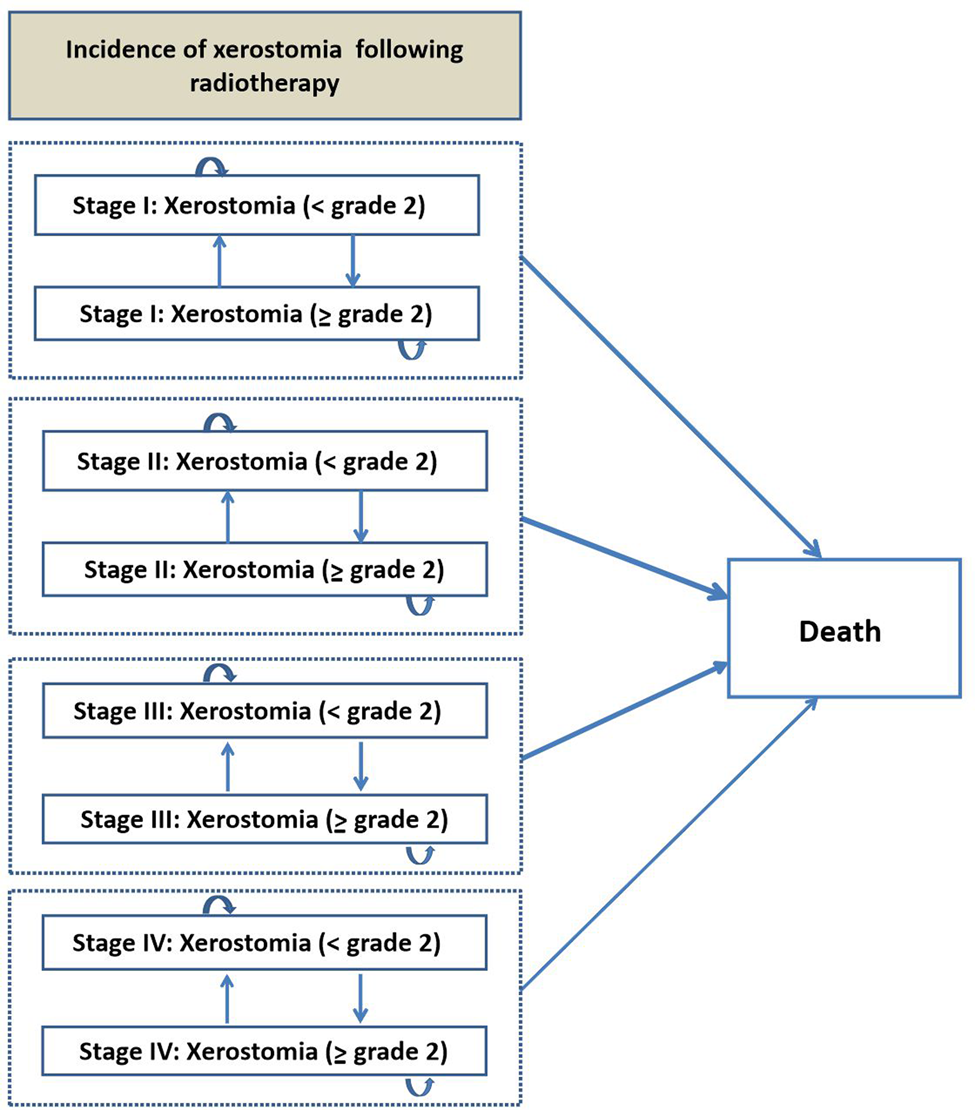
The model structure is shown in Figure 1. The model starts with patients in different stages of cancer, as per the existing pattern of stage-wise presentation of HNC patients in India. Following radical radiotherapy treatment (with 2-DRT, 3-DCRT, and IMRT), the patients in different stages of cancer were assumed to have xerostomia (xerostomia < grade 2 or xerostomia ≥ grade 2) based on its incidence following each of the radiotherapy technique. While in the xerostomia health stage, there was a possibility of intra-state movement between the severity states (xerostomia < grade 2 to xerostomia ≥ grade 2 or vice versa) (14;15). Likewise, there was a likelihood that the patient may remain in the same severity state after each model cycle. Lastly, patients were assumed to die based on the stage-specific mortality rates following radiotherapy treatment.
Model overview.

Xerostomia was included in the present model as it is one of well-documented long-term toxicity associated with the radiation therapy of HNC (6;7). It is considered reversible till one year following radiotherapy, and thus, patients can move between xerostomia severity states within the first year (16;17). However, few randomized controlled trials (RCTs) had measured the severity of xerostomia till 5 years following treatment (15;18). Considering the significant changes in xerostomia states in the first year after treatment, the cycle length was taken as 3 months during the first one year. Thereafter, an annual cycle length was considered appropriate and intra-xerostomia severity state movement was allowed till 5 years, after which the severity of xerostomia was assumed to be stable. With no strong evidence suggesting any significant difference in survival rates and progression (loco-regional progression or distant metastasis) between the radiotherapy techniques, we assumed similarly mortality rates for patients treated on each of the techniques and also did not consider disease progression in the model structure (8;14;15;19;20).
Clinical parameters
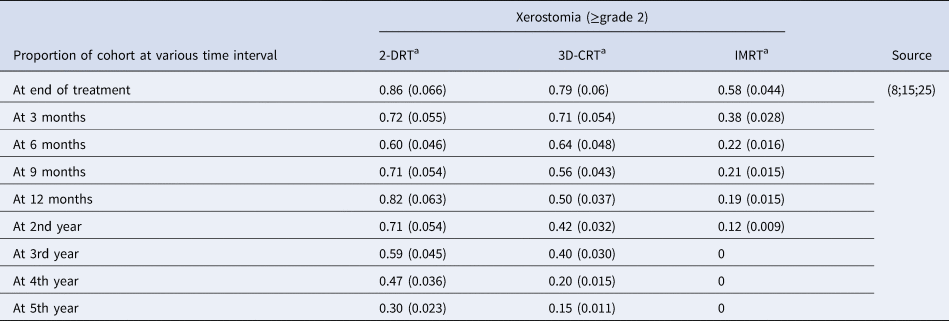
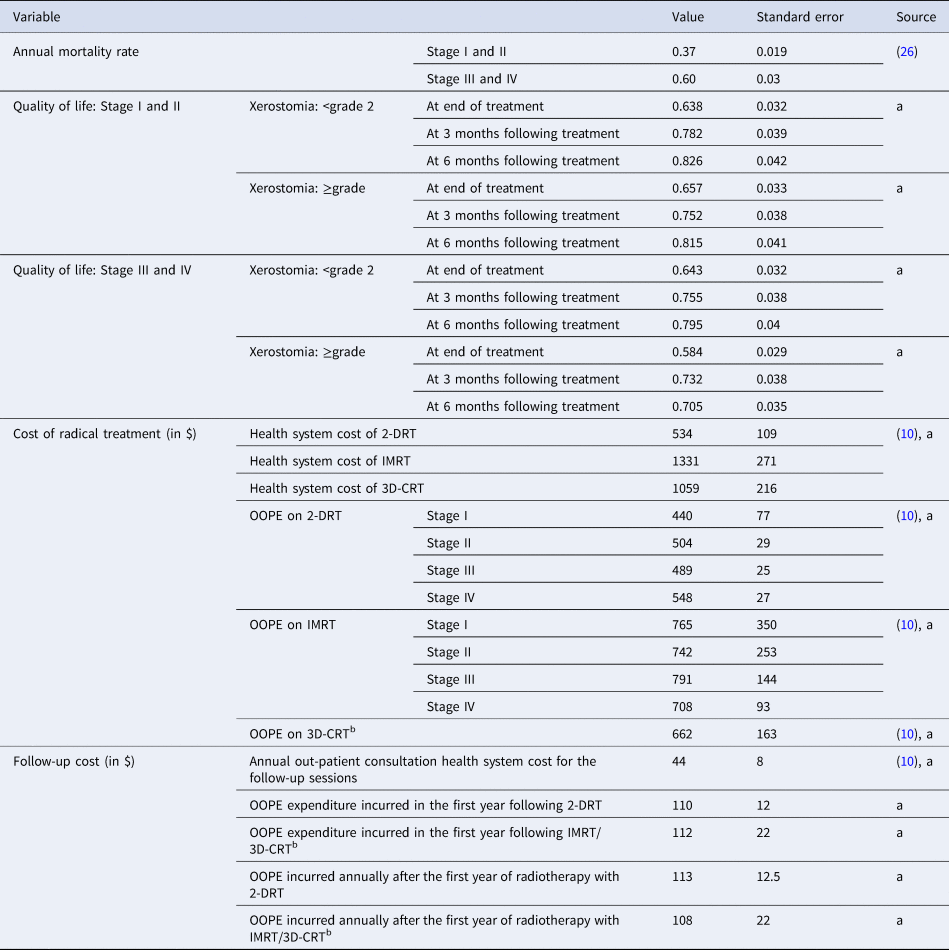
Data on presenting stage of disease was assessed from the published studies on hospital-based cancer registries across India (Reference Krishnatreya, Rahman, Kataki, Sharma, Nandy and Baishya21–Reference Singh, Prasad, Singh and Kumar24). Around 85 percent of the patients were assumed to be getting diagnosed in stage III/IV and the remaining 15 percent in stage I/II. The incidence of xerostomia following IMRT and 3D-CRT was assessed from the findings of existing two RCTs undertaken in Indian settings (15;25). From these RCTs, weighted average of the incidence of xerostomia at the end of radiotherapy treatment and at numerous end points, that is, at 3rd, 6th, 9th, 12th month post-treatment followed by annually till 5 years were deduced (Table 1). Further, there is a lack of robust evidence on the incidence of xerostomia following 2-DRT from Indian settings. Due to this, xerostomia rates post 2-DRT were specifically extracted from the findings of the previously undertaken meta-analysis that assessed the comparative effectiveness (with regards to the incidence of xerostomia) of IMRT with 2-DRT (Reference Marta, Silva, de Andrade Carvalho, de Arruda, Hanna and Gadia8). Further, annual mortality rate following radiation therapy of HNC was assessed from the results of a multi-institutional cancer study from India (Table 2) (Reference Nandakumar, Rath, Kataki, Bapsy, Gupta and Gangadharan26).
Proportion of HNC Patients with Xerostomia (≥grade 2) at Different Time Periods Following Treatment with 2-DRT, 3D-CRT, and IMRT

HNC, head and neck cancer; IMRT, intensity-modulated radiotherapy; 2-DRT, 2-dimensional radiotherapy; 3D-CRT, 3-dimensional conformal radiotherapy.
aValues in parenthesis indicate standard error.
Model Parameter Values

$, United States Dollar; IMRT, intensity-modulated radiotherapy; 2-DRT, 2-dimensional radiotherapy; 3D-CRT, 3-dimensional conformal radiotherapy; OOPE, out of pocket expenditure.
a: Based on the analysis of primary data collected by the authors.
b Due to restrictive sample size for patients treated on 3D-CRT, stage-wise OOPE as well as follow-up cost for 3D-CRT could not be estimated. Thus, an average OOPE on 3D-CRT (considering all stages) was reported and a similar follow-up cost as incurred on IMRT was assumed for 3D-CRT.
Health state utility values
Primary data was collected on QoL along with the severity of xerostomia from HNC patients recruited from the Radiotherapy Department of a tertiary care hospital in North India. Patients with histologically proven HNC, with a UICC stage of I-IVa, between the age of 18 and 70 years were included. The QoL and severity of xerostomia were assessed using standard EQ-5D-5L tool and Radiation Therapy Oncology Group (RTOG) scoring system, respectively (27;28). A total of 88 HNC patients were recruited at baseline (before radiotherapy) and were interviewed at the end of radiation therapy, followed by at 3rd and 6th months postradiotherapy. Based on the consultation with the clinicians/oncologists, it was assumed that health-related QoL postradiotherapy gets stabilized after 6 months post-treatment. Further, since QoL is directly dependent upon the current status of the patient based on the extent and severity of toxicities as well as on the presence or absence of recurrence, an average QoL score of the whole sample irrespective of the radiation technique was estimated for those with xerostomia < grade 2 and ≥ grade 2. QoL scores are shown in Table 2 separately for patients in stage I/II and stage III/IV. The QoL utility scores were calculated using EQ-5D-5L tariff values from Thailand (Reference Tongsiri and Cairns29). In view of the absence of EQ-5D-5L tariff values from India, the draft guidelines by health technology assessment board of India (HTAIn) recommends the use of Thailand-specific tariff values until the Indian value-set is generated (11). Moreover, recent economic evaluations that were commissioned by HTAIn have also used tariff values of Thailand for generating QoL utility scores (Reference Bahuguna, Prinja, Lahariya, Dhiman, Kumar and Sharma30–Reference Chugh, Dhiman, Premkumar, Prinja, Singh Grover and Bahuguna32).
Cost of IMRT and 2-DRT
As most of the cancer treatment in India is available at tertiary care hospitals, the entire cost of radical treatment (inclusive of diagnostics) was primarily assessed in the form of health system cost and OOP expenditure based on data collected from the radiotherapy department of a large tertiary care public sector hospital in India (Table 2), the methodology and findings of which have been published elsewhere (Reference Chauhan, Prinja, Ghoshal, Verma and Oinam10). Briefly, health system cost was estimated following standard bottom up (micro-costing) economic methods (Reference Chapko, Liu, Perkins, Li, Fortney and Maciejewski33), wherein data on the quantity and price of capital (space, medical, and nonmedical equipment) and recurrent resources (salaries, drugs, consumables, stationary) spent on the delivery of cancer care (w.r.t to the radiotherapy treatment) for the financial year 2014–15 were collected and analyzed. As the health system cost estimates in the costing study (Reference Chauhan, Prinja, Ghoshal, Verma and Oinam10) were based on 5 percent discount rate, these estimates were revised and updated considering 3 percent discount rate, similar to the discount rate used in the present study. Further, a total of 474 HNC patients were interviewed for assessing OOP expenditure incurred on the radiotherapy treatment, separately each of the three modalities. Payment receipts and bills available with the patients were checked to validate the expenditure reported by them. Indirect expenditure due to wage loss was not included in our analysis.
We had assumed that patients (postradical treatment) would receive regular check-up in the form of follow-up sessions every 3 months till lifetime. So, in addition to radical treatment cost, cost of follow-up visits was also incorporated in the model till the lifetime of the patient. This follow-up cost included cost of check-up session with the doctor (in the form of per outpatient consultation cost) as well as any out of pocket expenditure incurred during that time period. This long-term OOP expenditure was estimated by prospectively following up 159 patients (postradical treatment) on a quarterly basis till one year. Expenditure incurred in the last quarter of the year was used to derive the annual OOP expenditure from second year onwards. As the data collection for both health system cost and OOP expenditure pertains to the year 2014–15, all the costs reported in the present study are standardized for the same year. Conversion rate of 1$ (United States Dollar) = ₹61.02 as reported by the World Bank was used.
Sensitivity analysis
We undertook multivariate probabilistic sensitivity analysis (PSA) to account for joint parameter sensitivity (Reference Doubilet, Begg, Weinstein, Braun and McNeil34). While undertaking PSA, γ distribution was used for cost parameters. With regards to xerostomia rates, death probability, and QoL values, β distribution was used. Health system cost estimates were varied by 40 percent of the base value on both the upper and lower bounds. Standard error, as reported from primary data collection, was used for OOP expenditure. Xerostomia rate was varied by 15 percent of the base case value. Further, death probability and QoL values were varied by 10 percent of either side of the base case value. The median value of incremental cost-effectiveness ratio (ICER) along with 2.5th and 97.5th percentile was computed using 999 Monte Carlo simulations.
Univariate sensitivity analysis was also undertaken to assess the effect on ICER value by considering variations in the value of a single input parameter while keeping the other parameters constant. In addition, the effect on ICER of discounting health outcomes at 6 percent and cost at 0 percent was also assessed.
Ethical approval
Ethical approval was obtained from the Institute Ethics Committee of the Post Graduate Institute of Medical Education and Research, Chandigarh, India with reference number: NK/2490/Ph.D/6374. All the respondents during primary data collection were interviewed after obtaining written informed consent.
Results
Absolute outcomes
As per model output, the absolute number of QALYs lived by a patient treated with 2-DRT, 3D-CRT, and IMRT were 4.32 (3.80–4.84), 4.39 (3.91–4.97), and 4.46 (3.93–5.01), respectively. Similarly, total lifetime cost incurred was $1,795 (1,563–2,060), $2,449 (1,991–2,976) and $2,786 (2,288–3,462) for a HNC patient treated on 2-DRT, 3D-CRT, and IMRT, respectively. To reflect on the number of life years lived following radiotherapy treatment, stage-specific (stage I and II vs. stage III and IV) survival curve based on the output of the model is shown in the Supplementary Figure 1. Model output showed 5-year overall survival rate of around 50 percent and median survival time of 4.5 years following radiotherapy.
Incremental outcomes and cost-effectiveness
Over the life time of an HNC patient, IMRT results in a gain of 0.138 (0.103–0.176) and 0.067 (0.045–0.090) more QALYs at an additional cost of $992 (401–1,689) and $348 (25–665) compared to 2-DRT and 3D-CRT, respectively (Table 3). This result in an incremental cost-effectiveness ratio (ICER per QALY gained) of $7,072 (2,932–13,258) and $5,164 (463–10,954) with the use of IMRT compared to 2-DRT and 3D-CRT, respectively. Further, 3D-CRT at an additional cost of $645 (127–1215) results in a gain of 0.071 (0.046–0.091) QALYs per patient leading to ICER (per QALY gained) of $8,946 (1996–19313) compared to 2-DRT. There was 0.9 and 8.4 percent probability of IMRT to be cost-effective at the GDP per capita as compared to 2-DRT and 3D-CRT, respectively (Supplementary Figure 2). Similarly, the probability of 3D-CRT to be cost-effective was 2.3 percent compared to 2-DRT.
Incremental Median Cost, Health Outcomes, and Cost-Effectiveness Ratio of Treating Head and Neck Cancer Patient with Various Radiation Modalities

IMRT, intensity modulated radiotherapy; 2-DRT, 2-dimensional radiotherapy; 3D-CRT, 3-dimensional conformal radiotherapy; QALYs, quality-adjusted life years; $, United States Dollar.
Sensitivity analysis
Univariate analysis showed that ICER was much sensitive to the variation in the health system cost of IMRT ($5,259–$9,087) and the incidence of xerostomia ($5,984–$8,944) following 2-DRT, when IMRT was compared with 2-DRT (Supplementary Figure 3). Likewise, when 3D-CRT was compared with 2-DRT, the incidence of xerostomia following 2-DRT ($6,595–$ 14,906) and health system cost of 3D-CRT ($6,179–$12,123) had the greatest effect on the ICER value (Supplementary Figure 4). However, variation in both the health system cost of both IMRT ($1,170–$9,068) as well as 3D-CRT ($1,977–$8,262) had the greatest effect on ICER, when IMRT was compared with 3D-CRT (Supplementary Figure 5). Furthermore, when discounting health outcomes at 6 percent and cost at 0 percent, ICER value (per QALY gained) for IMRT increased to $7,877 and $5,474 as compared to 2-DRT and 3D-CRT, respectively. Similarly, ICER for 3D-CRT increased to $10,335 as compared to 2-DRT.
Discussion
The field of cancer treatment is flooded with various newer technologies ranging from an advanced form of surgeries to newer drugs and novel forms of radiotherapy techniques (Reference Baskar, Lee, Yeo and Yeoh35–Reference D'Cruz, Chaukar and Gupta37). It becomes necessary to argue that whether the potential health gains with a new technology are worth the additional cost associated with it. Thus, the present study was undertaken to assess the cost-effectiveness of a new radiation modality, that is, IMRT as compared to 2-DRT and 3D-CRT for the treatment of HNC in India. In addition, 3D-CRT was also compared with 2-DRT.
Guidelines of Health Technology Assessment, India states that an intervention is considered to be cost-effective if its ICER value falls below GDP per capita of the nation (11). Based on the GDP per capita of $1805 (₹117,325) during the year 2014–15 of India, the present study estimated that IMRT at an ICER of $7,072 and $5,164 per QALY gained is not a cost-effective option for treating HNC compared to both 2-DRT and 3D-CRT, respectively. Similarly, at an ICER of $8,946, 3D-CRT was also not a cost-effective option compared to 2DRT. Further, very low probability of IMRT (0.9–8.4 percent) and 3-DCRT (2.3 percent) to be cost-effective at GDP per capita substantiate and validate the finding that both IMRT and 3-DCRT are not financially feasible within the Indian context. In order to validate the model output, we compared the 5-year survival rate, as estimated in the present study, with the available evidence from India. Data from various hospital registries across India had shown a 5-year survival rate of between 38 and 48 percent for HNC patients diagnosed in locally advanced stages. Our study, on similar lines, also estimated a 5-year survival rate of around 45 percent for patients diagnosed in stage III/IV (Supplementary Figure 1) (26;38;39).
Guidelines of the National Cancer Control Programme of India recommend 2-DRT through Cobalt-60 machines (Co-60) as standard radiotherapy (40). The Standard treatment guidelines of the National Cancer Grid of India guidelines do not specifically recommend IMRT for HNC except for specific sub-site, that is, nasopharynx (41). Likewise, clinical guidelines, by Tata Memorial Cancer Centre, Mumbai, India, precisely prefer IMRT for definite sub-sites like nasopharynx, nasal cavity, and paranasal sinuses instead for all HNC (Reference D'Cruz, Chaukar and Gupta37). The results of the present study provide further economic evidence to support the current clinical and programmatic guidelines from India and show IMRT as not a cost-effective option for all sub-sites of the head and neck region.
As per the latest estimates, India has a total of 347 tele-radiotherapy machines and 235 linear accelerators (42). International Atomic Energy Agency (IAEA), in its Directory of Radiotherapy Centres (DIRAC) report, has categorized India among the poorest Sub-Saharan African countries, having <1 radiotherapy machine per million people (43). Further, Task Force for the Eleventh 5-year plan has reported a shortage of radiation oncologist in India (44). Latest technology (in the form of IMRT or even 3D-CRT) not only requires a high installation, operational, and maintenance cost, but also trained staff and more human resource time for treatment planning, dosimetry, delivery, and quality assurance (45;46). In resource-constrained settings like India, it may not be feasible to adopt and implement these new technologies. Moreover, it does not provide value for money. Although, the newer technology has a technological superiority over other radiation modalities, it can be reserved for specific sites, where it is a necessity rather than a choice. In such sites like that of the nasopharynx or paranasal sinuses, IMRT becomes beneficial because it is difficult to deliver appropriate radiation dose distribution to the tumor volume by conventional radiotherapy techniques without irradiating the critical adjacent tissues.
In terms of availability of radiotherapy machines in India, most of the district-level hospitals and medical colleges are installed with Co-60 radiotherapy machines and only specific tertiary care public hospitals and regional cancer centers are installed with linear accelerators (42). Whereas, private super-specialty hospitals have the provision of every radiotherapy modality and can give the choice of treatment depending upon the desired choice of the patients. From the point of view of the publicly financed health insurance schemes in India, which currently provide reimbursement for all forms of radiotherapy modalities including 2-DRT, 3D-CRT, and IMRT, the results of the present study could help in priority settings.
Strengths and limitations
Use of local data for assessing both the cost of cancer care and QoL is one of the major strength of our study. While estimating the cost of care, both the health system cost as well as OOP expenditure was included in the analysis. We recognize that undertaking a single institute study can have implications on the generalizability of the unit health system costs. However, as the pattern and quantity of resource allocation remain almost similar across tertiary care hospitals, unit cost could vary based on differences in the price of resources across regions or on the level of service utilization. The study hospital is one of the largest public sector institute catering to more than six Indian states/union territories, with the presence of more than 100 staff member (both medical and technical), involved in the delivery of cancer treatment to 5000 cancer patients annually. Thus, the present institute is not an under or over-resourced center and operates at around 100 percent capacity utilization, so unit costs are likely to represent the actual cost considering the level of resource use and service utilization. In order to further assess this uncertainty, unit costs were varied 40 percent on either side of the base value in the PSA.
The study sample included a heterogeneous mix of patients which was used to assess the OOP expenditure and QoL. Firstly, the study hospital patients belonged to eight different states of India, highlighting the regional diversity of the patient population. Secondly, we found that the caste and religion distribution of the patients were almost similar to the Census data (2011) (47). Thirdly, income-wise stratification of the sample was comparable with the nationally representative survey undertaken by the National Sample Survey Organization (NSSO) during the year 2014–15 (48). Thus, the estimates used in the present study are likely to be generalizable, considering heterogeneity on above mentioned parameters.
Most of the patients purchase over the counter drugs (such as pilocarpine) or other prescription-based medications to manage with post-treatment toxicities in the form of xerostomia. We had accounted for these longer post-treatment costs of managing toxicities by considering it as a part of follow-up costs. A limitation of the present study was that it did not account for indirect costs. Inclusion of productivity losses in economic evaluations is widely debated as there is no consensus among the methods (human capital vs. friction cost approach) to be used for estimating this cost (Reference Krol, Brouwer and Rutten49). This issue holds even significant importance in Indian context, where a large proportion of women are not working; however contribute significantly to household activities. Further, disaggregated data on wage and employment is not robust in India to evaluate the productivity costs comprehensively. In view of this, recently drafted health economics guidelines by the Department of Health Research of India also recommends excluding productivity losses, and considering disaggregated societal perspective that includes health system cost and direct OOP expenditure (11).
We considered xerostomia-only as a surrogate marker for QoL and did not account for the effect of other toxicities (such as dysphagia) that could have an impact on the assessment of QoL. Due to lack of incidence data on various combinations of toxicities, especially from South East Asia and developing country regions, xerostomia alone was considered in the model structure representative of all major toxicities. Further, as the evidence on the effectiveness using 2-DRT does not differentiate between 2D-cobalt and 2D-LINAC, it was not possible for assessing the comparative cost-effectiveness of 2D-cobalt and 2D-LINAC in the present analysis. As a consequence, the cost of treating with 2-DRT was also estimated in the form of average weighted cost based on the proportion of HNC patients treated on 2D-cobalt and 2D-LINAC. Lastly, our analysis considered HNC as a whole, and did not account for specific subsites, due to lack of data on the incidence of toxicities and survival rates for each of these sub-sites. We recommend undertaking future economic evaluations for those sites for which IMRT is specifically recommended.
Conclusion
Both IMRT and 3D-CRT are not cost-effective at 1 times GDP per capita for treating HNC in the Indian context. Further, the costs and benefits of using IMRT for other potential indications (e.g. prostate, lung) require to be assessed and economies of scale need to be considered before considering for its introduction in the public health system of India.
Supplementary Material
The supplementary material for this article can be found at https://doi.org/10.1017/S0266462320000677.
Financial support
This research received no specific funding from any agency, commercial or not-for-profit sectors.
Conflict of interest
None.