Racial discrimination is a very real part of Black culture in the United States. African Americans report experiencing more racial discrimination than do members of other racial or ethnic groups (Gee, Ryan, Laflamme, & Holt, Reference Gee, Ryan, Laflamme and Holt2006; Greene, Way, & Pahl, Reference Greene, Way and Pahl2006), and these experiences can have a profound impact on their health. Studies linking perceived racial discrimination (PRD) to poor health, especially among African Americans, continue to accumulate, adding support to the contention by many researchers that this particularly aversive form of life-long stress plays a major role in the health disparities that exist in the United States between Blacks and Whites. Earlier studies documented the basic relation, reporting significant correlations between self-reports of PRD and both mental and physical health status (Kessler, Mickelson, & Williams, Reference Kessler, Mickelson and Williams1999; see Berger & Sarnyai, Reference Berger and Sarnyai2015; Brondolo, Blair, & Kaur, Reference Brondolo, Blair, Kaur, Major, Dovidio and Link2018, for reviews). As the importance of the relation has become clearer, however, there has been a corresponding increase in interest among researchers in determining when and why PRD has these effects (in other words, developmental and mediational issues) and what can be done to counter them.
Very few studies have examined PRD developmentally, but some research has looked at mediation of its effects. These studies have suggested that PRD can have direct effects on health status (elevation of blood pressure or increases in cortisol and C-reactive protein, for example; Brown, Matthews, Bromberger, & Chang, Reference Brown, Matthews, Bromberger and Chang2006; Lewis, Aiello, Leurgans, Kelly, & Barnes, Reference Lewis, Aiello, Leurgans, Kelly and Barnes2010). However, the primary pathway from discrimination to poor health status appears to be indirect, through PRD's effects on unhealthy behaviors, including poor eating habits and increases in other unhealthy behaviors, such as substance use (see Gibbons & Stock, Reference Gibbons, Stock, Major, Dovidio and Link2018; Richman, Pascoe, & Lattanner, Reference Richman, Pascoe, Lattanner, Major, Dovido and Link2018, for reviews). These are behaviors that typically initiate in adolescence (or earlier), which means this developmental period is becoming more of a focus among researchers in this area.
Sensitive Periods and Stress
The current research is based in part on a perspective in developmental psychology referred to as “sensitive periods,” a time in the child's development when s/he is particularly sensitive to environmental stimuli (Knudsen, Reference Knudsen2004). A prime example involves stress: when it is experienced in childhood, it has a disproportionate impact on a number of health-relevant outcomes later in life, including several mental health disorders (e.g., depression and severe anxiety; Heim & Binder, Reference Heim and Binder2012; Zlotnick et al., Reference Zlotnick, Johnson, Kohn, Vicente, Rioseco and Saldivia2008). These disorders, in turn, are often linked with unhealthy behavior. Self-reports of “adverse childhood experiences” strongly predict risky behaviors like substance use, and that relation is mediated by negative affect (Edwards, Anda, Gu, Dube, & Felitti, Reference Edwards, Anda, Gu, Dube and Felitti2007).
A major adverse childhood experience for African Americans, and one with significant cultural involvement, is racial discrimination. African American children are aware of their racial status as early as age 7, and they have reported discriminatory experiences by the age of 9 (Dulin-Keita, Hannon, Fernandez, & Cockerham, Reference Dulin-Keita, Hannon, Fernandez and Cockerham2011). These early experiences appear to be especially consequential: PRD reported before age 13 has a stronger negative relation with “well-being” (mental health) in African American children than do similar experiences later in life (Lee & Ahn, Reference Lee and Ahn2013). Schmitt, Branscombe, Postmes, and Garcia (Reference Schmitt, Branscombe, Postmes and Garcia2014) have suggested this may reflect the fact that children lack the resources necessary to effectively cope with threats to their well-being and their identity, at a time when that identity is still developing. That is especially true among Black children, who, more so than White children, are dealing with issues of both self-identity and group-identity (Sellers, Copeland-Linder, Martin, & Lewis, Reference Sellers, Copeland-Linder, Martin and Lewis2006).
Others have made a similar argument regarding the mental, physical, and social impact of early (vs. later) PRD on African American adolescents (Mays, Cochrane, & Barnes, Reference Mays, Cochran and Barnes2007; McEwen, Reference McEwen2004; Sanders-Phillips, Settles-Reaves, Walker, & Brownlow, Reference Sanders-Phillips, Settles-Reaves, Walker and Brownlow2009). Brody et al. (Reference Brody, Yu, Chen, Kogan, Evans, Beach and Philibert2013), for example (see also Shonkoff et al., Reference Shonkoff, Garner, Siegel, Dobbins, Earls and McGuinn2012), emphasized the impact that early experience with stress, including PRD, can have on the developing child in terms of both biology (e.g., inflammation) and behavior. In the latter category (behavior), Gibbons et al. (Reference Gibbons, Fleischli, Simons, Gerrard, Weng and Gibson2018) found that PRD reported in childhood (M age 10.5) was a strong predictor of illegal behavior and both arrest and incarceration reported in early adulthood (M age 24.5), and it was a stronger predictor of adolescent deviant affiliation than was PRD reported in adolescence. More generally, early stress is associated with reductions in both executive functioning and emotion regulation (Pechtel & Pizzagalli, Reference Pechtel and Pizzagalli2011), both of which are linked with maladaptive behaviors.
PRD and health
Several reviews of the PRD/health literature have provided specific and consistent recommendations for future research in this area, the primary one being pay more attention to the impact of discriminatory experiences early in life (Sanders-Phillips et al., Reference Sanders-Phillips, Settles-Reaves, Walker and Brownlow2009). Like most adverse childhood experience research, however, the majority of early PRD studies have used retrospects of the discrimination (i.e., reports by adults about significant discriminatory events in their childhood). Although retrospective reports can be reliable, they are less effective than synchronous reports for measuring the impact that the early experience(s) had at the time (Reuben et al., Reference Reuben, Moffitt, Caspi, Belsky, Harrington, Schroeder and Danese2016). This is mostly due to the fact that retrospects are influenced by other factors, including events (especially recent ones) occurring since childhood (Hardt & Rutter, Reference Hardt and Rutter2004). Among other interpretational problems, this makes comparison of different types of adverse events, and especially assessments of mediation, more difficult.
PRD pathways
Sanders-Phillips et al. (Reference Sanders-Phillips, Settles-Reaves, Walker and Brownlow2009) also made specific suggestions as to which factors should be considered in these early PRD studies, including a focus on within-group variance (i.e., PRD effects among children of color), and also on the frequency, severity, and developmental timing of the PRD. Similarly, in a systematic review of the literature over a 22-year period (1990–2011), Priest et al. (Reference Priest, Paradies, Trenerry, Truong, Karlsen and Kelly2013) identified 121 studies that examined the relations between racism and both mental and physical health among racial/ethnic minority children and adolescents. The majority of these studies (78%) were cross-sectional, leading Priest et al. to their primary recommendation, which was another call for longitudinal studies. Like Sanders-Phillips et al., Priest et al. (Reference Priest, Paradies, Trenerry, Truong, Karlsen and Kelly2013) also suggested that these future longitudinal studies examine various hypothesized “pathways” from PRD to health at different developmental periods. In short, they were calling for studies that assess both mediators and moderators of the PRD → health relations. Finally, Gee, Walsemann, and Brondolo (Reference Gee, Walsemann and Brondolo2012) presented what they called a life course perspective on the PRD/health relation. They echoed previous calls for research on PRD throughout the lifetime, claiming in particular that exposure to PRD in adolescence may have lasting impact on health status later in life—a “sensitive period.”
Maladaptive responses
A similar research perspective was presented by Sroufe (Reference Sroufe1997) in discussing adolescents’ maladaptive responses to environmental stressors, in general. He maintains that understanding why some adolescents manifest these behaviors requires focusing on developmental pathways, “processes of initiation, continuity, and change in maladaptation” (p. 255). In other words, longitudinal research that begins before the maladaptation is “especially important” (cf. Causadias, Reference Causadias2013, discussion of cultural risk). He also argues that parenting and the reciprocal relation between child behavior and parents’ reactions to that behavior is critical.
Early stress, negative affect, and substance use
PRD and substance use
Research exploring the relations between PRD and poor health outcomes among Blacks has focused on both unhealthy behaviors (a type of maladaptive response) and negative affect. Many of these studies were part of the Family and Community Health Study (FACHS), which is an ongoing panel study of psychosocial factors related to the mental and physical health of members of African American families. Several studies with FACHS adolescents have demonstrated significant relations between early PRD and health risk behaviors, including risky sex (Murry, Berkel, Brody, Gerrard, & Gibbons, Reference Murry, Berkel, Brody, Gerrard and Gibbons2007; Roberts et al., Reference Roberts, Gibbons, Gerrard, Weng, Murry, Simons and Lorenz2012) and substance use (Gibbons, Gerrard, VandeLune, Willis, Brody, & Conger, Reference Gibbons, Gerrard, VandeLune, Wills, Brody and Conger2004). As expected, these latter relations are moderated by coping style; for example, the PRD/use relations are stronger for those who say they engage in avoidant coping (i.e., avoid thinking about or addressing problems they face; Gerrard, Gibbons, Fleischli, Cutrona, & Stock, Reference Gerrard, Gibbons, Fleischli, Cutrona and Stock2018) and they are mediated by negative affect associated with the PRD (Gibbons et al., Reference Gibbons, Etcheverry, Stock, Gerrard, Weng, Kiviniemi and O'hara2010, Reference Gibbons, O'Hara, Stock, Gerrard, Weng and Wills2012; cf. Cuevas et al., Reference Cuevas, Reitzel, Adams, Cao, Nguyen, Wetter and McNeill2014).
PRD and negative affect
Recent FACHS studies, including experimental studies in which PRD was manipulated, have suggested that PRD is associated with both internalizing (depressive symptoms and anxiety) and externalizing (anger and hostility) reactions; however, the impact of PRD on externalizing tends to be greater, and that type of affect appears to be a stronger mediator of the PRD effects on substance use than is internalizing (Gibbons et al., Reference Gibbons, O'Hara, Stock, Gerrard, Weng and Wills2012; Stock, Gibbons, Peterson, & Gerrard, Reference Stock, Gibbons, Peterson and Gerrard2013; Stock, Gibbons, Walsh, & Gerrard, Reference Stock, Gibbons, Walsh and Gerrard2011; Whitbeck, Hoyt, McMorris, Chen, & Stubben, Reference Whitbeck, Hoyt, McMorris, Chen and Stubben2001). In a study with adults in the FACHS sample, for example, Gibbons et al. (Reference Gibbons, Kingsbury, Weng, Gerrard, Cutrona, Wills and Stock2014) examined both internalizing and externalizing reactions to PRD and their relations to health status (e.g., physical functioning and poor overall health status) and substance use and abuse (e.g., alcohol problems). They found evidence of “differential mediation”: PRD was associated with an elevation in both depressive symptoms and anger/hostility, as well as both alcohol problems and health problems. However, the path from PRD to health problems was mediated only by internalizing reactions, whereas the relation between PRD and alcohol problems was mediated only by externalizing reactions. More generally, externalizing is associated with engagement in risky or maladaptive behavior (e.g., Aklin, Moolchan, Luckenbaugh, & Ernst, Reference Aklin, Moolchan, Luckenbaugh and Ernst2009), whereas internalizing is more often associated with risk avoidance (Rydell et al., Reference Rydell, Mackie, Maitner, Claypool, Ryan and Smith2008), as well as somatization and medical problems (Holahan et al., Reference Holahan, Pahl, Cronkite, Holahan, North and Moos2010).
Deviant affiliation
Another important mediator of the effects of early stress on health is affiliation with peers who are engaging in risky and/or unhealthy behaviors. This “social path” to risky behavior is very common in adolescence (Dodge, Dishion, & Lansford, Reference Dodge, Dishion and Lansford2006), including among African Americans (Unnever, Reference Unnever2016). Again, studies from FACHS have indicated that African American adolescents’ reports of personal experience with discrimination are prospectively related to their reports of deviant behavior among their friends (Simons & Burt, Reference Simons and Burt2011). As might be expected, adolescents who feel rejected in part because of their group membership may seek the company and solace of other group members who share a group identity (and culture) and so have had similar experiences (Richman & Leary, Reference Richman and Leary2009; Schmitt & Branscombe, Reference Schmitt and Branscombe2002). That affiliation pattern, in turn, can predict their own risky behavior.
Smoking
The current analyses examined the relations between PRD and smoking among African American adolescents. There were several reasons, besides the obvious health consequences, why this particular substance was chosen. Those include (a) early onset smoking is a very good predictor of adult smoking (Buchman et al. Reference Buchmann, Blomeyer, Jennen-Steinmetz, Schmidt, Esser, Banaschewski and Laucht2013; Kendler, Myers, Damaj, & Chen, Reference Kendler, Myers, Damaj and Chen2013), and also future use of other substances (i.e., it is a “gateway drug”; Kandel & Kandel, Reference Kandel and Kandel2014); (b) tobacco's connections with negative affect are well documented (Centers for Disease Control and Prevention, 2018); and (c) earlier FACHS studies have indicated that rates of smoking within the FACHS sample are very high.
Racial crossover
Another reason to focus on smoking (that is more central to this study) has to do with what has been called a “racial crossover” effect. During adolescence, prevalence of substance use is lower among Blacks than Whites (e.g., smoking; Centers for Disease Control and Prevention, 2015). Several explanations have been proposed for this, but a primary one involves social influence from both peers and family (Watt & Rogers, Reference Watt and Rogers2007). More specifically, substance use is less a part of African American culture, so there is more parental influence to not use (Kong, Camenga, & Krishnan-Sarin, Reference Kong, Camenga and Krishnan-Sarin2012) and less normative/peer pressure to use (Gibbons et al., Reference Gibbons, Pomery, Gerrard, Sargent, Weng, Wills and Tanski2010; Pugh & Bry, Reference Pugh and Bry2007). That use pattern reverses in adulthood, however, as smoking rates become higher for Blacks (Kandel, Schaffran, Hu, & Thomas, Reference Kandel, Schaffran, Hu and Thomas2011). This cross over reflects the fact that substance use generally declines during early adulthood (called “maturing out;” Finlay, White, Mun, Cronley, & Lee, Reference Finlay, White, Mun, Cronley and Lee2012), but that is less true among Blacks. Why this is the case, however, is not clear from the existing research.
Affect
Differential (affect) mediation was examined again in the current analyses, but with a developmental perspective over a much longer period of time. The expectation was that early PRD would predict both externalizing and internalizing reactions in adulthood, but the former relation (anger) would be stronger and, therefore, a stronger predictor and mediator of the early PRD → smoking relation than would depressive symptoms. Besides Gibbons et al. (Reference Gibbons, Kingsbury, Weng, Gerrard, Cutrona, Wills and Stock2014), other studies have found similar results: Cougle, Zvolensky, and Hawkins (Reference Cougle, Zvolensky and Hawkins2012) found a “unique” relation between anger and smoking relative to that of internalizing emotions (both anxiety and depression) and posttraumatic stress disorder. Eiden et al. (Reference Eiden, Leonard, Colder, Homish, Schuetze, Gray and Huestis2011) found that anger was a unique predictor of smoking (cf. Muscatello et al., Reference Muscatello, Scimeca, Lorusso, Battaglia, Pandolfo, Zoccali and Bruno2017), and suggested that it is often involved in the initiation stages of smoking among adolescents. Kassel, Stroud, and Paronis (Reference Kassel, Stroud and Paronis2003) reported that depression was correlated with heavy smoking among adults, but its relation with earlier smoking and experimentation was weaker. Kassel et al. also reported that the depression/smoking relation is amplified somewhat because it is bidirectional: smoking predicts depressive symptoms as well as vice-versa (Goodman & Capitman, Reference Goodman and Capitman2000).
Moderation
We also examined two moderators of the PRD effects, both related to parenting and both potential cultural protective factors. The first one, effective parenting style (which we call parenting style), defined as a combination of warmth, communication, and monitoring, has been shown to buffer PRD effects. Gibbons et al. (Reference Gibbons, Etcheverry, Stock, Gerrard, Weng, Kiviniemi and O'hara2010), for example, reported that parenting style reduced the impact of PRD on risky behavior. Another FACHS study found that parenting style buffered specifically against the PRD → depressive symptom relation (Brody et al., Reference Brody, Chen, Murry, Ge, Simons, Gibbons and Cutrona2006).
The second factor, cultural socialization, involves parents’ communication with their children about African American culture. Often prompted or increased by the child's experiences with discrimination (Hughes & Johnson, Reference Hughes and Johnson2001; Thompson, Reference Thompson1999), we assumed this kind of racial socialization would be negatively associated with smoking, for reasons mentioned earlier (use is less a part of Black culture). We also thought it would moderate affective reactions to PRD (less anger and fewer depressive symptoms) as a positive identification with one's reference group (including successful members of that group) should buffer the distress associated with the discrimination. Finally, we also conducted exploratory analyses examining whether additional racial/ethnic factors (related in some way to African American culture; cf. Causadias, Reference Causadias2013) moderated PRD effects on affect and substance use. Those included black pride, neighborhood cohesion and segregation, and percentage of friends who are African American.
Overview
FACHS presents a unique opportunity to examine the impact of early PRD on long-term mental and physical health consequences for African Americans. We are aware of no other existing panel studies that have the information necessary to assess these health effects and also compare the impact of PRD across different developmental periods, while examining important mediating and moderating factors, including some unique to African American culture. In the current study, the relations between self-reports of PRD experiences at multiple time periods and self-reported negative affect and cigarette smoking in adulthood were examined in a series of regressions and structural equation models (SEMs). The negative affect, specifically anger (externalizing) and depressive symptoms (internalizing), was assumed to mediate the PRD/smoking relation. PRD was assessed at each of the first six waves (W1–W6) of data collection, and those were included in the regressions. The SEMs focused on reports of PRD at W1 and W3 (M ages 10.5 and 15.5) and smoking at W6 (M age 24.5). In predicting smoking, the analyses controlled for a number of factors previously shown to be related to smoking and/or PRD. We also controlled for W3 smoking (relatively few smokers start smoking before age 15 or after age 18; US Surgeon General, 2014) because we were interested in the long-term predictive effect of early PRD.
There were two primary hypotheses:
H1: Affect
PRD reported at W1 (PRD1) will predict both anger and depressive symptoms reported 14 years later (at W6), with the PRD1 → W6 anger relation being stronger than the PRD1 → W6 depressive symptoms relation. This prospective pattern will maintain when earlier (W2) anger and depressive symptoms, as well as PRD3, are included in the model; it will be moderated by cultural socialization (weaker prospective relations for those high in cultural socialization). PRD3 will also predict W6 anger and depressive symptoms.
H2: Smoking
PRD1 and PRD3 will both predict cigarette smoking at W3 and at W6. This latter (W6) relation will be mediated by W6 anger and depressive symptoms, as well as deviant affiliation; once again, it will exist controlling for both W3 smoking and PRD3. Cultural socialization will also negatively predict W3 smoking. Finally, because of its negative impact on deviant affiliation, parenting style will moderate (buffer) the social path, that is, the effect of PRD1 on W3 smoking through deviant affiliation.
Method
Sample
FACHS is an ongoing study of psychosocial factors related to the mental and physical health of African Americans. The sample comprises a panel of 889 African American families, half (originally) from Iowa and half from Georgia. Each family included an adolescent who was in fifth grade at W1 and self-identified as African American or Black, and his/her primary caregiver (parent). Most of the parents (92%) and 54% of the adolescents were female; 84% of the parents were the adolescents’ biological mothers. At W1, parents’ M age was 37 (SD = 8.2), and their mean level of education was slightly above high school level; 55% of them were single mothers. Retention was very high for a mobile sample like this one, ranging from 89% (N = 787) of the original (W1) sample at W3 to 78% (N = 689) at W5 and then 79% (N = 699) at W6. The sample was generally representative of the demographics: African American families in lower and middle socioeconomic status (SES), nonurban neighborhoods in Iowa and Georgia.
Recruitment and procedure
Recruitment
Families were recruited in 1997 from 259 block group areas in Iowa and Georgia that varied in terms of racial composition. Sites included small metropolitan areas and suburbs with mostly lower/middle-class families. School liaisons and community coordinators compiled lists of all families in the area that included a fifth-grade Black child. Potential participant families, chosen randomly from the lists, received an introductory letter followed by a recruitment call. Complete data were gathered from 72% of the families on the lists. Those who declined to participate usually cited the amount of interview time (~3 hr per wave) as the reason. Further description of the FACHS can be found in Cutrona, Russell, Hessling, Brown, and Murry (Reference Cutrona, Russell, Hessling, Brown and Murry2000) and Gerrard, Gibbons, Stock, Lune, and Cleveland (Reference Gerrard, Gibbons, Stock, Lune and Cleveland2005).
Procedure
All interviewers were African American; most lived in the communities where the study took place. They received extensive training in interview techniques. The interviews were conducted in participants’ homes or nearby locations, and required two interviewers and one or two visits. Questions were presented using the Computer Assisted Personal Interview technique; there was also a structured diagnostic assessment (the Diagnostic Interview Schedule for Children; see below). Compensation ranged from $70 at W1 to $150 at W6. Average time between interviews was 24 months for W1–W2, 36 months for W2–W3, W3–W4, and W4–W5, and 26 months for W5–W6. All procedures were approved by the relevant university institutional review boards.
Measures: Focal (Measurement wave noted in parentheses for each construct)
PRD (W1 to W6)
Participants completed a 13-item, modified version of the Schedule of Racist Events (Landrine & Klonoff, Reference Landrine and Klonoff1996). This measure, which is commonly used in the PRD literature (Pascoe & Smart Richman, Reference Pascoe and Smart Richman2009), describes various discriminatory events and asks participants how often they have experienced each type of event because of their race, including “How often has someone said something insulting to you just because you are African American?” (from 1 = never to 4 = several times; αs for all waves >0.86). Scale modifications included dropping items (e.g., on discrimination in the workplace), adding items (e.g., on friends’ and family members’ experiences with discrimination), and altering vocabulary to accommodate a sample of 10-year olds (see Appendix A for the complete scale).
Mediators
Anger (W1, W2, and W6)
At W1 and W2, four items (adapted from Forgays, Forgays, & Spielberger, Reference Forgays, Forgays and Spielberger1997) assessed how often during the last year the participants: lost their temper, felt grouchy or annoyed, got mad, and were angry because they felt things were unfair (from 0 = never to 4 = nearly every day); αs = 0.65 and 0.74. At W6, four questions asked participants how often they feel frustrated, annoyed, mad, or angry (from 1 = less than once a week to 4 = nearly every day), and seven questions asked if they described themselves as having, for example, a fiery temper, being quick tempered, or flying off the handle (from 1 = almost never to 4 = almost always); α = 0.88.
Depressive symptoms (W1, W2, and W6)
At W1 and W2, 22 items asked participants if they had experienced different symptoms of depression in the last year (from the Computerized Diagnostic Interview Schedule for Children; Shaffer, Fisher, Lucas, & Comer, Reference Shaffer, Fisher, Lucas and Comer2000); αs = 0.85 and 0.83. At W6, 16 items asked participants if they had experienced different symptoms of depression for more than 2 weeks over the past year (Composite International Diagnostic Interview; Kessler et al., Reference Kessler, McGonagle, Zhao, Nelson, Hughes, Eshleman and Kendler1994); α = 0.89).Footnote 1
Deviant affiliation (W2)
Participants were asked how many of their close friends engaged in 12 different deviant behaviors, including stole something expensive or attacked someone with a weapon (1 = none of them, 2 = some, 3 = all); α = 0.82.
Cultural socialization (W3)
We used a modified version of Hughes and Johnson's (Reference Hughes and Johnson2001) measure of cultural socialization/pluralism that included 5 items (e.g., “How often within the past year have the adults in your family … [celebrated cultural holidays of your racial group?] … [talked to you about important people or events in the history of your racial group]; [taken you to places or events that reflect your heritage]; from 1 = never to 5 = 10 or more times); α = 0.84.”
Outcome
Smoking (W1 to W6) was measured with a single item. At W1–W3, it was lifetime (yes/no). At W4–W6, it was how often the participant smoked in the last 3 months (0 = never, 1 = smoked but quit, 2 = a few times a month… 5 = more than a few a day).
Moderators
Parenting style (W1) came from Gibbons, Gerrard, Cleveland, Willis, & Brody (Reference Gibbons, Gerrard, Cleveland, Wills and Brody2004); it was measured as the average of the standardized value of four components asked of the parents and the adolescents. The first two components comprised four questions for the parents and five questions for the adolescents (both αs > 0.60): how often they/their parent monitors where they are and what they are doing (1 = never to 4 = always). The third component comprised nine questions measuring the adolescent's perception of his/her parent's warmth (e.g., acts supportive, listens carefully, acts loving and affectionate; 1 = never to 4 = always); α = 0.83. The last component included three questions asking the adolescents how often their parent has talked to them in the past year about cigarettes, alcohol, and illegal drugs; α = 0.90. Cultural socialization (described above) was both a mediator and a moderator.
Measures: Controls
Six constructs that have been shown to be related to smoking behavior, some also previously linked to PRD, were controlled in the SEMs. Five were assessed at W1, two of which came from the parents: SES was the average of the parents’ reports of their years of education and the log of their income, both standardized (α = 0.61); and self-reported smoking was the number of tobacco products used in a typical day (the vast majority were cigarettes). Both SES and parent tobacco use are predictors of adolescent smoking (initiation and maintenance; Centers for Disease Control and Prevention, 2018; Gilman et al., Reference Gilman, Rende, Boergers, Abrams, Buka, Clark and Lloyd-Richardson2009). Controls from the adolescents included gender and two personality constructs frequently linked with substance use: academic orientation (8 items including “School bores you” and “Grades are very important to you”; α = 0.68), and poor self-control (10 items from Kendall & Wilcox, Reference Kendall and Wilcox1979, including “You usually think before you act” and “You can deliberately calm down when you are excited …”; α = 0.73). A sixth control, deviant values, was first assessed at W3, by asking participants how wrong they thought it was for someone to engage in seven different illegal behaviors (e.g., steal something, hit someone with intent to injure, or purposely damage property; from 1 = not at all wrong to 4 = very wrong; Elliot et al., Reference Elliott1966); α = 0.92. Thus, the constructs reflected our emphasis on both social-level and individual-level factors (cf. Causadias, Reference Causadias2013).
Results
Analysis plan
There are four analysis sections: (a) means and correlations among the primary measures and controls; (b) regressions predicting anger and depressive symptoms at W6 by their W2 versions, followed by all six controls, W3 smoking, and then six waves of PRD, each entered hierarchically (followed by cross-lag SEM analyses examining the direction of influence in the PRD/affect relations); (c) SEMs using PRD1 then PRD1 and PRD3 to predict smoking at W6, controlling for W3 smoking; anger and depressive symptoms at W2 and W6 and deviant affiliation at W2 included as mediators and indirect (mediated) effects presented when informative; and (d) moderation of the relations found in the SEM by (cultural) protective factors, parenting style, and cultural socialization.
Means and correlations
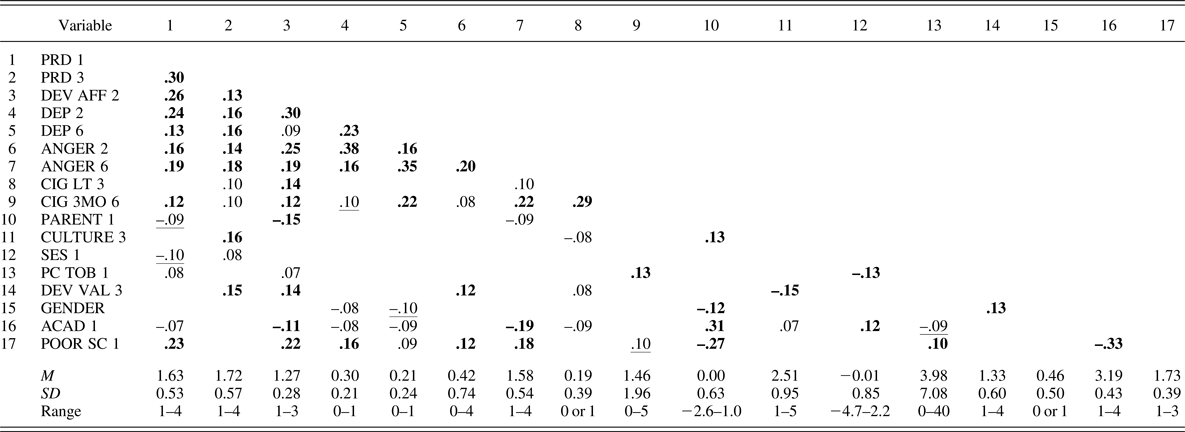
Means of the primary measures and controls are presented in Table 1. At W1, some PRD was reported by 90% of the sample; 1% (N = 8) reported smoking in the last year. Because we were interested in PRD1 predicting smoking, these eight people were discarded (though, with an N of only 8, including their data did not change the pattern of results). At W2, 3.4% of the sample reported cigarette use in the last year. The largest percentage increase in smoking (as is typical for African Americans) occurred between ages 15 and 18: for smoked in the last year: W3 N = 71 (9.4%); W4 N = 201 (28%). Thus, W3 smoking was an appropriate control for these analyses. The numbers increased somewhat by W6 (N = 215, 31%). At all waves, the numbers are above national norms (Centers for Disease Control and Prevention, 2014).
Correlations of primary measures

Note: Higher scores indicate more of the construct. Number after variable name indicates wave of data. PRD = perceived racial discrimination. DEV AFF = deviant affiliation. DEP = depressive symptoms. CIG LT = ever smoked cigarettes (lifetime). CIG 3MO = amount of cigarettes smoked in the last 3 months. PARENT = parenting style. CULTURE = cultural socialization. PC TOB = primary caregiver amount of tobacco used in the last year. DEV VAL = deviant values, ACAD = school orientation. POOR SC = poor self-control. Correlations not shown for: p ≥ .05, regular font: p < .05, underline: p < .01, bold: p < .005.
Correlations among the covariates and focal variables are also presented in Table 1. Several relations are worth noting. PRD1 and PRD3 were both correlated with W6 smoking (ps = .002 and .01, respectively); correlations with smoking for the other PRDs ranged from .09 to .03 (ps from .02 to .40). All but two of the control variables (deviant values and gender: ps > .07) were correlated with PRD1 (all ps < .04), as were the affect mediators (anger and depressive symptoms; both ps < .001). W3 cultural socialization was correlated positively with PRD3 (p < .001) and academic orientation (p ≤ .04), and negatively with W3 smoking (p ≤ .02) and deviant values (p < .001). W1 parenting style was correlated positively with academic orientation and cultural socialization (both ps < .001); and negatively with PRD1 (p < .01), deviant affiliation (p < .001), W6 anger (p < .02), gender (p < .001; lower for males), and poor self-control (p < .001).
Finally, attrition analyses indicated that those who had dropped out of the panel by W6 did not differ from those still in it on any of the six primary measures: PRD1; PRD3; W2 anger, depressive symptoms, and deviant affiliation; and W3 smoking (all ps > .15).
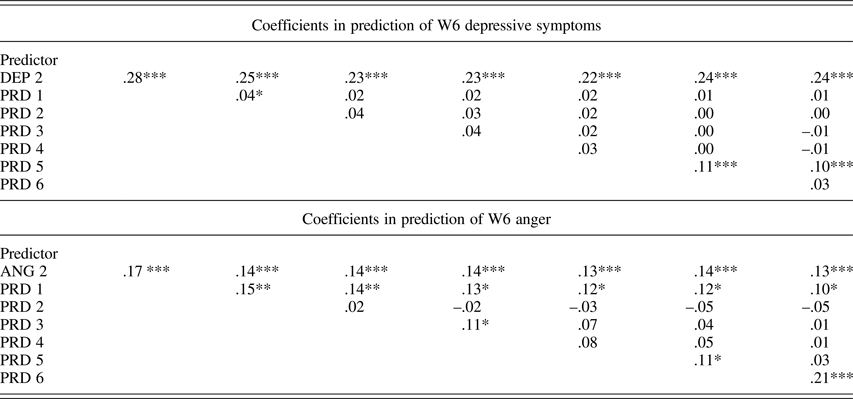
Regressions and cross-lags: PRD1–PRD6 predicting W6 anger and W6 depressive symptoms
PRD1 to PRD6
To examine the relative impact of PRD1 versus other PRD assessments on depressive symptoms and anger, two hierarchical regressions were conducted (using IBM SPSS Version 25), one for each type of affect. The W2 version of negative affect was entered first, then the six controls and W3 smoking; finally, each one of the six waves of PRD was entered one at a time. Results of the first step with just W2 affect and then the last six steps of the regressions, adding PRD from W1 through the final step (W6 PRD), can be seen in Table 2. For depressive symptoms, PRD1 entered significantly (t = 1.95, p = .05), but then became nonsignificant when W2 PRD was entered (p = .31) and remained nonsignificant through each additional step (all ps > .40). With all six PRD scores entered, PRD5 was the only significant PRD predictor of depressive symptoms (t = 3.75, p < .001; all other ps > .15). In contrast, for anger, PRD1 entered significantly (t = 3.23, p = .001), and remained significant for each step through PRD5 (all ts for PRD1 > 2.28, ps < .02). At the final step, PRD6 entered significantly (t = 4.06, p < .0001), but PRD1 remained significant (t = 1.95, p = .05). Thus, PRD at age 10.5 predicted anger at age 24.5, controlling for W2 anger and W6 PRD (both of which were strongly related to W6 anger themselves; p < .0001).
Hierarchical regressions predicting Wave 6 depressive symptoms and Wave 6 anger

Note: Number after variable name indicates wave of data. PRD = perceived racial discrimination. DEP = depressive symptoms. ANG = anger. Control variables (socioeconomic status, primary caregiver tobacco use, gender, academic orientation, poor self-control, and deviant values) plus Wave 3 smoking were entered (but not shown) between the Wave 2 affect and before the six PRD measures. The PRD measures were entered one at a time. *p ≤ .05. **p < .01. ***p < .001.
Temporal ordering
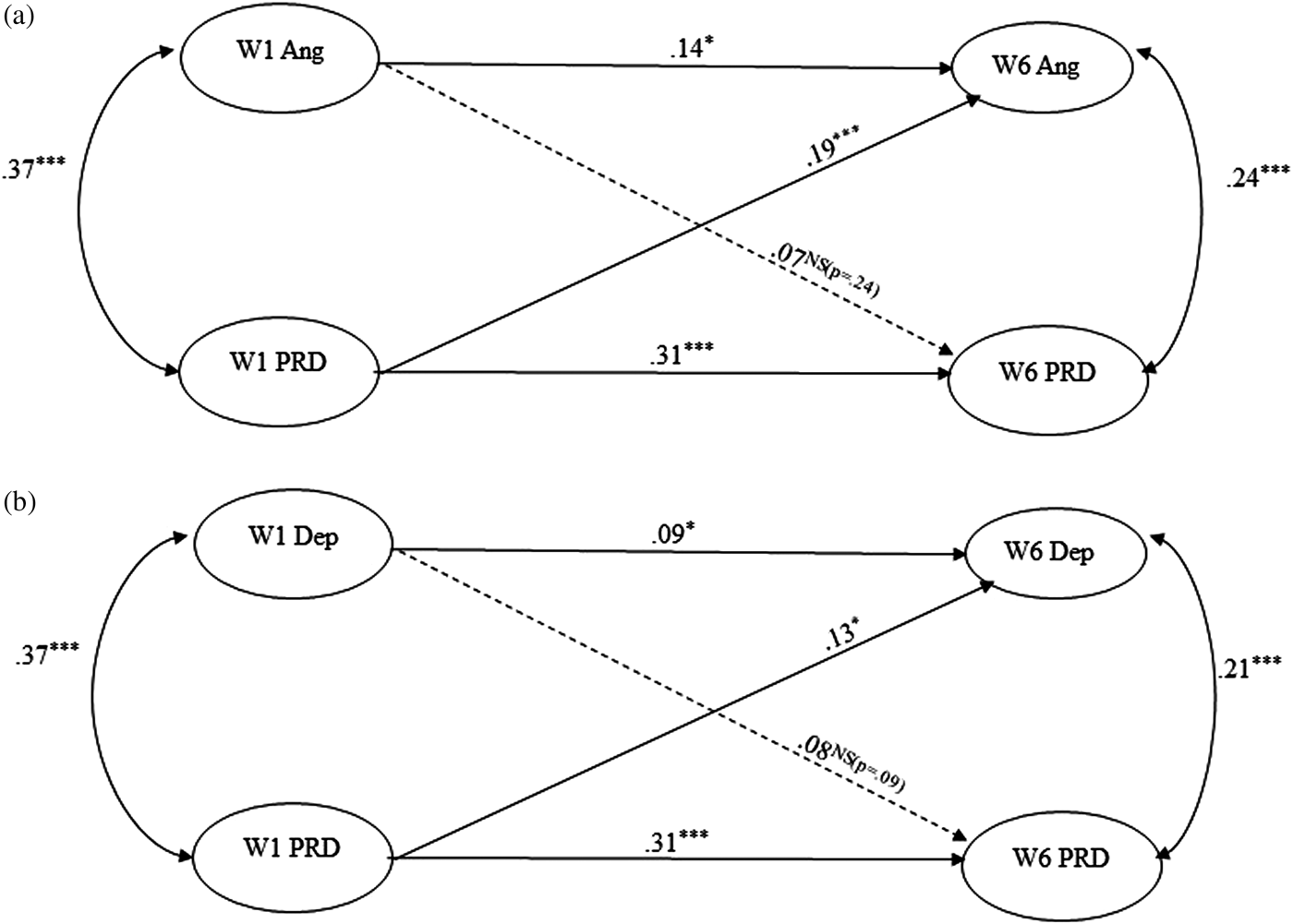
It is possible that the order of the affect/PRD prospective relations was opposite of what we had anticipated; that is, angry African American adolescents or those with some depression elicit discrimination from others more than the reverse (Phinney, Madden, & Santos, Reference Phinney, Madden and Santos1998). To check on this, cross-lag analyses (models) were conducted using MPlus (Version 7.0; Muthen & Muthen, Reference Muthén and Muthén2012) with the maximum likelihood with robust standard errors (MLR) estimator (due to nonnormality of some measures). W1 and W6 PRD and depressive symptoms were included in the first model, and then W1 and W6 PRD and anger in the second (see Figures 1a and 1b). The cross-lags (PRD1 to W6 affect and W1 affect to PRD6) were first constrained to be equal, and then that model was compared with one in which the two lags were allowed to vary. A significant change in χ2 from the constrained to the free model indicates the two paths differ in strength. That was the case: PRD1 was a stronger predictor of W6 anger than vice-versa, Δχ2 (1) = 10.66, p = .001. PRD1 was also a stronger predictor of W6 depressive symptoms than was W1 depressive symptoms of PRD6, Δχ2 (1) = 5.68, p < .02.Footnote 2
Cross-lag model with (a) Wave 1 and Wave 6 anger and Wave 1 and Wave 6 PRD and (b) Wave 1 and Wave 6 depression and Wave 1 and Wave 6 PRD. PRD = perceived racial discrimination. Dep = depressive symptoms. Ang = anger. All coefficients are standardized. *p < .05. **p < .01. ***p < .001.

Effects of PRD on affect and smoking: SEMs
SEM: Model fit
The SEMS were also run using MPlus (Version 7.0) with the MLR estimator. The full structural models included the six controls, and seven latent constructs, each with three randomly assigned parcels: PRD1 and PRD3, W2 deviant affiliation, and depressive symptoms and anger at W2 and W6. Because they were single items, the two smoking constructs were manifest. All constructs in the measurement models were allowed to correlate. For both of the PRD SEMs (i.e., PRD1 and PRD1/PRD3), fit for the measurement models was good: all χ2 df ratios ≤ 1.20, comparative fit indices and Tucker–Lewis indices > .99, and root mean square errors of approximation < .02. The two PRD SEMs also provided good fit to the data: χ2 df ratios ≤ 1.15, comparative fit indices and Tucker–Lewis indices > .99, and root mean square errors of approximation < .02.
Early PRD: Affect
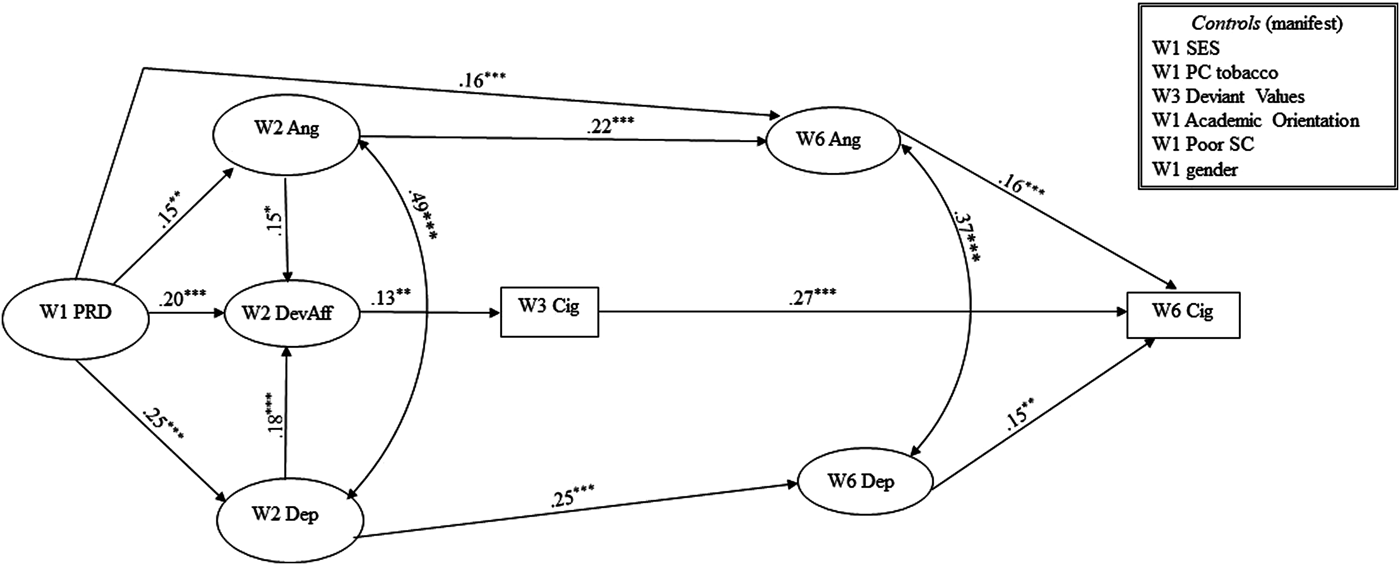
Figure 2 has the SEM for just PRD1. Looking at the impact on affect: the total effect of PRD1 on W6 anger was β = .19, z = 4.65, p < .0001; for W6 depressive symptoms, the total effect of PRD1 was β = .06, z = 3.60, p < .001. PRD1 also predicted both W2 anger (β = .15, z = 2.82, p < .005) and W2 depressive symptoms (β = .25, z = 5.52, p < .0001); both affect autocorrelation paths (W2 to W6 anger and W2 to W6 depressive symptoms) were also significant (ps < .0001). As seen in Figure 2, PRD1 had a direct relation with W6 anger, controlling for W2 anger (β = .16, z = 3.82, p = .0001); the same path was not significant for depressive symptoms (β = .08, z = 1.68, p = .09). These two paths were significantly different, as determined by bootstrapping with 5,000 samples: β (of the difference) = .14, z = 1.97, p < .05; 95% confidence interval [.01, 28]. In short, early PRD appeared to be somewhat more strongly related to early depressive symptoms than to anger, but that pattern had reversed 14 years later; at that time, PRD related more to anger than to depressive symptoms.
Structural equation model of early PRD effects on cigarette use. PRD = perceived racial discrimination. DevAff = deviant affiliation. Ang = anger. Dep = depressive symptoms. W3 Cig = ever smoking (lifetime). W6 Cig = amount of cigarettes smoked in the last 3 months. Controls are correlated with each other and exogenous variables in the model. Controls are predictors of all endogenous and model variables. See the text for details on the indicators that make up all latent variables. All coefficients are standardized. *p < .05. **p < .01. ***p < .001.

Early PRD: Smoking
The overall effect of PRD1 on W6 smoking was significant: β = .05, z = 4.00, p < .0001. The social path (through affiliation) was significant, overall effect: β = .01, z = 2.48, p = .01. The affect mediational paths were also significant, but they differed somewhat in a pattern similar to that reported above. The path from PRD1 to smoking through W2 and then W6 depressive symptoms was somewhat stronger (β = .01, z = 2.34, p < .02) than the path through W2 and then W6 anger (β = .01, z = 1.95, p = .05). However, the path from PRD1 directly to W6 affect (and then on to smoking) was significant for anger and not for depressive symptoms: β = .03, z = 2.41, p < .02 versus β = .01, z = 1.48, p < .14. As a result, the overall effect through anger was somewhat stronger than that through depressive symptoms: β = .03, z = 2.60, p < .01 versus β = .02, z = 2.10, p < .04.
Early versus later PRD: Affect
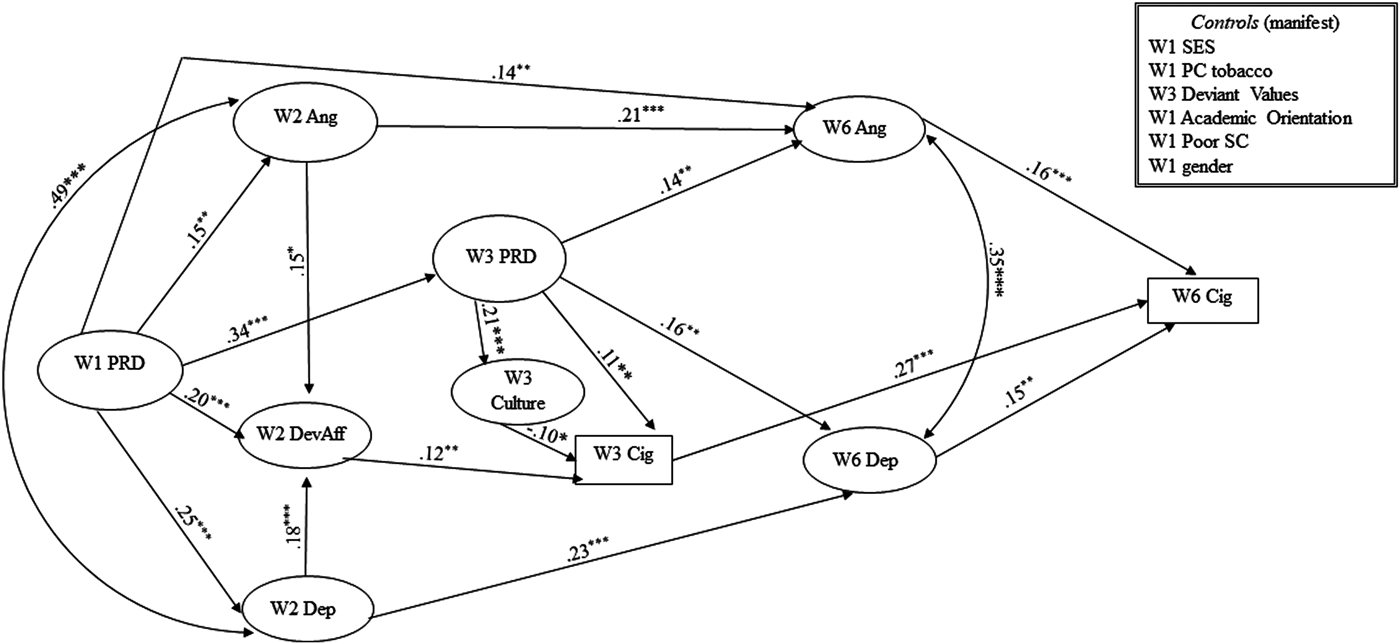
The SEM in Figure 3 adds PRD3 (age 15.5) and cultural socialization to the model in Figure 2. PRD3 predicted W6 depressive symptoms, controlling for W2 depressive symptoms: β = .16, z = 3.27, p = .001. In addition, PRD3 also predicted W6 anger, controlling for W2 anger: β = .14, z = 3.01, p < .003. As with the regressions, the direct path from PRD1 to W6 anger remained significant, even with PRD3 in the model (β = .14, z = 3.01, p < .003). The same direct path for depressive symptoms was not significant (p = .43).Footnote 3
Structural equation model with mediation of early and later PRD effects on cigarette use. PRD = perceived racial discrimination. DevAff = deviant affiliation. Ang = anger. Dep = depressive symptoms. Culture = cultural socialization. W3 Cig = ever smoking (lifetime). W6 Cig = amount of cigarettes smoked in the last 3 months. Controls are correlated with each other and exogenous variables in the model. Controls are predictors of all endogenous and model variables. See the text for details on the indicators that make up all latent variables. All coefficients are standardized. *p < .05. **p < .01. ***p < .001.

Early versus later PRD: Smoking
As expected, PRD3 predicted W3 smoking (p = .008), and the social path (from PRD1 through affiliation to W3 smoking) remained significant: β = .02, z = 2.34, p < .02. With PRD3, however, there were no other social paths to W6 smoking. Thus, PRD1 did predict early smoking, but it was entirely through the social path. Both paths through the W6 affect measures on to later (W6) smoking were significant (ps < .01). Once again, however, the situation was different for the PRD1 prediction of W6. The total effect of PRD1 on W6 smoking was β = .07, z = 4.86, p < .0001. The paths to W6 smoking through W2 anger and then W6 anger, and through W2 and then W6 depressive symptoms, were both significant (β = .005, z = 1.94, p = .05; and β = .009, z = 2.31, p = .02, respectively). As a result, the total effect of PRD1 on smoking through W6 anger was significant: β = .03, z = 2.69, p = .007. The same indirect effect of PRD1 through W2 and W6 depressive symptoms to W6 smoking was also significant: β = .017, z = 2.64, p = .008. However, again, this indirect effect from PRD1 through depressive symptoms to W3 smoking was largely attributable to the strong relations between PRD1 and W2 depressive symptoms (p < .0001) and the high W2 to W6 depressive symptoms autocorrelation (also p < .0001). In contrast, the same effect of PRD1 through anger was partly attributable to the direct effect of PRD1 on W6 anger; there was no such direct effect on depressive symptoms. Finally, another, more conservative, regression was conducted in which anyone who reported smoking at W3 was discarded (N = 71). In this analysis, none of the six controls predicted (late start) smoking at W6, but PRD1 still predicted smoking (p < .05) that started after W3, between 5 and 10 years later.Footnote 4
Cultural socialization
As expected, PRD3 was strongly, positively related to cultural socialization: β = .21, z = 4.87, p < .0001; and cultural socialization, in turn, was a cultural promotive factor, as it was negatively related to W3 smoking: β = –.10, z = –2.50, p = .01.Footnote 5
Moderation
The two parent-based moderators were cultural socialization and parenting style. In addition, a series of exploratory moderation analyses was conducted that included factors associated with African American culture (see below). These analyses included multigroup models (SEMs, also run with MPlus, V.7 and the MLR estimator) in which the moderator was split at the median, forming a higher and lower group for each variable (if the moderator was a control, it was removed from the control list before running the analyses). Paths for the higher and lower groups were first constrained to be equal, and then (as with the cross-lags) they were allowed to vary. Change in χ2 for model fit between the constrained and free models was then calculated.
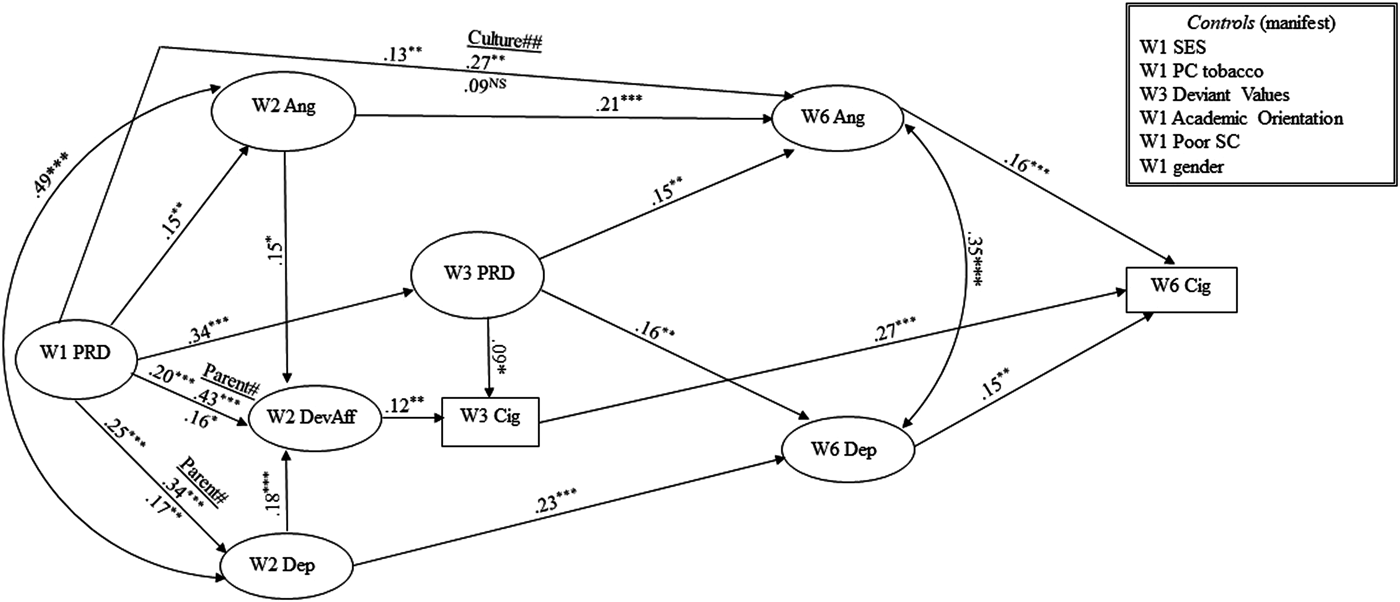
Parenting style has been shown to moderate PRD effects in the past (Brody et al., Reference Brody, Chen, Murry, Ge, Simons, Gibbons and Cutrona2006; Gibbons et al., Reference Gibbons, Etcheverry, Stock, Gerrard, Weng, Kiviniemi and O'hara2010; Simons et al., Reference Simons, Simons, Burt, Drummund, Stewart, Brody and Cutrona2006). In this case, parenting style mitigated the impact of PRD1 on both deviant affiliation and depressive symptoms (see Figure 4). The path to deviant affiliation was significant for both the lower and the higher parenting groups: β = .43, z = 4.06, p < .0001, and β = .16, z = 1.97, p < .05, respectively; but, it was significantly stronger for the lower parenting group: Δχ2 (1) = 4.90, p < .03. As a result of this moderation effect, the social path from PRD1 through deviant affiliation to W6 smoking was significant for the lower parenting group but marginal for the higher parenting group (p < .02 vs. p = .07). Similarly, the path from PRD1 to W2 depressive symptoms was significant for both the lower and the higher parenting groups: β = .34, z = 5.35, p < .0001 versus β = .17, z = 2.75, p < .006; but, again, it was significantly stronger for the lower group: Δχ2 (1) = 4.88, p < .03. As a result, the path from PRD1 through W2 and then W6 depressive symptoms to W6 smoking was again significant for the lower parenting group, but not the high parenting group (p = .02 vs. p = .07). In sum, parenting style made a significant difference in terms of both the child's affective reactions to PRD (depressive symptoms) and his/her peer affiliations, and this difference was related to adult smoking.
Structural equation model with mediation and moderation of early and later PRD effects on cigarette use. PRD = perceived racial discrimination. DevAff = deviant affiliation. Ang = anger. Dep = depressive symptoms. W3 Cig = ever smoking (lifetime). W6 Cig = amount of cigarettes smoked in the last 3 months. Controls are correlated with each other and exogenous variables in the model. Controls are predictors of all endogenous and model variables. See the text for details on the indicators that make up all latent variables. For multigroup analysis: #Above the line represents lower levels of parenting style; below the line represents higher levels of parenting style. ##Above the line represents less cultural socialization; below the line represents more cultural socialization. All coefficients are standardized. *p < .05. **p < .01. ***p < .001.

The multigroup model including cultural socialization identified a direct path from PRD1 to W6 anger that differed for the two groups. The path was significant for the lower socialization group: β = .27, z = 2.82, p < .005; but not the higher socialization group: β = .09, ns. Comparison of the two paths showed they differed significantly: Δχ2 (1) = 3.98, p < .05. In sum, a combination of high PRD and low cultural socialization put participants at higher risk for W6 anger, independent of the other constructs. The same moderation effect was not significant for W6 depressive symptoms, however (p for χ2 change > .55). Thus, cultural socialization was both a cultural protective and a cultural promotive factor.
Exploratory analyses (regressions, followed in some cases by SEMs) were also conducted examining factors that are related to Black culture and that have been linked with either affect or substance use; those included Black pride, two additional types of racial socialization (mistrust and preparation for bias), and neighborhood segregation (a full list is presented in Appendix B). None of them moderated the relation between early PRD and either affect or tobacco use. However, that does not mean that they do not have translational potential. Several of these variables acted as (cultural) promotive factors vis á vis both smoking and negative affect, and in some cases, did so among both the adolescents and their parents. For example, community cohesion (e.g., “… in the neighborhood surrounding your house, people are willing to help each other out” and “…there are adults in the area that teens look up to”) was consistently correlated negatively with anger and depressive symptoms for the adolescents and their parents (all ps < .001 for parents and ps < .004 for adolescents). Segregation (i.e., percentage African American in the neighborhood) was correlated negatively with tobacco use for the parents (ps < .02) and the adolescents at W6 (p < .04). Similarly, contact with Black friends (i.e., self-reported percentage of friends who are African American) also appeared to have salutary effects for the adolescents. The higher the percentage of the participants’ friends who were African American, the lower the likelihood of (a) smoking at W6 (p < .007), (b) having symptoms of depression at W6 (p < .001; cf. Hurd, Stoddard, & Zimmerman, Reference Hurd, Stoddard and Zimmerman2013), or (c) being angry (p = .03). Finally, Black pride (e.g., “Black is beautiful …” and “Black people are very smart”) was correlated negatively with both anger and depressive symptoms for the parents (ps < .01).
Discussion
Results of this study were consistent with previous research in documenting a prospective relation among African American adolescents between PRD and both negative affect and unhealthy behavior. It extends this literature by indicating how early this relation starts, and also how long it lasts. Moreover, the relation maintained controlling for a number of factors that have been shown repeatedly to be predictive of both negative affect and smoking among adolescents, including their parents’ SES and tobacco use, and several of their own individual differences: poor self-control, deviant values, and academic orientation. The fact that PRD assessed at age 10.5 not only predicted anger and smoking at age 24.5 but also predicted onset of smoking after age 15 further attests to the durability of the PRD effect.
PRD and affect
Synchronous relations between PRD and negative affect existed at every wave in the current analyses (cf. Gibbons & Stock, Reference Gibbons, Stock, Major, Dovidio and Link2018). PRD1 also predicted both types of negative affect at W2, which is not surprising given that the lag was only 2 years. However, negative affect does tend to be fairly labile during adolescence (Larson, Moneta, Richards, & Wilson, Reference Larson, Moneta, Richards and Wilson2002), and that was the case for these adolescents. Although significant, the autocorrelations were modest for both anger and depressive symptoms over the 12-year period from W2 to W6 (age 12.5 to age 24.5; βs = .21 and .23, ps < .001). Moreover those W2/W6 autocorrelations were not much stronger than the PRD1/W6 affect prospective relations. Duration of stress effects like this is not commonly found in the adverse childhood experiences literature. However, discriminatory experiences are not typical adverse childhood experiences; they are not single traumatic events or a series of traumatic events, like loss of a parent or physical/sexual abuse. Rather, they involve a perception by the child that they are disliked, not trusted, and/or looked down upon by some simply because of their racial/ethnic group. Over time, an abused child may realize that the event(s) is over, and for some, the emotional damage will eventually dissipate. An African American child who is the victim of racism early in life may have the opposite reaction, however, a perception that does not diminish as they grow older (and may even increase) that the situation is not going to get any better.
Still, the long-term impact that early PRD appeared to have had on these adolescents is surprising. Not only was PRD1 significantly correlated with both anger and depressive symptoms at all six waves, but PRD1 remained as a significant predictor of W6 anger in the regressions (and the SEMs; see Footnote 3) when all six PRDs were entered (only PRD6 also predicted W6 anger). Moreover, the cross-lag analyses gave some indication of the temporal ordering of these relations (and by implication, the causal ordering as well): PRD1 appeared to be causing the anger at W6 more so than W1 anger was prompting the W6 PRD (the same was true, though to a lesser extent, for early PRD vis á vis depressive symptoms in adulthood). In short, childhood PRD had a strong impact on these adolescents’ early negative affect, and that effect was somewhat stronger for depressive symptoms than for anger. However, the impact on anger appeared to last a long time and was manifested not only as continued negative affect in early adulthood but also as an increase in or maintenance of unhealthy behavior.
These affect results also offer further support for the sensitive period perspective, in particular, suggesting that discrimination experienced early in life can have a disproportionate impact on an African American child's mental health and his or her physical health, as well. It is during this late childhood period that the child's self-identity and racial identity (i.e., what it means to be African American and how African Americans are viewed in society) are developing (Sellers et al., Reference Sellers, Copeland-Linder, Martin and Lewis2006). Unlike White children, for many Black children, the development of group identity is more likely to be influenced by unpleasant experiences with others. These experiences, often unprovoked and unexpected, may be seen initially as confusing and also very unfair by the child. Over time, the perceived unfairness is likely to translate, for some, into lasting anger and perhaps depression. Unfortunately, some of them may turn to unhealthy behavior, which they have avoided in adolescence, as a means of coping with the negative affect (Gerrard et al., Reference Gerrard, Gibbons, Fleischli, Cutrona and Stock2018).
PRD and smoking
Timing
The links between PRD and smoking were clear; however, the timing of these relations was somewhat nuanced. Whereas PRD3 directly predicted early (age 15) smoking, PRD1 did not; the same was true for early negative affect (the correlations between early smoking and both types of early negative affect as well as PRD1 were not even significant). Instead, the relation from PRD1 to smoking at W3 followed the social path (peer influence effects that do not necessarily involve negative affect). This is a common path among adolescents, regardless of their race or ethnicity (Dodge et al., Reference Dodge, Dishion and Lansford2006). In contrast, the impact of PRD1 on smoking was delayed: a kind of “sleeper effect” (Kumkale & Albarracin, Reference Kumkale and Albarracín2004). More specifically, PRD1 predicted changes in negative affect that occurred between age 12.5 and age 24.5, for anger; this, in turn, predicted changes in smoking from age 15.5 to adulthood. Moreover, PRD1 also predicted initiation of smoking after age 15, which is unusual: later uptake is more often predicted by social factors (peers) than early individual experiences or individual differences (Conrad, Flay, & Hill, Reference Conrad, Flay and Hill1992; Ferguson & Meehan, Reference Ferguson and Meehan2011).
Smoking and affect: Relapse and the racial crossover
Anger (and to a lesser extent, depressive symptoms) has also been a factor implicated in research on causes of smoking relapse. Elevated levels of anger are associated with both difficulty in quitting and relapse (Cougle, Hawkins, Macatee, Zvolensky, & Sarawgi, Reference Cougle, Hawkins, Macatee, Zvolensky and Sarawgi2014). Patterson, Kerrin, Wileyto, and Lerman (Reference Patterson, Kerrin, Wileyto and Lerman2008), for example, reported that smokers with elevated postquit anger were twice as likely to relapse as those who did not have such an increase after quitting. Together, these relations speak to the issue of the racial crossover in terms of tobacco use (less use among African American adolescents, but more dependence among African American adults). Specifically, it appears that the crossover may be partly a reflection of the fact that enduring anger caused by PRD, some of it maintaining from childhood, may be interfering with the motivation and/or ability to quit. Evidence of this can be seen in the current study: among W5 smokers, those reporting very high amounts of anger at W6 (in the top 10% of the distribution) were more than six times as likely to still be smoking as were the rest of the smokers. This difference was only marginal, due to the fact that few smokers actually quit during this period, but it is a factor that should be examined in future research.
Intervention implications
Parenting
Several possible targets of intervention are suggested by the results of these analyses. One clear buffer has to do with parenting style. Deviant affiliation is one of the strongest predictors of adolescent risk behavior, including tobacco use, and it is also a common reaction to PRD. Previous FACHS analyses have indicated that this “social path” from PRD to risky behavior reflects selection more than socialization (Roberts et al., Reference Roberts, Gibbons, Gerrard, Weng, Murry, Simons and Lorenz2012; cf. Burk, van der Vorst, Kerr, & Stattlin, Reference Burk, van Der Vorst, Kerr and Stattin2012); in other words, adolescents who have experienced discrimination are more inclined to seek out “deviant” peers (who are engaging in risky behaviors) than they are to succumb to pressure from those peers to engage in risky behaviors after affiliating with them. The fact that parenting style reduces the likelihood that the child will affiliate with others, many of whom have experienced discrimination themselves,Footnote 6 is encouraging; that is, it is easier to monitor and, if necessary, shape the behavior of one's own child than the behavior of his or her friends. Equally encouraging is the fact that this same parenting style appeared to mitigate the impact of the child's PRD on his or her depressive symptoms.
Cultural socialization
As mentioned earlier, cultural socialization was both a protective and a promotive factor. This parenting “style” (it was correlated with effective parenting style) appeared to have several positive effects on their children, including less likelihood of early smoking, higher academic orientation, and less acceptance of deviant behavior. Strengthening the adolescents’ sense of connection with positive elements of both their racial group and its successful members is likely to motivate them to succeed themselves. In addition, the fact that it buffered against the primary effect of PRD1, its long-term impact on anger, suggests more research should examine why it has this effect.
Racial identity: Unhealthy behavior
People in the same social network often share preferences for health habits, eating specific foods and exercise, for example (Oyserman & Fisher, Reference Oyserman, Fisher, Major, Dovidio and Link2018). These habits can become a source of both self- and group identity (i.e., “these are things we do”), and they can promote a shared meaning within the group (Oyserman, Fryberg, & Yoder, Reference Oyserman, Fryberg and Yoder2007). These cultural preferences can be either promotive or risk factors (healthy or unhealthy; Christakis & Fowler, Reference Christakis and Fowler2007). African American and Native American college students, for example, report that healthy habits, like exercising daily, are not things their groups “do” (Oyserman, Fryberg, & Yoder, Reference Oyserman, Fryberg and Yoder2007). To the extent that a group is stigmatized, these behaviors also can become stigmatized; that is, the behaviors become associated with the group. One consequence of this process is that these racial identities can increase a sense of fatalism (“There's nothing I can do—it's in my genes”), and when the stereotypes are activated, they foster a sense of inadequacy regarding one's ability to inhibit the unhealthy behavior, a process that Oyserman and Fisher (Reference Oyserman, Fisher, Major, Dovidio and Link2018) say must be addressed in interventions designed to alter self-efficacy regarding one's ability to change his or her behavior.
Racial identity: Healthy behavior
The Strong African American Families program (SAAF; Brody et al., Reference Brody, Murry, Gerrard, Gibbons, Molgaard, McNair and Chen2004; Gerrard et al., Reference Gerrard, Gibbons, Brody, Murry, Cleveland and Wills2006) is a family-focused preventive-intervention that was designed, in part, to delay and reduce alcohol use in African American adolescents by counteracting this tendency toward group fatalism and by facilitating the development of a positive racial identity. SAAF was based mostly on Brody and Murry's extensive research on protective aspects of Black families (Brody, Kim, Murry, & Brown, Reference Brody, Kim, Murry and Brown2004; Brody, Murry, Kim, & Brown, Reference Brody, Murry, Kim and Brown2002) and partly on Gibbons, Gerrard & Lane's (Reference Gibbons, Gerrard, Lane, Suls and Wallston2003) model of adolescent health risk behavior (e.g., research on Black adolescents’ social images of alcohol users; Gerrard et al., Reference Gerrard, Gibbons, Reis-Bergan, Trudeau, VandeLune and Buunk2002; Gibbons, Gerrard, Cleveland, et al., Reference Gibbons, Gerrard, Cleveland, Wills and Brody2004). More specifically, work by Brody and Stoneman (Reference Brody, Stoneman, Sigel, McGillicuddy-DeLisi and Goodnow1992) has shown that high levels of parental control are interpreted by African American adolescents as evidence of parental involvement and concern (suggesting it is part of African American culture). This perceived emotionally supportive and nurturant involvement, in turn, contributes to low levels of drinking in African American youth. SAAF also borrows an element of social norm theory (Prentice & Miller, Reference Prentice and Miller1993), by using accurate information to show Black adolescents that Black adolescents are less likely to use substances than are White adolescents. One goal of this is to promote a kind of racial pride in these young adolescents (“this is an unhealthy behavior that we do not do”) that will effectively combat typical normative pressure toward risky behavior. The intervention process is facilitated by the fact that compared to White adolescents, Black adolescents appear to be less susceptible to social influence (Gibbons et al., Reference Gibbons, Etcheverry, Stock, Gerrard, Weng, Kiviniemi and O'hara2010; Robinson et al., Reference Robinson, Murray, Alfano, Zbikowski, Blitstein and Klesges2006), and they tend to be more oriented toward independence and distinctiveness than conformity and compliance (Unger, Reference Unger2003). In short, these interventions use positive (healthy) aspects of African American culture to promote group-identified healthy behavior. In combination with a second arm of the intervention that targets parenting (e.g., monitoring and warmth), the SAAF program has been effective at slowing the escalation of health risk behavior that is common among adolescents (Brody et al., Reference Brody, Chen, Kogan, Yu, Molgaard, DiClemente and Wingood2012).
Education
Finally, academic orientation has consistently been a protective factor when it comes to maladaptive behavior. Adolescents who are committed to their schoolwork are less likely to smoke, and that was the case here at W3. What was somewhat unexpected, however, was that academically oriented students were also less likely to report anger (p < .0001) and symptoms of depression (p < .05) at W6. There is little doubt that evidence-based, education-focused interventions are likely to have beneficial effects in terms of health as well as career. Implementing such programs may encounter some difficulties, however, in the sense that academic performance is seen by some Black adolescents as “acting White” (Obama, Reference Obama2004; Ogbu, Reference Ogbu2004). In other words, it is more a part of White culture than Black culture, but the potential benefits, if successful, are likely to be manifold.
Limitations
There are several limitations of this study that should be noted. First, the reliability of some of the constructs was low (e.g., parenting and SES ~.60), and some of the items in these constructs changed over time. Both of these issues are not uncommon in longitudinal studies, especially those with as many waves and participants as young as this one. Reliability among child respondents is often low, and questions about anger for 10-year olds, for example, may not work as well for them at age 25. Second, one of the controls (deviant values) and one of the moderators (cultural socialization) was assessed after the primary predictor (PRD1). That is more of an issue for the moderator than the control. Cultural socialization is a dynamic construct, and it does evolve over time (Phinney & Ong, Reference Phinney and Ong2007; Umana-Taylor et al., Reference Umaña-Taylor, Quintana, Lee, Cross, Rivas-Drake and Schwartz2014), which means using any wave may have created some problems. Nonetheless, it is the case that this moderator could have been influenced by the predictor; for example, PRD1 and/or PRD3 affecting W3 socialization (which could have contributed to the PRD/socialization correlation at W3), and might therefore alter interpretation of the moderation. Third, we did not have any other-respondent verification of the smoking or the PRD (e.g., parents’ reports of their child's discrimination), and we did not have biomarker verification of the smoking self-reports (see Future Directions below). Fourth, FACHS is a nonurban sample, so comparison with inner-city populations (where most studies of African American stress have taken place) should be done with caution.
Future directions
In some respects, the current results raise more questions than they answer, which means there are many possible avenues for future research suggested by what we (and others) have found. Some of them are specific issues to be explained or clarified; others represent major topics of future concern.
What predicts internalizing versus externalizing reactions?
Affective responses to PRD among African Americans, especially adolescents, appear to have significant consequences in terms of both mental and physical health. There were too few physical health problems in this young adult sample to examine the question directly, but previous studies have provided evidence that externalizing reactions are more often associated with poor health behaviors (e.g., substance use), whereas internalizing predicts physical health problems (Gibbons et al., Reference Gibbons, Kingsbury, Weng, Gerrard, Cutrona, Wills and Stock2014). Determining what leads an African American adolescent or adult to respond to PRD in one affective way or the other (or perhaps both) would be very useful information to have from an intervention perspective.
Institutional racism
Our research has dealt almost exclusively with interpersonal racism, but that is only one type of discrimination confronting African Americans in the United States. Minorities across the country face different types of institutional racism that clearly can have an impact on their mental health (e.g., frustration in the job market or inability to advance within a particular employment setting), and their physical health (e.g., racism within the criminal justice system; Gibbons et al., Reference Gibbons, Fleischli, Simons, Gerrard, Weng and Gibson2018). One particular locus of concern, in terms of both mental and physical health, is the healthcare system. With much uncertainty currently surrounding health insurance and healthcare delivery, we believe there is an urgent need for additional studies examining why minorities appear to seek less treatment, and receive worse treatment, than Whites, and what can be done to counter that (Penner, Phelan, Earnshaw, Albrecht, & Dovidio, Reference Penner, Phelan, Earnshaw, Albrecht, Dovidio, Major, Dovidio and Link2018).
Biology
One direction that the FACHS project is heading in, and we believe the same will be true for other researchers interested in race and health as well, is toward more consideration of the biological effects of racism. Psychologists and others have been interested in this topic for a while (Geronimus, Bound, Waidmann, Hillemeier, & Burns, Reference Geronimus, Bound, Waidmann, Hillemeier and Burns1996; Mays et al., Reference Mays, Cochran and Barnes2007), but, again, most of the early studies were cross-sectional (or experimental). As mentioned, early work showed direct effects of PRD on health factors, such as inflammation (e.g., C-reactive protein; Lewis et al., Reference Lewis, Aiello, Leurgans, Kelly and Barnes2010), cortisol levels (Adam et al., Reference Adam, Heissel, Zeiders, Richeson, Ross, Ehrlich and Peck2015), and vulnerability to cardiovascular disease (Guyll, Matthews, & Bromberger, Reference Guyll, Matthews and Bromberger2001), and many studies have documented indirect effects through unhealthy behavior (Gibbons & Stock, Reference Gibbons, Stock, Major, Dovidio and Link2018). These results are concerning, but at the same time, there is reason for optimism. In two cohorts of Black children, Brody, Miller, Yu, Beach, and Chen (Reference Brody, Miller, Yu, Beach and Chen2016) assessed PRD across 3 years (starting at ages 18 or 19) and then their epigenetic (biological) age at chronological age 20 or 22. They found, as expected, that the children who reported high levels of PRD in adolescence were actually older in terms of epigenetic age than those who had not had these experiences, but not if they had a supportive family environment.
What is needed now are longitudinal studies that trace the impact of racism over time using biomarker assessments and indicators of physiological status at various developmental periods (cf. Causadias, Reference Causadias2013; Causadias, Telzer, & Lee, Reference Causadias, Telzer and Lee2017). Examining how stressors, assessed at various stages of development across eight waves and 26 years of data collection, affects epigenetic age and what social and intrapersonal factors mediate and moderate this process (as buffers and risk factors) will be a primary focus of the FACHS project for the next 5 years. In particular, we will be examining how PRD compares with various other stressors, often experienced by African Americans, in terms of emotional, interpersonal, and biological impact.
Conclusion
Discrimination is a part of African American culture. It is aversive at any age, but the current set of analyses indicates that the impact of PRD experienced early in life, before age 11 or 12, is a significant risk factor that has a lasting impact on African Americans’ negative affect at least into early adulthood. Moreover, this enduring effect on anger, and to a lesser extent depressive symptoms, predicts unhealthy behaviors, such as smoking in adulthood and changes in smoking from middle adolescence into early adulthood. We believe there is a clear need for more longitudinal research that can inform the development of intervention and preventive intervention programs that can address this issue of buffering PRD effects among African American adolescents. One important goal of this research will be identifying aspects of the Black experience and of Black culture that can protect Black adolescents and adults from the “weathering” effects of the racism that still persists in American society today.
Appendix A Perceived Racial Discrimination—Schedule of Racist Events (Modified from Landrine & Klonoff, 1996); Responses: 1 = Never, 2 = Once or Twice, 3 = A Few Times, 4 = Several Times
1. How often has someone said something insulting to you just because you are African American? Is it …
2. How often has a store owner, sales clerk, or person working at a place of business treated you in a disrespectful way just because you are African American? Is it …
3. How often have the police hassled you just because you are African American? Is it …
4. How often has someone ignored you or excluded you from some activity just because you are African American? Is it …
5. How often has someone suspected you of doing something wrong just because you are African American? Is it …
6. How often has someone yelled a racial slur or racial insult at you just because you are African American? Is it …
7. How often has someone threatened to harm you physically just because you are African American? Is it …
8. How often have you encountered Whites who are surprised that you as an African American person did something really well? Is it …
9. How often have you been treated unfairly because you are African American instead of White? Is it …
10. How often have you encountered Whites who didn't expect you to do well just because you are African American? Is it …
11. How often has someone discouraged you from trying to achieve an important goal just because you are African American? Is it …
12. How often have close friends of yours been treated unfairly just because they are African American? Is it …
13. How often have members of your family been treated unfairly just because they are African American? Is it …
Appendix B Cultural Measures Tested as Potential Moderators That Were Not Significant
We also examined potential cultural moderators of the path from perceived racial discrimination (PRD) to anger, depressive symptoms, and smoking individually, using regressions. For the targets, W2 and W6 anger, W2 and W6 depressive symptoms, and W3 and W6 smoking were regressed on W1 PRD, the moderator, and the product of the moderator and PRD. For the parents, W1 hostility and anger, W1 depressive symptoms, and W1 and W2 smoking were regressed on W1 PRD, the moderator and the product of the moderator and PRD. If there was any promise shown in the regressions, we also ran multigroup structural equation models to test for moderation. The measures not tested with structural equation models were two forms of racial socialization: preparation for bias and neighborhood segregation. The cultural moderators that were tested and found not to be significant were as follows:
Racial socialization—Preparation for bias. Six items from Hughes and Johnson (Reference Hughes and Johnson2001); for example, “How often within the past year have the adults in your family indicated that people might limit you because of your race?” and “How often within the past year have the adults in your family indicated that some people might treat you badly or unfairly because of your race?” (1 = never to 5 = 10 or more times).
Racial socialization—Promotion of mistrust. Four items from Hughes and Johnson (Reference Hughes and Johnson2001); for example, “How often within the past year have adults in your family talked to you about how you can't trust kids from other racial or ethnic groups?” and “How often within the past year have the adults in your family encouraged you to keep your distance from kids of a race or ethnicity that differs from yours?” (1 = never to 5 = 10 or more times).
Black pride. Twenty-one items from Smith and Brookins (Reference Smith and Brookins1997); for example, “Black is beautiful” and “Black people are very smart” (1 = strongly disagree to 4 = strongly agree).
Neighborhood cohesion. Nine items for participants and 15 items for parents. Adapted from Sampson, Raudenbush, and Earls (Reference Sampson, Raudenbush and Earls1997); for example, “In the neighborhood surrounding your house, people are willing to help each other out” and “… there are adults in the area that teens look up to” (1 = not at all true to 3 = very true).
Neighborhood segregation. Percentage of population in the census block that is African American from the 1990 census.
Percentage of Friends who are African American. Two items (adolescents only). “What proportion of your casual friends is African American?” and “What proportion of your close friends is African American?” (1 = 10% or less to 5 = greater than 80%).