

I. INTRODUCTION
After the Second World War, in the aftermath of what came to be called the Keynesian revolution, macroeconomics was centered on the theory of income determination, the level of national income determining the level of employment. The business cycle was a specialist topic within macroeconomics. This was a reversal of the situation at the beginning of the century where, for most economists other than a few heretics, employment was discussed within the context of the business cycle. In Britain, this transition from taking the business cycle as fundamental to explaining the level of employment independently of the business cycle is evident in the early 1930s, with Arthur Cecil Pigou writing The Theory of Unemployment (Pigou Reference Pigou1933). Others, such as Friedrich Hayek, may have argued that unemployment needed to be considered in the context of the cycle, but with The General Theory of Employment, Interest and Money (Keynes [Reference Keynes1936] 1972) and the ensuing literature, employment was increasingly explained without reference to the business cycle.
The reason for this change in perspective is easy to explain. British unemployment in the 1920s could hardly be explained as a cyclical phenomenon—there was a clear cycle in the early 1920s, but the stagnation of the mid- to late 1920s, dominated by certain industries, invited explanation either in terms of structural factors (industrial decline, affecting shipbuilding, textiles, coal, steel) or in terms of the exchange rate and the failure of wages to adjust so as to keep these industries internationally competitive. When the Great Depression struck, it involved the effects of a world crisis on a country already hit by unemployment. It was not clear that it made sense to analyze British experience in terms of an endogenous business cycle. Keynes may have offered an analysis of “credit cycles,” but his Treatise on Money ([1930] 1971) was framed in terms of a static analysis of money, prices, and output. The General Theory went even further in the direction of a static theory focusing on income and employment. In both books, there was one chapter on the problem of the cycle (Keynes [Reference Keynes1930] 1971, vol. 1, ch. 20; Keynes [Reference Keynes1936] 1972, ch. 22).
In contrast, economists in the United States had reason to take a different view of the relation between theorizing about employment and the cycle. The Great Depression came at the end of a long boom, and it made much more sense to analyze the depression in terms of the business cycle. It could easily be seen as a cyclical downturn following the overexpansion that had taken place in the 1920s. There was the problem of explaining why the depression was so deep, but it made sense to start from the assumption that the Great Depression was a cyclical downturn that had, for some reason, taken a different course from most depressions. It was not until 1937–38, when there was a new downturn before unemployment had recovered to anything that could plausibly be thought full employment, that thinking had to change. But, even then, the problem could be posed in relation to the cycle: Why had the recovery stalled much earlier than it should have done? Some economists turned immediately to Keynesian explanations, concluding that government policies had caused a shortage of aggregate demand; but others sought an explanation tied up with the long-term growth of the American economy, such as the closing of the frontier, demographic changes, and the course of innovation. It was only with the Second World War, when federal military spending rose dramatically, dominating private investment, that this position had to be modified, for wartime experience could clearly not be understood in terms of an endogenous business cycle. When, in the 1950s, business cycle theory became a specialized topic within macroeconomics, it was conceived not as the framework within which to discuss the short-run level of output, but as an extension to the theory of income determination, whether the latter was conceived on Keynesian lines or as part of a Walrasian general equilibrium model.
Two economists, both central to post-Second World War Keynesian economics, who fall into the second of these two categories, treating the theory of income determination apart from long-term structural considerations only during the Second World War, are Alvin Hansen and Paul Samuelson. Hansen was one of the prominent American business cycle theorists of the 1920s and 1930s, but by the 1950s he was arguably America’s leading Keynesian, writing a widely read A Guide to Keynes (1953), helping to establish the IS-LM model—static, short run, and devoid of cyclical considerations—as the main analytical device in macroeconomics. Working very closely with Hansen, Samuelson made the same transition: someone who started as a business cycle theorist wrote a textbook, Economics (1948), one of the major works in economics after the Second World War, in which “The Business Cycle” was simply the sixth out of seven chapters dealing with what later came to be known as macroeconomics. Samuelson and his creation, the 45-degree line model found in most elementary textbooks, are well known, but the origins of this branch of American Keynesianism have been examined much less closely than other strands of Keynesianism, such as the IS-LM model (with the partial exception of Mehrling Reference Mehrling1997).
II. ALVIN HANSEN
From the start of his academic career, Hansen had been a specialist in business cycles. His dissertation, “Cycles of Prosperity and Depression” (1921), focused on a single cycle, covering the dramatic crash of 1907. Using monthly data, he engaged in a type of statistical analysis that would have been appreciated by the economists engaged in the Harvard Economic Service, decomposing data into seasonal, cyclical, and trend components, and using correlations to establish the place of different series in the cycle. (Warren Persons was one of the economists with whose results he compared his own.) What were the relations between the groups of time series relating to investment, industry, and banking, and what were the relations between cycles in Britain, the USA, and Germany? It involved more than naive Baconian empiricism, for Hansen used his data on the relationships between movements in credit, prices, and outputs to evaluate alternative theories of the cycle.
Starting from the presupposition characteristic of twentieth-century business cycle theory, that business should be seen “as a dynamic changing thing which must be studied as a process,” rather than as a static condition of prosperity interrupted by crises, he reached the conclusion that cycles of prosperity and depression were driven by money and credit (Hansen Reference Hansen1921, pp. 7, 110). Significantly, in view of his later work, he sought to explain both cycles and long-period trends, and he considered the underconsumptionist John A. Hobson to have effectively rebutted the charge that overproduction was impossible (ibid., p. 88). He used the accelerator to argue that the fact that fluctuations in investment were much greater than fluctuations in consumption did not prove that the cause of a crisis lay with investment: a slowing down in the growth of consumption could be sufficient to explain a large fall in investment.
During the 1920s, as Hansen established his reputation as one of the country’s leading business cycle theorists, his work remained, like his thesis, squarely in the institutionalist tradition. However, his views changed in important ways (see Mehrling Reference Mehrling1997, pp. 96–101). Turning to the ideas of Albert Aftalion, Arthur Spiethoff, and other continental European writers, he began to see fluctuations in investment, driven by population changes and waves of innovations, as the root cause of the cycle. He still thought monetary factors played a role, but they served merely to magnify other forces rather than being an independent factor.
One element in this was Aftalion’s theory that the price level is determined by the level of money income in relation to the quantity of goods and services being produced. The important feature of this was that it focused on flows of income. The other element was the idea, taken from Spiethoff, that there were certain investment opportunities available and once these were taken up, investment would fall off, causing a downturn. The price system played a dynamic role, assisting the movement of resources into sectors with greater investment opportunities. A free enterprise system tended towards full employment because price flexibility encouraged a healthy level of investment and a high level of spending. However, though there was a tendency towards full employment, the business cycle was an inevitable feature of a dynamic, growing economy with rapid technological change. Only if the economy matured and accumulation slowed down would the cycle become a thing of the past. It was in the course of expounding these ideas that he expressed a different view on Say’s Law, arguing that it was impossible to have unemployment caused by a shortage of purchasing power. Perhaps part of the explanation lay in the fact that Business Cycle Theory (1927), the book in which he expressed this idea, had originally been written for a competition to find the best critique of the work of two underconsumptionists, William Foster and Waddill Catchings.
Because movements of resources from one sector to another were essential in a dynamic economy, and because the price mechanism served to bring about such changes, any policy that prevented price flexibility was liable to impede progress. He was thus suspicious of what John Maurice Clark (Reference Clark1926), in a book that went through many editions in the 1930s, called the “social control of business.” Social control tended to produce rigidities that would hold back investment and slow down technical progress. He also questioned the need for government spending to get out of a depression, for there would eventually be a revival of investment that would bring the economy back towards full employment.
These views conditioned Hansen’s response to the Great Depression. It was a particularly deep depression because it was the result of large monetary and technological shocks happening together (see Mehrling Reference Mehrling1997, pp. 107–110). Recovery required innovation and technological advance that would lower costs, raise profitability, and stimulate investment. If markets were left to themselves, recovery would eventually come. He thus opposed Theodore Roosevelt’s National Recovery Administration, which, through allowing collusion, enabled certain sectors to isolate themselves from market pressures. However, the depth of the depression meant that there was a problem for complete price flexibility, which would push the burden of adjustment on to vulnerable sections of society. There was, therefore, a case for using monetary policy to prevent prices from falling, even if this led to some inflation. Government investment posed a similar dilemma: it could lower unemployment, but the cost would be that it would take resources away from the private investments that would lead to innovation and progress. A measure that could work, along with monetary policy, was unemployment insurance, for this would help stabilize purchasing power and prevent the depression’s worsening.
In the depths of the depression, surveying business cycle theory in Econometrica, Hansen chose to focus on what he called “investment and savings” analysis, represented by Hayek and John Maynard Keynes. He was critical of both Hayek’s view that “neutral money” would be sufficient to tame the cycle and Keynes’s excessive faith in “the occult powers of counter monetary adjustments” (1933, p. 121). Though it worked with a peculiar definition of income, Keynes’s theory was in essence the same as Aftalion’s, and his main criticism was the way he used it, “as a kind of slot machine into which one may insert a question and draw out the correct answer” (ibid., p. 130). He clearly believed that increased government spending could improve the situation, but it needed to be undertaken very carefully, because if the government issued bonds to finance investment, it weakened confidence and thereby discouraged private investment. It was an error to argue that it did not matter whether investment was being undertaken by government or private investors, because they had very different effects on the psychology of the private sector. In an economy where most production was being undertaken by the private sector, it was impossible to have any “sound revival of business until private enterprise enters the investment field” (1933, p. 132).
Though Hansen was still seeing the relationship between prices and costs as the crucial problem, he attached great importance to what he termed “the flow of purchasing power.” He wrote of “three faucets” through which purchasing power could enter the economy: business spending (construction and investment); consumer spending of hoards of money; and government spending (Hansen Reference Hansen1934, p. 211). He even recognized that if new funds were spent through any of these faucets, the effect on total income was likely to be higher than the amount originally injected. Though still talking in terms of the velocity of circulation of money, he was clearly thinking in terms of the multiplier, worked out by Keynes’s colleague Richard Kahn a few years earlier. The flow of investment could, he argued, be analyzed in terms of Knut Wicksell’s theory (related to the theories of Hayek and Keynes), according to which the rate of interest regulated the relationship between investment and saving. However, though Hansen thought this important, it was limited because interest rates affected only one component of business costs, and it was reductions in costs that were necessary to restore business confidence. Increasing the investment (the business faucet) required both monetary measures and cost reductions.
The most significant feature of Hansen’s thinking at this point is perhaps that, despite his emphasis on monetary policy and on cost reductions, he recognized that the flow of purchasing power was crucial, and that “business enterprises cannot be responsible for the maintenance of purchasing power” (Hansen Reference Hansen1934, p. 236). The main responsibility for preventing a collapse in purchasing power lay with central banks, but there might be times in which they needed help from government. To this end, he proposed various measures to establish funds that could be used to increase the flow of funds through the consumers’ and government faucets.
It may be that we have reached a stage in the development of modern industry in which free enterprise and the price system cannot continue to function unless we develop new institutions, in cooperation with the central banks, to safeguard the maintenance of purchasing power as a whole. Without this, in a state of general collapse of producer confidence, each entrepreneur in self-defense contracts his operations—a policy which, if pursued by all, is suicidal to the general economy. (Hansen Reference Hansen1934, pp. 236–237)
The difficulty, as Hansen saw it, was to find a way to ensure that business as a whole did not experience losses, without interfering with the risks facing individual businesspeople.
Two years later, Hansen provided another appraisal of the multiplier, this time using the word and attributing it to Richard Kahn and Keynes. He clearly accepted the idea, though he doubted that the proportion of income saved would be constant, calling into question their simple formula (Hansen et al. Reference Hansen, Boddy and Langum1936, p. 59). It was, however, important not to lose track of the significant technological forces that were contributing to economic progress, to which Joseph Schumpeter had drawn attention. He also made it clear that part of his difference with Kahn and Keynes concerned his attitude towards mathematical models, and that he was becoming more receptive to such work.
[T]here have been at least three developments with respect to the mathematical attack [on the problem of the business cycle], which should lead the “literary” business-cycle theorist to preserve an open mind as to its value. First, the devising and improvement of mathematical methodology have already progressed so that somewhat closer approaches to reality are now possible than was true earlier. Secondly, this new approach necessitates a rigorous statement of the postulates of the system and so leads to a re-examination of fundamental definitions and concepts which may have been inexactly stated or slurred over by the “literary” theorist. And, thirdly, the mathematical method, by its requirement of stating in definite form the assumed or agreed-on relationships among the variables, has pointed out a very specific lack of factual knowledge with respect to many fundamental relationships. With these results attained, we may await, at least without appreciable skepticism, the products which may flow from this newer mode of attack. (Hansen et al. Reference Hansen, Boddy and Langum1936, p. 61)
By the time he came to Harvard in 1937, Hansen had accepted many Keynesian ideas. However, this was hardly a conversion to Keynes, for he was gradually integrating Keynesian ideas into a theory of the cycle that had been evolving since the beginning of the 1920s. Though his writings in the 1930s contained many features later to be associated with Keynesian economics—notably his analogy of the faucets through which spending flowed into the economy and the need to maintain aggregate purchasing power—he was still talking about it in language taken from Aftalion rather than Keynes, and he insisted on seeing the cycle as an aspect of longer run developments related to the growth of the American economy. This is why Perry Merhling (1997, p. 131) has described the story of Hansen’s sudden conversion to Keynesianism as a myth: it made a marvelous story, very useful to the young Keynesians, but it hardly describes what happened.
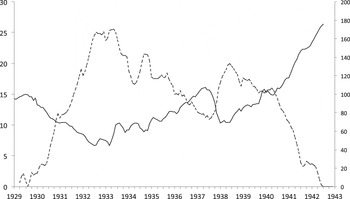
From 1933, the United States recovered from the depression, but in the summer of 1937, this recovery stopped abruptly. Unemployment was still well over 10%, but it began to rise rapidly and industrial production started to fall, as shown in Figure 1. Over the following four months, this turned into the most dramatic fall in output that the US had experienced, with the possible exception of 1920–21. This dramatic change challenged existing theories more profoundly than had the events of 1929, for it was not explicable in terms of existing theories of the cycle. To explain it, Hansen began arguing in terms of “secular stagnation,” a phrase he had used four years earlier, but without attaching any importance to it. In his Presidential Address to the American Economic Association (Hansen Reference Hansen1939), he explained the weakness of the recovery by adducing long-term structural factors that limited the opportunities for investment. In the nineteenth century, the expansion of the frontier, a key factor in the growth of the American economy, had provided massive outlets for investment, such as the development of railroads. In the early twentieth century, a series of capital-using innovations—electricity, the automobile—had also required high investment. But, by the 1930s, these sources of demand for investment were no longer available and, in addition, population was growing more slowly. All of this meant that opportunities for investment were limited. Lack of investment demand could explain the weakness of the recovery. Though Hansen had not abandoned the business cycle framework for thinking about the problem of unemployment, his focus on structural change was moving away from it. The Second World War, in which military expenditure accounted for over 40% of national income, half of which corresponded to a government deficit, completed the shift.
Unemployment and Manufacturing Output, 1929–1943.
Source: Macro history database at www.nber.org. Unemployment percentages (broken line, left axis) are from the NBER Macro history database; Manufacturing production, 1929=100 (solid line, right axis) is from Robert J. Gordon’s data on the same website. Figures are monthly. The peak in July 1937 is 104, when unemployment was at 11%. Note that these are modern statistics.

III. PAUL SAMUELSON
By 1938, when he gave his Presidential Address, Hansen was sympathetic to Keynesian ideas, but he remained very critical of Keynes. To someone who had completely accepted Aftalion’s income theory, developing a dynamic theory of the cycle, the General Theory seemed very static and missing the important factors. A major component in Hansen’s business cycle theory was the accelerator, for it was a dynamic theory that fitted well with Aftalion’s theory of the income flows. As Hansen began to take Keynes more seriously, he put Keynes’s concept of the multiplier together with the accelerator to produce a theory that he analyzed using a series of numerical examples. Assuming that the multiplier was ½ and the accelerator was 2, he found to his surprise that income went into decline, and he thought that it could possibly explain the 1937 recession, when the downturn occurred a long way from full capacity output (Samuelson Reference Samuelson1959).
He discussed this problem with Paul Samuelson, then aged twenty-two and a Junior Fellow who had just completed his coursework at Harvard in 1937. Though he had studied business cycle theory with Joseph Schumpeter and Gottfried Haberler, he had been studying dynamics independently of any interest in business cycle theory. Samuelson recognized Hansen’s system as a difference equation that would produce repeated oscillations, something Hansen would have discovered had he worked through his example for more periods. Samuelson formulated the model algebraically, generalized it for any values of the multiplier and accelerator, and solved it, working out combinations of multiplier and accelerator that would produce stability, instability, or periodic fluctuations.
Samuelson acknowledged Hansen’s help on the first page of the article in which he wrote this up, “Interactions between the Multiplier Analysis and the Principle of Acceleration” (1939a), saying that the paper had been written at his suggestion and that “Professor Hansen has developed a new model sequence which ingeniously combines the multiplier analysis with that of the acceleration principle or relation” (p. 75). The paper is well known, but several important features of the way Samuelson developed the theory are not. He was critical of the way the concept of the multiplier, then a new and unfamiliar term, was being used, expressing fear that “this extremely simplified mechanism” might be hardening into a dogma, “hindering progress and obscuring important subsidiary relations and processes” (1939a, p. 75). Moreover, “the conventional multiplier sequences [were] special cases of the more general Hansen analysis” (p. 76). He reiterated this point by saying that “the Keynes–Kahn–Clark formula” was “subsumed under the more general Hansen analysis.” In a footnote, he minimized the originality of the analysis by claiming that his model was formally identical to the model sequences analyzed by the Swedish economist Erik Lundberg and the Dutch econometrician Jan Tinbergen.
This makes it clear that when he wrote this paper, presumably in late 1938, Samuelson was following Hansen in fitting ideas that were coming to be associated with Keynes into the older framework of American business cycle theory. This was made even clearer in his second article on the subject (Samuelson Reference Samuelson1939b), published in the Journal of Political Economy in December. Where his previous paper had used the accelerator to complicate the theory of the multiplier, this one used the multiplier to add a missing element to business cycle theories based on the accelerator. The idea behind the multiplier was not new—the idea that “actual movements of consumer demand depend on the movements of purchasing power; and these in turn are governed by the rate of production in general” (Samuelson Reference Samuelson1939b, p. 786, quoting John Maurice Clark) was well established—but the mechanism and the mode of its interaction with the accelerator were not understood.
Samuelson related his theory to debates that took place in 1931–32 over the role of consumers’ spending in the cycle, involving Charles Hardy, Ragnar Frisch, and Clark, from the last of whom the previous quotation is taken. These writers, he claimed, realized that to explain fluctuations, it was necessary to explain both investment and saving, but while they formulated the acceleration principle very clearly, they were less clear on what determined consumption. This is where Keynes came in, providing a clear statement of the multiplier that could be placed alongside the accelerator to make a fully specified theory. The General Theory had been followed by work by Roy Harrod, Haberler, and Hansen, who brought the two concepts together into a theory that could explain turning points, and hence the cycle. However, there was no agreement, and their work contained many flaws. There was, for example, confusion over the roles of net and gross investment and about what caused the downturn at the top of the cycle.
After this brief review of the literature, Samuelson proceeded to cut through the confusion. His starting point was the consumption function. If consumption depended on current income, and given the level of net investment, only one level of income was consistent with business’s not making losses, for only at this level of income would the amount business received from consumers equal the amount they paid out to factors of production. Significantly, the diagram, later commonly known simply as “the 45-degree line diagram,” was labeled “Determination of the level of national income.” Though he did not point this out, the diagram could be seen as a summary of the central thesis of the General Theory. This derivation of what became, through Samuelson’s textbook, the most important representation of what Keynes had called the “principle of effective demand” thus came out of an attempt to incorporate the multiplier into a theoretical framework rooted in pre-Keynesian ideas. The diagram arose naturally in the course of Samuelson’s development and analysis of a theory that Hansen had developed.
If the multiplier alone could determine the equilibrium level of national income, “[t]he acceleration principle can determine the nature of the oscillations but not the average level of the system” (Samuelson Reference Samuelson1939b, p. 791, where this sentence is placed in italics). To make it possible to analyze dynamics, he then assumed that consumption depended on the previous period’s income, writing down the multiplier-accelerator model he had analyzed in his previous paper, reproducing the diagram that showed the range of possible outcomes. It turned out that the lag between consumption and income was necessary if the system was to generate cycles. Having performed this analysis, he could then sort out issues that Harrod had been unable to settle. For the first time, he defended Keynes against the claims found in American business cycle theory: “From the long-run point of view Keynes was partially justified in ignoring the acceleration principle completely. The average level of the system is independent of its operation, depending rather upon the level of investment outlets” (Samuelson Reference Samuelson1939b, p. 795). Of course, this was implicitly a highly qualified defense in that Keynes was not concerned with long-run growth, and Samuelson’s reference to “investment outlets” echoed Hansen, not Keynes.
In the early 1940s, Samuelson’s work inevitably turned to problems related to the wartime emergency, one of the main ones being public finance: the problem of analyzing the effects of public spending and the government deficit. He participated in discussions of the multiplier with other economists working for the government in Washington, writing papers that analyzed the multiplier independently of the cycle (Samuelson Reference Samuelson1942 and Reference Samuelson1943). The cycle played a much smaller role in his writing. When he taught this material in 1943, it was still under the heading of “Business Cycles,” and the course began with a section on the cycle, before he turned to the problem of aggregate demand. At the end of the war, Samuelson was tasked by his department with writing a new introductory textbook. In this book, the analysis of income was central for a different reason. He wanted to begin the book with material that would be familiar to his student readers, so he began with “individual and family incomes,” after which he turned to other types of income, such as business incomes. National income brought these different types of income, and hence different sectors of the economy, together. However, even in 1946, he was still proposing to discuss the business cycle before any discussion of national income. It was not until the published version that the now-familiar sequence in which business cycles are discussed after the determination of national income, and monetary and fiscal policy, was established.
IV. CONCLUSIONS
The cases of Alvin Hansen and Paul Samuelson show how, in the United States, it was possible to see the problem of the determination of output and employment in the context of the business cycle much later than was common in Britain. Immersed in a dynamic theory of the cycle, in which fluctuations in economic activity were linked to long-term factors underlying America’s economic growth—the closing of the frontier and major technological innovations such as electricity and motor vehicles—they were skeptical about static theories such as that found in Keynes’s General Theory. They drew on dynamic arguments to explain the development of the American economy right up to the Second World War. The shift away from that perspective took place only during wartime, when endogenous theories of the cycle were clearly irrelevant to explaining what was happening, for the crucial factor in explaining spending was no longer private investment but military spending by the federal government. The move to seeing the business cycle as secondary to the problem of income determination was also influenced by pedagogic considerations: the fact that national income could be used to integrate discussions of different sectors of the economy, making it natural to turn to the determination of national income before turning to the more complex problem of the cycle. In the “golden age,” in which business cycles were much milder than before the war, and in which there was a move towards demand-management policies, it became natural to see income determination as fundamental and to play down factors related to long-term growth. It was only with the macroeconomic turbulence of the 1970s that the business cycle was reinstated as being central to macroeconomics, and problems of economic growth once again became central to macroeconomics. In the new-classical world in which the concept of involuntary unemployment made no sense, and in which short-run fluctuations in output were attributed to “random” shocks, whether from monetary policy or technological change, the long run and problems of economic growth reasserted their importance.