Introduction
Currently, the global transition towards diets high in calories has contributed to 2.1 billion people becoming overweight or obese (Tilman and Clark, Reference Tilman and Clark2014). It is predicted that this will increase to two-thirds of the global burden of disease if dietary trends continue (Chew et al., Reference Chew, Ng, Tan, Kong, Lin, Chin, Lim, Huang, Quek, Fu, Xiao, Syn, Foo, Khoo, Wang, Dimitriadis, Young, Siddiqui, Lam and Wang2023). Reproductive abnormality is a common phenomenon in obese and dyslipidaemic individuals (Broughton and Moley, Reference Broughton and Moley2017). The abnormality of reproduction caused by obesity and abnormal lipid metabolism is related to many factors such as epigenetic disorders, DNA damage, or apoptosis induced by high reactive oxygen species (Rodríguez-González et al., Reference Rodríguez-González, Vega, Boeck, Vázquez, Bautista, Reyes-Castro, Saldaña, Lovera, Nathanielsz and Zambrano2015; Wen et al., Reference Wen, Han, Liu, Hao, Zhang, Wang, Zhou, Ma and Liang2020).
Traditionally, studies have mainly focused on the maternal effects on the health of offspring, while the effects of fathers has been ignored (Biagioni et al., Reference Biagioni, May and Broskey2021; Bhadsavle and Golding, Reference Bhadsavle and Golding2022). Recently, more and more studies have shown that paternal factors also closely affect the health of offspring (Jawaid et al., Reference Jawaid, Jehle and Mansuy2021; Bhadsavle and Golding, Reference Bhadsavle and Golding2022). Obesity induced by a high-fat diet (HFD) can reduce the number, activity and morphology of sperm in mice, and reduce the combination of capacitation and oocytes (Binder et al., Reference Binder, Hannan and Gardner2012). Factors such as paternal age and environmental stress exposure can also directly affect the phenotypes of offspring by inducing DNA damage or producing gene mutations (Godschalk et al., Reference Godschalk, Remels, Hoogendoorn, van Benthem, Luijten, Duale, Brunborg, Olsen, Bouwman, Munnia, Peluso, Mariman and van Schooten2018; Kaltsas et al., Reference Kaltsas, Moustakli, Zikopoulos, Georgiou, Dimitriadis, Symeonidis, Markou, Michaelidis, Tien, Giannakis, Ioannidou, Papatsoris, Tsounapi, Takenaka, Sofikitis and Zachariou2023). The offspring of obese fathers have higher risks of cancer and metabolic diseases, and are more likely to be related to epigenetic changes in sperm (Fontelles et al., Reference Fontelles, da Cruz, Gonsiewski, Barin, Tekmen, Jin, Cruz, Loudig, Warri and de Assis2021; Pascoal et al., Reference Pascoal, Geraldi, Maróstica and Ong2022). There is increasing evidence that direct non-genetic paternity effects can be transmitted via epigenetic factors in sperm such as DNA methylation, histone modification and non-coding RNA. Methylation of certain loci in the sperm epigenome can evade epigenetic reprogramming during embryogenesis, which may affect the epigenetic modification of disease-related genes, thereby transmitting adverse information to offspring and affecting their health.
Previous studies have reported that a HFD leads to stress in testicular cells (Deshpande et al., Reference Deshpande, Nemani, Pothani and Balasinor2019; Sertorio et al., Reference Sertorio, César, de Souza, Mennitti, Santamarina, De Souza Mesquita, Jucá, Casagrande, Estadella, Aguiar and Pisani2022). SETD 2, a key epigenetic gene that is highly conserved among species, is an important regulator of the response to stress (Liu et al., Reference Liu, Zhang, Chen, Jin, Zhang, Chen, Xie, Huang, Zhao, Wang, Xu, Chen, Chen, Li, Zhang and Sun2020; Zhu et al., Reference Zhu, Yang, Lu, Wang, Tong, Li, Liu, Bao, Xu, Gu, Yuan, Liu and Zhu2021). SETD2 protein is a crucial methyltransferase for converting H3K36me2 into H3K36me3, thereby altering the chromatin structure state and promoting transcription extension. In addition, SETD2/H3K36me3 can play a role in regulating gene transcription by effecting variable splicing of mRNA, inhibiting hidden transcripts, recruiting m6A methyltransferase METTL14 to guide RNA methylation modification, mediating DNA damage and repairing functions (Molenaar and van Leeuwen, Reference Molenaar and van Leeuwen2022). Mutations in the SETD 2 gene occur in many human tumours, leading to chemotherapy resistance and a poor prognosis by mediating DNA damage and repair function, or an epigenetic state (Zhang et al., Reference Zhang, Zhang, Wu, Wang, Lv, Zhao, Wang, Liu and Zhang2023). The adverse effects of offspring caused by paternal high-fat related to SETD2/H3K36me3 are unknown. In this study to test this hypothesis, we compared the patterns of H3K36me3 in pre-implantation embryos derived from normal or obese mice induced by high diet, and could throw new light on the effects of paternal obesity on offspring from an epigenetic perspective.
Materials and methods
Animals
Four-week-old male Institute of Cancer Research mice (ICR; CD-1 mice) mice were randomly assigned to receive either a CD containing 10% of the kcal as fat or an HFD containing 60% of the kcal as fat for 8 weeks. Then the males from each group were mated with 12-week-old female oestrous mice fed the CD. Mice were maintained under controlled temperature (22°C ± 1°C) and humidity conditions with a 12 h:12 h light:darkness cycle. All offspring mice were fed the CD.
Collection of embryos
Twelve-week-old female ICR mice were injected with 5 IU serum gonadotrophin (NSHF, Ningbo, China), followed by an injection of 5 IU of chorionic gonadotrophin after 48 h, and then mated with males from the CD or HFD group. The next morning, the female mice were used for collecting embryos. Embryos at the 1-, 2-, 4-, 8-, and 16-cell stages, and the morula stage were collected from the oviduct, and embryos at the blastocyst stage were collected from the uterus.
RNA extraction, cDNA synthesis and real-time PCR
Total RNA was extracted from embryos using the Cells-to-Signal Kit (Invitrogen, Carlsbad, CA, USA). Reverse transcription to cDNA using PrimeScript RT Reagent Kit (TaKaRa). Real-time PCR was performed using a CFX96 real-time PCR detection system (Bio-Rad) using SYBR Premix Ex TaqII (TaKaRa) as previously described (Qu et al., Reference Qu, Luo, Du, Zhang, Song, Yuan, Lin, Li and Liu2020). Fifteen embryos per group were processed in each replicate.
Immunofluorescence
Immunofluorescence was performed as previously described (Qin et al., Reference Qin, Qu, Hu, Cao, Liu, Zhang, Zhao, Nazira and Liu2021). Briefly, embryos were fixed in 4% paraformaldehyde in phosphate-buffered saline (PBS) for 1 h, then treated with 0.1% Triton X-100 for 30 min. After blocking with 1% bovine serum albumin (BSA) for 2 h at RT, the embryos were incubated with anti-H3K36me3 antibody (Abclonal) overnight at 4°C. The embryos were washed in TBST for 5 min and incubated for 2 h with Alexa Fluor 488-labelled secondary antibody (Abclonal) at RT. After washing with TBST for 5 min, the DNA was stained with 4′,6-diamidino-2-phenylindole (DAPI) for 5 min, the embryos were mounted on slides, and imaged under a fluorescence microscope (Nikon, Eclipse Ti-S, Tokyo, Japan).
Statistical analysis
Body weight, relative level of mRNA and relative fluorescence intensity were determined and compared by unpaired Student’s t-test using Graph Pad Prism software (version 9; Graph Pad Inc.; San Diego, CA, USA). A P-value < 0.05 was considered statistically significant. All the data are presented as mean ± standard error of the mean (SEM).
Results
Female F0 mice mated with HFD males had abnormal SETD2 expression in pre-implantation embryos
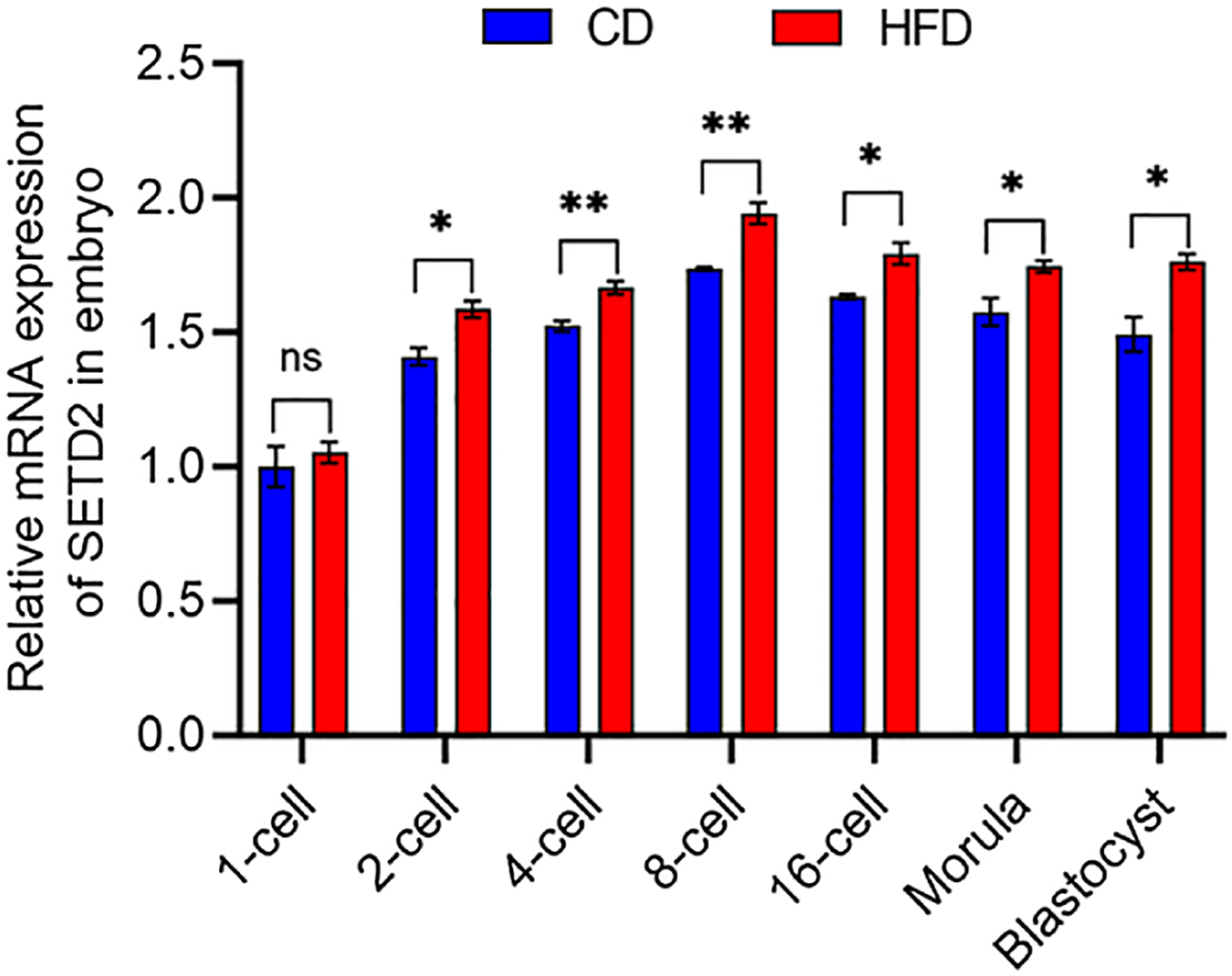
F0 male mice from CD and HFD group were mated with CD females, and the relative expression of SETD 2 mRNA from embryos at the pre-implantation stage was measured and no significant difference was seen between the two groups at the 1-cell stage. At the 2-, 4-, 8-, and 16-cell stages, and the morula and blastocyst stages, SETD 2 mRNA was significantly higher in the HFD group than in the CD group (Figure 1).
Paternal HFD caused abnormal SETD2 expression in pre-implantation embryos.
Relative mRNA expression of SETD2 between the two groups at the 1-, 2-, 4-, 8-, and 16-cell stage, and the morula and blastocyst stages. **Above the bars indicates P < 0.01, and *above the bars indicates P < 0.05.

Paternal HFD did not significantly alter H3K36me3 of embryo at the 1-cell stage
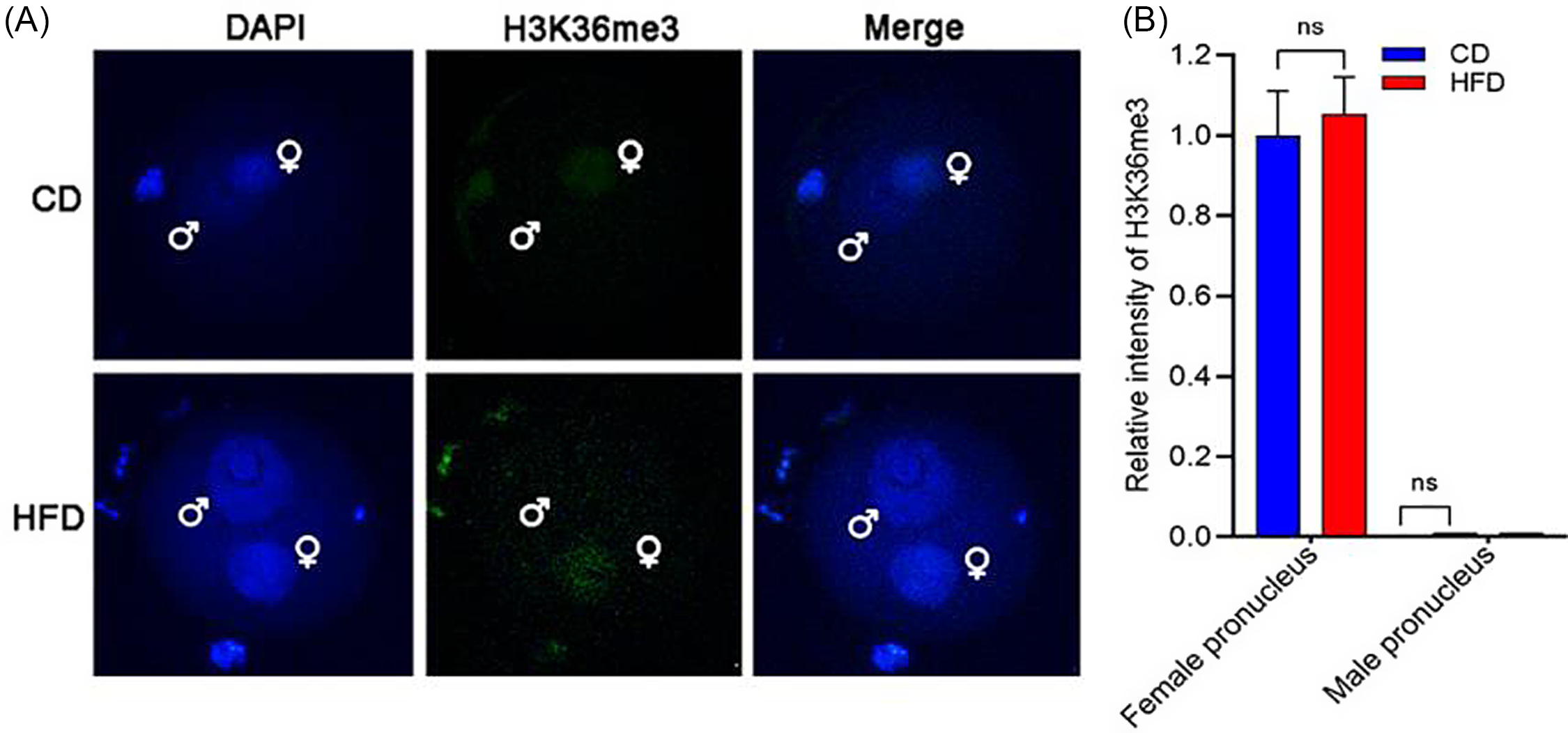
F0 male mice from CD and HFD groups were mated with CD females, and the relative level of H3K36me3 in pre-implantation embryos showed no significant difference between the two groups at the 1-cell stage, and almost no H3K36me3 was detected in the male pronucleus (Figure 2A,B).
No significant change of H3K36me3 pattern of embryo at the 1-cell stage between paternal HFD or CD.
(A) Staining pattern for H3K36me3 in embryos at the 1-cell stage, (B) and relative fluorescence intensity of H3K36me3 in embryos at the 1-cell stage. Green: H3k36me3; blue: DNA.

Female F0 mice mated with HFD males had abnormal H3K36me3 in pre-implantation embryos
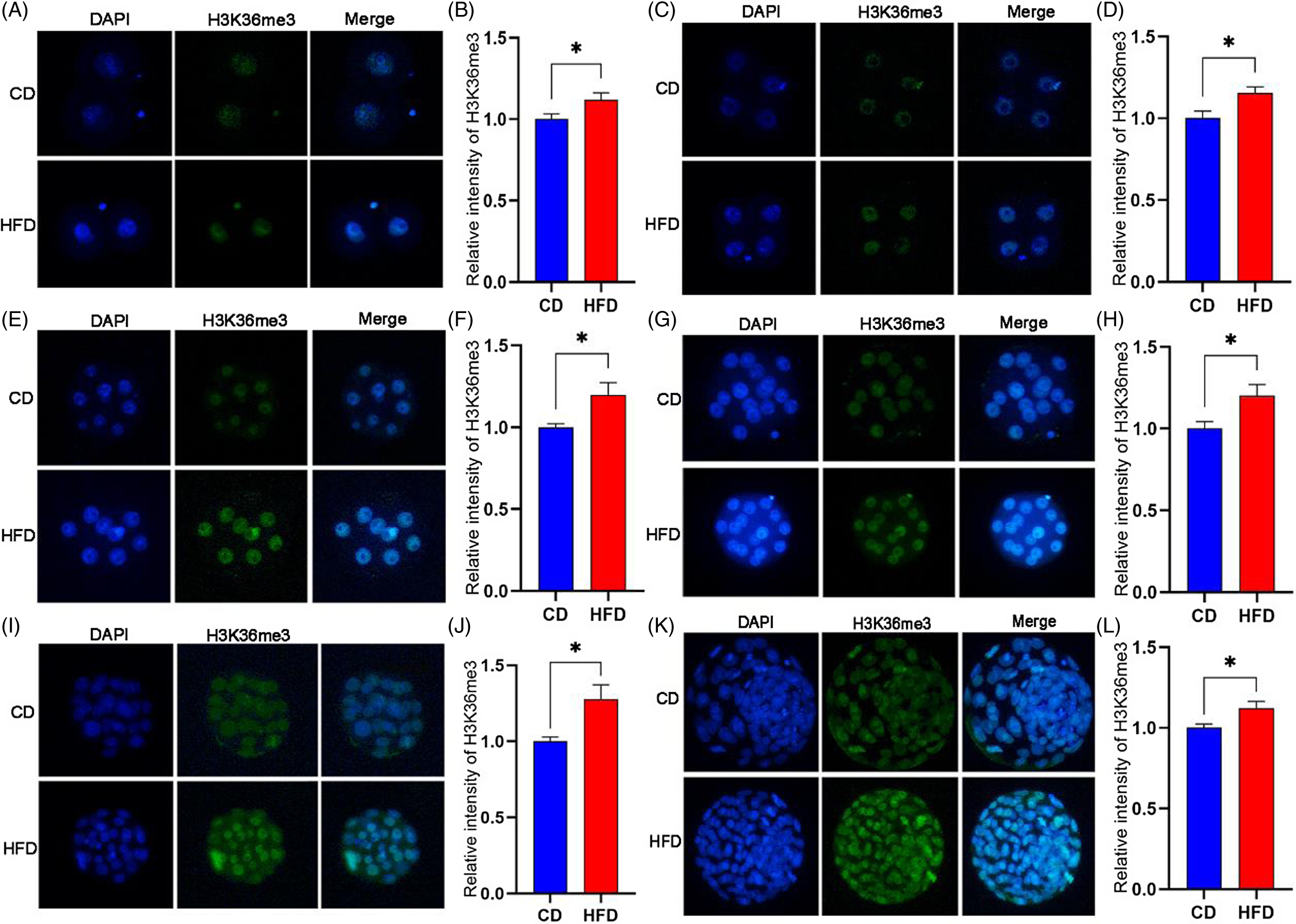
F0 male mice from CD and HFD groups were mated with CD females, and the relative level of H3K36me3 embryos at the 2-cell, 4-cell, 8-cell, 16-cell, morula stage, and blastocyst stage. The results showed that relative levels of H3K36me3 in the HFD group at the 2-cell (Figure 3A,B), 4-cell (Figure 3C,D), 8-cell (Figure 3E,F), 16-cell (Figure 3G,H), morula stage (Figure 3I,J), and blastocyst stage (Figure 3K,L), were significantly higher than in the CD group.
Paternal HFD caused abnormal H3K36me3 in pre-implantation embryo.
Staining pattern for H3K36me3 in embryos at the 2-cell (A), 4-cell (C), 8-cell (E), 16-cell (G), morula (I), and blastocyst stages (K). Green: H3k36me3; blue: DNA. Relative fluorescence intensity of H3K36me3 in embryos at the 2-cell (B), 4-cell (D), 8-cell (F), 16-cell (H), morula (J), and blastocyst stage (L). *Above the bars indicates P < 0.05.

Discussion
It is well known that sperm mainly carry DNA, a specialized cell that provides half the genome required to produce healthy offspring. However, we now know that sperm carry more than a set of haploid chromosomes. Clinical and biomedical studies have shown that epigenetic factors, such as non-coding RNAs, histone posttranslational modifications, and DNA methylation, carried by sperm can significantly affect the health of offspring (King and Skinner, Reference King and Skinner2020). Paternal stress could lead to abnormal expression of imprinted genes in placenta (Choufani et al., Reference Choufani, Turinsky, Melamed, Greenblatt, Brudno, Bérard, Fraser, Weksberg, Trasler and Monnier2019). For example, placenta of offspring derived from obese males exhibited an anomalous expression of imprinted genes such as IgF 2, Peg 3, Peg 9, and Peg 10 (Mitchell et al., Reference Mitchell, Strick, Strissel, Dittrich, McPherson, Lane, Pliushch, Potabattula, Haaf and El Hajj2017). During spermatogenesis, histones are replaced by transition proteins and then by protamine, and a small fraction of human sperm chromatin escape this remodelling. The remaining sperm histone modifications are transferred to the embryo and suggest that their effects extend beyond fertilization. Patterns of trimethyl histone H3 lysine 4 (H3K4me3) or dimethylhistone H3 lysine 9 (H3K9me2) in sperm were altered by a paternal HFD (Pepin et al., Reference Pepin, Lafleur, Lambrot, Dumeaux and Kimmins2022). The inheritance of these epigenetic changes could directly affect chromatin accessibility, affecting the transcription and then regulating cell lineage differentiation and development. The changed pattern of histones in sperm can alter the dynamics of chromatin and delay the activation of the embryonic genome. Abnormal changes of H3K4me3 in sperm are mainly located at transcriptional active sites, which control inflammation and metabolism, all of which are transcriptional dysfunctions in placenta (Pepin et al., Reference Pepin, Lafleur, Lambrot, Dumeaux and Kimmins2022). Paternal high-sugar altered H3K9me3 and H3K27me3 deposition in the zygote, which was associated with obesity susceptibility (Öst et al., Reference Öst, Lempradl, Casas, Weigert, Tiko, Deniz, Pantano, Boenisch, Itskov, Stoeckius, Ruf, Rajewsky, Reuter, Iovino, Ribeiro, Alenius, Heyne, Vavouri and Pospisilik2014).
H3K36me3 is present at transcribed genes, peaking toward the middle and 3′ ends of coding regions but mostly missing from promoters (Zhang et al., Reference Zhang, Cooper and Brockdorff2015). Broad exclusive distribution of H3K36me3 over active euchromatin may prevent the spreading and accumulation of silencing marks (Molenaar and van Leeuwen, Reference Molenaar and van Leeuwen2022). It is worthwhile to interrogate regions enriched in H3K36me3, such as those involved in maintaining X-linked gene expression and X chromosome inactivation, which is closely related to the risk of offspring diseases (Ohhata et al., Reference Ohhata, Matsumoto, Leeb, Shibata, Sakai, Kitagawa, Niida, Kitagawa and Wutz2015). SETD2-mediated H3K36me3 is optional for early embryonic development in zebrafish, while SETD2/H3K36me3 is involved in the regulation of germ cell differentiation in Drosophila (Liu et al., Reference Liu, Zhang, Chen, Jin, Zhang, Chen, Xie, Huang, Zhao, Wang, Xu, Chen, Chen, Li, Zhang and Sun2020). In mice, zygotic SETD2 defective embryos stagnate at E10.5–E11.5, and maternal or paternal SETD2 regulates oocyte maturation and spermatogenesis, respectively (Hu et al., Reference Hu, Sun, Zhang, Kuang, Hu, Wu, Shen, Du, Li, He, Xiao, Wang, Liu, Lu, Huang, Chen and Chen2010; Xu et al., Reference Xu, Xiang, Wang, Wang, Brind’Amour, Bogutz, Zhang, Zhang, Yu, Xia, Du, Huang, Ma, Zheng, Li, Liu, Walker, Jonasch, Lefebvre and Xie2019). Knockdown of SETD 2 through RNAi also inhibits blastocyst formation and disturbs lineage differentiation (Shao et al., Reference Shao, Ning, Liu, Zou, Yao, Kang and Cao2022). H3K36me3 is a rich and conservative epigenetic factor that plays an important role in mediating developmental stress. The viability and developmental ability of embryos exhibiting abnormal H3K36mp3 patterns are reduced, even fatal. A paternal HFD causes testicular tissue cells to be in a stress state, which is negative for embryonic development. Whether H3K36me3, as a conservative epigenetic modification in response to environmental stimuli, is involved in this regulation remains unclear. Here we compared the changes in H3K36me3 at the zygotic stage between the two groups, and found no H3K36me3 enrichment in the male pronucleus. Also, there was no significant difference in SETD2 expression between the HFD and CD group. Previous studies have found that H3K36me3 was mainly enriched in female pronuclei but not in male pronuclei during the zygotic stage (Xu et al., Reference Xu, Xiang, Wang, Wang, Brind’Amour, Bogutz, Zhang, Zhang, Yu, Xia, Du, Huang, Ma, Zheng, Li, Liu, Walker, Jonasch, Lefebvre and Xie2019; Deng et al., Reference Deng, Chen, Liu, Cai, Wan, Zhou and Wang2020). These results suggest that it did not seem to have an important effect on the content of H3K36me3 in embryos at the one-cell stage.
In diploid mouse embryos, SETD 2 is derived from both paternal and maternal gametes (Xu et al., Reference Xu, Xiang, Wang, Wang, Brind’Amour, Bogutz, Zhang, Zhang, Yu, Xia, Du, Huang, Ma, Zheng, Li, Liu, Walker, Jonasch, Lefebvre and Xie2019). As with most genes, expression of SETD 2 in embryos before zygotic gene activation (ZGA) should be mainly maternal, while after ZGA, paternal and maternal sources jointly determine the embryonic expression level of SETD2 (Xu et al., Reference Xu, Xiang, Wang, Wang, Brind’Amour, Bogutz, Zhang, Zhang, Yu, Xia, Du, Huang, Ma, Zheng, Li, Liu, Walker, Jonasch, Lefebvre and Xie2019). Therefore, both paternal and maternal SETD2 play important roles in embryonic development. Conditional knockout of SETD 2 in testis results in failure to form sperm, while knockout or knockdown of SETD2 in oocytes causes abnormal oocyte development and embryonic lethality (Li et al., Reference Li, Diao, Qiu, Jiang, Li, Han, Li, Hou, Ge, Ou, Liu and Wang2018; Zuo et al., Reference Zuo, Rong, Li, Lv, Lan and Tong2018; Xu et al., Reference Xu, Xiang, Wang, Wang, Brind’Amour, Bogutz, Zhang, Zhang, Yu, Xia, Du, Huang, Ma, Zheng, Li, Liu, Walker, Jonasch, Lefebvre and Xie2019). Our results showed no significant changes in the relative levels of SETD2 and H3K36me3 in embryos at the one-cell stage (before ZGA) between the two groups, which suggest that paternal SETD2 may not be expressed at this stage. The relative levels of SETD2 and H3K36me3 in embryos were significantly higher in the HFD group compared with CD after ZGA at the 2-, 4-, 8-, and 16-cell stages, and the morula, and blastocyst stages, which suggests that paternal SETD2 may be expressed after ZGA. The results seem to indicate that a paternal HFD can alter embryonic SETD2 expression and affect the H3K36me3 pattern in embryos.
Both overexpression and underexpression of the SETD 2 gene appeared to have deleterious effects. Reducing the SETD2–H3K36me3 level could increase DNA damage and apoptosis in early embryos, while decreasing the SETD2–H3K36me3 level significantly improved the developmental capability of cloned embryos (Wei et al., Reference Wei, Antony, Meng, MacLean, Rhind, Laible and Oback2017; Li et al., Reference Li, Huang and Gu2020). Previous studies have demonstrated that SETD2–H3K36me3 has an important role in reproductive development, immune response, metabolism, vascular remodelling, and tumorigenesis (Hu et al., Reference Hu, Sun, Zhang, Kuang, Hu, Wu, Shen, Du, Li, He, Xiao, Wang, Liu, Lu, Huang, Chen and Chen2010; Chen et al., Reference Chen, Liu, Liu, Xia, Zhang, Han, Jiang, Wang and Cao2017; Xu et al., Reference Xu, Xiang, Wang, Wang, Brind’Amour, Bogutz, Zhang, Zhang, Yu, Xia, Du, Huang, Ma, Zheng, Li, Liu, Walker, Jonasch, Lefebvre and Xie2019; Liu et al., Reference Liu, Zhang, Chen, Jin, Zhang, Chen, Xie, Huang, Zhao, Wang, Xu, Chen, Chen, Li, Zhang and Sun2020). Some studies have reported that paternal HFD significantly increased the risk of metabolic disease and other abnormalities in offspring (Terashima et al., Reference Terashima, Barbour, Ren, Yu, Han and Muegge2015; de Castro Barbosa et al., Reference de Castro Barbosa, Ingerslev, Alm, Versteyhe, Massart, Rasmussen, Donkin, Sjögren, Mudry, Vetterli, Gupta, Krook, Zierath and Barrès2016; Park et al., Reference Park, Yoo, Cho, Lim, Lindroth and Park2018). Here we found that an abnormal SETD2 expression and H3K36me3 profile in pre-implantation embryos was induced by paternal HFD, which might be related to abnormalities and disease in offspring; more research is needed to elucidate the mechanism of this effect.
In conclusion, male F0 mice fed an HFD showed abnormal SETD 2 expression, as well as abnormal H3K36me3 levels in pre-implantation embryos, suggesting that dietary changes in F0 male mice fed an HFD were traceable in SETD 2/H3K36me3 of embryos.
Data availability
The data that support the study findings are available from the corresponding author upon reasonable request.
Acknowledgements
Not applicable.
Authors’ contribution
BM, and EL conceived the presented idea. BM, JH, PQ, WC, YZ, YX and JQ carried out the experiments. BM wrote the manuscript with support from SL, CS, JZ and EL. All authors read and approved the final manuscript.
Funding
This work was supported as part of a project funded by the National Natural Science Foundation of China under grant nos. 32100649 and 82270496, and by the Natural Science Foundation of Shaanxi Province under grant nos. 2020PT-001, 2021PT-039, and 2021PT-050.
Competing interests
The authors declare no conflict of interest.
Ethical standard
All animal protocols were reviewed and approved by the Xi’an Jiaotong University Animal Care and Use Committee. The experimental protocol was carried out in accordance with the National Institutes of Health Guide for Care.