Introduction
There has been concern since the 1970s that the prevalence of mental disorders is increasing (Compton et al. Reference Compton, Conway, Stinson and Grant2006; Marcus & Olfson, Reference Marcus and Olfson2010). The National Psychiatric Morbidity Survey (NPMS) programme (www.mentalhealthsurveys.co.uk/) includes repeated large-scale, cross-sectional household surveys of the English adult population, carried out in 1993, 2000 and 2007, with standardized and essentially unchanged methods of evaluation (Jenkins & Meltzer, Reference Jenkins and Meltzer1995; Meltzer et al. Reference Meltzer, Gill, Petticrew and Hinds1995; Singleton et al. Reference Singleton, Bumpstead, O'Brien, Lee and Meltzer2000; Jenkins et al. Reference Jenkins, Meltzer, Bebbington, Brugha, Farrell, McManus and Singleton2009; McManus et al. Reference McManus, Meltzer, Brugha, Bebbington and Jenkins2009). This programme was intended to monitor the mental health of people living in private households in England to inform government mental health policy. Because it involves repeated cross-sectional surveys, it is possible to compare the health experience of successive birth cohorts, resampled as they aged over a 15-year period. Recent analyses of the adult household sample of the NPMS (Spiers et al. Reference Spiers, Bebbington, McManus, Brugha, Jenkins and Meltzer2011) have found no clear trend in common mental symptoms or disorders, suggesting that the prevalence of common mental disorders (CMDs) was unchanged in successive cohorts, at least in men born since 1950.
CMDs comprise different types of depression and anxiety. This study concentrates on the ICD-10 category of depressive episode (WHO, 1992) (roughly equivalent to major depressive disorder in DSM-IV), the most disabling of the CMDs, in terms both of symptoms and of impairment of social functioning (Hurry & Sturt, Reference Hurry, Sturt, Wing, Bebbington and Robins1981). There are clear indications for treatment, but undertreatment is common, and the consequences of non-treatment are likely to be considerable (Bebbington et al. Reference Bebbington, Brugha, Meltzer, Farrell, Ceresa, Jenkins and Lewis2000a , Reference Bebbington, Brugha, Meltzer, Jenkins, Ceresa, Farrell and Lewis b ; Meltzer et al. Reference Meltzer, Bebbington, Brugha, Farrell, Jenkins and Lewis2000; NICE, 2010). Given that there have been major increases in treatments targeted on depression (Brugha et al. Reference Brugha, Bebbington, Singleton, Melzer, Jenkins, Lewis, Farrell, Bhugra, Lee and Meltzer2004; Moore et al. Reference Moore, Yuen, Dunn, Mullee, Maskell and Kendrick2009), we might expect to find reductions in prevalence since the early 1990s. Specific investigation of changes in prevalence of depressive episode is therefore merited.
For this study, we used NPMS data to describe age profiles and cohort differences in major depressive disorder and depressive symptoms, with the null hypothesis that successive birth cohorts experience the same prevalence of depression as they age.
Method
Data source
The methods used for the three national surveys have been described in detail elsewhere (Meltzer et al. Reference Meltzer, Gill, Petticrew and Hinds1995; Singleton et al. Reference Singleton, Bumpstead, O'Brien, Lee and Meltzer2000; McManus et al. Reference McManus, Meltzer, Brugha, Bebbington and Jenkins2009). Adults living in private households in England were sampled using population-based, multi-phase probability sampling, and interviewed in the first phase by lay interviewers. Although improvements were made in successive surveys, the emphasis was on using identical instruments wherever possible. Stratification of primary sampling units by region and socio-economic characteristics was more fine-grained in 2007 than in 2000 and 1993, but in each case data were weighted to represent the English household population at the time of each survey. Sample sizes were designed to have the statistical power required for estimating the prevalence of rare disorders (0.5–1.0%), by age, sex and region, and therefore have sufficient power to analyse prevalence of depression by age, sex and birth cohort.
Data on depression were available at all three time-points using identical questions. Fieldwork was carried out between April and September 1993, between March and September 2000, and between October 2006 and December 2007. Response rates for the household NPMS were 79% in 1993, 69% in 2000, and 57% in 2007. The paper-and-pencil questionnaires used in 1993 were replaced by computer-assisted interviewing in subsequent surveys, but this is not thought to have had a substantial effect upon the results (Baker et al. Reference Baker, Bradburn and Johnson1995).
Ethical approval
We were advised that ethical approval was not required for the Adult Psychiatric Morbidity Survey (APMS) 1993. Ethical approval was obtained for APMS 2000 and APMS 2007 from Research Ethics Committees of the National Research Ethics Service appropriate for non-clinical populations.
Measures
Depression was assessed using the Clinical Interview Schedule – Revised (CIS-R; Lewis et al. Reference Lewis, Pelosi, Araya and Dunn1992) in all three surveys. In 1993 and 2000, the CIS-R was in an early section of the interview. In 2007, it came slightly later, after sections on health, caring, activities of daily living and medication. The CIS-R is a structured schedule, designed for lay interviewers. Questions refer to symptoms experienced in the past week or month. The participants' answers to the CIS-R were used to define the ICD-10 diagnosis of depressive disorder. The CIS-R does not differentiate between single and recurrent episodes, so this measure includes depressive episode (F32) and recurrent depressive disorder (F33) (McManus et al. Reference McManus, Meltzer, Brugha, Bebbington and Jenkins2009). In addition, we analysed the prevalence of the CIS-R symptoms of depression (score on depression subscale ⩾2; this asks whether respondents are miserable or depressed or unable to take an interest in things) and of depressive ideas (score on subscale ⩾2; this measures feelings of guilt and hopelessness, and how depression affects daily activities) (see Appendix).
Participants
Data were weighted to allow for survey design and differences in non-response by age, sex, region and socio-economic status, so that results are representative of the English household population of comparable age at the time of survey (McManus et al. Reference McManus, Meltzer, Brugha, Bebbington and Jenkins2009). The lower age limit was 16 years in all three surveys, the upper age limit was 64 years in 1993 and 74 years in 2000, and there was no upper age limit in 2007. Because of the 7-year gaps between surveys, nine 7-year birth cohorts were defined, based on participants' ages at the time of the respective surveys. These covered birth dates from 1929 to 1991, and nine age groups from 16–22 years to 72–78 years. Birth cohort attribution is approximate, insofar as precise birth dates were not available. Those aged 72–74 years in the 2000 survey were excluded from the pseudo-cohort analysis because they did not form a complete 7-year birth cohort. Those aged ⩾79 years when interviewed in 2007 were also excluded, as these cohorts were only sampled once and were strongly selected by survival, making interpretation difficult.
Statistical analysis
The challenges posed by the pseudo-cohort analysis are discussed in more detail in our earlier paper (Spiers et al. Reference Spiers, Bebbington, McManus, Brugha, Jenkins and Meltzer2011). It is difficult to separate age, period and cohort effects statistically, as this usually requires assumptions beyond what the data allow (Klermann & Weismann, Reference Klermann and Weismann1989; Smith, Reference Smith2008). Our approach is to carry out an age–period–cohort analysis using a constraint-based approach, as described by Keyes et al. (Reference Keyes, Utz, Robinson and Guohua2010). We conceptualize cohort differences in depression as arising from common influences on the experience of birth cohorts at key moments of development. Period effects are conceptualized as contemporaneous influences that potentially confound the relationship between birth cohort and prevalence. In the logistic regression modelling, period effects are constrained to be zero, to estimate age and cohort effects. The validity of our constraint cannot be tested empirically, but we do examine its plausibility by reference to side information both within and extra to the NPMS dataset, for example prevailing economic conditions, indicated by changes in the rate of unemployment, and changes in health service use.
Men and women were analysed separately. The weighted prevalence of depression was graphed by age (the midpoint of the 7-year age group) and birth cohort. The SVY logistic procedure in Stata 11.0 for Windows (Stata Corporation, USA) was used to fit logistic regression models for age and birth cohort, taking into account the complex survey design. The final model was chosen using backwards selection to determine the adjustment for age, starting with cubic age. Using the age midpoint for each 7-year age group, the linear effect of age, together with indicator variables for the 7-year birth cohort, was forced into the model. Thus, all models included a linear effect of age, and quadratic and cubic effects of age were included where statistically significant at the 5% level. Models were compared using the adjusted Wald test with a two-sided 5% significance level. Differences in prevalence of depression were estimated between successive pairs of birth cohorts. Smoothed profiles of depression prevalence by age were plotted for the median cohort, born 1957–1963.
Results
Sample characteristics
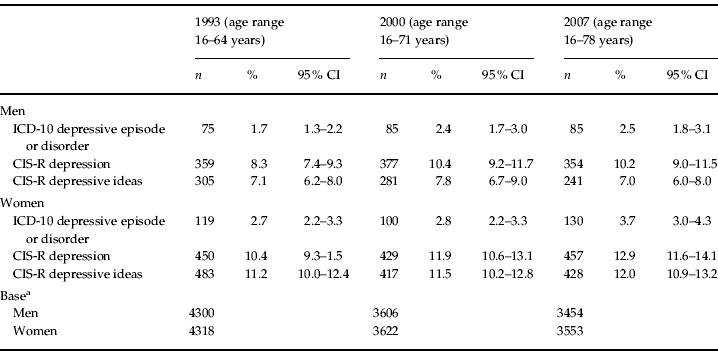
A total of 8670 adults aged 16–64 years were interviewed in English private households in 1993, 6799 adults aged 16–71 years in 2000, and 6815 adults aged 16–78 years in 2007. The prevalence of depression by sex and survey is given in Table 1. Overall prevalence increased between 1993 and 2001 in men, but then scarcely changed between 2000 and 2007. Prevalence of depressive episode in women was increased in 2007, relative to the earlier surveys. Missing items were minimal and did not affect the conclusions.
Prevalence of depression by sex and year of surveyFootnote a

CIS-R, Clinical Interview Schedule – Revised; CI, confidence interval.
a Data are weighted to represent the English household population of comparable age.
Age cohort models for depression
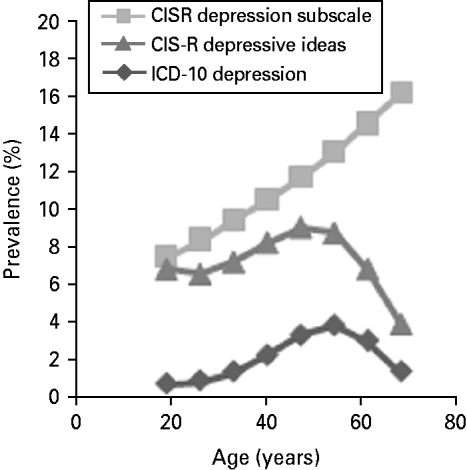
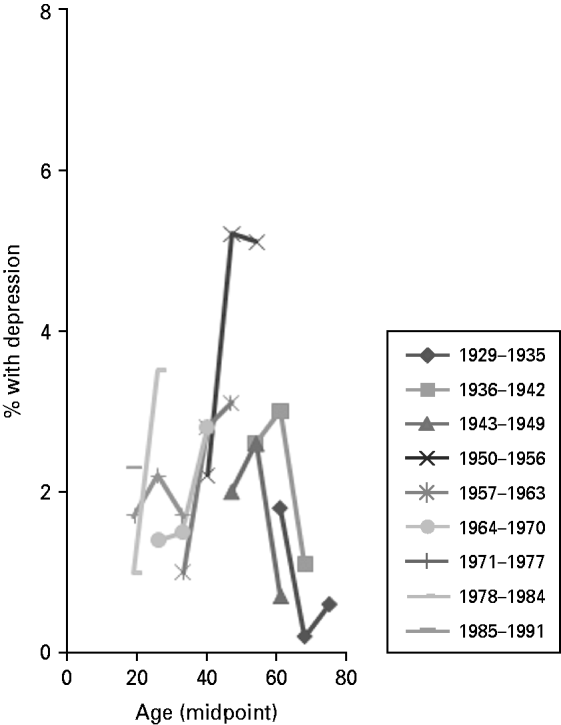
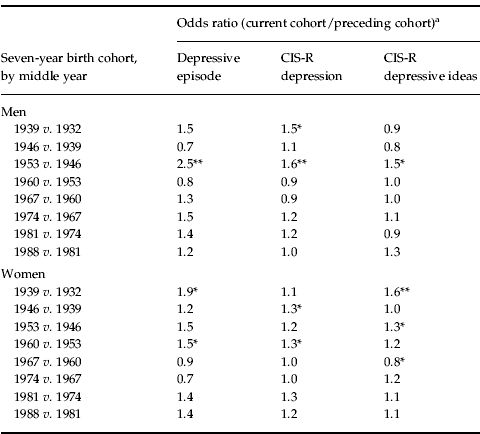
Male rates of depressive episode and CIS-R depressive ideas peaked in middle age (Fig. 1), whereas rates of the CIS-R symptoms of depression continued to rise across the older age groups. The cohort of people born between 1950 and 1956 had significantly higher rates of depression than their precursors born between 1943 and 1949, across all three depression measures (Table 2). Age-specific rates of depression were then relatively stable across all cohorts born after 1956, with the possible exception of depressive disorder. The latter showed consecutive but non-significant increases in prevalence across all four pairs of cohorts from 1964–1970 to 1985–1991. The models for the CIS-R depressive symptom scales support a step change in prevalence in men, with the cohorts born before 1949 having low rates and subsequent cohorts higher rates. For depressive episode, however, it is less clear whether there was a step change, or just an unusually high prevalence in the cohort born 1950–1956 (Fig. 2).
Predicted age profiles of depression from age–cohort models: men. Profiles were for the median cohort born 1957–1963. CIS-R, Clinical Interview Schedule – Revised.

Prevalence of ICD-10 depressive episode or disorder by age and birth cohort: men.

Birth cohort differences in depression, NPMS 1993, 2000 and 2007, adjusted for ageFootnote a

NPMS, National Psychiatric Morbidity Survey; CIS-R, Clinical Interview Schedule – Revised.
a Adjusted for linear trend with age, with the exception of depressive episode and CIS-R depressive ideas in men (adjusted for cubic age).
* p<0.05, ** p<0.01, *** p<0.001.
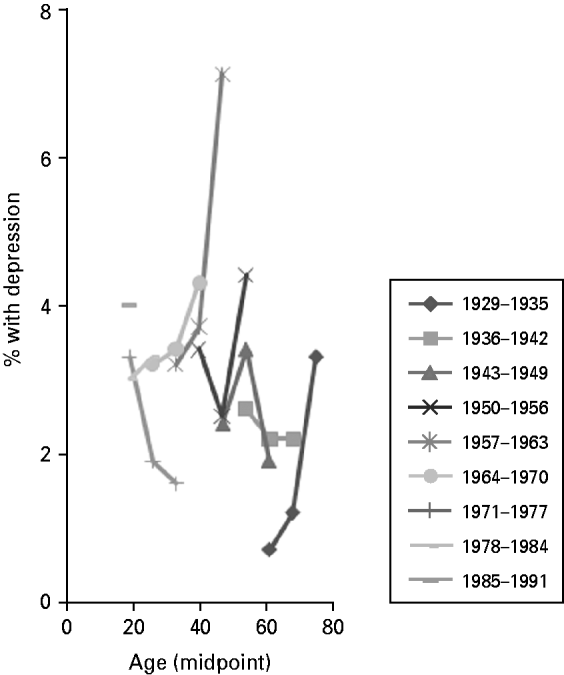
The most notable feature of the prevalence of depression in the female population is very high rates across all three measures in the cohort born between 1957 and 1963, when surveyed in 2007 aged 44–50 years. For example, the prevalence of depressive episode in this age–sex group was 7.1% (Fig. 3), compared to 5.1% predicted by the age–cohort model. This contrasts with the male population, where prevalence for those born in 1957 to 1963 was consistent with the rates in younger cohorts. Because the high prevalence in women aged 44–50 years in 2007 was potentially influential, a sensitivity analysis was carried out with the addition of an indicator variable to allow for the increased rates in this age–sex group in 2007.
Prevalence of ICD-10 depressive episode or disorder by age and birth cohort: women.

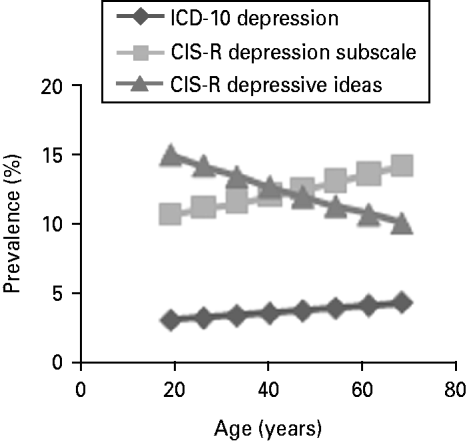
In the female population, the predicted prevalence of depressive episode showed a statistically significant increase with age, but this was largely due to the outlying value for women aged 44–50 years in 2007. When the outlying group was accounted for in the model, the prevalence of depression was unchanged with age, at around 3–4% (Fig. 4). There was no evidence of age changes in the prevalence of the CIS-R symptoms of depression and depressive ideas.
Predicted age profiles of depression from age–cohort models: women. Profiles were for the median cohort born 1957–1963, from model with outlying age–sex group accounted for. CIS-R, Clinical Interview Schedule – Revised.

There was a very low prevalence of depressive episode and CIS-R depressive ideas in women born between 1929 and 1935 when surveyed in late middle age in 1993 and 2000, although it was higher in this cohort in 2007 (Table 2, Fig. 3). The significant increases in prevalence of depressive episode and CIS-R depression between those born 1950–1956 and those born 1957–1963 are almost entirely due to the unusually high prevalence in the latter cohort in 2007. There were further significant increases in the prevalence of CIS-R depression between cohorts born 1936–1942 and those born 1943–1949, and in the prevalence of depressive ideas between cohorts born 1943–1949 and those born 1950–1956. There were no significant increases in prevalence on any depression measure in women born since 1963.
Discussion
The prevalence of depression presented here generally supports our earlier conclusion of no overall trend towards poor mental health. Successive cohorts of men born since 1950 have experienced a similar prevalence of depression as they age through adulthood. Consistent with the previous analysis of CMDs (Spiers et al. Reference Spiers, Bebbington, McManus, Brugha, Jenkins and Meltzer2011), men born between 1950 and 1956 had higher prevalence than those born between 1943 and 1949. The results for women were less consistent, with some significant increases and decreases in depression between pairs of earlier cohorts, but stability or a decline in rates in those born since 1963.
An exception was the very high prevalence of depression in women born between 1957 and 1963, when surveyed aged 44–50 years in 2007. Although this is a single age–sex group with unremarkable levels of depression when sampled in 1993 and 2000, the high prevalence in 2007 is clearly unusual. This group also had a high prevalence of CMD at age 44–50 years, noted in our earlier paper, partly because of their high prevalence of depression. As the excess prevalence is confined to a single age–sex group, it is unlikely to be due to improved recognition or lower diagnostic threshold. Although a change in prevalence of this magnitude within 7 years is implausible, it is impossible to determine the extent to which the high rate is a quirk of sampling, or represents some unique experience of this female birth cohort as they reached middle age.
Comparison with other studies
Data from the USA give conflicting results for trends in mental disorder between the early 1990s and 2000s. Rates of treatment for depression increased (Kessler et al. Reference Kessler, Demler, Frank, Olfson, Pincus, Walters, Wang, Wells and Zaslavskt2005; Marcus & Olfson, Reference Marcus and Olfson2010), and a comparison using consistent assessment instruments in two large nationally representative cross-sectional surveys found that past-year depressive episode increased markedly between 1991–1992 and 2001–2002 (Compton et al. Reference Compton, Conway, Stinson and Grant2006). This increase was consistent across age groups and so not associated with a particular birth cohort. By contrast, results from the National Comorbidity Survey (NCS) 1990–1992 and the NCS replication 2001–2003 (Kessler et al. Reference Kessler, Demler, Frank, Olfson, Pincus, Walters, Wang, Wells and Zaslavskt2005) showed no increase in mental disorder or serious mental disorder. Differences in the questionnaires used to assess major depression, and in the age groups surveyed, make comparison with other surveys difficult. More recent data from the US National Survey on Drug Use and Health show a slight decline in prevalence of past-year major depressive disorder between 2004 and 2007 (www.nimh.nih.gov/statistics/1MDD_ADULT.shtml).
Our results are broadly comparable with a British cohort study of self-reported mental health diagnoses (Rice et al. Reference Rice, Lang, Henley and Melzer2010). A lack of change in the prevalence of psychological morbidity has also been reported from Scottish routine data and health surveys (Munoz-Arroyo et al. Reference Munoz-Arroyo, Sutton and Morrison2006). Rait et al. (Reference Rait, Walters, Griffin, Buszewicz, Petersen and Nazareth2009) reported no increase in the incidence of depression between 1996 and 2006, based on General Practice records from the Health Improvement Network. In an analysis of the incidence of depression between 1993 and 2005 in the General Practice Research Database (GPRD), Moore et al. (Reference Moore, Yuen, Dunn, Mullee, Maskell and Kendrick2009) found either no change or a decline in incidence, with the exception of an increase in younger women and, to a lesser extent, in young men. Relating changes in prevalence of depression to studies of incidence must remain speculative, given that depression represents a broad spectrum of morbidity with a heterogeneous course (Patten et al. Reference Patten, Bilsker and Goldner2008; Colman & Ataullahjan, Reference Colman and Ataullahjan2010). The increase in reported incidence of depression in young women aged 18–30 years from the GPRD is not followed by an increase in prevalence in the same birth cohort in the NPMS, surveyed at similar ages in 1993 and 2000 and then again in their twenties and thirties in 2007. General practitioners (GPs) were being exhorted to diagnose depression more during this period (Rix et al. Reference Rix, Paykel, Lelliott, Tylee, Freeling, Gask and Hart1999), so the increase in the GPRD may be an artefact of altered practice. However, these cohorts are yet to reach middle age in the NPMS, so a corresponding increase in prevalence in newer cohorts reaching middle age remains a possibility.
Moore et al. (Reference Moore, Yuen, Dunn, Mullee, Maskell and Kendrick2009) concluded that changes in antidepressant prescribing were due to small changes in the numbers who progress to long-term prescribing and in the average duration of this prescribing. Changes in the prevalence of depression may be influenced by similar small changes in the risk and duration of recurrent or relapsing disease. In the Canadian National Health Population Survey, one in five patients with a major depressive episode fulfilled criteria for persistent or recurring depression (Patten et al. Reference Patten, Wang, Williams, Lavorato, Khaled and Bulloch2010). This is consistent with results from the Upper Bavarian Longitudinal Community Study, where 85% of participants were disease free at long-term follow-up (Fichter et al. Reference Fichter, Quadfleig, Fischer and Kohlboeck2010). Other sources suggest that the proportion progressing to persistent disease may be larger (Young et al. Reference Young, Klap, Shoai and Wells2008; Vuorilehto et al. Reference Vuorilehto, Melartin and Isometsä2009). Such patterns of persistent disease imply that the prevalence pool would continue to expand as the birth cohorts age. However, the decline in male prevalence of depression after age 60 in the NPMS and elsewhere (Kessler et al. Reference Kessler, Berglund, Demler, Jin, Koretz, Merikangas, Rush, Walters and Wang2003; Blazer & Hybels, Reference Blazer and Hybels2005) contradicts this, and suggests that recoveries do occur, although selection by mortality may be an alternative explanation (Murphy et al. Reference Murphy, Gilman, Lesage, Horton, Rasic, Trinh, Alamiri, Sobol, Fava and Smoller2010).
Strengths and limitations
A major strength of this study is the use of standardized psychiatric evaluation with identical measures, across three large representative cross-sections of the English household population spanning 15 years. As such, it is an essential adjunct to studies using routine data from self-selected general practices, which may be subject to variations in help-seeking behaviour by patients, and in diagnostic and reporting behaviour by GPs.
The surveys measured mental health symptoms experienced in the past week or month, so recall bias was minimized. There is a possibility that the later placement of the CIS-R in 2007, after sections on health, caring, activities of daily living and medication, may have influenced responses. This would be expressed as a period difference that could not be addressed in our analysis. However, depression prevalence in 2007 was not consistently higher than in the previous surveys. Overall, the possibility of spurious period differences arising artefactually from changes in survey methods is small, but there is a period difference in the response rate, which was clearly lower in 2007 than in 1993 and 2000. Although national surveys have the advantage of producing data on large representative samples, falling response rates are a concern. The 2007 survey data used for this analysis were based on a response rate of 57%. Nevertheless, great care was taken to reduce biases by the use of a sophisticated weighting procedure. In addition, recent non-response analyses of surveys from Scandinavian countries (especially those using a population register as a sampling frame) indicate very little non-response bias on a wide variety of physical and mental health measures (Korkeila et al. Reference Korkeila, Suominen, Ahvenainen, Ojanlatva, Rautava, Helenius and Koskenvuo2001; Sogaard et al. Reference Sogaard, Selmer, Bjertness and Thelle2004; De Winter et al. Reference De Winter, Oldehinkel, Veenstra, Brunnekreef, Verhulst and Ormel2005).
When analysing the prevalence of depression, we chose to fit age–cohort models, with the consequence that hypotheses about period differences could not be tested. It is also possible that such influences confound the relationships that we have reported between birth cohort and depression. To assess the potential for such confounding, we have critically examined the possibility of period effects due to survey, treatment, and economic and social conditions, discussed in detail in our earlier paper (Spiers et al. Reference Spiers, Bebbington, McManus, Brugha, Jenkins and Meltzer2011). English unemployment peaked in 1993, after rising since 1989, and the subsequent improvement in economic conditions might be expected to have some effect on depression prevalence, which could not be accounted for in our analysis.
It is also possible that the stability of the prevalence of depression is attributable to the increase in treatment with antidepressants between 1993 and 2000, which may have suppressed an increase in prevalence of depression. Overall prevalence of antidepressant use increased from 1.1% to 4.5% between 1993 and 2000 and then continued to rise to 5.3% in 2007. The numbers needed to treat for depression in primary care have been estimated at 7–16 for tricyclic antidepressants and 7–8 for selective serotonin reuptake inhibitors (Arroll et al. Reference Arroll, Elley, Fishman, Goodyear-Smith, Kenealy, Blashki, Kerse and Macgillivray2009), insufficient to make a substantial difference to depression trends.
A further potential limitation is the exclusion of people who are homeless or living in institutions, likely to be older and in poorer mental health than those in private households. These subgroups have been sampled elsewhere in the national survey programme, and are small relative to the general population, especially at ages less than 65 years. As exclusion criteria remained the same with each survey, trends are unlikely to be affected.
Conclusions
These results are consistent with our previous conclusion that demand for mental health services may stabilize or even fall for men, although economic recession may have impacts that are not accounted for in our analysis. In women also, there is no clear trend towards higher prevalence of depression. However, the findings turn the spotlight on the birth cohort of women in their late forties in 2007, and the need for further data to monitor an apparently serious increase in prevalence of depression in this group.
Appendix
Calculation of symptom score for depression
Score 1 for each of:
-
• Unable to enjoy or take an interest in things as much as usual in the past week.
-
• Felt sad, miserable or depressed/unable to enjoy or take an interest in things on four days or more in the past week.
-
• Felt, sad, miserable or depressed/unable to enjoy or take an interest in things for more than three hours in total on any day in the past week.
-
• When sad, miserable or depressed, you did not become happier when something nice happened, or when in company.
Calculation of symptom score for depressive ideas
Score 1 for each of:
-
• Felt guilty or blamed yourself when things went wrong when it hasn't been your fault at least once in the past seven days.
-
• Felt that you are not as good as other people during the past week.
-
• Felt hopeless, for instance about your future, during the past seven days.
-
• Felt that life isn't worth living in the past week.
-
• Thought of killing yourself in the past week.
Acknowledgements
We thank participants and interviewers of the NPMS. The APMS 2007 was commissioned by the National Health Service (NHS) Information Centre for health and social care, with funds from the Department of Health. The pseudo-cohort analysis was not funded. The researchers were independent of the funders. The APMS datasets, questionnaires, reports for 2000 and 2007 and technical appendices are freely available at the Economic and Social Research Council (ESRC) Data Archive (http://www.esds.ac.uk/findingData/pmsTitles.asp). Consent for datasharing was not obtained but the presented data are anonymized, and risk of identification is low.
Declaration of Interest
None.