In the early years of the nineteen fifties the river of London's sexual vice, which had been flowing more or less underground for almost forty years, suddenly flooded into the open. Prostitutes, always a feature of certain London streets, spread to areas where prostitutes had never been before. (John Gosling)
Ex-superintendent John Gosling's observation in the sensationalist The Shame of a City tapped into the wide public attention that prostitution received in the postwar era.Footnote 1 The popular press was instrumental in fostering a climate of disgust over the state of the metropolis in the run up to the Festival of Britain (1951) and the coronation of Elizabeth II (1953).Footnote 2 While it was realized that a massive increase in the number of prostitutes arrested in London in the 1950s might have been due to a rise of police activity, many believed that prostitution had expanded significantly in scale and location.Footnote 3 The chief superintendent of “C” (St. James’s) Division stated in 1952: “There is little doubt that there has been an increase in the number of these women soliciting in the West End since the war.”Footnote 4 Five years later a report concerning prostitution in the East End, coauthored by Edith Ramsay, stated starkly: “Pre-war Stepney was characterized by poverty, bad housing and concomitant social evils. But moral standards in the restricted sense of that term were high, and prostitution almost unknown.” However, prostitution had now reached the East End.Footnote 5 The timing of the latter findings was crucial since the Home Office inquiry into prostitution and homosexuality, famously known as the Wolfenden Report, was published during the same year.Footnote 6 The revelations about Stepney received a wide spectrum of local and national media attention.Footnote 7 Concern over prostitution in Stepney played an important role in shaping the passage of the Street Offences Bill through Parliament.Footnote 8 Following the recommendations of the Wolfenden Report, the 1959 Street Offences Act criminalized soliciting by prostitutes across England and Wales.Footnote 9
Certain historians continue to replicate this picture. Jerry White, in his prize-winning history of London, nods toward the problem of assessing the incidence of prostitution in the twentieth century, yet he reproduces Gosling's lurid imagery. For example, he opens his analysis of prostitution by stating: “The Edwardian West End at night was the world's largest flesh market, of that or any other time.”Footnote 10 White then goes on to argue that “highly visible prostitution survived the Second World War in a way that had not happened after the first.”Footnote 11 Statements about a postwar rise in prostitution heralding a return to conditions not witnessed since the Edwardian era are built upon assumptions about the interwar years.Footnote 12 Overall the “true crime” genre, concentrating on the more glamorous and infamous role of the Messina brothers in postwar prostitution, dominates the literature.Footnote 13
Serious historical treatment of interwar prostitution or policing is increasing, yet little has been written on the interaction between the two.Footnote 14 While Helen Self examines the history and development of legislation and policy affecting prostitution in the twentieth century, her analysis of the subject prior to 1945 is limited.Footnote 15 Adopting a similar “top down” approach, Julia Laithe argues that repressive police action along with increased recidivism suggests a fall in the number of streetwalkers and a professionalization of the sex industry during the interwar years.Footnote 16 However, little solid data concerning the extent of prostitution have been gathered.
It was noted some time ago that attempting to ascertain the number of prostitutes in London is “an exercise comparable in futility with attempts by theologians to estimate the number of angels who could be accommodated on the head of a pin.”Footnote 17 Howard Taylor argues that, as crime statistics are supply driven, they provide useful information about official attitudes toward offenses and may be probed for evidence of management policy.Footnote 18 Yet Tony Henderson points out that to suggest that policing priorities may only be discerned from official figures is as reductionist as suggesting that they point to the “reality” of crime.Footnote 19 Any historian writing about prostitution is faced with the problem of attempting to infer the incidence of streetwalking from statistical evidence.
Two methodologies facilitate the interpretation of the official records. First, devoting attention to the geography of prostitution demonstrates how reports of crime, in the words of Dick Hobbs, were “situationally justified.” Policing was constrained by financial and manpower considerations, a blind eye being turned to certain types of criminal behavior deemed not to challenge the social order.Footnote 20 Building upon the work of Henri Lefebvre and Michel de Certeau, historians such as Matt Houlbrook, Louise Jackson, and Frank Mort highlight how official and media representations of deviancy were constituted by and constitutive of a geography of policing predicated upon local knowledge gained on “the beat.”Footnote 21 This knowledge was often shaped by ideas of race, ethnicity, and class. Thus, the perception and policing of prostitution was grounded in a cultural construction of place within a specific urban environment.Footnote 22 The second methodological principle used is microhistory. Indebted to insights from anthropology, microhistory relies on “thick description” to illuminate events and facts that remain hitherto unobserved.Footnote 23 Taken together, this approach highlights the commonsense, beat-level decisions involved in the social construction of “vice.”Footnote 24 Use of the term “social construction” does not deny the existence of prostitution and its attendant socioeconomic causes and consequences; the concept seeks to distinguish between social reality and an idea of prostitution.Footnote 25
This essay opens with an examination of the operation of the solicitation laws in the broader context of street policing. In common with other forms of discretionary offenses, for example, street betting, the police pursued a policy of containment in order to manage the streets.Footnote 26 Moving beyond administrative, bureaucratic, and legal considerations, police action is shown to have been the product of the occupational culture in which decisions were made.Footnote 27 The realities of policing meant that officers developed their own operational standards, which often diverted from or even contradicted the rule book.Footnote 28
The second section explores how moves to regulate discretionary police action caused officers to concentrate arrests on known prostitutes, especially in areas such as Mayfair (in the West End) that lay outside the bounds of tolerated prostitution. Police statistics, which historians use to argue for a fall in prostitution, are more likely to indicate these changing police practices. Closer inspection of the evidence suggests that prostitution was rising in the West End during the 1930s.
Indeed, reliance on official statistics presents a skewed picture of prostitution. Blending a variety of primary sources, the third section demonstrates that prostitution existed in areas where officials declared that streetwalking was practically nonexistent. For example, in the East End, prostitution manifested itself in a less commercialized form and was tolerated by the local population. A lack of public pressure to “clean the streets” meant that no specific patrols were used to target prostitutes. Prostitution in these districts did not fit official and popular notions of vice.
In the light of this reinterpretation of policing and prostitution in the interwar years, the final section demonstrates that the “rise” in prostitution after 1945 was not a statistical fact but a product of increased police and public intolerance to streetwalking. The factors that precipitated these shifts in attitude were apparent by the late interwar period.
Operational Policing
The main statutory instrument used to arrest prostitutes during the interwar years was Section 54 (11) of the Metropolitan Police Act of 1839, which criminalized prostitutes who caused annoyance while soliciting in public.Footnote 29 Legislation deployed previously to tackle the “problem” of prostitution, such as Sections 3–5 of the Vagrancy Act of 1824, could no longer be used to arrest common prostitutes behaving in a “riotous or indecent manner.”Footnote 30 The police were aware that, if prostitutes appealed against their sentence under the Vagrancy Act, Quarter Sessions would quash the conviction if there was no definite evidence of riotous behavior or indecency.Footnote 31 These laws applied to women only.Footnote 32
The Police Act gave officers wide discretionary powers over a variety of street activities. Stephen Inwood describes the act as “a charter for public order, cleanliness and decency, an imposition of respectable standards of behavior on the streets of London.”Footnote 33 For example, Section 25 of the Police Act was used to close Trafalgar Square following “Bloody Sunday” in 1887.Footnote 34 However, possessing such powers and having an ability to exercise them with authority are two separate matters. A number of historians attest to the fact that policing in practice was shaped by resource constraints, legal considerations, and public opinion, which led to a modus vivendi between the police and the masses in controlling the streets of London during the Victorian era.Footnote 35 The maintenance of public order was based upon the “beat” system, and this high-visibility strategy needed the compliance of the public in order to succeed.Footnote 36 A specific form of surveillance bounded by time and space, social control, not crime control, was the order of the day.Footnote 37 Practical policing concerned crime management, not elimination, for in certain areas the police still faced a hostile public throughout the interwar years.Footnote 38 Taylor notes that, in the case of nonindictable offenses, criminal statistics suggest that the police adopted a system of targets to bring in a similar number of offenders year by year and that the drop in arrests for such offenses in the twentieth century is indicative of a prioritization of indictable cases and the pressure of motorists on the beat system.Footnote 39 Taylor claims that increasing bureaucratization allowed the police, the Treasury, and the Home Office to maintain the impression of a steady level of offending; the collection of statistics allowed such bodies to police and manage the output of the figures.Footnote 40 While there is no evidence of any Treasury interference, the figures indicate that the police pursued a policy of containment for certain offenses.Footnote 41
Containment was a means of preserving order on the streets, a practical way of maintaining a visible police presence in the face of budgetary and manpower constraints while paying lip service to legal considerations and public opinion. Strategies of containment remained the preferred method of most police forces in England and Wales as a means of dealing with prostitution throughout the twentieth century.Footnote 42 “C” Division could potentially have faced major public order problems since it covered most of the West End of London; in 1926, there were 620 licensed premises in the district, including theaters, cinemas, and cafés, as well as pubs and clubs. While the division had an authorized strength of 442 men, at any one time 127 were engaged with traffic duty, 20 were usually tied up in court, 12 dealt with rowdyism (including prostitution) and disorderly premises, and 52 were on weekly leave. During the annual leave season, a further 42 men would be absent from service.Footnote 43 Thus, only a limited level of manpower was available for front-line policing
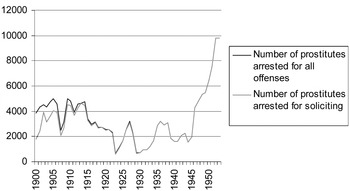
—Graph of prostitution arrests for 1900–1953

duties. Maintaining the peace led to a degree of police discretion over public order offenses.Footnote 44
Containment had been used to manage prostitution since the late nineteenth century. It was realized that, if the police and vigilance groups tried to eliminate prostitutes in one district, the problem would merely move elsewhere. It was thus better to keep prostitution within bounds in a well-policed area.Footnote 45 This modus vivendi balanced the maintenance of order with the preservation of civil liberties.Footnote 46Figure 1 shows stability in the arrest rate for prostitution offenses between 1900 and 1914, with an average of 4,312 prostitutes arrested each year.Footnote 47 When this arrangement was upset, for example, in the furor following the wrongful arrest of Madame D’Angely for soliciting in 1906 (which led to the establishment of a Royal Commission to inquire into police practices), officers ceased to arrest prostitutes.Footnote 48
Although it is believed that prostitution rose during the First World War as a result of increased demand from troops based in London, the blackout and a shift of prostitution from main thoroughfares to side streets caused arrest rates to plummet by 37 percent.Footnote 49 Arrests rose in the aftermath of the war, though Footnote figure 1 demonstrates that the threshold of arrests for prostitution offenses was lower in the interwar years. There has been a tendency to ascribe this decrease to a fall in the number of prostitutes in London. In a long-term context, there is general agreement among historians that prostitution had declined since the Victorian and Edwardian eras, mainly as a result of the improved economic position of women, better street conditions, the decline of drunkenness, the rise of the “amateur” prostitute, changing leisure patterns, the decline of chaperonage—which allowed increased unsupervised contact between young men and women—and a falling transient male population.Footnote 50 However, it is difficult to substantiate any direct link between these trends and a decline in prostitution. Few researchers have inquired into the alleged decline in prostitution.Footnote 51 Indeed, reliance on official sources presents an exaggerated picture. In his doctoral thesis on policing, J. B. Lopian dismisses many contemporary explanations as “absurd.”Footnote 52
A brief consideration of drunkenness helps to explain the fall in the arrest rate of prostitutes. The Metropolitan Police's figures for prostitution offenses contained in the commissioner's annual reports are aggregate; they refer to prostitutes arrested for all offenses, including drunkenness. Figures supplied by the Home Office show that an average of 3,575 prostitutes were arrested each year between 1900 and 1914 for soliciting.Footnote 53 No such disaggregated data have been gathered for the years prior to 1900. Fortunately, the annual reports of Superintendent James Thomson to the commissioner survive for the period 1869–87. Of the 7,361 prostitutes arrested between 1875 and 1886, 70 percent (5,161) came to the attention of the police for being drunk, the remainder being arrested for soliciting.Footnote 54 While a fall in drunkenness may serve as one explanation for a decline in the number of women recorded as practicing prostitution, the same figures may explain why fewer prostitutes came to the attention of the police in the interwar years.Footnote 55 These interpretive difficulties call for a more sophisticated analysis of the source material. An understanding of official statistics is furthered by an appreciation of the realities of policing.
To aid containment, “rowdyism” patrols dealt with prostitution offenses in recognized “vice” areas. In the “E” (Holborn) Division, the prostitute beat concerned the West End of the Strand, Southampton Row, the Euston Road, and one or two streets off the Strand, such as Villiers Street. Up to three patrols of two men together (in plain clothes) were detailed for surveillance, depending on the number of complaints. For example, in late November/early December 1927, all six men were used throughout the day to clamp down on prostitutes in the Hunter Street district off the Euston Road. However, following this pressure, only one patrol was needed.Footnote 56
In “C” Division, three pairs of police officers (likewise in plain clothes) were used daily to deal with the “problem” of street prostitution. Officers, however, did not act at random. Levels of surveillance fluctuated according to the time of day. During “rush hour,” up to four men were detailed to the patrol.Footnote 57 Women police were also used in both divisions to arrest prostitutes, but their main work concerned prevention rather than the arrest of offenders.Footnote 58 For example, the proprietor of Messrs J. and E. Atkinson Ltd., a perfumery at 24 Old Bond Street, raised the issue of soliciting in front of his premises with the commissioner. The commissioner informed Westminster City Council that 133 prostitutes had been arrested in the vicinity of those premises in the three months prior to November 1934. It was suggested that, resources permitting, women police would be detailed to pay greater attention to the area.Footnote 59
No evidence has been found to support claims that police policy against prostitutes grew more repressive during the 1920s.Footnote 60 In 1922, 842 prostitutes were arrested for 1,209 offenses of soliciting within the boundaries of the two West End Police Courts—Bow Street and Marlborough Street. Seventy-seven percent were arrested once only. As will be seen, by 1937, the police were under pressure to intensify action against prostitutes. In 1937, 641 women were arrested for 1,571 soliciting offenses. Yet 337 (52.5 percent) were arrested once only, 121 (18.8 percent) twice, and a smaller number apprehended more frequently.Footnote 61 The courts tended to show leniency toward prostitutes who appeared before the bench a second time within a short period, fining them around 10 shillings as opposed to the usual 40 shillings.Footnote 62 Indeed, while some officers expressed hostility to prostitutes and others stressed the degraded side of the profession and the inherent laziness or deceitfulness of the women involved, there is evidence of a degree of sympathy for the plight of the prostitute.Footnote 63 Evidence submitted to the street offenses committee confirms this sympathetic outlook. Dr. Morton, governor of Holloway Prison, stated: “I am quite positive from my own observation that some of them are on very friendly terms with the police.” Sir Chartres Biron, chief metropolitan magistrate, and Hugh Macmillan, chairman of the committee, also observed such familiar behavior. Indeed, Alison Neilans, secretary to the Association for Moral and Social Hygiene, thought that the danger was not that the police were repressive, but that they were “too friendly with them [the prostitutes] in some cases.”Footnote 64 Familiarity with prostitutes did, however, allow the police to discourage the arrival of too many newcomers, thus providing a degree of stability within the accepted geographical bounds of street prostitution.Footnote 65 In a private communication to Lady Astor, Ex-Magistrate Edward Lankester commented, “Any man who walks down Jermyn Street at night will know the street is full of prostitutes and police officers in uniform and plain clothes. The police are in constant conversation with their friends, if a stranger makes an appearance, she is immediately pounced upon by the policeman and is told that it is better to plead guilty.”Footnote 66 Stability was also provided by self-regulation within the sex industry; prostitutes were very protective of their territory in the West End.Footnote 67
Experience of the beat and interaction with prostitutes gave the police a distinct idea of what a prostitute was and where she could be found. The chairman of the street offenses committee asked the police commissioner how officers knew someone was soliciting. Sir William Horwood replied:
It is not a question of what is said. It is partly the appearance of the prostitute and the way it is done. … No, I do not think that they are at the mercy of the police officer at all. After all, you must take the locus into consideration in taking these cases. I think if a police officer arrests a woman in Jermyn Street at 11.30 at night, I think the presumption would be, at any rate to the mind of the Magistrate, and certainly to the mind of a Station Officer, that the charge if brought forward would be a correct one.Footnote 68
However, police assumptions of what constituted prostitution cannot just be ascribed to the development of an occupational culture. Such preconceptions were often a reflection of wider societal attitudes.Footnote 69 On the morning of the coronation of George VI, a volunteer for Mass-Observation was surveying the nightlife in Regent Street: “Two real negresses on pavement mistaken for part of the band by crowd, which gathers round waiting for negresses to perform. One negress just stares back, the other combs her hair, back-chatting. Police approach, doubting their sexual intentions, but retire reassured when one negress points out her husband.”Footnote 70 This vignette also supports the notion that the police suppressed “newcomers” to the area.
The maintenance of cordial relations, as with regulating street betting, was crucial to the ritual of containment.Footnote 71 Historians and contemporaries have claimed that prostitution was regulated by a rota system, facilitating the management of prostitutes on the streets without appearing overzealous.Footnote 72 Yet the court records show no evidence of a formal rota; it is more likely that the police were adhering to a quota system. Some officers took this form of crowd control further. Former police officer Harry Daley recollected the reign of the infamous Sergeant Goddard, head of the West End vice squad: “On the appointed day, in places like Lisle Street, they formed small queues waiting to pay their dues” to him.Footnote 73 Some prostitutes complained about being arrested even though they had supplied the officer with “palm oil” or “dropsy.”Footnote 74
The practicalities of operational policing account for the relative stability in the arrest rate for soliciting offenses during the interwar years. The average annual arrest rate for prostitution offenses between 1918 and 1922 was 2,575, while it was 2,676 for 1926–28, suggesting that a quota was being filled.Footnote 75 Overall, there was a level of consistency to these figures. In 1927, the police commissioner commented: “I do not remember any Superintendent having come up to me and said ‘There is a serious outbreak of street offenses in a certain area’. It is what I might call fairly constant.”Footnote 76 This picture remains consistent for the following decade. Private police figures for 1935–38 detail an average of 3,005 arrests for soliciting per annum.Footnote 77 The superintendent of “C” Division commented in 1938: “The prostitute problem in the West End is still very acute, but our present powers, while insufficient to keep prostitutes off the streets, do enable us to keep them within bounds.”Footnote 78
Managing the West End
A glance at the police court data for the West End appears to confirm the notion that prostitution declined during the interwar years. While the arrest rate rose by 30 percent, the number of individuals charged at court fell by just under 24 percent.Footnote 79 Appearances, however, can be deceptive. While the statistics indicate police adherence to a quota system, two sharp falls can be seen for the years 1923–24 and 1929–31.
In 1922, Sir Almeric Fitzroy, then clerk to the privy council, was arrested for annoying women in Hyde Park. His subsequent conviction was overturned on appeal. Arrests for soliciting in “H” Division stopped suddenly in December 1922, the month after Fitzroy had his conviction for “annoyance” in Hyde Park quashed.Footnote 80 As with the D’Angely case, the police were discouraged from taking action. As a result, there was a dramatic decline in the arrest rate of prostitutes, from 2,291 apprehensions in the Metropolitan Police District in 1922 to 650 during the following year.Footnote 81 Brigadier-General Sir William Horwood, commissioner of police of the Metropolis, complained: “No cases of a controversial nature have arisen in connection with sexual offenses during the year, presumably on account of the extreme reluctance of Police officers to take action which they feel may bring them into collision with the Magistrates, the Press, and the public. It is not at all a satisfactory condition of affairs, but in all circumstances it is not to be wondered at.”Footnote 82 As will be seen, the Fitzroy case had significant consequences for the policing of prostitution outside recognized vice areas.
The second police scandal of the 1920s had more serious repercussions for the policing of prostitution within the West End. On 23 April 1928, Sir Leo Chiozza Money and Irene Savidge were arrested for public indecency in Hyde Park. The case was dismissed with costs awarded against the police at Marlborough Street Police Court on 2 May. The seriousness of this matter was indicated by apposite questions being raised in the House of Commons five days later. The director for public prosecutions initiated an inquiry in order to examine the accusation of police perjury. The subsequent interrogation of Savidge by Chief Inspector Collins led to the appointment of a Royal Commission on Police Powers and Procedures.Footnote 83 Confidence in the police was further dented in January 1929, when Sergeant George Goddard, the head of the West End vice squad, who took bribes from prostitutes, was sent down at the Old Bailey with eighteen months hard labor and a £2,000 fine with costs.Footnote 84
As a result, the arrest rate for prostitution offenses fell steeply from 2,315 in 1928 to 723 the following year, and again to 695 by 1930.Footnote 85 Due to public distrust and the fact that magistrates raised the threshold of evidence needed in court, individual officers on the beat made the decision to avoid arresting prostitutes since apprehending them was deemed a sensitive and problematic issue. The commissioner complained: “Another effect of the critical attitude of press and public has been a general reduction in the number of charges brought. For this there may be other contributory causes, but there is good reason to believe that the Constable's confidence in the public and himself was for a time shaken and that the efficiency of the Force suffered in consequence.”Footnote 86 There were two main consequences of the debacles that occurred in the late 1920s. In 1930, Police General Orders were amended in line with the recommendations of the Royal Commission and the Committee on Street Offences. The Home Office and senior police officers sought to formalize police operations as part of a deliberate response to diffuse public mistrust of the Metropolitan Police's judgment.Footnote 87 Mistrust centered upon the use of plain-clothes police officers to apprehend prostitutes. The amendment stated: “It must be clearly understood that it is the duty of the Police, in dealing with prostitutes, more to prevent loitering and importuning than to detect it. Arrests should only be made to enforce obedience to the law where warnings have been disregarded.” Paragraph 19b went on to state that this “duty will be performed by uniformed officers, who will be specifically employed where offences are rife.” Four years later Assistant Commissioner Percy Laurie had to remind all superintendents that this order needed strict implementation.Footnote 88
Magistrates adopted a strict interpretation of the law. For example, Mr. Mead, at Bow Street, dismissed the cases of three prostitutes arrested for soliciting on 29 and 30 January 1929. Sub-Divisional Inspector Conser minuted Superintendent J. Concannon at “C” Division that “the learned Magistrate has hitherto accepted similar evidence of annoyance—even in disputed charges—when sitting at Marlborough Street Police Court.” The shift in interpretation meant that the focus was upon annoyance of foot passengers in the plural; more than one person was needed to demonstrate evidence of “annoyance.”Footnote 89
In view of moves to formalize police practices, stemming the wide discretionary power that a small coterie of officers held, and a rise in the number of complaints about prostitution, all officers were directed to pay attention to soliciting offenses from the mid-1930s. This shift in policy caused the arrest rate to rise from 1,656 in 1934 to 2,870 the following year, an increase of 73 percent.Footnote 90 Officers within “C” Division increasingly directed their attention toward the Mayfair and Piccadilly areas. In October 1935, a complaint was received from the secretary of Duke's Court regarding the nuisance caused to their residents by soliciting in Duke and Jermyn Streets.Footnote 91 Three years later, complaints had been sent by ratepayers, residents, owners, and agents of properties in the areas bounded by Berkeley Street, Charles Street, Park Lane, and Piccadilly, and, specifically, Curzon and Clarges Streets.Footnote 92 In 1939, a committee of property owners and agents had been formed in the area to tackle the rise in prostitution.Footnote 93 Other pressures led to the upward drift in arrests.
Media interest in prostitution intensified in the months running up to the coronation of George VI in May 1937, precipitating an increase in police surveillance. One hundred and fifty-three arrests leading to charges were made within the bounds of the Bow Street and Marlborough Street Police Courts in January, rising incrementally to a peak of 177 in April. Court appearances then plummeted to sixty-two during the month of the coronation, which may either represent a diversion of police resources or prostitutes soliciting with greater caution due to increased attention on the West End. Arrests later rose to a peak of 167 in October.Footnote 94 The police also believed that a plan had been hatched to ship in prostitutes from Europe to cater for extra tourists, leading them to target the alleged foreigners “behind the scene.”Footnote 95 Seventy-three women detailed in the Metropolitan Police's list of 102 foreign prostitutes were charged with soliciting in 1937, accounting for 11 percent of individuals arrested; these women comprised just under 29 percent of total arrests.Footnote 96 As has been argued elsewhere, influential public voices—the press in particular—increasingly associated foreigners with prostitution.Footnote 97 Furthermore, during this period both Harry Daley and Charles Hanslow recalled an increased pressure to arrest as rival subdivisional inspectors competed against each other. Arrests were a means to show who was the most efficient. At the same time, officers realized that they could avoid onerous tasks, such as traffic duty, if they took the time to process an arrest; both cited the detaining of prostitutes for this purpose.Footnote 98
The registers of Bow Street Police Court suggest that the police directed their attention toward Mayfair in line with the broader policy of containment (the Marlborough Street books do not record the location of arrests). In 1922, 609 prostitutes were charged at Bow Street. Seventy-nine percent of arrests took place in the vicinity of Soho and Leicester Square. Indeed, the latter was prominent, accounting for nearly 18 percent of the total. Of the remaining 20 percent, frequent references are made to Endsleigh Gardens, the Euston Road, and Southampton Row. By 1937, 1,210 prostitutes appeared before the “beak” at Bow Street. There was then, however, scant reference to Leicester Square, though Lisle, Gerrard, Wardour, and Little Newport Streets still featured. Soho was known as the haunt of low-class prostitutes, in the words of Superintendent Cole “the lowest type of all—drabs.”Footnote 99 “Nutty” Sharpe, a former chief inspector at the Flying Squad, who retired in July 1937, claimed that, in some Soho streets, women solicited from every doorway.Footnote 100 A former resident recalled seeing prostitutes on every street corner.Footnote 101 Prostitutes in these poorer areas probably caused less offense than they did in the more up-market parts of the West End, for just over 60 percent of arrests took place in the environs of Mayfair and Piccadilly. The age range of those arrested shifted, which suggests that the police targeted more professional prostitutes: 35.5 percent of the prostitutes charged at West End police courts were aged 17–23 years in 1922; this age cohort's share of total arrests had fallen to 16 percent by 1937. Those aged 24–29 years rose from 41.5 percent in 1922 to just under 50 percent fifteen years later. Crucially, within the same time frame, the proportion of prostitutes in their thirties rose from 18 percent to just under 30 percent of the total.Footnote 102 A drop in the proportion of charges that were withdrawn or dismissed—from 18.4 percent in 1918, to 5.6 percent in 1926, to 0.4 percent in 1935—indicates that the police may have been concentrating on a core of professional prostitutes.Footnote 103 Overall, of the 3,062 arrests for soliciting offenses in the metropolis in 1938, 2,298 were apprehended on the streets of “C” Division.Footnote 104
It seems probable that the main center of prostitution shifted west during the interwar years. This coincided with the depopulation of the City, which led to the decline of the Strand as a red-light area and the relocation of the pornographic book market from Aldwych to Soho.Footnote 105 Some historians attribute the shifts outlined above to a fall in the number of women soliciting and the concomitant professionalization of prostitution in the West End.Footnote 106 While these findings do not contradict the latter view, the police policy of containment and increased sensitivity to dealing with prostitution following the Savidge and Goddard scandals suggests that the police limited their action to arresting the “usual suspects” so they would be seen to be dealing with prostitution while avoiding controversy. A variety of sources confirm the notion that prostitution was increasing during mid-1930 to the late 1930s. Alison Neilans, secretary to the Association for Moral and Social Hygiene—a group not prone to hyperbole about prostitution—reported in a private letter to Nancy Astor that she had managed to secure an interview with the police commissioner, Sir Philip Game, to discuss the rise in the arrests of prostitutes and the number of visible foreign filles de joie, coupled with an apparent deterioration in the condition of the streets.Footnote 107 The crux of the matter was organizational and spatial. First, concern was voiced that prostitution manifested itself in an increasingly commercialized form.Footnote 108 Indeed, the activities of individuals associated with foreign prostitution conform to Timothy Gilfoyle's definition of commercial sex as “the product of entrepreneurs supplying a demand.”Footnote 109 Second, anxieties focused on the spread of prostitution in the direction of elegant Mayfair. Crucially, the commissioner believed that the number of prostitutes on the West End streets was increasing.Footnote 110 In 1938, an assistant commissioner went as far to remark: “I have asked many people as to a comparison of open prostitution 30–40 years ago. It is hard to come to any conclusion. Generally speaking, opinion is that it is no less, but as far as the West End … is concerned the area is increasing and the nuisance spreading to the Mayfair area.”Footnote 111 Anecdotal evidence supports this view. Former Chief Inspector Sharpe recalled: “Sitting in a Squad van one night we counted seventy-six [prostitutes] in one stretch of roadway near Piccadilly.”Footnote 112 George Ryley Scott commented in 1936 that it “is popularly believed that the West End harlots, at any rate, earn a good deal of money, and are able to live in the most prosperous circumstances. It is not [true] as regards the majority. There are too many professional prostitutes in the West End of London.”Footnote 113 This contagion of “vice” was believed to be infecting nearby Paddington. A committee representing 400 residents in Portsdown Road petitioned the bishop of London in 1938 regarding soliciting and kerb-crawling. Thirty-eight houses were either suspect or had convictions for brothel-keeping.Footnote 114 In turn, requests to the police by local authorities for observation of disorderly houses in the vicinity increased from eight in 1937 to twenty-six in 1938.Footnote 115 The Evening Standard noted: “There is a plague of undesirable women in the Paddington area now. … We are told that this type of woman has been leaving Soho for the past three years. Many of them have settled in Paddington.”Footnote 116
On the Streets of Stepney
In outlining the geography of prostitution, there is a need to avoid replicating police perceptions that street sex was just a West End phenomenon.Footnote 117 Indeed, charting the extent of prostitution is hampered by the problematic nature of official sources. It is probable that prostitution declined through the early twentieth century in former well-renowned red-light areas. Lambeth and Southwark were areas notorious for prostitution in the late nineteenth century, though conditions were believed to have improved significantly by the eve of the First World War.Footnote 118 However, pockets of prostitution survived into at least the early 1920s. For example, 134 women were arrested by officers from the “L” (Lambeth) Division and charged with 171 soliciting offenses at Westminster and Tower Bridge Police Courts in 1922. By 1937, no prostitutes south of the Thames were charged at Westminster Police Court, and only three charges for soliciting were heard at Tower Bridge.Footnote 119 Gosling ascribes this shift to slum clearance, urban redevelopment, and local population change.Footnote 120
However, a detailed examination of prostitution in the East End serves as a reminder that official sources need to be handled with caution. Police action needs to be “situationally justified.” In the words of Charles Booth: “Conduct which in Cadogan Square would lead to the police cells, might be passed over in Slaidburn Street.”Footnote 121 For example, testifying before the street offenses committee in 1927, the commissioner of police claimed that soliciting was practically nonexistent in the East End and Docklands although a small amount of prostitution occurred around Bethnal Green. According to the police, most prostitutes in those districts traveled to the West End. From October 1926 to October 1927, there was not one arrest for soliciting at Thames Police Court. This was attributed to the fact that the population was less transient, that sex was not “sold” in the way that it was “up West,” and that short-term concubinage was quite common, thus demand was less.Footnote 122 During 1927, no charges for solicitation were heard at the other East End police court at Old Street.Footnote 123 The evidence of J. A. R. Cairns, a magistrate at Thames police court, leads to the impression that prostitution in the East End did not fit official and popular notions of vice: “There are girls who if they can get work will do it, but if they are thrown back by sheer economic necessity or nightwalking, will solicit. They are not prostitutes, however.”Footnote 124 Taken at face value, these official views offer a misleading and exaggerated portrait of prostitution decline in Stepney, suggesting that tolerance toward streetwalkers was long-established practice. While prostitution was far removed from the levels of its mid-Victorian heyday, drawing on a wider selection of sources presents a more nuanced picture of prostitution in the East End.Footnote 125 Former chief superintendent Peter Beveridge, who was posted to the “H” (Whitechapel) Division when he joined the police in December 1919, recalled: “Then there were stories of Jack the Ripper, the murderer who prowled the streets at night claiming his victims from the local street women. I noticed that his depredations had in no way decreased their enthusiasm.”Footnote 126 In 1925, officers of the London Public Morality Council recorded an average of eighty-eight women plying their trade in Limehouse and Whitechapel over a three-day period.Footnote 127 Court records confirm this picture, suggesting that the tolerance that Cairns alluded to was recent practice. In 1920, officers from the “H” Division arrested ninety-two women for 137 soliciting offenses. While the number of arrests declined to eighty-nine two years later and involved seventy-two women, the number of women with a background in charring or domestic service fell from 68 percent to 52 percent, suggesting that the collapse of the postwar economic boom drew a wider range of working-class women into prostitution. Indeed, the proportion of women aged 17–29 years rose from 28 percent to 38 percent. Prostitution in this district remained mainly a casual affair; only sixteen of the women arrested by “H” Division in 1920 were rearrested two years later.Footnote 128
Cursory research into the Jewish community in Whitechapel suggests that prostitutes in this district were relatively well integrated within broader working-class culture.Footnote 129 Jack Shaw, who was brought up in the East End during the interwar years, was asked in an interview: “Was there a lot of prostitution around?” He answered: “Oh yeah. There was, in Aldgate, there was the Jewish prostitutes. And … they … they kept to themselves. There was the Jewish ponces, who kept, who didn’t interfere with anybody.” It seems that he uses the word “interfere” in a malign sense, as opposed to prostitutes remaining distant from the surrounding community, for Shaw also recalled earning money as a boy by running messages and errands for the local prostitutes.Footnote 130 Communal assistance went even further. Bernard Kops remembered: “My father was unemployed and on the means test, and was somehow expected, God knows how, to bring us up on twenty-eight shillings a week. A woman who lived nearby sometimes brought us in potatoes. She worked Up West, my mother told me—‘Up West’ was that fabulous world beyond, our Eldorado. It was only years later that I guessed what sort of work that woman did—for who in the [Stepney Green] Buildings could afford to give their neighbours potatoes in those days?”Footnote 131 However, police lack of interest in prostitution hampers our knowledge of such offenses. In 1923, the “H” Division made only one arrest for soliciting.Footnote 132 As of yet, no direct evidence has been found to account for this abrupt fall. It stretches the imagination to attribute this decline to a sudden slide in the number of prostitutes in the district. Nor can the fall be ascribed to the appointment of a new divisional superintendent, as no such change occurred.Footnote 133
The first major controversy over police discretionary power in the 1920s, the Fitzroy case, serves as a viable explanation. It is probable, though no written instruction has as yet been found, that following this bad publicity senior officers at Scotland Yard urged police to target prostitution only in notorious areas such as the West End. Henry Waddy, a magistrate at Thames Police Court, wrote of the Fitzroy case: “The ‘extreme reluctance’ of the police to take the necessary and proper action for the purification of the streets is apparently to be continued until magistrates shall have learnt their lesson, or the law of the country be altered to conform with the view that the police witness shall be put into a unique and exceptional position, and be treated as an infallible super-witness to whom the ordinary rules of procedure and evidence shall no longer apply.”Footnote 134 The year 1923 was significant for the way that certain discretionary offenses, in particular “victimless” crimes, were regulated. For example, the 1923 select committee investigation into betting and gaming heralded a shift in policy from that of suppressing to one of containing street betting.Footnote 135 Official statistics pointing to a decrease in prostitution are indicative of this shift in policy toward discretionary offenses as opposed to being a signifier of social reality in terms of criminal behavior.
Prostitution still thrived in the district, especially within the bounds of the Edwardian red-light area, centered on Brick Lane, Flower and Dean Street, and Thrawl Street.Footnote 136 Jerry White wrote of one of his interviewees in his history of the East End for the period 1887–1920: “Clarissa Harriet Knight [pseudonym] was born the daughter of a Norwich fishmonger in 1889. … By the early 1920s she had drifted into the lodging houses of the East End, spending a short time at one in Hanbury St and then coming to Flower and Dean St. Clarissa found what work she could as a charwoman: but ‘many women used to pick up with men. You understand me, now? Good many of ‘em.’”Footnote 137 The existence of prostitution is corroborated by an unpublished paper written by Edith Ramsey, who served as a care officer for the London County Council from 1922 to 1925.Footnote 138 Ramsay wrote of a common lodging house at the corner of Brick Lane and Flower and Dean Street:
At all hours of the day and night, its habituees can be seen lounging and gossiping on the pavement outside. … Although there are many young girls in this house, no evidence has yet been obtained that the children are taken there but in a similar house in Duval Street there lived for some months a little girl aged ten, with her mother. The moral atmosphere is obviously ruinous to any child, since the women admittedly earn their living as prostitutes, haunting street corners and coffee shops of ill-fame, only waiting for a man who will maintain them in “The Doubles” next door.Footnote 139
While it is probable that prostitution fell in Stepney due to gradual population decline, dockers and sailors continued to fuel the demand for prostitutes; economic activity around the Port of London remained robust throughout these years.Footnote 140 In 1921, the London Branch of the Services Committee of the British Social Hygiene Council observed: “Even in these depressed times, there was an average of 16,000 men ashore for the night. For 2,700 of these, there was practically no decent accommodation. Many of the lodging houses were either attached to brothels, or joined them with communicating doors.”Footnote 141
A tapering in the number of prosecutions by Stepney Borough Council against disorderly houses from fifty-seven (1918–29) to twenty-one (1930–39) during this period suggests evidence of a decline in the incidence of prostitution.Footnote 142 Moreover, in 1930, the Jewish Association for the Protection of Girls and Women noted that the number of women charged with “immoral offenses,” such as soliciting and using insulting words and behavior, had fallen significantly.Footnote 143 Soliciting offenses were still low by the late 1930s, perhaps reflecting the decline of prostitution in Stepney, for any major resurgence would have received police recognition given the media and official attention that “vice” was receiving in the West End. Only nine women were charged for eleven offenses of soliciting at Old Street Police Court in 1937; no charges were heard at Thames.Footnote 144 Again, these sources merit closer inspection. Seven of the arrests were made in Commercial Street, Spitalfields, at the heart of the red-light area. Moreover, one of the women, arrested twice, traveled from Pimlico (Westminster) to walk the streets of Stepney. Women would not have traveled that distance had the area not had a reputation for selling sexual services. Indeed, Ian Forbes, who was attached to the “G” Division when he joined the police in 1938, remembered: “It was the original Jack the Ripper district and had its full share of sleazy back streets. One curious road was White's Row, a turning off Commercial Street, which was known as ‘the singles and the doubles.’ At that time it consisted almost entirely of lodging houses that let single and double rooms and attracted all sorts of odd customers. To the singles went the drop-outs of the day—vagrants and methylated spirits drinkers of both sexes, while the doubles were havens of prostitutes and foreign seamen.”Footnote 145 As was the case with certain areas of Edinburgh, such as the Leith docks in the 1950s, the police operated zones of toleration for prostitutes.Footnote 146 In 1936, Police Constable W. A. Jones was patrolling around the Campbell Road, Finsbury Park:
I heard a female voice call out to me “Hi, copper!” I looked out to the opposite side of the road and saw that the bottom sash of the first-floor window at the front was fully raised. It was covered by a dirty white curtain in which was a large circular hole. This hole was filled by a dirty white female breast with a large red nipple. As I looked round female laughter broke out. I did not alter my annoyed expression and the laughter stopped. Then a female voice said loudly to another female, “Put it away, you daft cow. Do you want to get us knocked off?” … The house was that of a resident prostitute, obviously touting for business. I did not bother to take any action.Footnote 147
Given that these areas were poor, the presence of prostitutes was not deemed an affront to decency when compared to more politically and media sensitive areas such as the West End. As such, this kind of illicit sexual activity did not constitute “vice.”
Postwar Policy
Several historians have addressed the significant rise in the arrest rate of prostitutes following the lull during the Second World War. The police appear to have targeted prostitutes with increased zeal for several reasons: a fall in demand (due to troops moving out of London following the cessation of hostilities) seems to have led to more aggressive soliciting; there was also an intense media spotlight on London during the early 1950s as the capital was hosting the Festival of Britain and a coronation. Similarly, communities undertook a grassroots campaign to clean the streets, and there were broader concerns over the rise of immigrants in society.Footnote 148 For example, while 571 arrests had been made for soliciting and outraging public decency in 1956 at Thames police court in the East End, police files show that only twenty-five to thirty women frequently prostituted themselves in the area. Most were well-known East End prostitutes.Footnote 149 Moreover, senior officers in “C” and “D” (which covered Paddington) divisions were also keen to highlight the presence of “colored” men in their districts and their association with “vice.”Footnote 150
It is probable that there was a climatic shift in attitudes toward criminals in general, signified by the panic over juvenile delinquency and broader fears over rising crime in the capital from 1956.Footnote 151 Evidence also points toward a hardening in attitudes toward prostitutes. By the 1950s, full employment and the existence of the welfare state appeared to undermine economic causation as an explanation for prostitution.Footnote 152 Moreover, a new concept of citizenship articulated in the Second World War placed a premium on the sexual behavior of women and girls; social legislation of the postwar period reinforced the traditional role of females as wives and mothers.Footnote 153
During the 1950s, senior officers were not able to state with the same confidence as in the 1930s that prostitution had increased. In 1954, the deputy commissioner remarked: “[We, the senior officers,] felt that the real danger in high numbers of arrests and that which caused us most anxiety, was the feeling that the police were being pressed to arrest these women. [I, myself,] felt that there was an urge to keep figures up, which was highly dangerous.”Footnote 154 It is ironic that just as the police were to be handed increased powers to tackle prostitution, the “problem” was, if anything, decreasing. In 1957, Commander Townsend noted for the commissioner that a drop in the number of recorded new prostitutes suggested that, if anything, their numbers on the streets of London had decreased over the past five years.Footnote 155 Divisions were probably responding to local concerns about prostitution; as of yet, no evidence links the rise in arrests to a central police command. While the research of Helen Self stresses that the Home Office resolved as early as 1951 to adopt stern measures to tackle prostitution, there is scant evidence concerning who it was that authorized the crack down.Footnote 156
An examination of the practices of “C” Division, which accounted for 65 percent of arrests for soliciting between 1947 and June 1954, supports the premise that there was little, if any, major increase in prostitution in the postwar era.Footnote 157 A pressure to arrest prostitutes, in evidence from the late 1930s, was sharpened by the payment of overtime, a policy introduced on 1 January 1946, which paid officers up to 14 shillings for attending court the morning after an arrest. The commander who suspected that overtime was being abused by the rank and file had been an inspector and chief inspector in the “C” and “A” Divisions between 1934 and 1939 and was familiar with the prostitution “problem.” A detailed investigation of who was arresting the prostitutes confirms the picture of individual officers acting overzealously. For example, in “C” Division in 1948, 160 officers apprehended 2,861 prostitutes. However, 19 percent of officers were responsible for just over 50 percent of arrests. While overtime was scrapped in 1949, the manpower crisis meant that young officers were used to tackle street prostitutes in the inner divisions; before, this had been a task left to more experienced officers.Footnote 158 In giving evidence to the Wolfenden Committee, a policeman from “C” Division who had worked in the capital since 1923 testified that prostitution in the West End had not changed since the 1930s.Footnote 159
All the evidence points to an increase in manpower being responsible for the increased number of arrests of prostitutes. From 1948, specific patrols were utilized in the Paddington division to deal with prostitutes, and by the mid-1950s, “C” Division's rowdyism patrol had increased to fourteen men.Footnote 160 A breakdown of the figures supports this view. By October 1952, 6,035 arrests had been recorded during the year. However, that total only related to 771 individuals.Footnote 161 Only 1,140 prostitutes were charged at Marlborough Street Police Court in 1926, yet this number related to 660 individuals.Footnote 162 Although the number of individuals involved increased by 16.8 percent, the arrest rate increased by over 429 percent.
Conclusions
Challenging the extent of the fall in the number of prostitutes raises questions about the scale of the apparent relaxation in sexual behavior during the interwar years. It was certainly believed that having to pay for sex repelled the “modern man” as resort to prostitutes reflected negatively upon his masculinity.Footnote 163 Lesley Hall notes that “this significant social change … may have existed less as an actual phenomenon than as a myth about the modern world and the effects of the war's upheavals, but it points to a growing public sense of the lack of acceptability of male resort to prostitutes.”Footnote 164 Yet, as Angela Woollacott points out, historians’ assessments of the interwar years present a contradictory picture of sexual activity.Footnote 165 That prostitution declined less rapidly than hitherto claimed chimes with Hera Cook's recent characterization of the interwar years as a period of restraint in noncommercial sexual relations.Footnote 166 However, further research is needed into the police court registers to assess the extent of illicit sexual activity, including paid sex. Moreover, this study of prostitution in London would merit comparison with venal sexual conduct in other urban metropolises in the United Kingdom, such as Belfast, Cardiff, Edinburgh, and Liverpool.
Despite anxieties over the sexual behavior of young women between 1914 and 1918, no moral panic resulted over crime in the immediate post–First World War era, unlike what occurred in the years after 1945.Footnote 167 Indeed the explosive debates over policing, manifested explicitly over the Fitzroy and Savidge/Goddard cases, meant that officers adopted a measured approach to the policing of prostitution. Administrative, bureaucratic, and legal procedures established a framework for policing, yet in practice action was based upon an occupational culture predicated on the importance of knowledge gained on the beat. Public opinion acted as a further constraint, leading officers to pursue an unofficial policy of containment as a means to reconcile the conflicting and competing demands of maintaining both order and liberty on the streets. Along with other forms of public order offenses, the practicalities of managing the streets led to some complicity with the trade, and in some cases it fostered a culture of corruption.Footnote 168 Containment was concerned with numerical and geographical limitation; police arrested a de facto quota of prostitutes each year to show that the “problem” was being addressed. These factors influenced how the police constituted “vice”; thus, in areas such as the Commercial Street district of Spitalfields (East London), it is probable that only flagrant prostitutes were arrested. This interpretation of prostitution supports Paula Bartley's claim that historians overplay the repressive aspects of policing and Roger Davidson's findings, which stress the local as opposed to state-driven pressures to clamp down on prostitution.Footnote 169 Certainly prostitution was policed less harshly than in France or the United States.Footnote 170
Yet explanations for increased police surveillance in the years after the Second World War can be found from 1935. Heightened police activity resulted from operational shifts, local complaints, increased media attention, and an association of prostitution with notions of foreignness. At the same time, the available evidence suggests that, while commercialized prostitution was increasingly concentrated within the West End, and to a lesser extent around Paddington, the number of women involved in professional prostitution was increasing in the mid- to late 1930s. This assertion needs to be set against the background of a decline in the number of casual prostitutes across London.
In view of the increasingly hostile climate toward prostitutes in the 1950s, the Home Office pushed for measures that envisaged a form of containment based on a distinction between public and private behavior. In the words of Tim Newburn: “The practical corollary of such a stance is that the boundaries of what is considered to be private behaviour are extended and the areas of public behaviour are more minutely defined and subjected to increased surveillance.”Footnote 171 Following the recommendations of the Wolfenden Report, the Street Offences Act of 1959 tightened the laws against prostitution. Powers that had eluded the police throughout the twentieth century were granted to them at the stroke of a pen. Officers no longer needed to prove that a prostitute's soliciting had caused “annoyance”; soliciting in itself was criminalized. For a third and subsequent conviction, a prostitute faced a fine not exceeding £25 and/or up to three months in prison. The raison d’être of the act was threefold: to formalize the distinction between law and morality, to rationalize the control of prostitution and increase the certainty of conviction, and to remove the visibility of vice from the streets.Footnote 172 The new law was a success: in the first three months of its operation, prosecutions within the Metropolitan Police District dropped to just 10 percent of their level in the corresponding period of the preceding year.Footnote 173 Indeed, the legislation proved to be more successful than expected in removing prostitutes from the streets.Footnote 174 Yet, as Frank Mort concluded in his study of the Wolfenden Report, “subsequent events on the ground, especially in the metropolis, were to show just how difficult that line was to hold.”Footnote 175 Prostitutes did not disappear, nor did the controversies associated with prostitution such as methods of regulation, police corruption, and the abuse of women.