To mitigate the growing health threat of antimicrobial resistance, and to address other negative consequences of antibiotic misuse including adverse effects and Clostridioides difficile infection, implementation of antimicrobial stewardship programs (ASPs) is rapidly occurring in hospital settings.Reference Leung, Wu, Langford and Garber1, Reference Pollack, van Santen, Weiner, Dudeck, Edwards and Srinivasan2 A key component of an ASP is prospective audit and feedback (PAF), an approach that involves the evaluation of antimicrobial regimens by an infectious diseases or antimicrobial stewardship-trained clinician with recommendations made to the prescriber to optimize antimicrobial use.Reference Barlam, Cosgrove and Abbo3 PAF is an enabling intervention that aims to maintain prescriber autonomy while increasing the capacity for prescribers to improve the use of antibiotics in absence of an ASP clinician.Reference Michie, van Stralen and West4 Newly introduced PAF programs have been shown to reduce antimicrobial use and improve patient outcomes.Reference Davey, Marwick and Scott5
However, data comparing different approaches to PAF and their association with antibiotic use are lacking; they are a missing piece to the design of more robust interventions. Additionally, there is wide heterogeneity in design of PAF interventions in hospital settings, with varying patient populations, antibiotics evaluated, frequency of evaluation, and format of recommendation delivery.Reference Davey, Marwick and Scott5 Given the significant resources required to operate a PAF initiative, knowledge of the level of intensity required to have an impact on and to sustain improved outcomes is necessary. Most PAF studies have evaluated its impact in the critical care setting, with less data supporting its role in those less critically ill, such as an internal medicine population. We examined the impact of a high-intensity, interdisciplinary, rounds-based PAF compared to a low-intensity PAF on antimicrobial use on internal medicine wards in a 400-bed community hospital.
Methods
The setting for this study was St Joseph’s Health Centre, a community teaching hospital in Toronto, Canada. Five general internal medicine units were involved in this study. An ASP was established at our hospital in 2011, with a multimodal approach including PAF, development of guidelines and order sets, microbiology laboratory report optimization, and education. Staffing included a lead ASP physician and 2 full-time-equivalent ASP-trained pharmacists during the study period. This study, including both pre- and postintervention periods, was performed from September 2012 to December 2016.
Intervention
Pre-intervention: low-intensity phase. Prior to the intervention, PAF was provided to prescribers on each internal medicine unit mainly by ASP pharmacists. The focus of PAF during this phase was to evaluate patients receiving targeted antibiotics. Patients receiving selected antimicrobial classes were assessed weekly (1–2 classes daily: fluoroquinolones, third-generation cephalosporins, antipseudomonal penicillins, carbapenems, clindamycin, vancomycin). Patients were seen, paper and electronic charts were reviewed, and interventions were identified (eg, streamline, change route, discontinue therapy, alter duration, etc). A one-on-one recommendation to the internal medicine physician was performed for each patient requiring intervention.
Post-intervention: high-intensity phase. Structured, twice-weekly ASP rounds were initiated in a sequential fashion on the 5 internal medicine wards between September 2014 and December 2015. These rounds addressed all patients on antimicrobial agents and included an interdisciplinary team to discuss the appropriateness of therapy. This team consists of an ASP pharmacist, the ward pharmacist, an internal medicine physician, and the antimicrobial stewardship physician. The rounds lasted ∼30 minutes per unit. One day per week the ASP pharmacist led rounds, identified each patient on antimicrobial therapy, and reviewed the indication for treatment, the prescribed regimen of therapy, the day of therapy, as well as relevant laboratory values and clinical assessment and any recommendations for improvement. The second rounds day of the week was led by the ward pharmacist. Any disagreements regarding the final choice of antibiotic regimen were resolved by discussion at rounds, but the final decision was up to the internal medicine physician.
Outcomes
The primary outcome of interest was antimicrobial use measured in defined daily doses (DDD) per 1,000 patient days (PD), 1–24 months prior to the intervention compared to 1–24 months after the intervention. Secondary outcomes included stratification of the postintervention period, months 1–12 and months 13–24. Targeted and nontargeted antibiotic use were examined, in addition to the process measure of the number of recommendations made.
To ensure that there were no unintended consequences to the approach to PAF, clinical outcomes for each ward were included: nosocomial C. difficile infection (CDI) per 10,000 patient days, length of stay, readmissions per 100 discharges, and in-hospital mortality rate per 1,000 patient days.
Statistical analysis
We conducted analyses looking at each antibiotic use and clinical outcome. In unadjusted models, we compared the incidence rate of antibiotic use in the low-intensity period (up to up to 24 months before the intervention) to the high-intensity period (up to 24 months after the intervention) using a linear regression model. In the unadjusted analyses, the intervention effect was modeled using a simple level-change model: an indicator variable for the post intervention period, with the preintervention period as the referent category. The unadjusted models included only the indicator variable in a linear regression model.
The adjusted models were level- and slope-change models.Reference Bernal, Cummins and Gasparrini6 , Reference Hemming, Taljaard and Forbes7 These models included terms for the trend before the intervention, the level-change after the intervention, the slope change after the intervention, and a cyclic cubic spline (2 parameters) to capture seasonality. A random intercept, slope, level change, and slope change were included within each ward. Adjusted models were fit using MCMC sampling, using the rstanarm package in R.
Ethics
This initiative was approved by the Research Ethics Board at St Joseph’s Health Centre. Individual patient consent was not required.
Results
Across the 5 wards, we observed a total of 229 ward months of follow-up, for a total of 228,722 patient days. During this period, 4,503 recommendations were made: 9.6 per 1,000 patient days in the low-intensity phase and 28.7 per 1,000 patient days in the high-intensity phase (difference, 18.2; 95% CI, 13.6–22.8). No substantial difference was observed in average monthly recommendation acceptance rate in the low-intensity phase versus the high-intensity phase (84% vs 85%, respectively).
Antibiotic use
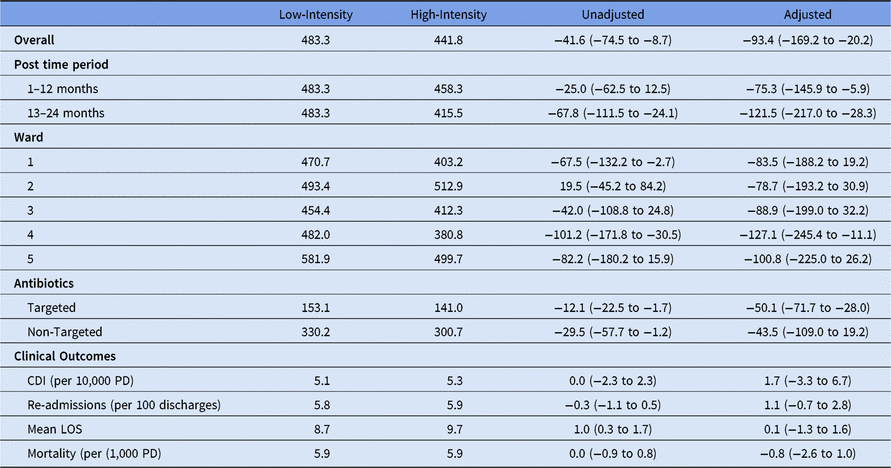
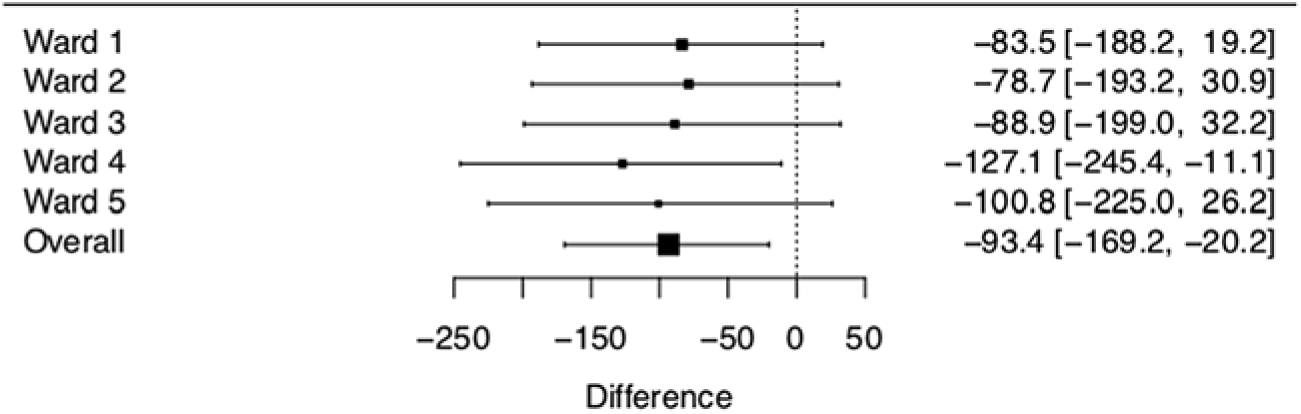
With the transition from low-intensity to high-intensity PAF, a reduction in overall usage was seen, from 483 DDD/1,000 PD during the low-intensity phase to 442 DDD/1,000 PD in the high-intensity phase (Table 1, difference −42; 95% CI, −74 to −9). This reduction in usage was more pronounced in the adjusted analysis, which accounted for the trend in usage prior to the transition, as well as for seasonality (difference, −93 DDD/1,000 PD; 95% CI, −169 to −20). A greater reduction in usage was seen the latter half of the high-intensity period (12–24 months), with an adjusted difference of −121.5 (95% CI, −217.0 to −28.3) and for targeted agents (adjusted difference, −50.1; 95% CI, −71.7 to −28.0). A forest plot of ward-specific estimated change in antibiotic use showed no evidence of heterogeneity (Fig. 1).
Antibiotic Use (DDD/1000 PD) and Clinical Outcomes Associated with Low vs. High Intensity PAF (95% Confidence Intervals)

Forest plot of changes (with 95% confidence interval) in antibiotic use with transition from low to high intensity prospective audit and feedback (PAF) (adjusted model).

Clinical outcomes
No changes in clinical outcomes of CDI, readmission rate or mortality on the general medicine wards were observed after the switch to high-intensity PAF. Although an increase in length of stay was noted in the high-intensity phase, this was not seen in the adjusted analysis.
Discussion
Implementation of high-intensity PAF was associated with a 19% (adjusted analysis) reduction in overall antibiotic use compared to low-intensity PAF in our community teaching hospital without any changes in patient clinical outcomes.
Although PAF has been identified as a key component of antimicrobial stewardship programs,Reference Barlam, Cosgrove and Abbo3, Reference Davey, Marwick and Scott5, Reference Morrill, Caffrey, Gaitanis and LaPlante8, Reference Langford, Wu and Brown9 the ideal approach and intensity have not been previously studied. A Cochrane review led by Davey et alReference Davey, Marwick and Scott5 suggested that further studies evaluating antimicrobial stewardship interventions are unlikely to alter the conclusion that ASP interventions are effective. The authors call for additional work to evaluate and compare different ASP interventions to each other. Our research comparing low-intensity and high-intensity PAF suggests that there may be an optimal approach to PAF that encompasses a number of factors: (1) interdisciplinary, (2) face-to-face, and (3) comprehensive (ie, reviewing all patients on antibiotics).
This collaborative, engaging approach to PAF was also evaluated by Hurst et alReference Hurst, Child, Pearce, Palmer, Todd and Parker10 using a concept coined “handshake stewardship.” These authors focused on in-person, rounds-based audit and feedback led by a pharmacist–physician team in a pediatric hospital. The team noted a hospital-wide reduction in overall antibiotic usage by 10%. The reduction was potentially the product of both the direct effect of collegial communication during rounds and the indirect effect of improved antibiotic prescribing due to the educational nature of rounds. The success of our intervention may be due to this method of “handshake stewardship.” In addition, the presence of an ASP physician during rounds for the high-intensity period may have helped to facilitate improved uptake through direct peer-to-peer communication, thereby influencing reduced antibiotic prescribing.
Encouraging antimicrobial stewardship principles through enabling the interdisciplinary team may help to improve the quality of antibiotic decision making when ASP clinicians are not present on the wards. Our team involved ward-based pharmacists as part of the team in reviewing antibiotic use and providing recommendations to the prescriber. This approach leverages the in-depth knowledge pharmacists possess about their patients as well as the trust gained with the internist through ongoing daily interactions. DiDiodato and McArthurReference DiDiodato and McAthur11 evaluated the impact of ward-based pharmacists in antibiotic stewardship of patients with community-acquired pneumonia. This nondedicated pharmacist model appeared to be similar to the approach of dedicated ASP pharmacists in terms of acceptance of recommendations as well as reduced patient length of stay.
A typical approach to PAF involves evaluating selected targeted antibiotic agents in an attempt to reduce broad-spectrum exposure for patients.Reference Klatte, Kopcza, Knee, Horton, Housman and Fisher12, Reference Palmay, Elligsen and Walker13 Although evaluating targeted antibiotic is important, others have advocated for providing PAF services to all patients receiving antibioticsReference Campbell, Decloe, Gill, Ho, McCready and Powis14 to ensure broader impact and avoid shifting usage and subsequent resistance from one antibiotic class to another, a concept termed “squeezing the balloon.”Reference Peterson15 A recent single-center study in Japan reported the results of modifying pharmacist-led PAF from select targeted IV antibiotic agents to all IV antibiotics.Reference Ohashi, Matsuoka, Shinoda, Mori, Yoshida, Yoshimura and Sugiyama16 The authors indicated there was a significant reduction in duration of IV antibiotics and a shorter length of patient stay, highlighting the potential benefits to a more comprehensive antibiotic assessment. Our approach of focusing on all patients on antibiotics resulted in a reduction of targeted agents with no compensatory increase in nontargeted antibiotics. Although there were no changes in pharmacy ASP staffing during the study period, focusing on all patients receiving antibiotics biweekly facilitated a 3-fold increase in the number of recommendations made, which may help explain the improved outcomes associated with high-intensity PAF. Although it was not possible to determine whether the increased number of recommendations or the change in the rounds format itself, or both, were responsible for reduced antibiotic use in the high-intensity period, the trend of more substantially reduced antibiotic use in the latter half of the high-intensity period suggests that the rounds format may play an important role. This trend may be due to an educational effect of rounds that may take longer to manifest in reduced antibiotic use.
This project has some limitations. Given the retrospective ecological design, it is possible that confounding factors may have contributed to changes in antibiotic use over time. However, no major shifts were observed in patient population across all units that would have explained this phenomenon. Additionally, our time-series analysis accounted for seasonal and secular trends in antibiotic use in the low-intensity phase to mitigate the impact of any confounders. Second, the ward-level data we collected lack granularity to evaluate specific patients, providers and services. Because wards include most general internal medicine patients along with medical subspecialty patients, it is difficult to determine the impact of PAF on our targeted population. Future research could benefit from patient-level and provider-level antibiotic use and outcomes data, as well as an evaluation of appropriateness in addition to volume of utilization. Third, we were also unable to capture granular workload data associated with this intervention. Clearly high-intensity PAF will result in a greater need for time and effort by all team members, including pharmacists and physicians. Each interdisciplinary rounds lasts ∼30 minutes in length, resulting in an additional hour per week for each clinician involved, in addition to any preparatory time required by pharmacists. This additional workload should be balanced against the potential benefits of this intervention. Despite these limitations, this study provides considerations for ASPs in acute-care settings implementing PAF programs. Incorporating both pharmacists and physicians, ASP specialists, and nonspecialists on the team. Reviewing all patients on antibiotics may be a desirable approach to optimize the impact of prospective audit and feedback.
In conclusion, high-intensity PAF was associated with reduction in antibiotic use compared to a low-intensity approach without any adverse impact on patient outcomes. The decrease in antibiotic use was notable particularly at >12 months postintervention and for targeted antibiotics. Interdisciplinary face-to-face rounds with a comprehensive evaluation of all antibiotics may be an optimal approach to PAF in an ASP. A decision to implement high-intensity PAF approach should be weighed against the increased workload required.
Supplementary material
To view supplementary material for this article, please visit https://doi.org/10.1017/ice.2019.189
Financial support
No financial support was provided relevant to this article.
Conflicts of interest
All authors report no conflicts of interest relevant to this article.