


Introduction
Psychological inflexibility, experiential avoidance and cognitive fusion
The debate between disorder-specific and transdiagnostic case conceptualization is ongoing (Dudley et al., Reference Dudley, Kuyken and Padesky2011). Psychological inflexibility and experiential avoidance have been associated, implicitly or explicitly, with psychopathology, being intrinsically embedded in a wide range of psychological disorders (Kashdan and Rottenberg, Reference Kashdan and Rottenberg2010). They had been emphasized as a core pervasive psychological processes to be overcome within different approaches, such as behaviour therapy (Foa et al., Reference Foa, Steketee and Young1984), client-centred therapy (Rogers, Reference Rogers1961), emotion-focused therapy (Greenberg, Reference Greenberg2015), emotional schema therapy (Leahy, Reference Leahy2015), dialectical behaviour therapy (DBT; Linehan, Reference Linehan1993) and acceptance and commitment therapy (ACT; Hayes et al., Reference Hayes, Strosahl and Wilson2011).
Hayes et al. (Reference Hayes, Strosahl and Wilson2011) define psychological flexibility as the ability to stay in the present moment, despite unpleasant internal experience, while choosing one’s actions based on the context and personal values. However, there are other definitions (Kashdan and Rottenberg, Reference Kashdan and Rottenberg2010). According to the ACT psychopathological model, psychological inflexibility depends on three fundamental domains, which are: (1) avoidance and cognitive fusion, (2) not being in the present and conceptualized self, and (3) values without committed action (Harris, Reference Harris2009). According to Hayes et al. (Reference Hayes, Strosahl and Wilson2011), experiential avoidance and cognitive fusion are the core of psychopathology, emerging as the most representative constructs of psychological inflexibility. In this study, cognitive fusion will be used as a measure of psychological inflexibility.
Cognitive fusion may be defined as the rigid and inflexible way cognitions are experienced. It may reflect a human susceptibility to become trapped in thoughts as a consequence of a high degree of believability in their literal content (Hayes et al., Reference Hayes, Strosahl and Wilson2011; Hayes et al., Reference Hayes, Pistorello and Levin2012; Gillanders et al., Reference Gillanders, Bolderston, Bond, Dempster, Flaxman, Campbell, Kerr, Tansey, Noel, Ferenbach, Masley, Roach, Lloyd, May, Clarke and Remington2014). When individuals attempt to avoid, disrupt, attenuate, suppress or control internal experience and/or unpleasant emotions, a paradoxical effect occurs, wherein emotions and thoughts may increase in frequency or intensity (Blackledge and Hayes, Reference Blackledge and Hayes2001; Hayes et al., Reference Hayes, Strosahl and Wilson2011). Without exposure or acceptance of private experiences, individuals do not learn to cope with distressing emotions, leading to cognitive fusion (Blackledge and Hayes, Reference Blackledge and Hayes2001; Hayes et al., Reference Hayes, Strosahl and Wilson2011). Moreover, cognitive fusion may also impair the metacognitive ability of decentring or disidentification of painful experiences which may also comprise the allocation of flexible emotion regulation strategies (Faustino et al., Reference Faustino, Vasco, Oliveira, Lopes and Fonseca2019; Gross, Reference Gross2002).
Previous research has associated cognitive fusion with early maladaptive schemas and psychological needs (Faustino and Vasco, Reference Faustino and Vasco2020a,b), lower levels of metacognition (Faustino et al., Reference Faustino, Vasco, Oliveira, Lopes and Fonseca2019), depressive symptomatology (Gillanders et al., Reference Gillanders, Bolderston, Bond, Dempster, Flaxman, Campbell, Kerr, Tansey, Noel, Ferenbach, Masley, Roach, Lloyd, May, Clarke and Remington2014) and psychological distress (Bardeen and Fergus, Reference Bardeen and Fergus2016). Furthermore, Plonsker et al. (Reference Plonsker, Gavish Biran, Zvielli and Bernstein2017) showed that cognitive fusion impairs emotional differentiation, which is the ability to identify and describe different emotions. Krafft et al. (Reference Krafft, Haeger and Levin2019) showed that cognitive fusion was a better predictor than cognitive reappraisal of psychological distress and symptomatology. Levin et al. (Reference Levin, MacLane, Daflos, Seeley, Hayes, Biglan and Pistorello2014) describe psychological inflexibility as a transdiagnostic pathological process and a target for interventions in anxiety, depression and substance use disorders. Moreover, Faustino and Vasco (Reference Faustino and Vasco2020b), found that cognitive fusion mediates the relationship between early maladaptive schemas and symptomatology. Thus, this evidence shows that cognitive fusion is associated with several dysfunctional psychological constructs, including difficulties in emotional differentiation. However, it is not clear how cognitive fusion (as a measure of psychological inflexibility) is related to emotional regulation strategies, such as cognitive reappraisal and emotional suppression, and to what extent these relationships have a transdiagontic potential.
Emotion regulation and emotional dysregulation domains
Emotion regulation and emotional dysregulation are emphasized as targets for psychological intervention in most psychotherapies or theoretical models, despite their theoretical roots, including cognitive behavior therapy (CBT; Beck, Reference Beck1976), schema therapy (ST; Young et al., Reference Young, Klosko and Weishaar2003), metacognitive interpersonal therapy (MIT; Dimaggio et al., Reference Dimaggio, Montano, Popolo and Salvatore2015), mentalization-based therapy (MBT; Bateman and Fonagy, Reference Bateman, Fonagy, Allen and Fonagy2006), mindfulness-based cognitive therapy (MBCT; Segal et al., Reference Segal, Williams and Teasdale2013) and paradigmatic complementarity metamodel (PCM; Vasco et al., Reference Vasco, Conceição, Silva, Ferreira and Vaz-Velho2018). Furthermore, emotion regulation has empirical support as a transdiagnostic construct (Barlow et al., Reference Barlow, Farchione, Bullis, Gallagher, Murray-Latin, Sauer-Zavala, Bentley, Thompson-Hollands, Conklin, Boswell, Ametaj, Carl, Boettcher and Cassiello-Robbins2017; Sloan et al., Reference Sloan, Hall, Moulding, Bryce, Mildred and Staiger2017).
Despite the wide range of methodological approaches and conceptual applications, a clear definition and differentiation between emotion regulation and emotional dysregulation is still lacking (Hallion et al., Reference Hallion, Steinman, Tolin and Diefenbach2018). Gross (Reference Gross2002) defines emotion regulation as the strategies used to increase, maintain or diminish the various components (feelings, behaviours, cognitions and physiological responses) of the emotional response. The author proposes that emotion regulation may be achieved by cognitive reappraisal, i.e. change of the way to assess the situation before it happens, and emotion suppression, i.e. response modulation whose focus is after emotional impact. Linehan (Reference Linehan1993) defines emotional dysregulation as a vulnerability to regulate emotions and a lack of regulatory skills to apply emotion regulation strategies.
Furthermore, cognitive reappraisal has been associated with lower levels of anxiety and depression, whereas emotion suppression has been associated with higher levels of psychopathology (Aldao et al., Reference Aldao, Nolen-Hoeksema and Schweizer2010). In a meta-analysis by Webb et al. (Reference Webb, Miles and Sheeran2012), strategies focused on emotion suppression were found to be less efficient in emotion regulation than cognitive reappraisal. Morris and Mansell (Reference Morris and Mansell2018) propose that whether suppression is pathological could be viewed as context specific (e.g. suppression of extreme sadness at the work is not necessarily pathological), rather than a generalized coping strategy. The authors emphasize that individual differences in the application of efficient emotion regulation strategies may be a key feature determining psychopathology. In their view, it is the inflexible application of the emotion regulation strategies, such as emotion suppression, that may increase symptomatology.
Gratz and Roemer (Reference Gratz and Roemer2004) state that the process of emotion regulation involves the ability to control impulsive behaviours, the ability to orient behaviours towards goals when experiencing unpleasant emotions and flexibility in the use of the various strategies, in order to adapt the strategy to be used to the context of the specific situation, taking into account individual objectives, their costs and benefits. When these capacities are not possessed, difficulties arise in emotional regulation (Gratz and Roemer, Reference Gratz and Roemer2004; Gross, Reference Gross2002). The authors list six emotional dysregulation domains (which will be the term used in this work): (1) lack of awareness of emotional responses (consciousness); (2) difficulty of understanding the emotional response (clarity); (3) non-acceptance of emotional response (non-acceptance); (4) limited access to emotional regulation strategies perceived as effective (strategies); (5) difficulty of impulse control (impulses); and (6) difficulty engaging in goal-oriented behaviours when experiencing unpleasant emotions (objectives).
Previous research has associated emotional dysregulation domains with experiential avoidance and emotional expression (Gratz and Roemer, Reference Gratz and Roemer2004), anxiety and mood disorders (Abravanel and Sinha, Reference Abravanel and Sinha2015; Marganska et al., Reference Marganska, Gallagher and Miranda2013), post-stress traumatic disorder (Lilly and Lim, Reference Lilly and Lim2013), psychological distress (Castelo-Branco, Reference Castelo-Branco2016), symptomatology (Coutinho et al., Reference Coutinho, Ribeiro, Ferreirinha and Dias2010) and borderline personality disorder (Scott et al., Reference Scott, Stepp and Pilkonis2014). Questions may be raised about the role of cognitive reappraisal and emotion suppression on emotional dysregulation domains: how these strategies facilitate or supplant emotional difficulties, or if cognitive fusion may also play a role in these processes. Thus, it is not clear how emotional dysregulation relates to cognitive fusion and if it facilitates symptomatology.
Theoretical research issues and hypothesis
According to the ACT model of psychopathology, psychological inflexibility is essentially a consequence of experiential avoidance and cognitive fusion (Hayes et al., Reference Hayes, Strosahl and Wilson2011). Importantly, cognitive fusion may be related to emotional regulation strategies (cognitive reappraisal and emotion suppression), although one may be adaptive and the other may be maladaptive. Thus, emotion suppression may be viewed as a form of experiential avoidance and it has been more associated with psychopathology than cognitive reappraisal (Aldao et al., Reference Aldao, Nolen-Hoeksema and Schweizer2010). Therefore, it is important to explore if these two processes would predict cognitive fusion across two samples. According to Gross (Reference Gross and Gross2014), emotion regulation is a developmental process that may be disrupted through dysfunctional emotional experiences which in turn leads to experiential avoidance and cognitive fusion, in turn leading to emotional dysregulation and symptomatology.
The inflexibility associated with cognitive fusion may also play a role in the relationship between emotion regulation strategies and emotional dysregulation domains. Thus, it is the inflexible way of the application of regulatory process that may lead to psychopathology (Morris and Mansell, Reference Morris and Mansell2018). Therefore, it would also be interesting to explore if cognitive fusion mediates the relationship between emotion regulation strategies and emotional dysregulation domains across different samples. It is also expected that there may be some individual differences in the application of emotion regulation strategies. However, it is not clear if these relationships are the same in the non-clinical and clinical populations.
Finally, cognitive fusion had been consistently associated with symptomatology (Bardeen and Fergus, Reference Bardeen and Fergus2016; Faustino and Vasco, Reference Faustino and Vasco2020a,b; Gillanders et al., Reference Gillanders, Bolderston, Bond, Dempster, Flaxman, Campbell, Kerr, Tansey, Noel, Ferenbach, Masley, Roach, Lloyd, May, Clarke and Remington2014). However, it is not clear if emotional dysregulation domains play a mediational role in the relationship between cognitive fusion and symptomatology beyond diagnosis. Furthermore, if cognitive fusion and emotion regulation strategies are related beyond the two samples, this may support the previous assumption of these processes being transdiagnostic constructs.
To test these predictions, two samples were analysed (non-clinical and clinical) and compared on the described psychological constructs. Within this framework, the following research issues and hypotheses were raised:
-
Cognitive fusion, emotion regulation strategies (reappraisal and suppression) and emotional dysregulation domains are statistically different in the two samples (Hypothesis 1);
-
Cognitive fusion is associated with emotion regulation strategies (reappraisal and suppression) and emotional dysregulation domains in the two samples (Hypothesis 2);
-
Cognitive fusion is predicted by emotion regulation strategies (reappraisal and suppression) and emotional dysregulation domains in the two samples (Hypothesis 3);
-
Cognitive fusion is a significant mediator of the relationship between emotion regulation strategies (reappraisal and suppression) and emotional dysregulation domains in the two samples (Hypothesis 4);
-
Emotional dysregulation domains are significant mediators of the relationship between cognitive fusion and symptomatology in the two samples (Hypothesis 5).
Method
Participants
The sample included 297 participants, distributed in two different samples, the non-clinical sample and the clinical sample. The non-clinical sample consisted of 231 participants, of whom 50 were male (21.6%) and 181 were female (78.4%). The age of the men varied between 20 and 67 years (mean = 32.72, SD = 12.37) and the age of the women varied between 18 and 62 years (mean = 30.30, SD = 11.48). Educational level frequencies were 41 (17.7%) with 12th grade, 131 (56.7%) with a Bachelor degree and 59 (25.6%) with a Masters or Doctoral degree. The clinical sample consisted of 66 participants, 16 males (22.7%) and 50 females (77.3%). The age of the men varied between 20 and 67 years (mean = 44.73, SD = 16.19) and the age of the women ranged from 18 to 77 years (mean = 47.00, SD = 12.26). Educational level frequencies were 7 (10.6%) with 4th year, 3 (4.5%) with 6th year, 9 (13.6%), with 9th year, 24 (36.4%) with 12th year, 19 (28.8%) with a Bachelor degree and 4 (6.1%) with a Masters or Doctoral degree.
Individuals in the clinical sample were diagnosed by two resident psychiatrists according to Diagnostic and Statistical Manual of Mental Disorders IV (DSM IV) criteria. In the clinical sample (N = 66), the diagnostic distribution was: dysthymia (n = 14, 21.2%), major depressive disorder (n = 10, 15.2%), depressive episode (n = 7, 10.6%), recurrent depressive disorder (n = 4, 6.1%), bipolar disorder type 1 and 2 (n = 7, 13.8%), anxiety disorders (n = 5, 8.6%), obsessive-compulsive disorder (n = 3, 4.5%), borderline personality disorder (n = 3, 4.5%), depressive personality disorder (n = 1, 1.5%), anti-social personality disorder (n = 1, 1.5%), dependent personality disorder (n = 1, 1.5%) and delirium disorder (n = 1, 1.5%). There were also post-partum depressive disorder, pathological grief and psychotic episode (all with n = 1, 1.5%). There were six participants (9.1%) that did not have any diagnosis. Participants with co-morbidity with personality disorder were 10 (17.2%), and six (9.1%) without. Sixty-one participants (83.4%) were in a psychotherapy process, whereas only five (7.6%) were not.
Materials
Cognitive Fusion Questionnaire
The Cognitive Fusion Questionnaire (QFC; Gillanders et al., Reference Gillanders, Bolderston, Bond, Dempster, Flaxman, Campbell, Kerr, Tansey, Noel, Ferenbach, Masley, Roach, Lloyd, May, Clarke and Remington2014; translated and adapted by Gouveia et al., Reference Gouveia, Dinis, Gregório and Pinto2013), is a self-report measure with seven items, designed to assess cognitive fusion. Each item is rated on a 7-point Likert scale (1 = never true to 7 = always true). Internal consistency was high in the non-clinical (α = 94) and clinical (α = .89) samples.
Emotion Regulation Questionnaire
The Emotion Regulation Questionnaire (ERQ) was developed by Gross and John (Reference Gross and John2003) to evaluate and understand the use of two strategies of emotional regulation. The ERQ (Portuguese version by Vaz and Martins, Reference Vaz and Martins2009) is a self-reporting measure that contains 10 items to be answered on a Likert scale. Items are organized into two factors that reflect the two strategies of emotional regulation: cognitive reappraisal and emotional suppression. Internal consistency ranged from α = .73 to α = 79 in both samples.
Difficulties in Emotional Regulation Scale
The Difficulties in Emotion Regulation Scale (DERS; Gratz and Roemer, Reference Gratz and Roemer2004; Portuguese version by Coutinho et al., Reference Coutinho, Ribeiro, Ferreirinha and Dias2010) is a self-report scale that aims to assess emotional dysregulation domains in adults. It consists of 36 items, divided into six subscales representative of emotional dysregulation domains. It is a self-report questionnaire to be answered according to a Likert scale, whose extremes are 1 (almost never) to 5 (almost always). Internal consistency ranged from medium (α = 75) to high (α = .92) in total index and subscales in both samples.
Brief Symptom Inventory
To evaluate symptomatology, the Brief Symptom Inventory (BSI; Canavarro, Reference Canavarro, Simões, Gonçalves and Almeida1999; Portuguese version of the Brief Symptom Inventory: Derogatis, Reference Derogatis1993) was used. The BSI is a self-report inventory, composed of 53 items, with a 5-point Likert-type response scale (0 = never to 4 = many times), aiming to evaluate the psychopathological symptoms. This scale had a high internal consistency (α = .90) in its original study. In the present investigation, the internal consistency was considered high in both samples (non-clinical, n = 231, α = .97; clinical, n = 66, α = .97).
Procedures
The clinical sample was collected at the Centro Hospitalar Lisboa Ocidental (CHLO). Individuals in the clinical sample were diagnosed by two resident psychiatrists. The non-clinical sample was collected online through social media. Participants were tested individually, within a 4-day maximum period to complete the research protocol. All participants consented in participating in the study, which was approved by the ethics committee of the Scientific Committee of Faculty of Psychology of University of Lisbon. There was no compensation for participating in the study.
Data analysis
Descriptive statistics were used for sample characterizations. To explore mean differences within the two samples, a t-test was used. To test associations between variables, a Pearson product-moment correlation coefficient was used. A stepwise regression analysis was used to explore predictive values. Mediation analysis was performed with a Process matrix to SPSS (Hayes, Reference Hayes2013). Statistical analyses were performed in IBM SPSS Statistics version 24.
Results
Comparison between samples
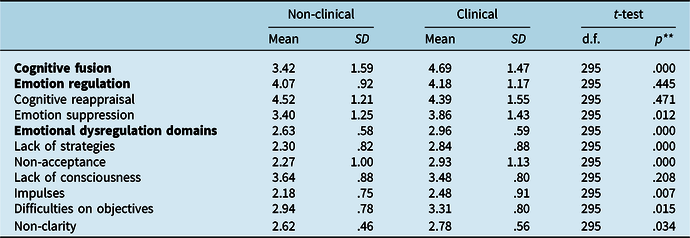
Means, standard deviations and t-test for independent samples for cognitive fusion, emotion regulation and emotional dysregulation domains in the non-clinical sample (n = 231) and the clinical sample (n = 66) are described in Table 1. Statistically significant differences were found between the two samples for almost all variables (p < .001). However, no statistically significant differences between the two samples were found in emotion regulation, cognitive reappraisal and lack of consciousness (partial confirmation of Hypothesis 1).
Means, standard deviations and t-test values for cognitive fusion, emotion regulation and emotional dysregulation domains in the non-clinical sample (n = 231) and the clinical sample (n = 66)

** p < .001.
Correlations between cognitive fusion and emotional dysregulation
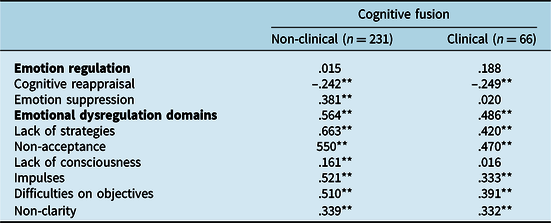
Through Pearson’s correlations, the associations between cognitive fusion, emotional regulation and emotional dysregulation domains in the non-clinical sample (n = 231) and the clinical sample (n = 66) were identified – see Table 2. In the non-clinical sample, cognitive fusion was negatively correlated with cognitive reappraisal (r = –.242, p < .001) and positively correlated with emotion supression (r = .381, p < .001) and emotional dysregulation domains (p < .001). In the clinical sample, cognitive fusion was also negatively correlated with cognitive reappraisal (r = –.249, p < .001) and medium to strongly correlated with almost all emotional dysregulation domains (p < .001) with the exception of lack of consciousness. Hypothesis 2 was thus partially confirmed.
Correlational analysis between cognitive fusion, emotion regulation and emotional dysregulation domains in the non-clinical sample (n = 231) and the clinical sample (n = 66)

** p < .001.
Stepwise regression analysis with cognitive fusion and emotional dysregulation
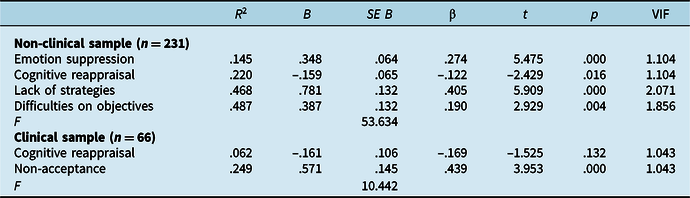
Stepwise multiple linear regression was used to assess whether cognitive fusion was predicted by emotional regulation strategies and emotional dysregulation domains in the two samples – see Table 3. An integrative model was found with four predictors explaining 48% of the variance of cognitive fusion (R 2 = .487, F = 53.634, p < .000) in the non-clinical sample (n = 231). In the clinical sample (n = 66), an integrative model was found with two predictors explaining 25% of the variance in cognitive fusion (R 2 = .249, F = 10,319, p < .000). Hypothesis 3 was thus partially confirmed.
Hierarchical regression analysis with emotion regulation strategies emotional dysregulation domains on cognitive fusion as a dependent variable in the non-clinical sample (n = 231) and the clinical sample (n = 66)

Only significant results are shown. VIF, variance inflation factor.
Mediational analysis between cognitive fusion, emotional dysregulation domains and symptomatology
It was tested with Process SPSS macro (Hayes, Reference Hayes2013), if cognitive fusion was a significant mediator of the relationship between emotion regulation strategies and emotional dysregulation domains in the two samples (bootstrap of 1000 computations was used). In the non-clinical sample, cognitive fusion mediates the relationship between cognitive reappraisal [b = –.315, 95% confidence interval (CI) –.100 to –.024, p < .001] and emotion suppression (b = .483, 95% CI .021 to .152, p < .001) with emotional dysregulation. In the clinical sample, the relationship between cognitive reappraisal and emotional dysregulation was mediated by cognitive fusion (b = –.234, 95% CI –.098 to –.001 p < .025). Cognitive fusion was not a significant mediator of the relationship between emotion suppression and emotional dysregulation on the clinical sample. Thus, Hypothesis 4 was partially confirmed.
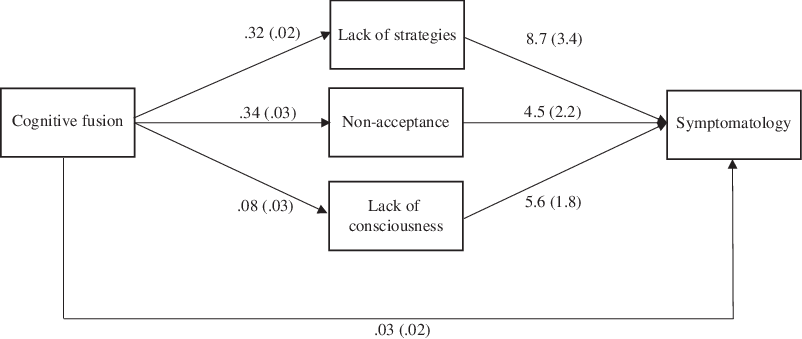
Moreover, it was tested if emotional dysregulation domains were significant mediators of the relationship between cognitive fusion and symptomatology in the two samples. In the non-clinical sample, the relationship between cognitive fusion and symptomatology was mediated by lack of strategies, non-acceptance and non-consciousness (p < .001) – see Fig. 1.
Mediation analysis between cognitive fusion and symptomatology in a non-clinical sample (n = 231). Only significant results are described.

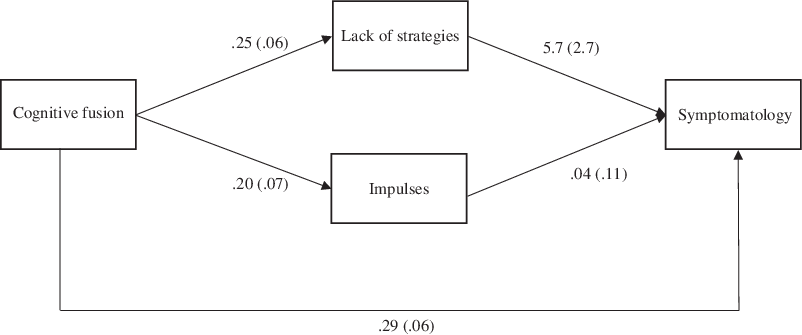
In the clinical sample, the relationship between cognitive fusion and symptomatology was mediated by lack of strategies and impulses (p < .001) – see Fig. 2. Therefore, there was a partial confirmation of Hypothesis 5.
Mediation analysis between cognitive fusion and symptomatology in a clinical sample (n = 66). Only significant results are described.

Discussion
Psychological inflexibility may be viewed as a consequence of experiential avoidance and cognitive fusion, leading to symptomatology. This research focused on the relationships between cognitive fusion, emotion regulation, emotional dysregulation domains and symptomatology within a transdiagnostic perspective. Cognitive fusion was expected to be negatively associated with cognitive reappraisal and positively associated with emotion suppression and emotional dysregulation domains in the two samples. All hypotheses were partially confirmed. Results were mixed but may support a transdiagnostic perspective.
Regarding the first hypothesis, the majority of variables revealed statistically significant differences between mean samples, whereas cognitive reappraisal and lack of emotional awareness were not statistically different in the two samples. These results show that cognitive reappraisal and the lack of consciousness may be independent processes and may be present in a wide range of individuals with or without symptomatology. Cognitive reappraisal is viewed as an adaptive process and may be applied by individuals in both non-clinical and clinical samples. Furthermore, almost all means in the clinical sample were higher than in the non-clinical sample. Individuals in the clinical sample tended to have a higher degree of cognitive fusion, apply emotion suppression more often and have a higher degree of emotional dysregulation than individuals in the non-clinical sample, being in line with previous results (Bardeen and Fergus, Reference Bardeen and Fergus2016; Gillanders et al., Reference Gillanders, Bolderston, Bond, Dempster, Flaxman, Campbell, Kerr, Tansey, Noel, Ferenbach, Masley, Roach, Lloyd, May, Clarke and Remington2014; Levin et al., Reference Levin, MacLane, Daflos, Seeley, Hayes, Biglan and Pistorello2014; Plonsker et al., Reference Plonsker, Gavish Biran, Zvielli and Bernstein2017; Webb et al., Reference Webb, Miles and Sheeran2012). This was expected because cognitive fusion has been associated with clinical populations (Faustino and Vasco, Reference Faustino and Vasco2020a,b) and emotion suppression has been associated with higher levels of symptoms than cognitive reappraisal (Aldao et al., Reference Aldao, Nolen-Hoeksema and Schweizer2010). In the same sense, emotional dysregulation domains of lack of strategies, non-acceptance, impulses, difficulties on objectives and non-clarity were also higher in the clinical sample than the non-clinical sample, this being in line with previous findings (Coutinho et al., Reference Coutinho, Ribeiro, Ferreirinha and Dias2010). Leahy et al. (Reference Leahy, Tirch and Napolitano2011) discuss that emotion suppression may be adaptive in some situations, such as suppression of fear in a catastrophic situation. Emotional suppression can also be useful in more mundane situations, such as in a discussion with a partner, friend or co-worker, if anger, resentment or disdain increases unproductively (Greenberg, Reference Greenberg2015). Therefore, this strategy may be used by different individuals as a normative emotion regulation skill, independently of symptomatology (Aldao et al., Reference Aldao, Nolen-Hoeksema and Schweizer2010; Brockman et al., Reference Brockman, Ciarrochi, Parker and Kashdan2017; Morris and Mansell, Reference Morris and Mansell2018). Finally, lack of consciousness (which means difficulties in understanding the emotional response) may also be beyond diagnosis because it may also reflect a difficulty in attending to emotional experience which may be viewed as broader (Greenberg, Reference Greenberg2015). Individuals with severe psychopathology may often engage in experiential avoidance, which contributes to not having consciousness of their emotions (Gratz and Roemer, Reference Gratz and Roemer2004; Hayes et al., Reference Hayes, Strosahl and Wilson2011; Linehan, Reference Linehan1993). Nevertheless, individuals in treatment may have developed the ability to give attention to emotional experience, giving them higher abilities of emotional awareness.
The second hypothesis was also partially confirmed. Cognitive fusion correlated negatively with cognitive reappraisal and positively with emotion suppression and emotional dysregulation domains in the non-clinical sample, but it did not correlate with emotion suppression and lack of consciousness in the clinical sample. These results support the assumption that cognitive fusion may have a pervasive impact on emotion regulation strategies (Krafft et al., Reference Krafft, Haeger and Levin2019; Plonsker et al., Reference Plonsker, Gavish Biran, Zvielli and Bernstein2017). However, the absence of associations of cognitive fusion with emotion suppression and lack of consciousness in the clinical sample may be explained by the effects of psychotherapy. One could argue that individuals in the clinical sample may have developed some degree of new adaptive emotion regulation skills, such as attention to emotional experience and decentering which could weaken the association between cognitive fusion and emotional suppression. Attention to emotional experience is a key aspect to the development of emotional awareness (Greenberg, Reference Greenberg2015). Another possible explanation may be due to reliability issues in the lack of consciousness subscale of DERS. Ruganci and Gençöz (Reference Ruganci and Gençöz2010), described some inconsistencies in internal consistency and test–retest in different psychometric studies of DERS, which may introduce some measurement limitations of the operationalized construct. Nevertheless, DERS was already used to explore transdiagnostic constructs associated with emotional dysregulation (Neacsiu et al., Reference Neacsiu, Eberle, Kramer, Wiesmann and Linehan2014). In this sense, it is necessary to replicate these results to further explore this issue. Moreover, the association between cognitive fusion and emotion suppression in the non-clinical sample indicates that suppression may be adaptive or maladaptive. Morris and Mansell (Reference Morris and Mansell2018) stated that emotion suppression becomes maladaptive when used inflexibly, regardless of context-specific demands. As stated before, the suppression of distressful emotions in a work context may be adaptive. However, when suppression is always applied, regardless of context-demands, it may lead to maladaptive experiential avoidance, which in turn leads to cognitive fusion (Hayes et al., Reference Hayes, Strosahl and Wilson2011; Morris and Mansell, Reference Morris and Mansell2018). The results obtained here further suggest that the association between cognitive fusion and cognitive reappraisal may be more significant in the clinical population than the association between cognitive fusion and suppression, which is in line with previous research (Gross and John, Reference Gross and John2003; Kashdan and Rottenberg, Reference Kashdan and Rottenberg2010; Webb et al., Reference Webb, Miles and Sheeran2012).
The third hypothesis was partly confirmed. In the non-clinical sample, cognitive fusion was predicted within a composite model of emotion suppression, cognitive reappraisal, lack of strategies, difficulties on objectives and lack of consciousness. In the clinical sample, cognitive fusion was predicted by cognitive reappraisal and non-acceptance. In the two samples, cognitive reappraisal was a significant predictor of cognitive fusion within a composite model by absence, which means that it is the lack of reappraisal abilities that contributes to the explained variance in the regression models. The regression model in the clinical sample may support the theoretical assumption that individuals who lack reappraisal skills and have difficulty accepting their emotions tend to be more fused with their thoughts (cognitive fusion), which is consistent with the psychopathological model ACT (Hayes et al., Reference Hayes, Strosahl and Wilson2011). These results may support the assumption that cognitive reappraisal is an adaptive regulation strategy (Aldao et al., Reference Aldao, Nolen-Hoeksema and Schweizer2010; Gross, Reference Gross2002; Gross and John, Reference Gross and John2003) and cognitive fusion may be a result of emotion suppression which is a form of experiential avoidance (Hayes et al., Reference Hayes, Strosahl and Wilson2011; Morris and Mansell, Reference Morris and Mansell2018). These results also align with the negative correlation between cognitive fusion and cognitive reappraisal which was evident in the two samples, implying that this association may be a candidate for a transdiagnostic feature. Cognitive reappraisal is the adaptive emotion regulation strategy that individuals use to re-evaluate stressful situations, reducing emotional arousal (Gross, Reference Gross2002; Gross and John, Reference Gross and John2003), which imply to some extent some form of psychological flexibility. In order to shift from the first to the second cognitive evaluation (reappraisal), individuals must have the ability to distance themselves from the first evaluation. It is the ability to shift internal dispositions accordingly with context-dependent demands that underlies psychological flexibility (Kashdan and Rottenberg, Reference Kashdan and Rottenberg2010). Therefore, these results show that lower levels of cognitive reappraisal and higher levels of emotion suppression may predict some degree of cognitive fusion. Moreover, other variables were also significant on the regression analysis in the non-clinical sample. Thus, difficulties in assessing strategies to cope with or being aware of emotions associated with cognitive reappraisail and emotional suppression, may add explanatory value to the variance of cognitive fusion. Therefore, this can emphasize the predictability of the multidimensionality of cognitive fusion and psychological inflexibility. This imply that several factors may underlie psychological inflexibility which is in line with previous findings (Aldao et al., Reference Aldao, Nolen-Hoeksema and Schweizer2010; Hayes et al., Reference Hayes, Strosahl and Wilson2011; Kashdan and Rottenberg, Reference Kashdan and Rottenberg2010; Morris and Mansell, Reference Morris and Mansell2018).
The fourth hypothesis was partially confirmed. Cognitive fusion was a significant mediator of the relationship between emotion regulation strategies (cognitive reappraisal and emotion suppression) and emotional dysregulation in the non-clinical sample. However, in the clinical sample cognitive fusion was only a significant mediator of the relationship between cognitive reappraisal and emotional dysregulation. This was not expected, because cognitive reappraisal has been associated with lower levels of anxiety and emotional suppression has been associated with higher levels of psychopathology (Aldao et al., Reference Aldao, Nolen-Hoeksema and Schweizer2010; Webb et al., Reference Webb, Miles and Sheeran2012). One likely explanation may be due to the development of new emotion regulation strategies because individuals in the clinical sample were engaged in psychotherapy. Maybe individuals in the clinical sample may already have developed some abilities to some extent tolerate, control and soothe emotional distress, giving them some flexibility in the implementation of emotion suppression. Therefore, this may disrupt the direct inflexible association between cognitive fusion and emotion suppression. It is the association between these two variables that may have weakened and not the use of emotion suppression, as there is a significant difference between sample means in the Emotion Regulation Questionnaire. A second possible explanation may be related to individual differences that could be associated with the first explanation, because it encompasses diverse factors (e.g. effects of therapy, previous coping strategies, psychopathology). Morris and Mansell (Reference Morris and Mansell2018) proposed that individual differences in inflexibility may be a core factor in the application of coping processes, which could help to explain why cognitive fusion was only a significant mediator of both emotion regulation strategies in the non-clinical sample. Webb et al. (Reference Webb, Miles and Sheeran2012) described that different strategies in emotion regulation have different levels of effectiveness (e.g. reappraising the emotional response was less effective than reappraising the emotional stimulus), which also implies that individual differences are relevant in emotion regulation (Gross and John, Reference Gross and John2003). A third explanation may be due to different underlying pathological mechanisms of different diagnoses in clinical sample. Leahy et al. (Reference Leahy, Tirch and Napolitano2011) state that emotion regulation may have different underlying mechanisms of emotion intensification (e.g. terror, panic, trauma), emotion deactivation (e.g. dissociation, depersonalization, splitting) and strategies such as rumination, worry and avoidance, which may be different for anxiety and depressive disorders. Furthermore, cognitive fusion was a significant mediator in the two samples, which shows that the relationship between cognitive fusion and cognitive reappraisal may be more widespread and less susceptible to individual differences. Thus, this result supports the previous assumption that cognitive fusion and cognitive reappraisal may be a transdiagnostic process in precipitating and maintaining emotional disorders (Levin et al., Reference Levin, MacLane, Daflos, Seeley, Hayes, Biglan and Pistorello2014; Sloan et al., Reference Sloan, Hall, Moulding, Bryce, Mildred and Staiger2017).
The fifth hypothesis was partially confirmed. In the non-clinical sample, the relationship between cognitive fusion and symptomatology was mediated by lack of strategies, non-acceptance and lack-consciousness, whereas in the clinical sample the same relationship was mediated by lack of strategies and impulses. To some extent this was expected (Coutinho et al., Reference Coutinho, Ribeiro, Ferreirinha and Dias2010; Gratz and Roemer, Reference Gratz and Roemer2004; Marganska et al., Reference Marganska, Gallagher and Miranda2013). The lack of strategies is the common dominator here, which implies to some extent that individuals who do not have accesses to emotion regulation strategies could be prone to symptomatology (Aldao et al., Reference Aldao, Nolen-Hoeksema and Schweizer2010; Gratz and Roemer, Reference Gratz and Roemer2004), beyond diagnosis. Maybe this emotional dysregulation domain may be also a candidate to be considered as a transdiagnostic construct. Moreover, Webb et al. (Reference Webb, Miles and Sheeran2012) suggested that several mediators may play a role in emotion regulation effectiveness (e.g. to-be-regulated emotion, frequency of strategies used), which may also help to explain the difference in the mediation models in the two samples. This is also true for depression (Abravanel and Sinha, Reference Abravanel and Sinha2015). It is noteworthy that in the non-clinical sample, there were more emotional dysregulation domains than in the clinical sample. Clinical populations seem to have fewer variables that explain symptomatology in predicative models where in non-clinical populations there could be more dysfunctional mechanisms responsible for underlying psychological problems than in the clinical population (Faustino and Vasco, Reference Faustino and Vasco2020b; Morris and Mansell, Reference Morris and Mansell2018). It seems that in clinical populations the dysfunctional mechanisms are more related to severity than diversity. However, more studies are required to explore this statement.
Limitations and future directions
Regarding the limitations, it is possible to make several considerations. The use of self-report measures circumscribes the responses to individuals’ self-knowledge. The present study was made using a cross-sectional design which limits cause/effect interpretations. The discrepancy in the samples size may have some implications in comparisons. The sample size of the clinical sample may have had an impact on regression and mediation analyses. Maybe the reduced size of the clinical sample may have limited the power of statistical analysis. However, the tested model may forecast possible new studies with larger samples. An inherent condition for clinical populations is their heterogeneity in terms of dysfunctional variables, coping mechanisms and symptomatology, which may constrain participants’ responses in face-to-face assessment. In the future, we expect to explore the predictive and mediational value of cognitive fusion in emotional processing difficulties (Faustino and Vasco, Reference Faustino and Vasco2020c) and emotional schemas (Faustino et al., Reference Faustino, Vasco, Silva and Marques2020). Also, it is intended to explore the relationships between cognitive fusion, psychological distress and well-being.
Conclusions
Psychological inflexibility and emotional dysregulation are associated beyond diagnostic criteria. Individuals tend to apply emotion regulation strategies as cognitive reappraisal or emotion suppression according to individual differences in coping with symptoms or with emotional difficulties underlying emotion dysregulation. However, the relationships between cognitive fusion, cognitive reappraisal and lack strategies tend to be less sensible to individual differences and may be a core transdiagnostic processes in the precipitation and maintenance of psychological inflexibility and emotion dysregulation.
Acknowledgements
None.
Financial support
No funding policy was applied to this work.
Ethical statements
All procedures performed in studies involving human participants were in accordance with the ethical standards of the institutional and/or national research committee and with the 1964 Helsinki declaration and its later amendments or comparable ethical standards. Our study was approved by Scientific Committee of Faculty of Psychology of University of Lisbon.



Comments
No Comments have been published for this article.