INTRODUCTION
In 2007, the controversy over Kenya's 27 December elections triggered severe violence throughout the country. This politically based violence, the most severe since 1963 when Kenya gained its independence from Britain (Chege Reference Chege2008), made headlines around the world. In the wake of the vote, over 1,000 people were killed (Kiai Reference Kiai2008; Kilonzo Reference Kilonzo2009). An estimated 300,000 to 500,000 people were forced to flee their homes, 75% of whom were women and children (Kiai Reference Kiai2008; Obonyo et al. Reference Obonyo, Omondi and Mwinzi.2008).
At the heart of the post-election crisis were claims of electoral dishonesty, following the victory of presidential incumbent Mwai Kibaki, leader of the Party of National Unity (PNU) (Chege Reference Chege2008). According to Kiai (Reference Kiai2008), for years Kibaki's opponents had accused him of amending voting procedures to increase the powers of his ruling party. This included appointing commissioners to appropriate the tallying of votes. In 2007, Kibaki's party won only 43 of 210 parliamentary seats, while the opposition – the Orange Democratic Movement (ODM), led by Raila Odinga – won ninety-nine seats. This would have made it very difficult for Kibaki to form a cabinet (Dagne Reference Dagne2008). Eventually, the two leaders signed a power-sharing agreement, mediated by the former United Nations secretary-general Kofi Annan. This led to formation of a coalition government on 28 February 2008 (Nasongo et al. Reference Nasongo, Achoka and Wamocha.2009), and in April 2008 the parties agreed on a new forty-member cabinet (Dagne Reference Dagne2008).
Kenya has more than forty different ethnic groups, the largest being Kikuyu (22%), followed by Luhya (14%), Luo (13%) and Kalenjin (12%) (Chege Reference Chege2008). The Kikuyu are traditionally agriculturists from the rich central highlands and in the past wielded strong economic power (Chege Reference Chege2008). Jomo Kenyatta, a Kikuyu, was the president of the Kenyan African National Union (KANU) until his death in 1978, when he was succeeded by Daniel Arap Moi, a Kalenjin (Klopp & Kamungi Reference Klopp and Kamungi.2008). Moi ruled for twenty-four years until December 2002, when Mwai Kibaki, a Kikuyu, and Raila Odinga, a Luo, joined forces and formed the National Rainbow Coalition (NaRC) to defeat Uhuru Kenyatta, Jomo Kenyatta's son and Moi's chosen successor for KANU (ibid.; Chege Reference Chege2008). When Kibaki became president, he promised constitutional reforms that would give Odinga the newly created position of Prime Minister (Klopp & Kamungi Reference Klopp and Kamungi.2008). This never happened, and Odinga remained a cabinet minister. He was pushed into the opposition after Kibaki surrounded himself with a Kikuyu clique as his advisory caucus (Chege Reference Chege2008). Historically, there have been clashes between the Kikuyu and Luo. Most Luos feel they have been politically cheated by Kikuyu throughout Kenya's history (ibid.). As a cabinet minister in December 2001, Odinga demanded that the predominantly Kikuyu landlords in Kibera lower their rates by 50% for tenants, many of whom were Luo (Klopp & Kamungi Reference Klopp and Kamungi.2008). Fifteen people were killed when this policy was enforced by ODM supporters wielding machetes (ibid.).
Both sides used ethnicity to gain votes. The Kikuyu voted largely for Kibaki's PNU, while Luos and Kalenjins voted largely for ODM (ibid.). The heaviest post-election turmoil occurred in the Western Province, and in Nairobi where both candidates had strong support. Odinga was the Member of Parliament (MP) for Langata, a division of the Kibera slum in Nairobi. Western Kenya and Kisumu in particular were an ODM stronghold (ibid.). It is said that local radio stations conveyed hateful messages directed at different ethnic groups (ibid.). Mueller (Reference Mueller2008) talks of a ‘lack of programmatic political parties which gave rise to a winner take all view of parties. These were inherently clientist and ethnically driven, something that raised the stakes of winning and gave rise to violence.’
According to a Human Rights Watch, government police used live ammunition to control public demonstrations, and were allegedly responsible for eighty-one deaths between 26 December 2007 and 24 January 2008 (Klopp & Kamungi Reference Klopp and Kamungi.2008). The murder of thirty Kikuyu men, women and children, burned alive in a church in Eldoret, also in Western Kenya, made global headlines (ibid.).
After Kibaki assumed control, Kenya's economy grew by between 2% and 7% annually (Dagne Reference Dagne2008), due to the effects of globalisation and Kenya's neo-liberal economic policies, privatisation and state deregulation, which at the same time widened the gap between the rich and the poor (Campbell Reference Campbell2006); 10% of the population controlled 35% of the national income (UNDP 2005). Economic inequalities certainly played a role in the pre-election tension. In 2000, the incidence of poverty was 51% in rural areas and 38% in urban areas, and by 2005, poverty levels had reached 56% overall, despite improvements in health and education (Oluoko-Odingo Reference Oluoko-Odingo2009). By the time of the election, the proportion of Kenyans living under the poverty level exceeded 70% in parts of the country (ibid.).
The Western Province is among the poorest in the country. In the districts of Busia and Kakamega it is estimated that 70% and 50% of the population respectively live in extreme poverty (Thornton et al. Reference Thornton2002). Perhaps some poor citizens were disappointed because they were not experiencing any positive effects of government intervention, and believed that a change in power with representation by someone from their own tribe would improve their lives.
After the 2007 elections, Kenya experienced a serious economic crisis, especially in tourism, agriculture and trade. The day after the elections, the Nairobi Stock Exchange dropped by US$600 million (Klopp & Kamungi Reference Klopp and Kamungi.2008), and the estimated cost of crisis-related damage was US$1 billion by 7 January 2008 (ibid.). Hotel occupancy rates dropped from over 80% in December 2007 to under 20% by January 2008 (Bohnstedt Reference Bohnstedt2008; Wadhams Reference Wadhams2008), and by early February 120,000 tourism-related jobs had been lost. Some rail lines were destroyed and roads were blockaded, preventing transport of vital goods, especially fuel (Klopp & Kamungi Reference Klopp and Kamungi.2008). Although the impact of the crisis on Kenya's trade and tourism is well documented, very little attention has been paid to the specific economic effects on the majority of Kenyans, namely the 70% who live in rural areas. Most of these people are farmers, many of whom live in poverty.
The impact of the crisis on the livestock sector cannot be underestimated; Gregory and Grandin (Reference Gregory and Grandin.2007) have stated that life without livestock is difficult, especially in rural communities. Pigs play an important role in the livelihood of many people living in rural communities of western Kenya. In this area, pig keeping is a relatively new but expanding component of livestock farming. A study by Mutua et al. (Reference Mutua2010b) showed that farmers in Busia and Kakamega had owned pigs for an average of six and eleven years respectively. In one recent study in Busia District, pigs represented 41% of livestock kept by smallholder farmers (Kagira et al. Reference Kagira2010). The province is the most densely populated region of the country. In this region, pork is the second most preferred meat after beef. Most families consume some pork (74%), but only 40% do so once per week. Farmers like to keep pigs because they grow faster and have more offspring than sheep and cattle, eat leftover food, and are very easy to sell (Lekule & Kyvsgaard Reference Lekule and Kyvsgaard.2003; Mutua et al. Reference Mutua2010a). Smallholders also prefer pigs to other livestock because the butchers come to the farm to buy the pig, so the farmer does not have to take it to market (Kagira et al. Reference Kagira2010; Levy et al. Reference Levy, Dewey, Weersink and Mutua.2009a; Mutua et al. Reference Mutua2010a).
Smallholders live in extended family compounds on an average of one to two acres of land (Kagira et al. Reference Kagira2010; Mutua et al. Reference Mutua2010b). They grow their own food and therefore have insufficient land for other livestock, particularly ruminants that need more space to graze. Most farmers have either no formal education or some primary school education (Kagira et al. Reference Kagira2010). Pigs are kept in the traditional manner in a mixture of free range and tethered management style, largely because the inputs are much lower than under intensive management (Kagira et al. Reference Kagira2010; Lekule & Kyvsgaard Reference Lekule and Kyvsgaard.2003). Pigs are kept to bank small amounts of money, for income generation, and to source money in a hurry when there is a family emergency (Kagira et al. Reference Kagira2010; Lekule & Kyvsgaard Reference Lekule and Kyvsgaard.2003; Mutua et al. Reference Mutua2010a). The main crops for these farmers are maize, beans, cassava and sweet potatoes. All farmers keep some chickens and some keep a few sheep, goats or cattle as well as pigs (Mutua et al. Reference Mutua2010a).
Pigs in smallholdings are given foodstuffs similar to the staple diet of the farmers. The most frequently fed foods given to pigs include cooked ground maize (ugali), kitchen leftovers, dried fish (omena), vegetables from the farm, sweet potato vines and cassava (Kagira et al. Reference Kagira2010; Mutua et al. Reference Mutua2010b). The pigs grow more slowly than pigs of improved breeds that are kept confined, and therefore achieve weights of only 12 kg, 30 kg and 42 kg at 2–5 months, 6–10 months and 11–24 months of age respectively (Mutua et al. Reference Mutua2011).
Only 19% of farmers keep sows (Kagira et al. Reference Kagira2010) and own an average of 1·3 sows (Mutua et al. Reference Mutua2010c); most of the pigs are bred from boars borrowed from neighbours. Most sows (56%) were sold after they weaned one litter, 91% of them to the butcher. On average, sows weaned 6·6 pigs from their first litter when they were twelve months old (Mutua et al. Reference Mutua2010c). Pigs are typically kept by women (Mutua et al. Reference Mutua2010a) and the money earned from the pig is used to support family needs such as school fees, medicine or hospital bills, food and clothing (Kagira et al. Reference Kagira2010; Mutua et al. Reference Mutua2010a).
In this paper, we study the ramifications of the post-election crisis on smallholder pig farmers and butchers in Western Kenya. We measure the change in livestock ownership, the market price of meat, the operation of butcheries, and also the impact on families. Our study period, from June 2006 through June 2008, covers times both of relative peace and of severe violence.
MATERIALS AND METHODS
To better understand the effects of the post-election crisis in Busia and Kakamega Districts, we collected data from pig farmers and pig butchers. The surveys were conducted in June 2008, six months after the country's general elections (a copy of surveys used are available on request from the corresponding author).
Study sites and selection of study farms
The focus of this study is the pig industry because the research team conducted a multi-year, longitudinal research project involving smallholder pig farmers from 2006 to 2009. We had built positive and trusting relationships with the farmers, butchers and community leaders during this community-based research work, providing a strong framework within which this research was possible during a time of fear and distrust following the crisis. The study was conducted in the Busia and Kakamega Districts of western Kenya. Busia District, which accounts for 14% of Western Province, had a population of 370,600 in 1999. Kakamega District, which accounts for roughly 17% of the land mass of Western Province, had a population of about 603,500. These districts were chosen because Busia is rural, while Kakamega is peri-urban, with farmers living close to a city.
Two sub-locations with a known history of smallholder pig-keeping were identified in each district. A month before beginning the field work, we established a list of smallholder pig-keeping households in the sub-location through brief interviews with village elders and a sample of the farmers. All the villages in the selected sub-locations were included in the study. Farms within each village were randomly selected proportional to the number of farms present. This included between 65% and 75% of all farms in each village. In the course of the study, farms were visited three times, three to six months apart. Interviews were conducted with farmers from 110 rural households and with thirty-six butchers in the two districts during June 2008. These included fifty-nine farmers and seventeen pork butchers in Busia, and fifty-one farmers and nineteen pork butchers in Kakamega.
Post-election crisis survey
By December 2007, the farmers in Busia had already been visited three times, and further data from these farmers were collected during six training sessions conducted following the election crisis. A training of trainers (TOT) approach was used, whereby the researchers trained the local government staff who would, in turn, teach the farmers. Workshops were held at pig farmers’ compounds that were convenient for farmers from three to four neighbouring villages to attend. All farmers in the region were invited to the workshops. During the workshops in Busia, questionnaires were administered to farmers who were part of the longitudinal study. Interviews were conducted in Swahili, the local language or English, depending on the language preference of the participants. The government staff served as translators for the English-speaking researchers.
In Kakamega District, questions relating to the political crisis were incorporated into the on-farm, face-to-face survey that was part of the longitudinal study. The surveys were completed during on-farm visits. A list of butchers who purchased pigs from the sub-locations in the research project was identified by interviewing the government meat inspectors and farmers in the area. Each butcher was interviewed in a face-to-face meeting at his butcher shop, using a pre-designed questionnaire. During the interviews, farmers were asked to describe how many animals they owned in June 2007 and in June 2008. Farmers itemised each animal sold from June to December 2007, and between January and June 2008. The major reason for selling that animal was described by the farmer, using an open-ended questionnaire. In Busia, farmers were asked to list three effects of the political crisis, using an open-ended question. Meanwhile, farmers in Kakamega were given a list of thirteen potential effects of the crisis, and were asked whether they had experienced any of these. The results of this portion of the questionnaire for the farmers in the two districts are thus not directly comparable.
The butchers were asked to describe the impact of the political violence on their business, and specifically how long their business was forced to be closed during the crisis. They were also asked about the prices of meat before the crisis and after the crisis. Paired t-tests were used to compare livestock ownership for individual farmers from 2007 to 2008. A Wilcoxon signed-rank test was used to compare factors between Busia and Kakamega before and after January 2008. Paired t-tests were used to determine whether the within-district costs per kilogram of each meat type differed before and after January 2008. A two-tailed student's t-test was used to determine whether the cost per kg of each meat differed between the Busia and Kakamega Districts before and after the political crisis.
RESULTS
Livestock ownership
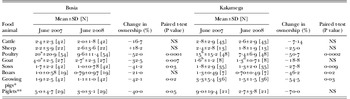
Livestock ownership in both districts decreased for all animal species, except for sheep in Busia (Table 1). In Busia, the numbers of sows, growing pigs and piglets decreased by 41%, 42% and 40% respectively. In Kakamega, sows and boars decreased by 27% and 46%; growing pigs and piglets decreased more substantially, by 55% and 70% respectively. In both districts, the number of poultry was reduced by half from 2007 to 2008.
Numbers of livestock owned by smallholders in June 2007 and June 2008 in Busia and Kakamega Districts

Notes:
NS=not significant.
* Growing pigs are ⩾8 weeks old.
** Piglets are <8 weeks old.
Reason livestock were sold
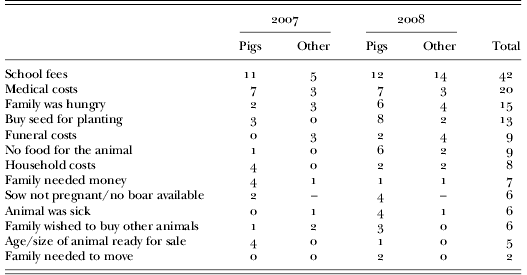
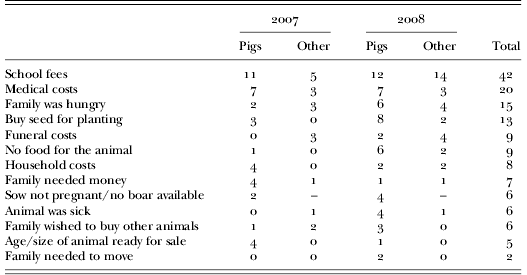
In total, 148 animals were sold during this time period: fifty-seven from June to December 2007, and ninety-one from January to June 2008 (Table 2). There were thirty-nine and fifty-eight pigs sold in 2007 and 2008 respectively. The eighteen other animals sold in 2007 included six chickens, one sheep, four goats and seven cattle. The thirty-three other animals sold in 2008 included twelve chickens, six sheep, seven goats and eight cattle. The most common reason for selling animals was to pay for school fees or medical costs. In 2008, five animals were sold specifically to reduce the number of animals on the farm, or because the farmers had to move and there would be no family members left to care for them. Given the small number of animals in each category, these numbers are not statistically significant. More animals were sold in 2008 than in 2007 because the family was hungry, to buy seeds for planting, for funeral expenses, or because there was no food for the animal, the sow was not pregnant, or the animal was sick.
The reasons farmers in western Kenya sold pigs and other livestock, including chickens, cattle, sheep and goats, in 2007 and 2008
Market increases
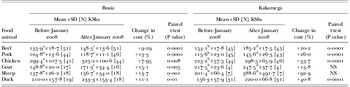
In both districts, there were significant increases in the cost of beef, pork, chicken and duck. While the cost of goat and sheep meat also increased in Busia, the average increase was typically more dramatic in Kakamega (Table 3).
Cost of meat per kg before and after January 2008 in Busia and Kakamega Districts of western Kenya

Notes:
NS=not significant.
Superscripts indicate different prices before January 2008 at p<0·05.
Effect on business
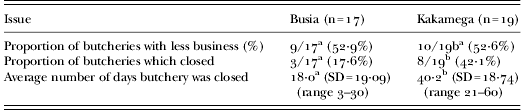
More than half the butcheries in both districts reported a considerable drop in business during the political crisis. In Busia, 18% of butchers had their shops closed for an average of eighteen days (Table 4). Those in Kakamega were more severely affected, with 42% of butcheries needing to close for an average of forty days.
Proportion of pork butchers whose business was directly affected by the political crisis
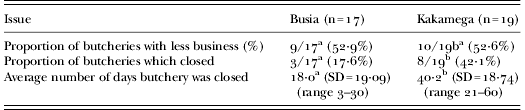
Superscripts indicate significant differences at p<0·05.
Effects on farmers
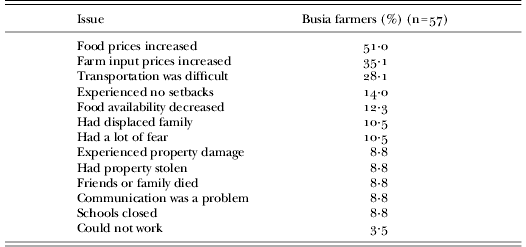
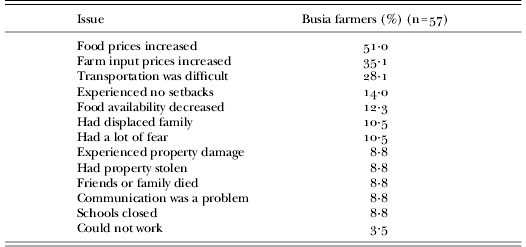
In Busia, farmers were asked to list the top three effects of the political crisis on both themselves and their families. Although 14% of the farmers experienced no setbacks, more than half of the respondents said food prices increased (Table 5). Additionally, prices of farm inputs increased (35%), and it was difficult to travel outside the villages (28%). Others experienced serious adversities, including damaged or stolen property (9%), the death of family or friends (9%), closed schools (9%), and the inability to work (4%).
Percentage of farmers from Busia who mentioned each challenge when they were asked about the impact of the political crisis in an open-ended question
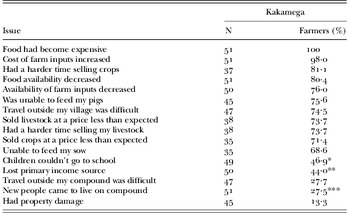
All farmers in Kakamega said that food had become expensive (Table 6). Most of these farmers also said that the cost of farm inputs increased (98%), the availability of inputs decreased (76%), and it was harder to sell crops (81%) and livestock (74%). Meanwhile, food availability decreased (80%), additional family members came to live in the compound (25%), and they were not able to feed their pigs (76%). These farmers also had a hard time travelling outside their village or compound, and children were not able to attend school (47%). In 44% of homes, the primary source of income was lost, and more than 13% experienced property damage.
Percentage of farmers from Kakamega who agreed that the specified challenge had affected them or their family because of the political crisis

Notes:
* Of these, an average of 3·1 children per household.
** Of these, 12/22 (54·5%) permanent loss and 8/22 (36·4%) temporary loss.
*** Of these, 7/14 (50·0%) had children come at an average of 2·3 per compound, and 12/14 (85·7%) had adults come at an average of 2·6 per compound.
DISCUSSION
Livestock are a versatile commodity, a source of economic security, and in times of crisis, provide a source of income similar to cash cropping (Kerner & Cook Reference Kerner, Cook., Downs, Kerner and Reyna1991). They are valuable and therefore universal articles of trade, and in some circumstances, they can even replace monetary currency as a medium of exchange. Somali refugees customarily accept payment of compensation in the form of livestock to the aggrieved party as a form of justice (Crisp Reference Crisp2000). Most farmers in this region of western Kenya kept pigs as a source of income to deal with family needs such as school fees and medical bills (Kagira et al. Reference Kagira2010; Mutua et al. Reference Mutua2010a). In 2008, livestock were also sold to pay for funeral expenses. The post-election crisis resulted in increased costs of food and farming inputs such as seed and fertiliser. Some of this was a result of road closures, reducing the transfer of maize and seed from the Rift Valley and the destruction of crops in central Kenya (Kilonzo Reference Kilonzo2009). Many farmers in 2008 sold livestock to buy food for the family or seed for the crops. Other farmers sold their livestock because they couldn't afford to feed the animals. Fear of death may prompt abandonment of land and displacement of people and resources (Gonzalez & Lopez Reference Gonzalez and Lopez.2007). In the current study, two pigs were sold because the family needed to move and there was no one left to feed the animals. Livestock can be understood as an insurance policy or a savings account: families keep them in order to sell them in times of crisis (Kerner & Cook Reference Kerner, Cook., Downs, Kerner and Reyna1991). This occurred in early 2008 in western Kenya as a means of human and economic survival.
Livestock provided the lifeline for these subsistence farmers, and thus another illustration that in times of political unrest, animals have the potential to sustain a country (Gregory & Grandin Reference Gregory and Grandin.2007). While sale of livestock sustained these families in the short term, the increased sales and the subsequent reduction in pig numbers will cause, at least over the subsequent few years, a negative impact on the pig industry. The numbers of pigs owned by the farmers drastically declined, during and in the months following the political violence. Farmers have no means to source and transport livestock from distant places, and almost all farmers (95%) buy weaned pigs from their neighbours in the local villages (Kagira et al. Reference Kagira2010; Mutua et al. Reference Mutua2010a). Breeding animals are typically weaned pigs that are kept long enough to reach puberty (Mutua et al. Reference Mutua2010a). Hence a reduction in both the growing and breeding pigs in the population will reduce the availability of weaned pigs for farmers wishing to use pigs as a step out of poverty (Thornton et al. Reference Thornton2002). The number of sows was reduced by 41% and 27% in Busia and Kakamega respectively. Relatively few farmers keep sows because they are more costly to feed than growing pigs (Kagira et al. Reference Kagira2010). Therefore, any reduction in sow numbers will reduce the supply of weaned pigs to the village. Sows do not typically wean their first litter until they are 13–14 months of age (Mutua et al. Reference Mutua2010c). Hence, a farmer must purchase a weaned pig and feed her until she is fourteen months old before earning money from the animal. The reduction in sows in the villages will reduce the numbers of weaned pigs available for other farmers to purchase as growing pigs for the meat market. This problem is further exacerbated by the reduction in the numbers of boars. Most sows are bred from a local boar owned by a neighbour (Mutua et al. Reference Mutua2010c). The numbers of boars in Kakamega decreased by 47% from 2007 to 2008. In Busia, although there was no significant reduction in the numbers of boars, the number of farmers who owned boars decreased from fifteen to ten. Our findings agree with Kagira et al. (Reference Kagira2010) who found that few farmers (3·7%) keep boars. Hence a decrease in the numbers of boars may result in a loss of pig breeding capacity in the village. If a village does not have a boar, then farmers will be forced to sell the sow for meat because she cannot be bred. This was reflected in our study, where three farmers sold their sows because there was no boar available to serve them.
A concurrent decrease in both market-weight pigs and replacement breeding stock for the farming community is certain to have a ripple effect on the local industry. Clearly, it will only return to its previous size if and when local farmers choose to keep pigs long enough to have breeding sows and boars. However, with the drastic decrease in the number of piglets – 40% in Busia and 70% in Kakamega – it will take the pig industry at least a full year to recover. Existing piglets must grow and mature to produce their first offspring. Since the market is driven by supply and demand, there will be inflation in the price of piglets. During the interviews, the farmers reported that they paid sow owners for piglets as soon as they were born, before they were ready to be weaned (data not shown). It will be a full year before new piglets are available from these newly weaned pigs, and a further 8–10 months before they reach sufficient market weight for the butcher industry.
The farmers in this study sold not only pigs but sheep, goats, cattle and also some chickens. It is beyond the scope of this study to determine the impact of the reduction in the numbers of ruminants. While an outbreak of infectious disease can cause a decrease in livestock numbers, there was no evidence of disease in the pig or ruminant industries in this region. Indeed, there has been no such report in recent literature. Two members of the research team are veterinarians who have been examining the pigs on these farms since 2006, and neither researcher observed a disease outbreak in the pig population. However, much of the decrease in the poultry population in Busia from June 2007 to June 2008 was likely to be due to infections such as Newcastle disease, infectious bronchitis, or coryza sinusitis, which affect chickens in western Kenya (Okitoi et al. Reference Okitoi, Ondwasy, Siamba and Nkurumah.2007). Many farmers who were interviewed talked of their chicken flocks being eliminated by disease.
The pork butchers rely on a local supply of pigs, and villagers coming to the market to purchase their pork (Kagira et al. Reference Kagira2010; Levy et al. Reference Levy, Dewey, Weersink and Mutua.2009a; Mutua et al. Reference Mutua2010b). More than half of them reported a reduction in their business during the post-election violence, due to both closures of the markets and reduced sales of meat. A higher proportion of butcheries were closed in Kakamega, and these were closed for much longer than those in Busia. The villages in Kakamega are close to the city of Kakamega, the provincial headquarters for Western Province. Some of the markets are located on the main road linking Kakamega and Kisumu. The latter, which is the third largest city in Kenya, is a stronghold of the ODM, and a high proportion of Kakamega residents were politically aligned with the party's leader. They became targets for violence by police and government troops (Kiai 2008). This also may have led to violence committed by those who had felt politically wronged. Another reason for the higher proportion of closed businesses in Kakagema may relate to the fact that the crisis, and the presence of armed forces, were more focused in urban settings. Kakamega is a flourishing city: the butchers in this peri-urban district told the researchers that their shops were closed because the army closed the marketplace. Markets were less likely to be closed and were closed for a shorter time in the villages in the Busia District than in the more urbanised markets of the Kakamega District. In an effort to reduce violence, government directives barred people from congregating. This initiative affected the length of time that a market was closed for business, and reduced the income from these butcheries. The fixed costs of the butcheries such as annual public health and business licenses, annual cost to test the scale and rent continued over this time of reduced income (Levy et al. Reference Levy, Dewey, Weersink and Mutua.2009b). An extended closure of one or two months would have severely impacted the families of these butchers, many of whom rely on the income from this business.
Like the farmers, the butchers do not own motorised vehicles (Levy et al. Reference Levy, Dewey, Weersink and Mutua.2009a). They purchase pigs within a small geographical radius, travelling to farms by foot or bicycle. In the study by Kagira et al. (Reference Kagira2010), 96% of farmers sold their pigs to the local pig butcher, 1% to Farmer's Choice (the large packing plant in Kenya), and 3% to their neighbours. The fates of the butchers are thus inextricably linked to those of the farmers. The reported decrease in the number of growing pigs between 2007 and 2008, 42% in Busia and 54% in Kakamega, resulted in a reduced supply of pork for consumers, fewer reproductively capable pigs, and fewer piglets to ensure the future of the cycle. This shortage of grower pigs put added pressure on butchers trying to stock their shops. Although pigs are considered a favourable livestock commodity because they have a good average daily gain and convert food to protein efficiently, in this region many pigs are not sold until they are at least nine months old (Kagira et al. Reference Kagira2010). The cost of a live pig will be higher, and there will be pressure to buy a pig at a younger age and smaller weight than is ideal. If the pig is too small, the butcher will not have sufficient pork to make a profit since he has to pay to butcher a pig at a slaughter slab, and have the carcass examined by a government inspector (Levy et al. Reference Levy, Dewey, Weersink and Mutua.2009b). The butcher may have to increase pork prices to cover the costs, with a negative impact on poor villagers who struggle to find money to purchase meat.
Most meat prices rose significantly during the post-election crisis. Although this occurred at a time when there was a simultaneous global rise in food prices, the extent of the increase is not entirely explained by global increases (Rosset Reference Rosset2008). The global increase was in part triggered by a planned movement called ‘food sovereignty’. Rather than complying with the policies of the World Trade Organisation (ibid.), this gives every country and people the right to establish agricultural and food policies. However, global prices did not increase as much as the 20% seen for pork and beef in this region. The Kenyan Shilling (KSh) also hit an eight-month low against the US dollar after the crisis began (Klopp & Kamungi Reference Klopp and Kamungi.2008). This gives a monetary reason for the increase in food prices: since the KSh decreased in value temporarily, the food would have been worth more KSh per kilogram. However, since the products were bought and sold exclusively within a very narrow geographic area, the US dollar would have had little effect on local prices. When farmers in Busia were asked an open-ended question concerning the setbacks their family faced as a result of the political events, an increase in the cost of food was the most frequent answer (51%). When Kakamega farmers were asked the same question in a closed-ended manner, 100% reported an increase in food cost. It is reasonable to assume that the increase in food price was extreme, and seriously affected the people in this region.
The entire pig industry experienced such a dramatic period of loss that it will need time and resources to return to its former vitality. The key will be a concerted and collaborative effort by farmers, butchers, government and other stakeholders to ensure this happens. However, there are many challenges. Clearly, growing pigs attain a higher body weight at a younger age when they are fed more feed, and this increases their market value. But with food prices continuing to run high in Kenya, this is an expensive proposition for farmers. Similarly, enabling sows to have multiple litters provides the best route to expand the regional pig population rapidly: sows are capable of weaning two litters a year, and are typically most productive in their third, fourth and fifth litters. However, in their need for income, farmers may have to sell a sow after she has weaned her first litter (Mutua et al. Reference Mutua2010c). Butchers may also wish to purchase weaned sows because they produce sufficient pork to ensure a profit. Both farmers and butchers should be encouraged to maintain these sows as breeding animals until the pig population returns to the pre-crisis level.
Clearly, the farmers, butchers and families of rural and peri-urban western Kenya were adversely affected by the post-election political crisis of 2008. It was a time of hardship: there were barriers to travel, schools were closed; many suffered lost employment, property damage, bodily harm, and death of family members. The pork butchers were affected in the short term due to the forced closure of the markets and a restriction on movement so that they were unable to purchase pigs. The farmers responded to the crisis by selling large numbers of livestock. It is evident that there are many perspectives to a plunge in livestock ownership during crisis. Livestock act as lifelines for physical and economic survival (Crisp Reference Crisp2000). Hence, if the intended purpose of keeping animals was to sell them in a time of need, the ultimate goal of the livestock farmer has been satisfied. However, the drastic decrease in numbers of pigs in the villages will have a negative effect on the long-term viability of the market due to decreased availability of growing, breeding and market-weight animals. Since many of these factors are interrelated, there can be little doubt that there will be a long-term negative impact on the local pig industry in western Kenya. This will be felt by the smallholder, subsistence farmer and butcher alike.

While it may be difficult to predict the impact of a severe political crisis on small rural and peri-urban stakeholders, our research offers a warning to policy and decision makers: it is naïve to believe that big business alone suffers in times of adversity. The subsistence farmer and the village butcher in western Kenya, however invisible they may have been on the international stage, weathered enormous difficulties during the crisis of 2007–8. A Swahili proverb says: ‘Wapiganapo tembo nyasi huumia.’ This translates as: “When the elephants fight, it is the grass that suffers” (Rajan Reference Rajan1974). The farmers, butchers, families and communities of Busia and Kakagema suffered deep wounds. It will take time before the pig farmers and butchers return to the pre-crisis industry level. The degree to which their response to the crisis and their suffering is understood is a bellwether of our deeper appreciation of diverse populations in times of political instability.