Introduction
Sugarcane is an important crop in Khuzestan Province in southwestern Iran. Sugarcane borers belonging to the genus Sesamia (Lepidoptera: Noctuidae) are the major pests of the crop, causing heavy losses in cane and considerable reduction in sugar yield (Askarianzadeh et al., Reference Askarianzadeh, Moharramipour, Fathipour and Narrei2008b). Two species of noctuid pink borers (of sugarcane), namely Sesamia cretica and Sesamia nonagrioides (Lefebvre), are widely distributed in all the sugarcane-growing areas and infest the plant during all the stages of crop growth (Daniali et al., 1977).
The egg parasitoid Telenomus busseolae Gahan (Hym.: Scelionidae) is the most important parasitoid of Sesamia spp. and plays an important role in the suppression of populations of the pests in Iran (Baniabbasi, Reference Baniabbasi1981). It parasitizes up to 90% of Sesamia eggs in corn fields and 90% in sugarcane fields (Abbasipour, Reference Abbasipour2004; Narrei et al., 2005). Telenomus busseolae has been reported from many countries in sub-Saharan Africa, the Middle East and southern Europe (Polaszek et al., Reference Polaszek, Ubeku and Bosque-Perez1993) and is one of the most important natural enemies of the maize stem borers (Alexandri and Tsitsipis, Reference Alexandri and Tsitsipis1990; Setamou and Schulthess, Reference Setamou and Schulthess1995; Ndemah et al., Reference Ndemah, Schulthess, Korie, Borgemeister, Poehling and Cardwell2003; Bayram et al., Reference Bayram, Ozcan and Kornosor2005).
This parasitoid is a solitary parasitoid with pro-ovigenic egg production and attacks concealed egg masses of noctuid stem borers (Sesamia spp. and Busseola fusca Fuller). Females produce more than half of their eggs within the first 6 h and more than 78% of their progeny during their first 3 days of adult life (Chabi-Olaye et al., Reference Chabi-Olaye, Schulthess, Shanower and Bosque-Perez1997; Polaszek, Reference Polaszek1998). Data on the reproductive potential of T. busseolae adults on S. cretica eggs at 30 °C revealed that they can, on average, oviposit 102 eggs in their lifetime (A. Jamshidnia, unpublished data).
Temperature is a critical abiotic factor that influences the dynamics of arthropods and their natural enemies (Huffaker et al., Reference Huffaker, Berryman, Turchin, Huffaker and Gutierrez1999). Due to the importance of T. busseolae as a biological control agent in sugarcane fields, there is interest in understanding its impact on sugarcane borers at different temperatures. In this study, we determined whether there are any differences in the killing efficiency of the parasitoid at different temperatures. Differences in killing efficiency can be compared by the estimation and comparison of functional response parameters (Livdahl and Stiven, Reference Livdahl and Stiven1983; Juliano, Reference Juliano, Scheiner and Gurevitch2001). There is evidence that temperature can influence the functional response of natural enemies (Mohaghegh et al., Reference Mohaghegh, De Clercq and Tirry2001; Skirvin and Fenlon, Reference Skirvin and Fenlon2003; Kalyebi et al., Reference Kalyebi, Overholt, Schulthess, Mueke, Hassan and Sithanantham2005).
Although some studies on the functional response of T. busseolae to S. nonagrioides have been conducted (Askarianzadeh et al., Reference Askarianzadeh, Moharramipour, Fathipour and Narrei2008a; Jamshidnia et al., Reference Jamshidnia, Kharazi-Pakdel, Allahyari and Soleymannejadian2010), no study has been reported on that of T. busseolae to S. cretica. Therefore, to improve our knowledge of the effects of temperature on host–parasitoid interactions, we carried out an experiment to evaluate the effect of temperature on the functional response of T. busseolae to different egg densities of S. cretica.
Materials and methods
Insect-rearing procedures
A colony of S. cretica was established from larvae collected from sugarcane stalks in Amirkabir Agro-Industry located in Khuzestan Province of Iran (48°10′E, 30°5′N). The S. cretica colony was maintained in the laboratory for three generations before tests were conducted. The larvae were reared in the laboratory on sugarcane stalks in plastic rearing cups (diameter: 19 cm; height: 17 cm) at 25 ± 2 °C, 50 ± 10% relative humidity and a 16L:8D photoperiod until pupation. Pupae were removed from the arena and kept in plastic containers (diameter: 10 cm; height: 5 cm) until the emergence of adults. Four pairs of females and males of S. cretica were confined in a plastic oviposition cage (diameter: 17 cm; height: 27 cm) together with four young sugarcane shoots; the eggs were laid under the leaf sheath. The shoots were checked daily. Egg masses were used in the experiment.
Telenomus busseolae was obtained from S. cretica and S. nonagrioides egg masses in the same sugarcane fields where S. cretica egg masses were collected. Parasitoids were reared on S. cretica egg masses for four to five generations in an incubator at 27 ± 1 °C, 65 ± 5% relative humidity and 14L:10D photoperiod. Adult parasitoids were kept in a glass tube (internal diameter: 25 mm; length: 17 cm) and fed a 20% honey–water solution streaked on the tube wall.
Male and female T. busseolae were easily distinguished by the type of antennae, which were filiform in males and clubbed in females (Polaszek et al., Reference Polaszek, Ubeku and Bosque-Perez1993).
Experimental design
To determine the functional response of T. busseolae to various host densities, individual wasps were exposed to nine densities (2, 4, 8, 16, 32, 64, 80, 100 and 120) of S. cretica eggs ( < 24 h after being laid). For each host density, eggs were placed in a glass tube (diameter: 25 mm; length: 17 cm). A single 1-day-old mated, naive female wasp was introduced into each glass tube and provided with streaks of 20% honey solution. For the purpose of acclimatization, the wasps were placed at each experimental temperature at least 30 min before testing.
Fifteen replicates for egg levels 2, 4, 8 and 10 for the other densities were used. The glass tubes were placed in a controlled growth chamber at four temperatures (20 ± 1, 25 ± 1, 30 ± 1 and 35 ± 1 °C) at 60–70% relative humidity and a 16L:8D photoperiod. After 24 h, the wasps were removed from the glass tubes, while the host eggs were maintained in the same glass tubes and temperature regimen until the percentage of parasitism could be determined by counting the number of eggs that turned black after 8–10 days.
Data analysis
The general linear model (PROC GLM) in the SAS software (SAS Institute, 2003) was used to determine the effects of temperature, host density and the interactions between these factors on the number of eggs parasitized by T. busseolae.
Data analysis of functional responses includes two steps (Juliano, Reference Juliano, Scheiner and Gurevitch2001). The first step is the determination of whether the functional response is type II or type III. The most effective way to distinguish type II and III functional responses involves logistic regression of the proportion of parasitized hosts versus number of hosts present (Trexler et al., Reference Trexler, McColluch and Travis1988; Juliano, Reference Juliano, Scheiner and Gurevitch2001).
Polynomial function (1) was fitted to all the data (Juliano, Reference Juliano, Scheiner and Gurevitch2001). A cubic expression was used, because it provides a good starting point for fitting a logistic regression and often provides a good fit to a type III functional response (Trexler et al., Reference Trexler, McColluch and Travis1988; Juliano, Reference Juliano, Scheiner and Gurevitch2001):
 $$\frac { N _{a}}{ N _{0}} = \frac {\,exp\,( P _{0} + P _{1} N _{0} + P _{2} N _{0}^{2} + P _{3} N _{0}^{3})}{1 + \,exp\,( P _{0} + P _{1} N _{0} + P _{2} N _{0}^{2} + P _{3} N _{0}^{3})}, $$
where P 0, P 1, P 2 and P 3 are the parameters to be estimated, N a is the number of parasitized eggs and N 0 is the initial host density. These parameters were estimated using the CATMOD procedure in the SAS software (SAS Institute, 2003).
A non-significant linear coefficient (P 1) indicates a type I functional response (Li et al., Reference Li, Tian and Shen2007). P 1 and P 2 can be used to distinguish the shape of curves. A positive linear parameter (P 1) and a negative quadratic parameter (P 2) indicate that the functional response is type III, whereas if both parameters are negative, the functional response is type II (Juliano, Reference Juliano, Scheiner and Gurevitch2001; Allahyari et al., Reference Allahyari, Fard and Nozari2004). The second step is the estimation of handling time (T h) and attack constant (a). For this purpose, we used non-linear least square regression (NLIN procedure with DUD method in SAS). Initially, the random parasite equation (2) was used to fit data from all the replicates; if the parameters were not meaningful (statistically or biologically), we used Holling's disc equation (3):
 $$ N _{ a } = N _{0}\left [1 - \,exp\,\left ( - \frac { aT _{ t }}{1 + aT _{ h } N _{0}}\right )\right ], $$
 $$ N _{ a } = \frac { aT _{t} N _{0}}{1 + aT _{h} N _{0}}, $$
where a is the attack constant (or instantaneous searching rate), T t is the time of exposure and T h is the handling time. For modelling the type III functional response, the attack constant a must be set as a function of prey density. In the most general useful form (equation (4)), a is a hyperbolic function of the initial number of hosts:
 $$ a = \frac { d + bN _{0}}{1 + cN _{0}}, $$
where b, c and d are constants that must be estimated. To compare the functional responses of the parasitoid under different temperatures, equation (5), which has an indicator variable, was used:
 $$ N _{a} = \frac {[ b + D _{b}( j )] T _{t} N _{0}^{2}}{1 + [ b + D _{b}( j )][ T _{h} + D _{Th}( j )] N _{0}^{2}}, $$
where j is an indicator variable that takes a value of 0 for one temperature and that of 1 for the other temperature. The parameters D b and D Th estimate the differences between two temperatures in the values of the parameters b and T h, respectively (Juliano, Reference Juliano, Scheiner and Gurevitch2001).
Results
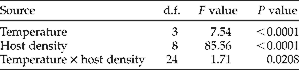
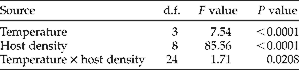
Temperature, host density and the interaction between these factors significantly affected the number of S. cretica eggs parasitized (Table 1). A significant increase in the number of eggs parasitized with increasing egg density was observed at all the temperatures tested.
Effects of temperature and host density on the number of Sesamia cretica eggs parasitized by Telenomus busseolae
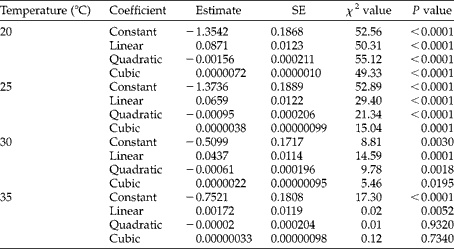
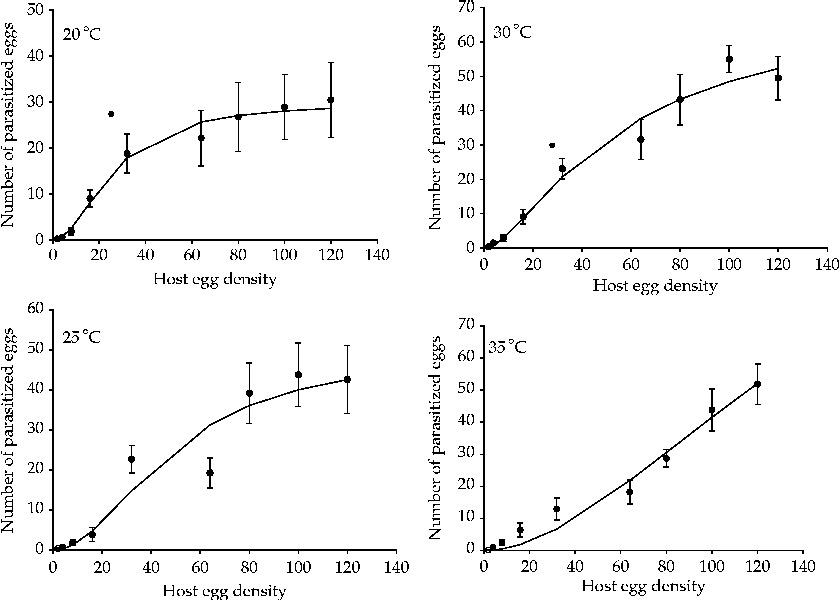
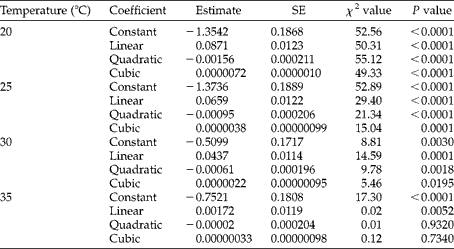
The functional response of T. busseolae to egg densities of S. cretica at all the temperatures tested was type III, because the linear parameters of the logistic regression were positive and significantly different from 0 and the quadratic parameters were negative at all the temperatures (Table 2). The type of functional response was not affected by temperature. Plots of the observed mean number of parasitized eggs and the number predicted by the model at various temperatures are illustrated in Fig. 1.
Results of logistic regression analysis of the proportion of Sesamia cretica eggs parasitized by Telenomus busseolae at different temperatures
Functional responses of Telenomus busseolae to densities of Sesamia cretica eggs at different temperatures (symbols: observed (mean ± SE); line: predicted by model)

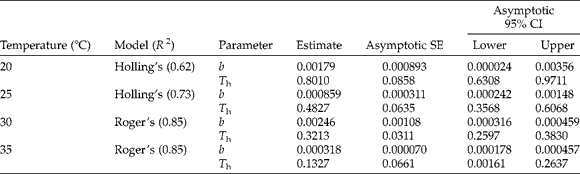
The random parasite equation fitted the observed data at 30 and 35 °C, and this equation could not provide meaningful parameters at the other temperatures (b was not significantly different from 0); therefore, Holling's disc equation fitted the data at 20 and 25 °C.
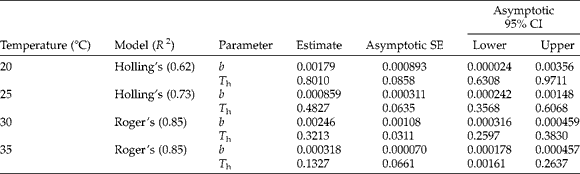
For obtaining parameter estimates, we used the full model with four parameters (equation (4)), but the results of non-linear least square regression indicated that parameters c and d were not significantly different from 0 (not shown); therefore, we eliminated them from the model and used a reduced model (a= bN 0). In this case, both parameters b and T h were significant (Table 3), indicating that the relationship between attack rate (a) and the initial number of hosts (N 0) was linear at different temperatures. Therefore, the attack rate for T. busseolae ranged from 0.0036 to 0.2148, 0.00017 to 0.1031, 0.0049 to 0.2952 and 0.0006 to 0.0382 per h at 20, 25, 30 and 35 °C, respectively. Estimated handling times were 0.80, 0.48, 0.32 and 0.13 h at the respective temperatures. Handling time decreased as temperature increased.
Parameters estimated by equations (Roger's or Holling's) of Telenomus busseolae to densities of Sesamia cretica eggs at different temperatures
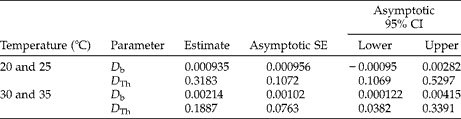
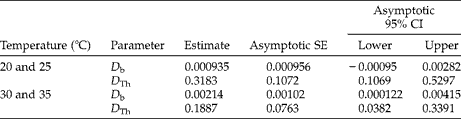
Because different models were used to describe the functional response at lower temperatures (20 and 25 °C) and higher temperatures (30 and 35 °C), comparisons could only be made between temperatures described by the same model. Based on asymptotic 95% confidence intervals, attack rate did not differ significantly between 20 and 25 °C, but handling time at 20 °C was significantly lower than that at 25 °C. Significant differences were observed in attack rate and handling time between 30 and 35 °C (Table 4).
Result of test for differences of functional response parameters of Telenomus busseolae to densities of Sesamia cretica eggs at different temperatures
Discussion
For evaluating a parasitoid as a biological control agent, an understanding of the functional response is basic to describing parasitism (Hassell, Reference Hassell2000). The relationship between S. cretica egg density and parasitized egg number revealed a sigmoidal functional response (type III) at all the temperatures tested. The type III functional response is generally attributed to an increase in searching activity with increasing host density over a limited range of host densities (Hassell, Reference Hassell1978). These results are promising, because this type of functional response suggests a density-dependent response to host density, which is the only type of functional response that could provide population regulation (Holling, Reference Holling1959). A type III functional response can be explained by an increase in attack rate or a decrease in handling time as host density increases (Hassell et al., Reference Hassell, Lawton and Beddington1977; Collins et al., Reference Collins, Ward and Dixon1981; Fernandez-Arhex and Corley, Reference Fernandez-Arhex and Corley2003). The functional response of T. busseolae to S. cretica eggs was type III at temperatures of 20–35 °C. Our results were consistent with the findings of Jamshidnia et al. (Reference Jamshidnia, Kharazi-Pakdel, Allahyari and Soleymannejadian2010), who showed a type III functional response for T. busseolae on S. nonagrioides eggs at different temperatures. In another study (Askarianzadeh et al., Reference Askarianzadeh, Moharramipour, Fathipour and Narrei2008a), a type III functional response for T. busseolae on S. nonagrioides on different sugarcane cultivars was reported. Although the type of functional response could be affected by factors such as temperature, host plant and host species (Juliano and Williams, Reference Juliano and Williams1985; Messina and Hanks, Reference Messina and Hanks1998; De Clercq et al., Reference De Clercq, Mohaghegh and Tirry2000; Mohaghegh et al., Reference Mohaghegh, De Clercq and Tirry2001), the shape of T. busseolae functional response was not affected by these factors. The type III functional response of Trichogramma chilonis to Galleria mellonella eggs was attributed to superparasitism at low densities of the hosts (Reay-Jones et al., Reference Reay-Jones, Rochat, Goebel and Tabone2006). Telenomus busseolae is able to discriminate parasitized eggs and therefore avoid ovipositing in them (Agboka et al., Reference Agboka, Schulthess, Chabi-Olaye, Labo, Gounou and Smith2002).
Roger's random parasite equation is a more appropriate model of functional responses than Holling's disc equation when re-encounter for a parasitoid occurs during the experiment (Juliano, Reference Juliano, Scheiner and Gurevitch2001). If Roger's model provides invalid parameters (negative or non-significant) then Holling's model is used (Allahyari et al., Reference Allahyari, Fard and Nozari2004). In this study, initially, we used the random parasite equation, but this model could describe the functional response of T. busseolae only at 30 and 35 °C. Therefore, we used Holling's disc equation for the analysis of data at 20 and 25 °C.
The parameters of the functional response of T. busseolae were affected by temperature. The handling time of the parasitoid significantly decreased with increasing temperature. Based on our results, the maximum parasitism (T/T h) of T. busseolae was determined to be 30, 50, 75 and 184.6 eggs at 20, 25, 30 and 35 °C, respectively. The maximum parasitism of T. busseolae on S. nonagrioides was 40.8, 47.8, 45.35 and 82.33 eggs at the same temperatures, respectively (Jamshidnia et al., Reference Jamshidnia, Kharazi-Pakdel, Allahyari and Soleymannejadian2010). Therefore, T. busseolae appears to be more efficient on S. cretica eggs than on S. nonagrioides eggs at higher temperatures.
Field studies carried out in Khuzestan Province indicated that the highest numbers of S. cretica and S. nonagrioides occur during June–October and March–May, respectively (Narrei et al., 2005), and T. busseolae is active from mid-March to mid-November (Abbasipour, Reference Abbasipour2004). Recent observations on Sesamia spp. eggs in sugarcane fields have revealed high parasitism by T. busseolae during September and October (A. Jamshidnia, unpublished data). Therefore, the high parasitism of sugarcane borers is probably because of high numbers of S. cretica. However, significant natural control of S. cretica by T. busseolae in sugarcane fields could be expected during June–October when the average monthly temperatures range from 29 to 36.8 °C.
However, functional response studies in small laboratory arenas have been criticized (O'Neil, Reference O'Neil1989; Li et al., Reference Li, Tian and Shen2007), because factors such as large searching areas, host plants and weather under field conditions could influence the effectiveness of parasitoids. Additionally, the spatial structure of natural host populations and the interactions between individual parasitoids in the population make it hard to relate the results of experiments on individuals in single-patch, single-parasitoid experiments to process occurrence at the population level (Jervis, Reference Jervis2005).
Although our laboratory data provide useful information on the host–parasitoid interactions, field-based studies are needed to determine the impact of a parasitoid on its host and thus achieve more realistic results on its behaviour.
Acknowledgements
The authors thank anonymous reviewers for their critical comments on an earlier version of the manuscript. This work was supported by Sugarcane and By-products Development Company and University of Tehran.