Technological innovation, enabled by state and federal policy, is a defining feature of natural gas booms and a source of political conflict. The invention of electric arc welding, improvements in metals and pipe-making, and federal investment and facilitated pipeline expansion in the 1930s, the U.S. federal government spent the next forty years struggling to address interstate transmission and pricing problems. Intergovernmental policymaking debates arose during this time as municipalities, gas-producing states, and the federal government sought to address gas ownership, interstate distribution, and market imperfections. Through a combination of significant private-sector investment and federal subsidies, hydraulic fracturing (i.e., fracking), directional drilling, and 3-D seismic imaging technologies were developed in the early 1980s, and the full-scale application of these technologies is driving the present unconventional gas boom from the Rockies to the Appalachians. The widespread use of fracking technology from rural, sparsely populated Wyoming landscapes to more populous urban areas along Colorado’s front range is fueling intense debate, mobilizing stakeholders, and resulting in intergovernmental conflicts. Local governments from Fort Collins to Longmont have passed moratoriums or bans on fracking only to be sued by Colorado and the industry-led Colorado Oil and Gas Association.Footnote 1 In May 2016, Colorado’s Supreme Court handed down a decision overturning Fort Collins’s five-year moratorium and Longmont’s fracking ban declaring municipal prohibitions that operationally conflict with state natural gas laws and regulations are void—effectively reasserting state primacy.Footnote 2 These examples demonstrate the key role technology plays in natural gas development and highlight the unique, sometimes acrimonious relationships among federal, state, and local governments.
The U.S. federal government and states occupy distinct policy jurisdictions during the extended history of natural gas regulation. From its inception through today, federal policymaking has focused on market and fiscal mechanisms to encourage resource development and solve interstate disputes, with nonpublic land exploration and production issues addressed by the states. At the state level, the initial suite of policies and governance institutions were geared to foster natural gas exploration and production, minimize waste, protect fuel mineral ownership rights, and promote revenue generation.Footnote 3 These goals are imbued in the policy outputs for Wyoming and Colorado and the public-private and state institutions remain driving forces today.Footnote 4 During the most recent unconventional gas boom, fueled by technological innovations like fracking, the resiliency and scope of these policies and regulatory institutions are being tested from the local to the national level.Footnote 5 Stakeholders are challenging extant policies and demanding inclusion of values relating to environmental protection, public health, surface owner property rights, and local regulation. Challenges are not only being levied at state and federal agencies and supporting natural gas statutes, but also the suite of federal environmental protection laws (e.g., the Clean Air Act) is now being called upon to address these issues through new regulation.Footnote 6
These challenges are leading to questions about the scope and locus of government regulation. What role has the U.S. federal government played in natural gas policy, and how does that complement state policymaking? Can the states as stewards of these nonrenewable resources balance boom-time economic benefits against the environmental and social costs of development? As veterans of natural gas policy, how can Wyoming and Colorado through their policy responses inform other states that are experiencing similar boom-related issues? Using federalism as a guide, this research explores the conflicted, complementary, and unique natural gas policy paths of the U.S. federal government, Wyoming, and Colorado and analyzes how policies facilitate and respond to booms.
First, I begin with a discussion of how natural gas policymaking exemplifies fragmented federalism and explain why understanding federal policy is a necessary precursor to contextualize state action. Then I will discuss relevant federal natural gas policies, paying close attention to their scope and relation to state policy. Next, I document the most recent natural gas boom in Wyoming and Colorado, with emphasis on production and economic benefits. Using archival document analysis, interview data, and relevant statutes, I analyze the genesis, content, and direction of Wyoming and Colorado state natural gas policies. These enduring state policies support the present boom and continue to provide public and private economic benefits. Finally, I document state-level responses to the boom-time challenges, providing examples of policy change and retrenchment.
Natural Gas and Federalism
Previous researchers studying environmental policymaking through the lens of federalism have noted how the federal government typically provides broad oversight and general direction while giving states regulatory authority and discretion.Footnote 7 In their fracking policy analysis, Warner and Shapiro observe that the federal government under the George W. Bush administration willingly ceded regulatory authority over fracking to the states in the 2005 Energy Act through the “Halliburton Loophole,” which exempted fracking from most of the existing federal environmental laws.Footnote 8 These scholars conclude that this interest group—industry—guided policy creates a fractured and fragmented regulatory regime, more lawsuits, interstate fracking wastewater disposal conflicts, and problems between state and local governments. Warner and Shapiro argue this federal abdication is unusual and there is precedent for involvement. However, I will demonstrate that past federal regulation focused primarily on resource ownership, leasing, taxation, and markets while generally leaving most exploration and production regulations, like fracking, to the states.
Contextualizing Wyoming and Colorado policymaking within federal policy is important for many reasons. First, the U.S. government is the administrator of vast federal land holdings in Wyoming (30.01 million acres, 48.1 percent public) and Colorado (23.87 million acres, 35.9 percent public), and federal agencies, including the Bureau of Land Management (BLM) and the U.S. Forest Service, have primacy over natural gas development on these lands.Footnote 9 Second, early natural gas–related laws, including the 1920 Mineral Leasing Act, separated surface ownership from subsurface mineral ownership, creating a split-estate. The land-use conflicts between natural gas development and other surface uses, including ranching, housing development, recreation, and agriculture, are exacerbated by the presence of a split-estate and complicated by multiple-use federal land management decision-making.
Third, the federal government treats and regulates each energy source and industry separately, which results in unique politics and policies.Footnote 10 The fragmented policymaking of federalism, regulation by energy source, high technical complexity, and generally low public attention precludes holistic policymaking and necessitates analysis of both state and federal policy.Footnote 11 Fourth, state natural gas policy is situated within the larger U.S. national energy policy where war, energy crises, trade policy (import and export quotas), and tax policy (depletion allowances) all factor into policymaking. Fifth, the federal government serves as an arbiter of state disputes by developing policies to regulate leasing, pricing, interstate gas distribution, taxation, revenue allocation, and conservation (i.e., nonwasting) of the resource. These federal regulations have been the source of conflict, as evidenced by extensive litigation over price controls, conflict between cities and natural gas holding companies over price and supply, debates over federal to state revenue distribution, and ineffective interstate pipeline regulation.Footnote 12 Finally, federal investment enabling pipeline expansion prior to and during World War II, unconventional gas tax credits beginning in the 1980s, and corporate research and development subsidies play fundamental roles in natural gas policy.Footnote 13 This next section emphasizes key statutes, interstate issues, policy outcomes, and the distinct regulatory role filled by the federal government.Footnote 14
U.S. Federal Natural Gas Policies (1870s–1980s)
Charles F. Wilkinson argued that many natural resource laws, including the 1872 Mining Law, the 1902 Reclamation Act, and the 1916 Stock Raising Homestead Act effectively subsidized and facilitated resource development while encouraging colonization.Footnote 15 The 1872 Mining Law, forming the foundation of American mining law through today, exemplified the assertive federal opening of the mineral estate to facilitate western economic growth and resource maximization. Following the Mining Law’s passage, public lands mineral claims and development skyrocketed. Conservationists criticized this wasteful and singular use of public lands and the federal government responded through executive and legislative action in the early twentieth century.
Early federal energy regulation was affected by factors ranging from war to shortages, and it varied by fuel industry and was reactive. For example, the oil and gas boom in California from 1903 to 1928 and fears over shortages, overexploitation, and wasteful development spurred executive action and exposed the limits of the 1872 Mining Law.Footnote 16 Presidents Theodore Roosevelt and William H. Taft reacted by withdrawing nearly 150 million acres of public lands from development, effectively halting new oil and gas development on public lands until 1920.Footnote 17 To assist the U.S. Navy in its switch from coal to oil and secure supply, President Taft signed a 1910 executive order establishing the Naval Petroleum and Oil Shale Reserves, which prohibited any claims on more than 3 million acres of public lands in California, Wyoming, and Colorado’s Roan Plateau.Footnote 18 Congress codified Taft’s executive action through the 1910 Pickett Act, and the U.S. Supreme Court also affirmed this presidential land withdrawal in a 1915 decision in U.S. v. Midwest Oil Company.
World War I energy shortages coupled with problems including overproduction, resource wasting, negligent operation, over supply, depressed prices, speculative occupation, and draining oil and gas from adjacent claims prompted Congress to propose seven different gas bills between 1909 and 1920.Footnote 19 Due to issue complexity, interest-group competition, conflict between eastern and western legislators, and differences among municipal, state, and national interests, compromise over oil and gas development on public lands proved elusive.
The 1920 Mineral Leasing Act, Amendments, and the IOGCC
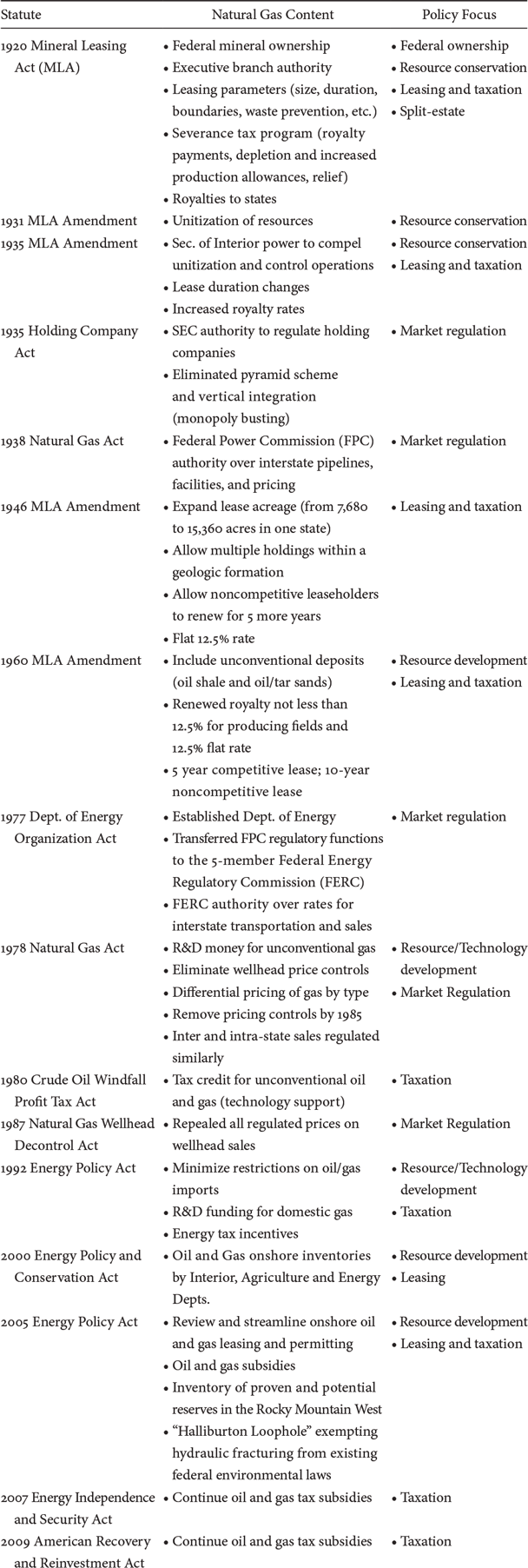
The debate over the 1920 Mineral Leasing Act (MLA), including the rationale, direction, and scope of federal regulation, was complex and acrimonious. Western legislators generally wanted the discoverer to receive a patent (i.e., title) to the resource, while eastern legislators wanted to retain federal title and lease it for exploration and development.Footnote 20 Not only were title issues a concern, but also taxation, revenue distribution, leasing parameters, and the locus of authority within the executive branch were contested. Following considerable debate, Congress passed the Mineral Leasing Act (MLA) in 1920, which codified eastern legislators’ desire for federal mineral ownership beneath public lands; created a leasing and severance tax program; established separate regulatory structures for fuel mineral and metal mineral mining; helped cement the split-estate; and outlined the remuneration of federally collected revenue back to the states.Footnote 21 Table 1 provides a summary of relevant federal statutes, including content and policy focus.
U.S. Natural Gas Related Statutes

The 1872 Mining Law and the 1920 MLA regulated metal and fuel mineral development beneath public lands, but regulation of minerals beneath private lands also received congressional attention. The MLA plus three other federal statutes enabled the federal government to cede surface land ownership to individuals while retaining subsurface mineral rights—a relationship defined as a split-estate.Footnote 22
What must have seemed at the time a logical means to ensure federal ownership and revenue generation from the mineral estate is now one of the most politically contested issues in Colorado and Wyoming natural gas politics. Unfortunately, well-intentioned policies often produce unintended consequences. In Wyoming, roughly 50 percent of the lands are split-estate, and with more than 60 million split-estate acres peppering the American West, the conflict between surface and mineral owners is growing.Footnote 23 This split-estate conflict is being played out in Rocky Mountain West state legislatures and courts, and both states in this study passed laws addressing this issue.
In the 1920 MLA, western legislators were able to secure most of the royalty proceeds for the states, and eastern legislators secured their desired leasing and federal mineral ownership goals. The MLA codified executive branch authority and included conservation measures addressing the duration and size of the lease, drilling near lease boundaries, royalty payments and relief (including depletion allowances), and reasonable prevention of oil and gas waste.
Resource ownership and overproduction were not adequately addressed in the original legislation. The development of oil and gas began under the legal concept called the “rule of capture,” where oil and gas were not owned until they were produced.Footnote 24 This was problematic because a lessee could produce oil and gas from beneath their lease but also from adjacent lands because of resource migration. The only recourse adjacent mineral owners had was to drill an offset well to protect their resource, resulting in excessive drilling, hurried production, waste, and low prices. In 1931 Congress amended the MLA by allowing lessees to enter into a cooperative unit plan of production with other lessees, a process called “unitization.”
In 1931, oil- and gas-producing states, including Arkansas, California, Kansas, Louisiana, Oklahoma, Texas, and Wyoming, recognized these problems and formed an Oil States Advisory Committee (i.e., Governor’s Committee).Footnote 25 Considerable debate ensued over how industry should be regulated. As a result, in 1935 the Interstate Compact to Conserve Oil and Gas was born, ratified by six state legislatures (including first by Colorado and later by Wyoming) and approved by the 74th Congress. This compact established the Interstate Oil Conservation Commission (IOCC), later renamed the Interstate Oil and Gas Compact Commission (IOGCC), and fostered state-level regulation of oil and gas exploration and production, leaving most market issues to the federal government.
Significant domestic oil and gas discoveries and antiquated royalty rates spurred 1935 congressional amendments to the MLA that increased royalty rates for new discoveries from 5 percent to 12.5 percent; changed lease times from twenty to ten years for proven reserves and five years for speculative leases; provided the Secretary of Interior with power to compel unitization; eliminated prospecting permits for unproven lands and substituted a 12.5 percent royalty; and retained executive-branch control over leasing (see Table 1).Footnote 26 Additionally, oil and gas demands during World War II, depleted U.S. reserves, and shortage fears again compelled Congress to pass a 1946 amendment that encouraged development on public lands by enlarging lease acreage areas and allowing multiple holdings within a single geologic formation.
In sum, the 1920 MLA and subsequent amendments established the federal government’s role concerning ownership, leasing, and taxation rights with the overarching goal of resource conservation. Responding to real or perceived supply issues, the federal government opened or closed development as reflected via congressional amendments and executively mandated actions through the Department of Interior. For example, overproduction in the 1920s and 1930s spurred the federal government to legislate and regulate for resource conservation through tools like unitization and strictures on leasing parameters. Similarly, fears of undersupply during World War II and the subsequent discovery and production of massive oil and gas deposits from the Middle East to Venezuela prompted further amendments (1960 MLA) that stimulated new development of unconventional deposits on public lands (see Table 1).Footnote 27
The 1938 Natural Gas Act: Interstate Issues
Clark notes that during the transition between electricity and fossil-fuel-energy in the late nineteenth and early twentieth centuries, “governments at the municipal, state, and federal levels evolved roles that had a lasting impact on the production, distribution, and pricing of energy as well as upon the organizational structure of the energy industries.”Footnote 28 Davis adds that “the political status of the gas industry derives from its physical characteristics and the general political context of the era in which it rose to prominence.”Footnote 29 Before the 1930s, natural gas was a local commodity, an unwanted by-product of oil production and coal mining, and a tertiary energy source.Footnote 30 Technological innovation combined with no interstate pipeline regulation enabled large, vertically integrated transmission companies (i.e., holding companies) to form. These monopolistic companies manipulated the price, quality, and quantity of natural gas distributed to cities.Footnote 31 Holding companies charged exorbitant prices to consumers, cut off services to many midwestern cities, and stymied competition. Responding to municipal and consumer complaints, the federal government passed the 1935 Holding Company Act, providing authority to the nascent Securities and Exchange Commission (SEC) to regulate how holding companies administered their finances (see Table 1).
During the 1930s, oil- and gas-producing states began regulating gas production for conservation purposes (upstream) and municipalities regulated its distribution and consumption as a public utility (downstream), but interstate pipeline regulation lagged (midstream). State governments lacked the authority to regulate interstate transmission and that also undermined their ability to regulate intrastate transmission and control price. Only the federal government could address this interstate problem. Congress, responding to a cacophony of consumer, municipal (U.S. Council of Mayors), and state voices, unanimously passed the Natural Gas Act of 1938, which extended the Federal Power Commission’s (FPC) regulatory authority over the sale of natural gas in foreign and interstate commerce, including jurisdiction over pipelines, facilities, and pricing.Footnote 32 Regulating new pipeline and facility construction proved to be less controversial and easier at that time than determining price. Thus, the federal government began its long and litigious regulation over interstate distribution and pricing.Footnote 33
The 1938 Natural Gas Act granted the FPC authority to regulate the wholesale rates of natural gas but lacked clear direction on how the rates should be determined. In 1954, the U.S. Supreme Court ruled in Phillips Petroleum v. Wisconsin that the FPC had authority to regulate the price of gas sold by producers (from the wellhead) to the pipeline companies, but this only added to the FPC’s ongoing pricing issues. Thus, federal natural gas policy in the 1940s and 1950s was characterized by the FPCs inability to solve these problems and considerable congressional debate included a failed attempt at deregulation (the 1956 Fulbright-Harris bill) that was vetoed by President Eisenhower over consumer-protection deficiencies.Footnote 34
Unable to handle the administrative burden, in 1960 the FPC attempted to set rates based on geographic region but failed again to determine reasonable rates due to differences in production costs per well and producer. Finally, in 1974, the FPC implemented national price ceilings for the sale of gas into interstate pipelines, but these ceilings remained well below actual market values of gas sold to consumers. While consumers and local distributors desired low prices, producers and competing fuel industries such as coal and railroads wanted higher prices. This inefficient, reactive, and controversial federal regulation of interstate gas markets continued until the FPCs price-ceiling regulation facilitated severe natural gas production and reserve shortages in the 1970s.Footnote 35
The 1978 Natural Gas Act: Deregulation and Subsidies
Attempting to address the inadequacies of the 1938 act, Congress debated for decades how to regulate interstate transmission and fix pricing issues between producers and consumers. Responding to FPC market mismanagement, incessant litigation over FPC pricing decisions, and 1970s gas shortages and oil embargos, the federal government passed a series of energy-related laws, including the 1978 Natural Gas Policy Act (NGPA). The 1978 NGPA was complex and multifaceted. It created a single national market, treated intra- and interstate sales similarly, established differential pricing by category of gas well (old vs. new), and removed price controls on most classifications of gas by 1985.Footnote 36 Ultimately, the deregulation of wellhead pricing led to a production bubble and the Federal Energy Regulatory Commission (FERC, which replaced the FPC in 1977) adjusted prices higher until consumer demand fell and the 1985-price deregulation came into effect. In 1987 the Natural Gas Wellhead Decontrol Act completed the deregulation of federal wellhead pricing (see Table 1).
The 1978 NGPA also encouraged new natural gas development via incentive pricing and promoted unconventional natural gas exploration through R&D programs. Federal oil and natural gas development supports also included increased public lands leasing and federal R&D funding by the newly established Department of Energy (DOE). The 1978 DOE R&D efforts included the Eastern Gas Shales Program, the Western Gas Sands Program, and the Methane Recovery from Coalbeds Program. Between 1978 and 1998 these three unconventional natural gas R&D programs, tax credits, incentive pricing, and private-sector initiatives effectively increased industry revenues by $705 million, saved consumers over $8 billion, bolstered annual unconventional gas production from 70 Bcf to 380 billion cubic feet (Bcf), and opened up new natural gas basins from the Powder River to the San Juan and from the Michigan to the Fort Worth Basins.Footnote 37
Federal R&D policies combined with massive private investment contributed to the technological innovations that support this present boom. Horizontal drilling technology, pioneered by the oil industry in the early 1980s, became commercially viable by the late 1980s.Footnote 38 Between 1986 and 1990, the DOE, partnering with the gas industry, piloted the first horizontal drilling in unconventional shale formations and identified technical barriers to its application.Footnote 39 DOE programs also facilitated the development of fracture technology for tight gas, shale gas, and microseismic fracture mapping, as well as 3-D seismic imaging.Footnote 40
U.S. Energy Policies (1990s–2010s)
Congress passed the Energy Policy Act in 1992, which placed fewer restrictions on oil and gas imports; promoted natural gas heating and cooling technologies; fundamentally altered the electric utility industry by facilitating a competitive market for wholesale electric power; and encouraged domestic natural gas development through technological innovation and funding. The Clinton administration valued public lands as an important source of domestic energy and federal land energy production increased during the administration from 13 percent in 1992 to 25 percent of total domestic production in 1999.Footnote 41 These efforts were eventually codified through the 2000 Energy Policy and Conservation Act (EPCA), which directed the Secretaries of the Interior, Agriculture, and Energy to conduct an inventory of oil and natural gas resources beneath onshore federal lands.
Congress passed, and President George W. Bush signed into law, the Energy Policy Act of 2005 (EPA 2005), which required the Department of Interior (DOI) and the Department of Agriculture (DOA) to coordinate, streamline, and expeditiously review onshore oil and gas leasing and permit practices for conventional and unconventional fuels while subsidizing fossil fuels by nearly 39 percent. Subtitle F of the statute codified President Bush’s Executive Order 13212, provided for continuing appropriations for the DOI and DOA to ease access to federal lands and prompted the DOI to streamline and expedite the approval process for lease applications and permits to drill.
Despite the new push for renewable energy and efficiency under the Obama administration, federal natural gas policy remains dedicated to the development of domestic natural gas and oil.Footnote 42 Although the 2007 Energy Independence and Security Act includes provisions for energy efficiency, biofuel subsidies and increases in corporate average fuel-economy standards, the tax subsidies for oil and gas development persist. Similarly, the 2009 American Recovery and Reinvestment Act (ARRA) continues the fossil fuel subsidies while also providing $100 billion for renewable-energy projects.Footnote 43 This federal natural gas push, however, is tempered by a 2015 BLM rule regulating fracking on public land with respect to well-casing specifications, closed-loop waste storage, and chemical disclosure requirements. Unsurprisingly, the BLM rule is being challenged by industry and several states in the 10th federal district circuit court in Wyoming.Footnote 44 Similarly, public concerns over the impacts of fracking and its undisclosed chemicals on drinking water prompted the Environmental Protection Agency (EPA) to study these potential effects and release a draft report in 2015.Footnote 45
During its century-long history, federal natural gas policy promotes resource development via fiscal policy mechanisms, including market regulation, taxation, and R&D technology subsidies, and addresses interstate disputes and intrastate leasing and ownership issues. Federal policymaking also responds to several issues including the political context when natural gas first became a viable energy resource, technological innovation, resource abundance, and the unintended consequences of its own policies. For example, the 1920 Mineral Leasing Act reflects resource development ideals and federal concerns over shortages, resource overexploitation, mineral ownership, and federal revenue-collection goals characteristic of the time. A product of the New Deal, the 1938 Natural Gas Act tasked the FPC and SEC with breaking up the pipeline monopolies and market regulation. While the SEC largely succeeded, the FPC’s regulation of price was a forty-year regulatory quagmire.
The 1978 NGPA is the key piece of federal legislation facilitating the recent boom through a combination of R&D money for technological innovation, tax credits, favorable leasing policies, and price deregulation. Federal policymaking around the millennium that continued gas subsidies, expedited permitting, enabled scientific inventories, and promulgated fracking exemptions from federal environmental laws are contributing factors. Finally, industry investments in pipelines and infrastructure, high gas prices in the 2000s, cheap and available water, abundant geologic deposits, and amenable state policies make the boom a reality.
The Wyoming and Colorado Natural Gas Boom
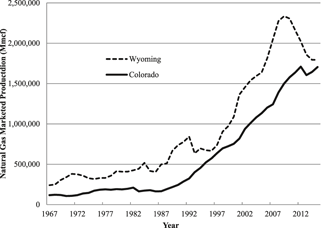
The Rocky Mountain West natural gas boom beginning in the late 1980s is characterized by conventional and unconventional natural gas development.Footnote 46 The U.S. Geological Survey (USGS) defines natural gas deposits as either conventional or continuous (i.e., unconventional).Footnote 47 Conventional natural gas deposits are defined as discrete fields with high permeability, high recovery rates, and clearly defined water-hydrocarbon contacts. Conventional natural gas deposits have provided most of the natural gas produced within the United States. However, recent technological innovations have enabled industry to exploit these difficult-to-extract unconventional natural gas deposits.Footnote 48 Unconventional natural gas accumulations include coal-bed methane (CBM), shale, tight sands, and basin-centered reservoirs and have low permeability and recovery rates but greater resource potentials than conventional accumulations. Figure 1 shows Wyoming and Colorado natural gas marketed production volumes from 1967 through 2015.Footnote 49
Wyoming and Colorado Marketed Natural Gas Production (1967–2015).

Note the boom in natural gas production for these two states beginning in the late 1980s. Total production in Colorado rises significantly from 163 Billion cubic feet (Bcf) in 1986 to 1.7 Trillion cubic feet (Tcf) in 2012, dropping slightly to 1.67 Tcf in 2015.Footnote 50 During this time, Wyoming marketed gas-production rises from 403 Bcf in 1986, peaks at 2.335 Tcf in 2009, and declines gradually to 1.701 Tcf in 2015. To put these numbers in perspective, between 1986 and 2015 annual U.S. natural gas consumption rose from 16.2 to 27.5 Tcf with projected consumption expected to reach 33 Tcf by 2025.Footnote 51
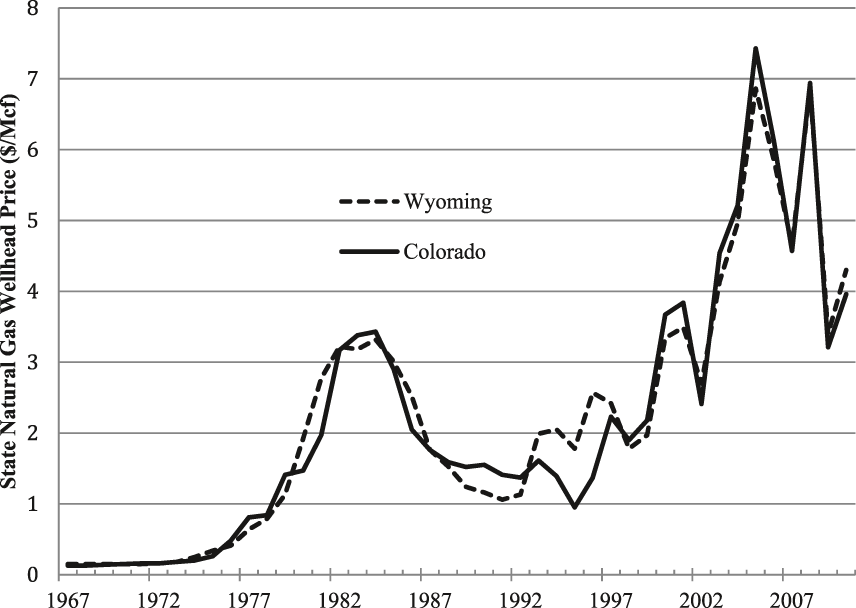
Natural gas is a commodity and the incentive to expand or restrict production is also controlled by price fluctuations and demand. Figure 2 shows the average annual wellhead price ($/mcf or thousand cubic feet) for natural gas in each state.Footnote 52
Wyoming and Colorado Natural Gas Wellhead Price (1967–2011).

FPC controlled natural gas wellhead prices remained low (relative to consumer rates), rising gradually from 1967 through 1983. Following federal deregulation, wellhead prices dropped but began rising dramatically from 1995 through 2008. The price drop in 2008 can be attributed in part to the rapid development of unconventional shale deposits throughout the United States. Notably, the rise in marketed gas production (Fig. 1) follows the same general path as the price of natural gas between the late 1980s and 2000s (Fig. 2). As private and federal R&D investment produced effective horizontal drilling, fracturing, and 3-D seismic technologies, industry ramped up production, taking advantage of the unconventional deposits, market deregulation, and higher prices.
While industry realizes profits, the states also prosper economically. State, local, and federal governments benefit from natural gas development in the form of state severance taxes, state mineral royalties and rents, county property taxes, and federal mineral lease revenues. Notably, part of these federal revenues are returned to the states and used to support local governments, fund education, and buttress other state programs. Early in the boom (1999), Wyoming prospered financially with the taxable value of natural gas at $1.3 billion (6 percent or 2 percent tax rate depending on classification) and by collecting nearly $60 million in severance taxes. According to the Wyoming State Auditor, mineral revenues in 2008 were the most significant contributor to the state’s general fund, totaling $1 billion in oil and gas property taxes.Footnote 53 An industry-sponsored 2007 report estimated the oil and gas industry’s total economic output at $15.5 billion, which accounted for 32 percent of the state’s total economic output, 20 percent of employment, 25 percent of total earnings, and 43 percent of the Gross State Product.Footnote 54 In 2013, Wyoming natural gas property taxes totaled $315.2 million, severance taxes topped $305.4 million, and state and federal royalties for oil and gas exceeded $713 million.Footnote 55
From 1997 through 2014, Colorado oil and gas production values ranged from $3 billion to $15.8 billion—with natural gas accounting for $6.9 billion in 2014.Footnote 56 During this same time span, severance taxes rose from $20 to $330 million; property taxes jumped from $70 to $434 million; federal revenues, rents and bonuses returned to the state rose from $30 to $315 million; and state royalties, rents and bonuses reached $158 million in 2014.Footnote 57 Overall with Colorado’s oil and gas revenue stream topping $1.2 billion in 2014 and Wyoming’s haul at $2.2 billion in 2013, state and local budgets and programs have benefitted greatly from the boom. Because Colorado’s economy is more diverse than Wyoming, Wyoming relies more heavily on the natural gas industry to fill its general fund than Colorado. This leads, in part, to recent differences in legislative outputs—which are covered in the last section.
Wyoming and Colorado State Natural Gas Policies
Since its foundation, the IOGCC has been instrumental in the state-led regulation of the oil and gas industry “through a variety of programs designed to gather and share information, technologies, and regulatory methods.”Footnote 58 The first natural gas laws in Wyoming and Colorado were based on the IOGCC template for oil and gas resource conservation and maximization. Additionally, these states created oil and gas conservation commissions and boards in the early to mid-twentieth-century to facilitate energy development. Early oil and gas regulation focused on exploration and production in order to prevent waste of the resources; to protect the opportunity for owners to share in oil and gas production; and to avoid drilling unnecessary wells.Footnote 59 Although each state varied in the authority and regulatory jurisdiction provided to their respective oil and gas commissions, industry influence on the laws, regulations and regulatory commissions was pervasive.
Wyoming
Wyoming natural gas laws and regulations are extraordinarily supportive of the oil and gas industry. The Wyoming state legislature has an extended history in dealing with natural resource issues and “controlling the waste” of those resources.Footnote 60 Wyoming first began regulating oil and gas exploration and production in 1921 through the Commissioner of Public Lands who appointed an Oil and Gas Supervisor responsible for enforcing drilling, production and well abandonment regulations.Footnote 61 Prior to 1951, the state lacked a comprehensive statute dealing with natural gas issues but addressed that when it passed the Oil and Gas Conservation Act (Oil and Gas Act), whose primary purpose was to prevent the waste of natural gas. The original language reads as follows (ch. 94 §13(a)(1) [1951] Wyoming Session Laws 129):
The waste of oil and gas or either of them in the State of Wyoming as in this act is hereby prohibited. . . . (Waste is defined as) the escape, blowing or releasing, directly or indirectly, into the open air of gas from wells productive of gas only, or gas from well producing oil or both oil and gas; and the production of gas in quantities or in such manner as will unreasonably diminish the quantity of oil or gas that might ultimately be produced; excepting gas that is reasonably necessary in the drilling, completing, testing and producing of wells and gas unavoidably produced with oil if it is not economically feasible for the producer to save or use such gas.
The definition of waste also included protection of aquifers from drilling contamination, prevention of the release of gas from wells except during drilling and testing and penalties for nonconformance with well placement and density.Footnote 62 The Wyoming Oil and Gas Conservation Commission (WOGCC), established by this act as the primary oil and gas regulator, was given the responsibility to “prevent waste of natural gas.” In short, early natural gas legislation mandated the WOGCC to promote the exploration, production and conservation of natural gas while protecting the correlative rights of property owners. From the 1951 Act through all subsequent amendments, industry has worked with the state in crafting legislation and the law still maintains fidelity to its original exploration and production, nonresource wasting and mineral-owner-protecting mission.Footnote 63
Colorado
The statutory command to develop natural gas resources in Colorado is consonant with neighboring state laws and with ideals and language set forth by the IOGCC. Colorado first addressed oil and gas conservation in 1915 and later created the Gas Conservation Commission (1927) to prevent waste from oil and gas wells.Footnote 64 Colorado signed the Interstate Compact and followed with its own Oil and Gas Conservation Act in 1951—with considerable support and political maneuvering by Warwick Downing. Statutory language in the 1951 Colorado Oil and Gas Conservation Act is unequivocal in its promotion of natural gas and oil development. The act also establishes the Colorado Oil and Gas Conservation Commission (COGCC) as the primary regulatory agency.
The Colorado Oil and Gas Conservation Act mirrors the 1949 IOGCC Conservation Model Act, and subsequent amendments have been guided by IOGCC recommendations.Footnote 65 A 1955 amendment strengthened COGCC regulatory authority and subsequent amendments maintain the original pro-development and conservation intent.
Natural Gas Policy Change and Retrenchment
Colorado Policy Change
Resource abundance, amenable state laws, federal subsidies, including the unconventional fuels tax credit (IRS Section 29), and technological innovation combine to enable the present natural gas boom. At the beginning, this boom stirred animosity between the oil and gas industry, agricultural interests, and developers.Footnote 66 In 1994, the Republican-controlled legislature and Democratic governor Roy Romer responded by passing SB94-177 (C.R.S. § 34-60-102 through 126), a law that significantly changed Colorado’s Oil and Gas Act. This 1994 revised statute (C.R.S. § 34-60-102 through 126) contains Colorado’s first protections for public health, safety, and welfare as part of oil and gas development. Amendments to the Oil and Gas Act also include: expanded and changed requirements for the Oil and Gas Conservation Commission membership—moving it away from an industry captured agency; establishment of an Environmental Response Fund; provision for reclamation and waste management; and expansion of COGCC’s authority to prevent and mitigate significant adverse environmental impacts on any air, water, soil, or biological resources resulting from oil and gas operations to the extent necessary to protect public health, safety, and welfare, taking into consideration cost-effectiveness and technical feasibility. Following this statutory shift, the COGCC spent the next several years writing, considering public and industry comments and implementing regulations invoked by the revised statute.
What is important about the 1994 Oil and Gas Act amendments? First, this significant policy shift was driven largely by the land-use conflict between the natural gas industry and the agriculture and farming sector.Footnote 67 The coalitions of actors and protagonists involved in this early 1990s policy shift are different from the broader, unconventional coalitions active in the post-2000s conflict.Footnote 68 Second, this legislation and subsequent rulemaking alter the status quo by protecting human health and environment while further solidifying industry’s right and the state’s commitment to foster, promote, encourage, and not waste the natural gas resources. Third, these substantive policy changes increase and clarify the regulatory burden on the natural gas industry, with industry’s input and blessing. Fourth, this substantive policy shift occurred when the Republicans controlled both houses and Democrat Roy Romer was governor. Thus, generalizations regarding the relationship between party control and energy-policy change are not always correct.
In 2005, Democrats controlled the legislature for the first time in forty years. Two years later, Democrat Bill Ritter was elected governor and four notable status-quo-challenging laws were enacted. For example, the legislature passed and Governor Ritter signed into law a bill that fundamentally restructured the COGCC (HB07-1341) by reducing industry membership from five to three, expanding the commission to nine members, and adding representatives from the environmental, wildlife, and public health communities. The act directed the COGCC to foster the responsible, balanced development of Colorado’s oil and gas resources consistent with the protection of public health, safety, and welfare, including the environment and wildlife resources (C.R.S. §34-60-102(1)). Governor Ritter immediately appointed five new COGCC members, including an ecologist, an environmental consultant, and a west-slope county commissioner.Footnote 69
For decades, natural gas development on split-estate lands had created heated land-use debates and political fights over surface-owner compensation for loss of land development opportunities, especially during the 1990s conflict between agriculture, developers, and the gas industry. A 1992 bill attempting to clarify split-estate property rights failed, but the fundamental debate over how each estate should accommodate the other persisted. Five split-estate bills between 2000 and 2006 failed, but the issue’s continued presence on the institutional agenda speaks to the enduring and contested nature of the problem. In one interview, a rancher in southwestern Colorado asserted that surface owners had weak regulatory protection and were “largely powerless, with the deck stacked against them” in the face of natural gas development.Footnote 70 After considerable debate, an extended legislative history and assertive interest-group advocacy, Governor Ritter signed the Landowner Protection Act in 2007 (HB07-1252), designed to level the playing field (in part) between the estates—and address the long-standing issue brought about by the 1920 MLA. This act codifies the common law doctrine of accommodation and requires operators to use alternative well locations or other means of operation that minimize intrusion and damage to the surface estate.Footnote 71 This Landowner act also gives surface owners a cause of action to litigate with the burden of proof upon the natural gas developer. In effect, the Colorado state legislature understood the act would be tested in the courts over surface-owner compensation and whether gas companies could be forced into more expensive directional drilling to accommodate surface owners and housing developers.
Also in 2007, the legislature passed the Wildlife Protection Act (HB07-1298), which directs the COGCC to promote conservation of wildlife habitat, minimize adverse impacts to wildlife resources, and ensure proper reclamation. This alters the status quo by forcing oil and gas companies to minimize and mitigate impacts on wildlife habitat as a result of drilling operations. Colorado also passed the Severance Tax Coalbed Methane (CBM) Seepage Act (HB07-1341) in 2007. This act creates a natural gas severance tax and a CBM cash fund to investigate and mitigate CBM gas seepage. Balancing the economic benefits from oil and gas development with wildlife habitat, surface-owner property rights and public health concerns was no easy task for the COGCC. With an expanded mission and new commissioners representing diverse interests, the COGCC spent 2007–8 developing and revising rules in response to these new statutes.
Despite theses policy changes, the boom continued and natural gas supporters had moderate legislative success. Colorado passed SB07-202, which maintains COGCC’s authority to regulate oil and gas operations and also limits local government authority to finance the payment of directional drilling costs in the Wattenberg area. Following this flurry of legislative activity, no natural gas issues reaching the state agenda passed until 2010, when three status-quo supporting bills (HB10-1060, HB10-1190, and HB10-1365) became law. The first statute provides for increases in penalties for failing to report, withhold, and make severance-tax payments. HB10-1190 promotes the use of natural gas and other fuels for manufacturing by exempting the fuels from state sales and use taxes. Finally, HB10-1365 provides incentives for the electric utility industry to reduce air emissions by switching to natural gas or other low-emitting energy sources.
As Colorado broadened its regulatory authority in response to the boom, public concerns relating to public health, wildlife habitat, and land use, intergovernmental and interest-group conflict simmered over the federally controlled Roan Plateau. Considered a special place by industry for its resource potential and by conservationists, outdoor enthusiasts, hunters, and anglers for its wildlife habitat and aesthetics, conflict over land use in the Roan escalated.Footnote 72 Set aside in President Taft’s 1910 executive order as the U.S. Naval Oil Shale Reserves No. 1 and 3, the Roan Plateau was transferred to the DOE in 1977 and then to the DOI-BLM in 1997 through the National Defense Authorization Act with the intent to lease and develop the resources.Footnote 73 The 2000 EPCA-inspired onshore oil and gas inventories confirmed vast resources under the Roan and the 2005 Energy Policy Act called for leasing this federally controlled gas. Following BLM’s Roan Plateau Resource Management Plan (RMP) 2007 Record of Decision (ROD) to open most of the 73,000 acres to oil and gas leasing, Secretary of the Interior Dirk Kempthorne delayed leasing until Governor Ritter could analyze and comment on the plan.
In his analysis, Governor Ritter called for a phased leasing strategy, protection for 36,000 acres of wildlife habitat, increased environmental safeguards, and a greater state share of lease revenues. Responding in 2008 ROD, the BLM designated 21,304 acres as Areas of Critical Environmental Concern with strict drilling stipulations to account for wildlife and opened the remainder of the Roan to leasing, much to the consternation of Governor Ritter and his supporting coalition. Ritter lamented the all-at-once lease sale, which resulted in “vastly undervalued bids,” and complained that the federal government “has done a tremendous disservice to our state and to every Western Slope community impacted by drilling.”Footnote 74 The 54,000 Roan Plateau acre lease sale generated a record $113.9 million in revenues with $56 million handed to Colorado.Footnote 75
Environmental groups immediately sued the BLM over its 2008 RMP, and after four years of legal wrangling Denver U.S. District Judge Marcia Krieger did not invalidate the leases but found the BLM failed to sufficiently address air quality and nearby private landowner impacts from proposed development. The issue was finally resolved in late 2014, when Secretary of the Interior Sally Jewell, in coordination with Governor John Hickenlooper (D) and U.S. Senator Michael Bennet (D), withdrew all but two leases on the Roan and returned nearly $50 million to leaseholder Bill Barrett Corp.Footnote 76 Colorado subsequently passed SB15-244, which included a plan to reimburse the federal government for Colorado’s share of the canceled lease payments.
Colorado continued to innovate and lead the nation in natural gas regulatory adjustments to the boom on multiple fronts. During 2012–13, the COGCC became the first state to promulgate rules (Rule 609) mandating statewide baseline water-quality sampling before and after oil and gas development. Concurrently, the COGCC promulgated setback rules requiring oil and gas operators to move operations further away from buildings (500 feet statewide or 1,000 feet from “high occupancy buildings,” including schools, daycares, hospitals, nursing homes, etc.) to eliminate, minimize, or mitigate the noise, safety, and aesthetic impacts of operations. Colorado continued this innovative policymaking in 2014 by promulgating the first state-level air-pollution rules, severely limiting the amount of volatile organic compound (VOCs) and methane (greenhouse gas) emissions from oil and gas operations—to address air-quality violations of ozone. Regulators, industry, and politicians all noted how these efforts strike a balance between continued development and social concerns.
Citizens and environmental groups concerned about the public health effects from potential air and water pollution also called for public disclosure of fracking chemicals.Footnote 77 Responding to these concerns, in 2012 the COGCC promulgated major rules regarding hydraulic fracturing chemical disclosures to public health professionals and the COGCC, landowner notice, and fines for violations.Footnote 78 However, industry managed to stop their trade-secret, proprietary chemicals from full public disclosure. Although Colorado worked aggressively to address public health concerns, the state was reluctant to cede any regulatory authority to municipalities. Front-range cities, desiring more control over industry within their boundaries, passed fracking bans and moratoriums that were subsequently overturned by the Colorado Supreme Court in 2016.
Legislatively, Colorado sought even greater environmental protections during its 2013 session. The legislature passed a law requiring the COGCC to develop a risk-based inspection strategy targeting operational phases most likely to experience spills and violations (SB13-202) and another expanding the reporting requirements of exploration and production waste spills (HB13-1278). Increasing the regulatory ratchet, the legislature passed HB14-1356 (2014), raising the penalty for violating a COGCC regulation from $1,000 to $15,000 per day. Cumulatively, the laws and supporting regulations are increasingly attentive to environmental, habitat, and public health protections as they relate to exploration and production activities. Among natural-gas-producing states, Colorado policymakers and regulators have adapted to the changing conditions brought about by the unconventional gas boom in unique and assertive ways. Notably, they have been first movers with respect to water-quality sampling, air rules, and landowner protection, and they even addressed public disclosure requirements. Based on this statutory and regulatory history, Colorado is an exemplar for other states seeking a balance between the boom-time economic benefits and environmental and social costs of development.
Wyoming Policy Retrenchment
The late, three-term Democratic governor Ed Herschler presided over Wyoming during its 1970s and 1980s energy booms and frequently asserted that “growth on our terms” included protection of the land, air, water, and people.Footnote 79 Herschler’s rhetoric aside, Wyoming allowed its mineral estate to be aggressively developed during his tenure. Republican governor Jim Geringer (1995–2003) championed CBM development on state rather than BLM lands and saw CBM development in the Powder River Basin as an economic savior for Wyoming.Footnote 80 For example, in November 1999 the Wyoming Office of State Lands and Investment sent a letter to natural gas operators urging them to “go blue” by acquiring and developing leases on state lands, the blue areas on land-status maps.Footnote 81 The letter argues that CBM development on state rather than federal lands is preferable because developers would pay lower permitting costs, enjoy less environmental regulation, and “get more bang for the drilling buck.” Additionally, Geringer instructed all state regulatory agencies to direct their comments through his office to ensure that the state spoke with a “unified voice” on natural gas development, and this effectively muted any criticisms state regulators may have had.Footnote 82 Wyoming’s economic needs, Geringer’s desire and mandate to stimulate the economy and fund state programs, and the state’s abundant natural gas deposits all contributed to an assertive natural gas development policy.
Whereas Geringer aggressively promoted natural gas development, subsequent Democratic governor Dave Freudenthal (2003–11) attempted to balance the growing concerns of environmentalists, ranchers, farmers, and outdoor enthusiasts with state economic benefits and industry’s mineral rights. Freudenthal’s natural gas development strategy was complex and nuanced. He encouraged natural gas development on state lands; raised environmental questions and objections regarding development on BLM controlled lands (e.g., Bridger-Teton and Pinedale areas); called for increased regulatory oversight, promoted surface-owner protection bills; but refused to regulate CBM discharge water in the Powder River Basin despite Wyomingites concerns and a 2007 lawsuit by Montana (Montana v. Wyoming 131 S. Ct. 1765).Footnote 83
Around the millennium, state legislators proposed and passed numerous bills creating new institutions and enabling existing institutions to promote the economic benefits of natural gas development. A 2001 Senate bill (SF-0185, Enrolled Act No. 52) established the Wyoming Energy Commission with a mission to “facilitate development, production, transportation and marketing of all natural resources . . . to streamline permitting and eliminate barriers to transportation.” The Enhanced and Improved Oil Recovery Act (SF-0061, 2004, Enrolled Act No. 44) created a new Oil/Gas Recovery Commission with the goal of advancing research and technology related to oil and gas development. Similarly, a School of Energy Resources and Energy Resource Council was established at the University of Wyoming to research, teach, and support the development of Wyoming’s energy resources (SF-0037, 2006, Enrolled Act No. 65). Cumulatively, these bills reflect the economic importance of natural gas and Wyoming’s enduring commitment to its expeditious development.
Wyoming preceded Colorado in passing a surface-owner accommodation act (2005), the Split Estates Procedures for Oil and Gas Operations (SF-0060, 2005, Enrolled Act No. 45 Ch. 0081).Footnote 84 However, this Split-Estates Act was considerably less beneficial to surface owners than Colorado’s law with respect to financial assurance, compensation for surface damages, and burden of proof. If surface owners and oil/gas operators could not come to an agreement, then operators were only required to secure a surety bond for $2,000 per well site. In 2014, the WOGCC, at the behest of the legislature, changed bonding requirements by increasing the statewide blanket bond to $100,000, split-estate bonds to $10,000 per well site, and individual bonds at $10/ft per well (Wyo. Stat. Ann. § 30-5-402(b)). In 2005, the legislature also passed the Water-Rights (SF-0028, Enrolled Act No. 49) and the WOGCC Penalties Acts (SF-0073, Enrolled Act No. 9), which raised and amended penalties for violating water laws with respect to CBM/natural gas development and increased WOGCC penalties for rule violations from $500 to $5,000 per violation. In short, the legislature was amenable to ensuring moderate surface-owner protections and penalizing environmental violations, despite the economic benefits of natural gas development.
However, in 2006 Wyoming passed six laws that were designed to facilitate oil and gas development. The Wyoming Pipeline Authority (SF-0084, Enrolled Act No. 6), Sales Tax Exemption for Oil and Gas Wells Act (HB-0031, Enrolled Act No. 26), Natural Gas Valuation bill (HB-0043), Omnibus Water Bill (HB-0145, Enrolled Act No. 54), and the School of Energy Resources Act (SF-0037, Enrolled Act No. 65) reflect the economic importance of and legislative commitment to the natural gas industry. Only one status-quo-challenging bill was passed into law, the Permanent Wyoming Mineral Trust Fund (HJ-0004, HEJR No. 0001), during this 2006 session. This statute imposed a 1.5 percent excise tax in addition to the existing severance and ad valorem taxes on coal, oil, and natural gas.
Since 1995, the WOGCC permitted more than 106,000 oil and gas wells and environmental groups, including the Wyoming Outdoor Council and Powder River Basin Resource Council (PRBRC), have demanded and pursued increased public health, environmental and surface-owner protections because of this boom. For example, the PRBRC petitioned the WOGCC in 2012 to change rules to reduce flaring and air pollution, increase well setbacks from homes and schools, and create regulatory violations for accidents and spills. The PRBRC and other environmental plaintiffs also filed suit in the 7th Judicial District Court (Wyoming) against the WOGCC under the Wyoming Public Records Act, requesting the commission to provide them with information about the chemicals found in hydraulic fracturing fluids. The 7th District Court rejected the plaintiffs’ claims and affirmed the WOGCC decision to withhold the fracking chemicals from public disclosure due to industry trade secrets. Upon appeal, the Wyoming Supreme Court adopted a definition of trade secrets but remanded the case back to the 7th District Court because there was insufficient information to determine if the ingredients were actually trade secrets. In 2015 the WOGCC, Halliburton Energy Services Inc., and the plaintiffs settled the dispute by requiring industry to justify their trade secrets to the WOGCC, thereby withholding public disclosure upon WOGCC approval.Footnote 85 Despite this loss, environmental advocates were able to push the WOGCC to adopt two new rules in 2014–15 for baseline groundwater sampling and monitoring and well setbacks. In 2016 the WOGCC promulgated additional bonding, applications for permits to drill fees, and authorization for flaring and venting of gas regulations.Footnote 86 Overall, Wyoming’s policy history shows deference to the economic benefits relative to the environmental and public health affects of natural gas development, unlike its neighbor to the south.
Conclusion
The ongoing Rocky Mountain West natural gas boom is fueled by resource abundance, enabled by technology, funded by public and private investment, and supported by enduring federal and state institutions, laws, and regulations. The initial pro-resource-development path charted by industry and government remains largely intact today as measured by the simplest output—production. Close examination of federal and state natural gas policy histories shows how each level of government occupies a distinct jurisdiction while sharing a common goal of resource development. More comprehensive analysis, however, reveals a new path walked by more stakeholders with competing demands and values as economic arguments are increasingly challenged by environmental, public health, and land-use concerns. These previously neglected values are gaining policy traction within Colorado, and to a lesser extent in Wyoming, and will also influence future policy direction. Colorado demonstrates that if the political will exists, states can balance the economic benefits with the environmental and social costs of gas booms. The issues surrounding natural gas are not unique to Wyoming, Colorado, or the U.S. West, but the political responses differ. Other natural-gas-producing states can follow the more environmentally protective Colorado path, the more industry friendly Wyoming route, or something in between. Production numbers have not dropped as a result of Colorado’s recent policy changes, so the additional layers of protection have helped internalize some of the negative externalities of development. Future research efforts could focus more specifically on the drivers of policy change, paying close attention to issue salience, state-level political control, economic benefits, and competing problem definitions. One could also explore how federal regulation is expanding beyond its historic jurisdiction to include environmental and public health concerns resulting from exploration and production. Whether states serve as stewards or laggards is a function of federalism and choice, but the direction of federal and state natural gas policy remains a long-term play.