Exclusive sale and exchange agreements among news outlets reduce the cost each news outlet incurs in gathering the news and, simultaneously, increase the quantity of news available to each outlet. Such arrangements are common, but coordinating the exchange of exclusive news among a plethora of organizations is costly, which accounts for the propensity among publishers to integrate such exchange through the creation of associations. Associations for this purpose exist all over the world, many of which, although they operate in a variety of different ways, are modeled after the Associated Press (AP), which is based in the United States.Footnote 1 The principal difficulty that confronted the formation of these associations was not the prospect of free-riding after publication, but devising a method by which to encourage a multiplicity of publishers with different needs to share with one another the news they individually collected.Footnote 2
The archives of the AP, which only recently have been opened to researchers, reveal that the newspapers that formed the AP were only able to devise, modify, and maintain rules and contracts for the exchange of news before publication by finding a balance between exclusivity and cooperation. Members were obliged to share with the association exclusively and before publication all the breaking news they gathered independently in return for exclusive franchises that entitled them to receive the news reports the association produced. The AP, in addition to serving as a clearinghouse for the exchange of exclusive news, was an exclusive club. Making entry to the association exclusive encouraged participation and compensated larger newspapers for sharing their news with smaller newspapers throughout the country. But exclusivity encouraged the existence of rival news associations, which either weakened the viability of an exclusive regime or diluted it. By prohibiting a considerable portion of the nation’s newspapers from joining the association, the AP intentionally encouraged establishment of a viable rival to avoid accusations of monopoly. Tightly controlling entry to the AP encouraged rivalry among news agencies and associations, but at the expense of preventing some newspapers from accessing the news reports that the premier news organization generated.
The AP, by virtue of the way in which it overcame coordination problems among newspapers, had to tread a fine line between the private interest its members had in exclusive franchises and conceptions of the public’s interest in access to the news reports that members of the association collectively produced. The courts and state governments recurrently attempted to stipulate the appropriate balance between exclusivity and cooperation by limiting the extent of autonomy assigned to the association and formulating responses to constrain or replace its external relations and internal operations.Footnote 3 That the AP operated in two markets–those for newsgathering and for newspapers—complicated this task.
Although necessary to its formation and initial success, exclusivity brought the AP into conflict with policymakers’ perceptions of the public interest and with the law. The AP was embroiled in the conflict between free competition and freedom of contract that engrossed jurists between 1888 and 1911; it was a symbol of the “era of cooperative competition” of 1911–33; and it was at the heart of debates surrounding the development of New Deal political economy between 1933 and 1948.Footnote 4 Throughout the period, judges and legislators sought to protect plurality among newspapers by removing the barriers to entry that the AP erected, but such efforts threatened the ability of the association to moderate competition among newsgatherers through the valve of membership.
Conceiving Cooperation, 1848–1900
The exchange of news via post after publication, which the Post Office subsidized, was a long-standing and well-established practice before the advent of the telegraph.Footnote 5 Newspaper editors clipped articles from the papers that arrived in the mails and then reprinted them, often with few alterations, in their own publication. Exchange post-publication, for which purpose the existing Post Office infrastructure served admirably, and which imposed no burden of secrecy, the news being publicly available once published, was inexpensive compared with exchanging news pre-publication. James Gordon Bennett, the ever-enterprising publisher of the New York Herald, gained an advantage over his rivals by exchanging news before publication. He printed “news-slips” that were sent free by express mail to newspapers in the interior of the country. These “news-slips,” which reached publishers one mail in advance of the regular issues of the Herald, placed the paper receiving the service under obligation to ensure that the Herald in turn received all the important news from its territory before the other New York papers.Footnote 6 American newsgathering organizations, which formed later in the century, worked on a similar principle.
Although the increase in competition telegraphy generated during the 1840s encouraged newspapers to form partnerships, the limited reach of the nascent communications network, and the consequent costs of coordination among a large group of publishers, kept participation in these early news organizations small, personal, and regional.Footnote 7 After the Civil War, when the telegraph network rapidly expanded, there emerged a loose federation of news associations comprising organizations operating in different parts of the country, such as the Western Associated Press in the Midwest and the Southern Associated Press, all of which were largely subordinate to the New York Associated Press.Footnote 8 In 1875, this coalition of news associations served approximately 350 of the nation’s daily newspapers out of a total population of 458, or 76 percent of the market, but recurrent disagreements over the manner in which the news was collected and distributed prohibited the federation from operating as a unified body.Footnote 9 Attempts to form an integrated nationwide organization, although proposed several times, remained impracticable until the 1880s, when quadruplex telegraphy, which increased bandwidth fourfold, became widespread.Footnote 10
Once telegraph bandwidth was sufficient, integration was possible and enticing. Publishers in the Western Associated Press chaffed under the yolk of New York and repeatedly sought equality. In 1892, the long-standing disagreement between the publishers of Chicago and New York again flared and the coalition that existed between them, and with other associations, collapsed. In 1893, Victor F. Lawson, proprietor of the Chicago Daily News, and a leader of the schism, along with several Midwestern publishers, incorporated the AP in Chicago. Lawson intended to reform the association as part of a two-firm solution, believing that closer cooperation between Chicago and New York would stifle competition from third parties, but he quickly realized that a single nationwide organization would better protect his control over the allocation of the news in Chicago, and the Midwest generally, and generate considerable economies.Footnote 11
The different business models of the two associations determined the outcome of the ensuing battle between Chicago and New York. Although the AP incorporated as a corporation for profit, it issued stock to overcome differences among its members, not to declare dividends. The AP service was rendered at cost, so there were no disbursements. By contrast, the United Press Association (UPA) of New York, which had subsumed the New York Associated Press, was openly a commercial joint-stock company. Members of the AP argued that the pursuit of profit offered no protection for either the interests of publishers or the public. Instead, wrote Lawson, “the open and avowed purpose of making dividends on its capital” meant that at the UPA “the temptation to excessive assessment is obvious.”Footnote 12 According to members of the AP, the UPA executives were financiers “of the typical Wall Street kind,” “mercenary sharks,” and speculators in pursuit of a trust “more lucrative than the sugar, the oil, the cordage, or any other of the numerous modern monopolies which have grown fat at the expense of legitimate trade of the country.”Footnote 13 It would “not only be dangerous to the rights of the clients,” wrote Lawson to Harrison Gray Otis, president and general manager of the Los Angeles Times, but “the service itself would inevitably deteriorate.”Footnote 14
The UPA countered that it was impracticable, if not impossible, for the AP to coordinate the exchange of news before publication among the numerous and various newspapers of the country on an ostensibly cooperative basis. The cooperative model, wrote Walter Phillips, manager of the UPA, was “a cumbersome piece of machinery.” “It is like attempting to steer a ship with a multitude of rudders. . . . No railroad, no newspaper, no bank, no insurance company, no business has ever succeeded in which several hundred men had equal shares in the management and meddled alike in its affairs.” Rather than promote an alternative method of governance for a nationwide organization, Philips favored a “federation of the various associations, each to preserve its autonomy and to govern itself in its own fashion.”Footnote 15 This was a strategic blunder. Federation was inconceivable; the question was which model of newsgathering would win.Footnote 16
The vituperative rhetoric of the AP and the UPA obscured the advantages and disadvantages of their respective methods of governance and organization. In fact, the corporate structure of the AP generated profits for its members more effectively than did that of the UPA for its subscribers. The AP granted so-called “first-class” papers exclusive franchises that covered a geographic area 120 miles in diameter. Within their territory these members could veto applications for admission. First-class members, which took the entire news service and paid full tolls, rendered by their corps of correspondents a larger service to the AP than others, which covered only the local news of their city. Voting privileges protected these exclusive franchises from alteration. Each first-class member took eight voting shares, whereas other newspapers were allowed only one each. Additionally, contracts were made for over ninety years to protect franchise rights from changes in administration. The “absolute mutuality of financial interests” among first-class members, wrote Lawson to M. H. de Young, editor of the San Francisco Chronicle, ensured “permanence of our franchises.”Footnote 17 Other newspapers included in the association, wrote Lawson, had “no voice at all.”Footnote 18 Second-class members were mostly foreign-language newspapers. They had no exclusive rights. Third-class papers took a limited service, called a pony report.Footnote 19 All members, however, were required to send exclusively to the AP, and before publication all their breaking news within their territory, or within a thirty-mile radius from their place of publication.Footnote 20 Members caught violating the rules of the AP could be fined, suspended, or expelled.
The UPA also provided exclusive franchises, which it sold to clients, but the AP’s method of organization better protected these privileges. Being motivated by the pursuit of profit, the UPA was encouraged to serve all customers at a reasonable rate, or to charge a high rate for exclusive access, whereas members in the AP with exclusive rights benefited from a system of assessments in which rivals were excluded without any increase in payment.Footnote 21 The tendency to extort high payments for exclusivity, a practice the UPA had employed since the 1880s, caused the AP to create a bylaw that prohibited members from receiving the news of any businesses declared “antagonistic” to the association. Aside from curtailing the development of rival associations, this bylaw reduced the likelihood that newspapers would be obliged to purchase exclusive franchises at extortionate prices, and not for the value of the news they entailed but simply to prevent rivals from buying them.Footnote 22
Exclusive franchises encouraged newspapers to join the AP, adhere to its bylaws, and fight for its ascendancy. Franchises were tangible assets and property rights of value beyond the news they entailed. In 1896, Lawson, perhaps optimistically, valued an AP franchise in Chicago at $11,000, or nearly $300,000 in prices from 2010.Footnote 23 Much of this value derived from exclusive possession of the news reports of the AP. “The exclusive character of the news,” wrote Charles W. Knapp, president of the St. Louis Republic, was “an essential element of its value, and incentive to its collection.”Footnote 24 From Omaha, Nebraska, to New Bedford, Massachusetts, members wielded their exclusive contracts to prevent the emergence of rivals.Footnote 25 Lawson had to plead with Joseph Pulitzer to waive his exclusive rights and admit William Randolph Hearst’s Journal of Commerce as well as Adolph Ochs’s New York Times.Footnote 26 Pulitzer actively prevented Hearst from obtaining an AP franchise in New York. Although he eventually agreed to admit the Journal, Pulitzer came to regret it as “one of the stupidest mistakes.”Footnote 27 He also admitted the New York Times to membership, but not without stipulating that it be of secondary status and that its franchise could never pass to Hearst.Footnote 28
The protection that the AP’s method of organization afforded enabled it to attract a critical mass of members quickly.Footnote 29 After several of the principal American dailies joined the association, other publishers desired to be connected to the same network for the exchange of news.Footnote 30 In the contest of the 1890s, such “network effects” enabled the AP to beat the UPA. In 1895, the UPA had 338 members to the AP’s 396. As in other sectors of the economy at the time, a period of merger followed in which the AP absorbed the extant regional associations.Footnote 31 By 1897, the AP had 637 members.Footnote 32 That year, the executives of the UPA filed for bankruptcy.Footnote 33
If exclusive access to the news reports of the AP strengthened the competitive position of its members, it also increased the strength of the association. It was a long-standing explicit policy of the AP to guarantee the news to a limited number of newspapers and thereby to build them into strong, substantial, permanent, and paying members of the association, which in turn increased the permanency and power of the AP.Footnote 34 Despite the benefits it initially provided, exclusivity created two problems: first, attempting to prevent certain publications from access to its news reports brought the AP into conflict with competition policy; second, while it ensured the market value of members’ franchises, it prevented the association from admitting new papers to membership, which became customers of rival news organizations.
Cooperation and Competition Policy, 1901–1918
During the 1890s, associations, whether commercial cartels or labor unions, occupied a central role in debates over the limits of the liberty of contract and the boundaries of the public interest, and the rules of the AP, in part owing to the democratic qualities attributed to the good in which it traded, were no less subjected to judicial and legislative scrutiny.Footnote 35 The collapse of the UPA in 1897, and the resultant inability of certain newspapers to obtain news of the Spanish-American War, coverage of which cost the AP over $7 million in prices from 2010, increased demand for state intervention among those newspapers excluded from the association.Footnote 36 In 1898, Kentucky, Tennessee, and Texas passed bills to compel the AP to admit any applicant.Footnote 37 Speaking on the bill, Representative Cooke of Kentucky said the AP was a “monopoly” that “seeks to control public thought itself.”Footnote 38 State legislatures in Mississippi and Nebraska also passed similar laws.Footnote 39 Other newspapers excluded from the AP challenged the legality of its bylaws in court. In the early 1890s, the New York Court of Appeals, which led the trend in increased toleration of contracts traditionally held to be in restraint of trade, opined that exclusive dealing arrangements in news associations were ordinary limitations. The court denied that such organizations had an obligation to serve the entire public.Footnote 40 That Justice Peckham approved of such rules in Mathews v. AP in 1893, only to adopt a literalist interpretation of the Sherman Act in Trans-Missouri four years later, highlights the distinction that existed between doctrine respecting restraints of trade and competition policy.Footnote 41
However distinct the restraints doctrine and competition policy may have been in Justice Peckham’s mind, the two became increasingly blurred during the 1890s. Peckham’s opinion in Mathews was mentioned repeatedly in antitrust cases adjudicated later in the decade, including Knight and Addyston Pipe.Footnote 42 Thanks to Peckham, the rules of the AP were welcome in New York, but in other jurisdictions the restraints doctrine was interpreted differently.Footnote 43 A new theory emerged that held when a firm or a group of firms acting together dominated a market such that buyers in the market lacked adequate alternatives, then price increases or refusals to deal could be inherently coercive.Footnote 44 In Inter-Ocean v. Associated Press, the Supreme Court of Illinois applied this theory.Footnote 45
The AP had suspended the Inter-Ocean for subscribing to news reports from The Laffan News Bureau, among other organizations, in contravention of the AP’s bylaws, and the Inter-Ocean sought an injunction to prohibit implementation of the suspension. Expulsion of the Inter-Ocean from the AP may have been politically motivated. Since its formation in 1872, the Inter-Ocean, which predated Lawson’s establishment of the Daily News in 1875, had passed to Herman Kohlsaat, who had purchased it with the backing of Charles T. Yerkes, a notorious speculator and Chicago’s streetcar boss. Yerkes, who became chief owner of the Inter-Ocean in 1897, used the paper to attack Lawson’s Daily News and Medill’s Tribune, who protested against Yerkes’s schemes for Chicago’s streetcar system. Whatever the motivation underlying the expulsion of the Inter-Ocean may have been, the Supreme Court of Illinois sided with Yerkes.
The court’s rationale for circumscribing the AP’s behavior rested on two pillars. The first derived from the AP’s charter. The AP possessed a vestigial clause in its articles that enabled it to erect, operate, and purchase telegraph lines.Footnote 46 Telegraphy, held the court, was a business “essentially public in its nature,” and a telegraph company was “bound to treat all persons and corporations alike, and without discrimination in its business of receiving and transmitting messages.” Further, “where one is the owner of property which is devoted to a use in which the public has an interest, he in effect grants to the public an interest in such use, and must, to the extent of that interest, submit to be controlled by the public for the common good as long as such use is maintained.” The AP, by reasons of its ability to construct telegraph lines, “voluntarily sought corporate existence to engage in an enterprise which invests it with, among others, the power of eminent domain,” and “a corporation so engaged” was “amenable to public control.” In effect, the AP could be regulated like a public utility.
The second pillar of the court’s judgment was that the news reports of the AP were an essential facility for newspapers and it therefore was imbued with a public interest. No newspaper, held the court, could independently obtain the same amount of information provided by the AP and no paper could be regarded as a newspaper of worth unless it had access to and published the reports of the association. The news the AP provided was “of vast importance to the public, so that public interest is attached to the dissemination of that news”; consequently, all newspapers desiring to buy such news for publication were entitled to purchase it without discrimination against them. The court concluded that the association’s exclusive dealing obligations restricted trade and tended toward a monopoly capable of dictating the character of news furnished to the public. By contrast, in 1901, a year after the decision of the Illinois Supreme Court in Inter-Ocean, the Supreme Court of Missouri, when deciding a similar case, found no authority to hold that business that was otherwise without a public interest became so merely by reason of its extent.Footnote 47 Although these cases are now forgotten, at the time they became part of the larger debate over the distinction between businesses held to be private and those clothed with a public interest, which questioned the degree to which the trusts that dominated certain facets of American enterprise could be regulated and, by extension, be declared a public calling.Footnote 48
After Inter-Ocean, members threatened to abandon the AP if it violated their exclusive contracts and newspapers excluded from the association instituted suits against it. The rules governing property and contract rights varied from state to state. New York was a more attractive domicile for the AP’s practices and afforded it an opportunity to sidestep the ruling of the Illinois Supreme Court.Footnote 49 Justice Peckham’s judgment in Mathews and advantageous legislation made incorporation in New York attractive. The Membership Corporation Law (1895), a revision of existing statutes that authorized the incorporation of non-pecuniary organizations, such as agricultural, cemetery, fire, hospital, and library corporations, as well as boards of trade, enabled the AP to reestablish its method of organization in the Empire State.Footnote 50 John G. Johnson, the celebrated corporate lawyer who acted for companies in most of the great American antitrust cases at the turn of the century, such as Knight, Northern Securities, Standard Oil, and American Tobacco, suggested to Lawson that the AP reincorporate under the New York law.Footnote 51 Publicly, Melville Stone, the first general manager of the AP, claimed it was George Jacob Holyoake and the Rochdale cooperative stores that inspired him to move to New York, but the bylaws of the AP were less egalitarian than those of the Lancashire weavers.Footnote 52 Privately, however, Stone acknowledged that “the purpose of this whole operation, is to protect our friends in their rights.”Footnote 53 “Unfortunately,” wrote E. F. Mack of the Montreal Gazette to Stone, Canadian law did not provide for the incorporation of membership associations. The Canadian news association had to be formed under the joint-stock companies act, and was therefore liable, like the AP of Illinois, “to be declared a public service corporation.”Footnote 54 Such international comparison exemplifies how critical state law and judicial opinion were to the successful formation of the AP.
The Membership Corporation Law prohibited the creation of shares, but allowed for concentrating control by means of the votes of bondholders, despite the equal distribution of membership voting rights. The new corporation issued bonds that, although they paid no interest, entitled the holder to vote for the board. The voting privilege, albeit limited to the election of members of the board of directors, allayed the apprehension of the papers paying large assessments who feared that the small papers might numerically control the organization and alter the character of the news service as to make it undesirable for those paying a considerable proportion of the bills.Footnote 55 The vast number of small papers, which were not bondholders at all, had one vote each, but first-class members received forty bonds of $25 each. The bonds were made small to make the voting power of bondholding members large. These members consequently had one vote on the board and one vote for each bond, or a maximum voting power of forty-one, which meant that bondholders held a total of 6,150 votes.Footnote 56 The association never had more than 1,400 members, so bondholders could outvote normal members by a large margin.Footnote 57 This “protected suffrage,” as one member called it, enabled the bondholders always to elect the board of directors.Footnote 58 On other matters raised in general meetings, vote was by a poll of members.
The voting structure purposefully engendered stable and conservative government. “As the British House of Lords is a body of hereditary peers,” said Adolph Ochs, the famous proprietor of the New York Times, and a leading member of the AP, “so perhaps it may be said the bondholders of the A.P. are.”Footnote 59 The analogy between the private government of the association and the public government of the British Parliament was apt. As one AP member put it, the board of directors was “a sort of perpetual body.”Footnote 60 Lawson served as a director and member of the executive committee for more than twenty-eight years; Ochs served for twenty-four. Frank Noyes, publisher of the Washington (D.C.) Star, was president of the AP for thirty-eight. The 1902 directors served an average of more than fifteen years.Footnote 61 In theory, the House of Lords is removed from the pressures of politics, and therefore capable of disinterested decision-making, just as the bondholders of the AP were intended to mediate in internal political disputes. In practice, bondholders, like peers, had agendas of their own. Ochs, for example, more than other board members, typically sided with incumbents in membership disputes.Footnote 62
The board was responsible for the admission of new members. A bylaw that prohibited the board from admitting a new member over the protest of an incumbent circumscribed its powers only slightly. John G. Johnson, and the eighteen other eminent corporate lawyers around the country that counseled the AP on its relocation to New York, advised that the perpetuation of an absolute veto power on the admission of a new paper in a prescribed district was likely to be in restraint of trade.Footnote 63 Although a member’s protest could stop the board of directors from approving an application, applicants had to have a right to apply to the corporation as a whole; the bylaws could only stipulate by what vote a member could be admitted. The new bylaws therefore made a four-fifths majority necessary for admission over a right of protest. “This feature,” said Ochs many years later, “is the one particular appeal we make to public confidence in this organization that it is not a monopoly.”Footnote 64 The right of protest, however, was as effective as the lost right of veto, and, in some respects, better still. To be approved for admission, the applicant had to obtain a written waiver of protest from incumbents in the same district, which meant newspapers no longer had to file protests at all and which enabled them to avoid the odium associated with objection. Silence, explained St. Claire McKelway of the Brooklyn Eagle, did not give consent.Footnote 65
In practice, the right of protest was nearly superfluous, it being almost always the policy of the AP board to vote against the application of a potential competitor to an incumbent member.Footnote 66 Rights of protest were limited to those publishers who had possessed them as members of the Illinois association. It required a seven-eighths vote of all the members to grant protest rights, which made it difficult to expand the list of protest holders, and after the membership was enlarged it was practically impossible. Consequently, although the membership grew, the proportion holding protest rights remained the same until 1928. In 1915, a total of 131 cities had 237 members holding de jure protest rights out of a total membership of 900.Footnote 67 Yet, “with never a deviation for twenty-five years,” observed Lawson in 1924, protest right, or not, neither the board nor the membership ever “installed an additional membership in the home field of an original member.”Footnote 68 This policy of years standing, observed Kent Cooper, then AP general manager, had “so ingrained itself into the fabric of the organization” that non-protest members were convinced they had de facto protest rights.Footnote 69 Between 1900 and 1928, 103 applications for membership subject to protest rights were submitted to the vote of the members. Only six obtained the requisite four-fifths vote for admission. All six were located in cities other than those in which the papers of the protesting members were published. Of the ninety-seven applicants refused admission, twenty-five were taken in after the extent of protest rights was reduced during the 1920s; sixty-three were never admitted. After 1928, protest rights were extended to all members of five years’ standing, and during the years 1929–41 inclusive, only four applications involving protest rights were submitted to a vote of the members and all were rejected.Footnote 70
As Inter-Ocean demonstrated, the validity of the AP’s internal rules turned on competition policy, which in turn hinged upon perceptions of the public interest with respect to news as a tradable article. According to custom, when members gathered news that they shared with the agent of the AP, the news was without public interest so long as it was within the knowledge only of the newspapers by which it was collected. When, in 1866, the newspapers of California applied to the New York Associated Press for the news reports of Chicago, Daniel H. Craig, general manager, observed that these reports “are the property of our Association until published” and all agreed.Footnote 71 Numerous examples from before and after Craig’s pronouncement affirm that publishers throughout the country shared his view that unpublished news was “property.”Footnote 72 The prevalence of this perspective explains why attempts to purloin the news before publication were widely deprecated and punished.Footnote 73 The AP sent out bogus dispatches to reveal those publishers who, although not members of the association, intercepted its telegrams to gain access to the news before publication.Footnote 74 The association offered financial rewards for the identification of spies and disloyal telegraphers who facilitated interception. The AP even established rules dictating the spatial arrangements of its members’ newsrooms to prevent pirating before publication by telegraphers working for rival news associations.Footnote 75 The courts long upheld the customary protection of unpublished news and the Supreme Court affirmed it in Board of Trade v. Christie Grain & Stock Co.Footnote 76
By contrast, published news was customarily regarded as “public property.”Footnote 77 In 1851, Thomas Milner Gibson, chairman of the parliamentary Select Committee on Newspaper Stamps, asked Horace Greeley, publisher of the New York Tribune, whether he had cause to “complain of piracy in the United States; for instance, of one publisher who has not himself been at the expense of obtaining news, copying immediately from another?” To which Greeley replied: “It is sometimes talked of for effect’s sake; yet, on the whole, I would rather that those who do not take it should copy than not . . . the evening journals all copy from us, and we rather like it.”Footnote 78 The practice of benefiting from a difference in time zone to republish published news was common; indeed, it had been standard practice since the telegraph first spanned several time zones, which helped to liberate newspapers in the hinterland from their reliance on the mails and to eat into the country circulation of widely distributed city publications.Footnote 79 In 1895, T. T. Williams, business manager of the San Francisco Examiner, and a member of the AP, beseeched Lawson for relief from the practice of M. H. de Young, who admitted to taking messages from the New York Sun after publication and printing them in his San Francisco Chronicle; yet Lawson offered none. “After news is printed and issued it is of course public property, and any newspaper can do just what Mr. de Young claims he is doing,” wrote Lawson to Williams. “The difference in time in favor of the Pacific Coast makes it of course an entirely practicable matter for the newspapers of that section if they deem it worth their while to go to the expense.”Footnote 80 In Tribune Co. v. AP, Justice Seaman upheld this custom, affirming literary property to be “protected at common law to the extent only of possession and use of the manuscript and its first publication by the owner.”Footnote 81 Although Professor Epstein was right to argue that “there was a stable system of customary property rights in news,” the custom was that there was no private-property right in published news, the taking of which was permitted and customary.Footnote 82
An appreciation for the different customary rights in unpublished and published news sheds new light on the landmark, and controversial, case of International News Service v. AP.Footnote 83 In that case, the AP accused INS, the private news agency of William Randolph Hearst, of bribing employees of newspapers to furnish the AP’s news before publication for transmission to the defendant’s clients; inducing members of the AP to violate the association’s bylaws by permitting the defendant to obtain news before publication; and copying news from bulletin boards and from early editions of AP newspapers and selling it either bodily or after rewriting. The first two claims concerned the taking of news before publication. In the district court, Judge Augustus Hand held that these practices constituted tortious interference with contracts, which affirmed the custom prohibiting the taking of exclusive unpublished news.
The important question before the Supreme Court in INS was whether the news was similarly protected after publication; that is, as Hand put it, “whether abandonment to the public has been so complete that no further justifiable cause remains for protecting these business interests from competitive interference.”Footnote 84 As stated in the original bill of complaint, and as Hand understood, what was of value to the AP was “the power to control the sale of news [it had] gathered until sufficient time [had] elapsed to enable it to be published by the newspapers” it supplied.Footnote 85 By reducing the time difference that had historically existed between unpublished and published news, and consequently the territory in which the AP’s news was exclusive, the INS’s practice of copying news from bulletins confused the distinct customs attaching to these hitherto separate categories of news.
To reinstate the customary distinction between published and unpublished news, Hand perceived that despite the existence of publicly available bulletins on the East Coast, “the news is in effect unpublished and unavailable for use by competing news agencies until the time for general publication has elapsed.” To substantiate this interpretation, Hand required no recourse to concepts of property. Instead, he predicated his argument on the theory of an “implied contract arising from the relations of the parties.” As with lectures, plays, or trade secrets, the real basis for invoking equitable aid, wrote Hand, is that “one who has, with labor and expense, created something which, while intangible, is yet of value, is entitled to such protection against damage as is not inconsistent with public policy.” Accordingly, the creators of intangibles, without claiming any property right, possess rights, not simply against the individuals with whom they contract, but against their competitors as well, which, however limited, protects the value of their labor and expense.Footnote 86 The U.S. Supreme Court also came to a similar conclusion, but it invoked arguments about property to get there. Hand’s decision, and that of the Supreme Court, sought to preserve the customary treatment of unpublished and published news despite the fact that technology, by allowing for more rapid publication, had narrowed the gap in time upon which the distinction between them was predicated.Footnote 87
According to one recent interpretation, the decision of the U.S. Supreme Court, which precluded a direct competitor from misappropriating time-sensitive factual information, is concerned principally to establish a formal mechanism to overcome the collective-action problem of collecting news in the face of an incentive to free ride on the efforts of others.Footnote 88 This conclusion ignores that the AP existed for the exchange of news before publication, not after, and that the collective action problem it confronted was not one of free-riding, but of exchanging among its members news they each held exclusively. This distinction is critical. Only if it is apparent that the AP sought to protect the exchange of news among its members do the full strategic implications of the court’s decision become apparent.
In the years preceding the trial, the AP had increased caused to fear regulation and competition. After 1911, the state and federal courts’ consistent enforcement of a per se rule against cartel practices, as well as the Supreme Court’s sanction of increased state and federal regulatory activism, boded ill for the AP.Footnote 89 In 1913, after the AP refused to admit to membership a newspaper in Little Rock, the Arkansas state legislature passed a law that prevented news-gathering associations from giving exclusive franchises to any one newspaper per city.Footnote 90 The muckraker William H. Irwin attacked the AP in the press.Footnote 91 After passage of the Clayton Act (1914), Thomas Watt Gregory, the southern progressive United States Attorney General, advised the AP that its bylaws, which prevented members from obtaining news from other sources, constituted a restraint of trade. The association abrogated the offending clauses from its articles, which eradicated the mechanism employed to prevent rival associations from auctioning exclusive franchises.Footnote 92 In addition to these regulatory threats, the AP faced growing competition from the United Press (UP), established in 1907. The UP, like INS, was a product of vertical integration by an existing newspaper chain.Footnote 93 It was therefore more of a threat to INS than to the AP. As early as 1927 rumors circulated that the two organizations might merge and in 1958 they finally did.Footnote 94
In the face of regulatory and competitive threats, the AP pursued a property right in news primarily to protect the exclusive rights it had to the news of its members, and only secondarily, if at all, to prevent pilfering of its news reports. The connection between a property right in news and the maintenance of the association’s internal rules was apparent to AP executives.Footnote 95 If, even after publication, news could be withheld from rivals, then the AP’s exclusive claim to the material its members produced, which was always its great source of advantage over rivals, was strengthened and extended. In fact, the INS decision created little difficulty for Hearst. He was the largest single bondholder in the association and continued to receive the news reports as a member.Footnote 96 The judgment created problems for the UP, which before the decision frequently rewrote local news from papers that were AP members. As Roy Howard, general manager of the UP, understood it, the INS decision made it illegal for the UP to continue this practice.Footnote 97 The limited right the decision generated was all that the AP required. “Our sole interest in retaining exclusivity of our news,” wrote Kent Cooper, general manger of the AP, “can well be confined to the stipulation that it is exclusive as against a competitor, rather than as against any one.”Footnote 98
Cooperative Competition, 1919–1945
In 1892, Lawson envisioned forming a secondary organization “so as to give a limited service to papers outside our Association—a service which we can at all times shape and control—and thus prevent the growth of a new competing association to serve that portion of the market that had been excluded from the AP.” Little came of this idea, although INS occasionally served this purpose.Footnote 99 Instead, by controlling the valve of membership the board of the AP contrived competition. This was a common pattern in American business. Du Pont, for example, intentionally limited its market share to discourage regulation of its business.Footnote 100 To oblige the AP to give its news report to all, observed Lawson after Inter-Ocean, would remove the stimulus to competition.Footnote 101 In 1921, Ochs similarly argued that given that the service of the AP was “so good as to be indispensable to a newspaper,” opening the AP to all would make it a monopoly. This was one of the “dangers” that the AP had confronted for many years. Consequently, said Ochs, “the Board of Directors have carefully considered every application and refused admission to a considerable number who could be adequately served by competing associations. There has been a definite purpose to avoid anything like the destruction of competition either through a wholesale admission of applicants or by any other process.”Footnote 102
The members of the AP were less concerned to increase the market share of their association than they were to protect their franchise rights. Had they been eager to control the market, they would have permitted all newspapers to join. This preference moderated competition between the AP and its opposition. Open entry, it was argued, would have led to monopoly. By the 1920s, the “era of cooperative competition” may have been in full bloom among jurisprudents, but within the AP the boundaries between exclusion and cooperation were still subject to negotiation.Footnote 103
Despite Lawson’s best intentions, members clung to their exclusive franchises sufficiently to prevent the AP from admitting new members in important locations. The inability to admit new members invited the establishment of a stronger rival than the AP board desired. E. W. Scripps, whose chain of newspapers catered to the Midwestern working-class, established a competing agency, and in 1907 he amalgamated several regional organizations to form the UP. That year, it had 367 clients.Footnote 104 The UP paid dividends and was known for its attention to the human-interest angle as well as its “bright and snappy” stories. The reporting of the AP was regarded as prosaic.Footnote 105 An enterprising spirit and dedication to serving the afternoon newspaper field, in which the AP service was especially wanting, made the UP a success.Footnote 106 Its client base grew to 515 in 1914. That year, the AP had 895 members out of a total daily newspaper population of approximately 2,500.
Competition from the UP obliged the AP to improve its reports, generate new services, and liberalize its organization.Footnote 107 In 1908, a year after the UP was established, members of the AP began pressing for reforms to expand and democratize the association.Footnote 108 By 1912, the AP faced an annual deficit of $50,000 ($1 million in constant prices from 2010). That year, the membership accused Melville Stone of mismanagement.Footnote 109 Historians have portrayed Stone as a capable manager who led the AP to become the dominant domestic news agency, but it was widely known at the time that he was not.Footnote 110 An insurrection against him led to the appointment of several department chiefs who divided the executive work of the association into news, traffic, and finance divisions.Footnote 111 This change led to a reduction in expenditures by $100,000 ($2 million).Footnote 112
Exclusivity limited the AP’s growth and encouraged the UP, but attempts to liberalize the association had to overcome the value members ascribed to their exclusive franchises. Members in large cities assigned high values to their AP franchises, especially after they were found to be free from taxation.Footnote 113 Others used franchises as collateral to borrow money.Footnote 114 The promise of an exclusive AP franchise enticed purchasers to buy the Portland (Oregon) Evening Telegram.Footnote 115 The New York Daily News purchased the New York Commercial Bulletin, for $500,000 ($6 million in constant prices from 2010) solely for the AP franchise.Footnote 116 Newspapers, such as the Chicago Daily News and the St. Paul (Minnesota) Dispatch, sold their AP bonds to investors.Footnote 117 In at least one instance, the AP upheld an exclusive franchise to bolster the sales value of the newspaper that owned it.Footnote 118
For the publishers of newspapers in cities with small- to medium-sized populations, exclusive territory was an advantage. A leased wire report in a town of sixteen thousand, such as Muscatine, Iowa, at an expense of $59.50 ($1,300) a week, was a heavy undertaking, but, according to one local publisher, it increased “newspaper prestige and worth.”Footnote 119 In dozens of cities across the country, members objected to the admission of competitors on an equal basis, refused to admit applicants without compensation for the money already invested in the association, and benefited from the advantage exclusive access to the AP reports provided over rivals.Footnote 120 Incumbents argued that the admission of a new member would damage their competitive position, and consequently the interests of the association, and the AP, said one senior manager, “always considered the representations of an existing member as to whether the town would support two newspapers.”Footnote 121 Insofar as the quality of the association’s news reports depended on the quality of its membership, protecting incumbent members was important. Indeed, until the AP developed a significant staff of its own reporters in the 1930s, the right to obtain exclusively a member’s local news was a contribution, said the directors, “quite as valuable as the weekly sum he pays as his share of the expenses of the organization.”Footnote 122
When determining whether a city could support more than one newspaper, the AP considered the contribution of the newspaper to the news reports, the industrial development of the area, and the “quality” of the population in the area of circulation.Footnote 123 “Quality” was occasionally a euphemism for the racial composition of the population. “A large percentage of colored population,” wrote S. Lover, president of the Norfolk (Virginia) Dispatch to the AP board, “would permit of no argument for the development of another paper in this field.”Footnote 124 A large “foreign population of non-readers,” such as “Lithuanians, etc.,” claimed Edgar E. Bartlett of the Rockford (Illinois) Register-Gazette, meant that the AP service could not “possibly be of the same relative value as in some other city.”Footnote 125 The editor of the Lawrence (Massachusetts) Tribune, being more “the type of man that the members of the Associated Press would regard as representative of the organization,” was admitted over the Lawrence Telegram.Footnote 126 “Spite” papers—newspapers started for political purposes—were unlikely to gain admission.Footnote 127 Free newspapers and publishers that undersold members were barred, as were newspapers that threatened existing collusive arrangements among members in particular regions.Footnote 128 In this way, the AP indirectly reinforced the status quo among American newspapers and perhaps encouraged their depoliticization. Whichever newspaper was predominant, whether Republican, Democratic, or, as was more often the case, apolitical, it received membership in the AP and the others labored under a double disadvantage: first for having smaller circulations, and second by being denied the AP news reports.
The advance of the UP, however, convinced the AP board that it had more to fear from ossification in the face of a strong rival than it did from legal sanctions. The UP’s success, and the ability for newspapers to obtain an alternative and competitive report, undermined the value of exclusive franchises, which made it easier for the association to reduce them in size and number. Kent Cooper, who was appointed head of the traffic department in the shake-up of 1912, led the charge. Cooper, a young upstart from Indiana and the son of George William Cooper, the sometime Democratic congressman, initially worked for the UP, before moving to the AP in 1910. Beginning in 1915, Cooper and Noyes led a movement to reduce the geographic reach of protest rights. “Fairness to the general membership,” wrote Cooper, now required that members protesting the admission of a new member beyond a ten-mile limit, or “home territory,” should at least pay to the general funds the amount that such a member would pay to that fund if elected.Footnote 129 Threats of increased assessments brought about a reduction in the size of exclusive territories and the number of members exercising protest rights. By June 1916, of the original 131 cities with 237 members holding protest rights, 41 cities with 88 members continued to exercise protest rights outside a ten-mile limit; yet, owing to these 87 members, there were more than 150 papers, not in the local fields of AP newspapers, that the board could not elect.Footnote 130
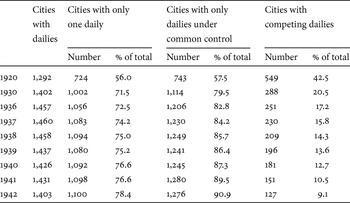
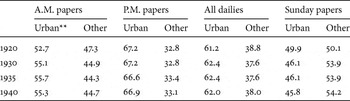
Although management initiatives partly account for members’ willingness to permit reform, the restrictions that World War I imposed caused the closure of numerous newspapers throughout the country, which, in conjunction with urbanization, weeded out exclusive territories, reduced the value of franchise rights, and facilitated reform. Whereas in 1909, 689 cities had competing daily newspapers, in 1929 only 288 cities had two or more dailies.Footnote 131 By 1945, the bulk of the dailies in towns with fifty thousand or fewer people lacked local competition (see Table 1).Footnote 132 Urbanization increased city circulation, which diminished regional competition, and correspondingly reduced the value of exclusive territory outside a newspaper’s “city of publication,” particularly among morning newspapers (see Table 2).Footnote 133 The majority of Americans did not live in major cities until 1920, but thereafter a sixty-mile protest territory was of comparatively small importance in many locations.Footnote 134 In certain areas of the country, such as Dallas and Salt Lake, urbanization was less rapid and large protest areas remained valuable, but twelve of the fifteen AP directors had city circulations on their papers that varied daily from 50 percent to 88 percent. Of these twelve, five achieved over 70 percent of their circulation within their city of publication.Footnote 135 By 1942, the AP served 1,274 newspapers and the UP served 981. In addition to having the larger membership numerically, the AP served papers constituting 81 percent of the daily morning market, with 97 percent of the nation’s circulation, and 59 percent of the evening newspapers, with 77 percent of the circulation.
Cities with one daily, all dailies under common control, and with competing dailies, 1920–1942

Source: US v. AP, 326 U.S. 1 (1945), Transcript of record, vol. 3, p. 1066.
Urban and nonurban circulation of U.S. daily and Sunday newspapers, 1920–1940 (%)Footnote *

Source: US v. AP, 326 U.S. 1 (1945), Transcript of record, vol. 3, p. 1052.
* Computed from Audit Bureau of Circulation figures for English-language daily and Sunday papers as reported in Editor & Publisher, “International Year Book Numbers” for 1920–21, 1931, 1936, and 1941.
** This was the classification the Audit Bureau listed as “City Zone.” It was the circulation in the urban area of the city of publication, which the Audit Bureau designated in consultation with the newspapers. It was recognized that these areas tended to expand during the period.
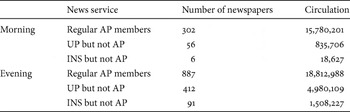
Distribution of daily morning and evening newspapers among the major news services, 1941

Source: US v. AP, 326 U.S. 1 (1945), Transcripts of record, vol. III, p. 1074.
In 1925, the year Cooper was appointed general manager, 119 of the 614 members elected in 1900 had either resigned or merged with other titles. The total membership was 1,198, which meant, according to Cooper, that 703 new members came into the organization “very largely through waivers given by the charter members.” Only 205 of the 495 remaining charter members had any right of protest.Footnote 136 Although the membership increased, the percentage of papers that received a leased wire report, namely, the larger papers, remained almost static at 59 percent of the membership.Footnote 137 In 1927, there were 2,001 daily newspapers published in the continental United States, 1,926 of which received news reports, or 96 percent. Of this total, 1,169 (58 percent) were members of the AP. The total listed clientele of the Scripps-Howard service was 662; the Hearst-owned service, 338. Of the number taking UP and INS services, 30 percent were AP members. Of those subscribing to the Scripps-Howard service, 24 percent were AP members; and 37 percent of Hearst’s clientele were members in the AP.Footnote 138
While this process of liberalization was under way, the “anti-monopoly moment” of the late 1930s precipitated a flood of regulatory law that spilled over into the supply of news.Footnote 139 The legislatures of Missouri and New York, although historically safe havens for the AP, considered bills to regulate the press and specifically the association.Footnote 140 These bills failed, but antitrust prosecutions under the Sherman Act also increased after 1938, as did the assault on exclusive trading practices. In 1942, Wendell Berge and Charles B. Rugg, the great trustbusters, began an investigation of the AP under the direction of Francis Biddle and Thurman Arnold of the Department of Justice.Footnote 141 That year the AP served 1,274 newspapers and the UP served 981. In addition to having the larger membership numerically, the AP served papers constituting 81 percent of the daily morning market, with 97 percent of the nation’s circulation, and 59 percent of the evening newspapers, with 77 percent of the circulation (see Table 3).
In AP v. US, as in Inter-Ocean and INS before it, freedom of contract vied against freedom of the press. The AP argued that newspaper “copy” before it was printed was not an article of commerce, and therefore the courts could not compel members to share it with anyone against their will. According to the Chicago Times, a member of the association, “the exclusive ownership of copy prior to its publication in those who write and produce it is the very essence of freedom of the press,” and to undermine it was destructive of initiative and industry.Footnote 142 When the case came before the Second Circuit, Judge Learned Hand, a well-known advocate of press freedom, argued that the production of news is inevitably subject to “personal impress,” which made it impossible to treat two news services as interchangeable. It being “only by cross-lights from varying directions that full illumination can be secured,” wrote Hand, to deny any paper the benefit of any news service of the first rating was to deprive the public of important information. In the marketplace for ideas, the report of the AP was an essential facility. This assertion was different from claiming that the news reports of the AP were essential for producing a successful newspaper, which several profitable papers that solely relied on the UP demonstrated was false. Even so, perceptions of the public’s interest in news trumped the protection of private property, and in this respect the size of the AP was determinative. A reporter and editor were free from this obligation to the public interest, but the AP, “a vast, intricately reticulated, organization,” was not.Footnote 143
In AP, the Supreme Court, affirming Hand’s opinion in the lower court, privileged competition in the newspaper market over competition in the news-gathering market.Footnote 144 The exclusionary bylaws of the association, and all aspects of its protest right, were found in restraint of trade. There could be no restrictive practices with respect to membership. The consequent consent decree required that the AP bylaws contain a positive declaration that in passing upon applicants the elective body would not consider the competitive effect of an election either upon the applicant or the member, although the association was allowed to retain the exclusive right to the news of its members.Footnote 145 The “inability to buy news from the largest news agency,” wrote Justice Black for the court, meant that a newspaper without the news service of the AP was “more than likely to be at a competitive disadvantage.” The bylaws of the AP, which “aimed at the destruction of competition,” made it so difficult for newspapers in competition with incumbent members to gain access to the news that “the opportunity of any new paper” was seriously limited.
Dissenting, Justice Roberts, writing for Justice Stone, and Justice Murphy, who wrote separately, observed that there was no evidence the AP intended to destroy competition. Roberts also objected that the size of the association had no apparent bearing on the question of restraint. Converting the AP into “a public utility subject to the duty to serve all on equal terms,” opined Roberts, was “government-by-injunction with a vengeance,” which might “well result not in freer competition but in a monopoly in AP.”Footnote 146 The implications of the decision were far-reaching for the news industry and for jurisprudence. Although refusal to deal when part of a scheme to dominate the market or suppress competition might be unlawful, in AP the court found no suppression of competition in the gathering of news; instead, it predicated its decision on the interests the public had in the service of the association.Footnote 147
International comparison helps to establish the relative strength of the Supreme Court’s property-rights action. In Britain, after the nationalization of telegraphy in 1868, the Post Office stipulated that all newspapers be included in the formation of any nationwide news association.Footnote 148 By World War II, however, the Press Association embraced private practices that were less cooperative and more exclusive, while the AP became more akin to a regulated public utility. Convergence appears to have been partially purposeful. In the private papers of Justice Frankfurter, who consented in AP, is an editorial in which he underlined passages that suggested the AP ought to be open to all like the British association.Footnote 149 The business of the American association, wrote Frankfurter in his judgment in AP, “is the promotion of truth regarding public matters by furnishing the basis for an understanding of them. Truth and understanding are not wares like peanuts and potatoes.” In Britain, the Press Association avoided the difficulties of balancing exclusion and cooperation, but it paid the price in terms of its reliance on the limited productivity of the Post Office telegraph department. The comparatively weak American state privileged productivity over equality. The stronger British state enforced equality but decreased productivity.Footnote 150
Conclusion
From the 1890s to the 1940s, American courts repeatedly found that the dominance of the AP and its refusals to deal with certain news outlets were detrimental to the public interest. In their decisions, judges favored small newspapers over large newspapers and, consequently, over rivalry between news-gatherers. This propensity reflected a desire to maintain a plurality of newspapers to uphold “free trade in ideas,” which became “commercial canon” before it became a metaphor for the constitutional protection of political speech.Footnote 151 It may appear to be contradictory that the court simultaneously prohibited competitors from misappropriating the AP’s news and prohibited the AP from refusing to deal, but the courts understood the prohibitions to be distinct, and a clear conception of the disparate markets to which they applied makes them reconcilable and consistent.Footnote 152 By protecting the AP from misappropriation, the court confined itself to the news-gathering market; its prohibition against refusals to deal applied to the newspaper market.
Forcing open the AP undermined the possibility to control admission, and by extension to control competition in the news-gathering market through the valve of membership. After AP, more newspapers subscribed to the association than before, which increased the economies accruing to membership and in turn entrenched the dominance of the AP.Footnote 153 Provided it could be kept in check, size had considerable advantages, including an increased supply of news for public consumption at a cheaper price. The enforcement of American antitrust laws, although intended to preserve competition, encouraged big business. In all events, it its clear that the suit in 1945 was hardly a “watershed departure by government from its largely laissez-faire attitude toward media economic concentration,” but rather the continuation of an established tradition of regulation.Footnote 154