Introduction
Seeds represent one of the most complex and evolutionarily successful forms of sexual reproduction in vascular plants, and at the same time they are the key dispersal unit. Therefore, there is a wide range of literature examining their evolution, ecology, physiology and anatomy (e.g. Baskin et al., Reference Baskin, Baskin and Li2000; Fenner, Reference Fenner2000; Baskin and Baskin, Reference Baskin and Baskin2001; Rodriguez-Pontes, Reference Rodriguez-Pontes2008; Graeber et al., Reference Graeber, Linkies, Wood and Leubner-Metzger2011; Morris et al., Reference Morris, Linkies, Muller, Oracz, Wang, Lynn, Leubner-Metzger and Finch-Savage2011). Seeds can be dispersed with various kinds of additional tissue, usually represented by the pericarp, which is formed from the ovary. Free seeds, fruits and any other type of dispersal unit are collectively called diaspores. But is the seed coat less developed when there is a pericarp? There is some evidence in the literature that in some taxa, post-dispersal pericarp presence results in a relatively thin, underdeveloped seed coat (e.g. Tsou and Mori, Reference Tsou and Mori2002). The question remains whether this relationship can be generalized through various taxa.
Phylogenetic relationships are probably the best predictors of diaspore anatomy (Martin, Reference Martin1946; Baskin et al., Reference Baskin, Baskin and Li2000; Linkies et al., Reference Linkies, Graeber, Knight and Leubner-Metzger2010; Yang et al., Reference Yang, Baskin, Baskin and Huang2012). It seems obvious that closely related taxa have a more similar histo-anatomical diaspore structure than very distant relatives. For example, in the Apiaceae family one usually finds diaspores with thin, single-layered seed coats coalesced with a thicker pericarp, with ribs and secretory oil ducts (Petri, Reference Petri1979; Tămaș, Reference Tămaş2004; Calvino et al., Reference Calvino, Martinez and Downie2008; Bercu and Broasca, Reference Bercu and Broasca2012; Lobiuc et al., Reference Lobiuc, Zamfirache and Ivănescu2012). In the Fabaceae, the diaspores are seeds with thick seed coats consisting of palisade sclerenchyma, brachysclereids and some live nutritious tissues (Tămaș, Reference Tămaş2004; Rodriguez-Pontes, Reference Rodriguez-Pontes2008). Phylogeny can also predict the morphology and size of the diaspores. Gymnosperms, for example, have somewhat less variation in seed mass and have, in general, bigger seeds than angiosperms. Angiosperms radiated out of the tropics and shifted from being predominantly small-seeded to having a much wider range of seed sizes (Moles et al., Reference Moles, Ackerly, Webb, Tweddle, Dickie and Westoby2005). Furthermore, seed size seems to be correlated with plant size (Thompson and Rabinovitz, Reference Thompson and Rabinovitz1989; Fenner, Reference Fenner2000; Linkies et al., Reference Linkies, Graeber, Knight and Leubner-Metzger2010).
The seed coat has a crucial role in diaspores. It protects the embryo and endosperm, it may regulate seed dormancy (physical dormancy) and it facilitates dispersal (Howe and Smallwood, Reference Howe and Smallwood1982; Kelly et al., Reference Kelly, Van Staden and Bell1992; Baskin et al., Reference Baskin, Baskin and Li2000; Tsou and Mori, Reference Tsou and Mori2002; Daws et al., Reference Daws, Garwood and Pritchard2006). The protection of the embryo is essential for the successful establishment of the next generation because, after dispersal, the seed can meet inhospitable conditions for embryo survival or seed germination (Kelly et al., Reference Kelly, Van Staden and Bell1992; Dubbern De Souza and Marcos-Filho, Reference Dubbern De Souza and Marcos-Filho2001; Gómez-González et al., Reference Gómez-González, Torres-Díaz, Bustos-Schindler and Gianoli2011). It is expected that thicker and more complex seed coverings ensure better protection for the embryo and endosperm. Pearson et al. (Reference Pearson, Burslem, Mullins and Dalling2002) have studied the relationship between seed-coat thickness and seed size. They have found that larger, non-photoblastic seeds had more highly developed seed coats than smaller, photoblastic seeds. It is well known that persistence in soil is negatively related to seed size and variance in seed dimensions (Thompson et al., Reference Thompson, Band and Hodgson1993; Moles et al., Reference Moles, Hodson and Webb2000). This relationship is explained by the vertical penetration efficiency of diaspores through the soil: smaller and more rounded seeds can penetrate deeper than bigger or more elongated ones, and are able to form a persistent seed bank (Thompson et al., Reference Thompson, Band and Hodgson1993; Bekker et al., Reference Bekker, Bakker, Grandin, Kalamees, Milberg and Poschlod1998; Csontos and Tamás, Reference Csontos and Tamás2003). On the other hand, bigger and more elongated diaspores cannot penetrate to deeper soil layers, thus they are more exposed to seed predation on the surface (Thompson et al., Reference Thompson, Band and Hodgson1993; Rees, Reference Rees1996; Hulme, Reference Hulme1998; Cerabolini et al., Reference Cerabolini, Ceriani, Caccianiga, Andreis and Raimondi2003). Bigger seeds develop thicker and harder seed coverings for protection against predators (Morrison et al., Reference Morrison, Williams, Oi and Potter1997; Honek and Martinkova, Reference Honek and Martinkova2003; Lundgren, Reference Lundgren2009; Matías et al., Reference Matías, Mendoza and Zamora2009) and inhospitable environmental conditions to which they are exposed (Bond et al., Reference Bond, Honig and Maze1999; Gashaw and Michelsen, Reference Gashaw and Michelsen2002; Daws et al., Reference Daws, Garwood and Pritchard2005, Reference Daws, Garwood and Pritchard2006; Salvatore et al., Reference Salvatore, Moya, Pulido, Lovreglio, Lopez-Serrano, De las Heras and Leone2010).
Besides seed-covering thickness, there are also some traits related to chemical composition of seed coverings, more difficult to measure, which can be related to protection of the embryo. For example, lignification and cutinization of the seed coverings can also result in better protection and isolation of the seed interior (endosperm and embryo) against environmental factors such as light, water, oxygen, temperature extremes, mechanical threats, pathogens and predators (Rolston, Reference Rolston1978; Dubbern De Souza and Marcos-Filho, Reference Dubbern De Souza and Marcos-Filho2001; Daws et al., Reference Daws, Garwood and Pritchard2005, Reference Daws, Garwood and Pritchard2006).
The anatomy of the seed coat and pericarp can reflect the dispersion strategy of the diaspore as well (Fahn and Werker, Reference Fahn, Werker and Kozlowski1972; Werker, Reference Werker1997; Baskin et al., Reference Baskin, Baskin and Li2000; Linkies et al., Reference Linkies, Graeber, Knight and Leubner-Metzger2010). Morphology (size and shape) is also implicated and plays a crucial role in this issue. For example, diaspores distributed by wind are generally small and light and often have appendices to increase the surface area or to facilitate the flight (Fahn and Werker, Reference Fahn, Werker and Kozlowski1972; Venable and Brown, Reference Venable and Brown1988). Endozoochorous seeds are generally bigger, with thick sclerenchymatous seed coverings to resist digestion, and often have fleshy pulps. Epizoochorous seeds require hooks for attaching to fur, or elaiosomes if they are carried away by ants (myrmecochory) (Venable and Brown, Reference Venable and Brown1988; Werker, Reference Werker1997).
Most of the publications examining seed-covering anatomy are descriptive studies, often on plants with agricultural importance, or studies with a physiological point of view (Petri, Reference Petri1979; Toma and Rugină, Reference Toma and Rugină1998; Tămaș, Reference Tămaş2004; Finch-Savage and Metzger, Reference Finch-Savage and Metzger2006; Graeber et al., Reference Graeber, Linkies, Wood and Leubner-Metzger2011, Reference Graeber, Nakabayashi, Miatton, Leubner-Metzger and Soppe2012; Morris et al., Reference Morris, Linkies, Muller, Oracz, Wang, Lynn, Leubner-Metzger and Finch-Savage2011; Weitbrecht et al., Reference Weitbrecht, Muller and Leubner-Metzger2011; Lobiuc et al., Reference Lobiuc, Zamfirache and Ivănescu2012). Most articles examine seed anatomy on one or a few species within a genus and they often discuss taxonomical questions (Hermann et al., Reference Hermann, Meinhard, Dobrev, Linkies, Pesek, Hesl, Machackova, Fischer and Leubner-Metzger2007; Morris et al., Reference Morris, Linkies, Muller, Oracz, Wang, Lynn, Leubner-Metzger and Finch-Savage2011; Linkies and Leubner-Metzger, Reference Linkies and Leubner-Metzger2012). Fewer papers examine the ecological implications of seed-covering anatomy in seed dispersal, seed persistence and germination (Martinez et al., Reference Martinez, Garcia and Obeso2007; Norden et al., Reference Norden, Daws, Antoine, Gonzalez, Garwood and Chave2008; Widodo et al., Reference Widodo, Hartana and Chikmawati2009). Furthermore, there are very few articles examining differences in seed-coat anatomy between diaspore types (i.e. one-seeded fruits, free seeds). Tsou and Mori (Reference Tsou and Mori2002) compared the differentiation degree of the seed coat between free seeds and fruits as diaspores, and found that free seeds have more complex and better differentiated seed coats than fruits, where the pericarp takes on the protective function of the seed. Besides these topics, we found a lack of information in the literature about relationships between seed-coat anatomy and other seed traits of ecological importance, such as seed morphology (but see Martinez et al., Reference Martinez, Garcia and Obeso2007) and diaspore type (but see Tsou and Mori, Reference Tsou and Mori2002).
Based on this gap in the literature, and concentrating on problems of ecological importance, in this study we analyse how seed-covering anatomy is related to diaspore morphology in 39 herbaceous species from central-eastern Europe. We hypothesized that: (1) thickness and anatomical complexity of seed coverings (seed coat and pericarp) are related to morphology (size and shape) of the diaspores; furthermore (2) the thickness and anatomy of the seed coat (testa and tegmen) differ between free seeds and one-seeded fruits.
We predicted that: (1) bigger and more elongated diaspores have a thicker and anatomically more complex seed coat, with a greater proportion of lignified tissue due to an additional investment in these structures, ensuring a greater protection; and (2) the thickness and anatomical complexity of the seed coat are negatively influenced by the presence of the pericarp.
Materials and methods
Collection of diaspores
We collected diaspores of 39 common herbaceous plant species from temperate grasslands and ruderal habitats in Romania, which belonged to 12 common plant families of this region (Table 1). Our primary criteria of species selection within families were diaspore type and size. The free seeds or single-seeded fruits (that function as dispersal units) have been obtained from selected taxa belonging to a quite representative number of various families. Within families, we selected species with smaller (seed mass < 1 mg) and larger diaspores (seed mass > 1 mg) as well. Seed collection included at least 30 different mother plant individuals from one to three sites each. Diaspores were cleaned of appendages before measurements.
Studied species, their family, diaspore type, morphological traits of their diaspore (mass and shape) and results of our measurements on seed traits. Nomenclature follows Tutin et al. (Reference Tutin, Heywood, Burges, Moore, Valentine, Walters and Webb1964–1980). Diaspore type: S, free seeds; F, one-seeded fruits. Diaspore shape represents variance in diaspore dimensions. SC, thickness of the seed coat (mean ± SE); P, thickness of the pericarp (mean ± SE); LT, thickness of lignified tissue in diaspore coverings (mean ± SE); T-SC, number of tissue types in seed coat; CL-SC, number of cell layers in seed coat; T-P, number of tissue types in pericarp; CL-P, number of cell layers in pericarp

Measurements on diaspore morphology
We used mass as a proxy for diaspore size, therefore mean mass was determined by weighing three batches of 100 air-dried diaspores. The length, width and height of 30 diaspores per species were measured under a stereomicroscope using an ocular micrometer. We expressed diaspore shape as the variance of length, width and height, after first transforming all three values so that length = 1 (dividing all three values by the length); in this way, shape becomes independent of size (Thompson et al., Reference Thompson, Band and Hodgson1993; Bekker et al., Reference Bekker, Bakker, Grandin, Kalamees, Milberg and Poschlod1998).
Methods applied for sectioning of the diaspores, staining and fixation of these sections
For each species, three diaspores were randomly selected for the anatomical characterization. Diaspores were prepared for sectioning with an ultramicrotome. We first fixed the samples in glutaraldehyde (2.7%) for 24 h, then they were dehydrated using an increasing range of acetone concentrations (30, 50, 70, 80, 90 and 100%) for 1 h each. After fixation and dehydration, diaspores were embedded stepwise in Epon 812 resin and acetone (100%) solutions with an increasing proportion of Epon 812, and lastly in pure Epon 812 resin for 24 h each. After polymerization of the embedding agent and diaspores in an oven at 60 °C for 48 h, diaspores were sectioned. We used a Leica UC 6 ultra microtome (Leica Microsystems, Wetzlar, Germany) with a glass knife to obtain sections of 0.9–1.3 μm thickness, and stained them using Epoxy Tissue Stain. We took pictures of each section with a CCD-digital camera connected to an Olympus BX 51 optical microscope (Olympus Optical, Tokyo, Japan).
We measured the thickness of diaspore coverings (seed coat for free seeds and seed coat and pericarp for seeds enclosed in fruits) and lignified tissue using the pictures mentioned above with the ImageJ software (Abràmoff et al., Reference Abràmoff, Magalhães and Ram2004). The measurements were made in 100 different locations from all the sections we had per species, and we calculated the average thickness of the seed coat, thickness of seed coat with pericarp (diaspore covering thickness) and thickness of lignified tissue in diaspore coverings based on these measurements.
Furthermore, we calculated the relative thickness to mean radius of the diaspore for diaspore covering thickness (relative covering thickness) and for seed-coat thickness (relative seed-coat thickness). Thickness of lignified tissue relative to diaspore covering thickness was also calculated (lignification degree of coverings). Further, for a more detailed anatomical characterization of the coverings, we counted how many tissue types were involved in forming the seed coat and diaspore coverings, which could be distinguished according to simple cell morphology and colour. Finally, we counted the number of cell layers in seed coat and diaspore coverings.
Statistical analysis
To test our first hypothesis that diaspore mass and shape might influence diaspore anatomy, we used general and generalized linear mixed effect models (LMMs and GLMMs, respectively). We included diaspore covering thickness, relative covering thickness, lignified tissue thickness, lignification degree of the coverings as dependent variables in LMMs, and number of cell layers in diaspore coverings and number of tissue types in diaspore coverings as dependent variables in GLMMs with Poisson distribution. We included the morphological traits (diaspore mass and shape) as continuous explanatory variables, and taxonomical status as species nested within family as a random term in the analyses. When necessary, continuous dependent variables were log- or square-root-transformed before the analyses to meet the assumption of normality. There was no significant correlation between the two covariates (Pearson correlation, r = –0.22), which indicates no multicollinearity problems in these models.
To test our second hypothesis, whether the type of diaspore (free seed or seed enclosed in fruit) is linked to the anatomical traits of the seed coat, we applied LMMs with seed-coat thickness and relative seed-coat thickness as dependent variables, and GLMMs with Poisson distribution with number of cell layers in seed coat and number of tissue types in seed coat. We included diaspore type as predictor (seed or fruit), diaspore mass as covariate, and taxonomical status as species nested within family as a random term. An exception was relative covering thickness, where covariates were not used. All statistical analyses were performed in the R statistical environment version R 3.0.2 (R Development Core Team, 2012).
Results
Relationships between diaspore morphology and anatomy
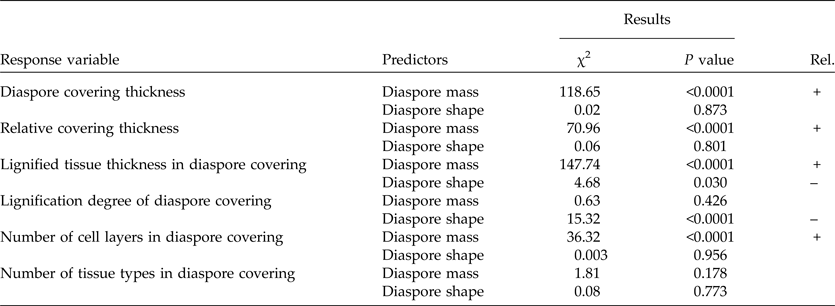
We found significant relationships between morphological and anatomical diaspore traits. Our results show that diaspore mass related positively to diaspore covering thickness and relative covering thickness. The number of cell layers of the diaspore coverings was also positively related to diaspore mass. Furthermore, the thickness of lignified tissue increased with increasing diaspore mass. In contrast, we found significant negative relationships between diaspore shape (variance in diaspore dimensions) and lignified tissue thickness in diaspore covering, furthermore the lignification degree of diaspore covering decreased with increasing variance in diaspore dimensions (Table 2).
Relationships between morphological (mass and shape) and anatomical traits of diaspores (LMMs for diaspore covering thickness, relative covering thickness, thickness of lignified tissue in diaspore covering, lignification degree of diaspore covering, GLMMs for number of cell layers in diaspore covering, number of tissue types in diaspore covering). df = 1 in all cases. Rel., direction of the relationship

Comparing seed coat anatomy between seeds and fruits
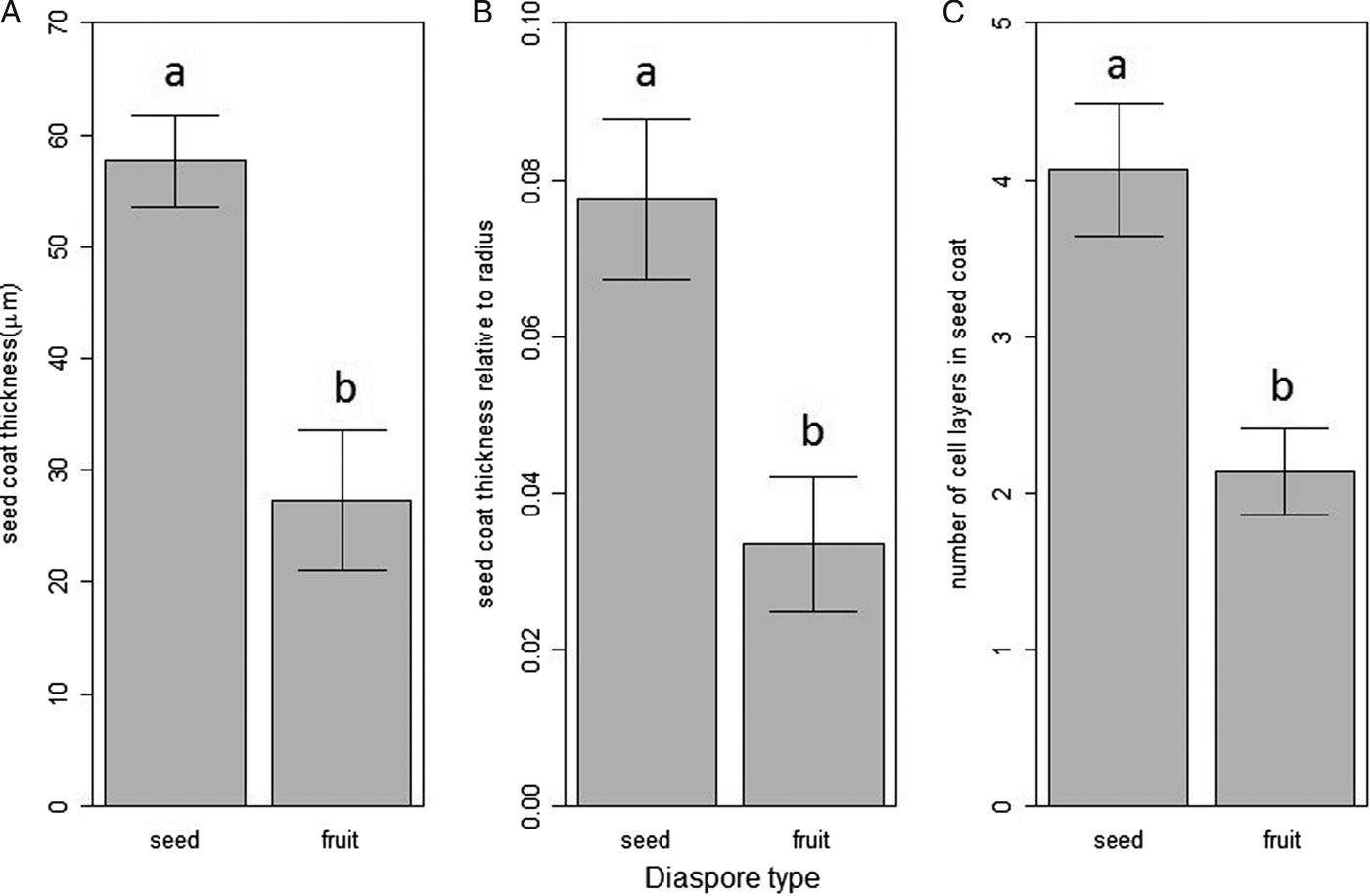
Based on our results, we found significant differences between seeds and fruits in three out of the four studied anatomical traits (Table 3). Free seeds had thicker seed coats than seeds enclosed in fruits and their relative seed-coat thickness was larger than in the case of seeds enclosed in fruits (Table 3, Fig. 1). There were significantly more cell layers in the seed coat of free seeds than in the seed coat of one-seeded fruits. In the studied species, lignified tissues occurred in 62.5% of the seed coats of seeds and in only 4.3% of the seed coats of one-seeded fruits. In the case of fruits, usually only the pericarp was lignified. In contrast, we found no significant difference between the number of tissue types in the seed coat of free seeds and that of one-seeded fruits.
Differences in some anatomical diaspore covering traits between free seeds (seed, n = 16) and seeds embedded in fruits (fruit, n = 23). (A) Thickness of seed coat; (B) thickness of seed coat relative to radius of the diaspore; (C) number of cell layers in seed coat. Bars represent mean ± SE.

The effect of diaspore type (S, free seeds; F, seeds embedded in fruits) on the anatomy of the seed coat. df = 1 in all cases

Discussion
Our results suggest that the thickness of diaspore covering does not only increase with the size of diaspores, but bigger diaspores have disproportionately thicker coverings (covering thickness relative to diaspore size), so there is a supplementary investment in covering structures in bigger diaspores. This is also reflected by the increasing number of cell layers and tissue types in diaspore covering with diaspore size. Furthermore, the degree of lignification of the covering also increases with diaspore size. One explanation for these relationships is that granivorous arthropods (ants, carabids and crickets) and other seed predators (rodents and birds) prefer to consume bigger diaspores due to their larger nutrient content, but also diaspores with thinner, more fragile coverings due to their more accessible nutrient content (Morrison et al., Reference Morrison, Williams, Oi and Potter1997; Lundgren, Reference Lundgren2009; Matías et al., Reference Matías, Mendoza and Zamora2009). Honek and Martinkova (Reference Honek and Martinkova2003) have shown that seeds of similar size and weight but different covering thickness were consumed at different rates by granivorous carabids: granivores preferred seeds with thinner covering structures. There are numerous studies involving rodent predation. Zhang and Zhang (Reference Zhang and Zhang.2008) have proved that rodent predation in a warm-temperate broadleaved deciduous forest in China selected negatively for lignified endocarp thickness and proportion of endocarp mass to seed mass. In a field study on wild olive seeds, Alcántara et al. (Reference Alcántara, Rey, Sánchez-Lafuente and Valera2000) have also shown that rodents prefer smaller seeds with thinner lignified coverings.
While larger diaspores are more likely to remain on the soil surface or in the litter after dispersal, and they are also more preferred by seed predators, large-seeded species often have disproportionately thicker coverings than smaller ones, to minimize predation risk (Fenner, Reference Fenner1983). Smaller diaspores are quickly buried in the soil and are well protected there; they are also much harder to crack mechanically (Lundgren and Rosentrater, Reference Lundgren and Rosentrater2007), so they do not necessarily need to invest in thick coverings for protection against predators. In addition, small-seeded species have more diaspores than those with larger seeds (Jakobsson and Eriksson, Reference Jakobsson and Eriksson2000; Aniszewski et al., Reference Aniszewski, Kupari and Leinonen2001) and their investment per seed is smaller, therefore their coverings, including seed coat and pericarp, are also likely to be simpler in structure and thinner than those of larger seeds (Morrison et al., Reference Morrison, Williams, Oi and Potter1997; Matías et al., Reference Matías, Mendoza and Zamora2009).
Besides predation, bigger seeds, which tend to remain on the soil surface, are much more exposed to extreme abiotic environmental conditions, such as drought, heat, frost and UV radiation, which can damage the seed and the embryo. This might be a reason why bigger diaspores have disproportionately thicker coverings to compensate for the absence of soil protection. Seed coat ratio was negatively related to mean monthly rainfall during the seed dispersal period, suggesting that seeds with thicker coverings may have better chances of survival under dry conditions (Hill et al., Reference Hill, Eduards and Frank2012). Furthermore, in fire-disturbed ecosystems, bigger diaspores with thicker and more lignified coverings have a greater chance to survive fire than similar sized but thinner-coated diaspores (Bond et al., Reference Bond, Honig and Maze1999; Gashaw and Michelsen, Reference Gashaw and Michelsen2002; Salvatore et al., Reference Salvatore, Moya, Pulido, Lovreglio, Lopez-Serrano, De las Heras and Leone2010; Gómez-González et al., Reference Gómez-González, Torres-Díaz, Bustos-Schindler and Gianoli2011). In addition, plants with bigger seeds or one-seeded fruits usually have a lower number of diaspores, thus they can invest more into one diaspore with anatomically more complex coverings (Venable and Brown, Reference Venable and Brown1988). Taken together, we conclude that these factors might be responsible for the positive selective force on thicker covering in bigger diaspores, resulting in disproportionately thicker covering in bigger diaspores.
Our results pointed out that the degree of lignification of the diaspore coverings is negatively related to the variance of seed dimensions, which means that more flat or elongated seeds have disproportionately thinner and less lignified coverings than more rounded ones. This might be explained by their higher surface-to-volume ratio compared to more rounded diaspores. Thus, the same amount of covering tissue is distributed on a bigger surface area, which leads to a thinner diaspore covering compared to more rounded seeds.
Furthermore, our results indicate that the seed coat of seeds as diaspores is more complex, in having a greater proportion lignified tissue and being disproportionately thicker than the seed coat of seeds embedded in fruits. It is likely that the pericarp takes over the protective function and compensates for the very thin and simple seed coat in fruits. In addition, the pericarp in fruits has other roles as well, such as dispersal. For seeds as diaspores, however, the seed coat remains the only covering structure for protection of the endosperm and embryo. While in this case the seed coat is the only barrier to the outside world, it has to offer sufficient protection for the interior parts of the seed by being more lignified, thicker and histologically more complex than the seed coats of seeds enclosed in fruits. We observed that seed coats of fruits as diaspores were usually not just thinner, but had a much simpler structure, with fewer cell layers, very few tissue types and homogeneous appearance. In most of the fruits, the seed coat was formed by living tissues, either epidermal or parenchymatous cells. The seed coat of seeds as diaspores, in contrast, was more differentiated histologically, with more cell layers and with the external cells usually lignified and dead. Tsou and Mori (Reference Tsou and Mori2002) have studied seed coat anatomy in 11 genera and 20 species of the Brazil nut (Lecythidaceae) family. They reported similar results to ours by comparing differentiation degree of the seed coat between seeds and fruits as diaspores, and showing that seeds have more complex and better differentiated coats than fruits, where the pericarp takes over the protective function of the seed.
Conclusions
In our study we showed that there is an allometric relationship between morphological traits of seeds and one-seeded fruits and anatomical characteristics of the seed coat and pericarp. Bigger diaspores had disproportionately thicker and more lignified coverings (seed coat or pericarp or both) with a more complex histological structure than smaller ones. We assume that predation pressure and exposure to inhospitable environmental conditions are responsible for plants with bigger diaspores allocating more in protection of the inner parts of seeds (embryo, endosperm and perisperm). This may be because they usually have transient seeds and stay closer to the soil surface, being more exposed than smaller seeds, which penetrate deeper into the soil. Further, we found that more elongated diaspores have disproportionately thinner and less lignified coverings than more rounded ones.
Related to seed coat anatomy of seeds and one-seeded fruits, we showed that free seeds have a thicker and anatomically more complex seed coat than those enclosed in fruits. One explanation may be that the seed coat is the only protective layer in the case of free seeds, while seeds included in fruits are surrounded by the pericarp as well. Therefore, fruits require a more differentiated pericarp but a less differentiated seed coat in contrast to free seeds.
Acknowledgements
We are very grateful to Monica Beldean, Anna Szabó, László Bartha, Péter L. Pap and Csongor I. Vágási for their help in seed collection, and to Constantin Crăciun for providing equipment and working conditions for the histo-anatomical study of the seed material.
Financial support
E.R. was supported by the János Bolyai Research Scholarship of the Hungarian Academy of Sciences.
Conflicts of Interest
None.