INTRODUCTION
Depending on your point of view the terms diagnosis and diagnostics can have a variety of meanings. An investigative bibliometric survey of the terms ‘new’, ‘diagnostics’ and ‘development’ in papers published in the period 2004–2014 yields over 48 K records (see Fig. 1a). It might, therefore, come as a surprise to find that less than 10% of these contain any reference to infectious or parasitic diseases, the vast majority of studied diseases being non-communicable, such as the detection of various cancers and their dynamics in response to treatment, or various genetic disorders. As might be expected within the infectious diseases, research on viruses is most evident. The more notable viruses under investigation are the respiratory viruses of the Coronaviridae, in particular the virus responsible for severe acute respiratory syndrome that led the World Health Organization (WHO) to issue a global alert in March 2003 and with it the rapid quest to develop much needed diagnostic tools. Thankfully the pandemic never materialized but a variety of diagnostic assays were developed, now ready and waiting for future use if a subsequent alert ever arises (Lipkin, Reference Lipkin2013). In line with other diseases, the importance of robust and reliable point-of-care tests for infectious diseases has been stressed (Caliendo et al. Reference Caliendo, Gilbert, Ginocchio, Hanson, May, Quinn, Tenover, Alland, Blaschke, Bonomo, Carroll, Ferraro, Hirschhorn, Joseph, Karchmer, MacIntyre, Reller and Jackson2013).
A bibliometric analysis, using the Web of Knowledge (wok.mimas.ac.uk), reveals the broader nature and application of diagnostics. A) Over 48K papers with the following terms ‘new’, ‘diagnostics’ and ‘development' have been published in the 2004–2014 period of which just less than 10% are on infectious or parasitic diseases. As might be expected, viral and bacterial diseases dominate the infectious disease landscape while malaria is dominant within that of parasitic diseases. B) Bar chart plotting the increasing number of publications focusing on the use of point-of-care RDTs for diagnosis of malaria while application and more formal review of their use within the health system appears understudied.

A focus on parasitic diseases and malaria
In contrast with the acute nature and the potential for rapid dispersal of viruses, parasitic diseases of either protist or helminth origin have a different epidemiological dynamic and global burden of disease for which they are responsible (Harhay and King, Reference Harhay and King2012; Murray et al. Reference Murray, Vos, Lozano, Naghavi, Flaxman, Michaud, Ezzati, Shibuya, Salomon, Abdalla, Aboyans, Abraham, Ackerman, Aggarwal, Ahn, Ali, Alvarado, Anderson, Anderson, Andrews, Atkinson, Baddour, Bahalim, Barker-Collo, Barrero, Bartels, Basanez, Baxter, Bell and Benjamin2012; Vos et al. Reference Vos, Flaxman, Naghavi, Lozano, Michaud, Ezzati, Shibuya, Salomon, Abdalla, Aboyans, Abraham, Ackerman, Aggarwal, Ahn, Ali, Alvarado, Anderson, Anderson, Andrews, Atkinson, Baddour, Bahalim, Barker-Collo, Barrero, Bartels, Basanez, Baxter, Bell, Benjamin and Bennett2012). Today the greatest burden caused by parasites is to be found in low- and middle-income countries in tropical regions, often with fragile health systems and marginalized populations living in impoverished conditions. In these settings malaria can present in either acute or chronic forms in children or adults, respectively and often concurrently with other infections such as HIV and tuberculosis (Dye, Reference Dye2014). Such co-infections have also brought to light new confounding aspects within diagnostics such as the occurrence of false-positive HIV tests owing to cross-reactions with Plasmodium or Schistosoma infections (Gasasira et al. Reference Gasasira, Dorsey, Kamya, Havlir, Kiggundu, Rosenthal and Charlebois2006; Everett et al. Reference Everett, Baisely, McNerney, Hambleton, Chirwa, Ross, Changalucha, Watson-Jones, Helmby, Dunne, Mabey and Hayes2010).
In the battle to control malaria, frontline tools have centred upon better point-of-care diagnostics and quicker access to medication, as typically set within the integrated management of childhood illnesses (Baiden et al., Reference Baiden, Webster, Owusu-Agyei and Chandramohan2011, Reference Baiden, Webster, Tivura, Delimini, Berko, Amenga-Etego, Agyeman-Budu, Karikari, Bruce, Owusu-Agyei and Chandramohan2012). With the development of lateral flow antigen detection immunochromatographic dipsticks, during the past decade there have been major technological advances in point-of-care diagnostic tools for malaria, as evidenced by the steady rise of publications (Fig. 1b). The majority of these detect antigens of Plasmodium such as histidine-rich protein-2 (HRP-2) and lactate dehydrogenase (Bisoffi et al. Reference Bisoffi, Gobbi, Angheben and Van den Ende2009) and have been adopted in a variety of settings such as in hospitals and health centres, in rural communities, in home-based management of malaria and in remote areas in expedition medicine (Ansah et al. Reference Ansah, Narh-Bana, Epokor, Akanpigbiam, Quartey, Gyapong and Whitty2010; Mosha et al. Reference Mosha, Conteh, Tediosi, Gesase, Bruce, Chandramohan and Gosling2010; Counihan et al. Reference Counihan, Harvey, Sekeseke-Chinyama, Hamainza, Banda, Malambo, Masaninga and Bell2012).
Expanded use with continued success?
Part of the success of malaria point-of-care testing with expansion to several millions of tests being applied each year has had unforeseen consequences. With a newly identified global diagnostic market for their production, a plethora of diagnostic companies has appeared manufacturing generic tests of varying degrees of quality. Seeking to reach consensus evaluation and that quality-assured tests were made available to those that needed them, formal evaluation guidelines were developed and expert bodies (e.g. Foundation for Innovative New Diagnostics (FIND) www.finddiagnostics.org) were formed (Mabey et al. Reference Mabey, Peeling, Ustianowski and Perkins2004; Banoo et al. Reference Banoo, Bell, Bossuyt, Herring and Mabey2006).
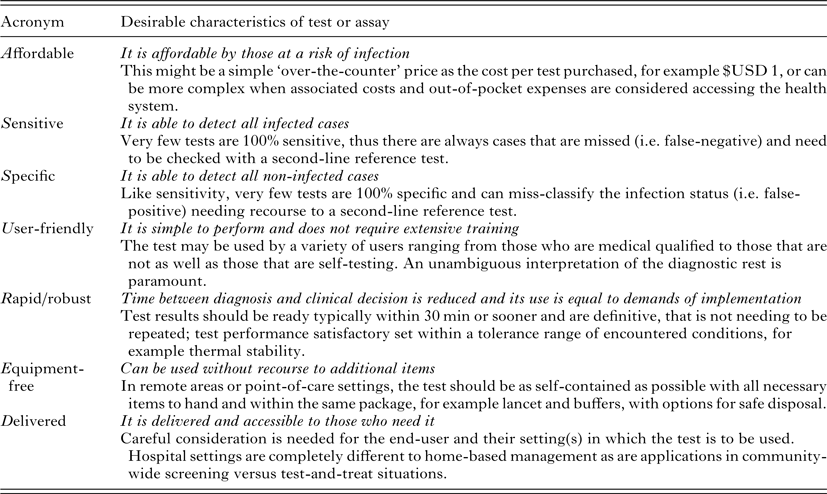
The fruition of these endeavours has led to extensive use of the acronym ASSURED (Table 1), as diagnostic evaluation criterion for any point-of-care test, and also in regular publication of review documents that conduct head-to-head evaluations of available rapid diagnostic tests (RDTs) against a reference panel of bio-banked samples (FIND et al. 2011). This provides information to Ministries of Health and associated health policy makers, to make informed decisions on the rational choice of RDT tailored to their epidemiological setting, for example their needs to discriminate Plasmodium spp. In comparison to the pharmaceutical sector, these bodies have little legal jurisdiction to prosecute manufacturers that continue to produce low-quality products, but the intention is that the industry will self-regulate upon direct market competition within and between quality-proven preferred suppliers.
Key features of the ASSURED criterion for an ideal diagnostic with associated clarifications in different diagnostic settings
Even with comprehensive reference bio-banks, with expanded use of diagnostics into previously poorly characterized endemic areas, the natural diversity of Plasmodium has created several surprises. In Asia the occurrence of zoonotic malaria has uncovered a need to identify Plasmodium knowlesi and presently used RDTs perform poorly (Foster et al. Reference Foster, Cox-Singh, Mohamad, Krishna, Chin and Singh2014). More astonishing has been the discovery of isolates of Plasmodium falciparum with a HRP-2 deetion, highlighting an erroneous assumption that this gene was present in all populations of P. falciparum (Koita et al. Reference Koita, Doumbo, Ouattara, Tall, Konare, Diakite, Diallo, Sagara, Masinde, Doumbo, Dolo, Tounkara, Traore and Krogstad2012; Maltha et al. Reference Maltha, Gamboa, Bendezu, Sanchez, Cnops, Gillet and Jacobs2012; Kumar et al. Reference Kumar, Pande, Bhatt, Shah, Mishra, Srivastava, Valecha and Anvikar2013). It is therefore immediately apparent that the diagnostic performance of any RDT when rolled out in the field is not precisely congruent with its use against a reference bio-bank. Therefore using RDTs in conjunction with those that utilize different criteria, for example microscopy, or targeting other biomarkers, for example DNA, is important to detect the occurrence of false-negatives more quickly. Similarly, not all evaluations reveal the harshness of the conditions encountered on the ground when environmental conditions exceed those conceived in the target product profile or the supply chain of RDTs is fragile and stock-outs occur even with the use of mobile phone reporting systems (Githinji et al. Reference Githinji, Kigen, Memusi, Nyandigisi, Mbithi, Wamari, Muturi, Jagoe, Barrington, Snow and Zurovac2013).
The use and application of diagnostics
In comparison to the pharmaceutical industry, the equivalent in the diagnostic sector is much smaller. However, they both suffer similar problems in the process of development and application of new products. Unlike pharmaceuticals, a unique feature of diagnostic tools is their application at various points within the health system and are used with a variety of clinical samples that range from tissue biopsy, blood, sputum, urine and stool from a variety of patients at various levels of infection and disease progression. Attempting to map out these features, Fig. 2 highlights generic differences within the health system. Even though a specific RDT or diagnostic assay might have been envisaged to have one specific use, the reality is it will have application in a variety of settings. Thus its performance is typically context-specific and the ASSURED criteria may be satisfactory at certain but not at all levels.
Schematic of the relationship between context of the diagnostic setting and tools/assays used with desirable features of the test; more technically demanding assays are restricted to specialist laboratories, e.g. DNA-based methods, however, microscopy can be considered at all levels. A traffic light system of red: poor, amber: fair and green: good, is used to compare across settings. [* note that while the cost of an RDT might be cheap when several thousand tests are need to be used in community screening settings it becomes more expensive and is a considerable financial burden on the peripheral health system].
As shown in Fig. 1b formal evaluations of use of malaria RDTs within the health system, albeit from largely informal use within communities by community volunteers to more formalized use in primary/secondary/tertiary health care, have not kept a pace with advances in their development and initial use. How these features map into the settings depicted in Fig. 2 is still open conjecture and that progress towards developing multiplex platforms co-screening several diseases is needed (Utzinger et al. Reference Utzinger, N'Goran, Caffrey and Keiser2011; Lammie et al. Reference Lammie, Moss, Goodhew, Hamlin, Krolewiecki, West and Priest2012; Solomon et al. Reference Solomon, Engels, Bailey, Blake, Brooker, Chen, Chen, Churcher, Drakeley, Edwards, Fenwick, French, Gabrielli, Grassly, Harding-Esch, Holland, Koukounari, Lammie, Leslie, Mabey, Rhajaoui, Secor, Stothard, Wei, Willingham, Zhou and Peeling2012).
A NEED FOR A MEETING FOCUSED ON PARASITIC DISEASES
With the recent progress in the development and application of RDTs for the management of malaria, it was important to realize that there were diagnostic needs for other parasitic diseases and that these might benefit from discussion of general progress and make reference to generic pitfalls for infectious diseases. This is equally true for parasitic diseases of veterinary importance to address the related issues in animal health and food production including those that impinge upon ‘OneHealth’ concepts. Seeking to bring together leading researchers actively engaged in diagnostics from their development, evaluation and implementation, a residential meeting at Ness Gardens, University of Liverpool was held on 24–25th September 2013. A total of 18 speakers were invited to present on a variety of topics. Through these contributors it was hoped to build a picture of how diagnostics were originally conceived and developed as new technologies come on line, are then validated against a variety of criteria and finally adopted within the health system to enhance patient care and ensure optimal deployment.
Diagnostic concepts and applications explained
Rosanna Peeling and David Mabey have been at the forefront of developing and evaluating diagnostics for sexually transmitted infections and malaria in the developing world (Peeling and Mabey, Reference Peeling and Mabey2010), and have now turned their attention to the diagnostic needs for neglected tropical diseases (NTDs) (Peeling and Mabey, Reference Peeling and Mabey2014). The diagnostic needs for human African trypanosomiasis (HAT) have been known for some time and good progress has been made with support from FIND in developing point-of-care tools such as LED microscopy or those based upon nucleic acid or antigen detection (Peeling and Mabey, Reference Peeling and Mabey2014). In contrast to the needs of individual case management of HAT, the needs for worm-related diseases such as soil-transmitted helminthiasis, schistosomiasis and lymphatic filariasis involve large-scale screening of communities for allocation of preventive chemotherapy. As control programmes move forward and the numbers of active infections and worm burdens decline this will impact upon the diagnostic performance of the present tools which may become progressively too insensitive and inadequate (Peeling and Mabey, Reference Peeling and Mabey2014). Such dilemmas in diagnostics have been raised previously and as yet have still not been fully resolved (Bergquist et al. Reference Bergquist, Johansen and Utzinger2009; Tambo et al. Reference Tambo, Ai, Zhou, Chen, Hu, Bergquist, Guo, Utzinger, Tanner and Zhou2014).
Thinking more about seeding and embedding diagnostic tools and assays within the health system, scenario planning and health system modelling plays an important role in rational deployment of technologies (Langley et al. Reference Langley, Adams, Doulla and Squire2014). With tuberculosis there are several options for diagnostics which involve detection of DNA with GeneExpert systems or visualization of Mycobacterium with light or fluorescent microscopy. The diagnostic algorithm becomes more complicated as patients need to be rescreened for cure/re-infection/recrudescence as well as for infections with multidrug resistance. Simulation modelling provides an opportune methodology to determine these needs more quickly without exhaustive on-the-ground studies which are slow and costly (Langley et al. Reference Langley, Adams, Doulla and Squire2014).
As with health system modelling, routine use of more sensitive diagnostic tests brings to light changes in the perceived distribution and burden of disease. When this information is utilized within predictive maps, for either medical or veterinary diseases, joined-up actions between diagnostic and epidemiological surveillance are needed (Cringoli et al. Reference Cringoli, Rinaldi, Albonico, Bergquist and Utzinger2013). With the introduction of FLOTAC, a flotation method for examination of parasites in stool, a key challenge is integration of these parasitological data with geospatial surveys, also taking advantage of modern mobile- and electronic-based data capture technologies (Rinaldi and Gringoli, Reference Rinaldi and Gringoli2014). Using the example of imported parasitic infections to Italy, the ability to interrogate and produce automated surveillance reports shows great potential for adaptive policy decision making.
Expanded microscopy at the point-of-care and specimen sampling
For well over 100 years, the ability to visualize parasites with the light microscope has been central to the diagnosis of parasitic diseases, especially those in the tropics where until the introduction of point-of-care immunodiagnostics, the microscope was the only appropriate technology. However, a major bottleneck was availability and access to microscopes. It was John McArthur who first designed a compact and portable microscope, believing it would be useful for diagnosis in remote areas in a stand-alone manner (McArthur, Reference McArthur1971, Reference McArthur1984), but his vision was never realized.
Some 50 years later, another attempt at revitalizing this concept took place with the commercial production of the Newton Nm1, as supported by the Wellcome Trust. Evaluating the performance of a portable microscope has features which set it apart from that of RDTs which are typically screened against a panel of bio-banked samples. Foremost, the microscope needs to be placed in the hands of competent users. It should be remembered that maintaining the diagnostic skills base within the health system, with refresher training when needed, is equally as important as the roll-out of RDTs for use by non-medical staff. Failure to do so imbalances the health system across the levels shown in Fig. 2 and distorts surveillance to those diseases amenable to RDTs alone.
Attempting to assess the performance of the Newton Nm1 alongside a mobile phone microscope and conventional microscope at low-power magnification (×100 & ×400) for detection of helminth eggs in stool, Bogoch et al. (Reference Bogoch, Coulibaly, Andrews, Speich, Keiser, Stothard, N'Goran and Utzinger2014) conducted an in-field evaluation in Cote D'Ivoire within an area endemic for schistosomiasis and soil-transmitted helminthiasis. Finding the performance of the mobile phone microscope lacking whilst the Nm1 was satisfactory, they concluded that future application of appropriate portable diagnostic technologies at the point-of-sample collection will enhance diagnostic coverage in several clinical and epidemiological settings (Bogoch et al. Reference Bogoch, Coulibaly, Andrews, Speich, Keiser, Stothard, N'Goran and Utzinger2014). In Uganda, conducting a similar evaluation for detection of malaria parasites within thick blood-films stained with Giemsa's stain, Stothard et al. (Reference Stothard, Nabette, Sousa-Figueiredo and Kabatereine2014a) found the performance of the Nm1 at high-power magnification (×1000 oil) to be reasonable. Indeed, further use of the Nm1 will go some way towards realization of the 3Ts (i.e. test, treat and track) initiative by WHO to expand access to light microscopy alongside further roll-out of RDTs (Stothard et al. Reference Stothard, Nabette, Sousa-Figueiredo and Kabatereine2014a).
A well-known drawback of fecal egg examinations is the need for repetitive stool sampling. This is especially true when the performance of anthelminthic drugs is assessed and several stool specimens need to be obtained over consecutive days from the treated patients. This is cumbersome and expensive and a disincentive to undertake drug efficacy checks regularly. By performing a meta-analysis across several drug efficacy studies that considered parasitological cure (CR) and fecal egg reduction rate (ERR), it was concluded that a single fecal examination with a thick Kato-Katz smear provided a reasonable and robust estimate of ERR but not CR (Levecke et al. Reference Levecke, Brooker, Knopp, Steinmann, Sousa-Figueiredo, Stothard, Utzinger and Vercruysse2014). With a simplification of the sampling protocols, there is now greater opportunity for pharmacodynamic surveillance of anthelminthic drugs.
Application of new molecular detection assays
While there are many RDTs available for malaria, the number is growing for other protist diseases, the repertoire for helminth diseases is very limited. Despite several million people being infected with schistosomiasis, there is only one commercially RDT, based upon detection of schistosome circulating cathodic antigen excreted in the urine of the host. The test is particularly useful for diagnosis of intestinal schistosomiasis but its performance for urogenital schistosomiasis is equivocal (Stothard, Reference Stothard2009). With funding from Schistosomiasis Consortium for Operational Research and Evaluation (SCORE), Corstjens et al. (Reference Corstjens, de Dood, Kornelis, Tjon Kon Fat, Wilson, Kariuki, Nyakundi, LoVerde, Abrams, Tanke, Leishout, Deelder and Van Dam2014) sought to improve the situation and develop a more sensitive point-of-care test, exploring the use of circulating anodic antigen. The level of detection of the test is impressive, likely down to single worm pairs, as lateral-flow assays use up-converting phosphor-labels to increase signal detection sensitivities (Corstjens et al. Reference Corstjens, de Dood, Kornelis, Tjon Kon Fat, Wilson, Kariuki, Nyakundi, LoVerde, Abrams, Tanke, Leishout, Deelder and Van Dam2014).
In recent years, there have been several technical improvements in DNA sequencing technologies and these have led to low cost-mass sequencing initiatives which have aided in the discovery of novel pathogens, especially those with relatively small genomes, with the so-called ‘shotgun metagenomics’. As technology advances and bioinformatic pipelines become more simplified, future application of diagnostic metagenomics for parasitic diseases will be realized (Pallen, Reference Pallen2014). Even with existing real-time polymerase chain reaction (PCR) technology using fluorescent reporter probes, the uptake of such assays for routine clinical use across European health agencies has been slow. Reasons for this are discussed by Verweij (Reference Verweij2014), however, with the use of robotics that automate total DNA extraction for stool, blood and urine, there are possibilities for high-throughput screening at modest cost, enhancing clinical management of patients.
A focus on protists
As discussed above, there have been many policy changes in the focus and balance of resources for diagnosis of malaria, as well as revision of clinical guidelines, nationally and internationally, in management of (non-)febrile illness associated with infection of Plasmodium. As Director of the Malaria Reference Centre at the Hospital for Tropical Diseases, Peter Chiodini gives an especially informative account navigating through these changes as both practitioner and policy maker where RDTs, PCR-based methods and most recently loop-mediated isothermal amplification (LAMP) have been used (Chiodini, Reference Chiodini2014). LAMP has been shown to be useful in speeding up the time taken in diagnosis, equal to expert microscopy in the UK, and has also undergone a favourable field trial in Uganda for diagnosis of P. falciparum (Hopkins et al. Reference Hopkins, Gonzalez, Polley, Angutoko, Ategeka, Asiimwe, Agaba, Kyabayinze, Sutherland, Perkins and Bell2013; Polley et al. Reference Polley, Gonzalez, Mohamed, Daly, Bowers, Watson, Mewse, Armstrong, Gray, Perkins, Bell, Kanda, Tomita, Kubota, Mori, Chiodini and Sutherland2013). The epidemiology of malaria in Uganda is, however, more complicated. Whilst P. falciparum is dominant it often co-occurs in mixed infections with both sub-species of Plasmodium ovale as well as Plasmodium malariae. Moreover, the presently used frontline RDTs do not capture these mixed infections accurately and using a combination of microscopy, RDTs and quantitative PCR (qPCR) is needed (Betson et al. Reference Betson, Sousa-Figueiredo, Atuhaire, Arinaitwe, Adriko, Mwesigwa, Nabonge, Kabatereine, Sutherland and Stothard2014). Indeed using qPCR, Betson et al. (Reference Betson, Sousa-Figueiredo, Atuhaire, Arinaitwe, Adriko, Mwesigwa, Nabonge, Kabatereine, Sutherland and Stothard2014) has brought to light that the performance of artemether–lumefantrine treatment in long-term management of parasitaemia is not satisfactory.
With regard to cutaneous leishmanisis there are specific challenges in the management in New and Old World forms (Adams et al. Reference Adams, Gomez, Scheske, Rios, Marquez, Cossio, Albertini, Schallig and Saravia2014; Al-Saleem and Acosta-Serrano, Reference Al Saleem and Acosta-Serrano2014). Adams et al. (Reference Adams, Gomez, Scheske, Rios, Marquez, Cossio, Albertini, Schallig and Saravia2014) report on the development of a novel qPCR assays applied to management of infections in Colombia by detection of parasites in swabs of skin lesions. In the Kingdom of Saudi Arabia, Al-Saleem and Acosta-Serrano (Reference Al Saleem and Acosta-Serrano2014) discuss the prospects for the elimination of disease. They also raise the possibility of using elevated titres of immunoglobulin G antibodies to alpha-galactosyl epitopes as a surrogate marker of cure, and low levels as markers of relapse since there was a clear division upon treatment outcomes over a 1-year period in their patient study group (Al-Saleem and Acosta-Serrano, Reference Al Saleem and Acosta-Serrano2014).
A focus on helminths
Helminth diseases typically have a chronic infection dynamic, and as adult worms do not replicate directly inside their host (they lay eggs), diagnosis of helminthiasis is often more concerned with morbidity rather than infection per se. In terms of farm animal production economic loses can be great (Charlier et al. Reference Charlier, van der Voort, Kenypon, Skuc and Vercruysse2014), the giant nematode Ascaris suum being notorious in pig farming for inducing substantive economic losses even with access to de-worming medications (Geldhof et al. Reference Geldhof, Vlaminck, Levecke and Vercruysse2014). Rather surprisingly the repertoire of diagnostic tools for Ascaris is limited in both veterinary and medical applications, Geldhof et al. (Reference Geldhof, Vlaminck, Levecke and Vercruysse2014) discuss the introduction of a new serological test into livestock that has application to human ascariasis.
There are several helminth diseases grouped within the NTDs, which are amenable to control with preventive chemotherapy, progressing from control of morbidity to prevention of transmission. Typically with these diseases use of diagnostics is more biased towards surveillance of infection and disease within sentinel groups. Given the chronic nature of infection, local dynamics of transmission are often inferred from detection of parasites in younger child cohorts or in the vectors or intermediate hosts. Rebollo and Bockarie (Reference Rebollo and Bockarie2014) address the use of a newly revised immuno-chromatographic test for monitoring lymphatic filariasis and its application within transmission assessment surveys.
By contrast, there is no simple single test for fascioliasis, a disease which has a complex epidemiology often involving zoonotic hosts. The present status and application of diagnostic tests are reviewed by Mas-Coma et al. (Reference Mas-Coma, Bargues and Valero2014). Like Fasciola which requires development in lymnaeid snails (Mas-Coma et al. Reference Mas-Coma, Bargues and Valero2014), schistosomes are linked with freshwater planorbids and the aquatic landscape, thus monitoring changes in disease and transmission requires both inspection of infections in man and snails (Stothard et al. Reference Stothard, Stanton, Bustinduy, Sousa-Figueiredo, Van Dam, Betson, Waterhouse, Ward, Allan, Hassan, AlHelal, Memish and Rollinson2014b). With schistosomiasis, there is also a diagnostic need partially met for point-of-care markers of morbidity such as markers of bowel and urogenital tract sequelae that are sufficiently dynamic to tract changes in morbidity following treatment (Stothard et al. Reference Stothard, Stanton, Bustinduy, Sousa-Figueiredo, Van Dam, Betson, Waterhouse, Ward, Allan, Hassan, AlHelal, Memish and Rollinson2014b). As these disease states are now known to occur at a much earlier age than previously thought, greater attention is now being placed on surveillance of the disease in pre-school-aged children (Wami et al. Reference Wami, Nausch, Bauer, Midizi, Gwisai, Simmonds, Mduluza, Woolhouse and Mutapi2014).
OUTLOOK
It was clear that the BSP Autumn Symposium was successful in that it brought together a variety of diverse diseases but found shared common ground in the diagnostic rational, tools and applications. With the papers reported here, diagnostics covers a spectrum of activities, from the theoretical, for example in modelling the performance of tests with or without a ‘gold standard’ reference or as operational modelling of placement of diagnostic tools within the health system. As new technologies come online, there are exciting opportunities to develop more rapid assays that detect different biomarkers, to greater levels of sensitivity. In line with more affordable IT systems and better Internet communications, shrinking the time between disease detection and control actions at the individual- and community-level are ever more possible. Realising the full potential of this will support control programmes move towards more effective interventions and eventual elimination of parasitic diseases.
ACKNOWLEDGEMENTS
We wish to thank the BSP in helping us realize of this Meeting on Diagnostics for Parasitic Diseases at Ness Gardens, University of Liverpool on September 2013. We also wish to thank Les Chappell for all his expert help and editorial support before being taking ill and then to Stephen Phillips in helping move this special issue forward to completion.