Introduction
Intimate partner violence (IPV) is recognized as a public health and a human rights problem in both low- and high-income countries (WHO, 2002; Campbell, Reference Campbell2002; Peralta & Fleming, Reference Peralta and Fleming2003; Gage, Reference Gage2005; Diop-Sidibe et al., Reference Diop-Sidibe, Campbell and Becker2006; Garcia-Moreno et al., Reference Garcia-Moreno, Jansen, Ellsberg, Heise and Watts2006). Most of the relevant research has been conducted in high-income countries (WHO, 2002; Garcia-Moreno et al., Reference Garcia-Moreno, Jansen, Ellsberg, Heise and Watts2006). When considering the impact of diverse cultures, there is a need for more context-dependent studies focusing on women's situation as wives (Koeing et al., Reference Koenig, Ahmed, Hossain and Mozumder2003; Bates et al., Reference Bates, Schuler, Islam and Islam2004; Gage, Reference Gage2005). Additionally, marriage is an important part of wives' socioeconomic security (Bates et al., Reference Bates, Schuler, Islam and Islam2004). Women's dependency on their husband's financial circumstances often gives rise to spousal conflicts (Simmons et al., Reference Simmons, Mitra and Koenig1992; Khan et al., Reference Khan, Hudson-Rodd and Saggers2004; Parveen & Leonhäuser, Reference Parveen and Leonhäuser2004). Such conflicts may not only result in verbal abuse, but can also cause physical and other forms of violence against women (WHO, 2002; Gage, Reference Gage2005).
In its multi-country study, the World Health Organization (WHO, 2005) strongly advocated for more studies as there are gaps in the research on violence against women, especially related to intimate partner violence in developing countries. The same multi-country study included Bangladesh as this lacks research knowledge and detailed information about IPV. It is known that studies devoted entirely to IPV are very effective as they yield higher levels of reporting (Ellsberg et al., Reference Ellsberg, Heise, Peña, Agurto and Winkvist2001). The current study is one of the few studies in Bangladesh devoted entirely to IPV, and has tried to obtain perpetrators' (husbands') characteristics from the victims (wives). Bhuiya et al. (Reference Bhuiya, Sharmin and Hanifi2003) advocated for more small-scale studies in the absence of national data on the general population in low-income countries. Therefore the current study aimed to explore the characteristics of abusive husbands in two sub-districts (upazilas) in Bangladesh.
Bangladesh has high rates of wife abuse. Studies have found that 47% of economically disadvantaged, rural women of reproductive age have ever been beaten by their husbands (Schuler et al., Reference Schuler, Hashemi, Riley and Akhter1996); the rate was 32% in another rural area (Steele et al., Reference Steele, Amin and Naved2001), and 42% if the violence was perpetrated by husbands or in-laws (Koenig et al., Reference Koenig, Ahmed, Hossain and Mozumder2003). In urban areas the rate was 61% (Azim, Reference Azim2000). The World Health Organization (WHO, 2005) also found the rate to be 42% in provincial and 40% in urban Bangladesh. Some studies reported that IPV in Bangladesh is a severe socio-medical problem (Schuler et al., Reference Schuler, Hashemi, Riley and Akhter1996; Bhuiya et al., Reference Bhuiya, Sharmin and Hanifi2003; WHO, 2005; Garcia-Moreno et al., Reference Garcia-Moreno, Jansen, Ellsberg, Heise and Watts2006). It is a consequence of gender imbalance and lack of empowerment (Khan et al., Reference Khan, Ubaidur and Hossain2001; Bhuiya et al., Reference Bhuiya, Sharmin and Hanifi2003; Bates, 2004). Physical and sexual violence has also been studied in Bangladesh (Silverman et al., Reference Silverman, Decker, Kapur, Gupta and Raj2007; Naved et al., Reference Naved, Azim, Bhuiya and Persson2006; Salam et al., Reference Salam, Alim and Noguchi2006; Bates et al., Reference Bates, Schuler, Islam and Islam2004). However, in Bangladesh physical violence against a wife by her husband is a frequent phenomenon with a very high prevalence rate (Bhuiya et al., Reference Bhuiya, Sharmin and Hanifi2003; Naved et al., Reference Naved, Azim, Bhuiya and Persson2006; WHO, 2005). Those studies in Bangladesh on wife beating by husbands were mostly to determine magnitude, and to estimate prevalence and help-seeking behaviour. The World Health Organization in its multi-country study (WHO, 2005) focused on characteristics of the perpetrator (husband) such as alcohol and drug use, employment status and physical aggressiveness towards other men. However, occupation, dowry, number of marriages and demands for extra money are some important partner characteristics in the context of Bangladesh. Such characteristics of the perpetrators are yet to be explored in the context of wife abuse. From media reports it is recognized that some husbands in rural Bangladesh restrict the daily food intake of their wives. The World Health Organization (WHO, 2005) highlighted this sort of abuse and advocated initializing its study. This study, therefore, focuses on verbal abuse, physical abuse and abuse by restricting food provision to wives by victim and perpetrator characteristics emphasizing the socioeconomic context of rural Bangladesh.
Methods
Study area and population
Two upazilas (sub-districts), Savar and Dhamrai in Dhaka district, were selected as study areas. Married women aged between 14 and 49 years, residing in the catchment areas of community clinics, were selected as the study population. According to the Ministry of Health and Family Welfare, Government of the People's Republic of Bangladesh, community clinics each provide services for approximately 6000 people, with their locations making them accessible to 80% of the population within less than 30-minutes walking distance (Normand et al., Reference Normand, Iftekar and Rahman2002).
Study design and sampling
A cross-sectional household survey was conducted of a group of randomly selected married women of reproductive age in rural Bangladesh.
The investigation was conducted by the Institute of Child and Mother Health (ICMH), situated in Dhaka. For continuous monitoring and supervision by investigators, and for feasible and practical purposes in the operation of the ICMH study, Dhaka district was selected. Two upazilas in Dhaka district, Savar and Dhamrai, were selected at random. First, the functioning community clinics of these two selected upazilas were listed; then, five community clinics from each upazila were randomly selected. Eligible women residing in the catchment areas of the community clinics were then selected using the following sampling techniques. First, a quick survey was conducted to list the eligible women (married women of reproductive age) in each study area. Second, from the lists of eligible women, 440 were randomly selected from the catchment areas of each community clinic. In total, 4411 women of reproductive age were interviewed.
Questionnaire and data collection
For every community clinic there was a study team. Each team comprised eight female interviewers and one supervisor. The female interviewers were previously experienced in data collection in health and social research and had university Bachelor degrees. The supervisors were well experienced and Master degree holders in social sciences and were responsible for quality control of data collection. In each team of interviewers for each community clinic there was a female psychologist for field-study consultations and to provide mental support and counselling to the respondents whenever it was needed. A pre-tested structured questionnaire was used. The pre-test gave valuable information on how to approach sensitive information about IPV, such as verbal, physical and food-related abuse, and other socioeconomic variables. Necessary adjustments to the final structured questionnaire and interview technique were made on the basis of experiences from the pilot study.
Both data collectors and supervisors were trained on conceptual as well as practical aspects of data collection. Training was conducted at the Institute of Child and Mother Health. All investigators were involved in a five-day comprehensive training programme. As a result of the pilot study, a training manual was developed and special training was given to the interviewers, with an emphasis on communication methods during the collection of data.
Respective Upazila Health and Family Welfare Officers' Offices were used as the nodal points at a local level during the data collection period. Data collectors and supervisors reported to their respective nodal offices. An action plan and weekly programme was placed in these offices. The investigators also used these offices during monitoring and controlling the whole field study. Supervisors provided support to the data collectors at field level and discussed the data collection activities at the end of every week. The investigators also took part in these problem-solving meetings as well as monitoring at the field level.
Two data collectors formed a data collection team. So, four such teams were involved in data collection. One supervisor was responsible for supervision of two such teams. All team members visited the selected households and conducted face-to-face interview with the eligible respondent. Data were collected in a suitable confidential place. After collection of data, questionnaires were submitted to the supervisor who eventually checked the consistency of the data and finally submitted them to the researchers.
Dependent variables
The following elements of intimate partner violence were used as dependent variables. The questions were formulated as dichotomized variables and defined in the following conditional statements:
Verbal abuse: if the husband had shouted, used any discriminatory language, or made threats of any severe and/or non-severe consequences to the respondent (during the previous month).
Physical abuse: if the husband had physically abused the respondent using fists or instruments (during the previous month).
Abuse by restriction of foods: if the husband stopped daily food to the respondent or whether he restricted the amount of food available to her (during the previous month).
Independent variables
The following independent variables were used to describe the husband's socioeconomic status:
Husband's age was divided into six groups with ten-year ranges: up to 19 years, 20–29 years, 30–39 years, 40–49 years, 50–59 years and 60 years and above.
Husband's education was divided into four groups: no education, primary education (from class one to five), secondary (classes six to ten) and higher education (class eleven or higher).
Husband's occupation was divided into eight groups: unemployed, student, agricultural worker, daily labourer, businessman, service-sector worker, driver and other. The unemployed and student husbands were conflated into a single category for the statistical analyses. It was initially planned for husband's income to be used as a variable. However, because most of the wives did not know the income of their husbands, husband's occupation was used instead.
Husband's number of marriages was defined as either ‘single marriage’ or ‘two or more marriages’ (i.e. the husband had either one or several wives).
The study also considered whether the husband was a smoker or alcohol misuser, and whether the husband had received a dowry; dowry is cash or an estate that a woman brings to her husband's house at the time of marriage.
Also, follow-up questions were added on the husband imposing pressure (or not) for more money and assets (current demands for more money) from the respondent's parents. Questions were also included on the respondent's suspicions about her husband's extramarital affair/s (suspected of extramarital affairs).
Husband's education and occupation were used as categorized responses, while all the other variables had dichotomized response alternatives (‘yes’ or ‘no’).
The demographic variables included were the respondent's age, religion and educational status. The respondents were divided into seven age groups in five-year intervals (15–19, 20–24, etc.). Religion was categorized as Muslim or non-Muslim. Educational level was divided into four groups: no education, primary education (from class one to five), secondary (classes six to ten) and higher (class eleven or higher).
Statistical analyses
Differences in values of the dependent variables (verbal abuse, physical abuse and sustenance abuse) between participants in different categories of the explanatory variables (i.e. husband's characteristics and demographic characteristics) were assessed by chi-squared tests. To control for possible confounding, independent associations between the dependent and independent variables were assessed using logistic regression. The magnitude and direction of associations were expressed as odds ratios (ORs). For all the statistical analyses, a significance level of p<0.05 was employed.
Ethical considerations
All the respondents were informed about the aim, content and procedure of the study. As a significant number of the respondents were illiterate, instead of written consent, verbal consent was taken from participants in the study and recorded on a protocol. The study secured privacy of the respondents. The study adhered to the standards for ethical and safety recommendations pertaining to the research on IPV set by WHO (2001). Accordingly, the study adequately trained the field staff, targeted to ensure respondent's safety with optimum response rate for disclosure of actual violence. Each team of interviewers included a female psychologist to provide mental support and counselling to the respondents whenever it was needed. The study was ethically approved by the Internal Review Board of the Institute of Child and Mother Health, Bangladesh.
Results
A majority (79%) of the respondents had been exposed to verbal abuse. Close to half (41%) had been exposed to physical abuse. A small proportion (5%) of the women had suffered food-related abuse. The mean age difference between husbands and wives was 9.06 years, with a standard deviation (SD) of 5.11. For men's age groups, the mean age difference between husbands and SD were: age up to 19 years, 2.15 (SD 4.02); 20–29 years, 6.49 (SD 3.12); 30–39 years, 8.84 (SD 3.76); 40–49 years, 10.49 (SD 4.63); 50–59 years, 14.44 (SD 5.05); and above 60 years, 27.84 (SD 10.67).
Demographic characteristics of the wives
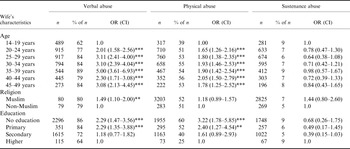
Proportionally, women's victimization of verbal abuse increases with their age. Teenage wives were less likely to experience verbal abuse than older wives. With the exception of teenagers, all age groups are proportionally affected by physical abuse to more or less the same extent. Wife's age is significantly related to verbal abuse and physical abuse. Women in the age group 40–44 years are more likely to experience physical abuse than their teenage peers. Religion does not indicate any proportional difference for victimization of violence. However, Muslim women are one and half times more likely to be verbally abused then their non-Muslim peers. Proportionally, women with no and primary education have more verbal and physical abuses. Compared with higher educated women, their peers with lower education faced more than two times increased risk of verbal abuse and nearly three times risk of physical abuse (Table 1).
Number of women (n) and proportions of women (% of n) who were abused by their husbands within each category, and adjusted odds ratios (OR) and confidence intervals (CI) by demographic characteristics

The adjusted OR shown for each variable has been adjusted for all other variables (i.e. demographic and husband's characteristics). All other variables were used as categorical variables, with the reference category denoted as OR=1.0.
* p<0.5
** p<0.01
*** p<0.001.
Demographic and other characteristics of the husbands
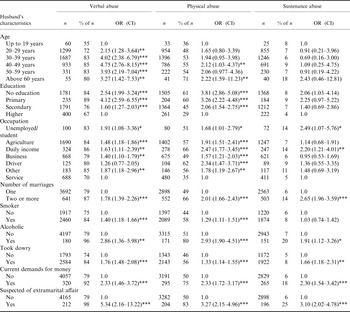
Table 2 shows that, proportionally, young husbands (teenagers and those in their twenties) are less likely to verbally and physically abuse their wives. Husbands in their thirties and forties are more than four times verbally abusive than their teenaged peers. However, husbands in their forties and above are two times more likely to physically abuse their wives for the same comparative groups. Lower education on the part of husbands was a risk factor for wife abuse. Proportionally, primary-educated men are four times more likely to verbally abuse their wives then their higher educated peers. Compared with higher educated men, husbands with no education are nearly four times more physically abusive to their wives.
Number of husbands (n) and proportions of husbands (% of n) who abused their wives within each category, and adjusted odds ratios (OR) and confidence intervals (CI) by demographic and other characteristics

The adjusted OR shown for each variable has been adjusted for all other variables (i.e. demographic and husband's characteristics). All other variables were used as categorical variables, with the reference category denoted a OR=1.0.
* p<0.5
** p<0.01
*** p<0.001.
The majority of the men (43%) work in agriculture. Men of all occupations are likely to verbally (>75%) and physically abuse (50%) their wives (except drivers in the case of verbal abuse). Compared with husbands employed in the service sector, unemployed/students and daily earners are more than two times more likely to stop food to their wives.
Proportionally husbands with two or more wives are much more abusive in all three categories. They are two times more likely to become abusive verbally, physically and by stopping foods. Smokers are proportionally and significantly more verbally and physically abusive. Alcoholic husbands are proportionally highly abusive: verbal abuse 96% (OR 2.86), physical abuse 80% (OR 2.93) and food restriction 20% (OR 1.91). However, alcoholic husbands did not stop or restrict the food intake of their wives.
Husbands who took a dowry during their marriage are proportionally also highly abusive: 84% verbal abuse (OR 1.76), 56% physical abuse (OR 1.33) and 8% food restriction (OR 1.66). For husbands currently demanding more money from their in-laws' house, the husbands are proportionally and significantly more abusive than their peers who are not demanding money from their in-laws' house: 92% verbal abuse (OR 2.33), 75% physical abuse (OR 2.33) and 18% food restriction (OR 2.30).
When the wife has suspicions about her husband's extramarital affairs, the proportion and ORs dramatically increase for wife abuse: for verbal abuse 98% (OR 5.34), for physical abuse 83% (OR 3.27) and for food restrictions 25% (OR 3.10) of husbands are abusive.
Discussion
Husbands' socioeconomic characteristics and behaviours were observed to be risk factors for verbal and physical abuse. A small proportion (5%) of women also reported abuse by restriction of foods. Triggering and contributing factors were the husband being a daily earner, polygamous behaviour, alcohol misuse, dowry recipient, economic pressure and having extramarital affairs. However, both teenage wives and husbands showed a significantly lower risk of verbal abuse, which may be explained by socioeconomic dependency on their parents. Dependency on parents/guardians probably reduces spousal conflicts, since seniors generally intervene in such cases. Verbal abuse towards women is a common phenomenon in rural Bangladesh (prevalence rate of 71%), and a couple's relatively low educational status is a significant risk factor. Social traditions of wife abuse and manhood ego problems may be seen as contributory factors. Intimate partner violence (IPV) seems to be a culturally accepted normal life phenomenon, which may be described as the ‘normalization of violence’ (Krantz, Reference Krantz2002; Stenson, Reference Stenson2004). On the other hand, husbands may presume that their wives should be submissive. Behaviours like disobedience, verbal interaction or becoming non-submissive may lead them to be more abusive towards their wives, irrespective of age. The age difference between husband and wife may also be a contributory factor. However, the educational levels of both victims and perpetrators show that higher education reduces the risk of abuse. Accordingly, a general increase in higher education in the population, in parallel with legislation, may promote non-aggressive behaviour in the long-term – as has been shown inter alia in the Nordic welfare states (Jansson et al., Reference Jansson, de-Ponse, Leon, Ahmed and Jansson2006).
It was also observed that, irrespective of occupational status, husbands were often verbally and physically abusive, which may be a part of the culturally accepted ‘normalization of violence’. As a result of poverty, uncertainty of income and related anxiety, daily earners are more violent, especially with regard to food restriction.
Dowry and money-related IPV against women seems to be a multi-disciplinary problem. By using different methods of abuse, husbands try to impose continuous pressure on their wives as a current and continuous source of monetary support from parents-in-law. In the literature, it is demonstrated that the combination of structural inequality between men and women, a male-dominated society, marriage-related norms, dowry and family structure are risk factors for IPV (Gautam & Trivedi, Reference Gautam and Trivedi1986; Rao, Reference Rao1997; Heise, Reference Heise1998; Khan et al., Reference Khan, Ubaidur and Hossain2001; Bates et al., Reference Bates, Schuler, Islam and Islam2004; Jeyaseelan et al., Reference Jeyaseelan, Kumar, Neelakantan, Peedicayil, Pillai and Duvvury2007). Additionally, it was observed that abuse is, in part, a way of drawing money from parents-in-law. A wife's suspicions concerning her husband's extramarital affairs is probably a trigger for spousal conflicts and IPV. Factors behind such conflicts and related abuse may be associated with manhood ego-related problems, women's relative powerlessness, and their socioeconomic dependency on their husbands.
The prevalence rate of physical abuse in this study is the same as that found in previous studies in Bangladesh (Schuler et al., Reference Schuler, Hashemi, Riley and Akhter1996; Bhuiya et al., Reference Bhuiya, Sharmin and Hanifi2003; WHO, 2005; Garcia-Moreno et al., Reference Garcia-Moreno, Jansen, Ellsberg, Heise and Watts2006). The current findings also replicate established knowledge of the demographic and habitual (alcohol) risk factors for wife abuse (WHO, 2005). However, in the context of Bangladesh economic issues (such as dowry, demands for more money from in-laws' house), and relationship issues such as suspicion of extramarital affairs, have been identified as another group of risk factors that might add knowledge to violence prevention activities. The World Health Organization (WHO, 2005) has indicated that women accept physical abuse from their intimate partners. Our study indicates that they are helpless. As suspicion of their husband's extramarital affairs leads them to become up to five times more at risk of verbal, physical and/or for food-related abuse, they might be compelled to accept such violence. Studies indicate that wife abuse is a way of controlling a wife's behaviour by the husband (Bates et al., Reference Bates, Schuler, Islam and Islam2004; WHO, 2005; Jeyaseelan et al., Reference Jeyaseelan, Kumar, Neelakantan, Peedicayil, Pillai and Duvvury2007). Restriction or stopping of food might be an extreme example of controlling behaviour – emotional abuse and an effort to prove a husband's right, and that the wife is socially, economically and personally dependent on her husband.
Collection of data on IPV raises ethical concerns and has methodological limitations. In order to reduce recall bias, skilled and trained interviewers were used for data collection. Each group of interviewers used a female psychologist for consultation and counselling. A quality-assurance system was implemented and followed, which included the training of interviewers. Finally, the accuracy of the estimates may also be affected by respondents' tendency to under-report sensitive experiences, such as physical and foods-related abuse. However, the method used in this study to collect data on abuse (using a set of questions asked by an interviewer in a private setting) has been found to elicit higher response rates on verbal, physical and food-related abuses than other methods (Lawoko et al., Reference Lawoko, Dalal, Jiayou and Jansson2007). The literature demonstrates that sexual abuse is an important issue for IPV. The World Health Organization (WHO, 2005) has indicated that women often experience both physical and sexual violence from their intimate partner. However, it was not possible to study sexual abuse of the respondents in the current study, which might be a drawback. With regard to generalizabity of results, the sample was not fully representative of Bangladesh as a whole. However, it provides an insight into the problem of spousal abuse and a basis for further studies, including sexual abuse. There are still only a few household surveys or prospective cohort studies published on the magnitude and risk factors for IPV in Bangladesh. More studies are needed in order to confirm the situation; especially in the case of abuse by restricting foods, a nationwide study is warranted.
In conclusion, well-established risk factors for family abuse have a high prevalence in rural Bangladesh. A small proportion of women also suffer from sustenance abuse, which has not been reported in the literature before.
In Bangladesh, finding a feasible and effective intervention for preventing violence against women is an urgent need. The findings of this study may assist policymakers and health planners to develop a multi-channelled strategy for reducing intimate partner violence (IPV), e.g. by using health care providers. Efforts to increase women's self-dependency can reduce the magnitude of the problem. Policymakers should support their women citizens by promoting gender equality (by reducing husband dependency), women's human rights according to international agreements, and establish, implement and monitor multi-sectoral action plans to prevent IPV.