Implications
The paper describes a method for objective evaluation of cattle locomotion that is applicable under regular cubicle house conditions. The normal variation recorded for different spatial elements of cow gait and the estimated associations between these elements and speed and body conformation should improve understanding of the normal movement pattern of dairy cows. The results could be useful in objective analysis of locomotion in cattle, as gait variability and relationships between different spatial gait parameters in dairy cows have not been reported earlier.
Introduction
Subjective locomotion assessment is most commonly used to characterise gait in cattle, with most attention being devoted to determining the degree of lameness (Sprecher et al., Reference Sprecher, Hostetler and Kaneene1997; Flower and Weary, Reference Flower and Weary2006). While locomotion scoring can help in the evaluation and treatment of foot and leg disorders, it does not provide sufficient objective evaluation of gait per se. Although it is possible to compare the results of locomotion scoring summaries from different studies, it should be noted that the accuracy of the scoring is strongly influenced by the observer’s skill and perception (Whay and Main, Reference Whay and Main1999). It has been demonstrated that the use of gait analysis with quantitative methods is superior to the subjective locomotion scoring method in horses (Keegan et al., Reference Keegan, Wilson, Wilson, Smith, Gaughan and Pleasant1998).
Interest in using quantitative measurements in characterisation of locomotion in cattle is currently increasing. One of the main objectives of quantitative gait analysis in cattle is to help develop an objective automated lameness-detection system. However, existing commercially available lameness-detection systems are not as sensitive in determination of painful lesions as visual locomotion scoring performed by a trained veterinarian (Bicalho et al., Reference Bicalho, Cheong, Cramer and Guard2007).
In order to quantify the geometry of cow movement, kinematic techniques are usually applied. The most detailed kinematic study of cattle locomotion, to date, was carried out by Herlin and Drevemo (Reference Herlin and Drevemo1997), who studied a number of temporal and angular variables of gait for 17 dairy cows using high-speed cinematography to determine the influence of different management systems and grazing on locomotion. Phillips and Morris (Reference Phillips and Morris2001) used video recordings when studying locomotion in dairy cows on floors with different friction properties. Recently, computed-aided kinematic analysis revealed significant differences in gait between cows with and without painful lesions (Flower et al., Reference Flower, Sanderson and Weary2005).
The majority of kinematic studies are carried out with sophisticated equipment (Clayton and Schamhardt, Reference Clayton and Schamhardt2001) which require special conditions, restraining their use on a regular dairy farm. Yet, some kinematic variables can be determined using a simple method of trackway measurements, that is, measuring the space between footprints on the ground. Such trackway measurements have been used as a straightforward method for gathering a range of spatial kinematic data in both modern and extinct animals (Sukhanov, Reference Sukhanov1974; Kuban, Reference Kuban1989). The first systematically evaluated and classified description of trackways was carried out in fossils by Hitchcock (Reference Hitchcock1836). Despite impressive progress in developing more sophisticated methods for gait analysis, data obtained from footprints are still likely to be used in human biomechanics in the future (Wilkinson et al., Reference Wilkinson, Menz and Raspovic1995). Data obtained from direct measurements of footprints have been used to validate new, sophisticated gait analysis systems in humans (Gaudet et al., Reference Gaudet, Goodman, Landry, Russell and Wall1990; McDonough et al., Reference McDonough, Batavia, Chen, Kwon and Ziai2001). In cattle, the first study applying trackway measurements to test the effects of different floor coverings and lameness on gait of dairy cows was carried out by Telezhenko and Bergsten (Reference Telezhenko and Bergsten2005). The method was summarised as being inexpensive, easy to apply and causing minimal interference to the home environment of the animals.
Animal locomotion has intrinsic variability that affects the validity of gait analyses. In order to estimate a representative pattern of cow gait, knowledge is needed on how the gait varies from stride to stride and over time. However, the actual variation in quantitative gait parameters has not been reported for cattle.
The main objective of the present study was to estimate the variability in gait variables obtained from direct measurements of cow trackways. Commonly used spatial characteristics for gait analysis were used in this study: stride length, step length and characteristics of base of support (step width and step angle). Three other potentially valuable characteristics were also measured: step asymmetry, and lengthwise (tracking) and sidewise (mediolateral displacement) position of the hind foot relative to the front foot. The subjective assessment of step asymmetry and tracking is an important part of lameness scoring (Flower and Weary, Reference Flower and Weary2006), and relative sidewise deviation in hind limbs might explain a higher predisposition to claw disorders in hind limbs (Schmid et al., Reference Schmid, Weishaupt, Meyer, Waldern, Peinen and Nuss2008). Preferred speed is often an important outcome influenced by lameness and floor conditions (Phillips and Morris, Reference Phillips and Morris2000; Flower et al., Reference Flower, de Passillé, Weary, Sanderson and Rushen2007), so an important part of the present study was to assess the extent to which the measurements of cow trackways were speed-dependent. In addition, relationships between gait parameters and body size (height and length) were estimated to highlight the importance of adjusting for body conformation when comparing the gait of different individuals. To comprehensively characterise the gait pattern of non-lame cows, the relationships between different spatial gait parameters were assessed on individual and group level.
The overall aims of the study were to provide the first, most complete description of the method of measuring trackways and to determine characteristics for the basic elements of the trackway in terms of using the method for objective gait analysis in dairy cows.
Material and methods
Animals
A total of 32 Swedish Holstein cows from the experimental dairy herd of the Swedish University of Agricultural Science, Alnarp, Sweden, were used. The animals were mostly in first and second (mean 1.6, range 1 to 4) lactation. Locomotion of cows in the herd was scored using a 5-point scale (Sprecher et al., Reference Sprecher, Hostetler and Kaneene1997) weekly by trained personnel. The cows included in this study had no scores higher than 2 (no clinical symptoms of lameness) during the test period (three observations). The cows were in early to mid-lactation at the start of the study period (mean 87 days in milk, range 47 to 150 days). The average height at the withers was 143 cm (range 133 to 154 cm) and the average body length (measured as maximum length between the pin bone and shoulder) was 181 cm (range 161 to 192 cm). Claws of all cows were trimmed by the same professional hoof trimmer 28 days before the study started. The average length of the dorsal border of the lateral claw after trimming was 68 mm (range 54 to 78 mm) and the average angle of the dorsal border was 47 degrees (range 40° to 54°). The cows were kept in a loose housing system with cubicles and slatted concrete passageways. A walkway (30 × 1.7 m) of concrete slatted floor from the milking parlour to cubicles was used for the gait analysis. The dynamic coefficient of friction measured along the slats by Portable Friction Tester (Swedish National Road and Transport Research Institute, Linköping, Sweden) was 0.55.
Preparing the tracks
Trackway measurements were used for the gait analysis. To obtain detectable footprints, lime powder (60 to 70 g/m2) was mixed with a thin layer of slurry on the walkway surface using a scrub broom. After each cow-walk and measurements, the lime-slurry layer was refreshed by brushing the surface with the scrub broom.
To determine the distance needed to obtain a certain number of strides, the following equation was used:

where D is the trackway distance (m); N is the number of consecutive strides; and S is the feasible stride length (m).
Possible stride length was estimated as 1.5 m and the total distance of four consecutive strides was set at 3.75 m. To avoid the influence of the start and end of the lime-treated walkway (in case cows could discriminate between the surfaces because of the slightly different colour) a length of three strides was added (in this case equal to 3 m) at the beginning and the end of the test line. In total, 10 m of lime-treated straight distance was used for trackway measurements.
Assessment of trackways
The measurements were carried out after morning milking. The cows walked one by one along the 30 m walkway at their own chosen speed. In order to make the cows walk continuously, a person followed them slowly at a distance of several metres. Only trackways from an apparently steady and regular walk were included. Trackways from deviating movements, such as trotting, galloping and turning, were not used in the study. Each cow was tested twice, with a 3-week interval between tests.
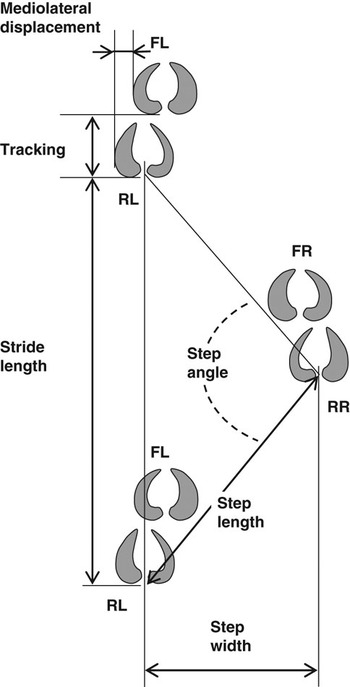
The following parameters were used (Figure 1):
Trackway measurements (Footprints: FL – front left, RL – rear left, FR – front right, RR – rear right).

• Stride length – the distance between the posterior edge of the bulb of two consecutive imprints of the same rear foot.
• Step width – the distance between the middle points of the line across the posterior aspects of the lateral and medial claws of the right and left rear foot imprints, along a line perpendicular to the line of progression.
• Step angle (pace angulation) – the angle between the lines connecting the middle points of the line across the posterior aspects of the lateral and medial claws of three consecutive imprints of the rear feet.
• Step length (pace) – the distance between posterior edges of the bulb of two consecutive imprints of the left and the right rear foot.
• Step asymmetry – the absolute value of the difference between the lengths of two consecutive steps.
• Tracking (overlap) – the lengthwise distance between the posterior edges of the bulb of the front foot imprint and the next imprint of the rear foot on the same side. The trait has a positive value if the rear foot is placed ahead of the front footprint, and a negative value if it is placed behind.
• Mediolateral displacement of rear feet – the sideways distance between the lateral edges of the front foot imprint and the next placement of the rear foot on the same side. The trait value is positive if the rear hoof is placed laterally to the front hoof and negative if it is placed medially to it.
All measurements were taken using a folding ruler and an angle meter (excluding step asymmetry, which was calculated). To estimate the walking speed of the cow, the time taken to walk the test course was measured with a stopwatch. All measurements were carried out by the author.
Statistical analysis
The main aspect of the analysis was an estimation of variance, and therefore hypothesis testing was not of interest. A completely random model was used to estimate the variance components of the gait parameters (the PROC MIXED procedure in SAS version 8 for Windows; SAS Institute, Inc., Cary, NC). The model for the trackway measurements was:

where Yijk is the trackway parameter of the ijkth record; μ is the overall mean; cowi is the effect of the cow (i = 1, 2,…32); testj is the effect of the test day (j = 1, 2); (cow × test)ij is the effect of the interaction between cow and day of the test; and eijk is the residual error term associated with the ijkth record.
As there was only one reading of walking speed per day and cow, the separate model for speed included terms for cow, test and cow × test interaction as a residual error term.
All the terms in the models were considered random and independent. Analysis of residuals did not reveal any serious violations of assumptions for normality and homoscedasticity.
The parameters for the variance components were estimated using a residual (restricted) maximum likelihood (REML) method. The total variance estimate for trackway measurements was presented as a sum of variance estimate between cows, between tests and within the same cow and test. The between-test variance estimate in its turn was the sum of the variance component due to test and that due to the interaction between test and cow.
The total variance estimate for speed was similar to that of trackway measurements but did not include within-cow and test variance component.
To assess the impact of each factor on the total variance, the percentage of each variance component was calculated. The Wald z-test was used to assess whether the variance estimate was different from zero.
To measure the strength of the linear association between the gait parameters, Pearson product–moment correlation coefficients were calculated for individual means (PROC CORR procedure, SAS version 8 for Windows; SAS Institute, Inc., Cary, NC). The same procedure was applied to assess correlations of locomotion parameters with body size. To estimate the linear association between gait parameters within individuals and tests, multiple regression analysis was used and partial correlation coefficients were calculated according to the method described by Bland and Altman (Reference Bland and Altman1995).
Results
Gait parameters
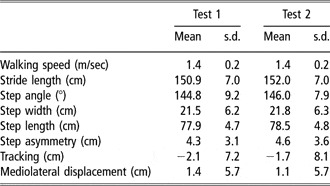
The descriptive statistics of the speed and trackway measurements are given in Table 1. There were no significant changes in any of the gait parameters between the two tests. However, strides and steps tended to be longer and tracking became less negative in the second test, while step angle increased by 1° and mediolateral displacement decreased. The cows on average put their hind feet slightly behind (negative tracking) and to the side of (positive mediolateral displacement) the front imprints.
Means and standard deviations of trackway measurements and walking speed obtained from 32 cows in two tests (3-week interval)

Pearson correlations
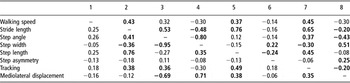
At group level, speed showed no significant correlation with any of the trackway measurements (Table 2). Stride length had moderate, positive correlations with step angle and tracking, a negative correlation with step width and a strong positive correlation with step length. Step angle had a positive correlation with tracking, a very strong negative correlation with step width and a moderate correlation with mediolateral displacement. Step width correlated positively with mediolateral displacement and step length. Step length correlated positively with mediolateral displacement and tracking.
Correlation coefficients for trackway measurements and walking speed

Values below the diagonal are correlations on group level (based on 32 pairs of individual means, Pearson correlation coefficient); values above the diagonal are partial correlations (based on analysis of multiple regression) describing relationships on individual level (within-cow, within-test).
Correlation coefficients shown in bold are significant (P < 0.05).
Partial correlations
Partial correlations represented the strength of linear association between gait parameters within cow and test (Table 2). Stride length, step length and tracking were positively associated with walking speed within individuals. Stride length correlated significantly with all the other gait parameters (except step asymmetry), with positive correlations for step angle, step length and tracking, and negative correlations for step width and mediolateral displacement. Step angle was negatively associated with step width and mediolateral displacement, and positively associated with tracking. Step asymmetry had a negative association with step length and a positive association with step width and mediolateral displacement. Furthermore, mediolateral displacement correlated positively with step width and negatively with tracking.
Correlations with body size
Height at the withers was positively associated with stride length, step length and step angle, and negatively with step width and mediolateral displacement (Table 3). Body length correlated positively with stride and step length, and tended (P = 0.08) to have a negative correlation with tracking.
Pearson correlation coefficients between trackway measurements and body size

Correlation coefficients shown in bold are significant (P < 0.05).
†P < 0.10.
Variability of locomotion parameters
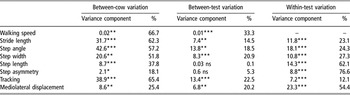
The majority of the total variation was attributable to differences between the cows in terms of walking speed, stride length, step angle, step width and tracking (Table 4). Step length and mediolateral displacement of the rear feet showed a fairly low between-individual variation. In addition, within-test variation was higher than between-test variation for stride length, step length and step angle.
Variance component estimates (obtained by residual maximum likelihood method) and their percentage of total variation for walking speed (32 observations, no estimates for within-test variation) and trackway measurements (256 observations)

P-values for the Wald z-test: *P < 0.05; **P < 0.01; ***P < 0.001; ns = non-significant.
Step asymmetry had almost negligible between-cow and between-test variation but within-test variation was large. Step length and mediolateral displacement of the rear feet also had a considerable degree of within-test variation.
Discussion
Assessing quality of locomotion with trackway measurements
This study was a first attempt to describe measuring the space between cow footprints (trackway measurements) to assess gait pattern in non-lame walking cows. Trackway measurement is an inexpensive method for obtaining a number of spatial kinematic variables in cows under conditions on a regular dairy farm. The presence of the thin film of lime-slurry mixture required to distinguish the footprints may alter the floor slip resistance (Phillips and Morris, Reference Phillips and Morris2000), but using slurry reproduces real floor conditions on the farm.
In the subjective assessment of locomotion in cows, there is usually no distinction made between gait quality and lameness (Sprecher et al., Reference Sprecher, Hostetler and Kaneene1997; Flower and Weary, Reference Flower and Weary2006). Good movements in cows include steady head carriage, flexible movements of joints, tracking-up (hind hooves land on or in front of the position of the front hooves) and symmetrical gait (Flower and Weary, Reference Flower and Weary2006). Impaired locomotion in cows has been described as stride shortening, a ‘stiff’ gait, and also in terms of the degree of abduction or adduction of the hind limbs (Whay, Reference Whay2002; Flower and Weary, Reference Flower and Weary2006). Stride length is the basic kinematic term characterising the length of one gait cycle and therefore the rate of progression. The stride length may be reduced because of lameness or due to slippery flooring (Phillips and Morris, Reference Phillips and Morris2001; Telezhenko and Bergsten, Reference Telezhenko and Bergsten2005). The trackway measurements allowed simultaneous measurement of the strides of left and right limbs, which provided a more comprehensive picture of the cow gait and was thus superior to observations using only one side of the animal.
Correlations calculated on group level showed that cows with long strides, in the present study, did not necessarily have a higher speed. The positive correlation between stride length and height at the withers suggests that longer strides may have been made by larger cows. However, on an individual level, lengthening of the stride was significantly associated with speed increase.
Step length, in spite of its close relationship with stride length, is mainly a characteristic of between-limb coordination (Drevemo et al., Reference Drevemo, Dalin, Fredricson and Bjorne1980b). The meaning of step length in this study deviates from the ‘classical’ kinematical definition in that here it is a function of the step width and the distance by which one foot moves forward in front of the other one. Each step contains the distance of protraction for the limb that is placed forward, while at the same time it contains the distance of the retraction for the contralateral limb. In a normal symmetrical gait, it is expected that the right foot will move forward as far in front of the left foot as the left foot moves in front of the right (Alexander, Reference Alexander2003). The difference between step lengths can be due to maintaining balance or lameness (Buchner, Reference Buchner2001). When steps are asymmetrical, the lengths of protraction and retraction are different between contralateral limbs, but the sum of the limb retraction and protraction should be equal between the left and right limbs because all legs must travel the same distance if a cow walks in a straight line. Therefore asymmetrical strides might not be a good indication of lameness but rather of speed inconsistency during walking and deviations from the straight line. However, several guidelines for subjective locomotion scoring refer to ‘asymmetrical strides’ probably meaning ‘asymmetrical steps’, and therefore standard terminology for describing lameness in cattle should be established.
Tracking has been associated with higher lameness score and the presence of painful claw lesions in dairy cows (Telezhenko and Bergsten, Reference Telezhenko and Bergsten2005; Flower et al., Reference Flower, de Passillé, Weary, Sanderson and Rushen2007). This measurement characterises the extent of protraction of the rear limbs and is correlated with stride length. Lameness can be characterised by either over- or under-reaching of the hind foot in relation to the front foot, and according to Whay (Reference Whay2002), overextension of the stride (positive tracking) is usually observed in the affected hind limb. Earlier measurements of tracking distance in cows with different degrees of lameness revealed that cows with mild lameness had increased tracking (over-reaching) in comparison with non-lame cows (Telezhenko and Bergsten, Reference Telezhenko and Bergsten2005), which was explained by a relative decrease in the propulsion phase of the stride. Cows with more painful lesions generally had seriously shortened strides and, as a result, negative tracking (Telezhenko and Bergsten, Reference Telezhenko and Bergsten2005; Flower et al., Reference Flower, de Passillé, Weary, Sanderson and Rushen2007).
A negative correlation between body length and tracking suggests that a body that is too long with relatively short legs would not allow the rear foot to reach the placement of the front foot. Conversely, relatively short body and long legs would allow greater tracking. Thus, attention should be paid to cow body proportions when scoring tracking, and body length should be adjusted for when comparing tracking measurements between different animals.
The parameters describing the base of support (step width and step angle) had low associations with speed, contradicting earlier observations in other species where increased speed led to increased step angle (Sukhanov, Reference Sukhanov1974; Alexander, Reference Alexander1985). A possible explanation for the absence of such an association in the present study is a correction for stability during locomotion on the slatted concrete floor. Assuming that the front feet move parallel to the median plane of the cow, while the hind feet are forced out of the plane by the udder (Schmid et al., Reference Schmid, Weishaupt, Meyer, Waldern, Peinen and Nuss2008), the mediolateral displacement of hind feet may characterise the deviation of placement of rear feet from the median plane and may also be a parameter of stability.
Although the parameters characterising the base of support can potentially assess any deficiency in balance, little is known about the ability of these measurements to describe discomfort due to lameness. The only evidence for an association between base of support and lameness is given by Telezhenko and Bergsten (Reference Telezhenko and Bergsten2005), who found that lame cows decreased step angle (i.e. increased base of support) on hard concrete floors in comparison with soft surfaces.
Although trackway measurements are able to characterise cow gait, it should be noted that the information obtained from trackways is not as precise and complete as that obtained by a sophisticated computer-based motion analysis system. Trackway measurements lack some important kinematic parameters such as angulations and trajectories of joints, as well as important temporal stride characteristics.
Gait variability
Measurements of the proportion of between-subject variation in results obtained from two or more repetitions of a test are often referred to as test–retest reliability, and introduce the concept of stability of gait characteristics over time and space (Moe-Nilssen, Reference Moe-Nilssen1998; Sorsdahl et al., Reference Sorsdahl, Moe-Nilssen and Strand2008). In contrast to the classical definition of measurement reliability (which assesses the impact of measurement error or agreement between different observers), the test–retest reliability is influenced by both the precision of the measurements and the natural variability of the parameters measured. Although intra- and inter-observer reliability should not be a serious issue in measuring trackways, owing to the objective nature of the procedure, some variation in measurement procedure may occur, for example, due to determination of reference points for the measurements.
The proportion of between-individual variation observed here was lower than that reported in trotting horses (Drevemo et al., Reference Drevemo, Dalin, Fredricson and Bjorne1980a, Reference Drevemo, Dalin, Fredricson and Bjorne1980b and Reference Drevemo, Dalin, Fredricson and Bjorne1980c) and humans (Kadaba et al., Reference Kadaba, Ramakrishnan, Wootten, Gainey, Gorton and Cochran1989). However, the present study showed that when environmental conditions were constant and cows were not lame, the cows could reproduce their preferred walking speed over time fairly well. As several trackway measurements are speed-dependent, it is important to make suitable control for speed when testing cow gait. The variation in trackway measurements between tests was generally low, suggesting that when walking at their own chosen speed, cows used, on average, the same gait pattern. It has been shown that when humans walk at their natural or preferred speed, they tend to keep stride length even less variable than speed (Kadaba et al., Reference Kadaba, Ramakrishnan, Wootten, Gainey, Gorton and Cochran1989). However, the current trackway measurements all revealed a significant proportion of within-test variation. This suggests that despite the fact that the cows walked apparently smoothly, it was difficult to achieve stability of the gait parameters within one test run. The use of only non-lame cows in this study may have contributed to the relatively high inconsistency of the gait parameters, as healthy animals can use a wider range of speed and manner of movement than lame animals. In a study by Peham et al. (Reference Peham, Licka, Girtler and Scheidl2001), stride length had lower variability in horses with orthopaedic pain than when pain was reduced, and the authors concluded that lame horses avoid deviation from a certain optimum compensatory pattern, which they use to reduce pain.
In the present study, stride length and tracking had between-individual variation of over 60%, which corresponds to moderate test–retest reliability. The test–retest reliability of step length and step asymmetry was low because the variability within tests was very high, which can be explained by non-systematic deviations in the step length in non-lame cows. The positive correlations between step asymmetry and both mediolateral displacement of rear feet and step width, suggest that, in non-lame animals, step asymmetry is associated with the effort to maintain balance during walking.
Base of support measurements had a slightly lower percentage of between-cow variation, and therefore lower test–retest reliability, than stride length and tracking. The within-test variation in mediolateral displacement was very high. The high instability of this measurement can be explained by cows walking with subtle deviations from a straight line. To get a more stable measurement of relative mediolateral deviation of rear limbs, the difference in step width between front and hind limbs should probably be used, but in this study the base of support was measured only in hind limbs.
Conclusions
The simplicity and applicability of trackway analysis allowed this method to be used for studying cow locomotion in their ‘home environment’. It was possible to classify the trackway measurements into three groups: those describing the rate of progression (stride length, tracking), those characterising balance (step width, step angle) and those associated with inter-limb coordination (step length, step asymmetry). The individual gait pattern was fairly stable in walking cows when re-measured after 3 weeks, but cow gait was characterised by considerable within-test variation. The measurements associated with rate of progression were most consistent, while the measurements related to inter-limb coordination had the highest within-test variation. Considering the inconsistency of cow-walk, it would be beneficial to use data from several gait cycles to increase precision and obtain a representative locomotion pattern for an animal.
In future studies it might be appropriate to study the variability in lame cows and to separate sources of systematic and random variation in analysis of measurement reliability of the method.