The invention of specialized disciplines in the early nineteenth century
The first of four basic principles listed in the NASA Astrobiology Roadmap (Des Marais et al. Reference Des Marais2008) as being fundamental to the astrobiology programme states ‘Astrobiology is multidisciplinary in its content and interdisciplinary in its execution.’ Collaboration among scientists of diverse disciplinary backgrounds is argued to be necessary for fruitful astrobiological research, and young astrobiologists are being trained to think and work outside their traditional disciplinary boundaries (Staley Reference Staley2003). The revolutionary nature of this ambitious programme can be more properly appreciated when placed in the historical context of how today's fragmented state of science first arose. In this paper we investigate (1) the historical factors that led to the formation of the specialized disciplines that astrobiology is now attempting to reunite, and (2) the implications of this historical perspective for the future of astrobiology as an interdisciplinary endeavour.
The disciplinary boundaries being attacked by astrobiologists arose approximately two centuries ago. In earlier times, such as the so-called ‘scientific revolution’ of the seventeenth century, major figures each indeed had their particular expertise (e.g. Kepler, astronomy; Newton, mathematics and physics; Leeuwenhoek, microscopy), but they were all part of a single community of natural philosophers that participated in a broader aristocratic group of intellectuals also including physicians, writers, politicians and churchmen. The concept of specialist communities did not yet exist.
The transformation of natural philosophy (as experimental science was then termed) into specialized disciplines can be epitomized by the founding of the Geological Society of London (GSL) in 1807Footnote 1. With this first specialized scientific society came the first specialized scientific journal and, as it turned out, a blueprint for successful discipline formation. In this paper we consider the formation of the new discipline of geology and its specialized journal and discuss whether analogous events may be occurring in the emerging science of astrobiology. After reviewing the formation of the GSL, we examine patterns of discipline formation using citation analysis of scientific papers published during the early nineteenth century, as well as in astrobiology journals today.
The Geological Society of London – an instructive case study
The first major society that significantly divided the sciences was the Linnean Society, formed in London in 1788 and publisher of the Transactions of the Linnean Society (Trans. Linn. Soc.) since 1791Footnote 2. The society's charter declared its role to be the ‘cultivation of the Science of Natural History in all its branches’, and it was seen as a sort of ‘assistant society’ to the venerable Royal Society (founded in 1660), one of the most prestigious societies in all of Europe. The powerful, long-time President of the Royal Society, Joseph Banks, was a founding member of the Linnean Society and fully supported its activities. Since Trans. Linn. Soc. published papers on descriptive natural history (what we would now call taxonomy), and the Philosophical Transactions of the Royal Society (Phil. Trans.) published reports mostly of experimental studies, the two societies enjoyed a friendly, non-competitive partnership that has continued into the present (Hall Reference Hall1984). The two societies served the same community of educated gentlemen, and many wrote articles in both journals.
As Rudwick (Reference Rudwick1963, Reference Rudwick1985) and other historians of science have demonstrated, the rise of the Geological Society of London (GSL) from a local dining club in 1807 to a controversial, revolutionary society of leading geologists by the 1820s was a very different story from that of the Linnean Society. Although six of the GSL's 13 founding members were fellows of the Royal Society (including the latter's Secretary, Humphry Davy), the GSL experienced an acrimonious relationship with Banks and his Royal Society. This arose in part due to the GSL's intention to arrange for its own rooms in London where meetings and collections would be held and to publish its own proceedings, steps that seemed to make the GSL a competitor to the Royal Society. The Linnean Society's existence alongside the Royal Society seemed to flow naturally from the longstanding division of the sciences into natural history and natural philosophy. The GSL, however, was proposing to subdivide natural philosophy, and Banks worried (presciently, it seems today) that this would be the first step in fragmenting the sciences and thereby weakening the Royal Society's position as a central forum for scientific communication.
The GSL's first two years were marked by profound disagreement regarding its direction. One faction, represented by gentlemen such as Charles Greville and Davy, wished no quarrel with Banks and saw no need for the GSL to become anything more than an ‘assistant Society without funds’. If the GSL decided to raise its own funds in order to independently finance society activities (publication of a journal, for example), then it would become, as Greville wrote, ‘no longer an assistant, but a subverting Society… and the great objects of National credit and of Science will risque being sacrificed to the Vanity or folly of individuals’ (Rudwick Reference Rudwick1963). It was only by maintaining official connections with the Royal Society that the GSL could ‘revise the facts of Geology with the new Lights of late discoveries in Chemistry’ (Rudwick Reference Rudwick1963).
The opposing faction, led by the GSL's first president, George Greenough, was encouraged by the rapid growth of the new society – in the first two years, 123 members were added to the original 13 (Woodward Reference Woodward1907). They strongly believed in the necessity of a geological society because progress required ‘the collection and arrangement of a vast variety of facts, which can only be done by the united exertions of those who have attended to this subject’ (Leonard Horner, quoted in Rudwick Reference Rudwick1963). Disillusioned by what they perceived as the rampant theorizing that had dominated geology, these members were committed to advancing geological understanding by empirically gathering minute and detailed information. Moreover, they promoted the acceptance of such evidence from anyone with information to share: ‘the Miner, the Quarrier, the Surveyor, the Engineer, the Collier, the Iron Master, and even the Traveller’ (Rudwick Reference Rudwick1963). This strongly contrasted with the aristocratic nature of the Royal Society. In short, they were dedicated to amassing as much knowledge about minerals and geological formations as possible; making connections to other branches of natural philosophy was secondary.
In a meeting in 1809 attended by 19 members, the GSL formally voted on how to define itself. The Greenough faction triumphed, and the Society became an independent, specialized body. By 1834, the GSL boasted 745 members (Rudwick Reference Rudwick1985) and exciting, drama-filled twice-monthly meetings, while the Royal Society had endured several years of political turmoil and discontent among its members (Lyons Reference Lyons1944). And by this time the GSL was not alone, for in 1820 the Royal Astronomical Society was founded despite the warning from Banks that it ‘will be the ruin of the Royal Society’ (Hall Reference Hall1984, p. 6). By 1850 there were 67 disciplinary societies in Great Britain – the great fragmentation of science into the specialized disciplines that we know today was well underway. Specialization was a boon to science: discoveries were frequent and wide-ranging, and new audiences and participants arose in the middle class. Meetings of the British Association for the Advancement of Science (founded in 1831), for example, often had large public audiences for scientific debates, and the meetings were divided into ‘sections’ along disciplinary boundaries (Morrell & Thackray Reference Morrell and Thackray1981). Geology was especially successful in enlisting the efforts of people from all classes, and debates among fellows of the GSL often received great public scrutiny, aided by the Geologists' Association, founded in 1858 to promote public awareness and education of geology (Rudwick Reference Rudwick1985).
The first specialty journal: Transactions of the Geological Society of London
The minutes of the first GSL meeting in 1807 begin:
Resolved: That there be forthwith instituted a Geological Society, for the purpose of making geologists acquainted with each other, of stimulating their zeal, of inducing them to adopt one nomenclature, of facilitating the communication of new facts, and of ascertaining what is known in their science, and what yet remains to be discovered.
(Woodward Reference Woodward1907)Leonard Horner, an influential member, realized early on that in addition to regular meetings, the stated goals would be well served by publishing a journal: ‘the Society will never do any real good, until they publish’ (Rudwick Reference Rudwick1963). As mentioned in the previous section, however, the right of the GSL to publish its own journal was one of the central disputes with the Royal Society. In fact, on more than one occasion the GSL first offered the Royal Society the privilege of publishing any papers submitted to the GSL. Banks refused, however, saying that it would be impossible for ‘papers of a Society entirely unconnected with the Royal Society …’ to be published in Phil. Trans. (Rudwick Reference Rudwick1963).
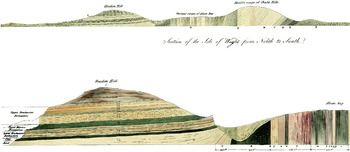
The GSL probably had no qualms about making such offers because they knew that the content and style of papers they wished to publish were very unlike those of Phil. Trans. Starting in 1811, the Transactions of the Geological Society of London (Trans. Geol. Soc.) published lengthy, formal papers filled with detailed descriptions of minerals, fossils, terrain, formations and strata. Moreover, each volume was supplemented with illustrations, sketches, and detailed, coloured maps, the likes of which had never been published in Phil. Trans. or any other journal of the time (Fig. 1). Rudwick (Reference Rudwick1976) has described in detail the emergence of this novel ‘visual language’ in geology. The attention in Trans. Geol. Soc. papers to detailed, empirical data, often contributed by a wide range of investigators, far surpassed anything that had been published in Phil. Trans. GSL members took great pride in their journal, and some looked with scorn on the geology papers published in Phil. Trans. Murchison complained of a paper he was refereeing for Phil. Trans.: ‘Why do such bunglers go to the R.S.? because they cannot cram their stuff down our throats at the Geo.’ (Morrell Reference Morrell1976).
Illustrations in Trans. Geol. Soc. represented a new type of visual language unknown within the pages of Phil. Trans. Shown is a copper-engraved plate illustrating sedimentary strata of the Isle of Wight from a paper by Thomas Webster in the second volume of Trans. Geol. Soc. (1814), one of 36 such plates in a volume containing 23 papers. Such detailed, coloured maps and diagrams of geological formations were never published in Phil. Trans. from 1800–1856.

From 1811 until its demise in 1856, Trans. Geol. Soc. published 12 volumes containing 290 papers. It was very successful until about 1840, but then suffered financial and organizational difficulties that led to long publication delays, making it less relevant to the increasing pace of scientific research. Instead, an alternative GSL publication, Proceedings of the GSL, arose during these years and supplanted Trans. Geol. Soc. These Proceedings were published several times a year and contained summaries (and later, full abstracts with illustrations) of papers read at the GSL's lively meetings.
Changes in Phil. Trans. after the founding of Trans. Geol. Soc
In addition to stylistic differences between the two journals, there was a marked difference in their content. Trans. Geol. Soc. focused entirely on geological topics, but the journal's actual content reveals that the GSL considered ‘geological’ to mean only topics related to mineralogy, fossils and Earth's history. We will refer to papers on these topics as ‘GSL-type’ geology papers; further explanation can be found in Materials and methods, below. On the other hand, the geological papers in Phil. Trans. were generally on volcanoes and earthquakes, as well as what we today call economic geology, geophysics, and geochemistry.
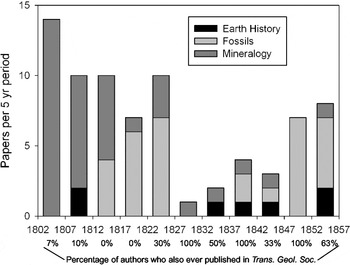
We tracked the number of GSL-type papers published in Phil. Trans. in order to test how it was affected by having a competitor for the first time in its history. Figure 2 shows that during the period 1812–1826, GSL-type papers continued to be published in Phil. Trans. at approximately the same rate as during the previous decade, but inspection of these papers reveals that they were generally shorter and contained fewer citations compared with the average Phil. Trans. paper or with GSL-type papers that were published prior to 1811. Furthermore, Fig. 2 shows that the number of mineralogy papers decreased substantially after 1811. Instead, GSL-type papers in Phil. Trans. reported mostly discoveries of fossils and mineral deposits in mines and did not contain the technical details, specialized jargon, and the emphasis on geological history that characterized the new type of paper in Trans. Geol. Soc. Papers focusing on geological history (e.g. analyses of sedimentary strata) were rarely published in Phil. Trans. at any time (‘Earth history’ category in Fig. 2), and this lack of attention to an important aspect of geological research during this period was an important impetus for the founding of the GSL and its journal (Rudwick Reference Rudwick2005). During 1827–1847, GSL-type papers became very rare in Phil. Trans. (Fig. 2); instead, reports on recent earthquakes and volcanic eruptions were common. Meanwhile, Trans. Geol. Soc. published 144 papers during this period. Thus it appears that Trans. Geol. Soc. was successful in drawing authors away from Phil. Trans., where appeared only brief reports of geological interest not suitable for Trans. Geol. Soc Footnote 3.
The number of ‘GSL-type’ geology papers in Phil. Trans. The number was low when Trans. Geol. Soc. was active (1811–1847) and high when it was not. Also note the shift from mineralogy to fossils and the overall scarcity of ‘Earth history’ papers (the most common subject of papers in Trans. Geol. Soc.). Data are reported as number of papers in each five-year interval; the first interval, for example, covers the years 1802 to 1806. Percentages indicate the proportion of papers in each interval written by authors who also wrote at least one paper in Trans. Geol. Soc. at any time. GSL-type papers never comprised much more than 10% of the total papers in any volume of Phil. Trans.

Did the two societies interact?
Of the 658 men (women were not allowed) who joined the GSL from 1807 to 1825, 111 entered already as Fellows of the Royal Society, and 221 of them would later become F.R.S. (data compiled from Woodward Reference Woodward1907). There existed the potential, then, of substantial communication between the two societies, but was this potential realized? We investigated this question by examining authorship and citation patterns in Phil. Trans. and Trans. Geol. Soc.; a detailed description of materials and methods is included below. Citation analysis is a tool that can provide valuable insight into the network of interactions that influenced groups of scientists and their publications. For an example of a more sophisticated and ambitious use of citation analysis for historical purposes, see Edge & Mulkay (Reference Edge and Mulkay1976) ; Edge (Reference Edge1979) also points out many of the flaws and limitations of the technique. Previous studies have examined citation patterns in Phil. Trans. (George Reference George1952; Allen et al. Reference Allen, Qin and Lancaster1994; Qin Reference Qin1994), but to our knowledge, this is the first citation analysis of papers in Trans. Geol. Soc.
To examine interaction between the two societies in the published record, we first counted how many authors wrote papers in both societies' journals, suspecting that the geologists of the GSL wrote predominantly for their own journal. Of the 122 authors in Trans. Geol. Soc. during 1811–1856, only 28 also wrote papers in Phil. Trans. during that time. Those 28 authors wrote 75 papers in Trans. Geol. Soc. (26% of the total) and 158 papers in Phil. Trans. (14% of the total)Footnote 4. Only 12 of these 28 authors wrote papers containing GSL-type content, however, and almost all of these GSL-type papers in Phil. Trans. were published after 1835 (Fig. 2). We conclude that: (1) most geological papers on topics relating to the Earth's history were published in Trans. Geol. Soc. and (2) a number of Trans. Geol. Soc. authors were interdisciplinary in the sense that they were also writing non-geological papers in Phil. Trans.
During the period 1837–1856, GSL-type papers returned to Phil. Trans. (Fig. 2), and they were in fact written mostly by GSL members. This reversal was probably caused by the relaxation of the feud between the two societies, the success and popularity of geology in Great Britain during that period, and the difficulties (mentioned above) in publishing Trans. Geol. Soc. on a regular basis. Only once the status of geology as a specialized, independent discipline was secure were the self-described geologists willing to write geology papers for Phil. Trans., the major multidisciplinary journal of the day.
The initial isolation of the two journals is also evident in their citation patterns. The near complete absence of any citations to the new society journals by articles in Phil. Trans. is striking. During 1811–1856, only 0.6% of all citations in Phil. Trans. and 4.6% of all citations in GSL-type papers in Phil. Trans. were of Trans. Geol. Soc. Citations to papers in Monthly Notices of the Royal Astronomical Society (0.07%, just two citations) and Transactions of the Linnean Society (0.4%, 16 citations) were even rarer. In short, authors of Phil. Trans. papers rarely found it necessary to cite papers from the new specialty societies.
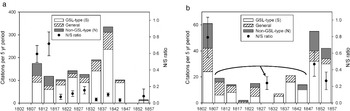
Trans. Geol. Soc. papers cited Phil. Trans. less frequently with time (never more than 13% of all citations and often 0% after 1828), while the proportion of citations to other Trans. Geol. Soc. papers generally increased with time, peaking at 40% in 1822. If Trans. Geol. Soc. authors did not cite papers in Phil. Trans., did they perhaps cite other non-geological sources of information? Figure 3(a) shows the breakdown of citations in Trans. Geol. Soc. into three categories: geology (including Trans. Geol. Soc. itself), general science (multi-disciplinary), and non-geological specialties (chemistry or history, for example). We used these data to obtain a quantitative measure of interdisciplinarity, also shown in Fig. 3, namely the ratio N/S of non-specialty citations (the third category) to specialty citations (the first category).
The number and interdisciplinarity of citations in (a) Trans. Geol. Soc. and (b) GSL-type papers in Phil. Trans. The ratio N/S of non-geology to geology citations of GSL-type papers decreased in both journals over time. N/S values (right-hand ordinates) are plotted as points with error bars. After 1837 N/S values for citations in GSL-type papers in Phil. Trans. (b) became more like those in Trans. Geol. Soc. (a). In Fig. 3(b), a combined single N/S value is shown for 1807–1842 due to small sample size. Citations to ‘general’ science sources (multidisciplinary publications such as Phil. Trans.) are also shown.

The first two volumes of Trans. Geol. Soc. (published in 1811 and 1814) had almost as many citations of non-geological specialty sources as of geological sources, with N/S equal to 0.59 and 0.72 (Fig. 3(a)). Almost all later volumes were far less interdisciplinary, with N/S values of 0.16 and lower. The reason for this fairly abrupt shift is not certain, but it may be characteristic of the development of a new discipline. As researchers make discoveries within a new discipline, inspiring work on more advanced and specialized topics, concepts and findings from outside the discipline become less influential.
The citation pattern of Trans. Geol. Soc. appears to have influenced Phil. Trans. as well. Before 1812, GSL-type papers in Phil. Trans. (Fig. 3(b)) cited geological sources only 30–50% of the time and cited general science sources more often (50–70%). After 1837, however, when GSL-type papers became frequent in Phil. Trans. again, the citation breakdown of these papers became more similar to that of Trans. Geol. Soc. with a high proportion of sources within geology. The N/S values after 1842 are not as low as those of Trans. Geol. Soc., but it should be noted that more than 80% of all ‘non-geology’ citations during 1842–56 were by Richard Owen, whose three papers on fossils relied heavily on anatomy publications. Furthermore, these later geology papers in Phil. Trans. were often supplemented with maps and illustrations, which were previously rare in Phil. Trans. but common in Trans. Geol. Soc. The GSL thus transformed the style, content, and degree of specialization of the formal geology research paper not only when published in its own journal, but eventually in Phil. Trans. as well.
In summary, the authors of the first specialty scientific journal rarely wrote papers on their chosen field in the most important multi-discipline journal of the day, were increasingly less likely to cite papers from that journal as their own society grew, and the papers that they did cite originated overwhelmingly within their own specialty. When these geologists returned to publishing papers in Phil. Trans., they continued to write in the new, highly specialized style developed in their own journal. The GSL had succeeded not only in creating a new scientific discipline, but also a new way of doing science with its own modes of research and communication.
Is astrobiology becoming its own specialized discipline?
The formation of the GSL grew from a conflict between two opposing views of science: the one giving primary importance to the long generalist tradition of natural philosophy and fearing fragmentation of science, the other focusing on collection of empirical data by specialists. In 1809, the latter view won out, and the structure of specialized science as we know it today began to take shape. Two hundred years later, astrobiology is revisiting this conflict and attempting to begin a defragmentation of science. Is it succeeding?
We have analyzed citations by nineteenth century research papers as an approximate means of measuring the degree of interdisciplinarity of those papers. A similar analysis of the two contemporary astrobiology journals may provide insight into whether astrobiology research papers are truly interdisciplinary. Furthermore, we can examine whether astrobiology journals are helping to transform astrobiology into its own specialized discipline in the same way that Trans. Geol. Soc. created the specialized discipline of geology. In this way we hope to shed light on contemporary issues with lessons from the past while remaining aware of the limitations of making comparisons between scientific communities separated by two hundred years of history.
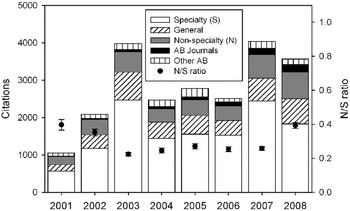
Of all citations in papers in Astrobiology and the International Journal of Astrobiology during 2001–2008, 59% were to sources within the discipline represented by the citing paper and 16% were to specialty publications in another discipline (Fig. 4), for an overall N/S value of 0.27 (see below for details of the citation analysis). In our experience, typical specialty scientific journals today cite far fewer publications outside the home discipline (N/S≪0.27), although we did not conduct such an analysis. These data therefore indicate that authors in the astrobiology journals are doing interdisciplinary research. Indeed, for many interdisciplinary papers in these journals it was problematic to identify a single ‘home discipline’.
The number and interdisciplinarity of citations in AB journals. The ratio N/S of non-specialty to specialty citations in astrobiology journals is high. Citations in every paper published in Astrobiology and the International Journal of Astrobiology for the period 2001–2008 were categorized according to whether the cited source was outside the paper's home discipline or not. In addition, citations to the two astrobiology journals (‘AB Journals’) and to the journal Origins of Life and Evolution of Biospheres and astrobiology-related books (‘Other AB’) were recorded. N/S values are plotted as points with error bars.

With the case study of the GSL in the early nineteenth century in mind, one might expect that astrobiologists, with their own conferences and journals, are creating their own specialized community at the expense of maintaining interdisciplinary connections. Figure 4 shows that, as one would expect, the fraction of self-citations by the astrobiology journals has slowly but steadily increased (at 5.5% in 2008) since their inception. If this trend continues into the future such that citations to astrobiology journals became dominant, then an insular astrobiology community isolated from its parent disciplines would be realized.
Astrobiology and the International Journal of Astrobiology are the first journals to feature the term ‘astrobiology’ in their titles, but the journal Origins of Life and Evolution of Biospheres has been publishing astrobiology-relevant papers since 1968 (and now describes itself as ‘the Journal of the International Astrobiology Society’). There are also a number of books for popular and technical readers that have been published on astrobiological topicsFootnote 5. However, if these sources (‘Other AB’ in Fig. 4) are lumped into an astrobiology category along with the two astrobiology journals, then the fraction of all astrobiology citations remains around 10% for all years. Further analysis reveals that astrobiology books declined from 52% of all astrobiology citations in 2001 to 28% in 2007–08. In other words, formal scientific papers are replacing books as the primary references for astrobiology research. This is likely to be a positive sign for the development of a productive astrobiological research community, but it should be noted that the same trend occurred with geology in the early nineteenth century. When Trans. Geol. Soc. and other geology journals became the dominant forum for scientific research, non-scientists lost the ability to read the primary scientific literature, as it had moved from books to jargon-filled journal articles that were often not publicly available (Allen Reference Allen, Jordanova and Porter1979). Spurred by the success of Trans. Geol. Soc., other disciplines published their own jargon in their own journals, eventually leading to the current state of affairs where scientists are unable to read journals outside their own specialties.
Is a similar barrier developing today between astrobiologists and other scientists? In addition to the creation of journals, several developments in astrobiology could be considered as ‘warning signs’. Astrobiologists now have their own (albeit politically volatile) funding source in the NASA Astrobiology Institute, which sponsors many astrobiology conferences and workshops. Several astrobiology societies have formed: for example, the European Astrobiology Network Association, the Astrobiology Society of Britain, and the Swedish Astrobiology Network. At the University of Washington, we have professors hired as astrobiologists, a graduate Certificate in Astrobiology, and our own course code ASTBIO. Astrobiology textbooks are now available for middle school through to graduate school. A dual-title Ph.D. in astrobiology and a second discipline is offered at Pennsylvania State University. All of these developments are likely to promote the scientific success of astrobiology as measured by the numbers of astrobiologists and scientific papers, but they also have the potential to isolate astrobiology from its component fields.
The brief publication record of the two astrobiology journals so far shows a healthy fraction of multidisciplinary citations and little sign of a trend in self-citations that might soon lead to isolation (Fig. 4) but, as they say on Wall Street, past performance may not be an indicator of the future. It will be interesting to observe whether this trend continues. We did not attempt to track citations of astrobiology papers in other journals, but such a study may indicate whether non-astrobiologists are able and willing to read, comprehend and utilize information from astrobiology publications – an important test of isolation. Considering the history of science since the origin of the first specialized disciplines two centuries ago, one could reasonably conclude that scientific progress and specialization are necessarily correlated. If so, astrobiologists, despite their interdisciplinary intentions, may find that developing their own modes of communication, which will then inevitably lead to more isolation, is unavoidable in today's scientific practice.
The astrobiological revolution
The fragmentation of science into specialized disciplines in the early nineteenth century may in fact have been part of the very creation of modern science. Cunningham and Williams (Reference Cunningham and Williams1993) have argued that the period usually considered as the birth of modern science – the ‘scientific revolution’ of the seventeenth century – should in fact be perceived as a revolution within natural philosophy. Scientific research after this so-called revolution, they argue, was indeed different, but it was still not what we now consider science. Natural philosophers of the seventeenth and eighteenth centuries were not partitioned into specialties, were primarily gentlemen working at leisure, and routinely used theological arguments in their work. These were not minor differences in otherwise modern scientists; they were essential characteristics of natural philosophy that are foreign to today's practitioners. Most historians now accept that:
… when the supposed heroes of ‘the scientific revolution’ such as Newton used theology, mysticism, alchemy and biblical chronology in their study of the natural world, this was neither insanity nor a failure to be properly ‘scientific’ but part of a coherent attempt to reach a deeper understanding of the Christian God by studying His creation.
(Cunningham & Williams Reference Cunningham and Williams1993)Cunningham and Williams argue that the birth of modern science should be located in the late eighteenth century or early nineteenth century, as this was when disciplines formed, professional laboratories and research ‘schools’ were created, the first doctorate degrees were awarded, the term scientist was invented and eventually replaced natural philosopher, and religious beliefs and arguments were no longer an explicit component of scientific communication. These characteristics remain today as fundamental aspects of modern science.
This argument bears on our conception of what it means to be ‘interdisciplinary’. If disciplines are an essential component of modern science, then interdisciplinary science is simply collaboration among scientists from different disciplines. The disciplinary boundaries do not disappear, however, and the scientists do not necessarily become any less specialized. If collaboration is what is intended by the Astrobiology Roadmap when it says ‘astrobiology is multidisciplinary in its content and interdisciplinary in its execution’, then astrobiology will become much like oceanography: a community of specialists collaborating across disciplinary boundaries to investigate common problems. Another example of an ‘interdisciplinary’ science is molecular biology, which is the result of a fusion of component disciplines to create a new specialty with its own societies, journals and jargon. Whether astrobiology remains a collection of specialists, as in oceanography, or becomes a new specialty like molecular biology, its interdisciplinary nature alone does not make it fundamentally different than these programmes except perhaps in combining a wider range of disciplines. In time, astrobiology might become unusually successful in promoting collaboration across disciplines, but it would not be forging a new type of science.
Collaboration does not necessarily require collaborators to understand the language and principles of each others' disciplines; mutual understanding is certainly helpful, but it is not inherent to collaboration. Astrobiology students, though, are currently trained to be fluent, if not experts, in multiple disciplinesFootnote 6. These astrobiologists-in-training seek more than mere collaboration; they seek true cross-disciplinary research that is oblivious of disciplinary boundaries. The Astrobiology Primer (Mix et al. Reference Mix2006) and the recent graduate textbook Planets and Life: The Emerging Science of Astrobiology (Sullivan & Baross Reference Sullivan and Baross2007), for example, are attempts to empower scientists from many disciplines to understand each other. Furthermore, the broad questions that astrobiology addresses (How did life originate and evolve? Is there a second genesis of life? What are the limits to life? Can we detect life in other solar systems?) may require an unprecedented integration of disciplines that cannot be fused into a single astrobiology specialty. The novel content and interdisciplinary citation patterns of the astrobiology journals, as discussed in the previous section, could be the preliminary indications of a new kind of science.
It is not clear that such lofty goals are attainable. Astrobiologists may succeed in communicating with each other, but in the process become incomprehensible to non-astrobiologists. In this case, astrobiology will have become only yet another specialized discipline. If disciplinary boundaries can be largely breached, however, and scientists can be trained to merge disciplines (and not just interact between them), then a fundamental component of modern science, originating two hundred years ago, will have been profoundly altered. It will be no less than a new scientific revolution.
Appendix: Materials and methods
For this study the first author examined all volumes of Philosophical Transactions of the Royal Society (Phil. Trans.) and Transactions of the Geological Society of London (Trans. Geol. Soc.) during the period 1802–1856. One volume of Phil. Trans. was published each year, typically comprising 20–30 papers. The publication schedule of Trans. Geol. Soc. was irregular, and a single volume contained from 12 to 46 papers. Three or more years often separated successive volumes; sometimes a volume was published separately as ‘parts’, and a year or two passed between publication of each part. A total of 290 papers including 1214 citations in Trans. Geol. Soc., and 1337 papers including 4331 citations in Phil. Trans., were tallied and classified. All volumes of Astrobiology and International Journal of Astrobiology were obtained online. A total of 260 papers including 14 711 citations from Astrobiology and 174 papers including 7753 citations from International Journal of Astrobiology were tallied and classified.
Categorization into subject content
Each volume of Phil. Trans. was scanned for papers that could be categorized as geological. Geology papers were further sub-categorized as papers focused on mineralogy, fossils, Earth history, current Earth processes such as volcanoes and earthquakes, geographical surveys and travels, and what we today would call geochemistry or geophysics. The ‘mineralogy’, ‘fossils’, and ‘Earth history’ subcategories were then joined to form what we call ‘GSL-type’ papers for the purposes of this study. We chose this operational definition guided by the content of the papers in Trans. Geol. Soc. (which contained few or no papers on volcanoes, earthquakes, surveys, chemistry, or physics), thereby using similar criteria to those of the self-defined geologists editing and writing for Trans. Geol. Soc. It should be noted that the papers on mineralogy and fossils in Trans. Geol. Soc. were often very different from those in Phil. Trans., especially before 1837, because Trans. Geol. Soc. papers usually discussed minerals and fossils in their geological context with the goal of understanding the history of the Earth. Mineralogy papers in Phil. Trans., in contrast, were often concerned with only the economic or other practical significance of minerals. Nevertheless, all papers on mineralogy and fossils in Phil. Trans. were included as ‘GSL-type’ for purposes of comparison.
Citations
For each paper in Phil. Trans. and Trans. Geol. Soc., we counted the number of citations to other papers in the two journals as well as to those in Transactions of the Linnaean Society and Monthly Notices of the Royal Astronomical Society. GSL-type papers in Phil. Trans. and all papers in Trans. Geol. Soc. were selected for further citation analysis. Each citation was categorized as ‘geology’, ‘general science’ or ‘non-geology discipline’. Since citations in both journals were sometimes incorporated within the text and sometimes in footnotes, every page was scanned by eye, and some human error is likely. A small sample of the volumes was selected for re-counting, and results were found to be nearly identical.
For Astrobiology and the International Journal of Astrobiology, the same process was used for tallying citations, with the difference that for each paper the field of specialty was determined and any citation to a specialized publication outside that specialty was categorized as ‘non-specialty discipline’. Since many astrobiology papers are interdisciplinary, identifying a ‘home’ specialty field for these papers was often problematic. For each citation, a specialty was assigned primarily based on the journal title; in rare cases where the journal title was uninformative, the article title was used. The ‘AB Journal’ category of citations includes all papers published in either astrobiology journal; papers from both journals were pooled together since no differences in citation patterns between the journals were apparent. The ‘Other AB’ category contains all citations to astrobiology-related books and to the journal Origins of Life and Evolution of Biospheres.
Acknowledgements
We thank the librarians of the University of Washington and the University of British Columbia for their cooperation and service. We also thank Mott Greene, John Baross, Tom Hankins and Shawn Domagal-Goldman for helpful discussions and comments. WJB has been supported by an IGERT traineeship in Astrobiology under NSF Grant 05-04219.