


Introduction
Stuttering is a speech disorder typically beginning in early childhood. Stuttering may interfere with academic, occupational, and social functioning. A critical factor influencing an individual's experience of stuttering involves thoughts and feelings about speech disruption. Estimates of spontaneous recovery of stuttering during childhood vary but are as high as 89%. However, for some, stuttering persists. Avoidant behaviors are key features of persistent stuttering (Guitar, Reference Guitar2006). The search for vulnerabilities that makes it more likely for stuttering to persist continues.
Children who develop into adult chronic stutterers may be those who have tried to hide their perceived imperfect speech. This hypervigilance to speak fluently may reflect perfectionistic tendencies. Perfectionistic people focus on failure and mistakes (Burns, Reference Burns1980). Perhaps being perfectionistic is another vulnerability that makes stuttering more likely to persist.
Experimental studies exploring perfectionism and stuttering are limited. In one study, Amster (Reference Amster, Starkweather and Peters1995) surveyed 47 PWS and 22 matched controls using the Burns Perfectionism Scale in both its original format (Burns, Reference Burns1980), and an adapted format in which subjects answered questions on the Burns Scale as they thought they would have responded as young children. Amster (Reference Amster, Starkweather and Peters1995) noted that PWS were more perfectionistic and viewed themselves as more perfectionistic during childhood than controls. Their intolerance of perceived speech errors and intense reactions to disfluency may have increased their desire to stop stuttering. In efforts to gain control of their speech, PWS may expend increased levels of energy, resulting in tension, effort, and struggle, types of behaviors thought to make stuttering persist (Starkweather, Reference Starkweather1987).
An important consideration about perfectionism is that while its effects can be destructive (Burns, Reference Burns1980), it can be modified with appropriate treatment. Ferguson and Rodway (Reference Ferguson and Rodway1994) used Cognitive Behavioral Therapy (CBT) with perfectionistic individuals and found that CBT was effective in treating perfectionism.
The purpose of the present study was to investigate the effectiveness of a brief modified CBT approach in reducing perfectionism and stuttering in PWS. Participants' perfectionistic tendencies, stuttering behaviors, and communication attitudes were investigated. Specifically, this investigation analyzed (1) degree of perfectionism recalled from childhood; (2) current degree of perfectionism; (3) communication attitudes; and (4) stuttering behaviors. All were measured at pre-treatment, mid-treatment (3 weeks), post- treatment (6 weeks), and 15-weeks follow-up. This investigation concurs with Starkweather's (Reference Starkweather1987) premise that stuttering has two major components, feelings and overt behavior, and both should be treated. He suggested that if feelings alone are treated, the client might relapse because the original overt behaviors remain, although reduced in severity. If only overt stuttering behaviors are treated, the fear of being disfluent probably remains and old reactions of struggle and avoidance may lead to a breakdown in treatment effects.
In this study, the first 3 weeks focused solely on CBT. This CBT approach included: personal goal setting, exploration of automatic thoughts and cognitive distortions, and use of an automatic thought record to develop more rational responses. At 4 weeks, in addition to the CBT therapy, traditional Stuttering Modification Therapy was discussed and briefly reviewed (Guitar, Reference Guitar2006) in conjunction with CBT. Stuttering modification therapy combines procedures to increase awareness of stuttering behaviors, increase acceptance of one's stuttering, and motoric techniques directed at decreasing the tension associated with stuttering moments, when they occur (Blomgren, Roy, Callister and Merrill, Reference Blomgren, Roy, Callister and Merrill2005). Throughout the 6-week treatment period, treatment was weekly and included both individual and group sessions. It was hypothesized that there would be a reduction in perfectionistic tendencies and stuttering severity and an increase in positive communication attitudes following this treatment with CBT alone, and that the addition of stuttering modification would further reduce stuttering behaviors.
Method
Eight participants, five males and three females who stutter, aged 27–56 years (M = 44 years, SD = 9.9 years) volunteered through their local National Stuttering Association chapter to take part in this study. Seven participants had a history of receiving speech therapy for stuttering. None received CBT in the past. All were gainfully employed. Each participant was seen individually at the La Salle University Research Laboratory for an initial intake evaluation with the authors (both licensed/certified speech-language pathologists, one board recognized in fluency disorders and the other also a licensed psychologist). As indicated during a brief clinical interview, all eight participants expressed fear and avoidance in various social situations. Responses were tape-recorded for review and accurate scoring.
The study measured perfectionism, stuttering severity, and communication attitudes at four points in time to determine the effects of the modified CBT treatment on perfectionistic tendencies as measured by the Burns Perfectionism Scale (Burns, Reference Burns1980; Amster, Reference Amster, Starkweather and Peters1995), stuttering severity as measured by the Stuttering Severity Instrument (SSI-3) (Riley, Reference Riley1994); and communication attitudes as measured by the Modified Erikson Communication Attitude Scale (Andrews and Cutler, Reference Andrews and Cutler1974), a self-rating checklist. All were measured and recorded at pre-treatment (1 week prior to beginning treatment), mid-treatment (3 weeks after CBT treatment began), post-treatment (6 weeks after the combination of CBT and Stuttering Modification treatment ended), and again at follow-up (15 weeks after treatment was withdrawn).
Treatment consisted of six individual one-hour sessions and six 90-minute group sessions with the authors serving as clinicians. All participants attended all 12 sessions during the 6-week time frame.
Initially, we discussed core beliefs with the participants, those underlying thoughts that guide behavior on a daily basis. Perfectionistic beliefs, especially the avoidance of mistakes, emerged for all participants who remarked that the overriding theme they shared since childhood was the need to be as perfect as possible, not only in communication but in most aspects of functioning (appearance, image, speech, relationships, and performance at work).
During treatment sessions, an automatic thought record was used to help participants consider their underlying thoughts and beliefs. During group sessions, participants assisted each other by sharing weekly experiences and helping one another interpret those events more rationally. At week four, stuttering modification was introduced and reviewed in both individual and group sessions. Participants analyzed moments of stuttering to reduce tension. CBT remained a major focus throughout the study.
Results
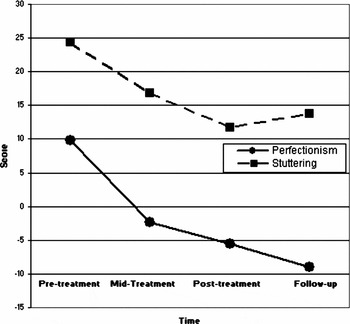
This open trial design used pairwise comparisons between pre-treatment, mid-treatment, post-treatment and follow-up, to indicate changes in perfectionism and stuttering severity over time. At pre-treatment all participants performed within the perfectionistic range on both current (M = 9.75; SD = 5.1) and child recollection (M = 9.75; SD = 8.5) formats. Using the Wilcoxon Signed Ranks Test, results indicated that recollection of childhood perfectionism did not change significantly over time but was a stable characteristic. However, when participants rated themselves on the Burns Perfectionism Scale currently as adults, there was a significant decline in perfectionistic tendencies after the modified CBT treatment model was employed. This was maintained 15 weeks after treatment ended. The most significant decrease in perfectionism occurred during the first 3 weeks of the study. Participants decreased an average of 13 points on the Burns Perfectionism Scale (a 40 point scale). The Wilcoxon Test indicated that Perfectionism scores for PWS at pre-treatment (M = 9.75, SD = 5.06) significantly decreased by mid-treatment (M = −2.38, SD = 8.09), Z = −2.1; p = .035. The effect size using Cohen's d was 1.80. From mid-point to end of treatment when stuttering modification was introduced, perfectionism continued to decline, however not significantly (Z = −1.7; p > .05). Perfectionism continued to decline after treatment was withdrawn (Z = −2.2; p = .027) (see Figure 1). Item analysis indicated that participants changed the most in avoiding less, being less upset at making a mistake and reacting less negatively to perceived failure.
Total mean scores for current view of perfectionism and stuttering severity.

Pairwise comparisons using the Wilcoxon Signed Ranks Test for scores on the Erickson Communication Attitudes Scale indicated that by post-treatment, participants had significantly more positive attitudes about communication (pre-treatment M = 19.00, SD = 3.46, mid-treatment M = 17.00, SD = 5.15, and post-treatment M = 12.38, SD = 4.95). Attitudes did not significantly change by the mid-point of the treatment, but by the end of the 6-week program participants showed a significant improvement in their attitude towards speaking as they found it easier to talk with others, were more confident about their speaking ability, and less nervous or embarrassed to talk (pre-treatment to post treatment Z = −2.38, p = .017). This was maintained at follow-up (M = 12.13, SD = 6.33).
At pre-treatment all participants met criteria for stuttering on the SSI-3 ranging from very mild to very severe. Pairwise comparisons as measured by the Wilcoxon Signed Ranks Test reflected statistically significant improvements in participants' speech fluency from pre-treatment to mid-treatment (when CBT was the sole treatment). Participants significantly decreased stuttering (Z = −2.3; p = .021). SSI-3 scores for PWS at pre-treatment were M = 24.38, SD = 9.01; and at mid-point, SSI-3 scores were M = 16.88, SD = 11.11. At post-treatment, SSI-3 scores were M = 11.75, SD = 8.79; and at follow-up, SSI-3 scores were M = 13.75 and SD = 8.63. Effects sizes using Cohen's d were.74 (pre-treatment to mid-treatment) and .51 (mid-treatment to post-treatment). Stuttering significantly decreased throughout both phases of treatment (see Figure 1). From pre-treatment to post-treatment stuttering severity and perfectionism significantly decreased. From post-treatment to 15 weeks follow-up, there was a decrease in degree of self-reported perfectionism, although stuttering increased slightly but not significantly. Participants related that they did not care as much about making mistakes when they spoke. They reported that their fears about stuttering reduced, and that they were no longer striving to speak perfectly.
Discussion
The purpose of this study was to investigate a modified CBT treatment approach on reducing perfectionistic tendencies and stuttering behaviors, and to compare the effects of CBT alone and with the addition of Stuttering Modification. Communication attitudes in PWS were analyzed throughout the study. Initial open-trial testing showed promising results. All participants at pre-treatment scored in the perfectionistic range on the Burns Perfectionism Scale (Burns, Reference Burns1980) and on an adaptation of the Burns Perfectionism Scale (Amster, Reference Amster, Starkweather and Peters1995). All participants considered themselves to have been perfectionistic as children, with childhood recollections of perfectionism remaining stable throughout the course of the study. Over the course of modified CBT treatment, self-ratings of current adult levels of perfectionism significantly decreased. PWS appeared to reduce their perfectionistic tendencies with modified CBT and continued to show reductions 15 weeks after treatment ended. As perfectionism continued to decrease, participants became more spontaneous in their speech production, monitoring their fluency less. The words of one participant at follow-up expressed this sentiment: “I notice that my speech has been not as much in my awareness.” Another participant conveyed similar thoughts: “I have changed the way I think in that I do not care as much how I speak; whatever happens is OK.” This spontaneous approach towards speaking resembles what happens in normal fluency (Starkweather, Reference Starkweather1987) and may account for the slight increase in stuttering behaviors at follow-up because of reduced self-monitoring.
CBT was associated with decreases in both perfectionism and stuttering behaviors. When stuttering modification was initiated during the second 3 weeks of treatment, only stuttering behaviors continued to decline significantly. Perfectionism did not significantly reduce during the second phase of treatment (mid to post treatment) but the initially substantial decrease in perfectionism was maintained. After treatment ended, from post-treatment to follow-up, there was another significant decrease in perfectionism, possibly indicating that the participants were continuing to self-reflect on their own. Communication attitudes improved significantly by the end of the 6-week treatment. This improvement was maintained at follow-up.
At the initiation of this study, participants were perfectionistic and demanding of themselves, trying to hide their imperfect ability to produce speech. Participants' goal-generating statements at pre-treatment indicated how their negative feelings were damaging to their self-image, making it more likely for them to attempt to hide their stuttering or struggle to try to control their speech. These negative thoughts and behaviors may actually make stuttering more distressing. Participants' comments supported the possibility that this modified version of CBT therapy reduced perfectionistic tendencies and may be a means to help PWS view their stuttering in a more accepting manner. However, with the limitations of this open trial (small number of subjects, lack of a control group, and brief duration of the follow-up period), the results must be viewed with caution. Participants in this study all considered themselves to have been perfectionistic as children and having this trait may help to explain why some young children may be less able to tolerate disfluencies and are more likely to use tension, effort, and struggle to control their speech. Modified CBT therapy seemed to have a beneficial effect on reducing cognitive distortions that can perpetuate perfectionism. The possibility that perfectionism increases an individual's distress about stuttering should be further explored.



Comments
No Comments have been published for this article.