On 20 September 1673, Henry Oldenburg wrote to the Danish mathematician Erasmus Bartholin, thanking him for a recent exchange of books and observations, and informing him of the latest philosophical news from the Royal Society. After mentioning Boyle's work on gems and Cassini and Flamsteed's observations of the moons of Jupiter, he comments,
Hevelius … has finished the first part, or description of instruments of his Machina Coelestis; we are in daily expectation of a few copies of it which (as he writes to us) he has entrusted to some Danzig ship sailing for England … We are filled with extreme longing to see this.Footnote 1
Hundreds of books passed through Oldenburg's hands in the correspondence networks that supported the early Royal Society, but Hevelius's work elicited special attention. Many of Oldenburg's letters to philosophical colleagues at the time mention this forthcoming volume, revealing the Royal Society's eagerness to see this new publication. Certainly the Machina Coelestis promised to be a large and useful reference tome, containing in subsequent volumes, as Oldenberg wrote to Cassini, ‘all [Hevelius's] observations from the year 1630 to the present day: and to this, when it is finished, he promises that he will prefix his introduction to astronomy together with a new catalogue of the fixed stars which, he says, he has enlarged and corrected’.Footnote 2 But the first volume, hot off Hevelius's own press in 1673 and eagerly expected, was a self-described Organographia, an exhaustive catalogue of the Danzig observatory replete with images and descriptions of his instruments.Footnote 3 It is this volume that the Royal Society members were so anxious to see. And Hevelius, for his part, was also eager that his work be seen by them. As he wrote to Oldenburg in a letter included with his gift copies of the book,
Moreover I wish to beg you over and over that you will be so good as to communicate [to me], out of your affection and openness towards me, the opinion of the illustrious Royal Society and other notable persons too, when in due course this little work has been examined and read, and that you will freely speak out as to what they feel about it, what they like, or perhaps what they don't like.Footnote 4
What exactly about this book aroused such expectation? On the one hand, Hevelius had promised to publish his method of lens grinding as early as the first volume of Philosophical Transactions, and many Fellows were keen to glean these technical details.Footnote 5 The book also offered a glimpse into Hevelius's distant observatory, with a stunning visual catalogue of his instruments and detailed descriptions of their construction and his observational techniques. However, more was at stake than simply information about instruments. The book appeared eight years after Hevelius reported a contested position for the comet of 1665, forcing the Royal Society to re-examine the validity of his observational claims and prompting an escalating tension between Hevelius and Robert Hooke about the merits of telescopic sights in positional astronomy. These events had not only proven difficult to manage politically within the Royal Society, but had also thrown Hevelius's observations and instrumental techniques into doubt in London and abroad. The Machina Coelestis Pars Prior therefore offered Fellows the chance to ‘see for themselves’ just how trustworthy both Hevelius and his observations were. For Hevelius's sake, it was important that they liked what they saw.
Recent work in the history of science has emphasized the importance of what we might broadly characterize as reputation management in the conduct of early modern science. Steven Shapin has argued that self-presentation, especially ‘gentlemanly’ behaviour and its associated ‘epistemological decorum’, was critical to managing testimony, as it was through interactions with others that an individual's character was revealed, essential to judging the veracity of his witness.Footnote 6 The man of honour, reputation or virtue was trustworthy, and could therefore stand as a credible witness in a society that communally generated and approved reliable knowledge claims. While Shapin focuses on face-to-face interactions, this does not necessarily mean that members at a distance were at a severe disadvantage; discussing the case of Galileo's interactions with the Medici, the Church and his colleagues, Mario Biagioli shows how time, distance and partial knowledge served as the very conditions of knowledge production, with historical actors employing a variety of techniques to establish their credibility, their personas, even their location as central or peripheral to emerging communities of practitioners.Footnote 7 In addition, in Lorraine Daston and Peter Galison's studies of atlases the authors argue that the production of ‘objective’ observations requires particular assemblages of observers, instruments, objects and their representations that, through practice, produce – and reproduce – ‘the scientific self’.Footnote 8 The production and circulation of images within a disciplinary community thus requires demonstrating the proper orientation to one's craft, with its associated disciplined self-restraint and rigour.Footnote 9
Such scholarship provides a useful frame through which we might appreciate the tensions that Hevelius faced in 1673. As a distant Fellow of the Royal Society, Hevelius could and did rely upon the flexibility of epistolary modes of communication to exchange information with a wider network of correspondents and to assert his status at a distance. Such methods produced and supported his authoritative persona, which he promoted abroad as the ‘Prussian Lynx’. But what could members such as Hevelius do when disputes arose that compromised their status within the community and cast their contributions – and their reputations – into doubt? What options for respectable self-presentation were available to distant members that would allow them at the same time to assert their credibility, avoid immodesty and maintain ‘epistemological decorum’?Footnote 10
This article claims that Hevelius addressed these related problems of reputation management through a programme of visual rhetoric: by prefacing his great collection of observational facts with a volume dedicated entirely to his instruments, replete with luxuriously detailed illustrations. As the author and engraver of the many plates in his Selenographia of 1647, it is perhaps unsurprising that Hevelius's keen interest in visual astronomy should translate into the production of another richly illustrated tome,Footnote 11 this time offering the reader the opportunity to virtually witness the Danzig observatory.Footnote 12 But while the book's many rich and detailed plates provide an interesting view of a late seventeenth-century astronomical observatory, this view is not transparent. The plates present a particular, crafted vision of this space to its distant observers, aimed at convincing them of the author's integrity and gentility as a peripheral member of their community. Though the textual side of the Organographia remained modest and constrained, with precise technical details and instrumental histories, the goal of the images was not to ‘record the things themselves as they appear’,Footnote 13 but rather to settle a controversy over instrumental observations in Hevelius's favour. Thus like Galileo's telescopes, letters, emblems and other artefacts crafted for the culture of the Medician court, the pictures of instruments in Machina Coelestis functioned as instruments of credit, aimed at managing Hevelius's reputation at a distance within the genteel culture of the Royal Society.Footnote 14
This paper recasts Hevelius's use of images in Machina Coelestis as central to a visual programme of remote self-presentation, exploring the visual techniques employed to reassure his colleagues of his trustworthiness and status, assert his instrumental expertise and maintain his opinion on telescopic sights. I first review the publication of Machina Coelestis in the context of the cometary observations and subsequent controversy with Robert Hooke. Next, I present an analysis of the frontispiece to the work with its presentation of the ideal astronomer, and then turn to a selection of images within the work to explore how Hevelius portrayed himself as an exemplary, even virtuous, astronomer. Finally, I discuss the images' reception in the aftermath of Machina Coelestis and Robert Hooke's vehement response. Ultimately, an analysis of the visual programme of the Machina Coelestis reveals how these pictured instruments operated as visual technologies, carefully crafted and deployed in the context of controversy in the history of science.
Background to the Machina Coelestis
By the time the Royal Society was incorporated in London, Johannes Hevelius (1611–1687) was already recognized as one of the foremost astronomers in Europe. The heir to a wealthy brewing family and a councillor in city government, he fostered his passion for astronomy by building his own observatory on the rooftop of his home in Danzig (now Gdansk, in Poland). His famous Selenographia (1647) offered more detailed positional and visual data about the Moon than had yet been published in a single work, and also earned him no small amount of fame for the description of his instruments, which he manufactured on-site.Footnote 15 As his civic responsibilities kept him from travelling abroad, Hevelius relied heavily on correspondence networks to participate in European philosophical discussion. He was especially interactive with the Royal Society through its prolific secretary, Henry Oldenburg, writing via Oldenburg to the group since its inception to relay his astronomical observations, exchange recent publications, and maintain fruitful discussions with such members as John Wallis and Seth Ward in particular.Footnote 16 He was also an active contributor to Philosophical Transactions, sending regular reports of observations and illustrations to the journal which were published alongside the society's other letters, papers and accounts of experimental proceedings. He was promoted to Fellow of the Royal Society in 1664. Finally, his patronage connections to the King of France guaranteed his connections with French astronomers such as Gassendi, Boulliau and, later, Cassini at the new Royal Observatory.Footnote 17 His correspondents concurred that his observations were unparalleled in their accuracy, and that Hevelius's persistence and eyesight were both extraordinary. Indeed, he was often known simply as the ‘Prussian Lynx’.Footnote 18
However, the Royal Society called Hevelius's observations into question early in 1665, when his reported position for the comet of 8/18 February of that year could not be reconciled with the parallel observations that had come in from England and France.Footnote 19 When the French astronomer Adrien Auzout wrote to Hevelius to protest the odd observation and suggest that perhaps some mistake had been made, the latter insisted upon its accuracy, but deferred publicly to the Royal Society to judge which record was correct. This case has already attracted analytical attention in the history of science as it presents an example of complex reputation management within the disparate network of Royal Society members: after all, to discredit just one of Hevelius's observations was to raise uncertainty about which of his observations could be trusted at all.Footnote 20 Ultimately the society judged in favour of Auzout's observation. But Hevelius countered by questioning in his Prodromus Cometicus whether or not they had observed the same comet. Perhaps, he suggested, there had been more than one heavenly phenomenon in the sky that evening, one with the coordinates that he had recorded. Thus his report could stand firm as an observation of a different comet, and his reputation as a reliable witness would be preserved.
In July of 1665, at the same time that Auzout pointed out the discrepancy between his own and Hevelius's cometary observations, Robert Hooke wrote to Hevelius through Oldenburg to suggest that Hevelius consider using telescopic sights to improve his observational techniques. Hevelius was famous for observing stellar positions using quadrants or sextants with open sights, in the same style as Tycho Brahe: lining the star up in the eyepiece to measure its angle in the heavens. Instead, Hooke proposed placing a telescopic lens at the point of sighting and outfitting the apparatus with an adjustable cross-hair micrometer. This way, instead of fidgeting with open sights and taking many painstaking observations to deduce an average position, one could simply sight the star in the telescope and use the adjoined micrometer to judge its position. Hooke prompted Oldenburg to write to Hevelius on his behalf:
Telescopic sights so greatly surpass those commonly used in instruments of all kinds, whether quadrants, sextants, or levels, especially for any kind of celestial observation, that with them an instrument of one span radius can be made much more accurate than another of sixty-foot radius, however good, having common sights … If [Hevelius] would like to know those I have discovered, I will gladly impart them to him at a word.Footnote 21
Hevelius's word appears to have been ‘no’. Over the next few years, he developed and relayed his arguments against telescopic sights through Oldenburg. According to Hevelius, sights were unreliable. They could shift on their mounts and were not easy to calibrate. Their lenses could fog up or crack in cold weather. But, especially, mounting a cross-haired sight onto a smaller instrument could not possibly generate as accurate results as could viewing through large instruments. He lambasted Hooke for promoting a tool that aimed to make astronomical observations quicker and easier: for Hevelius, as we shall see, astronomy was a moral profession shaped by the dedication, hard work and constancy demanded by its instruments. Hevelius repeatedly demanded that Hooke show him proof that the telescopic-sighted instruments were as many times better than open-sighted instrument as he would claim: for example, by requesting a comparison between the two styles in an observational experiment. Hooke could not or did not provide such evidence, and Hevelius grew frustrated with the fact that Hooke appeared to be all talk and no action.
The controversy spread from the two men to encompass astronomers across northern Europe.Footnote 22 By 1673, on the eve of the publication of the Machina Coelestis, John Flamsteed, who would soon become the first Astronomer Royal in England, wrote to his French colleague Cassini through Oldenburg with this biting criticism:
I hear that the famous Johannes Hevelius has promised [to effect] this reformation [of Tycho's errors], but as he is reported to measure the intervals between the fixed stars with open sights only, devoid of lenses, mounted upon his instruments, one can expect no greater precision than we find in Tycho, especially as we know how hard it is to line up open-sighted instruments on the fixed stars in the darkness of the night, particularly on the smaller stars. For this reason we hope that this very noble work will be undertaken by yourselves in the royal observatory that is fully worthy of your skill, for the renown of France, with a better application of telescopes to the instruments; we very much long to know whether we may expect this from you.Footnote 23
In this exchange not only Hevelius's prior observations were called into question due to his use of open sights, but his future observations were at stake as well. This presumably included his forthcoming magnum opus, the Machina Coelestis, with its tables of observations collected over his lifetime, and his forthcoming star catalogue (published posthumously). Oldenburg, who tidied up Flamsteed's Latin, tried to keep the letter from reaching Hevelius, purposefully leaving it out of his next package of correspondence with the excuse that
it takes up a whole printed sheet, and as I was reluctant to take any risk with this letter in these dangerous and uncertain times by swelling it to any notable size, I preferred to seek your pardon for some delay rather than place this letter … in jeopardy.Footnote 24
However, once the offending letter was reprinted in Philosophical Transactions Oldenburg attempted to soften the blow, telling Hevelius to ‘be assured that the writer proffered his remark not out of any sort of malice but through yielding to an excessive desire to advance and develop astronomy’.Footnote 25
The publication of Machina Coelestis, then, occurred at a time when Hevelius's reputation was on the line. The troublesome cometary observation and accusations of poor instrumentation had damaged his ability to claim authority as a contributing astronomer to the Royal Society. The subsequent correspondence with Hooke had sewn the seeds of a bitter dispute between the two astronomers that would soon explode into an ugly public controversy. And Hevelius's refusal to accept telescopic sights was already generating concern among English astronomers that his observations could not hope to advance the state of the art. Seen in this context, the Machina Coelestis was positioned to face a complex task: to assert Hevelius's authority and trustworthiness, to defend the quality of his instruments and observations, and to counter Hooke's arguments for telescopic sights, all the while maintaining the author's modesty and the ‘epistemological decorum’ required of the community of philosophers. Both the Machina Coelestis and the debate over telescopic sights were, on the surface, just about instruments, but what was fundamentally at stake in both was Hevelius's own status as a credible astronomer.
In his doctoral thesis, Derek Jensen called for a renewed appreciation of the images in Machina Coelestis as situated in response to the controversy over cometary observations; he notes how, compared with an image of Hevelius alone at a telescope from Selenographia (1647), the plates of Machina Coelestis sport the inclusion of multiple other observers (such as Elisabeth, the French observer Boulliau and assisting technicians) to demonstrate that Hevelius's observational reports were supported by other local witnesses. Extending this analysis, this paper argues that, taken together, the many illustrations throughout the book play an essential role in Hevelius's overall rhetorical programme. A closer reading of their form and content reveals how he uses a variety of visual appeals to renew his reputation as an authoritative practitioner in the course of what, on the surface, appears to be a genteel technical discussion of instruments.Footnote 26
The frontispiece: the ideal astronomer and ideals of astronomy
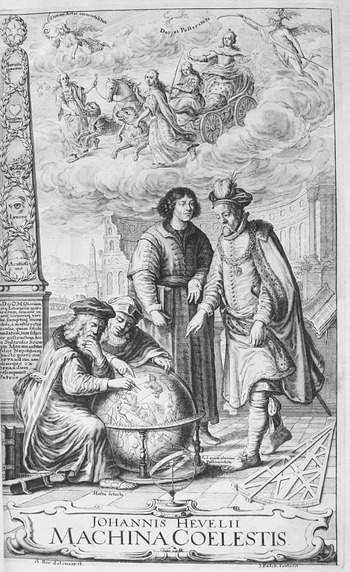
The first part of Machina Coelestis that the Royal Society Fellows saw was its frontispiece (Figure 1), sent ahead of the book in an earlier shipment.Footnote 27 A title page sets out the plan of the work as a description of instruments, but the iconographic frontispiece establishes a wider programmatic view of astronomy. Hevelius clearly wished to leave nothing open to chance interpretation; while not necessarily his common practice, he carefully explained his choice of symbolism in the Introduction. This caution was necessary, as in the frontispiece Hevelius presents the elements of the ideal astronomer, practising astronomy as a reasoned science whose truths could only be achieved through patient, virtuous dedication.
Frontispiece to Hevelius, Machina Coelestis Pars Prior (1673). Copyright: Governing Body of Christ Church, Oxford.

At the top of the scene, Hevelius explains, ‘Astronomy herself drives a chariot through the cloudy zodiac, clutching the sun in one hand and a crescent moon in the other.’ ‘Noblest’ Arithmetic and ‘Most Ingenious’ Geometry hold the reins of the lion, tiger and horse,Footnote 28 who pull the carriage under the direction of Reason. Hevelius clarifies that Astronomy can only proceed in her course under the trio's guidance, in order to be a true science and to eliminate doubt. The claim to certain knowledge, proceeding by means of mathematical and rational principles for the glory of God, makes Astronomy, as an angel declares, ‘Divinae Artis Immortalitati’. But while Astronomy may proceed with reason and mathematics in the heavens, she requires particular skills of her earthly astronomers. Hevelius discusses these requirements in two further iconographic statements. The first concerns great astronomers, and the history and progress of the science. True to convention, the text begins with a catalogue of past astronomers,Footnote 29 but Hevelius's frontispiece similarly recognizes the importance of history and collaboration. In the foreground of the piece, four famous astronomers – ‘Excellentium Virorum Virtutes’ – Tycho Brahe, Copernicus, Hipparchus and Ptolemy, gather in discussion around a celestial globe. At their feet is the inscription ‘Many things have they verily uncovered, but very many of these things have been left to Posterity’.Footnote 30
Such a statement about these great astronomers reveals three facets of Hevelius's approach to astronomy. First is the claim that astronomers from many different backgrounds – even periods – can work together and still rely on each other's work in a spirit of philosophical exchange. Important to his case, there are virtuous aspects of Tycho's work that ought still to be considered in contemporary research by a non-Tychonic astronomer, just as astronomers with different ideas about the heavens or about how to investigate them ought not to be discounted. Second, as he claims in his text, ‘These two (Hipparchus and Ptolemy) … demonstrate to us, taught by their example, in their attentive spirits inasmuch as their assiduous contemplation and scrutiny of the paths of so many brilliant stars, what we must aim for.’Footnote 31 Here Hevelius establishes a model for the kind of ‘scientific self’ required by astronomy, involving hard work, patience, contemplation and dedication. He returns to this theme many times throughout the book. Finally, he asserts that astronomy is made up of careful observations and expertise that may be lost, overruled or corrected by subsequent generations. This is trumpeted by a figure of Old Man Time flying overhead with his sickle, hourglass and bugle, proclaiming ‘DEO & Posteritati’. The same sentiment is echoed in the book's opening text, which declares that resolving and ascertaining truths in the Arts and Science comes ‘from these fountains of Geometry and Arithmetic, not from presentation to the eye, but from many observations joined together over a long time, owing to the observations acquired, deduced and produced with instruments’.Footnote 32
The pictured Excellent Men of Virtue set high standards for astronomers, who require a particular set of skills in order to perform the kind of morally and technically astute work that will lead them to both astronomical truth and a place in Posterity. These skills are carved onto a large obelisk to the left of the frame in what Hevelius called his ‘hieroglyphs’. The symbols are somewhat idiosyncratic in that they appear to be unique to this work, but to resolve any confusion about their meaning they are explained in detail in the text. At the bottom of the obelisk is the top of a human head, standing for Acutissimo – the greatest acuity. A true astronomer, says Hevelius, must have a sharp wit and a sublime, perceptive, and penetrating mind. Above this is an eye, under which is inscribed Lynceo: an astronomer must have exemplary eyesight, able to distinguish the most minute details and not only specializing in observations of large objects. Next is a plough, to designate indefatigability and hard physical work, Indefesso, as a keen intellect and keener eyes must be complemented by a disciplined body and careful, well-trained hands. Fourth is a heart, to signify Constancy – Constantatissimo, ‘assuredly of the spirit’,Footnote 33 for astronomers must be ‘most persevering, keeping the courses of the heavens always constant in their thoughts, observations, and studies … both day and night’.Footnote 34 Finally the obelisk is capped with Investigantur, signified with a star enwreathed with laurels. The investigation of the heavens is both the goal and the reward of ‘acute wit, lynx-like eyes, indefatigable labour, and constancy of spirit’.Footnote 35
In addition to following the example of the great astronomers, therefore, the ‘true astronomer’ must be intelligent, sharp-eyed, hard-working and true, and devoted to investigating the heavens. We might note that these virtues closely adhere to the virtues of the gentleman philosopher, who ought also to be reconciled to consigning many of his ideas to the neglect of Posterity through his genteel disinterest.Footnote 36 But we must also recall Hevelius's epithet, the ‘Prussian Lynx’. The invocation of Lynceo on the pyramid – instead of, perhaps, observatio or contemplatio (used on the frontispiece to Selenographia) – indirectly but distinctly identifies Hevelius himself with these virtues of astronomy. Thus, as much as Hevelius claims that these are the ideals that the entire community of astronomers (including, importantly, Hooke) must strive for, he also claims that these are values that he himself embodies in his own work. Further, these virtues reappear as visual themes throughout the text whenever Hevelius pictures himself interacting with his instruments. That is, while Hevelius modestly composes his text, apologizing for his imperfections and pointing to these virtues as shared disciplinary goals within astronomy, visually he portrays himself actively performing these duties throughout his instrumental images. Thus he crafts his persona as the epitome of the correctly disciplined scientific self, reinforcing his claim to excellence in astronomy. At the same time, he makes visual reference to his respectable social status and proper instrumental technique. It is to these images, picturing Hevelius as a virtuous astronomer, that this analysis now turns.
The instrumental image and the gentlemanly witness
The use of iconographic frontispieces was traditional even for scientific works in this period, but images of another form were also common: images of experimental apparatus or findings. For example, Michael Dennis has shown how the many illustrations in Robert Hooke's Micrographia (1664) served to instruct readers both about what the microscope was and about how it worked, and about the kinds of optical and philosophical result it could generate when properly used.Footnote 37 And Shapin and Schaffer have argued that such images formed part of the ‘literary technology’ that permitted the virtual witnessing of experiments.Footnote 38 By circulating pictures and detailed accounts of experiments, they argue, members of the Royal Society such as Robert Boyle could engage natural philosophers in distant parts of the society's network as witnesses to affirm their results. Hevelius's many detailed plates in Machina Coelestis certainly exposed his instruments' methods of manufacture and operation and, by extension, their philosophical propriety as guarantors of natural knowledge, but they also brought his distant colleagues into his observatory, encouraging them to ‘see for themselves’ the many extraordinary instruments he used on a regular basis. And like other kinds of literary and visual technologies, through their apparently direct window into the laboratory, these images constitute a rhetorical appeal to their viewers as they promote and naturalize a particular vision of practice and professional engagement.
Daston and Galison have explored the techniques available for crafting objective visual reports with respect to the conventions of eighteenth- and nineteenth-century anatomical atlases.Footnote 39 In their account, the artist may highlight their skilled eye and learned judgement, or their unbiased recording and mechanical means of production, in order to produce an image that attains a historically contingent status as objective and therefore factual. With respect to Hevelius's plates, a dual claim to trustworthy reportage is made. The first is the status of the image itself as ‘a matter of fact’: the close attention to detail, the settings of instrumental activity clearly located in the observatory, the external viewpoint picturing Hevelius using his instruments in the scene, and the naturalism of the representation all contribute to the sense that this is indeed a window into the observatory. But the second, consistent with the recent extension of the authors' arguments, is Hevelius's own status. Just as the image appears to be an objective record of fact, it also makes Hevelius himself appear to be an objective recorder of facts through his presentation of himself, his instruments and his practice of virtuous astronomy.
A gentleman and an astronomer
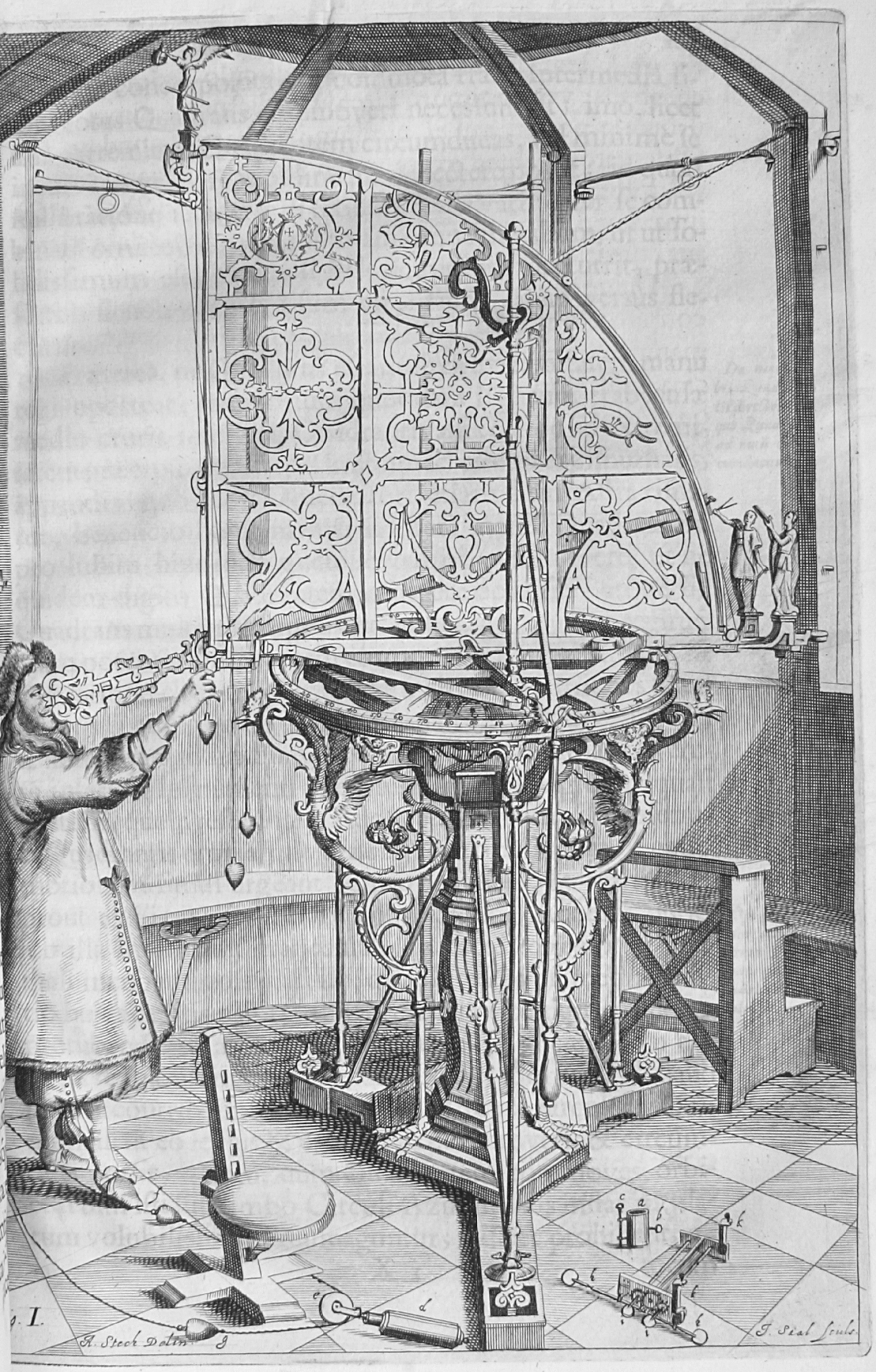
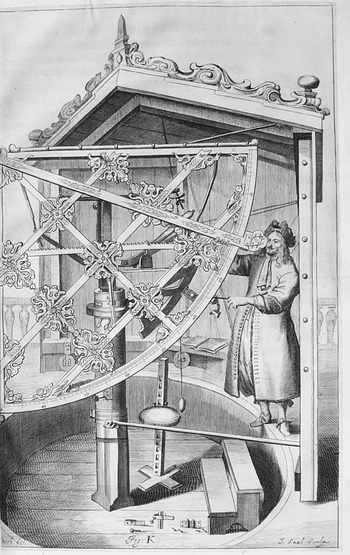
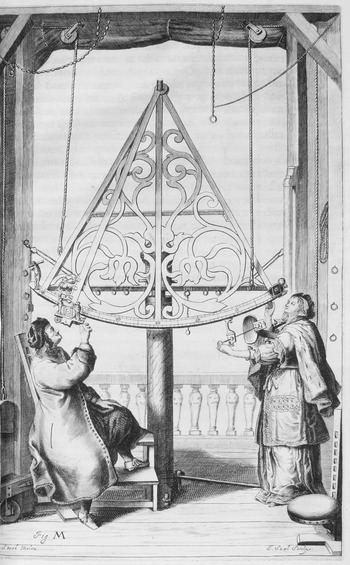
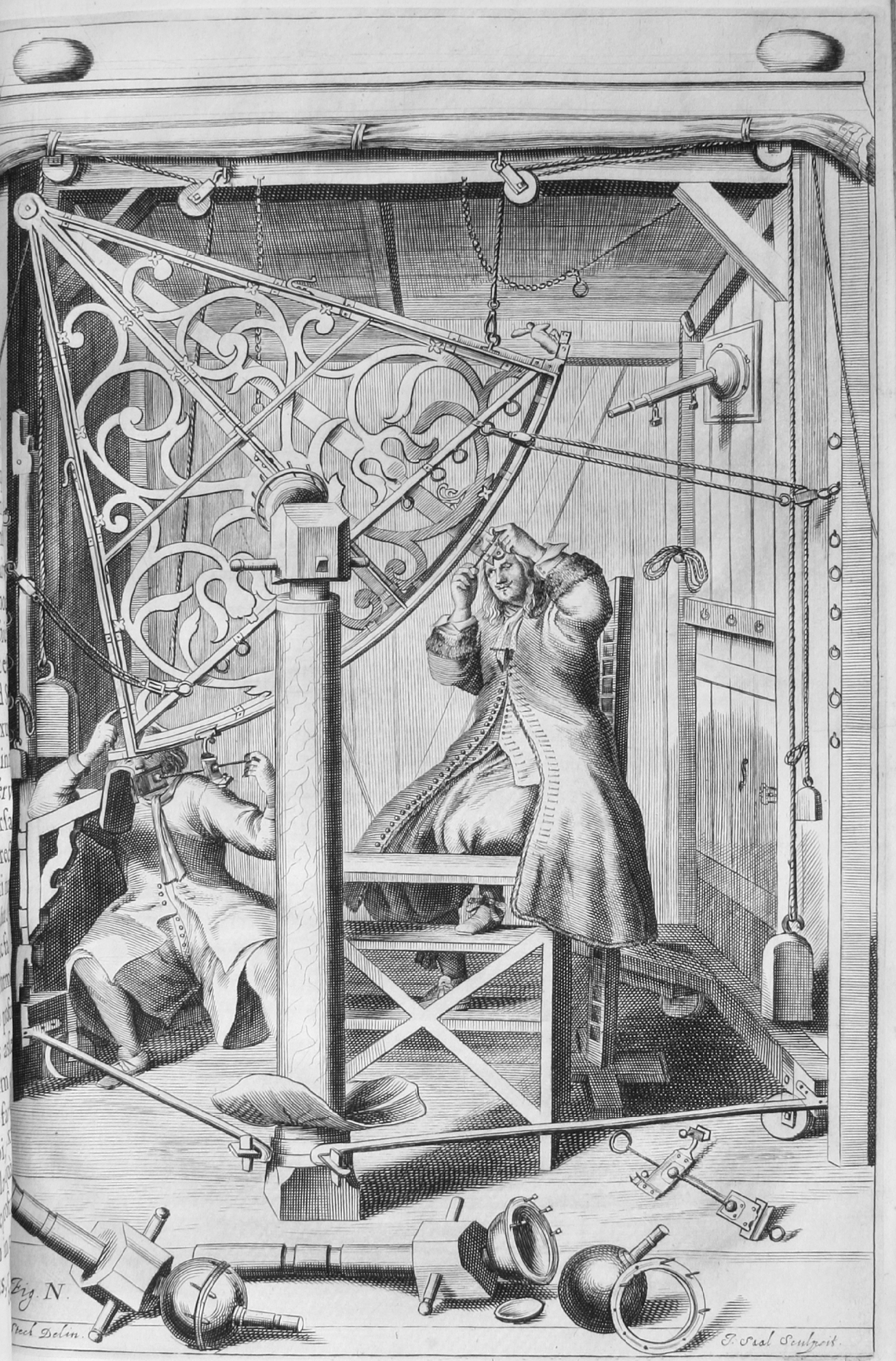
A suite of images reproduced in this paper (Figures 2–5) are typical of the style of the many plates in Machina Coelestis. Much like Tycho Brahe's Astronomiae Instauratiae Mechanica (1598), upon which the Machina Coelistis Pars Prior was modelled, each plate presents an instrument whose description and technical details are outlined in the accompanying texts. In each case, the instrument is the centrepiece of the frame, and is so ornate as to make the contemporary observer wonder as to its practical utility in everyday astronomical observations. However, ornamentation here makes a strong claim as to the instruments' own status and reliability.
Hevelius uses a quadrant. Note the difference between the engraving of the instrument and that of the surroundings, including Hevelius himself. From Hevelius, Machina Coelestis Pars Prior (1673), facing p. 164. Copyright: Governing Body of Christ Church, Oxford.
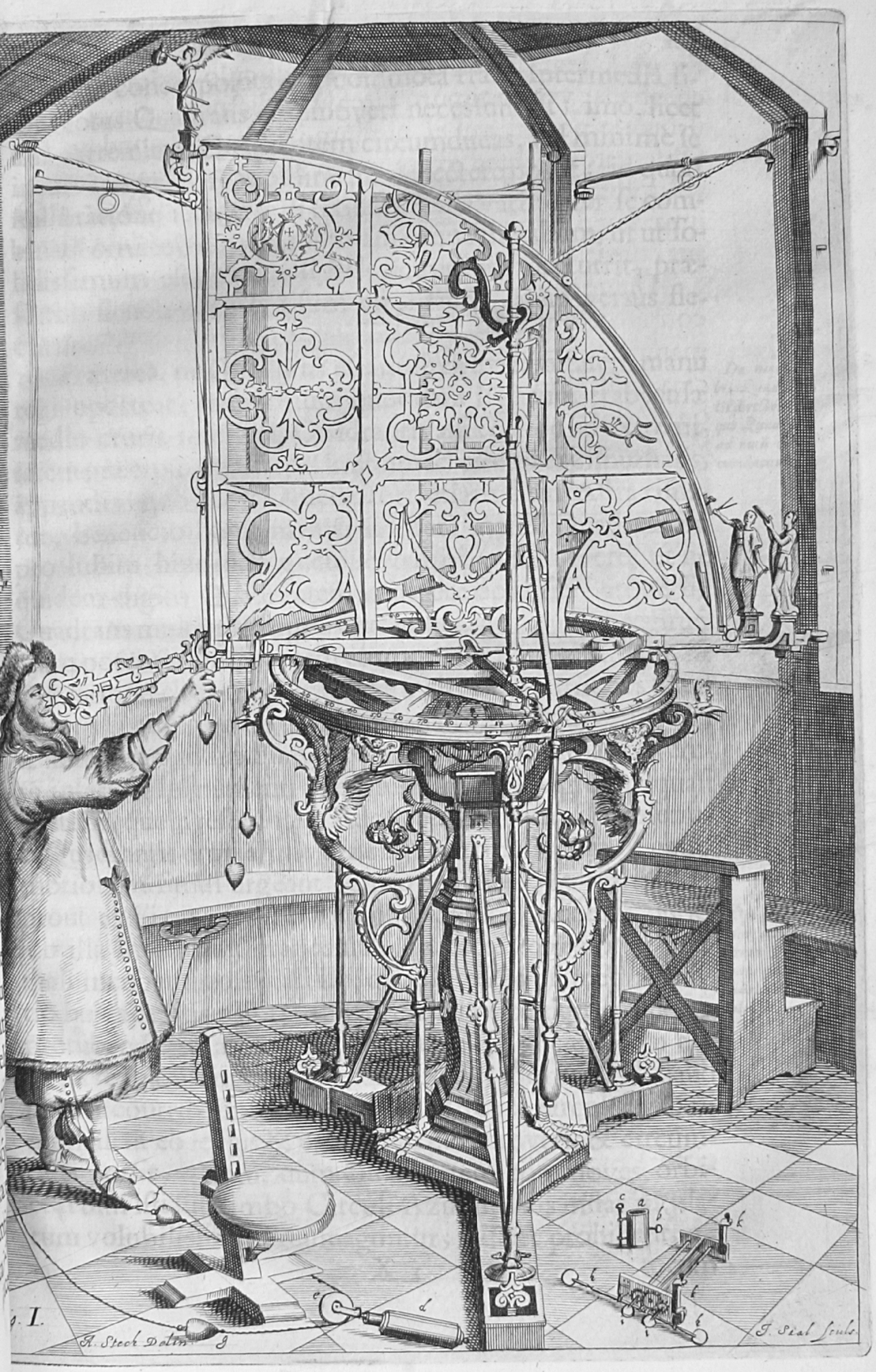
Hevelius uses a quadrant. From Hevelius, Machina Coelestis Pars Prior (1673), facing p. 184. Copyright: Governing Body of Christ Church, Oxford.

Johannes and Elisabeth Hevelius use a grand sextant. From Hevelius, Machina Coelestis Pars Prior (1673), facing p. 222. Copyright: Governing Body of Christ Church, Oxford.

Hevelius and an assistant work with a sextant. From Hevelius, Machina Coelestis Pars Prior (1673), facing p. 242. Copyright: Governing Body of Christ Church, Oxford.
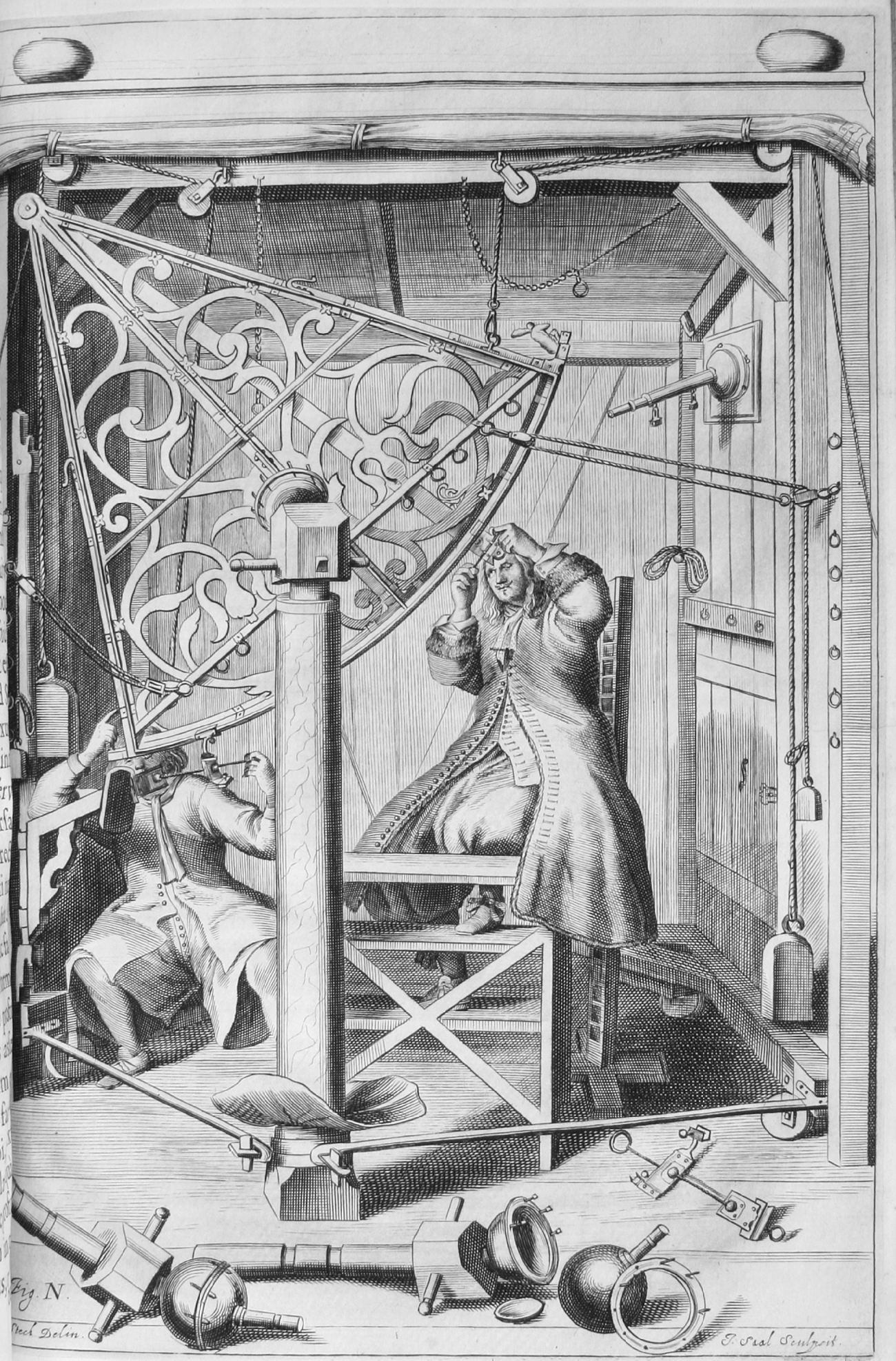
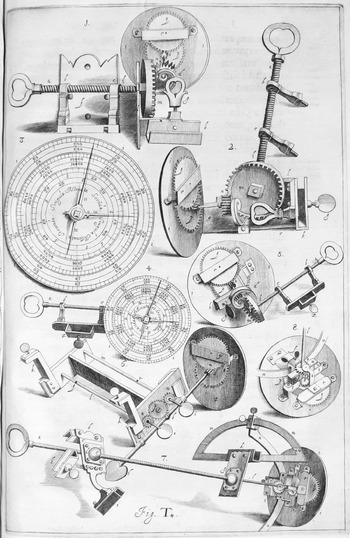
The balance between the status of the natural philosopher as gentleman and the expertise of the craftsmen who made the instruments of experiment was a careful one, wherein the lower social status of instrument-makers could call their instruments into question. Stories of poor lab technicians and lazy engravers plagued Royal Society members,Footnote 40 even if they made their own instruments (like Hevelius, who ground his own lenses). But craftsmen could be extremely valuable if they were proven to be exacting, precise, and highly capable. Hevelius's images of his ornate instruments thus make a claim as to the quality of craftsmanship that went into their production. Such elaborate tooling could only mean that the instrument was made by a careful and well-practised technician – so careful and knowledgeable that one could no doubt trust the workmanship that weighted the plumb line, aligned the eyepiece, and inscribed the geometrical projection that together enabled an astronomer to read off accurate measurements of stellar positions. This assertion is complemented, in a number of occasions in the text, by ‘exploded views’ of watches and telescopes alike, showing Hevelius's instruments as complex, expertly assembled, and made perfectly transparent, visible to the distant viewer (Figure 6).
The astronomer's clocks and their visibly reliable mechanisms, an exploded view, from Hevelius, Machina Coelestis Pars Prior (1673), facing p. 334. Copyright: Governing Body of Christ Church, Oxford.

Usually, however, the instruments do not stand in a vacuum; they are embedded in a scene in which we see Hevelius putting them to use. The instrument and the astronomer are each engraved in a different style with a slightly different technique, and may therefore have been engraved in two different stages of production, or by two different artists. However, the surroundings clearly indicate a place of astronomical work, wherein Hevelius becomes the paragon of such work. One first notices that Hevelius is as sumptuously dressed as his instruments are ornately decorated. In plate after plate Hevelius, and sometimes also his wife Elisabeth, stand at their quadrants and sextants, diligently observing the heavens while attired in courtly apparel. As these stellar observations took place at night in a town on the Baltic coast, Elisabeth's fur-trimmed gown may seen appropriate to the meteorological conditions, but it is still unlikely that any seventeenth-century astronomer, whatever their social standing, would perform their routine observations in such costume.Footnote 41 Complemented by the expensive instruments, however, the ornate dress expresses Hevelius's social status as an independent and wealthy member of the upper echelon of Danzig society. This is one way in which Hevelius can modestly, at a distance, claim to be a trustworthy astronomer: he is clearly a man of means and prestige, which puts him above bribery, bias or concerns for patronage.Footnote 42 Thus Hevelius's portayal in upper-class attire is one of many representational choices at play in the work, a visual statement towards his self-presentation as a credible and deserving Fellow of the Royal Society.Footnote 43
Hevelius does not stand outside the frame, presenting his instruments, or watching his assistants perform the work of his observatory. Rather, in the majority of the images featuring the larger instruments, he is actively engaged in using the instrument at hand. This makes these images useful to the historian as examples of how a sextant or quadrant was actually used, but alongside such a reading is another important visual statement. The viewer notes that Hevelius almost always stands at the eyepiece, looking through it at the heavens, often holding on to the cord that raises or lowers the apparatus into position, while the plumb line, if present, records the star's position in the sky. Even in the two plates which feature Elisabeth, or the other plates which include busy technicians, Hevelius is the one at the eyepiece, sighting the stars while his diligent staff assist in holding the instrument steady, themselves witness to his expert observational practice. The repeated emphasis is on Hevelius's constant, active looking. This visual repetition of Hevelius at the eyepiece reinforces his role as a keen and a diligent observer, dramatizing his reputation as ‘keen-eyed’ or the ‘Prussian Lynx’, and recalling the figure Lynceo on the frontispiece of the Machina Coelestis. And while Hevelius's skill is in the forefront of these images, telescopic sights are conspicuously absent.
Documenting his intensive involvement in his own observational enterprise may seem to compromise his status as a member of the scientific community, as someone so involved in his work could not possibly maintain the requisite degree of disinterestedness. However, we rarely see Hevelius recording his observations. Instead, a pendulum records the stellar position in the sky, or Hevelius turns a crank moving the telescope along carefully delineated grooves that mechanically offer a fixed position. In another example, he merely traces the position of the solar eclipse as it is projected into a room through a mounted camera obscura, which appears to inscribe itself on the paper. This may not be a claim for ‘mechanical objectivity’ so much as it is a claim for instrumental expertise and disinterest in the results.Footnote 44 Stellar positions essentially record themselves due to Hevelius's skill at the helm of the instrument, and thus Hevelius's distance from his recorded observations is maintained, presenting the image of calm, disinterested expertise.
Such images are all the more important due to the complex status of observational astronomy during this period. The introduction of the telescope into a discipline that had previously been concerned primarily with stellar positioning and mathematics opened up the question of exactly what the telescope was good for in astronomy: whether it should be used for judging stellar positioning, if it introduced another kind of practice into the field, and exactly what kind of knowledge – for example, mathematical or metaphysical – it produced.Footnote 45 Hevelius struggled with these questions in his own practice. For example, using different visual languages and modes of representation, the lunar images and maps in Selenographia quite literally draw a distinction between telescopic observations and metaphysical statements about the Moon's nature; and Hevelius's mid-century debate with Huygens over the latter's claim of observing satellites and rings around Saturn also reveals the questionable status of lone telescopic observations compared with others, however carefully collected.Footnote 46 Further, the very practice of observation in early modern science was not without its own tensions, positioned both as the guarantor of knowledge through empirical experience, and as the faulty result of post-lapsarian senses. Instrumental observation could perhaps improve man's imperfect vision, as Hooke hoped the microscope would do,Footnote 47 but on the other hand it could also serve to distance the observer further from the observed and thus compromise empiricism.
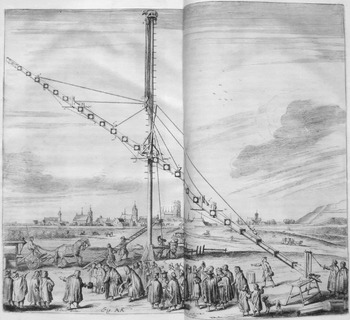
The images of Hevelius at his own instruments manage these competing and often contradictory issues in interesting ways. The repetition of images of Hevelius at the eyepiece make the claim both for observational expertise and for a certain directness of experience on behalf of the author of Machina Coelestis's forthcoming tables of observations. The incorporation of images of telescopes alongside – albeit independently – sextants and quadrants demonstrates the correct, distinct roles for both types of instrument within the new visual astronomy. But further, when Hevelius is not busy demonstrating his keen eyesight and observational expertise, he is demonstrating his hard work, his labour and his intellect. On some occasions, such as Figure 5, we see him at instruments in the process of repair, assembly or sight alignment, although even in these cases he is always placed at the instrument's eyepiece. In Figure 7, he points to his telescope with his sword, instructing a visiting nobleman about the value of the enormous instrument. The repetition of Hevelius's figure throughout the text emphasizes his steadfast involvement, his hands-on approach, his dedication – ultimately, his constancy and indefatigability in the service of astronomy.
The erection of the sixty-foot telescope. From Hevelius, Machina Coelestis Pars Prior (1673), double-page spread between pp. 410 and 411.

Recalling the hieroglyphs on the frontispiece, these repeated pictorial statements allow Hevelius to demonstrate visually, without compromising his modesty by stating outright, just how he embodies the virtues he has earlier established as those of the true astronomer. As such they also demonstrate how one might be an embodied observer and yet overcome some of the difficulties that plagued observational astronomy, such as the limitations of human vision and instrumentally assisted sight. The practice of contemplation, steadfastness and dedication at the telescope or the sextant demonstrates the right kind of labour and the right kind of reverence in the pursuit of natural knowledge. Indeed, depicting the arrangement of instruments, observers and objects that Hevelius claims to be appropriate for ‘true Astronomy’, they also depict an embodied moral self-fashioning. Positioning himself at the eyepiece, scene after scene, Hevelius also positions himself as the right kind of observer, an exemplary astronomer, whose work promises no more and no less than accurate results.
Bigger is better
Alongside his incorporation of the values of the virtuous, genteel and accurate astronomer into the illustrations in Machina Coelestis, Hevelius also indirectly addresses the telescopic-sights controversy. We have already noted that all of the images of his ornate positional instruments feature open sights. Further, his self-presentation as diligent and hard-working – performing again and again those careful observations which, accumulating over time, contribute to true knowledge in astronomy – is also directed at Hooke, whose method Hevelius accused of being too quick and easy to guarantee trustworthy results. Recalling the frontispiece, Astronomy in Hevelius's view proceeds through the use of reason and painstaking observations relegated to Posterity; this also formed an argument for a moral positioning with respect to instruments and to one's own observational powers that could produce accurate observations alongside the appropriate ‘scientific self’. This view was directly opposed to Hooke's, who promoted his telescopic sights on the basis of obtaining quicker sighting measurements through instrumental aids.
But another aspect of the Hevelius–Hooke debate was over telescopic size. According to Hooke, the use of telescopic sights would not only allow for faster observations, but also for smaller instruments that could guarantee a greater degree of accuracy: as he put it, ‘with them an instrument of one span radius can be made much more accurate than another of sixty-foot radius, however good, having common sights’.Footnote 48 Hooke also severely criticized large instruments as fatally flawed should they lack telescopic sights: ‘To what purpose therefore is it to make … any one part of the instrument or observation more accurate then another? Since the power of distinguishing by the naked eye is that which bounds and limits all the other niceness’.Footnote 49 For Hevelius, these claims were outrageous, even ad hominem. Everyone knew that when it came to instruments to measure stellar positioning, size mattered. After all, the unparalleled grandeur of Tycho Brahe's instruments had enabled him to make more acute observations than any other astronomer in Europe. And alongside his keen eyesight, which he claimed surpassed that of the average man and even the average astronomer, Hevelius prided himself on building and operating the largest telescopes on the continent, up to sixty feet long. Thus Hooke's attack on large, open-sighted instruments undermined Hevelius's entire operation in Danzig.
The final chapters of Machina Coelestis, therefore, attempt to show Robert Hooke and his followers just how impressively large, and therefore undeniably accurate, Hevelius's instruments were. The chapter descriptively titled ‘De Telescopo Nostro Maximo’Footnote 50 gives full descriptions and directions as to the construction and operation of Hevelius's sixty-foot aerial telescopes.Footnote 51 The technical details are complemented by a visual montage of the many stages of the telescopes' construction and use. In an initial image, we see Hevelius sitting at a telescope alone, with its component parts spilled out on the balcony, and tiny letters on the scene indicating, for example, his mechanism for aiming the telescope and keeping it steady. But we also see pictures of a large, open telescope being erected outside Danzig. While the images are labelled to give the impression of a technical diagram, they could not enable the construction of the same instrument in another location. Rather, they aim to impress the viewer with the unique scope of Hevelius's production, the grandeur and value of his enormous instrument and his prestige in Danzig. For example, Figure 7 features a collection of noblemen at the foot of the telescope, witnessing its miraculous erection, while Hevelius in his fur hat points to his apparatus. The nobles and the many technicians assisting in the extraordinary scene build excitement about the instrument and stand as testimony to Hevelius's technical prowess and social command. A subsequent image shows the observatory tower in which not one but four sixty-foot telescopes are being used or assembled. What we – and his Royal Society colleagues – are meant to see in these images is an impressive, reputable and even unparalleled space of work and instrumentation. The illustrations do not simply show his telescopes or give technical details as to their construction; they also demonstrate to the reader that Hevelius's observatory is the primary and deserved centre of astronomical production in the late seventeenth century.Footnote 52 Such images may have served as a powerful reminder to the Royal Society of just how fortunate they were to receive news from Hevelius, and how their own prestige was magnified by including such an observatory's owner amongst their Fellows. If such important observations made with such unparalleled instruments were still desiderata to the Royal Society, the images of Hevelius's impressive instruments reminded its members that they ought to accord the utmost respect to their distant Fellow.
Heritage and pedigree: Hevelius as Tycho's heir
It was difficult for a merchant or a self-made man to be taken for a true gentleman: much emphasis was placed on his pedigree, his heritage and even his title, issues which persistently plagued Robert Hooke in his involvement with the Royal Society.Footnote 53 While contributors such as Leeuwenhoek, a draper, were not titled citizens, they were also not so readily granted the status of Fellow within the society.Footnote 54 Hevelius was a civic councillor, a wealthy citizen brewer and a beneficiary of the king of France, all items to his credit abroad, but he did not possess any further noble pedigree. However, he does point to a particular lineage within astronomy as a resource to support his enterprise of self-presentation. To certify his status as the reigning authority on astronomy and the keenest celestial observer in Europe, Hevelius actively promotes a visual analogy between himself and Tycho Brahe.
Hevelius was a great admirer of Tycho Brahe and adopted many of his methods: indeed, it was his persistence in the use of Tycho's instrumental sights and projections that identified him as a Tychonic astronomer in methodology, albeit not in cosmological commitments. But to directly compare oneself to Tycho Brahe, one of the ‘Most Excellent and Virtuous Men’ as established in the frontispiece to Machina Coelestis,Footnote 55 would be a suspicious act of self-promotion. Hevelius thus keeps his admiration for Tycho clear throughout his text, humbly referring his own observations, methods and instruments to Tycho's as a point of comparison. But he simultaneously adopts several rhetorical demonstrations of note that establish a direct connection between himself and the Dane, by association attributing Brahe's honorary status, as if by inheritance, to his own production.
The first such rhetorical move is to state clearly and to emphasize the ‘in-house’ nature of Hevelius's operations. Like Tycho's, Hevelius's instruments were self-built, on location in Danzig, under close supervision. Further, like Tycho, Hevelius owned and operated his own printing press with which he engraved his own plates, did his own typesetting, made his own paper and distributed his own books. As Adrian Johns makes clear, this aspect of Tycho's production – tight control over all aspects of the print process – was an important factor in generating trust in the midst of the chaos and piracy of the early modern book trade.Footnote 56 But in addition to employing Tychonic strategies for building trust in his reports, the analogy continues in the presentation of the Organographia itself: a visual catalogue of instruments. The layout and concept of Machina Coelestis is modelled upon Tycho's Astronomiae Instauratae Mechanica (1598), also a catalogue of instruments.Footnote 57 Each separate chapter is titled with a single instrument's name; each sports a print of the instrument, displaying its technical details; and each then bears a lengthy description of the instrument's construction, its use, its projection, its mechanism and its history. Just as the Instauratae offered a much-sought-after glimpse into Tycho's extraordinary observatory, Hevelius's Machina Coelestis offers the same, and profits from the analogy. The connection was not lost on Robert Hooke, who picked up a copy of Brahe's Astronomiae Instauratae Mechanica five days after reading Hevelius's Machina Coelestis: he records this event in his diary as ‘Saw Tichoes Machina Coelestis.’Footnote 58
Hevelius refers to Tycho throughout the text, but nowhere is his connection made more explicit than in the final chapter, ‘De Stallaeburgo nostro’. In the last chapter of his Instauratae, Tycho Brahe discusses Uraniborg, his castle observatory on the island of Hven. So too does Hevelius close with a description of his brewery–observatory, which he calls his ‘Stellaeburg’:
The truth is, dear reader, isn't it, what I have persuaded you, that I approach the Magnificent, Splendid, Greatest, last king of Uraniborg, which the Noblest Tycho owned, commanded, outfitted and built by the king, even though my equipment is much poorer? … While I am not a King, still I am a citizen of Stellaeburg …Footnote 59
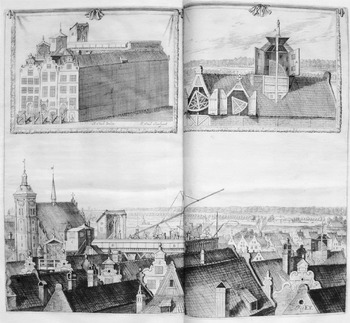
The relationship between Stellaeburg and Uraniborg continues with detailed illustrations of Hevelius's house and view of his instruments at work from the rooftop, peopled with a variety of observers and astronomers: a veritable hive of astronomical activity, a bounded social and physical space for the specific labours of science.Footnote 60 In Hevelius's Fig. EE (Figure 8) we see a house dedicated entirely to astronomy, much like Tycho's island palace. The reader is implicitly reminded of Tycho's own invocation at the end of his Astronomia Instauratae Mechanica: ‘For I hope that also in future there will be some who are caught by such high interests and who will take great pains to imitate or even surpass these works.’Footnote 61 By the end of Machina Coelestis, Hevelius makes clear that he has taken up Tycho's challenge. Despite his modesty in the text, the detailed plates and descriptions inspire the reader to view Stellaeburg as the heir apparent to Uraniborg. The images of Hevelius's observatory at work seal this claim, apparently sketched from a fictional vantage point but including an architectural sketch of the main house in a visual reference to Tycho's parallel illustration. At a time when Hevelius's own private institution was threatened by his colleagues' questioning his observations and at the dawn of the great national observatories, Hevelius makes a strong visual claim to his astronomical pedigree, in addition to his civic titles, all the while asserting the extraordinary and superior work and capacity of his own, private observatory.
Stellaeburg, Fig. EE from Hevelius, Machina Coelestis Pars Prior (1673), double page spread between pp. 444–445.

Hevelius weaves his careful self-presentation into the instrumental images in Machina Coelestis such that even a viewer interested in technical information would garner a sense of his status as a trustworthy observer. He constitutes this visual appeal to credibility with a variety of related elements: establishing and then exhibiting the virtues of the ideal astronomer; displaying his high social standing through costume, ornate instruments, command over a workforce or prestige among Danzig nobility; positioning himself as an instrumental authority while maintaining genteel distance from his results; and connecting the scope and importance of his production to that of the famous Tycho Brahe. Such a depiction presented the right kind of scientific self to his distant, doubting colleagues, a presentation aimed at inspiring renewed respect. But no story of visual rhetoric is complete without a consideration of its reception. As Machina Coelestis, the instruments and the observer it portrayed became the target of sustained attack, the subsequent controversy brought devastating implications for how the images were eventually received.
Reception and aftermath
On 26 August 1673, Hevelius packed six copies of his first volume of Machina Coelestis – one for the Royal Society, one for its president, one each to Cambridge and Oxford, and copies for John Wallis and Henry Oldenburg – into a ship destined for London. A few days later, he sent another ten copies for sale to ‘lovers of literature’ for four imperial ducats each, one of which would shortly be purchased by Robert Hooke.Footnote 62 After six anxious months (his most recent attempt to send valuable paper to England had failed when the ship was taken by Scottish pirates),Footnote 63 the copies were received and delivered. The final issue of Philosophical Transactions in 1673 featured a short account of the book and its contents, closing with the enigmatic remark ‘His thoughts of Telescopical Sights, and his Exceptions against them, deliver'd pag. 294, & seqq, we leave to the consideration of those, that prefer them to the Common ones.’Footnote 64 In spite of the longer technical review, this brief concluding note reveals the issue of pressing concern to the Royal Society. When Oldenburg wrote to Hevelius early in the new year reassuring him that the copies were delivered, he responded to the latter's request to ‘freely speak out as to what [the Fellows] feel about it, what they like, or perhaps what they don't like’Footnote 65 with caution:
I cannot yet let you know what the astronomers of our Society judge of your work; perhaps you may learn their opinion in the packet I am going to send you by sea … There are those among us, of whom Mr. Hooke is one, who despite what you have written on p. 294 against telescopic sights, persist in a constant and absolute preference for them as against the ordinary, established sights, and believe that without using them no accurate observations of the heavens can be effected.Footnote 66
But Oldenburg only revealed a partial truth to Hevelius in this careful reply. The Machina Coelestis was not delivered to most of its intended recipients until 20 December, and not written up in Philosophical Transactions until 22 December – but it had evidently arrived in England a whole month earlier.Footnote 67 Robert Hooke first saw a copy on 23 November. On 28 November, he consulted Tycho Brahe's Astronomiae Instauratae Mechanica, and by 3 December, he had reported, ‘At home all the afternoon and writ Lecture on Hevelius his Machina Coelestis.’Footnote 68 A week later, his Diary records,
Thursday December 11th, 1673. Read Sir J Cutlers lecture. Present Lord Brounker, Lord Dorset, Sir J. Louther, Sir W. Petty, Mr. Haak, Mr Colwall, Mr Smethwick, Dr. Whistler, Dr. Grew, Sir Cyril Wych, Dr. Croon, Mr Blackburne, Mr. Oldenburg, Mr Colwall junior. Read ¾ of an houre animadversions upon Hevelius his Machina Coelestis.Footnote 69
Thus by 9 January Oldenburg had not only sold a copy of Machina Coelestis to Robert Hooke, he had already been subjected to a forty-five-minute Cutler Lecture featuring Hooke's opinions on the new book. And he could not have avoided it further: Hooke ‘Discoursd’ his topic at the next week's meeting of the Royal Society as well, and on 15 January 1673/4 he performed an experiment to prove the superiority of his methods, placing Royal Society members at a distance from a ruler subdivided into minutes of a degree and making them sight the object with the naked eye. According to Hooke, this proved experimentally that
not any one present being placed at the assigned Distance was able to Distinguish those parts which appeard of the bignesse of a minute but they appeard confused. This expt he [Hooke] produced, in order to show, that we cannot by the naked eye make any astronomicall or other observation to a greater exactnesse than that of a minute, by Reason that what ever object appears under a lesse angle is not Distinguishable by the naked eye … unlesse the Eyes were assisted by other helps from optic glasses.Footnote 70
The same experiment was repeated on 22 January, and a week later, on 29 January, Hooke repeated his Cutler lecture (to ‘six or eight auditors’).Footnote 71 He produced a quadrant with telescopic sights by 23 April, and included plans for a new and improved quadrant among his many projects throughout the year.Footnote 72 When Oldenburg received Hevelius's response to the above-mentioned January letter with a discourse about telescopic sights that was eventually printed in Philosophical Transactions, Hooke was on hand to draft his reply, first reading the letter at Oldenburg's on 22 April 1674 and then taking it home with him ‘to coppy and answer’.Footnote 73 When the Cutler Lecture on the Machina Coelestis was printed in November of 1674 under the title Animadversions on the first part of the Machina Coelestis, Oldenburg could no longer protect Hevelius from knowledge of Hooke's activities. Hooke himself took the liberty of personally distributing copies of his published lecture among the key members of the Royal Society. A copy ultimately made its way to Danzig.
Hooke's book takes the guise of a lively philosophical discussion, as befits a Cutler Lecture, but upon closer reading it constitutes a personal attack. While it is beyond the scope of this paper to explore the Animadversions in detail, a few of Hooke's claims are of note for how they compromise the visual self-presentation that Hevelius had so carefully devised. Hooke destroys Hevelius's source of credibility through association with Tycho Brahe by focusing on the errors in Tycho's observations, the correction of which constituted a main goal of the period. He then profits by Hevelius's own analogy by insisting that Hevelius's instruments and eyesight are no better than Tycho's, thus implying that the former's observations would be subject to the same errors as the latter's. He repeatedly claims that size is not important to positional astronomy, and that his own invention enables a single-span telescope to out-perform one of sixty feet, making the large instruments appear cumbersome and unnecessary. He declares Hevelius remiss for not attempting to use telescopic sights more than ‘one tryal in seven years time’,Footnote 74 making the foreign astronomer appear either lazy, or too invested in his own methods to embrace the philosophical disinterest that would lead him to giving telescopic sights another try.
The written version of the lecture, too, prefaces with a frontispiece that lists Hevelius's title and social status in large letters, taking up most of the page, with only a small indication that this is a lecture given by Robert Hooke: this draws attention to precisely those aspects of Hevelius's person, book and reputation that Hevelius had hoped the Machina Coelestis would advance, while downplaying Hooke's role in their refutation. It is also not insignificant that Hooke took advantage of the distance between himself and his opponent by giving this lecture aloud, more than once, as an oratory in English to the audience of Royal Society members, with Hevelius far away in Danzig. He supplemented this discourse with a repeated experiment to demonstrate that such visual skills as Hevelius boasted were impossible without the assistance of optical glasses. Thus the rhetorical arsenal at Hooke's disposal outpaced Hevelius's decorous, careful Latin and static images, and did not allow for public criticism from the Hevelian perspective.
Finally, Hooke discredited Hevelius's impressive instrumental images at a single blow, identifying the key aspects of their visual presentation discussed above and dismissing them as fundamentally invalid:
There is therefore one thing in Hevelius his Instruments, that though they be never so large, never so accurately divided, of never so choice and convenient materials, and never so tractable for use, and never so skillfully and industriously used, will notwithstanding make them all equal as to use, with one of about two or three foot radius of metal with Ticho's Sights and Diagonal Divisions, which is occasioned by the limited power of distinguishing by the naked eye.Footnote 75
Reactions to Hooke's lecture indicate that it was outrageous enough to deserve special attention. Reputations and friendships were damaged and in need of careful management. For example, John Wallis wrote in indignation and concern to Oldenburg, worried that because Hooke had used one of his own theories in Animadversions, his colleague Hevelius would think that Wallis supported Hooke. He requested a reprint of this misquoted letter in Philosophical Transactions to set the matter straight.Footnote 76 Privately, he told Oldenburg,
I have now read ye whole of Mr Hooke's against Hevelius, which I think bears a little to hard upon him. Hee might have published his own way to as good advantage as he pleased, without so frequent Reflections on Hevelius, as he hath at every turn.Footnote 77
Wallis also included a letter for Oldenburg to send to Hevelius, which indicates his concern over his own friendship with the foreign astronomer and the tone with which Hooke's comments were received by his colleagues in England:
I should not like the distinguished Hevelius to believe that, because Mr. Hooke inserted my letter into his work, I concur with anything harsh which he [Hooke] may have written against him [Hevelius]. Indeed, I was entirely ignorant of the book itself before it appeared in the booksellers' shops. Not that I would deny, that when he recently asked me causally about whether I would permit him to make public what I wrote formerly about division by means of diagonal lines … I did not know that it was to be included in that book against Hevelius … But however this may be, there is nothing in this letter of mine (faultily printed) which Mr. Hevelius may take badly; or was written with malice.Footnote 78
It would take all the strength of Oldenburg's diplomacy to manage relations between Hevelius and the Royal Society following the Animadversions. Indeed, a previous priority dispute levelled by Hooke against another foreign member of the society, Christiaan Huygens, over a watch mechanism had undoubtedly left Oldenburg no stranger to managing the Royal Society's network under similar strain. In a mastery of understatement, Oldenburg advised the Prussian Lynx,
You will perhaps resent the comments which Mr Hooke has made on the first part of your Machina Coelestis. If you have some resources at hand with which to defend your work you may take the same philosophical liberty which he has used to make them public.Footnote 79
Oldenburg may even have taken some ‘philosophical liberties’ of his own: while the records of the Royal Society publicly note an injunction passed against Hooke on 25 January 1676/7, declaring ‘that what Mr Hooke had published against [Hevelius] was done without any approbation or countenance from this Society’, Hooke's own handwritten gloss on this section of Oldenburg's notes records that ‘this is a lye of Oldenburgs forging there was noe such order’.Footnote 80
Hevelius's long reply to Oldenburg's letter of 1675 indicates that he intended to take his ‘philosophical liberties’ in a later publication. He first expresses frustration with Hooke for writing in English, which required translation on location in Danzig and which Hevelius considered both rude and a waste of his time. He further complains of Hooke's obstinate interestedness in his own inventions and antipathy towards others: ‘nothing concerns him more than that he should persuade me and the whole world that his method of observing stars is the best of all’.Footnote 81 But he also reveals the core of Hooke's rhetorical moves against his own programme as established in Machina Coelestis, especially the triviality with which Hevelius's observations are treated and Hooke's forked tongue in praising Hevelius as a worthy astronomer while simultaneously destroying his credibility:
[Hooke] reviles my observations and small labours, slights them and makes them of no account, and myself he everywhere slanders, mocks and uses scornfully. For in his opinion nothing is ever rightly or properly undertaken or completed by me, nothing which does not deserve censure and his unseasonable correction, nor, so far as I could understand, does he approve of anything among my doings, whatever it may be … The best of the joke is, that while he almost assaults me with his praises [yet] as is evident from the rest of his phraseology on various pages he more and more mocks and wounds me …Footnote 82
Finally, Hevelius insists that Hooke has no right to ‘continually to tear to pieces, despise and scorn’ the observational labours that
it has never so far befallen the distinguished Hooke to watch, for there is no way in which he could have seen them, much less [know] what may be deduced from them: whether the observations may be made to so many whole minutes of arc only, or to seconds? Whether this or that lay in the power of any man of any nation, or no? and other questions of this kind, which depend upon actual events and experience alone …Footnote 83
With this particular appeal Hevelius undermines his own visual programme, or at least reveals its inefficacy. Hooke cannot, he claims, judge Hevelius's observational work without seeing it done in person. The images, clearly, were not enough to convince Hooke and his followers of Hevelius's powers of observation, and Hevelius therefore wishes to claim that some further, direct witnessing is required in order to establish the excellence of his observatory. His wish would be granted a few years later, when the Royal Society sent the young Edmond Halley to Danzig to observe with Hevelius at his observatory for three months in the summer of 1679 and then to report back to the society.Footnote 84 Clearly, the challenge to Hevelius's instruments as levelled and continued by Hooke had rendered the images merely decorative, even excessive and dated, instead of powerful visual rhetorical statements. Unable to use this visual technology to witness Hevelius's claims to excellence in astronomy, the Royal Society members were advised to see directly for themselves.
But Hevelius's images were damaged by the Animadversions beyond their inability to enable a convincing virtual witnessing experience. It suddenly becomes apparent that every time Hevelius is pictured looking through an ornate baroque instrument, he is doing so without a telescopic sight. What was originally a visual claim to accurate, diligent observation and appropriate, even moral, positioning suddenly appears, in the wake of Hooke's attack, a negligent, flawed and outdated practice. Hevelius's book was fresh off the boat: most Fellows had not yet had a chance to look through it before listening to Hooke's vehement lectures and participating in his demonstrations, and it was not distributed or reported in the Transactions until after Hooke's first lecture in early December of 1673. No doubt many of the Fellows who turned to Machina Coelestis after Hooke's Cutler Lecture interpreted the images in quite a different way than Hevelius had intended.
Conclusions
It is certainly no surprise to scholars of images in science that historical actors frequently use images or other visual materials to manage their reputations. Patricia Fara's study of portraits of Isaac Newton and Biagioli's discussion of Galileo's use of emblematism, among others, demonstrate how the visual can build credibility or even legendary status for these scientists among their contemporaries.Footnote 85 Among such company the Machina Coelestis, a self-published book printed by a Prussian councillor with limited circulation, distributed to remote philosophers instead of to princes or institutional benefactors, may seem like an outlier. However, as this article demonstrates, the visual programme of self-presentation is at work even in a book that is ‘just about instruments’. In this example, images were central ‘materials at hand’ out of which a distant Royal Society member attempted, in the face of controversy, to craft, present and reassert his identity as a trustworthy observer for the society.Footnote 86 Hevelius's frontispiece establishes the criteria for the ideal astronomer, and his subsequent visual statements complement his textual modesty with continual reassertion of these aims, goals and ideals as embodied in his practice. Through costuming, observational scenes of impressive scale and scope, and ornate instruments, he establishes his persona, while through his visual association with Tycho Brahe he assumes the famous astronomer's credibility and the international status of his observatory. And by putting himself in the picture, using his instruments, he presents his visual acuity in action and his long-term devotion to astronomy. Hevelius's images speak to his concerns at the outset of the debate over telescopic sights and in the wake of the cometary controversy of 1665; whether or not depictions of laboratories, experiments and apparatus in other times and places were produced under similar controversial circumstances, they may still present clues to the analyst as to their complex motives and positioning. The ‘scientific self’ is not just cultivated at a laboratory desk through scientific labour,Footnote 87 but is also produced as a persona through the crafting and circulation of images.
As these images allow the author to say one thing and show another, they can betray their own programmatic rhetoric distinct from or augmenting that of the text. Scholars have long recognized a role for imagery as part of a textual rhetorical programme: as discussed above, Shapin and Schaffer have argued that detailed illustrations alongside prolix text constitute the ‘literary technologies’ that gave readers a heightened sense of following an experiment.Footnote 88 Such a symmetry between the verbal and the visual may compose one rhetorical strategy for conscripting observers at a distance, but the visual strategies at play in Hevelius's work do not directly make visual his verbal claims. Rather, Hevelius employs the appeal of a virtual witnessing framework in order to relay images that emphasize what he reserves himself from stating outright in the text: his status as an exemplary astronomer, the head of the most prestigious observatory in Europe. These aims are complementary, no doubt, but different enough in aim and practical achievement as to deserve distinct analytical attention. Indeed, as Hevelius's bold images complement his textual modesty and relaying of technical details and instrumental histories, we might say that they comprise a distinct visual technology augmenting the literary techniques at work in the text. Separating the visual programme from the literary one permits analysis of various kinds of rhetorical assemblage, especially when different modes of argument are leveraged visually as opposed to verbally. Not just totius in verba,Footnote 89 then, but certainly aliqui in pictura as well.
However, as impressive as Hevelius's images were, they ultimately failed in their ability to reach their audience as intended. The outcome might have been different had Robert Hooke not published the Animadversions or had he heeded Wallis's suggestion to address his point without attacking Hevelius so directly and vehemently. But the Animadversions had a profound effect on how the images were received and disregarded. The subsequent rise of the English and French national observatories may have further influenced the practice of astronomy such that by the end of the century, Hevelius's plates would not find many sympathetic viewers.Footnote 90
With the failure of this visual programme in mind, it is tempting to cast this example as another episode in which distance plays a crushing role, thwarting the ability of an actor at the periphery of knowledge construction to receive the same respect as one who occupied a position at the centre. But such an approach would obscure the complexities that confronted actors at the time. More fruitful for the analyst is Mario Biagioli's recent argument for a reconceptualization of distance and the partial perspectives it produces as part of the condition of knowledge production: the background against which knowledge work is done and made meaningful, not a problem that required attention and resolution. Such an analytical perspective highlights how the distance between Hevelius and his colleagues in London was not so much delimiting as it provided opportunities for Hevelius to use images to great effect. The images in Machina Coelestis take for granted the geographical dispersion of its author and its readers, a distance that Hevelius attempts to employ to his benefit by deploying a virtual identity composed of elaborate displays of instrumental expertise alongside epistolary elegance. Hooke and Oldenburg also took this distance for granted in their responses to the text, whether in letters to Hevelius, publications circulated in Philosophical Transactions, speeches in London or conversations behind closed doors. Some methods were more successful at achieving these actors' aims than others.
Additionally, relocating the problem of knowledge reveals the techniques of manoeuvring networks of people and resources to meet and work within these conditions. Oldenburg's role in the management of controversy is of particular interest here as he so carefully chose what to reveal and what to conceal, to whom and how. It is no surprise to find that, yet again, solutions to both the problem of knowledge and the problem of social order are so closely intertwined,Footnote 91 but the strategic deployment of deceit, bureaucratic procedure, language, time and even piracy in the maintenance of this social order become visible for analysis once we assume that geography is not a problem with which actors grapple at every turn. Even categories such as ‘centre’ and ‘periphery’ cannot be easily applied here. The Royal Society was working hard at this time to establish London as a philosophical centre, and relied upon recognition from other locations of knowledge production, Stellaeburg among them, in order to stake this claim. The images in question reveal this tug of war between self-cast locations of authority that was unresolved at the time of the publication of Machina Coelestis; indeed, this is one of the very issues that the book's publication aimed to resolve in Hevelius's favour.
But this case also begs a historiographical question for the historian of images in science: should the failure of Hevelius's project matter to the reading of the images? That is, should knowledge of the images' reception influence an analysis of their symbolism, structure or intent? While clearly nonsensical when applied to texts, this question articulates a common problem faced by historians of the visual in science, who regularly confront a paucity of material to support their analysis – not a paucity of visual material, necessarily, but of associated texts about visual material with which to make robust claims. As historians we are adept at employing letters, manuscripts or other written materials as evidence, and as a result analysts frequently seek out corresponding statements in an image's accompanying text or extant audience responses that confirm the artist's intent. But as we have seen above, intent and reception, even literary and visual rhetoric, do not necessarily align. Quite the contrary: it is especially interesting when they do not.
Thus this analysis of Hevelius's images – and other analyses of visual material in science – ought not to depend upon how well the images achieved the author's aim, stated or unstated. Instead, in the same vein as the analytical symmetry required by the strong programme in the sociology of scientific knowledge,Footnote 92 we must hold images' reception in the balance in order to see them at work in their context of production and of contestation. The tools of the art historian are helpful here, especially Michael Baxandall's suggestion that the analyst seek ‘patterns of intention’, ‘a representation of reflection or rationality purposefully at work on circumstances’.Footnote 93 After all, Hevelius, like other ‘makers of pictures’, ‘is a man addressing a problem of which his product is a finished and concrete solution’.Footnote 94
Examining Hevelius's images in their historical and social context – after the cometary observations and during the escalating tension over telescopic sights, circulating among a far-flung network in which status played a role in the struggle for epistemological legitimacy – can help us to locate the relevant problem the images were meant to address and to catch a glimpse of the intent, as opposed to the eventual outcome, of his visual strategy. Such an approach opens up rich opportunities for the analysis of visualizations both as resources crafted by participants to address issues of concern and as contested objects over which actors vie for interpretative authority. It is perhaps thus that the images in Machina Coelestis provide a window into the seventeenth-century observatory after all, revealing a space in which the politics of a broader network are locally negotiated, where the eruption of controversy requires swift reputation management, and where even images of instruments can be instrumental.