Introduction
In the past, long-term care placement for elders with dementia or other chronic, disabling mental health conditions often meant admission to nursing homes (NHs). More restrictive nursing home entry criteria paired with increased private and public demand for less expensive and more homelike community-based services has increased the attractiveness of assisted living (AL) as an alternative residential care option in the United States. (Morgan et al., Reference Morgan, Gruber-Baldini, Magaziner, Zimmerman, Sloane and Eckert2001). AL typically provides housing, personal care services, health-related services, and supervision, and seeks to emphasize person-centered services that promote autonomy, dignity, and privacy and accommodate changing needs (American Health Care Association National Center for Assisted Living, 2009). As such, AL has become linchpin in the care continuum for elders with mental disorders, particularly dementia, whose medical acuity does not warrant nursing home care but who require a supervised, supportive setting in which to live. This is evidenced by the extensive proliferation of dementia care programs offered in AL over the past several years (Metropolitan Life Insurance Company, 2011). As the prevalence of dementia in the US population increases, it can be expected that AL utilization trends will continue to accelerate.
Cross-sectional data from the Maryland Assisted Living (MDAL) study based on direct physician assessment found that 80% of residents had either dementia (67.7%) or another psychiatric disorders and that recognition and treatment were often inadequate (Rosenblatt et al., Reference Rosenblatt, Samus, Steele, Baker, Harper, Brandt, Rabins and Lyketsos2004), and it is clear that this level of psychiatric morbidity is not unique to ALs in Maryland. Indirect estimates of cognitive impairment among AL residents in multi-state and nationally representative samples range from 40% to 63% (Hawes et al., Reference Hawes, Wildfire, Mor, Wilcox, Spore, Iannacchione, Lux, Green, Greene and Phillips1995; Morgan et al., Reference Morgan, Gruber-Baldini, Magaziner, Zimmerman, Sloane and Eckert2001; Magsi and Malloy, Reference Magsi and Malloy2005). Similarly, prevalence estimates for mood disorders and depressive symptoms among AL residents have ranged from 13% to 24% (Hawes et al., Reference Hawes, Wildfire, Mor, Wilcox, Spore, Iannacchione, Lux, Green, Greene and Phillips1995; Watson et al., Reference Watson, Garrett, Sloane, Gruber-Baldini and Zimmerman2003; Dobbs et al., Reference Dobbs, Hayes, Chapin and Oslund2006). The prevalence of mood disorders was approximately 18% in the MDAL study (Rosenblatt et al., Reference Rosenblatt, Samus, Steele, Baker, Harper, Brandt, Rabins and Lyketsos2004), falling in the middle of the range of these estimates. Further, estimates from the MDAL-I studies using proxy-rated and direct observation methods for assessing symptoms of anxiety suggest that 22%–45% of AL residents experience at least mild anxiety symptoms (Smith et al., Reference Smith, Samus, Steele, Baker, Brandt, Rabins, Lyketsos and Rosenblatt2008), with 13% meeting the DSM-IV-TR criteria for anxiety disorder (Rosenblatt et al., Reference Rosenblatt, Samus, Steele, Baker, Harper, Brandt, Rabins and Lyketsos2004). Less is known about the prevalence of other psychiatric conditions.
Mental disorders in AL have been associated with poorer resident outcomes. For example, the MDAL survival data show that residents with dementia exit the facility 209 days (about seven months) sooner than those without dementia (Lyketsos et al., Reference Lyketsos, Samus, Baker, McNabney, Onyike, Mayer, Brandt, Rabins and Rosenblatt2007). This differential risk of discharge may be explained in part by facilities propensity to discharge residents due to dementia-related behavioral issues. Dementia and related behavioral disturbances in AL are also associated with the worse quality of life (QOL; González-Salvador et al., Reference González-Salvador, Lyketsos, Baker, Hovanec, Roques, Brandt and Steele2000; Samus et al., Reference Samus, Rosenblatt, Steele, Baker, Harper, Brandt, Mayer, Rabins and Lyketsos2005) and higher dependency (Burdick et al., Reference Burdick, Rosenblatt, Samus, Steele, Baker, Harper, Mayer, Brandt, Rabins and Lyketsos2005; Dobbs et al., Reference Dobbs, Hayes, Chapin and Oslund2006; Samus et al., Reference Samus, Mayer, Onyike, Brandt, Baker, McNabney, Rabins, Lyketsos and Rosenblatt2009). Depression and mood disorders have been also shown to be highly predictive of discharge from nursing homes (Watson et al., Reference Watson, Garrett, Sloane, Gruber-Baldini and Zimmerman2003).
Since AL serves a substantial number of individuals with serious mental health disorders, and will likely to serve even more in the future, and the associations of these disorders with adverse outcomes have been documented, stakeholders have raised serious questions with regard to the extent of mental health morbidity in the AL setting and care quality. The majority of data on mental disorders and mental health care in AL come from cross-sectional studies that have often relied on indirect assessments. Longitudinal empirical data that describe the burden and care of mental disorders in AL are sorely needed as policy makers and the industry scramble to make critical decisions about how best to undertake quality improvement initiatives (National Center for Assisted Living, 2012). Here we present the first longitudinal evaluation of detection, course, treatment, and associated morbidity of mental disorders in a recently admitted cohort of AL residents in Maryland. Specifically, using direct physician assessments, we report on the prevalence, incidence, and persistence of psychiatric disorders over a 12-month period and describe the recognition and treatment of these conditions.
Methods
Study overview
This study (MDAL-II) is a longitudinal continuation of the original MDAL study (MDAL-I). A detailed description of the MDAL-I methodology has been presented previously (Rosenblatt et al., Reference Rosenblatt, Samus, Steele, Baker, Harper, Brandt, Rabins and Lyketsos2004). Briefly, MDAL-I (2000–2003) was a cross-sectional investigation of the prevalence of dementia and other psychiatric disorders in AL in a cohort of 198 AL residents (Cohort 1) residing in a random sample of 22 facilities in the Central Maryland region (seven counties and the City of Baltimore). MDAL-II (2003–2009) involved longitudinal follow-up of the original Cohort 1 and the enrollment and follow up of cohort of recently admitted AL residents (Cohort 2) assessed within the first 12 months of admission to AL. In total, MDAL has collected data on 401 residents from 30 facilities: 18 large (>15 beds) and 12 small (≤15 beds). The analyses presented here concern only the recently admitted Cohort 2 volunteers (n = 200).
Facility recruitment
Twenty of the original 22 facilities that participated in MDAL-I took part in MDAL-II; the other two had closed. Five (two large and three small) of these did not refer Cohort 2 residents for enrollment, but participated in the continued follow-up of Cohort 1 residents. Six additional large facilities were randomly selected using a selection strategy similar to Phase I (Rosenblatt et al., Reference Rosenblatt, Samus, Steele, Baker, Harper, Brandt, Rabins and Lyketsos2004). The sampling frame consisted of 1,812 licensed facilities in the Central Maryland region as of 8/2003. In total, 21 facilities (13 large and eight small) provided participants for Cohort 2.
Participant recruitment
The executive director of each facility initiated contact with recently admitted residents on the study's behalf or provided the study team with resident/family contact information. Residents with a long-term residential contract and who had been living in the facility for 12 months or less were eligible to participate. Respite stay residents were excluded.
Four hundred and forty-four recently admitted residents were referred to the study (395 from large facilities and 49 from small facilities). At initial contact, 51 were unreachable, 36 had moved, 19 did not meet the eligibility requirements, and 18 had died. Of the remaining 320 residents, 203 (63%) agreed to participate. After excluding three mistakenly enrolled due to administrative errors, the final sample is comprised 200 recently admitted enrollees. Reasons for non-participation included resident choice (59%), family refusal on the resident's behalf (26%), severe medical illness/hospice (9%), or severe mental illness (5%).
Baseline procedures
All study procedures were approved by the Johns Hopkins Institutional Review Board. Informed consent was obtained from the resident, or in cases of cognitive impairment, from a legally authorized representative using the Maryland Healthcare Decision Act as a guide. Written or verbal assent was obtained from the residents if they were not able to provide informed consent (Black et al., Reference Black, Brandt, Rabins, Samus, Steele, Lyketsos and Rosenblatt2008).
A geriatric psychiatrist (AR, CL, CO, or DJ), research nurse, and psychometric technician/research assistant conducted in-person assessments nearly identical to those in MDAL-I (Rosenblatt et al., Reference Rosenblatt, Samus, Steele, Baker, Harper, Brandt, Rabins and Lyketsos2004). This included mental status, neurological exam, and Structured Clinical Interview for DSM-IV (SCID; First et al., Reference First, Spitzer, Gibbon and Williams1995) by the geriatric psychiatrist with input from the resident, a responsible family member, and a direct care staff; a detailed narrative history; standardized quantitative measures; an AL chart review (e.g., medications, diagnoses, labs); and a 1-h neuropsychological battery. Limited facility-level demographic data were collected, including capacity, staffing ratios, for-profit status, current occupancy (number of current residents/number of available units), and years in operation (Rosenblatt et al., Reference Rosenblatt, Samus, Steele, Baker, Harper, Brandt, Rabins and Lyketsos2004).
Quantitative measures
The following standardized quantitative measures were rated:
1. Neuropsychiatric Inventory (NPI; Cummings et al., Reference Cummings, Mega, Gray, Rosenberg-Thompson, Carusi and Gornbein1994) to assess mental and behavioral symptoms in dementia.
2. Cornell Scale for Depression in Dementia (CSDD; Alexopoulos et al., Reference Alexopoulos, Abrams, Young and Shamoian1988), a widely used depressive inventory for individuals with cognitive impairment.
3. General Medical Health Rating (GMHR; Lyketsos et al., Reference Lyketsos, Galik, Steele, Steinberg, Rosenblatt, Warren, Sheppard, Baker and Brandt1999), a global rating of medical comorbidity.
4. Caregiver Activity Survey (CAS; Davis et al., Reference Davis, Marin, Kane, Patrick, Peskind, Raskind and Puder1997), an estimate of minutes per day that caregivers spend assisting individuals with day-to-day activities.
5. Psychogeriatric Dependency Rating Scale (PGDRS; Wilkinson and Graham-White, Reference Wilkinson and Graham-White1980) to measure functional dependency in basic activities of daily living.
The neuropsychological battery included the following:
1. Mini-Mental State Exam (MMSE; Folstein et al., Reference Folstein, Folstein and McHugh1975).
2. The Severe Impairment Rating Scale (Rabins and Steele, Reference Rabins and Steele1996).
3. Word-List Generation Test – supermarket fluency (Mattis, Reference Mattis1976).
4. Hopkins Verbal Learning Test – Revised (Brandt and Benedict, Reference Brandt and Benedict2001).
5. Developmental Test of Visual-Motor Integration (Beery and Buktenica, Reference Beery and Buktenica1989).
6. Hopkins Board (Brandt, Reference Brandt1999), a culture-fair test that measures short- and long-term memory for spatial orientation of objects with a 20-min delayed recall.
7. Trail Making Tests A and B (Reitan, Reference Reitan1958).
Family and staff recognition of dementia was assessed by asking: “Does (name of the participant) have dementia? By that we mean, “Does (name of the participant) have trouble with his or her memory, concentration, or problem-solving bad enough to interfere with day-to-day activities?” Recognition of other psychiatric disorders was assessed by asking: “Does (name of the participant) suffer from psychiatric, mental, or emotional problems?” Direct care staff was identified as those working most closely with the participants on a day-to-day basis. Eighty-seven staff members provided data for residents in the sample and most were female (93%), African American (75%), and had a mean age of 43.9 years (SD 14.4) and a mean education of 13.1 (SD 2.1) years. Of these 80% were certified nursing assistants, geriatric nursing assistants, or medication technicians, 13% were Registered Nurse or Licensed Practical Nurse, and 7% were listed as universal worker (no specific certification) or other.
Diagnostic and treatment adjudication
All assessment information listed above, including the SCID, the CSDD, the NPI, the mental status exam, neuropsychological testing, and the written report, was presented by the attending geriatric psychiatrist and reviewed by an expert consensus panel comprising main clinical investigators following a set of a priori panel guidelines established in MDAL-I (Rosenblatt et al., Reference Rosenblatt, Samus, Steele, Baker, Harper, Brandt, Rabins and Lyketsos2004). The disciplines of geriatric psychiatry, neuropsychology, geriatric medicine, and nursing were always represented. A highly experienced neuropsychologist (J. Brandt) reviewed and interpreted the neuropsychological battery results for the panel. The panel's objective was to form a consensus opinion as to diagnosis of dementia or another psychiatric disorder (as applicable) using the DSM-IV-TR criteria (American Psychological Association, 2000) and to evaluate the extent to which the disorder had been worked up and treated (i.e., complete, partial, or none). The panel was blinded to the final diagnostic opinion of the psychiatrist who evaluated the patient. Standardized clinical criteria were applied to differentiate types of dementia such as Alzheimer's disease (McKhann et al., Reference McKhann, Drachman, Folstein, Katzman, Price and Stadlan1984), vascular dementia (NINDS/AIREN International Workshop, 1993), Lewy body dementia (McKeith et al., Reference McKeith, Perry, Fairbairn, Jabeen and Perry1992), and fronto-temporal lobar degeneration (Neary, Reference Neary1990).
Panel consensus ratings of “complete” treatment indicated that all appropriate steps were in place to address the condition and/or associated symptoms, and the potential benefits of the interventions had been maximized to the extent possible for that individual. A rating of “complete” did not necessarily imply pharmacological or medical treatment or a successful outcome. For example, if a resident with dementia was receiving appropriate supervision and a behavioral plan was in place to prevent falls or wandering, then a rating of complete treatment would be rendered. A rating of at least partial treatment was almost always given if the participant's problems were recognized and some form of care plan was in place (Rosenblatt et al., Reference Rosenblatt, Samus, Steele, Baker, Harper, Brandt, Rabins and Lyketsos2004). The standards applied to ratings by the consensus panel were based on what treatment(s) and/or workup would be reasonably expected from a community-based primary care setting.
Semi-annual follow-up
In-person follow-up assessments were carried out at six-month intervals for three years or until discharge from the AL facility. Quantitative measures and a narrative interim history were completed at each assessment, and a physician examined the resident at 12-month intervals. Consensus panel conferences were held at corresponding 12-month intervals to review or revise prior diagnoses, determine whether new diagnoses should be made, and rate completeness of workup and treatment. Date, reason, and discharge destination were collected in the event of discharge or death. We report on data from the baseline and 12-month follow-up evaluations.
Results
Facility characteristics
Of the 21 facilities, two-thirds (66.7%) were for-profit, 13 were in a suburban setting, 6 in an urban setting, and 2 in a rural setting. At the time of assessment, large facilities had between 24 and 140 available units, with a median of 62, and current occupancy ranged between 55% and 96%, with a median of 82%. All small facilities were for-profit, compared with 46% (6/13) of the large facilities (p = 0.018).
Resident demographic characteristics
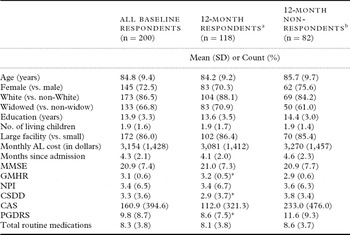
Descriptive statistics on resident characteristics appear in Table 1. Fifty-four percent were aged 85 years or older. Almost half (47%) had been admitted from an independent living setting, while the remainder were admitted from another AL (18%), rehabilitation facility (14%), family member's home (11%), nursing home (7%), medical hospital (3%), or another section of senior community (1%). Loss of functional abilities (60%) and acute medical problems (27%) were the most common reasons provided for moving into AL.
Baseline characteristics of assisted living residents by 12-month respondent status

Notes: *Group differences significant at p < 0.05 level.
aResidents who were assessed at baseline and at 12 months.
bResidents who were assessed at baseline but not at 12 –months.
MMSE = Mini-Mental State Exam; GMHR = General Medical Health Rating; NPI = Neuropsychiatric Inventory; CSDD = Cornell Scale for Depression in Dementia; CAS = Caregiver Activity Survey; PGDRS-P = Psychogeriatric Dependency Rating Scale-Physical.
T-test statistics were used to test group difference on age, education, monthly cost, months since admission, MMSE, GMHR, and total routine medications.
Pearson chi-square statistics were used to test group differences on sex, race, marital status, and facility size.
Mann-Whitney U Test statistics were used to test group differences on number of living children, NPI, CSDD, CAS, and PDGRS.
Prevalence of dementia and non-cognitive psychiatric disorders at baseline
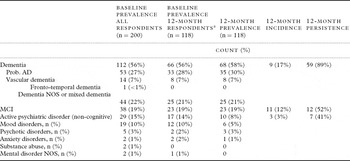
The prevalence of dementia and non-cognitive psychiatric disorders are shown in Table 2. The prevalence of dementia was 56% at baseline. The panel specified a dementia subtype in 61% (68/112) of cases. Of these, 53 (78%) had AD, 14 (21%) had vascular dementia, and 1 had (1%) fronto-temporal dementia. Thirty-seven percent had mild (MMSE ≥ 20), 37% had moderate (MMSE = 12–19), and 26% had severe (MMSE ≤ 11) dementia. Additional 38 (19%) participants were diagnosed with Mild Cognitive Impairment (MCI) (i.e., Cognitive Disorder Not Otherwise Specified (NOS) in DSM-IV).
12-month mental disorder morbidity among individuals recently admitted to AL

Notes: aResidents who were assessed at baseline and at 12 –months.
Mild cognitive impairment refers to individuals who met criteria for Cognitive Disorder Not Otherwise Specified according to the DSM-IV-TR definition.
Fifty-eight percent of those with dementia exhibited at least one neuropsychiatric symptom on the NPI in the past month; 39% in the clinically significant range (NPI ≥ 4). The most common symptoms were agitation (23.4%), irritability (17.1%), and “night time behaviors” (13.5%). AL staff spent an average of 133 more minutes per day on care for residents with dementia compared with those without (219 min/day vs 86 min/day, p = 0.014).
Of the entire sample, 15% of the participants had an active non-cognitive disorder at baseline. The most prevalent disorder types were depressive (10%) and psychotic (3%).
In total, 75% (150/200) of the residents had a current cognitive disorder at baseline. Further, two-thirds (131/200) of the residents had dementia or active non-cognitive psychiatric disorder, and 5% (10/200) had both.
Study attrition
The 12-month attrition rate for the entire study sample was 41% (82/200). Thirty-seven (19%) participants were discharged to a higher care level (i.e., nursing home, rehabilitation center, medical hospital), 16 (8%) died, 12 (6%) moved to another AL, 10 (5%) moved to an independent living setting, 4 (2%) moved in with family, and 3 (1%) withdrew from the study. Preliminary group comparisons of the baseline data (Table 1) showed that those discharged were in poorer health, as rated by the GMHR, (p < 0.001), were significantly more functionally impaired on the PGDRS scale (p = 0.016), and had more depressive symptoms on the CSDD (p = 0.016) but there were no significant differences in sex (p = 0.505), education (p = 0.091), MMSE (p = 0.936), presence of dementia (p = 0.886) or other non-cognitive psychiatric disorder (p = 0.879), or total NPI scores (p = 0.369). Factors related to discharge will be presented in greater depth in a forthcoming paper.
Incidence and persistence of dementia and non-cognitive psychiatric disorders
The incidence and persistence of dementia and non-cognitive psychiatric disorders are given in Table 2. The overall prevalence of dementia among those reassessed at 12 months was 58%. Among the 49 participants without dementia at baseline, 9 (17%) had developed dementia 12 months later. Of these incident cases, 7 had MCI at baseline, with an overall conversion rate to dementia of 30% (7/23).
The persistence rate for dementia was 89% (59/66). At the 12-month visit, five of the seven cases who no longer met criteria for dementia had a diagnosis of MCI, while two no longer met criteria for any cognitive disorder. The persistence rate of MCI was 52% (12/23), while 17% (4/23) had no cognitive disorder at 12 months.
The overall prevalence of non-cognitive psychiatric disorders at 12 months was 8%. Forty-one percent of those with a non-cognitive disorder at baseline remained symptomatic at 12 months. Overall, 81% (96/118) of the participants had either a cognitive disorder or a non-cognitive disorder at 12 months, although the rate of having co-occurring disorders was low (3%).
Recognition and treatment of dementia
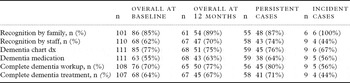
Table 3 shows dementia recognition and treatment rates. Of those who remained in the cohort and whose dementia persisted, staff recognition rates increased from 68% to 74%, while family recognition rates remained at 87%. For incident cases, family members, when available, recognized all cases correctly. Staff correctly identified 44% of the incident cases even though dementia was listed in 67% of these AL charts by the 12-month interval. By 12 months, 20% of the persistent cases still lacked a complete dementia workup, while a little over half (5/9) of the incident cases had had a complete workup. The average MMSE score of persistent but missed cases was 17.6. Dementia treatment was considered complete in 64% of residents with dementia at baseline. Considering only those who remained in the cohort, the baseline and 12-month complete treatment rates rose slightly from 66% to 71%.
12-month recognition and treatment of dementia

Notes: Recognition rates refer to family informant or staff endorsement of the following question: “Does (name of the participant) have dementia? By that we mean, “Does (name of the participant) have trouble with his or her memory, concentration, or problem-solving bad enough to interfere with day-to-day activities?”
Regarding pharmacotherapy for dementia, 44% were taking a cholinesterase inhibitor, 13% were prescribed memantine at baseline, and 9% were taking both. Use of these agents among cohort survivors with persistent dementia rose from 54% to 59% for cholinesterase inhibitors and remained stable at 14% for memantine. Around the time of admission, over half (55%) of participants with dementia were taking psychotropic medications other than acetylcholinesterase inhibitors or memantine, presumably for dementia-related neuropsychiatric symptoms, and 27% were taking both memory agent and psychotropic medication. Among cohort survivors with persistent dementia, rates of psychotropic medication use decreased from 53% to 47%.
Recognition and treatment of non-cognitive psychiatric disorders
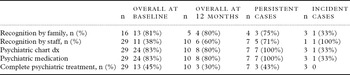
Recognition and treatment rates for non-cognitive psychiatric disorders are given in Table 4. In cohort survivors, rates of family recognition declined from 100% at baseline to 75% at 12 months, while direct care staff recognition increased from 43% to 71%. The expert panel rated more than half (55%) of the cases as not receiving complete treatment at initial assessment.
12-month recognition and treatment of non-cognitive psychiatric disorders

Notes: Recognition rates refer to family informant or staff endorsement of the following question: “Does (name of the participant) suffer from psychiatric, mental, or emotional problems?”
Eighty-three percent of those with an active non-cognitive disorder were on a psychotropic medication; 62% on antidepressants, 41% on neuroleptics, 17% on mood stabilizers, and 17% on benzodiazepines. Among cohort survivors with persistent non-cognitive psychiatric conditions, seven cases (100%) being treated with a psychotropic medication at baseline were taking them for 12 months; however consensus panel ratings of complete treatment decreased from 57% to 43% over the 12-month period. Examples of situations in which a resident might have their treatment rating changed from complete to incomplete included lack or misuse of a nonpharmacologic intervention, continuation of an ineffective medication, or lack of titration to effective dose.
Discussion
This was the first investigation to directly assess the morbidity, course, and care of mental health disorders among recently admitted AL residents over a 12-month period. Nearly two-thirds (66%) of a recently admitted sample of individuals admitted to 21 AL facilities in Maryland had either dementia or an active non-cognitive psychiatric disorder at baseline. Prevalence of dementia was 56%, a rate somewhat lower than 67.7% identified in a longer stay cohort in MDAL-I (Rosenblatt et al., Reference Rosenblatt, Samus, Steele, Baker, Harper, Brandt, Rabins and Lyketsos2004), and falling in the middle range of in-direct estimates of cognitive impairment from other AL-based studies (Hawes et al., Reference Hawes, Wildfire, Mor, Wilcox, Spore, Iannacchione, Lux, Green, Greene and Phillips1995; Morgan et al., Reference Morgan, Gruber-Baldini, Magaziner, Zimmerman, Sloane and Eckert2001; Magsi and Malloy, Reference Magsi and Malloy2005). Nineteen percent of residents in this sample had MCI compared with 7.6% in MDAL-I. Combining rates of dementia and MCI show that approximately 75% of residents in both cohorts suffered from a cognitive disorder. The high rate of MCI suggests that sub-threshold or incipient dementia is likely to be a significant contributor to AL admission, with cases declaring themselves after admission. The 12-month incidence of dementia was high, 17%, with seven of the nine incident dementia cases having MCI at baseline.
In general, rates of active non-cognitive psychiatric disorders were lower in this sample than in MDAL-I (15% versus 26%), as well as some other long-term care estimates. For example, we report 10% of the sample had a mood disorder at baseline, compared with 13–24% reported by other studies in AL (Hawes et al., Reference Hawes, Wildfire, Mor, Wilcox, Spore, Iannacchione, Lux, Green, Greene and Phillips1995; Watson et al., Reference Watson, Garrett, Sloane, Gruber-Baldini and Zimmerman2003; Dobbs et al., Reference Dobbs, Hayes, Chapin and Oslund2006). Similarly, our estimations for anxiety disorders (1%) was lower than previously reported in MDAL-I (13%) and from nursing home samples (3.5%–14%) (Parmelee et al., Reference Parmelee, Katz and Lawton1993; Cheok et al., Reference Cheok, Snowdon, Miller and Vaughan1996; Smalbrugge et al., Reference Smalbrugge, Jongenelis, Pot, Beekman and Eefsting2005). These discrepancies are likely due to differences in sample composition (recent admissions vs. longer stay residents; case-mix), setting (AL vs. nursing home), and diagnostic approaches (symptom questionnaires, chart review, clinical assessment by a single clinician, and consensus panel diagnoses). Further, the consensus panel guideline stated that they should only code psychiatric disorders if they met all criteria for a separate condition. Thus, neuropsychiatric symptoms may have been present but were primarily a feature of dementia. We also did not include non-active or historical disorders in full remission in our estimates. We found a 12-month incidence rate of 3% for non-cognitive psychiatric disorders but high persistence rates of 41%.
Staff recognition rates for persistent dementias increased over the 12-month period but 25% of the cases were still unrecognized at 12 months, at which time the average MMSE score of missed cases was 17.6 (i.e., moderate dementia). As in MDAL-I (Maust et al., Reference Maust, Onyike, Sheppard, Mayer, Samus, Brandt, Rabins, Lyketsos and Rosenblatt2006), we again note that unrecognized cases had fewer neuropsychiatric symptoms (NPI score: 0.7 vs. 6.9; p < 0.001) and tended to have higher MMSE scores (MMSE score: 18.2 vs. 15.6; p = 0.053) than those correctly identified. While the value of staff recognition, particularly in milder dementia, has not been demonstrated, we believe it is likely to have a benefit. Even though the AL environment is an intervention (e.g., 24-h supervision, meals, and medication administration), persons with mild dementia are at increased risk for financial problems or exploitation, delirium, apathy, or depression that interfere with social activities, and missed opportunities for participation in treatment decisions, pharmacotherapy trials to preserve cognition and function, and advanced care planning. Assuming that routine cognitive screening can be performed in a reasonably cost-effective manner, it is likely that improved staff recognition and subsequent behavior change may produce positive effects.
Consensus panel's complete treatment ratings for dementia at baseline were higher in the current sample than in MDAL-I, suggesting improved care quality over time on the part of the facility, treating physicians, or both. We previously reported that lack of dementia treatment, as rated by the consensus panel, along with medical morbidity were the major predictors of earlier discharge among AL residents with dementia (Lyketsos et al., Reference Lyketsos, Samus, Baker, McNabney, Onyike, Mayer, Brandt, Rabins and Rosenblatt2007). We plan to more fully evaluate the impact of psychiatric morbidity, workup, and treatment ratings on survival in the forthcoming analyses.
Both family and staff recognition of active non-cognitive disorders such as depression were slightly worse compared to dementia recognition rates. Recognition rates for these disorders among direct care staff increased over 12 months among cohort survivors. Nonetheless, 29% of the cases were still not identified at 12 months. One explanation may be that symptoms such as low mood and apathy may be less obvious during a resident's daily routine or may have been attributed to medical conditions, physical health, or just misperceptions about normal aging.
Attrition was common in this recent-admission cohort. Forty-one percent exited prior to the 12-month re-evaluation, a rate considerably higher than the longer stay cohort observed in MDAL-I. These findings share some similarities with the nursing home literature in that recent admissions were found to be at high risk for discharge within the year following admission (Arling et al., Reference Arling, Kane, Cooke and Lewis2010).
Several potential sources of bias should be considered in the interpretation of results. First, because the study focuses only on one state, the generalizability of the findings may be limited. However, the demographic make-up of the study sample is similar to other national and multi-state surveys (Zimmerman et al., Reference Zimmerman, Sloane, Eckert, Buie, Walsh, Koch, Hebel, Zimmerman, Sloane and Eckert2001; American Health Care Association National Center for Assisted Living, 2009) and Maryland's regulatory policies regarding mental health training and disclosure policies tend to fall in the middle range compared to other states’ AL regulations and requirements (Maryland Office of Health Care Quality, 2010). The prevalence estimates also pertain to the AL setting and cannot be extrapolated to individuals living in the community or nursing homes. Second, while use of the consensus panel for diagnostic adjudication is a strength of the study, panel decisions were limited to the information available. It is possible that clinically relevant tests or reports (e.g., MRI, CT scans, or specialty consults) had been done but the family was not aware of the results or the results had not been reported to the AL or placed in the AL chart. Third, non-enrollment may have affected observed prevalence rates of psychiatric disorders by producing either an over- or under-estimate. For example, of referrals who were reachable, the participation rate was 63%, about 10% lower than in MDAL-I. We believe that under-estimate of psychiatric disorder rates is more likely, since, in many cases, families refused participation for their loved ones because they felt they were too sick or impaired to participate, or families were amenable but participants themselves were too suspicious or depressed to provide consent. Attrition may also bias the incidence estimates if psychiatric symptoms led to an interim discharge of a previously asymptomatic resident. Further, the majority of our sample came from larger AL facilities, which may have tended toward an underestimate since psychiatric morbidity is higher among residents of smaller ALs (Leroi et al., Reference Leroi, Samus, Rosenblatt, Onyike, Brandt, Baker, Rabins and Lyketsos2007). Finally, MDAL was focused on resident-level variables and did not provide extensive information on facility-level mental health care practices.
The finding that recently admitted that AL residents in Maryland are at high risk for having or developing psychiatric disorders during the first year of their stay and that many cases, both incident and persistent, go unrecognized or untreated suggest the importance of routine dementia and psychiatric screening as part of the standard of care. Screening tools, such as the MMSE for cognition or the Patient Health Questionnaire-2 for depression (Watson et al., Reference Watson, Zimmerman, Cohen and Dominik2009), may be easy, effective, and cost-efficient ways to improve recognition rates.
Improving treatment is likely to be a more complicated process since it usually depends on individual and collaborative work between the facility staff, care provider, and family. Facility-directed interventions may include mental health-focused staff in service, use of specialized environmental design features, activity programming, routine care planning, promotion of a “mental health sensitive” culture, and building consultation networks with internal or external mental health professionals. Questions remain about the longitudinal impact of dementia recognition and treatment on resident outcomes and use of facility resources as well as the relative effectiveness of different types of interventions. We hope that future analyses of these data may further elucidate some of these issues.
Conflict of interest
None.
Description of authors’ roles
Drs. Onyike, Johnston, McNabney, Baker, and Brandt participated in acquisition of data and preparation of the paper. Drs. Rosenblatt, Lyketsos, and Rabins participated in concept and design, acquisition of data, and preparation of the manuscript. Dr. Mayer participated in concept and design and preparation of the paper. Dr. Samus participated in acquisition and analysis of data and preparation of the manuscript.
Acknowledgments
This project was supported by Grants R01MH60626 and K01MH085142 from the National Institute of Mental Health (NIMH) and the National Institute on Aging (NIA). We are grateful to the MD-AL study team for their fieldwork in evaluating participants. We wish to thank study participants, their families, the management, and staff of participating AL facilities for their dedication and assistance in the development and implementation of the study.