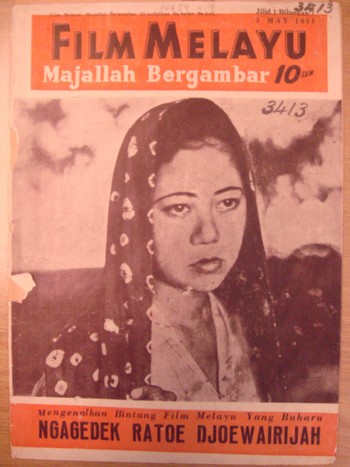
In May 1941 the first issue of Film Melayu (Malay Film), ‘a magazine with pictures’, appeared at newsstands in Singapore and Malaya. The cover of the first issue featured Ngagedek Ratoe Djoewairijah, ‘a new Malay film star’ who was modestly dressed with a scarf draped over her head. She was the star of the film Asmara Moerni (True Love), a Union Company Films release which also starred Dr A.K. Gani and Raden S. Joesoef. The extensive coverage that the film received in this first issue, as well as subsequent issues, reflected the close ties between Dutch and British colonial territories within the realm of culture as well as commerce. Asmara Moerni was an Indonesian film with Javanese actors being promoted as a ‘Malay’ cultural product. It was a Malay film in that it featured dialogue in Bahasa Melayu, the Malay language which promoted nationalistic unity in the Dutch East Indies (where it was known as ‘Bahasa Indonesia’) and the lingua franca in multi-racial, pluralistic Malaya. Asmara Moerni, however, was not the only Malay-language film released in Singapore in 1941. There were at least 20 Malay films released in Singapore that year, appealing to an urban cosmopolitan audience searching for stories that reflected their lives and hopes.
The cover of the first issue of Film Melayu (May 1941). Courtesy of the British Library (shelfmark 14654, no. 9)

The coverage Asmara Moerni received in the first few issues of this Malay film magazine represents the importance that film had in nationalistic circles at the time. Film was a new medium throughout Southeast Asia that allowed for stories to be presented on a massive scale to poorly educated communities throughout the region. It also held the seductive possibility of technology to transform a society, and create images of a new nation.Footnote 1 This potential was not lost on nationalists – or on entrepreneurs – throughout the Dutch East Indies and British Malaya. In 1940 and 1941 at least eight Malay-language films were produced for both profit and erudition in Singapore. The sudden proliferation of Malay-language film, from both Singapore and the Dutch East Indies, raises issues and questions over the meaning of Malay national identity and its relationship to publishing and technology in the immediate period prior to World War Two. While extremely rudimentary, these films became an avenue for nationalist aspirations and would serve as a basis for the development of the deeply influential Malay film industry in Singapore which produced over 250 films between 1947 and 1966. All of these pre-war films have been lost, mainly due to the use of nitrate film, which easily deteriorates even under the best conditions. Their role as a venue for nationalist discourse as well as discussions of modernity, however, remains evident in the pages of Film Melayu. There are only five extant issues of the magazine, all of which were published between May and September 1941; they are held in the British Library.Footnote 2 From these available texts much can be learned about not only film and its development in Singapore but also Malay culture and politics in late pre-war Malaya and how they reflected various debates in the publishing industry.
This article will explore some of the various ways to use such a text and what it reveals about the society at the time. The first section will focus on the early film world in Singapore and what is known about it. Then, by examining the content of Film Melayu, the next section will provide information on how films were produced in Singapore and the background of the participants, as well as the plots of some of these lost films. The last section will focus on how debates over the Malay nation (bangsa) and modernity were played out on the pages of the magazine. Through this examination, a variety of issues ranging from the significance of the writing script used to the participants in this new story-telling medium will be seen as metaphors for nationalistic values, purposes and debates, thus making film – and its portrayal in a popular film magazine – an engine for modernity and nationalism in the minds of Malay activists.
Film in pre-World War Two Singapore
Most films shown in Singapore and Malayan cinemas before World War Two were made overseas. In 1927, for example, 72 per cent of the films shown in the Straits Settlements of Penang, Melaka and Singapore were made in the United States, while 19 per cent were from China. Films from England only accounted for five per cent of the total, while German films represented three per cent, leaving only one per cent for ‘Other Origins’.Footnote 3 These percentages worried many Britons stationed overseas, as they saw film as potentially undermining their status. In 1926 an article in The Times about cinema in Asia claimed that it was difficult to show films in Singapore because they could not pass censorship standards, which led to a flurry of letters exchanged between London and Singapore. In response to enquiries from London, Laurence Guillemard, the Governor of the Straits Settlements, wrote that
there is no disputing the educational influence of the cinema among the native races or [the] fact that its influence has not always been in the interests of European prestige. It would, however, be easy to exaggerate its power and effect by crediting the local audiences with the mental receptivity and an aptitude to correlate ideas which they do not in fact possess.Footnote 4
Guillemard went on to add that ‘to cut out all that might be represented as derogatory to the European, as sensational and unedifying, would be tantamount to banning the cinematograph altogether’.Footnote 5
Despite such curt dismissals of the ability of Malayan audiences to understand basic messages and images, cinema was seen as a means of communicating complex ideas which held the potential to undermine European colonial authority. Much of the concern over the content of film, and British sentiments towards it, may be related to the nature of cinema viewing in Malaya. The cinema was one venue in which the various ethnic groups interacted freely, thus making Europeans sensitive to how they saw themselves portrayed on screen.Footnote 6 In an attempt to address such sensitivities, in 1927 British authorities raised the duties on American films, which were perceived as promoting anti-authoritarian and anti-colonial sentiment, in an attempt to discourage their distribution in the colonies. In the Straits Settlements an official cinematograph act along these same lines was promulgated in 1928.Footnote 7 By the end of the 1920s the content of American films, and how they might undermine the Empire, seemed to be the only concern of colonial authorities in the realm of cinemas or film production.
By the 1930s much of the tone related to the colonial reception of film shifted from censorship towards local production and the possibilities it held. As the centre of British rule in Southeast Asia, Singapore was well positioned to be the home for such technology. According to The Malayan Film Weekly, an English-language film magazine:
‘The growth of the cinema in this country generally and Singapore particularly, since the advent of the talkies, has been phenomenal. There are more than 20 cinema houses and it has been estimated that at least 8,000 people see the pictures each night. …Moreover, Singapore has been finding such great favour with the Hollywood film moguls recently that we have had a veritable invasion of stars and directors. It all points to this: That this unique city of such divergent contrasts with its heterogenous community, its sunny skies, its geographical position as the gateway to the Pacific, its babel of tongues, its colours and creeds, provides capital material for the production of films with an authentic background of exoticism.Thus, we do not think we are mere dreamers when we see in our mind's eye, in the not too distant future, a permanent film Colony in this city.Footnote 8
A nascent film industry in Singapore was already beginning to develop before 1936, when the above comment was made.
Until recently it has been commonly accepted that the first locally produced film in Singapore was Leila Majnun, which was filmed in 1933 and released in 1934.Footnote 9 A recent survey of Singapore film, however, has shown that there were a few other films produced and released a year or so before Leila Majnun, such as White Pearl and Samarang, and more importantly a Chinese film titled Xin Ke (The Immigrant) in 1926.Footnote 10 As Malay-language films dominated Singapore cinema before the 1970s, Xin Ke and the others, which were directed by Westerners, have quickly been forgotten in popular literature. Of importance, however, is that none of these early films were from individuals or companies which would have an impact on filmmaking in Singapore. For example, Liu Peh Jing, who produced Xin Ke, never made another film in Singapore. The same was true for the makers of Leila Majnun, the Motilal Chemical Company.
Leila Majnun was based on a popular Indian version of an Arabian tale that had been translated, localised and published in poetic form before it become a staple of bangsawan (traditional Malay) theatre productions throughout the Malay Peninsula.Footnote 11 Little is known about the public reception of Leila Majnun, but B.S. Rajhans, an important post-war director of Malay cinema, helmed the project, which starred bangsawan performers as well as ‘Miss Fatima benti Jasman of HMV Record's fame’.Footnote 12 Following the release of Leila Majnun in 1934, six years passed before another Malay-language film was produced in Singapore or Malaya, implying that little profit, monetarily or culturally, was made in this venture. In 1941 the film was mentioned in one editorial with the caveat that ‘sadly it was not an achievement because there were many things that needed improving’.Footnote 13 The impetus for renewed production in Malaya, which began in 1940, originated from the founding of a movie studio in Singapore as well as the development of film production in the Dutch East Indies and war in China.
The Dutch East Indies was an important influence on Malay film making due to the number of films made in Java which were eventually released in Malaya. These films found wide acceptance in the Malayan market due to their use of the Malay language, and eventually convinced Chinese entrepreneurs in Singapore of the potential profits in local film. This became particularly apparent with the release of Terang Boelan (Full Moon) in 1937, the first film made in Bahasa Indonesia, the national language of Indonesia, which was chosen by nationalists in 1928 as the unifying language for the Dutch-controlled archipelago in the struggle for independence. The film was advertised as ‘the first Indonesian movie… completely in the Indonesian language’.Footnote 14 Since the Indonesian language is based on Malay, which had functioned as a lingua franca of the archipelago's ports and administration for centuries, it was accessible to populations outside of Java, including Malaya. The film was such a hit in the Dutch East Indies that RKO bought the rights to show the film in Singapore and Melaka in 1939. When Terang Boelan was screened at the Queens Theatre in Singapore along with two Disney cartoons, it was promoted in advertisements as ‘the first and best Malay musical’.Footnote 15 The film is often mentioned in the pages of Film Melayu, where it served as inspiration for what the Malay film industry could achieve. Prior to the release of Terang Boelan, there had been little desire among companies or financiers in Malaya to support local film production. The film created a sensation and, along with the development of a thriving theatre network by the Shaw Brothers in the late 1930s, led to the establishment of stable Malay film production in pre-war Singapore.
The Shaw Brothers – there were four in total – were successful businessmen from Shanghai whose Ningbo-born father had made a fortune trading dye pigments. In 1925, five years after their father's death, the eldest son, Runje, moved the family into film production in China with the founding of Unique (Tianyi) Film Productions. This decision had come after several years of dabbling in film distribution during which Runje had realised that massive profits were possible in this new industry. At about this same time, Shaw Runme, who oversaw distribution, moved to Singapore from where he could supervise distribution of films in Southeast Asia; in 1926 his brother Run Run joined him. These two brothers developed a series of companies that eventually came to encompass all aspects of the entertainment industry. Although they initially focused on film distribution, by the late 1920s they ventured into exhibition with the construction of cinemas in Singapore and the Malay Peninsula, and by 1937 they owned a network of over 60 theatres. With the Japanese invasion of China in 1937, the number of Chinese films available for distribution dropped drastically, and distributors needed product for cinemas.Footnote 16 To fill these cinemas, and following the success of Terang Boelan in 1939, the Shaw Brothers imported their filmmaking techniques to Singapore and applied them to Malay film. This meant that they were made fast and cheap, as Runde Shaw instructed executives in 1938 to ensure that the entire production cycle for a film be limited to 10 days.Footnote 17
In 1940 Shaw Brothers built a studio at Jalan Ampas No. 8, which was to the north of downtown Singapore. This studio was to be the home of their filmmaking in Southeast Asia until the late 1960s, and cost $20,000 to build. As a press release in April 1940 announced, it was ‘to form the setting of the first of a series of Malay talking pictures’. Malay actors and actresses were being tested, and there were plans to produce one film a month in Malay. Each of these films would cost $50,000 to produce and would feature ‘well-known Malay kronchong [an indigenized form of Western music] singers and Malay actresses’.Footnote 18 It was also announced that the Singapore-based Shaw Brothers arranged for ‘all the technicians, sound engineers, cameramen and mechanics’ to be brought from Hong Kong for the production of the films. Among those imported to make Malay films was the director Hau Yaw. He was accompanied by Lily Lee, a film star who – it was planned – would eventually star in a series of Cantonese films to be made in Singapore.Footnote 19
Hau was the director of all of the Shaw Brothers Malay films made prior to World War Two. He had originally worked in the Shaw Brothers' Nanyang Film Company in Shanghai, where he wrote and directed several Cantonese films; little else is known about him. It is of interest that the various contemporary reports leave out the role of Wan Hai Ling, who is usually described in accounts written long after the fact as the co-director and co-writer of all of the Shaw Brothers pre-war Malay films and the first female director in Southeast Asia.Footnote 20 This claim is not supported in the pages of either the English-language press or Film Melayu. During a visit to the Jalan Ampas studios in mid-1941, the editor of the latter describes Wan as Hau's assistant. Hau was seen prodding the actors and overseeing the scene while using English to communicate, which was considered the most remarkable aspect of the visit.Footnote 21 The lack of attention given to Wan in accounts of that period may reflect reduced expectations for the role of women in a venue such as filmmaking, but this is uncertain, for her exact role in this filmmaking process is vague.Footnote 22 It is clear, however, that she did have a role in making Malay films prior to 1942.
Beginning in 1940, Hau and Wan oversaw the production of eight films for the Shaw Brothers. The first of these films was Mutiara (Pearl), ‘a story Replete with Action, Romance, Comedy, Songs and Music galore’, and starring ‘well-known Malay actors and actresses’, which premiered in July 1940 at the Alhambra Theatre in Singapore.Footnote 23 Four months later, in November 1940, Shaw Brothers released Bermadu (Polygamy). The response to these releases must have been quite positive, since in the following year residents of Malaya had the opportunity to see six more Shaw Brothers' Malay productions: Toping Saitan (The Devil's Mask), Hanchor Hati (Broken Heart), Terang Bulan di Malaya (Full Moon over Malaya), Ibu Tiri (The Step Mother), Mata Hantu (Ghost Eyes) and Tiga Kekasih (Three Lovers).Footnote 24
The Shaw Brothers were not the only distributors of Malay films in Singapore in 1941. That year there were two to three Malay releases per month available there and in Malaya from various film companies originating from Java, Singapore and even the Philippines. Each of these films was seen as important in the Malay community, although those made outside Singapore were seen as lacking in various facets, ranging from the plots to jarring differences in the Malay language pronunciation and use in the films, often leaving the audiences divided in their acceptance of this fare. Malay films were texts to be debated, with their ability to comment on the society and its relationship to technology being the main topics for consideration. This was particularly true of Singapore-made films. They were expected not only to fulfil an entertaining role but also to help in educating and modernising the community. To tap into these expectations, newspaper promotions for Shaw Brothers' Malay films continually emphasized the origin and broad support of their films, even proclaiming that Ibu Tiri was ‘the only Malay Talkie that appeals to all!’Footnote 25 Attracting an audience that saw film as a forum for debate and modernisation required new methods beyond newspaper advertisements. To fill this void Shaw Brothers began to support the publication of a Malay film magazine. It was a collaboration between the film studio and one of the strongest advocates of Malay nationalism in the late 1930s and early 1940s, Utusan Melayu Publications, Ltd.
Film Melayu, early film stars and plots
The first issue of Film Melayu cost 10 cents and contained 24 pages. The magazine was written and produced in Singapore at 30 Bussoroh Street in Kampong Glam, and printed at the Shaw Printing Works on Robinson Road. The print run for this new magazine was 1,000, which was quite a high number when even the most popular newspaper of the day rarely published more.Footnote 26 When Film Melayu appeared, it was a sensation. According to the editor, Haji Abdullah bin Ja'afar (whose pen name was Haaj), it was consumed as fast as ‘hot and crispy fried bananas’ (seperti goring pisang panas yang garing).Footnote 27
Prior to the publication of Film Melayu in 1941 there had been several English and Chinese film magazines produced in Singapore. Among these were The Malayan Film Weekly, which focused on English-language productions from Great Britain or the United States, and Screen Voice, which Shaw Brothers published for the Chinese film industry. There was little information available for an audience that only understood Malay. The success of the first issue of Film Melayu attracted the attention of Shaw Brothers, which subsequently decided to support the magazine. By the July 1941 issue, the third one, it was announced that Shaw Brothers had invested in Film Melayu, assuming all of the publishing costs. While this created rumours that the studio would control the editorial content, Haaj reassured his readers that he would continue to express his opinions freely and that Shaw Brothers had simply taken over the cost of production.Footnote 28
The relationship between Shaw Brothers and Malay film was also mirrored in the company's support of Malay theatre (bangsawan) productions in the 1930s, which were easily parlayed into film productions by the end of the decade. Bangsawan is a Malay form of Parsi theatre that originated in India, where it blended a variety of influences ranging from English theatre taught in missionary colleges to the rich corpus of Persian-Muslim literature. Parsi theatre arrived in Malaya via Indian immigrants in the late nineteenth century. As Malaya grew in population and its urban centres, particularly on the west coast, expanded, new forms of entertainment emerged. Through the blending of various cultural forms, theatre evolved into bangsawan commercial theatre, catering to a diverse audience. Performances mirrored Western vaudeville productions as they often included three or four short plays or one long one, with songs accompanying them or else played during the interludes, along with dances, comedy, novelty acts and other entertainment. The nature of bangsawan meant that the performances were constantly changing and allowed for a variety of cultural influences to be incorporated into the productions to reflect the tastes of the audiences. The presence of musicians and singers also made these performers among the earliest recording stars in Malaya, and their popularity ensured that music would be incorporated into any films that were going to be made.Footnote 29 Jamil Sulong, a leading director and screenwriter in the 1950s and 1960s, remembered in his autobiography that ‘the local audience had become familiar with Malay language phonograph records from Java at that time and with ease also accepted the films produced by the Shaw Brothers’.Footnote 30
The bangsawan origins of Malay film are also reflected in biographies of the stars of the Shaw Brothers films, which were presented in a special column each month in Film Melayu. In many ways, these biographies provide insight into not only early Malay film and its relationship to bangsawan, but also the borderless world between Indonesia and Malaya in the early twentieth century, particularly in the realm of entertainment. Bangsawan performers moved from the Straits Settlements and Malaya to Java, Sumatra and Borneo with ease, leading an itinerant life as a member of ever-changing entertainment troupes.Footnote 31 The circumstances they faced – unstable relationships, bangsawan circuits involving constant travel and shifts in the composition of the troupes – reflect the transient and borderless nature of much of the work at the time. Each of these early film actors was attracted to film because it offered a chance to settle down in one place and regular monthly salaries – usually between 80 and 150 dollars a month, depending on their roles – as well as bonuses and vacation leave. When not filming, they were allowed to continue with their bangasawan performances.Footnote 32
All eight Shaw Brothers films made in 1940 and 1941 featured the same group of performers, and their life stories were quite similar. Among these performers were the husband-and-wife team of Haji Gong and Tina. Haji Gong, the son of a cloth merchant, was born in 1901 in Palembang. At age 14 he accompanied two of his grandmother's friends on the Muslim pilgrimage to Mekka. Upon his return, Haji Gong opened a store that sold songkok, a cap worn by men on ceremonial occasions. A fan of bangsawan from a young age he joined the Baisorap bangsawan troupe on a tour to Bangka when he was 17 years old. Over the next decade he joined several other troupes and rose through the ranks of performer, as he travelled throughout Java, Sumatra and the Malay Peninsula. His wife, Tina binte Madikin, was born in Bogor, Java in 1909. Her father was described as a government undercover agent (se-orang memata gelap); after finishing her education at age 12, she worked with her mother in the rice fields. At 16 years of age, she married. Her husband died soon afterwards, and Tina suffered from a respiratory and joint illness (sakit-sakit sengal sendi) for three years. In 1929 she married Haji Gong, who was in Bogor as part of Union Jambi Opera, a travelling bangsawan troupe. They eventually arrived in Singapore in 1938, with the goal of performing on the Malayan bangsawan circuit. Beginning in 1939 the couple signed contracts with Shaw Brothers and subsequently became part of their pre-war Malay film troupe, in which Tina was promoted as ‘Malaya's greatest dramatic actress’.Footnote 33
Of the three other performers that were featured in the extant issues of Film Melayu, two were born in Singapore and one on the Malay Peninsula. Ibrahim bin Ja'afar, whose stage name was Yem, was born in 1900 in Taiping, Perak. Ibrahim was a bright student at school who was fascinated by, and frequently attended, bangsawan performances. After graduating from primary school he joined the Indera Permata bangsawan troupe for a salary of 10 cents a day and meals, and travelled with them to Penang. He then bounced between various bangsawan troupes during his teenage years, during which he also married twice, before ending up in Medan, where he performed for four years as part of the Indera Ratoe troupe. At age 23 Ibrahim arrived in Singapore as part of the Royal Medan Opera, and he subsequently moved between various troupes as he travelled the circuit of the Malay Peninsula, northern Sumatra and Java. He eventually returned to Singapore in the 1930s. At that time the Shaw Brothers loaned him money to form the Nooran Opera troupe, and in return they had to perform at Shaw Brothers-owned entertainment parks throughout Malaya. Beginning in 1940 Yem appeared in his first film, Mutiara.Footnote 34
The two Singapore-born performers became actors through family connections and as an alternative to more mundane work. For example, the actress Habsah binte Buang, who was born in 1918, was drawn to bangsawan as a child in Singapore when she followed her mother on a circuit that usually involved performances in Sabah, Sarawak and Pontianak, all on the island of Borneo. According to her biography she never had a formal education, but spent her time reading the Quran. Habsah eventually began to perform on her own, touring the Malay Peninsula and Sumatra. She even performed in Bangkok, while frequently returning to Singapore to appear in productions throughout the city. By the late 1930s she was one of the leading ladies of bangsawan, attracting a number of male followers. By 1941 she was a widow and had six children. Following World War Two she returned to Malay film production as a supporting actress and choreographer.Footnote 35
Habsah's compatriot Aman bin Chik was born in Singapore in 1912. After completing primary school at the Kampong Gelam Malay School, Aman studied at the Victoria Bridge School, an English-language institution. As a teenager he enjoyed boxing and moved up the ranks from amateur to professional. At his father's urging, he quit boxing and eventually found a job working as a storekeeper's assistant at the Singapore Boy Scout facilities. When he initially began appearing on bangsawan stages throughout the city, Aman would work at the Boy Scouts during the day, and perform at night. In the 1930s he followed the bangsawan circuit in the Malay Peninsula, only returning to Singapore after hearing of his father's death in 1938. In May 1940 he signed a contract with Shaw Brothers to become part of their growing film studio, and like his fellow actors appeared in the first Shaw Brothers Malay film, Mutiara. Habsah had already been under contract since 1939.Footnote 36
The world that these bangsawan performers were entering was one in which they were developing the techniques, traditions and ideas that would dominate the glory days of Malay filmmaking in Singapore in the 1950s and 1960s. The reception of the first two Malay films made in 1940 was so strong that by mid-1941 it was announced that due to increased film production Shaw Brothers was going to develop its own orchestra for the musical numbers needed in films.Footnote 37 In the fourth issue of Film Melayu, Haaj recounted a visit to the studio. Upon arrival, a Sikh guard questioned him before he was allowed to enter. Once inside, he watched the filming of a scene for the film Terang Bulan di Malaya. He described the set as being surrounded by ‘at least 12 large lights, with at least 500 candle watts of power’. Each scene was rehearsed three or four times before it was filmed; according to Haaj, it took a half-hour of work to film a two- or three-minute segment.Footnote 38
None of these pre-war Malay films continues to exist beyond scattered still photographs and references to them in Film Melayu and newspapers in which the plots are rarely explained, leaving room for criticism or praise based on how the Malay community understood them. For example, one discussion of the first Shaw Brothers Malay film, Mutiara, expresses disdain for its improper, foreign-sounding Malay as well as outlandish plot, which ‘was not suitable for customary approaches to Malay life’.Footnote 39 While little is known about Mutiara, a description of the plot of Bermadu can be found in Raphaël Millet's Singapore cinema: ‘A rich man has two wives and two brothers-in-law, each of them related to one of the wives. When he decides to go to England, he takes his first wife's brother with him. During his absence, his second wife, with the help of her brother, treats the first wife badly, eventually trying to get rid of her after she gives birth to a baby boy. The first wife, to save herself and her baby from being burnt, is forced to leave the house’.Footnote 40Bermadu was considered to be an improvement over Mutiara. In the Penang-based newspaper Saudara, Bermadu is described as ‘a film that uses Singaporean or Peninsular Malay that is much different from other Malay language films in both its camera work and sound… and the story is one that is truly extraordinary and useful among the community as there are numerous lessons, advice and metaphors that are beneficial’. Finally, the anonymous critic reflects that the writers, directors and actors in this film have ‘beautified and strengthened the Malay spirit’ with their efforts.Footnote 41
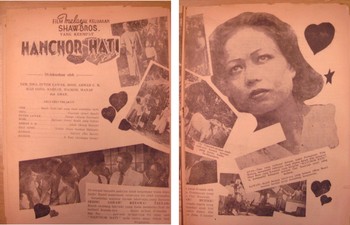
Apparently the plots of most of these pre-war films were quite similar, with a particular focus on the frailty of marriage, which perhaps can be related to the intersecting forces of urban migration, capitalism and mobility that audiences in modern, cosmopolitan cities in the Malay world such as Singapore were experiencing. An example of such a film can be found in the first issue of Film Melayu, which provided an account of the newly released Hanchor Hati (Broken Heart). The film tells the tale of a young man who comes to Singapore to work at a rubber factory and eventually marries the owner's daughter, living a life of happiness that is so rapturous that he has forgotten he is already married to a woman who is about to give birth in his village. The abandoned wife ventures to Singapore in search of her husband; when she is unable to locate him, she meets a manager of a bangsawan troupe, who upon hearing her story, decides to stage a version of it under the title ‘Hanchor Hati’. When the husband hears about the performance, he is enraged and arranges for a criminal to murder his first wife. When the wife survives the murder attempt, the husband decides to return to live with her.Footnote 42
Two-Page Promotional Advertisement for the Shaw Brothers' Fourth Malay Film Production, Hanchor Hati (Film Melayu, 2 [June 1941], pp. 12-13. Courtesy of the British Library [shelfmark 14654, no. 9])

The only other production for which there is a detailed account of the plot is Terang Bulan Di-Malaya, and it is an even more convoluted tale of migration, modernity and family than Hanchor Hati. The plot revolves around a young sailor named Borhan (played by Yem) who must choose between two women. He is in love with a Malay coffee shop employee named Maimunah (Tina). He leaves on a year-long voyage; and when he returns, Maimunah has given birth to a daughter and wants to marry him. When he leaves the house, supposedly to look for funds for their marriage, Borhan goes to a dance hall (rumah jogget) where he meets Naimah (Habsah) and sleeps with her. Borhan leaves again for a year-long voyage, and when he returns, Naimah has given birth to a son. At this time he rejects both Naimah and Maimunah, and marries the daughter of the ship's captain (Haji Gong), and soon thereafter they have a son. Twenty years later Borhan's children from his relationships with Naimah and Maimunah are keronchong singers named Dollah (Ahmad CB) and Zahrah, and they have fallen in love. Borhan and his second son, Daud (Adi Taruna), attend a performance by Dollah and Zahrah, not knowing who they are, and they both fall in love with Zahrah. Each of the men proposes marriage to Zahrah, and she finally accepts Borhan's offer. As Borhan and Zahrah prepare for their marriage ceremony, they learn about their blood ties, and the wedding is cancelled.Footnote 43 As Haaj accounted, this was ‘an exemplary story that had probably not been made into a film in Java as well as Hollywood or Europe’.Footnote 44 The plots of films such as Hanchor Hati and Terang Bulan Di-Malaya reflected an anxiety with a cosmopolitan culture that distanced Malays from prior traditional relationships, and spoke to these audiences in ways that films from the West could not.
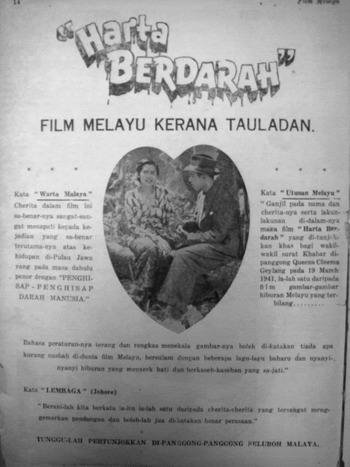
Diverse audiences, even among ‘Malays’ who came from throughout the archipelago, had to interpret plots involving the upheaval of traditional relationships in new environments when enjoying their urban, technologically advanced entertainment available in the growing Malay film market of Singapore and Malaya prior to 1942.Footnote 45 While Shaw Brothers released at least five Singapore-made films in 1941, numerous films produced in the Philippines and the Dutch East Indies were also released. These were promoted as Malay films based on their use of the language. In addition to Asmara Moerni, there are advertisements in the pages of Film Melayu for Harta Berdarah (Bloody Property), Nyai Dasima (Miss Dasima), Pantjawarna and Sorga Palsoe (False Heaven), all of which were made in Java, as well as the ‘first film made in Bali in the Malay language’, Mimpian di-Bali (Dreaming in Bali). There was also a Filipino film, Semangat Jantong (Mighty Heart), which was advertised as being in Malay and featuring a ‘more sophisticated sound than had ever been heard in a Malay film’.Footnote 46 These film advertisements feature extended explanations of the plot, most likely to prepare the audience for inaudible sound and poor production that would hinder their understanding of the film. The presence of a number of these ‘Malay’ films reflects the importance that cinema was having within the increasingly influential ideologies of modernity and nationalism in the region.
Advertisement for Harta Berdarah (1941), a film made in the Dutch East Indies, which is promoted as ‘A model Malay film’ (Film Melayu, 1 [May 1941], p. 14. Courtesy of the British Library [shelfmark 14654, no. 9])

Technology, modernity and the nation through writing about film
Singapore was the technological and economic centre of British rule in the region, and the Malay newspaper and publishing industry had been centred in the Straits Settlements colony for decades. Singaporean Malay movies were entering a market dominated by foreign-language films and would still have to compete alongside Malay-language productions from the Dutch East Indies, such as Asmara Moerni, and the Philippines. Just as the choice of Indonesian/Malay for films made in the Dutch East Indies was of great significance for nationalists throughout the archipelago, the possibilities that the technology and narrative abilities that film held for conveying modern ideas and concepts excited many Malay nationalists who worked in the world of journalism. Film was a tool for modernising the nation (bangsa).
‘Bangsa’ is a word that can be translated as ‘nation’, ‘race’ or ‘community’. Newspapers were one of the main forums for debating the meanings of this word in the early twentieth century, with Utusan Melayu being one of the main venues. Utusan Melayu appeared in two different periods, the first from 1907–22 and the second beginning in 1939. In an analysis of the writings of the founding editor of the first incarnation of Utusan Melayu, Mohammed Eunos Abdullah, Anthony Milner has emphasised how his use of the term bangsa is best translated as ‘race’, as his education in British-influenced schools in late nineteenth-century Singapore would have shaped his understandings of society based on assumptions of racial genetics in various ethnic groups.Footnote 47 Eunos Abdullah's emotive use of the term bangsa in Utusan Melayu and other writings was important in the conceptualization of an early twentieth-century Malay identity beyond traditional loyalties to individual sultanates (kerajaan). Throughout the pages of Utusan Melayu it was emphasised that the Malay race needed to maintain many aspects of its traditional culture, particularly with regard to courtesy, but to place the bangsa above the kerajaan. In his writings Eunos Abdullah pointed out that the race could only be sustained – particularly when competing with Chinese and Indians – if it reformed and modernised itself through education and the development of programmes focused around technology or agriculture.Footnote 48
Such understandings of bangsa also were prevalent in the second incarnation of Utusan Melayu. In 1939 Yusof Ishak founded Utusan Melayu Press Ltd, which also resurrected the newspaper of the same name after Malay journalists walked out on the Arab-owned newspaper Warta Malaya. Utusan Melayu was now founded on the principles of bangsa that Eunos Abdullah and Abdul Rahim Kajai promoted. This second figure, Kajai, was a key figure of 1930s Malay journalism and a strong advocate of Malay racial purity. He is perhaps best known for his diatribes against Indian and Arab attempts at inclusion in the Malay bangsa movement. The founding of Utusan Melayu thus was a continuation of attempts to think of the Malay bangsa as one based on the racial exclusivity of so-called Melayu jati (‘true Malay’) during a period of great debate over the definition of the Malay bangsa during which other groups were promoting concepts of solidarity and citizenship that were Malay-centric but not as exclusive.Footnote 49
One of the main advocates of a new and less exclusivist understanding of bangsa was Ibrahim Yacoob, the author of Melihat Tanah Air (Surveying the Homeland, 1941). According to Milner, Ibrahim's writings in the late 1930s and early 1940s pushed the concept of bangsa into the realm of territorial commitment, and thus citizenship and nation. Within this argument, Ibrahim was promoting the idea of expanding the previously notion of ‘Malay’ as limited to Peninsular Malays to a definition that would be more archipelagic, thus incorporating Boyanese, Javanese, Minangkabau and many of the other ethnic groups who had migrated to Malaya during the colonial period, a stance which stood in contrast to that found in the pages of Utusan Melayu.Footnote 50 The promotion of films from throughout island Southeast Asia as ‘Malay’, based on language use, reflects the power of this new idea. The presence of this new community-based understanding of bangsa in Film Melayu – an Utusan Melayu publication – also points to a shift in the understanding of its definition within publishing circles shortly before the Japanese Occupation.
This emphasis on new understandings of bangsa is apparent in the three editorials in the first issue of Film Melayu. The first of these editorials is an introduction by Kajai, the activist editor of Utusan Melayu, which raises questions about shifts in his understandings of bangsa as a racial category. In the editorial, Kajai describes his initial reluctance to support such a publication. He explains that although he has known the editor, Haji Abdullah bin Ja'afar, since 1935 as a fellow journalist in Singapore and eventually as a colleague in the Utusan Melayu group, Haji Abdullah left the organisation in order to develop a film magazine using Rumi (Romanised Malay, as opposed to the Arabic-based Jawi writing system which had been the predominant script for centuries), which Kajai felt was a bold step. This was quite a radical departure for the Malay community as few if any Rumi newspapers or magazines had met with success in the Malay Peninsula by the late 1930s, and there had been no successful film magazines. Before Kajai could meet him to discourage him from such folly, Haji Abdullah had already made up his mind. When the two finally met to discuss the issue, Haji Abdullah explained that Rumi would appeal to the ‘peranakan’ (those born in the Peninsula regardless of ethnicity), thus opening up the readership to a wider audience, particularly Chinese, interested in developing film and music as arts to new levels in the region.Footnote 51
The Romanisation of Malay writing was a controversial issue in the Malay community. In the early twentieth century R. J. Wilkinson, as the head of the Education Service, promoted the publication of Romanised script in the Malay Literature Series for the educational system. It was believed that if Malays could learn Rumi, their transition into an English-language educational system and civil service jobs would be much easier. The acceptance of Rumi as the script for written Malay was further enhanced in 1922 with the founding of the Sultan Idris Training College in Perak, an important training ground for both educators and nationalists, where the use of Romanised Malay was seen as an avenue to accessing Indonesian writings (which used Romanised script) and those from other societies. By the 1930s the acceptance of Rumi became a point of contention in nationalist circles, with such important writers as Za'ba stating that he did not fear the change, ‘for whatever script was used the contents would be still the same Malay language’.Footnote 52 In the pages of other Utusan Melayu publications, however, the preference for Jawi was vehemently defended.
Prior to World War Two, Romanized Malay remained mostly confined to the educational system, while almost all other writings, and most significantly newspapers, continued to be printed in Jawi. Only 12 per cent of Malay publications used Rumi, and even the colonial education system used the two different scripts, the choice often depending on the topic of study.Footnote 53 Much of the resistance to accepting Rumi as the written script lay in the rejection of immigrant groups in Malaya as well as the significance of Jawi as a connection to Islamic writing and a link to a historical Malay past, thus making it an important component of Malay identity in the first half of the twentieth century. Kajai was well known for his strong opinions, and he was among the staunchest supporters of the use of Jawi. In 1939 he accused the editors of Suara Melayu (Malay Voice) of trying to ‘poison Malay youth’ when they began to publish in Rumi.Footnote 54 Therefore, the presence of an editorial by Kajai supporting a Rumi publication in 1941 is one of the most remarkable aspects of Film Melayu.
The choice of Rumi had wide-ranging political – and financial – implications that focus on the acceptance of non-Malays in Malaya as well as conveying ideas associated with modernity and education. This is emphasised in another call to embrace changes that allowed for greater participation of a larger community, and interlinked with modernity and nationalism, on the same page as Kajai's welcoming letter in the first issue of Film Melayu. Written by Roha and entitled ‘On the way’ (Menuju ka-sana), this editorial also has nationalistic implications as it sets the tone for the possibilities that such a publication will hold for its readership in Malaya and the wider archipelago. Roha proclaims that when residents think of film throughout the archipelago (Nusantara), they will think of Film Melayu.Footnote 55 With this simple statement, Roha has further explained the magazine's decision to use Rumi. As the latter was the script of choice throughout the Dutch East Indies, the original home of many of the immigrants to the Malay Peninsula and Singapore, this magazine would be an attempt to unite them in their interest in a new technology and narrative techniques, as well as to make the magazine available to a larger urban audience that was most likely more familiar with Rumi, thus ensuring its success.
This shift in the notion of bangsa beyond an ethnocentric Malay ‘race’ to one advocating inclusion of the wider archipelagic community is raised in another page-long editorial in the first issue entitled ‘Achieving the masses’ request' (Menyempurnakan permintaan orang ramai). Written by the editor, Haaj, the editorial justifies the use of Rumi by explaining that although initial plans called for publishing the magazine in Jawi, many readers know only Rumi and are not proficient enough in English to enjoy other film magazines available in Malaya. Publication in Rumi would allow other communities (bangsa) to read the magazine.Footnote 56 Such a choice in a pre-war publication was path-breaking, signalling that understandings of the relationship between Malay identity, script and modern technology – as well as profit and market – were beginning to shift on the eve of the Japanese occupation. It was an attempt to unite various approaches to Malay nationalism and identity by uniting the choices of supporters of Utusan Melayu – represented by Kajai – with those of a more inclusive archipelagic approach, which would have been appealing to the cosmopolitan, urban-based readership of Singapore and other large cities.
The focus on the decision to use Rumi as the script for Film Melayu dominates the first issue – it is discussed in three different editorials – and reflects the importance of this step. It was not until eight years later, in 1949, that the Peninsular Malay Teachers Association (Persekutuan Guru2 Melayu Semenanjung) adopted Romanised Malay as the official script for schools, and the Malayan government endorsed the decision the following year. Indeed, its final acceptance at the Second Malay Language Conference in 1954 is considered an important turning point in the history of the language and its use for nationalistic purposes.Footnote 57 In 1941 the benefits of using the script were already clear as the larger Malayan community supported the magazine. The issues of Film Melayu sold quite well. It reached a point where, according to the editor (perhaps speaking in a self-serving manner), magazine sellers were complaining that not enough copies were being printed, leaving them to declare that ‘our community (bangsa) loves its own magazines and is particularly interested in magazines that are written using Romanized script’.Footnote 58
Beyond the choice of script, the various articles, editorials and columns in Film Melayu emphasise the role that film can play in modernising the nation. In the fourth issue, for example, Haaj wrote that ‘every participant can enlighten (tauladan) the audience with each step and each word’.Footnote 59 He then went on to make a plea for those who are good with words, or have sweet voices, to enter the film industry so that it could achieve the quality that other nations have achieved. Another writer opined:
film is not just for entertainment; actually it is the opposite. It is a type of school that reflects the achievements and principles of a refined and polite culture, and thus we need to examine it closely. Thus, while our elders may have frowned on those who went to watch films, now someone who has never been to the cinema is regarded as a jungle man or a hick (ulu).Footnote 60
This last comment appeared in a column that reflects another important component of Malay publishing in the pre-war period and a conduit for debate and consideration: Letters to the Editor. Almost all Malay publications were filled with such contributions, and they often formed the basis for great debate within the community.Footnote 61 Beginning in the second issue of Film Melayu in June 1941, excerpts of letters began to appear. Among these letters was one that supported a contention made by Roha in his editorial that Malay film would not develop until it eliminated many of the mannerisms of bangsawan theatre, which were not appropriate in the world of film.Footnote 62 In another letter in a later issue, the author complained that 90 per cent of Malay films seemed to focus only on tragedy or marriage. He went on to praise Renchong Atjeh (Acehnese Dagger), a film focusing on Acehnese seafarers in the Melaka Straits, who were often wrongly portrayed as pirates or robbers. This provided hope, according to the author, who urged film companies to focus on such positive stories. He recommended that they make films about great kings and brave warriors, as well as the common people who served these kingdoms when they were glorious. Other topics could include the stories of hard-working common people who become rich through their work ethic.Footnote 63 The focus on such stories and how they represented the community was also the concern of Osman from Muar, who hoped that just as Javanese studios had used literature as the basis for their film plots, Singaporean studios would do the same. He also advocated the development of schools to teach the skills needed to make such films.Footnote 64
The influence of film, and its implications for Malay identity, also worried some readers as it reflected conflicts between how Malayness was being interpreted in the community. Mohamed Amin Sagap of Simpang Rengam in Johor, for example, wrote that ‘Malay films in their screenings have already changed culture, language and attitudes of what is truly Malay’. He went on to argue that such changes were dangerous as they could have unintended consequences, and thus he urged filmmakers to ensure that they instilled proper values in the Malay community (bangsa Melayu).Footnote 65 Such sentiments were common in subsequent issues. In the fourth issue Ja'afar Albar wrote: ‘Truly, with the publication of the magazine Film Melayu there is an tremendous opportunity in the realm of Malay arts and it is also a beautiful chance to improve the conditions of our society with refined feelings from the spirited bangsawan and cinema stories that are good in their intentions’.Footnote 66 Ja'afar also felt that cinema was important since it could unite a community into a larger nation (umat).
The Letters to the Editor also allowed readers to discuss the state of Malay films made in Singapore in comparison with those from Java and other places. For example, in the second issue a reader praised the film Pantjawarna. Upon seeing the film at a showing at Sun Talkies New World in Singapore, during which so many people attended that standing room tickets were sold, the reader – A. B. S. from Serangoon Road – realised many of the problems with the groundbreaking film from Java, Terang Boelan, which had often been held up as the epitome of early Malay filmmaking.Footnote 67 This theme continued with the next letter, ‘Film is not bangsawan’, in which M. B. Ahmad of Johor Baru complained that he travelled to Singapore to see the Shaw Brothers Toping Saitan, only to leave feeling that he had wasted time and money. Many of his complaints focused on static camerawork and laughable dialogue spoken with non-Peninsular Malay accents.Footnote 68
Complaints about language use and the quality of production also appeared in many of the editorials, in which the authors perceived a link between film production and nationalistic aspirations. As Roha wrote in the first issue, ‘many times we have watched a Malay film that has been shown on the silver screen… but based on our opinion Malay film at this time has yet to be considered good, at best it can only be said that it is not bad’.Footnote 69 Roha attributed such low levels of achievement and expectations to the use of poor equipment as well as a lack of competence in its use. Furthermore, when viewing a film made in Malaya, he was embarrassed, as the actors looked unnatural in their mannerisms (‘gerak geri’), which he attributed to film studios' employment of bangsawan actors who had translated their stage techniques to film, with the resulting exaggerations.Footnote 70 Roha proclaimed that if the filmmakers, actors, writers and audience began to demand the best of each other, film held great potential as a unifying force to develop the nation: ‘Then we can journey together in the hope that the name of Malaya wafts like perfume and is held high by foreign nations. Since film art in each nation reflects the development of the nation, if our film is of high quality, no one can deny that our nation is developing’.Footnote 71 With this call for the future Roha placed film in its contextual role of developing the nation.
The people who would staff this new industry, however, had to bring a new attitude. Haaj promoted the idea that the studios should not rely on bangsawan performers, singers or even boxers; much more important was the actors' self-identity and desire. In this regard, the film Asmara Moerni was a model. Two of the stars, A.K. Gani and Raden S. Joesoef, were graduates of medical and religious schools respectively, and Gani was a well-known nationalist in the Dutch East Indies. Their participation in film was part of a strategy whereby producers realised that the educated had money for cinema tickets, and thus invited intellectuals to participate in film production.Footnote 72 Nationalists saw it as an opportunity to spread their message of modernity. Only with such commitment, it was believed, could the Malay film industry develop and reach the achievements of Hollywood.
The potential of Malay-language films made in Java to provide role models for actors and plots was emphasised further in the third issue, which featured Gani on the cover, with the coverage of a new movie entitled Pak Wongso; named for the main character, a Javanese detective, it was based on the popular Charlie Chan series of films. Pak Wongso was praised for following Hollywood's criteria for quality (atoran Hollywood) and for having a Southeast Asian act as a brilliant detective. (In fact, just as Caucasian actors – mainly Warner Oland and Sidney Toler – portrayed Charlie Chan in the best-known films in the series, an Eurasian Dutch actor – H.V. Wijnkamer, Jr. – portrayed Pak Wongso).Footnote 73 The film was advertised in the Singaporean press as ‘a thrilling Malay detective story…full of thrills and excitement from beginning to end’.Footnote 74 That ‘wongso’ is the Javanese equivalent of ‘bangsa’ also adds another layer to the promotion of such a film in archipelagic Southeast Asia.
Malay-language films produced in Java, however, were not fully accepted in Malaya, despite calls for an archipelago-wide acceptance. As more films produced in Malay but starring non-Malays were shown in cinemas in Singapore and Malaya, their presence began to reflect limits to how Malayness was understood. In July 1941, for example, there were at least five Malay films (Pak Wongso, Bajar dengan Djiwa, Asmara Moerni, Semangant Jantong and Roekiah Hati) shown in Singapore that were made in Java and the Philippines.Footnote 75 In mid-1941 there were also six Indonesians (Adi Taruna, Momo, Manap, Ahmad C. B., Mustajab and Joeriah) under contract at the Shaw Brothers studio. As Haaj asked, ‘where are those from the Peninsula?’Footnote 76 Selamat bin Haji Abdul Hamid echoed these sentiments in the letters forum when he provided an opinion that focused on the idea of Malayness being rooted in the Peninsula:
Malay films made in Malaya have yet to satisfy because the professionalism of the actors is vastly different than those from Java. At times their acting is good and then they suddenly become stiff, appearing fake, unlike good actors, which is known as ‘real acting’ in the language of white actors… I believe that all of these faults can be corrected if the Shaw Brothers employ a Malay who is knowledgeable in the science of film to lead and educate the actors in their roles, as a director.
He went on to add that a Malay director would be able to capture accurately the movements, language and culture of Malays, thus improving the quality of the films.Footnote 77 In the fifth issue of Film Melayu Mohamad Salim bin Ahmad from Singapore joined in this debate by focusing attention on the Chinese directors of Shaw Brothers films when he wrote that although Hau Yaw and Wan Hai Ling did a very reasonable job as directors and writers, it was regrettable that they did not understand Malay language and culture. His solution, however, was not to replace them; rather, he suggested that they be taught the Malay language and become more familiar with the culture. If they did so, ‘their product will improve much more than that which they have produced’.Footnote 78
In addition to the Letters to the Editor feature in issues of Film Melayu, the third issue introduced a new column, titled ‘Dong dan Neng’, which contained a number of nationalistic arguments focused on modernity, the economy and labour. This column featured (supposedly) a husband and wife who would comment on the state of film and film stars from the perspective of the average Malay viewer.Footnote 79 Dong and Neng claimed to have had little experience or formal education, having graduated from the school of ‘sitting under the banyan tree’. In their first essay, they described how they cut back on food expenses – tea without sugar and no fried bananas – for several days to save money to attend a movie starring a Doctor, clearly referring to Asmara Moerni. According to the couple, the film was from Java, and the fact that a person ‘with a title’ had appeared in a film showed that Malaya had a long way to go to reach such an achievement. Of greater importance, according to the author, Indonesians (bangsa kita sendiri) wrote and directed the films from Java, and all of the workers were unionised (in Sarikat Artisten Indonesia – SARI). Dong and Neng then advocated the creation of Kesatuan Artist Melayu Malaya (United Malay Artists of Malaya).Footnote 80 The ‘Dong dan Neng’ column in the next issue continued to focus on the issue of unionisation. According to the column, numerous letters had been sent to the editor in support of their call for the formation of Kesatuan Artist Melayu Malaya, since ‘if our artists had a strong union, it could raise our Malay community to greater heights’.Footnote 81 Most labour activism in Singapore prior to 1942 was associated with the Singapore General Labour Union (SGLU), which was linked to the Chinese and Indian labour movements. The call for unionisation of the film industry reflects how such movements were moving between different ethnic communities prior to the Japanese occupation, a development which would influence labour movements in the 1940s and 1950s.Footnote 82
Finally, like many other Malay publications, particularly those associated with Utusan Melayu, the fourth issue of Film Melayu began to feature short stories, which ‘are related to everyday life and may serve as examples that can be debated and become guides for all’.Footnote 83 Readers were urged to submit stories for consideration which might gain the attention of Malay filmmakers in Java and Singapore and become the basis for films. There were 43 submissions in the first month, and the editors were proud that the winning author was a woman, Norisa from Kuala Kangsar (Perak) which should ‘at the least encourage other Malay women’.Footnote 84 Her short story appeared in the last extant issue of Film Melayu (September 1941) and was entitled ‘New generation’ (Angkatan baharu).
The short story ‘New generation’ focuses on a conversation between two young women, Rohana and Nurhawa, who discuss their hopes and dreams as they are about to graduate from school. Rohana wants to open an ‘English school’ where she can teach girls different subjects in English so that they will be able to find better jobs; Nurhawa hopes to become a nurse so that she can care for the sick in her kampong (village). After graduation they pursue their dreams, but Rohana's school suffers from low attendance and Nurhawa helps her with the school while delaying her plans for becoming a nurse. After a series of advertisements and promotions appear in newspapers and magazines, the school becomes a sensation. With the increased enrolment, Rohana hires additional teachers and Nurhawa leaves to pursue her own dreams. She goes to the General Hospital in Ipoh where she studies nursing. After graduation, Nurhawa is sent with a mobile clinic that visits various villages in Perak. After completing the circuit a number of times, Nurhawa begins to notice that villages that keep their houses and public areas neat and clean begin to need fewer visits from the mobile clinic. After several years, Rohana arranges for a New Year's party at the school for the larger community to which she invites Nurhawa. During a speech before the gathering Rohana states: ‘Mothers and Fathers, please don't believe that providing an education for girls is a waste. It is not! At the least it will help our entire society in the future. Dismiss the mistaken beliefs from your hearts, mothers and fathers…’. After the successful party is over Rohana and Nurhawa walk hand-in-hand reminiscing about the past, considering their future.Footnote 85
In many ways Film Melayu followed the pattern of other Malay publications in the 1930s. It featured letters to the editor, short stories and debates over the role of Malays and non-Malays in the nation, as well as providing an insight into the potential of film in Singapore as a technology to reach the masses in late colonial Malaya. Although the magazine was a publication of the ethno-nationalist Utusan Melayu, nevertheless it represented a new approach to the nation, one that was still Malay, but not exclusivist. Also, the focus on a new technology that drew upon many of the traditions of bangsawan, a multi-ethnic form of performance, allowed film to become a metaphor for the nation. While Malay film had the input of a variety of ethnic groups, ranging from Chinese producers or directors to Indian- and Western-influenced theatre traditions, it was to be a vehicle for Malay nationalist aspirations. In many respects it mirrored the sentiments of the only short story to be found in extant issues of Film Melayu. As Rohana and Nurhawa walk hand-in-hand at the end of the story, they vow: ‘We will struggle forever and sacrifice ourselves for our community (bangsa); we will be the ultimate advocates for our society’.Footnote 86