Bats and birds carry out most of the seed dispersal in the Neotropics (Galindo-Gonzáles et al. Reference GALINDO-GONZÁLES, GUEVARA and SOSA2000), and are crucial for the dynamics and regeneration of tropical forests (Whittaker & Jones Reference WHITTAKER and JONES1994). However, only a few details are known about the interactions in particular bat–fruit systems. Most frugivorous bats are highly mobile (Bernard & Fenton Reference BERNARD and FENTON2003), and do not harm seeds (Fleming & Sosa Reference FLEMING and SOSA1994), suggesting that they are legitimate and effective seed dispersers (sensu Fleming & Sosa Reference FLEMING and SOSA1994).
Among frugivorous phyllostomids, Sturnira lilium (É. Geoffroy St.-Hilaire, 1810) is widespread and often represents one of or even the most abundant frugivorous bat in neotropical communities (Simmons Reference SIMMONS, Wilson and Reeder2005). Because of its strong dietary preference for fruits of Solanaceae (Gannon et al. Reference GANNON, WILLIG and JONES1989), S. lilium is likely to play a particularly important role in their dispersal. Some species of Solanaceae, like Dyssochroma viridiflorum, depend on bats both for pollination and seed dispersal (Sazima et al. Reference SAZIMA, BUZATO and SAZIMA2003). For plants, it is important that seeds are dispersed over large areas (Howe & Smallwood Reference HOWE and SMALLWOOD1982), and S. lilium seems to be able to provide this service (Giannini Reference GIANNINI1999). However, no radio-tracking studies have been published so far containing size estimates of the foraging areas of S. lilium.
In the present study, our main objective was to make a first assessment of the effectiveness (sensu Fleming & Sosa Reference FLEMING and SOSA1994) of S. lilium as a disperser of Solanaceae. We radio-tracked S. lilium to assess its movement patterns and combined those results with published data from a field study where we mist-netted S. lilium and monitored the bat's diet and the phenology of selected Solanaceae species (Mello et al. in press). Then, considering the theory of seed dispersal, we aimed to evaluate some predictions that are taken by most authors as important criteria for the effectiveness of seed dispersal.
First, the Solanaceae species primarily consumed by bats should produce fruits over longer periods of time in a ‘steady-state’ strategy, thus being reliable food sources for specialists (Snow Reference SNOW1965, van der Pijl Reference VAN DER PIJL1972). Second, S. lilium should feed frequently on fruits of the Solanaceae, to be a reliable disperser (Heithaus Reference HEITHAUS and Kunz1982). Third, the bats should fly over large areas and use a variety of night roosts, so that seeds would be widely scattered, increasing their chance to escape parent plants and colonize safe sites (Howe & Smallwood Reference HOWE and SMALLWOOD1982).
We carried out our field study on a monthly basis on 36 nights from October 2003 to February 2005 in the protected area ‘Parque Estadual Intervales’ (hereafter referred to as Intervales), south-eastern Brazil. Within Intervales, we worked in ‘Sede de Pesquisa’, located at 850 m asl (24°16′24.7″S–48°25′00.6″W), using a trail system of 400 ha. Regional climate is classified as humid subtropical (Cwa in Köppen's system; Mantovani Reference MANTOVANI and Leonel2001). The main vegetation consists of montane rain forest and has been recently inventoried (Mantovani Reference MANTOVANI and Leonel2001, Passos et al. Reference PASSOS, SILVA, PEDRO and BONIN2003). Data on climate of the study area, monthly variation in bat abundance and composition, as well as variation in diet and phenology of food plants are given in Mello et al. (in press).
To study the movement patterns of S. lilium, we conducted two radio-telemetry sessions including 10 consecutive nights each, one in October 2004 (rainy and hot season), and the other in February 2005 (cold and dry season). We followed six adult, non-reproductive S. lilium in each season leading to a total of six males and six females. Bats were equipped with small radio-transmitters (models LB-2 and BD-2N, Holohil Systems, Inc., Canada) glued onto their backs between the scapula with a drop of commercial surgical histo-acrylic glue. All transmitters weighed less than 5% of the bat's body mass (4.3% ± 0.4%; N = 12) (following Aldridge & Brigham Reference ALDRIDGE and BRIGHAM1988).
We used one radio-receiver (model TRX-1000S, Wildlife Materials, Inc.) to monitor individuals by triangulation, and recorded signals from one bat at a time. We began our tracking session in the subsequent night at the location where we had heard the signal of the bat's transmitter last, and then moved on to the next point until we found the target bat. Consecutive bearings were conducted at fixed locations with known coordinates determined with a GPS 12 Garmin. Time intervals between bearings varied between 1 and 3 min depending on the terrain. We excluded data from analysis when bearings did not intersect or when the bat moved before the triangulation could be finished. Our method mostly did not allow precise localization of bats in flight, but it permitted a reasonable estimate of the size of the foraging and roosting areas. According to previous field tests, the average error of our position estimates was about 30 m.
Data obtained by radio-tracking were first processed in the software LOAS 4.0.2.2 and then analysed with ArcView 3.2a and its extensions Spatial Analyst, Animal Movement and X-Tools. We distinguished between linear commuting distances, i.e. distance flown between day roost and foraging area, as well as maximum linear flight distance, i.e. distance flown between the outermost points of the foraging areas, and minimum convex polygon (MCP 100%), i.e. total area covered in 10 nights. We based all of our statistical analyses on Zar (Reference ZAR1996) and ran calculations in Systat 9.0.
Bats were monitored in detail by radio-telemetry for 10 nights (N = 6 individuals) during the dry and cold season (October 2004) when overall fruit abundance was high. Otherwise, we were unable to monitor the radio-tagged bats in greater detail because we consistently received only a few very weak or no signals from all individuals (N = 6) in the nights after tagging, although all transmitters were working well before the release of bats – suggesting that the bats must have used very large foraging areas or in some cases may have left the area altogether.
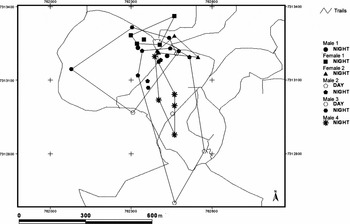
We received a total of 199 signals from all tagged bats in October 2004, but only 181 of them allowed a detailed analysis of movement patterns, and 62 permitted precise triangulation and hence assessment of area use based on the MCP method. We used the remaining signals for a rough confirmation of the foraging area but did not include them in the MCP analysis. The tracking data suggest a pattern of commuting distances of up to 700 m long and use of rather large areas up to c. 16 ha by individual bats. There was high variation among individuals, with area sizes ranging between 1.3 and 13.7 ha (Figure 1).
Positions of six individuals of Sturnira lilium radio-tracked for 10 nights in October 2004, during day (white symbols) and night (black symbols). Night positions include night roosts and foraging sites. We also present the MCP areas used by five of the six individuals of S. lilium. Coordinates are in UTM system (Zone 22J). Lines represent a trail system used in the area during the study, and crosses are a simplified representation of the geographical grid.

The maximum linear distance flown by a single bat from a day roost to the foraging area (commuting distance) ranged from 480 m (female) to 760 m (male). Bats consistently used feeding roosts at different locations (Figure 1). We also triangulated the positions of the day roosts of two tagged bats. The data revealed that they were at different locations during different days (Figure 1). Unfortunately, it was not possible to observe the bats at the day roosts, because the vegetation at the most probable locations was very dense. Furthermore, our tracking data suggested that the bats probably roosted somewhere rather high up (c. 20 m) in the canopy.
In our study we found indirect evidence for the effectiveness of S. lilium as seed disperser of some Solanaceae species as all of the three prerequisites outlined in Fleming & Sosa (Reference FLEMING and SOSA1994) were met. First, fruiting strategies of all species of Solanaceae monitored during a previous study (Mello et al. in press) were consistent with the ‘steady-state’ model (Heithaus Reference HEITHAUS and Kunz1982). Therefore, each of the Solanaceae species provides a reliable food source for S. lilium. Considering that different Solanaceae species fruited at somewhat different times, bats are likely to have continuous access to fruits almost throughout the whole year.
Second, S. lilium turned out to be a reliable consumer of Solanaceae fruits as it consistently took and ate the fruits throughout the year (Mello et al. in press). Interestingly, the tight association of S. lilium with Solanaceae as its main food appears to be the case all over the neotropics, for many authors have reported similar dietary preferences of S. lilium throughout its distribution range (Cáceres & Moura Reference CÁCERES and MOURA2003, Iudica & Bonaccorso Reference IUDICA and BONACCORSO1997, Passos et al. Reference PASSOS, SILVA, PEDRO and BONIN2003, Uieda & Vasconcellos-Neto Reference UIEDA and VASCONCELLOS-NETO1985), as well as in behavioural experiments (Bonaccorso & Gush Reference BONACCORSO and GUSH1987). It is thus reasonable to presume that S. lilium is particularly adapted to overcome the potentially negative effects of the secondary plant compounds that are common in the Solanaceae. Furthermore, it is also likely that fruits of this family allow bats to meet most or all of their nutritional requirements. This proposition is reinforced by Herrera et al. (Reference HERRERA, HOBSON, MANZO, ESTRADA, SANCHEZ-CORDERO and MENDEZ2001) who observed experimentally that a fruit-only diet may be sufficient for survival of S. lilium.
Third, we found some evidence with our radio-tracking results in the present study that the bats use rather large areas and use a variety of night roosts, thus potentially leading to a widely scattered seed shadow. It is known from our previous study (Mello et al. in press) and the literature (Cáceres & Moura Reference CÁCERES and MOURA2003, Iudica & Bonaccorso Reference IUDICA and BONACCORSO1997) that S. lilium usually does not chew or digest seeds, and takes fruits away from parent-plants to eat them at feeding roosts. Under natural conditions, the ingested seeds are then either defecated at the feeding roost or in flight, and it is likely that the seeds remain viable throughout the gut passage, as commonly observed (Fleming & Sosa Reference FLEMING and SOSA1994). This type of foraging behaviour is likely to increase the chances of successful germination for the seeds by escaping higher mortality in the close vicinity of their parent plant (Janzen Reference JANZEN1970), making S. lilium a legitimate disperser (sensu Fleming & Sosa Reference FLEMING and SOSA1994). The use of large foraging areas and different feeding roosts per night increases the possibility that part of the seeds dispersed by the bats land in ‘safe sites’ that are favourable for germination and establishment of the seedlings (Levin et al. Reference LEVIN, MULLER-LANDAU, NATHAN and CHAVE2003).
To summarize, we found indirect evidence that points towards S. lilium being a legitimate and effective seed disperser of Solanaceae. Therefore, given its high abundance at many sites and its effectiveness in the dispersal process, S. lilium is likely to be an important dispersal agent for Solanaceae species, most likely positively influencing their population dynamics in neotropical forests. Considering that the plants benefit by having their seeds dispersed, and that the bats benefit by having a reliable source of food, we consider this interaction as a facultative mutualism (sensu Boucher et al. Reference BOUCHER, JAMES and KEELER1982). In order to ‘close the seed dispersal loop’ as suggested by Wang & Smith (Reference WANG and SMITH2002), future investigations need to identify the exact sites that the bats use as nightly feeding roosts, where probably most seeds are dropped, and to find out more about the fate of seeds and seedlings there. Those data will contribute to assess the efficiency (sensu Fleming & Sosa Reference FLEMING and SOSA1994) of S. lilium as a disperser of Solanaceae in addition to its legitimacy and effectiveness.
ACKNOWLEDGEMENTS
We thank many colleagues at Universidade Estadual de Campinas, Universität Ulm, and Parque Estadual Intervales, who helped us a lot during this study, especially Ariovaldo Cruz-Neto, Mauro Galleti, Pedro Jordano, Sandra Silva, Jakob Fahr, Natália Leiner and Marcelo Gonzaga. MARM was sponsored by CAPES, FAPESP (02/09286-0), CNPq/DAAD (290088/2004-6), Bat Conservation International and Idea Wild.