Introduction
Corticobasal degeneration syndrome (CBDS) and progressive supranuclear palsy (PSP) are the most common neurodegenerative extrapyramidal entities after Parkinson's disease (Litvan, Reference Litvan1999). Their prevalence is estimated at between four and seven cases per 100,000 population, although further studies are warranted (Golbe et al., Reference Golbe, Davis, Schoenberg and Duvoisin1988; Mahapatra et al., Reference Mahapatra, Edwards, Schott and Bhatia2004). Since their first description by Rebeiz et al. (Reference Rebeiz, Kolodny and Richardson1967) for CBDS and by Steele et al. (Reference Steele, Richardson and Olszewski1964) for PSP, major advances have occurred in the recognition and understanding of the two disorders. Initial reports of CBDS patients emphasized the combination of movement disorders, variably associated with dystonia and myoclonus, along with cerebral cortical deficits including apraxia, alien limb and cortical sensory loss. In PSP, the main clinical characteristics include prominent early postural instability along with recurrent falls, vertical ophthalmoparesis, akinetic-rigid features, and prominent bulbar dysfunction (dysarthria, and dysphagia). Poor response to levo-dopa challenge is an adjunctive element of the two conditions.
The common genetic and pathological overlap of PSP and CBD with frontotemporal lobar degeneration (FTLD) variants prompted the inclusion of these atypical extrapyramidal syndromes under the same nosologic group (Kertesz et al., Reference Kertesz, Hillis and Munoz2003). Indeed, as reported in FTLD, a robust genetic association of these two conditions with MAPT mutations have been found, and PSP and CBDS are said to belong to tauopathies, also because of the excessive deposition of four-tandem repeat tau isoforms (Spillantini et al., Reference Spillantini and Goedert2000). Moreover, in the disease course, CBDS and PSP patients often exhibit behavioral disturbances along with impaired executive functions and language deficits – a spectrum of symptoms that collectively encompasses a fronto-subcortical dementia (Kertesz et al., Reference Kertesz, McMonagle, Blair, Davidson and Munoz2005). A few studies on behavioral disturbances in these two diseases are available. In particular, patients with CBDS and PSP were found to present overlapping neuropsychiatric features, including depression and apathy, although with a different profile (Litvan et al., 1998). By using a multidimensional approach to the models of awareness, patients with PSP and CBDS showed a significant loss of insight (O'Keeffe et al., Reference O'Keeffe2007). Systematic work using proper questionnaires to detect behavioral disturbances in dementia have still to elucidate the clear pattern of differences.
Kertesz and colleagues standardized the Frontal Behavioral Inventory (FBI), a caregiver questionnaire specifically designed to operationalize and quantify the personality and behavioral changes in FTLD (Kertesz et al., Reference Kertesz, Nadkarni, Davidsob and Thomas2000). Italian validation of FBI was demonstrated to differentiate FTLD from Alzheimer's disease (AD) (Alberici et al., Reference Alberici2007), and FBI has recently been used to correlate behavioral changes in PSP with brain atrophy (Cordato et al., Reference Cordato, Halliday, Caine and Morris2006). Among different clinical questionnaires available to assess neuropsychiatric symptoms occurring in neurodegenerative conditions, FBI was chosen because it was demonstrated to be a tool with established validity and reliability, and to be more specific in differentiating FTLD from other neurodegenerative conditions (Kertesz et al., Reference Kertesz, Nadkarni, Davidsob and Thomas2000; Alberici et al., Reference Alberici2007).
Evaluation of behavioral patterns in CBDS and PSP, and quantitative comparisons between these two conditions, are still lacking in the literature; such an evaluation could help to clarify the complex cortical and sub-cortical neuroanatomical frames of the two diseases (O'Keeffe et al., Reference O'Keeffe2007).
On clinical grounds, neuropsychiatric symptoms are important predictors of caregiver burden and the institutionalization of patients. The investigation of behavioral abnormalities in these atypical extrapyramidal conditions could help to minimize misdiagnosis, to plan adequate therapeutical interventions, and eventually to improve the quality of life for patients and their caregivers. Our study therefore aimed to measure behavioral abnormalities by comparing two large clinical series of CBDS and PSP patients.
Methods
Patients who met the current clinical criteria for CBDS and PSP (Lantos, Reference Lantos2000; Litvan et al., Reference Litvan1996) were consecutively recruited from March 2002 through December 2007 at the Center for Aging Brain and Neurodegenerative Diseases, University of Brescia, Italy.
All patients underwent a general medical examination, a review of their full medical history and routine laboratory screening before inclusion. The diagnostic assessment consisted of a full neurological examination, a semi-structured interview, a complete mental status evaluation by two independent and experienced neurologists (B.B., C.A.), and brain MRI and SPECT imaging. Only patients with full consensus agreement on their diagnosis by the two neurologists, and in the early stage of illness (within three years from disease onset), were enrolled for further investigation. All diagnoses were clinically confirmed at least at two years' follow-up.
Stringent exclusion criteria were applied: (i) cerebrovascular disorders, previous stroke, hydrocephalus, and intra-cranial mass as documented by MRI; (ii) a history of traumatic brain injury or another neurological disease; (iii) significant medical problems; and (iv) major depressive disorder, bipolar disorder, schizophrenia, substance abuse disorder, or mental retardation according to DSM-IV criteria.
For each patient, extrapyramidal features were evaluated by Unified Parkinson Disease Rating Scale (UPDRS-III), cognitive functions were measured according to a standardized battery, including the Mini-mental State Examination (MMSE), Short Story, Rey Complex Figure (copy and recall), Raven Colored Progressive Matrices, Token test, letter and category fluency, and Trail Making test. Instrumental Activities of Daily Living (IADL), and Basic Activities of Daily Living (BADL) were also assessed. Behavioral and psychiatric disturbances were evaluated by means of the Frontal Behavioral Inventory (FBI, parts A and B) (Kertesz et al., Reference Kertesz, Nadkarni, Davidsob and Thomas2000; Alberici et al., Reference Alberici2007). The FBI comprises a 24-item scale, with two subscales for negative (FBI-A) or positive behaviors (FBI-B), mainly chosen from the core items that appeared in the Lund/Manchester consensus. Quantitative measures are determined on a 4-point scale for each item, as gauged by caregiver interview, accounting for a total FBI score (FBI-AB). For each item, the extent of the behavioral change is scored according to the following: 0 = none, 1 = mild and occasional, 2 = moderate, 3 = severe and most of the time. The FBI score ranges from a minimum of 0 to a maximum of 72. In the validation study, the FBI score of neurologically healthy individuals was found to be 5.54 (SD 5.3) (Kertesz et al., Reference Kertesz, Nadkarni, Davidsob and Thomas2000). Previous studies have shown that the FBI has a high internal consistency and inter-rater reliability, and when compared to other neuropspychiatric measures, it was found to be able to distinguish FTLD from AD with a high diagnostic accuracy. The FBI scale was translated from English into Italian and then back-translated from Italian into English to ensure the fidelity of the translation. The Italian version has been previously validated (Alberici et al., Reference Alberici2007). In the Italian population, the total FBI score of 28.6 was found to be a conservative cut-off point to differentiate FTLD from other dementias (Alberici et al., Reference Alberici2007).
In the present work, FBI was administered blind to the clinical diagnosis by C.M. The Neuropsychiatry Inventory (NPI) was also administered (Cummings et al., Reference Cummings, Mega, Gray, Rosenberg-Thompson, Carusi and Gornbein1994).
All participants were made fully aware of the research goals, and informed consent was obtained from all patients. This study was conducted in accordance with local clinical research regulations and conformed to the Declaration of Helsinki.
Statistical analyses
The Mann-Whitney and χ2 tests were used to compare the demographic and clinical characteristics of PSP and CBDS patients. Analyses were run using SPSS software package (version 16.0 for Windows, SPSS Inc., Chicago, IL).
Results
Between 2001 and 2008, 125 patients (68 CBDS and 57 PSP) were consecutively enrolled at the Center for Aging Brain and Neurodegenerative Diseases, University of Brescia, Italy.
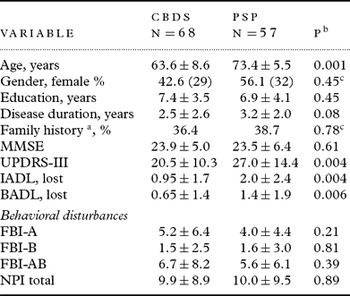
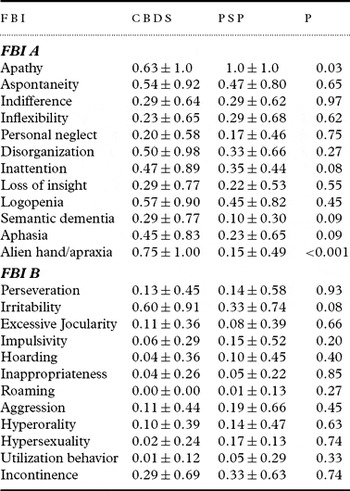
Demographic and clinical characteristics are reported in Table 1. PSP patients were older than CBDS, and they were more impaired in UPDRS-III, IADL and BADL. The two groups differed neither in term of disease duration nor for MMSE, FBI, and NPI total scores. PSP and CBDS did not differ in tests tapping memory functions (Short Story, Rey Complex Figure recall), visuo-spatial skills (Rey Complex Figure copy, Raven Colored Progressive Matrices), but PSP patients had worse scores on tests of language performances than CBDS, i.e. letter fluency (PSP vs. CBDS, 21.0 ± 9.3 vs. 26.0 ± 10.3, P = 0.007), and category fluency (28.1 ± 9.4 vs. 32.4 ± 10.8, P = 0.019). Mean FBI items in CBDS and PSP patients are reported in Table 2.
Demographic, clinical and behavioral characteristics in CBDS and PSP

a Differences in the total are due to missing values; b Mann-Whitney test; c χ2 test.
CBDS = corticobasal degeneration syndrome; PSP = progressive supranuclear palsy; UPDRS = Unified Parkinson Disease Rating Scale; IADL = instrumental activities of daily living; BADL = basic activities of daily living; FBI = Frontal Behavioral Inventory; NPI = Neuropsychiatric Inventory.
Mean FBI item scores in CBDS and in PSP

CBDS = corticobasal degeneration syndrome; PSP = progressive supranuclear palsy; FBI = Frontal Behavioral Inventory.
FBI-AB scores were relatively low in both groups, being 6.7 ± 8.2 and 5.6 ± 6.1 in CBDS and PSP, respectively (CBDS vs. PSP, P = 0.39).
Comparison of the behavioral profile between CBDS and PSP patients showed significant differences in apathy, which was more frequent in the latter group, and presence of alien hand/apraxia, more frequent in the former. Apathy correlated neither with age nor with motor disturbances as measured by UPDRS-III.
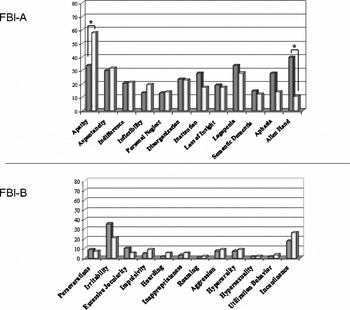
As shown in Figure 1, FBI behavioral disturbances were also analyzed as absent ( = 0) or present ( = 1–3). PSP showed greater apathy compared to CBDS (57.9% vs. 33.8%, P = 0.007), whilst CBDS, as expected, had an increased frequency of alien hand (39.7% vs. 10.5%, P = 0.001). Overall, the most frequent behavioral abnormalities in both groups (>25%) were aspontaneity and logopenia. Aphasia (27.9%) and irritability (35.3%) were more frequent in CBDS compared to PSP, even if not statistically different.
Percentage of FBI behavioral disturbances in CBDS and PSP patients. Gray columns = CBDS patients, white columns = PSP patients.

In both groups, FBI-A scores were worse than FBI-B scores. NPI item values were not significantly different between groups.
Discussion
Several points for discussion may be drawn from the present study. By considering a large sample of CBDS and PSP patients, we measured total FBI that was found to be close to what had been previously observed in a group of aged-matched healthy controls (5.54, SD = 5.3), and indeed it was very low compared to the score of 30, which was defined by Kertesz as a conservative cut-off point, differentiating FTLD from other dementias (Kertesz et al., Reference Kertesz, Nadkarni, Davidsob and Thomas2000; Alberici et al., Reference Alberici2007). This patient sample did not show the typical disinhibition syndrome of FTLD as evidenced by a low FBI score. We might argue that in early disease stages, CBDS and PSP, although belonging to the FTLD spectrum, need to be considered as separate diseases because of their relatively low behavioral abnormalities, which these patients tend to develop later during the disease progression (Kertesz et al., Reference Kertesz, McMonagle, Blair, Davidson and Munoz2005; Cordato et al., Reference Cordato, Halliday, Caine and Morris2006). In addition, the FBI measure seems to be particular useful in identifying behavioral variants in FTLD.
Total FBI scores do not differentiate the two extrapyramidal syndromes; however, a comparison of FBI items between CBDS and PSP showed a peculiar behavioral profile for PSP patients as characterized by a higher burden of apathy, while CBDS patients selectively exhibited apraxia and alien limb. These findings appear to be in general accordance with previous studies that reported apathy and disinhibition as the most frequent behavioral abnormalities in the majority of mid-stage PSP cases (Aarsland et al., Reference Aarsland, Litvan and Larsen2001). Apathy is currently defined as a quantitative reduction of self-generated voluntary and purposeful goal-directed behavior, with dysfunction occurring at the different steps of each action's elaboration, execution and control (Levy and Czernecki, Reference Levy and Czernecki2006). Therefore, apathy might not merely be considered as a single entity but rather as the consequence of the disruption of multiple underlying processes. In PSP patients, apathy may result from the disconnection of orbitofrontal and lateral prefrontal regions from subcortical brain regions, including the pulvinar, dorsomedial and anterior nuclei of the thalamus, and superior and inferior culliculum, as visualized in brain MRI imaging studies (Padovani et al., Reference Padovani2006). In our PSP sample, we did not find a correlation of apathy with UPDRS-III scores, which contrasts with what has been reported in patients affected by Parkinson's disease (PD) (Czernecki et al., Reference Czernecki2008). The dissociation between apathy and UPDRS further supports the view that apathy in PSP is not dopamine-dependent, but rather it might sub-serve a prefrontal-like deafferentation syndrome, implicating specific approaches to define future therapeuthical trials. As most of our PSP patients were within three years of disease onset, we suggest that disinhibition might develop later in this neurodegenerative condition.
It is worth noting that “apathy” is one the items also considered in the NPI, but sub-items analysis did not detected any significant differences between the two diseases. This discrepancy might be explained by the fact that the correlation of convergent validity between FBI with NPI showed only 25% of the variance, suggesting that the two scales weighed the same dimension of behavioral disturbances in dementia differently (Alberici et al., Reference Alberici2007).
FBI was able to characterize two important aspects in CBDS, the presence of apraxia and of alien hand, and highlighted a higher prevalence of aphasia (even if this was not statistically significant).
Finally, aspontaneity and logopenia were common features in CBDS and PSP, present in both groups over the 25% of cases.
We acknowledge that these results have some limitations. The study lacks an appropriate control group, including AD patients. In addition, the neuropathological confirmation is not available, even though we tried to strengthen the clinical diagnosis by extensive clinical, cognitive and neuroimaging assessment, the adoption of stringent exclusion criteria, and the two-year follow-up of patients. Validation of these FBI results through the use of brain autopsy studies or molecular markers will be advisable in the future.
The present study has provided previously unpublished measures of the FBI in a population of PSP and CBDS patients, and argues for the usefulness of FBI assessment for the differential diagnosis of FTLD spectrum entities. Future research in this area should evaluate behavioral profiles of CBDS and PSP to improve the design of therapeutic approaches.
Conflict of interest
None.
Description of authors' roles
Barbara Borroni designed the study, supervised the data collection, analyzed the data and wrote the paper; Antonella Alberici supervised data collection and assisted in writing the paper; Chiara Agosti collected the data, supervised the data collection and assisted in writing the paper; Maura Cosseddu collected the data; Alessandro Padovani supervised the designing of the study.