The global cancer burden was estimated to be 19.3 million new cases and almost 10.0 million deaths in 2020 (Reference Sung, Ferlay and Siegel1). Countries across the world suffer from huge economic burden, with the overall cost of cancer care in 2021 estimated to exceed $147 billion (Reference Hong, Li, Matusiak and Schumock2). During the COVID-19 pandemic, patients with cancer as a vulnerable population are more likely prone to many harms including diagnostic delay, interruption of their cancer therapy or usual medical care and susceptibility to life-threatening infections (Reference Jazieh, Akbulut and Curigliano3).
The high morbidity and mortality of cancer diseases have promoted the rapid process of cancer research and new drug development in recent years. The European Medicines Agency (EMA) approved about ten new cancer medicines per year from 2012 to 2018 compared to about four new medicines per year from 2001 to 2011 (4). In the United States, cancer remained the predominant area of innovation, accounting for an average of 25 percent among all approvals by the Food and Drug Administration (FDA) (5). Several regulatory programs such as fast track designation, accelerated approval and priority review in FDA and PRIME scheme in EMA have been established to expedite the development and approval of promising products for serious conditions with a high unmet need such as cancers (Reference Cox, Edmund, Kratz, Lockwood and Shankar6). These accelerated programs bring a big challenge for payers and health technology assessment (HTA) entities to make confident decisions on coverage and pricing for cancer drugs as the approvals under these regulations often rely on relatively limited evidence generated from poorly designed studies (open-label or single-arm studies), featured with small patient numbers and use of surrogate end points (Reference Ladanie, Schmitt and Speich7;8).
Considering the uncertainty surrounding the clinical evidence combined with the rising disease and economic burden for the new cancer products, several countries have taken specific measures to determine the value of these products and increase patient access to effective treatments as possible. In Canada, the pan-Canadian Oncology Drug Review (pCODR), which was established in 2011, is specifically responsible for the transparent and consistent assessment of cancer drugs (9); in England, the Cancer Drugs Fund, a source of funding exclusively for cancer drugs, has become part of the National Institute for Health and Care Excellence (NICE) process for reviewing new cancer drugs since 2016 (10); in Korea, the risk-sharing agreements (RSAs) in 2013 and the waiver of pharmacoeconomic data submission in 2015 were introduced to expand the coverage benefit to four severe diseases, including cancers (Reference Lee, Bae and Bae11); and in several countries, managed entry agreements (MEAs) between companies and healthcare payers are often adopted for high-cost cancer products to address uncertainty relating to their financial impact or performance (Reference Wenzl and Chapman12).
Due to the divergence in drug reimbursement systems and/or the socioeconomic situations, the reimbursement decisions of cancer drugs may differ across the countries (8;Reference Pujolras and Cairns13). In the last decade, several studies have been published to analyze and compare the HTA agency’s decisions for cancer drugs across the countries (Reference Pujolras and Cairns13–Reference Lim, Lee, Koh and Heo16). Most of the studies focused on the descriptive and comparative analyses of different reimbursement decisions (Reference Pujolras and Cairns13–Reference Chabot and Rocchi15) or the predictive factors (Reference Lim, Lee, Koh and Heo16) for favorable HTA recommendations. In recent years, more studies were interested in investigating the previous HTA decisions in quantitative ways to identify the revealed preference of decision-makers for cancer drug recommendations. Analysis of actual HTA decisions is promising, as it makes inferences from true instead of hypothetical decisions. It could be meaningful to assess the real preferences of decision-makers, which may deviate from predefined HTA processes (Reference Fischer17). However, to our best knowledge, none of the studies have attempted to pool the outcomes of these studies. Only two reviews tried to investigate the findings of the quantitative literatures for drugs in general, but not for cancer drugs (Reference Fischer17;Reference Ghijben, Gu, Lancsar and Zavarsek18). Considering the potential of cancer drugs to address life-threatening diseases, revealed prevalence for cancer drugs may be different from those for noncancer drugs.
Against this background, this study aimed to review the revealed preference of decision-makers identified from the quantitative studies for cancer drugs recommendations. The findings of this study may help decision-makers improve the transparency and fairness of the HTA process for better patient access and manufacturers understand the important factors considered by decision-makers for better evidence generation in the future.
Methods
Search Strategy and Selection Criteria
A systematic literature search was performed in MEDLINE and EMBASE databases from inception to July 2020. The methodology of this review followed the guidance for systematic reviews from the Centre for Reviews and Dissemination at the UK National Institute for Health Research (19). The search strategy (Supplementary Table 1) included but was not limited to the following keywords: “HTA” or “subsidy” or “coverage” or “reimbursement” or “listing” combined with “criteria” or “factor” or “driver” or “preference” and “recommendation” or “appraisal” or “decision-maker” and “cancer”.
The studies were eligible for inclusion if they (i) investigated HTA reports of cancer drugs, (ii) conducted univariable or multivariate analysis to explore factors and their relative importance on HTA recommendations, and (iii) were published in English. The studies were excluded if they investigated the stated preference of decision-makers using quantitative methods such as discrete choice experiments or surveys. The titles and abstracts of all the studies identified from the initial search were screened independently by two researchers. Full texts for potentially eligible studies were subsequently reviewed based on the eligibility criteria. Discrepancies were resolved via discussion and, if consensus could not be reached, they were solved through referral to a third reviewer. Reference lists of eligible studies and grey literature were manually searched to identify more relevant studies.
Data Extraction
The data of included studies were extracted by two researchers independently, including (i) study characteristics: title, publication year, objective, studied country, research agency, study period, data set, number of decisions, inclusion and exclusion criteria; (ii) analysis and modeling methods: definitions of factors impacting the decisions, definitions of decisions, analysis methods; (iii) descriptive results for categorical variables: category levels for factors, recommendation and rejection numbers for each category level; and (iv) modeling results: significant factors identified from univariable and multivariable analyses, and main outputs of modeling analysis.
Data Synthesis and Analysis
The classification of factors was based on the EVIDEM 10th Edition framework and the factors were integrated into five clusters: (i) characteristics of disease; (ii) characteristics of technology; (iii) health outcomes; (iv) economic outcomes; and (v) other aspects (Reference Goetghebeur and Cellier20). The factors were considered as the significant factors for HTA recommendations if their p-values were below the significance level of .05 from the univariable or multivariable analysis. The factors which were only analyzed in one agency and not found as a significant factor were excluded from the analysis. The outcomes combined by the researchers (e.g., the combined outcome of survival gain and adverse events) to evaluate their combined effects for recommendations were excluded from the analysis since it was not possible to evaluate the relative effect of each factor. We calculated the unadjusted odds ratios (ORs) for categorical factors based on the descriptive data (if available) from included studies to evaluate their relative importance with R software version 4.0.3.
Results
Characteristics of the Included Studies
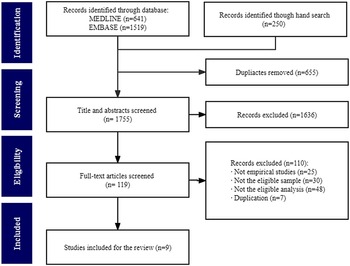
A total of 1,755 articles were identified for initial search after duplicate exclusion. A total of 1,636 articles were excluded after the screening of title and abstract, and 119 articles were included for full-text evaluation. Finally, nine articles were included in the analysis (Figure 1) (Reference Karikios, Chim and Martin21–Reference Skedgel, Wranik and Hu29).
Flow diagram of the study selection process. Process of eligible study selection and results were shown from the search in two databases, hand search, the screen of title and abstract, and the screen of full text.

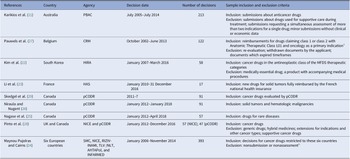
The characteristics of the included studies were shown in Table 1. The majority of studies (n = 7) (Reference Karikios, Chim and Martin21–Reference Li, Vivot, Alter and Durand Zaleski23;Reference Nagase, Stafinski, Sun, Jhangri and Menon25–Reference Pauwels, Huys, Nys, Casteels and Simoens27;Reference Skedgel, Wranik and Hu29) only investigated decisions in a single agency, except that Pinto et al. (Reference Pinto, Naci, Neez and Mossialos28) study researched the recommendations in two agencies in a separate analysis, and Maynou Pujolras and Cairns (Reference Maynou Pujolras and Cairns24) study pooled the decisions from six European agencies. A total of six agencies were studied independently, including Pharmaceutical Benefits Advisory Committee (PBAC) in Australia (Reference Karikios, Chim and Martin21), Commission of Reimbursement of Medicines (CRM) in Belgium (Reference Pauwels, Huys, Nys, Casteels and Simoens27), Health Insurance Review and Assessment Service (HIRA) in South Korea (Reference Kim, Kim and Lee22), National Authority for Health (HAS) in France (Reference Li, Vivot, Alter and Durand Zaleski23), NICE in the UK (Reference Pinto, Naci, Neez and Mossialos28), and pCODR in Canada (Reference Nagase, Stafinski, Sun, Jhangri and Menon25;Reference Niraula and Nugent26;Reference Pinto, Naci, Neez and Mossialos28;Reference Skedgel, Wranik and Hu29). The number of HTA decisions ranged from 17 to 393 (median = 75). Most studies (n = 6) have no specific restrictions on the types of cancers with three exceptions that Li et al. (Reference Li, Vivot, Alter and Durand Zaleski23) study was limited to the solid cancers, Niraula and Nugent (Reference Niraula and Nugent26) study was limited to the solid cancers and hematologic malignancies, and Nagase et al. (Reference Nagase, Stafinski, Sun, Jhangri and Menon25) study was limited to the rare cancers. The definitions of explored factors and analysis methods were summarized in Supplementary Tables 2 and 3, respectively. The factors which were investigated in only one agency and not identified to be significant were summarized in Supplementary Table 4.
Characteristics of Included Studies

a Medicines with added therapeutic value are assigned to class 1, while medicines without added value (me too medicines) belong to class 2 and generics are grouped in class 3.
b Nonsubmission captures decisions in NICE and SMC where the reimbursement body explicitly asked the manufacturer to make a submission, but they failed to do so. Nonsubmission is considered a nonfavorable decision for NICE or SMC, but it was classified separately because this negative decision is the result of a different process. Decisions categorized as either nonsubmission or nonassessment were not included in the econometric model. Because the exclusion of these categories could introduce sample selection bias and endogeneity problems in the estimation as a result of using a nonrandomly selected sample further analyses (i.e., robustness checks) were performed.
AHTAPol, Agency for Health Technology Assessment in Poland; CRM, Commission of Reimbursement of Medicines; HAS, National Authority for Health; HIRA, Health Insurance Review and Assessment Service; INFARMED, National Authority of Medicines and Health Products; MFDS, Ministry of Food and Drug Safety; NICE, National Institute for Health and Care Excellence; NLT, New Pharmaceutical Product Therapies; PBAC, Pharmaceutical Benefits Advisory Committee; pCODR, pan-Canadian Oncology Drug Review; RIZIV-INAMI, Belgium Health Insurance Agency; SMC, Scottish Medicines Consortium; TLV, Dental and Pharmaceutical Benefits Agency.
Results of Factors for Recommendations
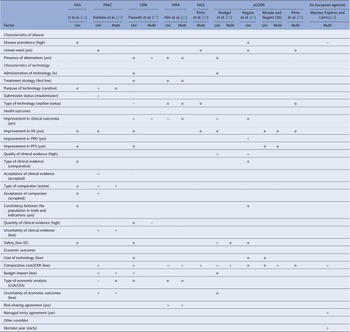
The associations between the investigated factors and HTA recommendations identified from the univariable and multivariable analyses were shown in Table 2. The ORs for categorical factors were presented in Figure 2.
Factors for Recommendations of Cancer Drugs

Notes. Symbols illustrate the relationship between the factor and recommendation: +, positive relationship (p < .05); −, negative relationship (p < .05); o, not significant (p ≥ .05). If one study performed more than one analysis, the analysis with the most factors was selected and shown in the table. This table only included the results for factors which were analyzed in more than one study or were found as the significant factors in one study.
AE, Adverse Event; CEA, Cost-Effectiveness Analysis; CRM, Commission of Reimbursement of Medicines; CUA, Cost-Utility Analysis; HAS, National Authority for Health; HIRA, Health Insurance Review and Assessment Service; ICER, Incremental Cost-Effectiveness Ratio; iv, Intravenous; Multi, Multivariable Analysis; NICE, National Institute for Health and Care Excellence; OS, Overall Survival; PBAC, Pharmaceutical Benefits Advisory Committee; pCODR, pan-Canadian Oncology Drug Review; PFS, Progression-Free Survival; PRO, Patient-Reported Outcome; Uni, Univariable Analysis.
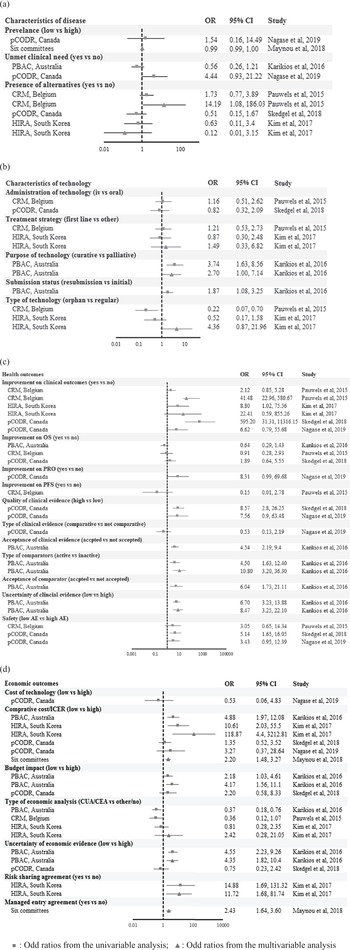
Odds ratios of factors for recommendations. The odds ratios of factors for recommendations across the different agencies and studies in the univariable and multivariable analyses were shown. The gray square symbol represented the odds ratios of factors in the univariable analysis. The blue triangle symbol represented the odds ratios of factors in the multivariable analysis. The factors were categorized into four clusters including (a) factors related to characteristics of disease, (b) factors related to characteristics of technology, (c) factors related to health outcomes, and (d) factors related to economic outcomes. AE, Adverse Event; CEA, Cost-Effectiveness Analysis; CI, Confidence Interval; CRM, Commission of Reimbursement of Medicines; CUA, Cost-Utility Analysis; HIRA, Health Insurance Review and Assessment Service; ICER, Incremental Cost-Effectiveness Ratio; iv, Intravenous; OR, Odd Ratio; OS, Overall Survival; PBAC, Pharmaceutical Benefits Advisory Committee; pCODR, pan-Canadian Oncology Drug Review; PFS, Progression-Free Survival; PRO, Patient-Reported Outcome.

Factors Related to Characteristics of Disease
Three factors related to characteristics of disease were investigated by univariable or multivariable analysis for recommendations in six single agencies and combined recommendations in six European agencies. In univariable analysis, no factors were identified to be significant for recommendations in HAS, PBAC, CRM, HIRA, and pCODR.
In multivariable analysis, the high disease prevalence was found as a negative factor for combined recommendations in six European agencies. The presence of alternatives became a positive factor for recommendations in CRM with the OR of 14.19 compared with the absence of alternatives (Figure 2a) while it was still not a significant factor in HIRA. The unmet need was not identified as a significant factor in NICE and pCODR.
Factors Related to Characteristics of Technology
Five factors related to characteristics of technology were investigated for recommendations in six agencies by univariable or multivariable analysis. In the univariable analysis, two and one significant factors were identified in PBAC and CRM, respectively. The curative intent of technology and resubmission status was found as the positive factors in PBAC and orphan drug status was identified as a negative factor in CRM. No significant factors were identified in HAS, HIRA, and pCODR.
In multivariable analysis, none of the factors was identified as the significant factors for recommendations in PBAC, HIRA, NICE, and pCODR. The curative intent of technology was no longer a positive factor with ORs decreasing from 3.74 to 2.70 compared with technology for palliative intent in PBAC (Figure 2b). The orphan drug was not found as a significant factor in HIRA, NICE, and pCODR.
Factors Related to Health Outcomes
Thirteen factors related to health outcomes were investigated for recommendations in six agencies by univariable or multivariable analysis. In univariable analysis, except that no significant factors were identified in HAS, a few factors were found to be the significant factors in PBAC, CRM, HIRA, and pCODR. The improvement in clinical outcomes was demonstrated to be a positive factor in CRM and HIRA with ORs of 2.12 and 8.80 compared with no improvement respectively (Figure 2c). The results were inconsistent for pCODR among the reported studies: one study found that the improvement in clinical outcomes was a positive factor, while another study indicated that it was not a significant factor. The active comparator and acceptance of comparator were found as the positive factors in PBAC, while not significant factors in HAS. The good safety profile was found as a positive factor in pCODR in one study, while not a significant factor in CRM and HAS. The improvement in overall survival (OS) was not found to be a significant factor in PBAC, pCODR, CRM, and HAS.
In multivariable analysis, the improvement in clinical outcomes was still a positive factor in CRM with the ORs increasing from 2.12 to 41.48 compared with no improvement (Figure 2c). While it was no longer a positive factor in HIRA even though the ORs compared with no improvement were changed from 8.80 to 22.41 (Figure 2c). The active comparator remained as the positive factor in PBAC. Safety was no longer a significant factor in PBAC. The improvement in OS was still not found to be a significant factor for recommendations in pCODR and NICE.
Factors Related to Economic Outcomes
Seven factors related to economic outcomes were investigated for recommendations in five single agencies and combined recommendations in six European agencies by univariable or multivariable analysis. In univariable analysis, a lower comparative cost or incremental cost-effectiveness ratio (ICER) was identified as a positive factor in PBAC, CRM, and HIRA. The results for pCODR were inconsistent: one study demonstrated that a lower ICER was a positive factor, while two studies did not identify it as a significant factor. The technology with a lower budget impact was identified as a positive factor in PBAC and CRM, while not a significant factor in pCODR (Reference Skedgel, Wranik and Hu29). The availability of cost-utility analysis (CUA) or cost-effectiveness analysis (CEA) was found as a negative factor in PBAC compared with the availability of cost-minimization analysis (CMA) or other analysis, while not a significant factor in CRM and HIRA.
In multivariable analysis, a lower comparative cost was still a positive factor in HIRA with the ORs increasing from 10.62 to 118.87 (Figure 2d). A lower ICER was identified as a positive factor for recommendations in NICE and combined recommendations in six European agencies. The results of ICER were still inconsistent for pCODR: two studies indicated a low ICER was a positive factor, while another study found it as a not significant factor. Low uncertainty of economic evidence and technology with low budget impact were still found as significantly positive factors in PBAC but the availability of CEA or CUA was no longer found as a significant factor. The availability of RSAs was identified as a positive factor for recommendations in HIRA and the availability of MEAs was a positive factor for combined recommendations in six European agencies.
Discussion
To our best knowledge, this is the first review which systematically analyzed the revealed preference of decision-makers for cancer drugs recommendations. Despite the different definitions of factors and analysis methods adopted in these studies, the factors related to health and economic outcomes were more likely to be identified as the significant factors compared with factors related to disease and technology among the different agencies.
It is hypothesized that the technologies targeting disease with an unmet clinical need (e.g., no treatment) should be more likely to be recommended in decision-marking, as more health resources should be allocated to the diseases with the high unmet need (Reference Wang, Qiu, Zhou, Francois and Toumi30). However, unmet need was not identified as a significant factor in PBAC, NICE, and pCODR, and the absence of alternatives was not identified as a significant factor in HIRA and pCODR, and even identified as a negative factor in CRM. One plausible explanation may be that the technology without alternatives or targeting the disease with a high unmet need was usually associated with a high price and may fail to meet the criterion of cost-effectiveness, where a high ICER was identified as a negative factor in these five agencies.
Orphan drug status was identified as a negative factor in CRM and not a significant factor in HIRA, pCODR and NICE compared with regular drug status. As it is known to all, orphan drugs are usually associated with limited availability of clinical data, high prices and high uncertainty in clinical and cost-effectiveness outcomes (Reference Adkins, Nicholson and Floyd14). However, most HTA agencies adopt the same HTA approval process for orphan drugs and other drugs, and it may be difficult for orphan drugs to provide robust clinical evidence and prove cost-effective based on the conventional HTA methods (Reference Nicod, Annemans and Bucsics31). Fortunately, more and more agencies have realized this difficulty for orphan drugs and implemented several measures to deal with it. A survey in 2020 found that thirteen of thirty-two investigated countries have included supplementary processes specifically targeting orphan drugs. In the UK, NICE has introduced the highly specialized technology evaluation process for ultra-orphan drugs targeting the disease with the prevalence of <1 in 50,000, where the ICER threshold increases to £100,000 (Reference Clarke, Ellis and Brownrigg32). Some HTA agencies implement MEAs to generate additional evidence for later reappraisal to accelerate access to orphan drugs (Reference Ferrario and Kanavos33). Many supplemental processes are still under exploration, but it can be foreseen that these processes could help decision-makers better deal with the uncertainty surrounding the orphan drugs and increase patient access.
Most factors related to health outcomes were identified to be the significant factors for recommendations in at least one of the included agencies. However, the improvement in OS was not identified as a significant factor in all investigated agencies including HAS, PBAC, CRM, NICE, and pCODR, where OS end point is generally regarded as the gold standard for demonstrating efficacy in oncology trials and the preferred criterion for HTA (Reference Solà-Morales, Volmer and Mantovani34). One explanation may be if the technology is supported through substantial evidence for OS benefit, pharmaceutical companies may ask a high price which may increase the ICER and reduce the probability of recommendations. In reality, evidence for OS may be not always available for HTA (8;Reference Davis, Naci and Gurpinar35), which usually requires long study follow-up and/or large numbers of patients to render concrete evidence of benefit. Most agencies may more likely rely on surrogate end points instead of OS (Reference Adkins, Nicholson and Floyd14) to evaluate the benefit of technology. However, the reliability of surrogate end points has not been well validated (8), and the relationship of surrogate end points to OS are heterogeneous by cancer type and setting (Reference Tan, Porcher, Crequit, Ravaud and Dechartres36–Reference Ciani, Davis and Tappenden38). Currently, only a few agencies provide specific guidance or detailed methodological advice on the statistical methods and metrics for the validation of surrogate end points (Reference Grigore, Ciani and Dams39). The regulatory (FDA or EMA) statements are usually used as a reference for the validation of surrogate end points by HTA agencies. However, regulators are more focused on safety and shorter-term efficacy while HTA agencies should focus more on a longer-term perspective to assess clinical effectiveness and cost-effectiveness, where the considerations on the acceptance of surrogate end points may be different between them (Reference Ciani, Grigore and Blommestein40). HTA agencies are suggested to develop more detailed methodological guidance for the selection of end points and validation of surrogate end points for the cancer diseases (Reference Grigore, Ciani and Dams39).
The important role of cost-effectiveness has been identified in most studied agencies. A lower comparative cost or ICER was found as a positive factor in all the investigated agencies. A previous study also proved that countries with healthcare systems financed by general taxation including NICE, PBAC, and pCODR emphasized more on cost-effectiveness for making reimbursement decisions for cancer drugs (Reference Lim, Lee, Koh and Heo16) and the high ICER has become the leading reason for rejection in some agencies. To our surprise, the availability of CUA/CEA may increase the probability of rejections in PBAC, CRM and HIRA compared with CMA or other analysis. It indicates that when the technology has demonstrably equivalent clinical effectiveness with alternatives, CMA is acceptable and sufficient for the agencies to make decisions. When CUA or CEA is submitted, decision-makers may judge the uncertainty of economic outcomes due to the complex technical and data availability issues with oncology economic modeling (Reference Miller, Foley and Russell41). In recent years, RSAs and MEAs are playing more and more important roles in decision-making to deal with the uncertainty surrounding the clinical and economic evidence for cancer drugs. The availability of RSAs and MEAs were identified as the positive factors for recommendations in HIRA and for combined recommendations in six European agencies respectively. A survey found that in South Korea, by the first half of 2019, a total of 39 drugs had been reimbursed under RSAs, and over three-quarters of them (n = 30) were cancer drugs (Reference Lee, Bae and Bae11). The number of drugs reimbursed under RSAs has increased dramatically since 2017 from three in 2016 to fifteen in 2017 which significantly enhanced patients’ access to new drugs (Reference Lee, Bae and Bae11).
Considering the complexity of the decision-making process, the included quantitative studies may also have a few methodological issues and limitations. Most studies simplified the outcomes into two parts for the modeling analysis due to the small samples for each category of recommendations, which was distinct from the real-life decisions where most agencies usually adopted an intermediate recommendation (e.g., restricted use, conditional acceptance, time-limited acceptance) between “accept” and “reject.” Certain factors such as disease burden, disease severity, and patient group submission were not investigated in the included studies. Some economic outcomes such as budget impact were not always available from public documents due to the protection of commercial confidentiality. Most studies did not consider real coverage decision processes (e.g., sequential nature of HTA decision, policy, and expertise changes) in the analyses.
The major limitation of this review was the small sample size of eligible studies. Only pCODR was analyzed by three studies, and the other agencies were only investigated by a single study. The inconsistent results have been observed among the studies which investigated the decisions from pCODR due to different definitions, selections of variables and samples, and modeling methodologies. Therefore, more evidence is awaited to determine the factors for HTA decisions more scientifically and comprehensively.
Conclusion
The factors such as unmet need, orphan drugs, and absence of alternatives which were supposed to have impacts on recommendations were not identified to be significant in most investigated agencies. One plausible explanation may be that drugs featured with these factors were usually associated with high prices due to high innovation levels, which may fail to meet the cost-effectiveness criterion. Currently, decision-makers have realized that the mechanistic decision approaches may fail to assess the drugs targeting the diseases with the high unmet need or rare diseases, and several measures have been implemented to increase patient access to those drugs.
Improvement in OS regarded as the gold standard for the efficacy of cancer diseases, was not identified as a significant factor in the investigated agencies. There is still a lack of HTA guidelines related to their accepted end points and methodological advice on the surrogate end points, which brings a big challenge for manufacturers to select the suitable and validated clinical end points in developing the new drugs. A strong consensus was observed that the cost-effectiveness criterion was important in most agencies.
Manufacturers are suggested to establish the early dialogue with local HTA agencies for the selection of end points and possible solutions such as RSAs and MEAs to deal with the uncertainty surrounding the clinical and economic outcomes. HTA agencies are suggested to adopt more flexible approval methods for orphan drugs or drugs with a high unmet need and develop specific guidelines for the selection of end points and validation of surrogate end points for cancer clinical trials.
Supplementary Material
The supplementary material for this article can be found at https://doi.org/10.1017/S0266462322000216.
Conflicts of Interest
The authors declare that they have no conflict of interest.