1 The situation today and its historical roots
When Daniel Jones first edited his English Pronouncing Dictionary (EPD) in 1917, he chose the symbol [ē] to represent the dress vowel and, in the vowel chart, placed it in the middle between the Cardinal Vowels (CVs) 2 and 3. However, he included the following remark (1917: xxii):
≪e≫ varies between cardinal ≪ε≫ and a point little above half-way between cardinal ≪e≫ and cardinal ≪ε≫. Some authors write the sound with the sign ≪ε≫, and there is much to be said in favour of this mode of representing it.
Why, then, he chose the symbol [ē] rather than [ε] for the dress vowel, remains unclear. A clue might lie in the sentence that immediately follows the above statement:
It must be borne in mind, however, that the ≪ε≫ of the diphthong ≪εə≫ has a lower tongue-position than the sound here written ≪ē≫.
In other words, it was probably his wish to keep the quality of the dress vowel symbolically distinct from the starting point of the square diphthong. On the other hand, it remains a mystery why he fixed in mid-position a vowel whose allophones could reach down as far as CV3 and only ‘little above’ half-way between CV2 and CV3, i.e. whose average lies below that half-way line. One can only assume that, had he placed it below the line, it would have been hard to argue in favour of the [ē] notation.
A significant change in argument took place in the eleventh edition (1956) of the EPD (p. xxxv):
[T]here are often variations as between one speaker and another. If, for instance, a number of Southern English people are asked one after another to say the expression get ready for breakfast . . ., it will generally be found that several varieties of ≪ē≫ are used. Some of the speakers will employ what may be termed an ‘average’ southern ≪ē≫ [footnote: i.e. a sound about half-way between Cardinal Vowels 2 and 3, in the system of eight Cardinal Vowels.], others will use a somewhat ‘closer’ vowel, others an ‘opener’ one, some possibly a ‘retracted’ variety, and so on.
It seems that, rather than adopting the more fitting symbol, a decision was made to ‘diffuse’ and ‘raise’ the vowel to a position which would still allow for the use of the [ē] symbol. Finally, a significant transcriptional change was made with the 14th edition, wherein the symbols for the square diphthong were changed from [εə] to [ēə] ‘for the sake of simplicity’.
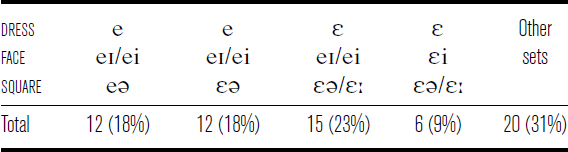
Jones’ successors as editors of the EPD (Alfred Gimson, Peter Roach and others) as well as other lexicographers (e.g. John Wells) took up the established tradition and used the [ē] symbol for dress. Since their pronunciation dictionaries were and are widely regarded as authoritative, numerous academics and publishers worldwide followed suit and have used the CV2 symbol ever since. One notable exception (‘notable’ since it is a pronunciation dictionary) is The Oxford Dictionary of Pronunciation for Current English (Upton, Kretzschmar & Konopka 2003), which uses the epsilon symbol for dress both for British and American English. However, beyond general and pronunciation dictionaries, there is no uniformity of usage at all. A survey of 65 works, of which 23 were books on general linguistics (mostly introductions), 31 on phonetics and 11 on varieties of English which included a description of RP, reveals that a variety of symbols have been used for the dress vowel and the related face and square diphthongs for ‘English’, ‘RP’, ‘Southern English’ or similar concepts. These findings are summarised in table 1.
Transcription conventions for dress, face and square.

One surprising fact may be the relatively high proportion of works that used none of the first four combinations; among these were, however, a number that employ /ēʲ/, /ēʲ/ or /ē/ for the face set. Most obscurely, three publications had the combination /ε/, /ēε/ and /ēə/. What becomes quite clear here, in any case, is that there is no universally agreed notational standard concerning the lexical sets in question; rather, various conventions seem to be fairly evenly distributed.
2 Articulatory evidence
In spite of the clarifying comments that Jones himself made, his placement of the dress vowel halfway between CV2 and CV3 in the vowel diagram also seems to have had a great impact on linguistic publications, albeit not to the same extent as his symbol usage. Of the works on general linguistics, phonetics or varieties of English surveyed, 26 gave a graphic representation of the dress vowel. Of these, seven followed Jones in placing it in the middle between CV2 and CV3, most (all but one) using the [ē] symbol. Surprisingly, 3 had it closer to CV2, and 16 (62 percent) placed it closer to (or even on) CV3. There seems to be, therefore, wide (though not unanimous) agreement that the actual (average) realisation of the dress vowel is just above CV3. However, there are two kinds of variation we have to consider before we reach a final verdict as to where to place a vowel in a vowel chart: intra-phonemic (allophonic) and intra-accent (RP) variation. According to Collins & Mees (Reference Collins and Mees2003: 94), there are two major allophonic varieties of all front checked vowels in English (including the dress vowel): a raised variety before velars (e.g. peck) and a lowered one before dark /l/ (as in bell). While the authors place the unmarked variety slightly above CV3, they see the lowered one as exactly on the cardinal. Again, we arrive at an average position closer to CV3 than to CV2.
A second point that needs to be considered is based on the fact that RP is not entirely homogeneous. Intra-RP variation exists due to the change that this speech form has undergone in the last century. A number of researchers have observed and commented on a general tendency to lower the dress and trap vowels in recent decades. Most recently, Hawkins & Midgley (Reference Hawkins and Midgley2005) provided experimental evidence for an anticlockwise movement of the monophthongs /ε/, /æ/, /uː/ and /ʊ/ (ibid. 193f.):
While no change in formant frequency can be attributed to changes in a single articulator parameter on the basis of acoustic measurements alone, the present data broadly confirm expectations in that they are consistent with auditory observations: /ε/ and /æ/ sound more open than formerly, and /uː/ and /ʊ/ sound more fronted and unrounded.
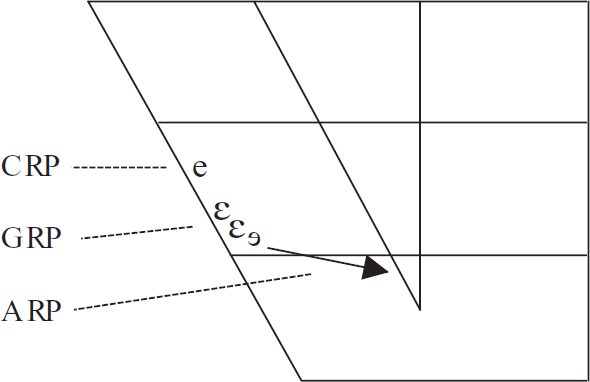
Other researchers, following Gimson (Reference Gimson1962: 84f.), distinguish between Conservative RP (CRP; used mainly by older speakers with certain social and professional backgrounds), General RP (GRP) and Advanced RP (ARP; spoken by the younger generation). Hubmayer provides a synthesis of these suggestions summarised in figure 1 (after Hubmayer Reference Hubmayer1980: 24; however, Hubmayer's experimental studies do not confirm the hypothesis of a diphthongisation of dress in Advanced RP). Hughes & Trudgill (Reference Hughes and Trudgill1996: 44), who use the epsilon for dress, state that an ‘/ε/ which is close to Cardinal [ē] may be heard amongst older upper-class speakers and those who would use them as models’, and Upton (Reference Upton, Schneider, Burridge, Kortmann, Mesthrie and Upton2004: 221f.) uses the two symbols [ē] and [ε] to distinguish ‘trad-RP’ (traditional RP) and ‘RP’. If we do not wish to assume that some publishers simply ‘raised’ the position of the vowel to better suit the symbol, this intra-RP variation may provide an explanation for those few cases where the dress vowel was positioned closer to CV2 than CV3 in that the representations were modelled on a very conservative variety of RP.
Intra-RP variation of dress.

Among those who aim at describing current British mainstream prestige pronunciation and who have specifically dealt with the question of vowel quality, however, there is widespread agreement that dress is closer to CV3 (for experimental data see also Deterding Reference Deterding1997). Wells himself, who uses [ē] rather than [ε], states that the ‘English bet vowel lies between [CV2 and CV3], but is more similar to [ε]’ (Wells Reference Wells2001). Since a number of researchers continue to use the [ē] symbol while graphically acknowledging the proximity of the vowel to CV3, this frequently leads to somewhat odd representations with a symbol in an inappropriate position or, rather, a less appropriate symbol in the correct position.
3 Perceptual evidence
Another way of attempting to solve the question of whether the [ē] symbol or the [ε] symbol is the more appropriate is to take the opposite, the perceptual, approach. In a small-scale study, ten speakers of (different forms of) British English of both sexes and various age groups and regional backgrounds were presented with the original recording of Jones’ eight cardinal vowels (see Cardinal vowels (2001)). The format short–short–long was chosen to avoid any bias towards long vowels. The informants were asked to judge whether they thought the vowel they heard was (a) part of ‘BBC English’ (to avoid the term RP), (b) similar to a vowel of BBC English or (c) not to be found in BBC English at all. In the first two instances, they were asked to supply one sample word which they considered to be the best example for this vowel. The response was not unanimous, but it showed clear preferences, as can be seen in tables 2 and 3.
Responses to hearing CV2.

Responses to hearing CV3.

In the second part of the survey, the informants were again presented with the CVs 2 and 3, but this time they were asked, ‘Which of the two vowels you are going to hear is closer to the vowel in the word “dress”?’ The result was hardly surprising: out of the ten informants, nine agreed that it was closer to CV3; the only exception was an informant who, in the first part of the survey, had not identified either CV2 or CV3 as a vowel of ‘BBC English’. Although this study is small-scale, it does indicate that there is considerable perceptual correspondence between CV2 and face on the one hand and between CV3 and both dress and square on the other and that, when asked to make a choice, informants will almost always agree that dress is closer to CV3.
4 Practical considerations
In addition to articulatory and perceptual evidence which supports the case for the epsilon symbol, there are also compelling practical arguments. The first of these relates to variation within the English language family, while the second is concerned with the efforts of those who have to learn English as a foreign or second language.
In the International Phonetic Alphabet, there are six symbols for unrounded front vowels (the four cardinal vowels plus [I] and [æ]), and there are six lexical sets in English which are primarily associated with front vowels (fleece, kit, face, dress, square and trap). The fleece, kit and trap sets clearly correspond to the sounds marked by the symbols [iː], [I] and [æ] (or [´]) throughout most of the inner-circle varieties of English, and even where they do not, there are usually no transcriptional collisions. However, there is considerable regional and social variation in the middle region of the dress, square and face sets. More often than not, with the exception of some North American forms of English, these world varieties employ closer realisations of the front vowels than speakers of Southern English English. In South African (or Australian or New Zealand) English, the dress vowel is considerably higher than in RP (around CV2); in Scottish English (ScE), face is a monophthong, but one which is also decidedly closer than RP dress, again around CV2. Even in the United States there are people who pronounce square with a diphthong around [ēɪ]. Without resorting to diacritics, these differences could not or not as easily be accounted for if it was not for a notational distinction between [ē] and [ε]. How, for example, would one denote the contrast between ScE pen and pain and their RP counterparts without the epsilon?
A look at outer-circle varieties of English further supports the case for the epsilon symbol. Many new varieties show a close correspondence between CV2 and face and CV3 for dress and square (and possibly trap). The guidelines of the IPA state that ‘[w]hen two sounds occurring in a given language are employed for distinguishing one word from another, they should wherever possible be represented by two distinct symbols without diacritics’ (IPA 1999: 159). If we follow these guidelines, descriptions (and dictionaries) of these varieties must employ both the [ē] and the [ε] symbol. Using the [ē] symbol for RP dress would, as described above in the ScE/RP case, have the very unfortunate effect that the same vowel, used for the same set of words, would be represented by different symbols. This point is particularly significant because, in various parts of the world, new local, regional or national standards are emerging (see, for example, Deterding Reference Deterding2005 for Singapore English). As standardisation goes hand in hand with the production of new dictionaries and descriptions of these varieties, using [ē] for RP dress would blur distinctions and lead to problems of inconsistency for dialectologists.
The variationist argument is enhanced by the fact that the International Phonetic Alphabet employs the additional symbol of [æ] for a vowel in between CV3 and CV4, thus providing for a higher notational density in the more open region of the front vowels than in the more close section. Thus, even if the dress vowel were half-way between CV2 and CV3, leaving the symbol [ε] unused would, from a variationist perspective, mean unnecessarily giving up notational potential, since variation can generally be more easily accounted for with [ε] as a starting point than with [ē].
One final argument stems from the fact that English is the world's most prominent lingua franca and therefore also the most studied foreign language. Many of the learners’ native tongues, however, employ some kind of a phonemic opposition between [ē] and [ε]. Among them are French, German, Hindi, Italian, Korean, Portuguese and Vietnamese. It follows, again, that the (pronunciation) dictionaries and phonological descriptions of these learner languages have to make use of both symbols. This, however, leads to unnecessary confusion when learners compare the symbols of their source language (whose pronunciation they know) with those of the target language English. To give an example: there is very little (if any) difference in pronunciation between English bet and German Bett ‘bed’. If a learner sees the former transcribed as /bēt/ and the latter as /bεt/, he or she will assume that there is a difference in pronunciation – which there isn't. Allophonic varieties may worsen the case. The vowel in English hell appears to be even more open than that in German hell ‘bright’, yet a transcription of the former as /hēl/ would indicate the exact opposite. In my own classes on Contrastive Phonology (German and English) I have to point out, therefore, that in the transcription of English dress words, students are not to follow the pattern they find in most dictionaries – a circumstance which does not make things easier and which runs counter to the IPA aim of providing ‘learners of foreign languages with phonetic transcriptions to assist them in acquiring the pronunciation’ (IPA 1999: 159). It is true that the Handbook also states that ‘[w]ith the vowel symbols it is especially important to note that they may represent slightly different sounds in different languages’ (ibid. 21); the example given here is that of the differences between the English and the French [i] as in Eng. heed vs. Fr. lit. The case of the dress vowel, however, is different for two reasons. First, in the case of dress, the IP Alphabet provides an alternative, more fitting symbol. Second, and more importantly, the dichotomy of [ē] vs. [ε] is one of phonemic opposition for many foreign learners of the language, something that cannot be claimed for English vs. French [i]. Thus, even if native speakers of English could do without a change of symbolism, many foreign learners would benefit from it; and it is certainly easier and more appropriate to carry out this change than to expect generations of learners to change their ideas of what the symbols stand for in different languages.
As I see it, there are only three arguments against the use of [ε] and for the use of [ē] in the dress set:
-
(i) People have always used the [ē] symbol; the symbol is an established norm.
-
(ii) The [ē] symbol is part of the Roman alphabet and therefore easier to use (e.g. in printing or transcription).
-
(iii) The [ē] is intuitively more appropriate.
Generally, tradition, ease of use and intuitive judgement should not be allowed to overrule phonetic appropriateness. As for the ‘standard’ argument, there is actually (as my survey of linguistic textbooks has shown) no universally agreed symbol for dress; rather, it would appear that the fact that Jones and his followers have used the [ē] symbol despite its phonetic inappropriateness has contributed to the current lack of uniformity.
Second, the argument of ease of use appears at first sight to be in line with principle 4 of the International Phonetic Association, which states: ‘Ordinary roman letters should be used as far as is practicable, but recourse must be had to other symbols when the roman alphabet is inadequate.’ (IPA 1999: 159) I believe, however, that I have shown that the use of [ē] is far from ‘practicable’, and that it leads to a number of unnecessary problems. Indeed, if this principle were to justify the use of [ē] in dress, it could be used with more justification for the use of [óː] (and not [ɔː]) for thought since the vowel employed here is truly intermediate between CV6 and CV7. Furthermore, people who transcribe English with any degree of accuracy have to use non-Roman symbols anyway, both for consonants and for vowels (among them, notably, the ‘reversed epsilon’ [ɜ] of the nurse set).
With regard to intuitive appropriateness, it must be pointed out that this intuition is one of native speakers of English, which stems from the fact that the majority of single stressed written 〈ē〉s in English are pronounced with the dress vowel (net, bell, end etc.). This intuition may or may not be shared by speakers of English as a foreign language. Non-native speakers’ native sound-letter correspondences (and, consequently, their intuitions) can, and often will, differ. In German, 〈ē〉 (or 〈E〉) as a letter of the alphabet is referred to as [ēː] (which, of course, is not the vowel as in RP net, bell etc.); as part of a word, its pronunciation alternates between [ēː] (in combination with 〈h〉 or 〈ē〉 as in mehr, Meer and sometimes in isolation as in beten, Weg) and [ε] (Text, weg, Ente). A similar case can be made for French, where the (graphemic) accent acts as an indicator for vowel quality. With an acute accent, 〈ē〉s are pronounced [ē] (élite, pédicure); those with a grave accent or a circumflex have CV3 quality (enlèvement, tête). In cases where there is no accent, [ē] (pedigree, espoir), [ε] (ferme, persuader) or, depending on various circumstances, other pronunciations may be employed. As an individual letter of the alphabet, 〈ē〉 is pronounced neither [ē] nor [ε] but [ə] (or [œ]). In other words, in the same way as the [ē] symbol may be intuitively appropriate for native speakers of English, it can be intuitively ambiguous or even misleading for foreign learners of the language.
We can conclude, therefore, that there is little reason for maintaining the convention of transcribing the lexical dress set using the [ē] symbol, but that there are several compelling arguments against it: (i) The actual (phonetic) realisation of the vowel is, in general, closer to CV3; (ii) perceptually, CV2 is more closely associated with the face set and not with the dress set, which, in turn, has a solid perceptual link with CV3; and (iii) both dialectologists and learners of English as a foreign language would benefit from the use of the symbol [ε] in dress.
The question remains which symbols are to be used for the diphthongs in the square and face sets. Of the two, square allows for a straight answer: since the starting point of the diphthong is even lower than dress (Hughes & Trudgill (Reference Hughes and Trudgill1996: 46) place it well below CV3), there can be no doubt that [εə] (or [εː]) is the more appropriate transcription. This is also the choice of the majority of the publications surveyed (73%, disregarding those who have opted for none of the four sets listed). face, on the other hand, presents more of a problem, empirically and theoretically. There may be good reasons for the use of the epsilon symbol here, too. First, from an articulatory perspective, ‘[t]he qualitative difference between the starting point of face and dress may be lost in RP’ (Wells Reference Wells1982: 141), even though, generally, face tends to start slightly higher. This argument may be buttressed by the current tendency to lower mid and low front vowels in British English. Secondly, on a world basis this diphthong (like most diphthongs) is very flexible. One could argue, therefore, along the same general variationist lines as with the dress vowel. However, typical realisations of face other than those close to RP would be [e], [æɪ] or [ʌɪ]. The argument of notational differentiation which held for dress does not necessarily then hold here since close varieties of face are usually monophthongised. In other words, the difference between, for example, ScE and RP face is represented in transcription regardless of whether one uses [ēɪ] or [εɪ] for RP. Furthermore, we may argue that (unlike [ē] for dress) [ēɪ] has achieved something like the status of a standard transcription for face. What we have here, therefore, is a true borderline case. How can we resolve it? Personally, I would accept either solution. I do think, however, that if an agreement of some sort is reached to employ [ε] for dress, the transcription of the face diphthong should be altered accordingly, both on phonetic grounds and to set the starting point of the diphthong off from the monophthong /ē/ as it is used for face in several world varieties of English. Finally, there may also be other lexical sets that deserve this kind of tidying-up; I believe, however, that none of them is as called for as dress.
Acknowledgements
I would like to thank Thomas Rist (University of Koblenz-Landau) for his comments on an earlier draft of this paper, my brothers and sisters from the Anglican Church Basel who volunteered to take part in the vowel perception test, and three anonymous reviewers for many helpful comments and their verdict to publish this paper even though not all of them agreed with its general thrust.