In a lively closing address at a 2007 conference, Lesley Wright demonstrated that the plot of Bizet's Carmen could be said to turn upon a single ink-blot in the Act 1 seguidilla.Footnote 1 As Carmen seduces Don José into untying her hands he declares, ‘Si je t'aime, Carmen, tu m'aimeras!’ [‘If I love you, Carmen, you will love me!’]. ‘Oui’, Carmen responds, but then continues ‘Nous danserons la séguidille…’ Is her ‘yes’ a response to Don José, or is she just confirming her plan to go dancing? In Bizet's manuscript the symbol after her ‘Oui’ seems to be a full stop (which supports the former reading). The Choudens 1877 orchestral score prints an exclamation mark, but the 1875 vocal score has a comma (which suggests the latter reading). Which article of punctuation is correct?
In the early songs of Gabriel Fauré – most of them composed within a decade of Carmen – the punctuation of poetry is not so dramatically tied to narrative outcomes. But ambiguities and inconsistencies in the presentation of poetic texts are nevertheless as important here as they are in Bizet's opera, raising numerous challenges for the editor and impinging directly upon performance. This study arose from a new critical edition of Fauré's songs currently in progress for Peters Edition, undertaken jointly by Dr Roy Howat and the author. An additional prompt was the recent publication of Jean-Michel Nectoux and Mimi Daitz's Hamelle-Leduc edition of 22 songs composed between 1861 and 1875, including two vocal duets, and three solo songs unpublished in Fauré's lifetime.Footnote 2 As the only currently available critical edition of this repertoire,Footnote 3 with its impressive range of sources, comprehensive explanation of editorial methodology and explicit engagement with questions of poetry and punctuation, Nectoux and Daitz's edition serves as an important precedent and point of reference.
E.A. Lequien began his 1826 Traité de ponctuation with the statement ‘Punctuation is the art of indicating, in written text and by recognised symbols, the proportions of the pauses that must be made when speaking.’Footnote 4 Twenty years later, the Abbé Girault's Traité de ponctuation opened with a near-explicit rebuttal of Lequien's thesis:
The sole purpose of punctuation must be to mark the interrelationship of ideas, to fix the precise sense of phrases, and decidedly not to indicate pauses for the voice. To indicate pauses by signs that are already employed with a different intention risks achieving neither one thing nor the other; in any case, all intelligent readers will handle their breathing so as never to stop when a break is forbidden by the sense.Footnote 5
If Lequien saw the purpose of punctuation as essentially aural, defining a play of sound and silence, Girault defined it as an exclusively visual and intellectual device, a subtext aiding communication between writer and reader. Like most of the (copious) other nineteenth-century French treatises on punctuation and grammar, however, both surveys have their basis not in poetry but in prose. The similarly abundant treatises of the period on the ‘rules’ of poetry (such as Théodore de Banville's 1872 Petit traité de poésie française), meanwhile, rarely or never touch on the specific function of punctuation in poetry.
In poetry, punctuation also serves as an indicator of rhythm and metre. This is perhaps particularly relevant to French poetry, which is primarily syllabic rather than metric: although predicated on regular patterns of syllables across lines or strophes, within these equal or regularised line-lengths patterns of accentuation are typically much more fluid than in English poetry. Punctuation plays a crucial role in marking internal divisions and rhythms: as David Evans observes, it can determine whether the rhythm of a line confirms a ‘metrical mould’ or creates tensions within it.Footnote 6 The rhythmic and expressive effect generated by punctuation at line-ends and caesuras, for example, is quite different from that created by adjacent accents or other punctuative disruptions of a regularised metre. (In the latter context Evans cites Victor Hugo's ‘tremendously “staccato” alexandrines, made up almost entirely of lists of monosyllabic words separated by commas’;Footnote 7 a similar quality is evident in the series of exclamation marks in Hugo's ‘Tristesse d'Olympio’, as quoted below.)
Intriguingly, both French treatises cited above seem to assume that the reader will be speaking aloud, using punctuation to clarify the verbal delivery of a text (be that through pace and emphasis, or through the interplay of sound and silence). Yet both prose and poetry are generally intended not only to be spoken but also to be read silently to oneself. Moreover, punctuation and formatting in poetry have a third function, one not typically present in prose: their purpose can be exclusively visual, set out purely to please the eye without necessarily serving any grammatical imperative. Thus, when we listen to a spoken poem we may not (unless the reader is Victor Borge) perceive the patterns that leap to the eye as we read, like the offset lines of Marc Monnier's ‘Barcarolle’ (quoted below), or the succession of semicolons in this Théophile Gautier poem (first published as ‘Guzla’ and set by Fauré as ‘Seule!’):
‘Guzla’ (‘Dans un baiser l'onde…’)
Gautier, Poésies complètes (Paris: Charpentier, 1845)
Dans un baiser l'onde au rivage
Dit ses douleurs;
Pour consoler la fleur sauvage,
L'aube a des pleurs;
Le vent du soir conte sa plainte
Au vieux cyprès;
La tourterelle au térébinthe
Ses longs regrets.
When a composer sets a poem to music, however, it is with the intention that – unlike either poetry or prose – the text is not to be read, but to be sung and heard. If we look at a page of a printed song we do not see the poem as the poet conceived it, with lines falling regularly one beneath the other, with indentations and offsets, with breaks between stanzas. Something of a poem's formal design is thus lost when set to music, because the visual effect of punctuation and formatting is unavoidably weakened. More radically, a composer may choose to alter, excise or repeat strophes or lines or words, thereby altering the structure of the poem itself.
Lequien's assessment of the function of punctuation as apportioning sounds and silences regains its impact in the context of sung poetry, where composers may clarify the sense of a text by measuring punctuative ‘pauses’ with long notes or rests (Fauré marks the end of the offset lines in ‘Seule!’ with semibreves). Although poetic patterns of rhythm, metre, pace and accentuation will not necessarily match musical ones, composers may also facilitate aural comprehension of a text by using rhythmic and melodic inflections to mirror natural patterns of spoken emphasis: a word followed by an exclamation mark may be set to a rising line or with dynamic intensification, for example.
As there is already a considerable distance between a poem and its musical realisation, to what extent do original patterns of punctuation and capitalization matter in the latter art form, beyond basic questions of syntax and comprehension? The semicolons in ‘Seule!’ could be full stops or commas; the strophe would still make the same semantic and grammatical sense, and Fauré would probably still have set the line-ends to semibreves. Moreover, a poem printed on the musical page without any punctuation at all could be perfectly comprehensible to a recital audience through just the sort of compositional elucidation mentioned above. Girault's more abstract conception of punctuation may help us here: punctuation can serve as a private dialogue between composer and performer, a crucial marker of sense and emphasis. If an audience may not be able to tell whether a semibreve signifies a comma, a semicolon or a full stop, punctuation printed on the musical page can suggest to a performer how best to connect textual and musical phrases and ideas.
Determining an editorial policy
Comparison of the various printed and manuscript sources of Fauré's early songs (those composed between 1861 and 1878, comprising the twenty songs of the first published ‘collection’ and three more unpublished in the composer's lifetime) reveals considerable discrepancies between how the punctuation, and sometimes capitalization, appears in the original poems, and how it appears on the musical page. The disparities are much more pronounced in Fauré's songs than in those of his fellow mélodistes Duparc, Debussy and Ravel: many articles of punctuation are omitted, innumerable others appear differently from their poetic originals (semicolons and commas or exclamation marks and full stops interchanged, for example) and occasionally new punctuation symbols appear. In the first eighteen bars of Fauré's ‘Dans les ruines d'une abbaye’, which set the first eight lines of Victor Hugo's poem, there are nine punctuation marks, of which just three (commas after deux, ravis and blancs) correspond with Hugo's: two commas are added (after Seuls and ombres) and four of Hugo's exclamation marks are replaced with other symbols (two commas, a semicolon and a full stop). In addition, where Hugo capitalizes every line of text, the song shows capital letters only at the first and third lines of each strophe. Fauré also reverses the order of the first two words in line seven.

In this instance the various musical sources at least agree in their presentation of the text (except that the separate edition of the song in A-flat, issued by Hamelle around 1890, misprints the final full stop as a comma). In other songs variants abound. ‘Seule!’ first appeared from the publisher Hartmann in 1871 with not one of the five punctuation symbols from the printed poem's first strophe intact. Eight years later it was printed in the Choudens collected volume of twenty songs with the final full stop restored (the Hartmann edition misprints it as a comma), but both publications omit the comma ending line 3, while the three semicolons become respectively an exclamation mark and two more commas. In 1890 Hamelle issued a high-voice version of the twenty-song collection (having bought out and reissued the Choudens volume in 1887; see Appendix), in which the text appears again as in the original Hartmann edition; and between these came an 1877 separate edition issued by Choudens, whose only punctuation consists of commas after lines four and eight. (The 1908 Hamelle reprint of both high- and medium-voice collections, as the first of the three volumes of Fauré's songs, introduces no amendments to the poetic or musical texts; again see Appendix.) On this occasion Fauré's manuscript is the only source to follow the printed punctuation, reproducing all five of Gautier's symbols.Footnote 8
These sorts of discrepancies raise the query of whether a nuanced editorial methodology is needed to deal with the poetic texts in Fauré's songs, one that views the demands of a grammatically and semantically coherent text within a musical context, rather than an exclusively poetic one. This is a facet of musical editing that has hitherto received only marginal scholarly attention. In critical editions, composers’ amendments to the wording of their chosen texts are scrutinized and, if deemed deliberate, generally accepted as a valid artistic prerogative. Where variant punctuation is concerned, however, it can be extremely difficult to distinguish between informed compositional choice and simple oversight on the part of composer or engraver. Therefore, when it comes to the presentation of poetry on the page, default procedure – if a procedure is identified at all – is usually to follow or restore the punctuation and capitalization of literary rather than musical sources. This is the policy of the Œuvres complètes de Claude Debussy, for example, which adopts the punctuation of the poetic text in the edition Debussy himself employed (so far as this can be ascertained). Editor-in-chief Denis Herlin notes that from the late 1880s Debussy was increasingly scrupulous with regard to punctuation – his manuscripts and published editions show few of the substitutions and omissions that litter Fauré's songs – so this policy represents a sensible extension of the composer's presumed intent.Footnote 9 Some other recent editions of French art song, including Roger Nichols's critical edition of Duparc's mélodies (Peters, 2005, EP7778) and his (part-critical) collections The Art of French Song (Peters, 1999, EP7519 and 7520), follow a similar policy. While the same default also applies in many editions of nineteenth- and early twentieth-century German art song, Kazuko Ozawa's 2005 edition of Schumann's Dichterliebe (Henle) suggests a slightly nuanced approach to punctuation. The ‘Note on the sources’ explains that
Punctuation marks missing from the first editions have been added in our text in accordance with the printed volume of poetry … whenever they occur in Schumann's working manuscript … or when they are obviously intended to form part of the compositional fabric (for example, where a rest in the music corresponds to a comma in the poetic text, or a fermata stands for a full stop).Footnote 10
The edition's critical commentary, however, lists no variants relating specifically to punctuation, making it difficult to quantify instances of added, omitted or amended markings.
Composers’ approaches to punctuation and the presentation of poetic texts vary widely, so an editorial methodology that suits one composer will not necessarily fit another. The Schoenberg Gesamtausgabe (Schott) is remarkable amongst critical editions in its detailed discussions of punctuation, and its willingness to adopt the composer's amendments to the punctuation of his texts, particularly in his later songs. While the critical commentary offers no overall editorial policy or philosophy for dealing with punctuation, individual songs list and discuss the significance of variants between the chosen principal source and the literary source. Where such variants are regarded as unimportant or unintentional the editors restore source punctuation, but those adjudged ‘clearly intentional and meaningful’ [‘offenkundig intentional und sinnreich’] are accepted.Footnote 11 One of the central foci of the present study is how we might determine the intent and significance of such variants.
In their new edition of Fauré's early songs Nectoux and Daitz adopt the more typical practice of reinstating all the punctuation and capitalization of the poetic sources, again identifying where possible the edition used by the composer (an unusually complicated task as many of Fauré's early songs set texts by popular poets such as Hugo and Gautier, which were appearing in numerous different editions and reprints in the 1860s and 1870s).Footnote 12 Explaining their methodology, the editors observe that ‘In his manuscripts as in his corrections of proofs, Fauré often neglected the punctuation and the capitalization of the poems set to music. We have corrected these…’Footnote 13 There are good reasons for restoring original punctuation and capitalization in Fauré's songs: oversights and inaccuracies are clarified, the integrity of the poem is maintained, and grammar and structure are clear on the musical page. The proliferation of source variants also makes ascertaining composer intent in this regard extremely difficult.
Yet this approach, straightforward and practical as it appears, can also create new disparities or illogicalities. Most immediately, where the printed poem and musical setting diverge (particularly where they diverge consistently; that is, where all musical sources agree on a poetic reading), it allows for compositional initiative with regard to word changes, while disallowing it with regard to punctuation. For a composer such as Fauré, who – as we'll see – thought carefully about the sounds and rhythms of his words, that could be a substantial assumption. Second, it raises important questions concerning the extent to which a critical edition should impose norms concerning textual primacy that were not necessarily shared by the composer. Is our first responsibility as editors to the composer, the poet or the performer?
It is true that in surviving manuscripts of his early songs Fauré's capitalization and punctuation can be haphazard. The same occasional sloppiness is equally clearly attributable to his engravers and publishers (Choudens, Hartmann and Hamelle, in these early years). Nevertheless, the relationship between autograph and published sources is a rather more complicated one than a blanket approach to punctuation allows: as we've seen already, for at least one song it is Fauré's manuscript that provides the most accurate transcription of its poetic text. Autograph manuscripts exist for just nine of the twenty songs that comprised the 1879 Choudens collection, together with several non-autograph copies, but not one of these served as engraver's copy (stichvorlage). The surviving manuscripts were thus not committed to paper specifically with publication in mind. This crucially affects our editorial understanding of and approach to Fauré's early songs. These manuscripts were intended primarily for performance, mostly by singers known to the composer and more often than not accompanied by him, in salons or intimate gatherings. (Several of the traced manuscripts are presentation copies addressed to those singers, supporters and friends.) Most of Fauré's performers would have been familiar with the idioms of both composer and poet, and many individual poems were probably known to them too: the text underlay in the manuscripts may have been intended more as an aide-mémoire than as a definitive transcription. There is thus a natural degree of shorthand frequently visible in Fauré's manuscript notation, which is evident not only in omitted or slipshod punctuation and capitalization but also in the often minimal details of dynamics, articulation and phrasing; by contrast, in this regard the published versions of the songs – destined for the unknown performer – are fairly thoroughly marked up. The absence of engraver's copy for all these songs makes it impossible to determine whether it was Fauré or a house editor who tidied – however indiscriminately – remaining details of punctuation and capitalization before publication.
Nor can all the extant manuscripts be considered on an equal editorial footing. Many of them date from a considerable time before publication; the early Victor Hugo settings, in particular, were composed years before Fauré entered into any contractual arrangement with a publisher. ‘Le papillon et la fleur’ was composed around 1861, ‘Mai’ probably in 1862, and ‘S'il est un charmant gazon’ (published as ‘Rêve d'amour’) in 1864; they remained unpublished until respectively 1869, 1871 and 1875, with considerable reworking evident in the printed versions of all three. Several other surviving manuscripts (‘Barcarolle’, ‘Ici-bas’ and three complete autographs of ‘Au bord de l'eau’) also present versions substantially anterior to their respective first editions. The manuscripts of ‘L'absent’, ‘Seule!’ and ‘La rançon’, however, are musically much closer to their first editions, in which context it is notable and significant that those of ‘L'absent’ and ‘Seule!’ also present markedly more consistent and accurate transcriptions of their poems (the manuscript of ‘La rançon’ appears to be mostly non-autograph, so it is harder to judge the provenance of small punctuation variants).
In editing these early songs there are many instances where original punctuation unquestionably has to be restored, where musical sources show either no symbol – particularly at points where the grammatical sense is not made clear by purely musical means – or an unviable alternative. But equally, there are many instances where musical sources show seemingly viable or interpretatively useful amendments to the punctuation and formatting of the poems, suggesting – as in many of Schoenberg's lieder – conscious and carefully planned compositional initiatives. Unfortunately, as often as not these can be found hard alongside obvious oversights, as in the first bars of ‘Lydia’ (see below); this is an endemic issue in Fauré's music, as Roy Howat has repeatedly observed in his Peters critical editions of Fauré's piano and chamber works.
Determining where divergences between poetic and musical texts are the result of deliberate intent, oversight or error thus involves an inescapable degree of editorial subjectivity. Nevertheless, the decision not to intervene in dubious cases, or to impose a blanket policy of restoring source punctuation, is also inescapably subjective. As James Grier bluntly puts it, ‘editing is an act of criticism’,Footnote 14 a remark to which Howat adds that ‘nothing imposes subjectivity faster than any attempt to duck it.’Footnote 15 If we cannot escape getting our editorial hands dirty when it comes to punctuation, critically informed decisions still can demonstrably be made, on the basis of grammatical and semantic logic, of textual patterns established by both poet and composer, and by comparing such issues across different songs. An important distinction must also be grasped between punctuation that serves a purely grammatical purpose (visually conveying the meaning and structure of the text on the musical page) and punctuation invested – as we'll see – with discernible musical purpose, helping to shape or define phrasing, breathing, dynamics, and the presence or absence of textual elisions or liaisons.
Fauré and his poets
From his very first songs Fauré – whose childhood training at the École Niedermeyer established a lifelong habit of working with singers – had a well-developed sense of the word-sounds and rhythms that were smooth and easy to sing and those that were awkward in the mouth or unmelodious in the ear: if he could sometimes be slipshod in setting down source punctuation, he was meticulous when it came to the words themselves. Late in life (December 1919) he was struggling to set ‘a horrible little poem’ selected as the winner of a competition in Le Figaro, Georgette Debladis's ‘C'est la paix’. ‘It contains the expression poilu, heroic in conversation but awful when it has to be linked with music!’, he wrote to his wife. Two days later he wrote ‘I've finished the song in honour of the Poilus. Only I've replaced that horrible word with soldats. Too bad for the poetess if she doesn't like it!’Footnote 16
François Le Roux has observed (in conversation) that Fauré was one of the boldest of song composers in his treatment of poetic texts, never hesitating to change a word or a line to make it fit his musical conceptions.Footnote 17 Most of his textual amendments reveal an astute practical musicianship: Nectoux has detailed how they were frequently ‘directed towards softening dental consonants (d, t), sibilants (f, s) and “ushing” sounds, as well as removing the vowel è [ɛ], which presents difficulties in the smooth unfolding of the vocal line’.Footnote 18 In ‘S'il est un charmant gazon (Rêve d'amour)’, the words ‘ferme dévouement’ became in Fauré's setting ‘tendre dévouement’ (avoiding the [ɛ] of ferme), while in ‘Dans les ruines d'une abbaye’ the plosive pair of ‘Purs ébats’ became ‘Frais échos’; a few bars earlier Fauré turned ‘Pleines jadis’ into ‘Jadis pleines’ (as noted above), allowing the soft [ $$\[-->$<>\raster="fx1"$$$], rather than the plosive [p], to fall at the downbeat. By contrast, in his setting of Gautier's ‘Chanson du pêcheur (Lamento)’Footnote 19 Fauré introduced the verb Plane – a near homonym of Pleines – in place of Gautier's S’étend (‘Sur moi la nuit immense / S’étend [Plane] comme un linceul’): if perhaps a less powerful poetic alternative, the substitution avoids an awkward pair of sibilants, and matches the sighing vocal line with a word bearing a strong tonic accent (Example 1).
‘Chanson du pêcheur (Lamento)’, bars 33–35 (as in forthcoming Peters edition)

Occasionally we can catch the composer red-handed. The first line of an early manuscript fragment of ‘Au bord de l'eau’ shows Sully Prudhomme's original text, ‘S'asseoir tous deux au bord d'un flot qui passe…’ Three later manuscripts, and the published song, soften the hard ‘d'un’ into the softer ‘du’, easier to sing (being nearer in the mouth to the [o] of ‘bord’ and ‘flot’) and more smoothly melodic. The surviving manuscript and first editions of Fauré's first song, ‘Le papillon et la fleur’, show Victor Hugo's original text in its final vocal cadence (‘Comme à toi!’). Before the song's publication in the 1879 Choudens collection, Fauré removed the ‘à’, avoiding a physically and musically obtrusive vowel and focussing attention instead on the [a] of ‘toi’ (Example 2). (The 1890 Hamelle high-voice edition inadvertently restored Hugo's text here.) This was a composer who thought both intuitively and carefully about his texts, who knew that words that made sense on the printed page might be less comprehensible when sung, and who understood the capacities and the habits of performers.
‘Le papillon et la fleur’, bars 62–65 (as in 1879 Choudens collection, showing textual variant from early sources)

The chosen poet of Fauré's youth and early manhood was Victor Hugo: eight solo songs survive, composed in the decade 1861–1871. Of these, five were published between 1869 and 1879 (‘Le papillon et la fleur’, ‘Mai’, ‘Dans les ruines d'une abbaye’, ‘L'absent’ and 'S'il est un charmant gazon’); three more remained unpublished during Fauré's lifetime (‘Puisque j'ai mis ma lèvre’, ‘Tristesse d'Olympio’ and ‘L'aurore’).Footnote 20 In 1870, after a brief but happy encounter with Leconte de Lisle (‘Lydia’), Fauré – along with his friends Duparc and Chabrier – turned his attention to Baudelaire, setting ‘Hymne’, ‘La rançon’ and ‘Chant d'automne’ in 1870–1871 (the latter two would not be published until 1879 but almost certainly date from the same time as ‘Hymne’, which appeared in 1871). Around the same time he made his first setting of Théophile Gautier (‘Les matelots’), which was followed by three more during the next three years (‘Seule!’, ‘Chanson du pêcheur’, ‘Tristesse’). In 1872 Fauré joined the circle of musicians, writers and artists surrounding the great mezzo-soprano Pauline Viardot (to whom he dedicated ‘Chanson du pêcheur’ and ‘Barcarolle’), and his songs of the mid-1870s include settings of texts by Viardot intimates Louis Pomey (‘Aubade’), Marc Monnier (‘Barcarolle’, plus the vocal duet ‘Tarentelle’) and Romain Bussine (‘Sérénade toscane’ and ‘Après un rêve’, both free translations of Tuscan poems). Around the same time Fauré made his first two settings of the Parnassian poet Sully Prudhomme (‘Ici-bas’ and ‘Au bord de l'eau’); a third, ‘Les berceaux’, would follow in 1880. In the meantime, in 1878 Fauré set a text by Paul de Choudens (1850–1925), the son of his then publisher Antoine de Choudens. The son was an indifferent poet – his work seems never to have been published – but Fauré's setting (‘Sylvie’) served a practical purpose by prompting Choudens to issue all Fauré's published songs to date in the abovementioned collected volume of 1879.Footnote 21
An essential first step in the critical process is to establish a reliable source for these poetic texts: identifying the version most likely to have been used by the composer immediately helps clarify matters of punctuation and other textual variants. This particularly affects Fauré's three Baudelaire settings (whose punctuation, along with some wording, vary considerably among different magazine publications and collected volumes), as well as the Victor Hugo setting ‘Mai’ (discussed below) and Sully Prudhomme's ‘Ici-bas’. In the first appearance of ‘Ici-bas’ in a collection (Stances et poèmes, published by Achille Faure in 1865), the second line of each strophe ends with a comma, thus –
Ici-bas tous les lilas meurent,
Tous les chants des oiseaux sont courts,
Je rêve aux étés qui demeurent
Toujours…
– while the 1872 Lemerre re-edition of the same collection replaces these commas with semicolons. All printed versions of Fauré's song (first published in 1877) follow the reading of the first edition, though the surviving manuscript has the comma in strophe 2 but exclamation marks instead in strophes 1 and 3. (The 2010 Hamelle-Leduc edition overlooks the 1865 edition of the poem, identifying only the Lemerre re-edition, and tacitly replaces the commas with semicolons; see note 12.) Alongside that, all sources of the song give the word toujours (which ends each strophe) in lower case, and replace the ellipses with exclamation marks in strophes 1 and 3, and in strophe 2 with a full stop (printed sources) or an exclamation mark (manuscript); we'll return to this below.
Interpreting the evidence
Source discrepancies of this kind can turn the field into an editorial quagmire, regardless of the critical procedure adopted. The musical sources for ‘Lydia’ offer a salient example. In the first few bars of the song (for which no manuscript survives) only two punctuation marks appear, neither of them Leconte de Lisle's. Along the way Fauré has also changed the text and verse structure, omitting the analogy ‘plus blanc / Que le lait’ and concomitantly replacing the plosive [p] and unattractive [y] vowel of plus with the softer word si.

The first comma (after Lydia) is obviously necessary and has to be editorially restored, and the second (after joues) has an important reciprocal function. The semicolon that replaces the final full stop, by contrast, is arguably a viable compositional amendment, its implied half-close matched by the music's cadence on the dominant and immediate beginning of the new phrase. Leconte de Lisle's third comma (after frais) is a more complex case: in restructuring lines 3–4, Fauré shifts the comma to the end of line 3, where it effectively replaces the original fourth comma (preceding roule). The recent Hamelle-Leduc edition follows Fauré's rewording (including the comma after blanc) but restores Leconte de Lisle's comma after frais, resulting in a new reading of lines 3–4 that follows the exact semantic sense of neither Leconte de Lisle nor Fauré.
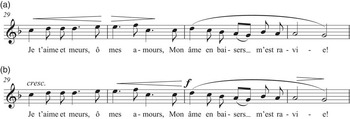
Elsewhere in ‘Lydia’, a considered relationship between musical and poetic declamation emerges from variant dynamics in different editions revised by the composer. In all printed musical sources the exclamation mark in Leconte de Lisle's lines ‘Je t'aime et meurs, ô mes amours! / Mon âme en baisers m'est ravie.’ is relocated to the end of the couplet (replacing the full stop), with a comma inserted at its original location. While the first (Hartmann) edition of 1871 treats the two lines as two separate musical phrases (Example 3a), the extended crescendo in subsequent editions sets the couplet as an effective four-bar phrase. With the culminating dynamic, added in the 1879 collection as mf, then revised to f in the 1890 high-voice edition of the volume, the combined indications make sense of the amended punctuation, leading compellingly to the relocated exclamation mark (Example 3b).
‘Lydia’, bars 29–32. a. Hartmann edition (1871). b. Subsequent editions, with f as in Hamelle 1890 high-voice collection

This compound amendment prompts examination of Fauré's treatment of the exclamation mark in other poems. Victor Hugo could be particularly generous with exclamation marks, as in the lines of ‘Dans les ruines d'une abbaye’ quoted above, or in ‘Tristesse d'Olympio’, Fauré's treatment of which is examined below. Fauré's general tendency is to replace exclamation marks that fall mid-line (or mid-phrase, as in ‘Lydia’) with softer symbols such as commas, almost certainly to facilitate the smooth unfolding of the melodic line. Thus in ‘Le papillon et la fleur’ Hugo's ‘Mais, hélas! l'air t'emporte et la terre m'enchaîne’ becomes in the musical sources ‘Mais hélas, l'air t'emporte…’, while in ‘Mai’ the twin imperatives ‘Viens! ne te lasse pas…’ and ‘Viens! et que le regard…’ are both softened to ‘Viens, …’ As set out above, in ‘Dans les ruines d'une abbaye’ the first of Hugo's exclamation marks becomes a comma and the second a semicolon, matching the composer's amended pattern of capitalization and smoothing out a compact and fast-moving four-bar phrase. (The song's replacement of Hugo's third exclamation mark with a comma is less semantically viable; nothing is ever simple in Fauré editing.)
Editorial decision-making here might be influenced by the words of Hugo himself, who frequently complained about ‘Belgian printers’ (in particular) strewing his texts with additional commas:
at certain critical epochs grasshoppers invade Egypt and commas invade punctuation. Belgian printers are particularly afflicted with this curse. Beneath this excess of [added] commas, artificially interpolated clauses become parasites within phrases, and all the breadth of the line and all the scope of the writing disappears.Footnote 22
The poet's concern for largeur and ampleur (breadth and scope) – qualities equally relevant to musical declamation – might, in this instance, prompt us to accept Fauré's modifications to the punctuation of his texts.Footnote 23
Other songs show Fauré conversely inserting exclamation marks himself. In ‘L'absent’, for example, he replaces no less than nine commas or full stops with exclamation marks – in a poem where, unusually, Hugo presents only one of his own. Six of those nine also appear in Fauré's manuscript (the second, in line 8, placed after ailleurs not pas).
‘L'absent’
Hugo, Les châtiments (Paris: Hetzel, 1870)
– Sentiers où l'herbe se balance,
Vallons, coteaux, bois chevelus,
Pourquoi ce deuil et ce silence?
– Celui qui venait ne vient plus.[!]
– Pourquoi personne à ta fenêtre,
Et pourquoi ton jardin sans fleurs,
Ô maison ! où donc est ton maître ?
– Je ne sais pas,[!] il est ailleurs.
– Chien, veille au logis.[!] – Pourquoi faire ?
La maison est vide à présent.[!]
– Enfant, qui pleures-tu ? – Mon père.[!]
– Femme, qui pleures-tu ? – L'absent.[!]
– Où s'enFootnote 24 est-il allé ? – Dans l'ombre.[!]
– Flots qui gémissez sur l’écueil,
D'où venez-vous? – Du bagne sombre.[!]
– Et qu'apportez-vous? – Un cercueil.[!]
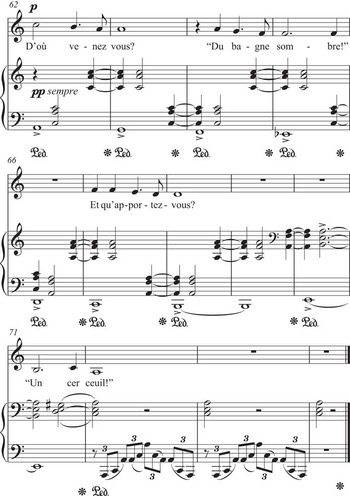
Youthful exuberance? Or, more potently, a display of passion at a time of national trauma? (Although the song remained unpublished until 1879, the manuscript of ‘L'absent’ is dated 3 April 1871, during the Paris Commune. The poem is taken from Les châtiments (1853), which, written in response to Napoléon III's seizure of power, offers the most forthright political and social commentary of all Hugo's collections.) Both interpretations may be true, but there is a strong musical and dramatic rationale as well. Many of these exclamation marks serve to mark the different ‘voices’ of the interrogator and the respondent (all but two belong to the latter): where the smooth legato line of ‘Mai’ carries a single voice describing a single subject, in ‘L'absent’ the dialogue form naturally invites a more strikingly punctuated text. Moreover, the exclamation mark, more directly than any other article of punctuation, delineates audible emphases and inflections, which relate directly to musical dynamics. In ‘L'absent’ Fauré uses the exclamation mark as an effective accent marker (>), demanding vocal stress and continuing intensity through the end of lines. This particularly affects the last page of the song, which in the original key descends to a low A (unusually low in Fauré's vocal writing), matched by a descending bass and more spacious piano chords. The exclamation marks can be read as guarding against the conclusion becoming lachrymose or laborious (Example 4).Footnote 25
‘L'Absent’, bars 62–74 (as in forthcoming Peters edition)

The exclamation marks with which Fauré replaced Sully Prudhomme's ellipses in ‘Ici-bas’ (noted above) would seem to serve a similar purpose. The same substitution may be noted in ‘Les matelots’, where Gautier ends every verse but the last (which does have an exclamation mark) with the ellipsis: the incomplete or indecisive symbol seems hardly suited to the confident ascending scales that close each strophe of Fauré's setting. As well as indicating intensity, in both ‘Ici-bas’ and ‘Les matelots’ the exclamation marks also serve to delineate key points of musical and poetic structure. Other songs show Fauré using punctuation in the same way. In ‘Mai’ he replaces Hugo's commas ending the ninth and twelfth lines (bars 18 and 51) with semicolons, the more conclusive symbol marking out the midpoint of each eight-line strophe and the concomitant shift to the minor mode. ‘Le papillon et la fleur’ alternates 12- and 3-syllable lines, and Hugo ends two-thirds of the latter with exclamation marks. Fauré draws our attention to the short lines by ending all of them with exclamation marks (in all printed versions of the song, though not the early autograph). Other songs mark line-ends with added commas that seem to serve a purely visual purpose (as signposts for the singer) rather than any grammatical or musical one. ‘Le papillon et la fleur’ is again a good example: Fauré adds commas after many of the twelve-syllable lines, where Hugo's text has none and the aural sense is in any case apparent from the rests. While this perceivable musical rationale must be balanced against the poet's clearly expressed sentiments concerning ‘proliferating’ commas, these additions have no impact on the sense of the line, fulfilling essentially the same function as a line-break in a printed poem.
Some added commas, however, do suggest an explicit musical purpose. As well as marking poetic line-ends they can also indicate musical phrase-ends, thus outlining phrase-shape, breathing and the absence of elisions or liaisons. This is particularly important where, as in ‘Dans les ruines d'une abbaye’, amended patterns of capitalization disguise line-ends: the comma in ‘Où l'abbesse joint les mains, en prière.’ (bars 55–58) is not Hugo's (the original reads ‘Où l'abbesse joint ses mains / En prière.’), nor is it semantically necessary – in purely grammatical terms it is less than useful – but by demarcating a line-end it vitally tells the singer to make no liaison between mains and En.
Slightly more complex, but equally important, is a pair of lines in ‘Mai’. In most of the (many) editions and reprints of Hugo's poetry that were appearing throughout the 1850s and early 1860s, in the surviving manuscript of Fauré's song (which probably dates from 1862), in the first (Hartmann) edition of 1871, and in the Choudens separate editions of 1877, the sixth line of the poem appears: ‘Et l'air et le printemps et l'horizon immense,’. But in at least one edition of the poem, an 1864 Hugo Œuvres complètes published by Houssiaux, the line reads ‘Et l'air, et le printemps, et l'horizon immense,’. The 1879 Choudens collection adds to the line just the first of those two commas; the 1890 Hamelle high-voice volume adds the second (but misplaces the first one after ‘Et’, necessitating some editorial tidying).Footnote 26 Did Fauré or a house editor consult the Houssiaux edition (and an engraver garble their instructions)? Or were the commas in the 1879/1890 collections purely the engraver's initiative? While in the poetic text this comma pair represents just the sort of engraver's interference that Hugo complained about, in a sung context the commas could be considered both semantically and musically useful, facilitating clearer enunciation by specifying two non-liaisons.
Phrasing is also closely related to patterns of capitalization. The poems of Fauré's early songs employ a variety of formal designs and line-lengths, and the published songs generally respect their poems’ patterns of capitalization (more so than the early manuscripts). There are, however, a few significant exceptions. Those of ‘Ici-bas’ and ‘Dans les ruines d'une abbaye’ have already been noted (in the latter Fauré converts Hugo's quatrains of alternating seven- and three-syllable lines into effective decasyllabic couplets). In ‘Barcarolle’, where Marc Monnier sets out each 6-line strophe in patterns of 7+3+4+7+3+4 syllables (as below), Fauré's song renders the first letter of lines 3 and 6 in lower case, converting Monnier's strophes into regular quatrains of 7+7+7+7 syllables.
‘Barcarolle’
Monnier, Poésies (Paris: Alphonse-Lemerre, 1872)
Gondolier du Rialto,
Mon château
C'est la lagune,
Mon jardin c'est le Lido,
Mon rideau,
Le clair de lune.
Gondolier du Grand-Canal,
Pour fanal
J'ai la croisée
Où s'allument tous les soirs
Tes yeux noirs,
Mon épousée !
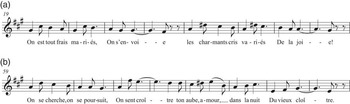
In other poems where long and short lines alternate, by contrast – ‘Le papillon et la fleur’, ‘Seule!’, ‘Au bord de l'eau’ – the printed songs retain the poetic patterns of capitalization. The perceivable rationale here is both poetic and musical. In both ‘Le papillon et la fleur’ and ‘Au bord de l'eau’ the short lines generally serve as commentary to the long ones (which can mostly be read as complete in themselves) and are set to correspondingly short, almost parenthetical phrases. In ‘Barcarolle’ and ‘Dans les ruines d'une abbaye’, however, the longer and shorter lines mostly cannot make sense without being read as one. The musical setting takes account of this by running the lines together as single fleet-footed phrases. The absence of intermediate capital letters helps define the sung shape of the phrase, without risking artificial interruptions to demarcate poem lines. More evidence of conscious authorial intervention in this regard emerges from bars 19–26 and 59–66 of ‘Dans les ruines’, where the patterns of capitalization shift (restoring the capital letter of each second line) in echo of Hugo's amended sentence structure. Elsewhere poetic phrases work mostly in couplet pairs (lines 1+2 and 3+4), but in these strophes alone line 2 begins a new phrase:
‘Dans les ruines d'une abbaye’
Hugo, Les chansons des rues et des bois (Brussels, Paris: Lacroix, Verboeckhoven et Cie, 1865); capitalization as in Fauré's settingFootnote 27
On est tout frais mariés.
On s'envoie
les charmants cris variés
De la joie.
[…]
On se cherche, on se poursuit,
On sent croître
ton aube, amour, dans la nuit
Du vieux cloître.
If the verse structure shifts here, Fauré's phrasing pattern does not: lines 1–2 and 3–4 are each four-bar phrases (Example 5). The lower-case start to line 3 in each verse may be a useful aide for singers in suggesting a continuity of thought and expression across the phrase break, particularly over the rests of Example 5a.
‘Dans les ruines d'une abbaye’. a. Bars 19–26. b. Bars 59–66

Applying a methodology
In two of his three Baudelaire settings – where he was dealing with more complex and nuanced poetry than Hugo or Gautier – Fauré mostly adheres more closely to the punctuation of his texts. ‘Chant d'automne’, the last and most musically adventurous of his settings, shows more extensive modifications. A little collation of musical sources is necessary here, as the original separate editions (published by Choudens in 1879, in A and C sharp minor) omit some punctuation that the 20-song collections restore; a few other variants are explained below.

Many modifications of the type already discussed above are evident here, and systematic comparison of the discrepancies between musical and poetic texts often supports a hypothesis of reasoned compositional intent. The first disparity is the semicolon that ends Baudelaire's first line, which all musical sources render as a comma (Example 6). This sort of amendment needs always to be assessed cautiously since it could easily be the result of a misreading, and in this case a semicolon appears semantically more logical. To make a case for Fauré's comma entails some closer musical scrutiny. The line-end marks the end of a long musical phrase (in Andante tempo), with a crescendo leading directly – except for a brief breathing rest – to the word Adieu. (The dynamic marking f follows the 1890 high-voice edition; earlier prints mark it mf. The 1879 Choudens collection omits the comma after Adieu.) Fauré often used such crescendo sequences to bridge gaps between two lines of text (cf. ‘Lydia’ above and ‘Au bord de l'eau’ below, together with similar examples in ‘Sérénade toscane’, ‘Chanson du pêcheur’, ‘Aubade’, ‘S'il est un charmant gazon’ and ‘Hymne’); it also relates to his tendency to propel the rhythmic impetus through cadences by placing poco rall. [or rit.] … a tempo markings just before rather than right on them (cf. bars 48–49 of ‘Sérénade toscane’). This broader context suggests that Fauré's comma at the first line of ‘Chant d'automne’ may be a deliberate renotation to assure the continuity inherent in his crescendo, something that the longer pause of a semicolon could conceivably disrupt.
‘Chant d'automne’, bars 10–16 (as in forthcoming Peters edition)

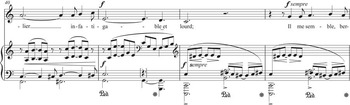
The semicolon that ends line 8 in the 1879 and 1890 collected song volumes (in place of Baudelaire's full-stop) replaces an unviable comma in the separate editions and serves a similar purpose to the semicolons in bars 18 and 51 of ‘Mai’ and the comma after ténèbres: in amending Baudelaire's punctuation by one ‘notch’, it marks out the end of a strophe whilst maintaining continuity across lines, a relationship underlined by the beginning of a new accompaniment figure at the word lourd (Example 7).
‘Chant d'automne’, bars 40–43 (as in forthcoming Peters edition)

The exclamation mark that ends line 10 in the 1879/1890 collections replaces the full stop of Baudelaire's original, which the separate editions reproduce (a circumstance that suggests composer intervention). Like the exclamation marks Fauré appended to lines 14 and 16, and like those of ‘L'absent’, ‘Les matelots’ and ‘Ici-bas’, it serves as an indicator of intensity, in line 10 reinforcing the fsempre marking of Example 7. The comma pairs Fauré added in lines 3 and 13 have similarly direct musical implications, as well as grammatical ones: besides their parenthetical function (accompanying a textual change in line 3, from ‘des chocs funèbres’ to ‘un choc funèbre’), the first comma of each pair also serves as a necessary breathing indication in a spacious vocal line.
This musical employment of the comma is noteworthy: none of the songs published by Choudens print breathing commas above the staff, so Fauré occasionally seems to have employed in-text commas to serve the same purpose (sometimes at the same time as marking non-elisions). Other examples of added in-text breathing commas can be found in ‘Mai’ (bars 30 and 59, after joyeux and nature) and ‘Hymne’ (bar 45, after ‘Grain de musc’), as well as an effective one in bar 15 of ‘Au bord de l'eau’ (after alentours). The latter (Example 8a) is a particularly interesting case: the comma is not present in the autographs, nor in the 1877 separate edition, appearing only in the 1879 Choudens collection and a later separate edition in B-flat minor (issued by Hamelle in the early 1900s), both of which omit the preceding slurs. In the 1890 high-voice collection the in-text comma is replaced with an above-staff breathing comma; the breath is not in fact necessary (though it could serve as a lifebelt for a short-winded performer), but the comma combines with the slur to emphasise that no breath is to be taken between the words fumer and Aux, and to ensure a fresh, incisive consonant on the word si. Oddly enough, the only other above-staff comma that appears in the 1890 high-voice collection doesn't actually demand a breath either: rather, it seems intended only to ensure a glottal stop (Example 8b).
‘Au bord de l'eau’, bars 13–16 (as in Hamelle 1890 high-voice edition)

‘Chanson du pêcheur’, bars 17–19 (as in Hamelle 1890 high-voice edition)

Fauré's later ‘Chanson d'amour’ of 1882 (Op. 27 No. 1) expands on the notation of ‘Au bord de l'eau’, creatively varying phrasing using a combination of in-text commas, breathing commas, slurs and cross-phrase crescendos and decrescendos. Here we see the composer making deliberate play with the French convention of regularized line lengths and the art of enjambment, in ways that relate directly to his love of irregular phrase structures, hemiola and hypermetre.Footnote 29
It is vital for a study of this sort not to become a search for excuses, either for editorial method or for the composer. What is needed is not to give the composer easy credence but on the contrary to subject such credence to all possible scrutiny. However, an equally fundamental premise of critical editing is to trust as far as reasonably possible in the intelligence and method of the composer (even while constantly testing it), using all possible means to ascertain intent and thoroughly analysing the viability of source readings before intervening. In that light, many of Fauré's amendments to ‘Chant d'automne’ and elsewhere offer sufficient evidence of coherent musical and literary thought to justify their retention as a thoroughly valid critical option. Undoing them to restore source punctuation throughout would necessitate a much more dramatic – and arguably subjective – editorial intervention, impinging on the composer's delicate equilibrium of music and text priorities.
Songs left unpublished in the composer's lifetime can throw up quite different challenges regarding poetic texts, as they were never subjected to the revision and scrutiny of the publication process. When the only manuscripts that exist are non-autograph, as with the early Victor Hugo settings ‘Tristesse d'Olympio’ and ‘L'aurore’ (though the latter does show a few autograph interventions in its musical text), it can be difficult to discern where musical and textual oddities, omissions or seeming errors are the fault of the composer or the copyist. In the manuscript of ‘Tristesse d'Olympio’, for example, only 12 of the 28 lines begin with Hugo's capital letters (with no discernible alternative system of capitalization) and much of the punctuation is just missing. More decisive editorial intervention is unequivocally necessary there to make sense of the text, especially given the provisional nature of the song's source. The last few strophes, however, do suggest some degree of authorial intervention, in their fairly systematic removal of exclamation marks from Hugo's overwrought lines.

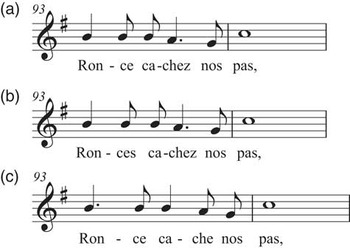
The problem is that often nothing replaces the missing symbols, leaving the editor with little option but to restore Hugo's originals. Exceptionally, the second of the three strophes reproduced above offers a marginally more coherent alternative, smoothing out intermediary punctuation in similar ways to those discussed above in ‘Le papillon et la fleur’ and ‘Mai’. The declamatory force of Hugo's text, however, does lose something in this more understated version, and the original punctuation perhaps accords better with Fauré's equally declamatory and vigorous vocal line. There is no easy editorial way through this situation, which is compounded by a moment of now irreversible compositional vagueness concerning the text itself. In the second line of the second strophe, Fauré effectively has Olympio addressing the weeds in the familiar tu form (use), but the brambles in the formal vous (cachez in place of Hugo's cache; Example 9a). This apparent oversight cannot be ascribed to the copyist, as the musical rhythm fits the amended text. The 2010 Hamelle-Leduc edition deals with this by restoring Hugo's conjugation cache – but without changing Fauré's rhythm, allowing the soft end-syllable -che to fall awkwardly on a dotted crotchet on a strong beat. Two alternative solutions present themselves: first, to maintain the musical integrity of Fauré's setting while quietly repairing its grammar by amending the word Ronce to the plural Ronces (Example 9b); or second, to offer an editorial ossia reading, setting Hugo's original text to an adjusted rhythm that matches its natural accentuation (Example 9c; the beat 3 crotchet could be pitched on either a’ or b’, the underlying harmony being G7, resolving to C on pas).
‘Tristesse d'Olympio’, bars 93–94. a. As in (non-autograph) manuscript. b. Editorially amended text. c. Editorially amended vocal line

From all this it can easily be seen what a wide variety of editorial challenges Fauré's early songs present in their poems alone (the musical texts provide ample scope for several more studiesFootnote 30). Source variants and lacunae, and in particular the absence of engraving copy and proofs, mean that attempts to define or intuit compositional intent can often be no more than critically informed or driven hypotheses. Crucially, it is thus impossible to regard any single presentation of the musical and poetic texts as definitive.
Composers’ attitudes to poetic texts are infinitely varied and we learn to read them as we read their patterns of notation more generally, their habitual shorthands and their idiosyncratic slips or oversights. In that context, it appears that Fauré's songs present sufficient evidence to justify extending our critical remit from changes to words and word-order to include punctuation and formatting of texts. Printing poems in their original forms alongside their musical realisations enables performers to compare sources critically and discern for themselves a rationale for amended punctuation and formatting. Importantly, accepting the premise of compositional initiative in this regard can have positive implications for the performer by encouraging exploration of an aspect of the text that might otherwise be overlooked. A blanket editorial approach may discourage such curiosity and scrutiny, weakening the symbiosis between musical and grammatical symbols.
The most fundamental purpose of punctuation is to facilitate comprehension. Song-settings of poetry generally use musical techniques to assure this, leaving printed punctuation as guides to the performer alone. But in Fauré's songs at least, punctuation can also assume subsidiary functions directly linked with musical performance: the in-text breathing (or non-elision/liaison) comma and the exclamation mark as musical accent are primarily musical rather than grammatical indications. Punctuation – both the poet's and the composer's – can serve as a marker of rhythmic play or enjambment; it shapes the relation of ideas and guides the narrative from phrase to phrase. However we choose to regard its purpose, and whatever editorial approach we may adopt, awareness of all these qualities – musical, textual and conceptual – can encourage a more considered and creative approach to performance, as well as a richer understanding of Fauré's compositional technique and his extraordinary ingenuity.
Appendix: Note on musical sources for Fauré's early solo songs (1861–1879)
Fauré's first song publisher was Choudens, who issued separate editions of twenty songs between 1869 and 1879, some in a single key, some in both high- and medium-voice keys. Exceptionally, ‘Mai’, ‘Lydia’, ‘Hymne’ and ‘Seule’ were first published by Hartmann in 1871; Choudens bought the rights to this collection in 1876 and issued the four songs in separate editions. In 1879 Choudens brought his twenty songs together in the collection Vingt mélodies pour chant et piano par Gabriel Fauré (A.C. 4595, with all but ‘Hymne’ in medium-voice keys). In 1887 Hamelle bought these songs from Choudens, reissuing the existing separate editions from the same plates (with new plate numbers 2692–2711), and the twenty-song collection with a modified title page and a few minor musical amendments. Hamelle continued to issue separate editions of various songs in additional keys from the 1880s until the 1920s.
In 1890 Hamelle reissued the 20-song collection again with further musical amendments, an entirely new title page and plate number (J.3149.H), and ‘Hymne’ transposed to the medium-voice key (F major), together with a corresponding high-voice volume (J.3150.H). These 1890 high- and medium-voice editions were reprinted in 1908 with musical and poetic texts unchanged, as the first of the three well-known ‘collections’ of Fauré's songs. (The only difference between the 1890 and 1908 editions of the first collection is that ‘Barcarolle’ was relocated to end of the second collection, which otherwise comprises the songs from Op. 18 to Op. 46, and ‘Noël’ was imported in its place.)
A full list of manuscript and printed sources for these songs and the three early songs unpublished during Fauré's lifetime (‘Puisque j'ai mis ma lèvre’, ‘Tristesse d'Olympio’ and ‘L'aurore’) may be seen in Roy Howat and Emily Kilpatrick, ‘Editorial challenges in the early songs of Gabriel Fauré’, Notes 68/2 (December 2011), 281–2.