Introduction
Removal, recycling and reuse of heavy metal ions from wastewater is an essential component of the goal of environmental protection and sustainability (Tan and Li, Reference Tan and Li2015, Wang et al., Reference Wang, Chen, Sun, Saleem, Wang and Safety2020a, Wang et al., Reference Wang, Kang, Jiang, Li, Ren, Xu, Jiang, Liu, Li and Zhang2021, Liu et al., Reference Liu, Xu, Xu, Buyong, Chay, Li, Cai, Hu, Zhu and Wang2022). To achieve the goal, various techniques including adsorption (Muhammad et al., Reference Muhammad, Wei, Cao, Yu, Ren, Jia, Saleem, Hua, Guo and Li2021, Haris et al., Reference Haris, Hamid, Wang, Wang, Yashir, Su, Saleem, Guo and Li2022, Zhang et al., Reference Zhang, Haris, Zhang, Zhang, Wei, Li, Niu, Li, Guo and Li2022b), precipitation (Xu et al., Reference Xu, Zhang, Zhou, Chen, Liu, Qian and Xu2023), ion exchange (Guo et al., Reference Guo, Zhao, Ren, Jia, Muhammad, Lv, Wei and Hua2021, Qiu et al., Reference Qiu, Liu, Ling, Cai, Yu, Wang, Fu, Hu and Wang2022), solvent extraction (de Souza E Silva et al., Reference Deng, Stack, Weber, Cao, De Yoreo and Hu2006), membrane separation (Ahmad et al., Reference Ahmad, Ang, Teow, Mohammad and Hilal2022), electrochemical means (Wang et al., Reference Wang, Zhang, Liu and Wang2022) and biological approaches (Guo et al., Reference Guo, Wang, Tu, Muhammad, Fan, Cao and Laipan2020) have been developed. In recent years, heavy metal removal based on two-dimensional layered double hydroxide (LDH) nano-minerals has become a topic of significant interest due to their extraordinary physiochemical properties (Yu et al., Reference Yu, Wang, O’Hare and Sun2017, Laipan et al., Reference Laipan, Zhu, Chen, Zhu, Xi, Ayoko and He2020). LDHs have been unequivocally proven as promising engineered adsorbents for anionic and cationic heavy metal ions removal (Wan et al., Reference Wan, Lacey, Dai, Bao, Fuhrer and Hu2016, Siebecker et al., Reference Siebecker, Li and Sparks2018, Laipan et al., Reference Laipan, Zhu, Chen, Zhu, Xi, Ayoko and He2020, Laipan et al., Reference Laipan, Yu, Zhu, Zhu, Smith, He, O’Hare and Sun2023). Increasing interest, therefore, has been paid in the field of preparing novel functionalised LDHs with even more exciting adsorptive performances (Wang et al., Reference Wang, Liu, Zhang, Tan, Jiang, Liu, Zhang and Zhang2020b, Cai et al., Reference Cai, Ma, Zhang, Li, Wang and Tong2023, Laipan et al., Reference Laipan, Yu, Zhu, Zhu, Smith, He, O’Hare and Sun2023). However, few researchers have paid attention to the fact that there are many natural LDHs composed of heavy metal ions in the environment, e.g. comblainite (NiCo-LDH), cualstibite (CuAlSb-LDH), droninoite (NiFe-LDH), glaucocerinite (ZnAl-LDH) and stichtite (MgCr-LDH) (Mills et al., Reference Mills, Christy, Genin, Kameda and Colombo2012). Previous studies have also demonstrated that a variety of heavy metal ions (e.g. Cu2+, Co2+, Ni2+, Zn2+, Mn2+ and Cd2+) can form LDHs under certain environmental conditions (Goh et al., Reference Goh, Lim and Dong2008, Benício et al., Reference Benício, Silva, Lopes, Eulálio, Santos, Aquino, Vergütz, Novais, d. Costa and Pinto2015, Siebecker et al., Reference Siebecker, Li and Sparks2018). It is further suggested that the immobilisation of heavy metals in the mineral lattice can significantly reduce the migration and harmfulness of heavy metals (Towle et al., Reference Towle, Bargar, Brown and Parks1997, Scheckel and Sparks, Reference Scheckel and Sparks2001, kumar Allada et al., Reference kumar Allada, Navrotsky, Berbeco and Casey2002, Peligro et al., Reference Peligro, Pavlovic, Rojas and Barriga2016, Siebecker et al., Reference Siebecker, Li and Sparks2018). Therefore, studying the fixation of heavy metals in the structure of LDHs during its formation may be more worthy of further exploration than simply using the formed LDH as an adsorbent. Additionally, many studies have shown that LDHs formed by heavy metal ions present varied special physiochemical properties, such as high adsorptive, catalytic and electrochemical activity (Laipan et al., Reference Laipan, Zhu, Chen, Zhu, Xi, Ayoko and He2020). Thus, the conversion of heavy metal ions in waterbodies, e.g. wastewater, to a LDH may be a promising and effective way to achieve removal, recovery and reuse of heavy metals.
However, a crucial question is how we can ensure the formation of pure LDH products while maintaining high heavy metal removal efficiency. As the formation of a LDH requires trivalent (or higher valence state) and bivalent metal ions, and most heavy metal ions in waterbodies are bivalent ions, it may be achievable with the addition of extra trivalent (or higher valence state) metal ions. Indeed, several efforts have been attempted and satisfactory results have been obtained (Zhang et al., Reference Zhang, Y., Zhou, Chen and Qian2012, Xu et al., Reference Xu, Ma, Zhang, Yang, Long, Chen, Song, Wu, Gao and Guan2013, Sommella et al., Reference Sommella, Caporale, Denecke, Mangold, Pigna, Santoro, Terzano and Violante2015, Peligro et al., Reference Peligro, Pavlovic, Rojas and Barriga2016, Hase et al., Reference Hase, Nishiuchi, Sato, Otake, Yaita, Kobayashi and Yoneda2017). Nevertheless there are also problems that cannot be ignored – that the resulting LDH is impure and has limited removal efficiency on low concentrations of heavy metals. For example, Zhou et al. (Reference Zhou, Wu, Liu, Orpe, Liu, Xu, Qian and Qiao2010) has suggested that heavy metal ions (Ni2+, Zn2+ and Cr3+) can be recovered from real polynary metal-ion-bearing electroplating wastewaters as LDH materials via a homogeneous coprecipitation process, but the crystallinity of the LDH is weak and produces impure phases. Zhang et al. (Reference Zhang, Y., Zhou, Chen and Qian2012) attempted to recover Cr(VI) and Zn2+ by promoting the formation of Zn-bearing LDHs via homogeneous coprecipitation, but also found the product had low crystallinity and impure phases. This problem has also been confirmed by other research (Xu et al., Reference Xu, Ma, Zhang, Yang, Long, Chen, Song, Wu, Gao and Guan2013, Sommella et al., Reference Sommella, Caporale, Denecke, Mangold, Pigna, Santoro, Terzano and Violante2015, Peligro et al., Reference Peligro, Pavlovic, Rojas and Barriga2016, Hase et al., Reference Hase, Nishiuchi, Sato, Otake, Yaita, Kobayashi and Yoneda2017). Additionally, studies have showed that although 90% or more heavy metals could be recovered, the residual concentrations may be still at a high level (tens or hundreds mg/L) (Zhang et al., Reference Zhang, Y., Zhou, Chen and Qian2012, Peligro et al., Reference Peligro, Pavlovic, Rojas and Barriga2016). Regardless of these drawbacks, these studies still provide a clear and promising direction for the removal/recovery of heavy metals from wastewaters. However ensuring the purity of the product on the basis of improving the removal efficiency of heavy metals with low concentration is still a big challenge.
Previous research has indicated that the adsorption process can sufficiently enrich the concentration of ions around the solid surface, which can then cause a local supersaturated state and induce the formation of surface precipitates (Yan et al., Reference Yan, Yu, Yan, Wu, Ning, Qi and Han2017, Siebecker et al., Reference Siebecker, Li and Sparks2018, Deng et al., Reference Dean2019). Therefore, we propose that the addition of solid materials in the solution system during coprecipitation of heavy metals may be able to gather the metal ions around the solid’s surface, resulting in a local supersaturation. Using this methodology, heavy metals with low concentration levels may be recoverable by a LDH formation method, but the question remains – how can we ensure that the product is a LDH?
Crystal seed-induced crystallisation may be a potential solution. The crystal seed-assisted crystallisation is a kind of ‘heteroepitaxy’. In addition to aggregating heavy metals, the hetero-surface of a crystal seed can act as a crystal nucleus and provide active sites, such that nucleation becomes energetically favourable and therefore causes changes in crystallisation behaviour and accelerates the crystallisation process (Yazdanpanah et al., Reference Yazdanpanah, Testa, Perala, Jensen, Braatz, Myerson and Trout2017). It has been demonstrated that the addition of crystal seeds during crystal synthesis could (1) enhance the crystallisation rate, (2) suppress the formation of undesired phases, and (3) cause local oversaturation of a low concentration solution via its adsorption or other effects, and thus result in induced crystallisation (Li et al., Reference Li, Sun, Wang, Xu and Yan2015). Consequently, it is possible that heavy metals (even at a low concentration) can be efficiently and rapidly recovered while producing pure crystals by a crystal seed induction method.
Therefore, we used hydrotalcite (one typical type of LDH) as crystal seeds in this work to verify if heavy metals can be efficiently recovered while producing pure a LDH. First, simulated wastewater with various heavy metal ions (Cu2+, Pb2+, Ni2+, Zn2+ and Cd2+) and an actual acid mine drainage were used to test whether the hydrotalcite seeds induction method is applicable to actual wastewaters. Al3+ was considered to be a trivalent metal ion; removal efficiency and recovered product of the heavy metals were compared with a homogeneous coprecipitation method (i.e. without hydrotalcite seeds). Second, Cu2+ was used as an example of a heavy metal ion to determine the impacts of different crystal seeds and whether certain crystal seeds can suppress the formation of undesired phases or induce the formation of the target phase. As crystalline hydroxide metal salts (HMSs, [Mx(OH)y(X)z·nH2O (M: metal, X: anion)]) that are commonly found in the soil environment can also be easily formed by heavy metals (Altmaier et al., Reference Altmaier, Metz, Neck, Müller and Fanghänel2003, Lin et al., Reference Lin, Burns and Lawrance2005, Georgaka and Spanos Reference Georgaka and Spanos2010), we selected this as another crystal seed. Finally, enthalpies of formation from the elements (∆f H° at 298.15 K) of different recovered products were employed to discuss the different crystallisation behaviours of heavy metal ions. The results of this work demonstrated that the LDH seed method can be a good solution for low concentration heavy metals removal/recovery together with producing a pure LDH product, achieving the goal of removal, recovery and reuse of heavy metals in wastewater.
Materials and methods
Materials
The substances Cu(NO3)2·3H2O (99.0%), CuCl2·2H2O (99.0%), Al(NO3)3·9H2O (99.0%), AlCl3·6H2O (99.0%), Mg(NO3)2·6H2O (99.0%), Zn(NO3)2·6H2O (99.0%), Ni(NO3)2·6H2O (99.0%), Cd(NO3)2·4H2O (99.0%), Pb(NO3)2 (99.0%), NaNO3 (99.0%) and NaCl (99.0%) were purchased from Aladdin–E (China). NaOH, HCl and HNO3 were purchased from Guangzhou chemical reagent CO., LTD (Guangzhou, China). All chemical reagents were used as received. Crystal seeds of hydrotalcite were synthesised by traditional coprecipitation methods (Laipan et al., Reference Laipan, Zhang, Wang, Zhu and Sun2015, Laipan et al., Reference Laipan, Yu, Zhu, Zhu, Smith, He, O’Hare and Sun2023, Laipan et al., Reference Laipan, Chen, Wang, Zhang, Yuan, Zhu and Sun2024) and paratacamite (one type of HMSs) was obtained by a direct precipitation method (Pollard et al., Reference Pollard, Thomas and Williams1989). Acid mine drainage was collected from Fenghuang Village, Baihe County, Ankang City, Shaanxi Province, China. The concentration of the heavy metals of the acid mine drainage are shown in Table 1.
Heavy metal ions and their concentrations of the acid mine drainage

Recovery of heavy metals from simulated wastewater using hydrotalcite seeds
First a 1 L solution (pH 3.0) of simulated wastewater with various heavy metal ions (Cu2+, Pb2+, Ni2+, Zn2+ and Cd2+; each a concentration of 1 mmol/L) and Al3+ (2.5 mmol/L) was prepared by using nitrates. Subsequently, 0.5 g of hydrotalcite seeds were added into the solution while adjusting the reaction pH (using 0.1 mol/L NaOH and HNO3 solution) by an automatic pH controller (Chroma CPH–2, China) and reacted for 12 h under magnetic stirring. To explore the effect of pH, the target reaction pH was maintained at 5∼9. Subsequently, the products were centrifuged to obtain the solids and supernatant. The supernatant was analysed by inductively coupled plasma mass spectrometry (ICP-MS, using an Agilent 7900) to determine the removal efficiency of various heavy metals, while the solid products were freeze dried for further analysis after washing with ultrapure water three times. A reaction system with pH 7.0 was also used to observe removal kinetic process of each heavy metal. The concentrations of the heavy metal cations in the supernatant were determined by sampling at intervals of 1, 2, 5, 10, 15, 30, 45, 60, 120 and 180 minutes.
Controlled experiments were also conducted, using the same experimental procedure as the above experiments but without adding hydrotalcite seeds.
Recovery of heavy metals from acid mine drainage using hydrotalcite seeds
A 200 mL solution of acid mine drainage was used to conduct the experiment. 0.2 g of hydrotalcite seeds were added into the solution while adjusting the reaction pH to 7.0 (using 0.1 mol/L NaOH solution) by an automatic pH controller (Chroma CPH–2, China). The concentrations of heavy metals in the supernatant were determined (using ICP-MS) by sampling at intervals of 5, 10, 30, 60, 90, 120 and 180 minutes. As there is Fe3+ in the drainage, no Al3+ was added into the drainage during the reaction. Controlled experiments without adding hydrotalcite seeds were also conducted.
Recovery of Cu2+ in the presence of different crystal seeds
The system Cu2+–Cl––Al3+ was used to test the effects of different crystal seeds (hydrotalcite and a crystalline hydroxide metal salt of paratacamite) on the products recovered. First a 1 L solution (pH 4.5) with 5 mM CuCl2·2H2O and 2.5 mM AlCl3·6H2O was prepared with the molar ratio of Cl to Cu to Al of 7:2:1, respectively. The crystal seeds of paratacamite or hydrotalcite were then added into the Cu2+–Cl––Al3+ system maintaining a crystal seed concentration of 1 g/L. After that, the solution pH was regulated to the targets of pH 5.0 and 7.0 and reacted for 12 h under magnetic stirring. Finally, the products were centrifuged and freeze dried for further analysis.
Characterisation methods
X-ray diffraction (XRD) patterns of the products were measured on a Bruker D8 ADVANCE X-ray diffractometer using CuKα radiation operating at 40 kV and 40 mA. The patterns were recorded over the 2θ range from 3 to 80° with a scan speed of 3°/min using a bracket sample holder. Scanning electron microscopy (SEM) images were obtained by FEI Verios 460 high-resolution field emission SEM. Scanning transmission electron microscopy (STEM) and element-distribution mapping images were collected by FEI Talos F200S high-resolution TEM.
Results and discussion
Effects of crystal seeds on heavy metals removal
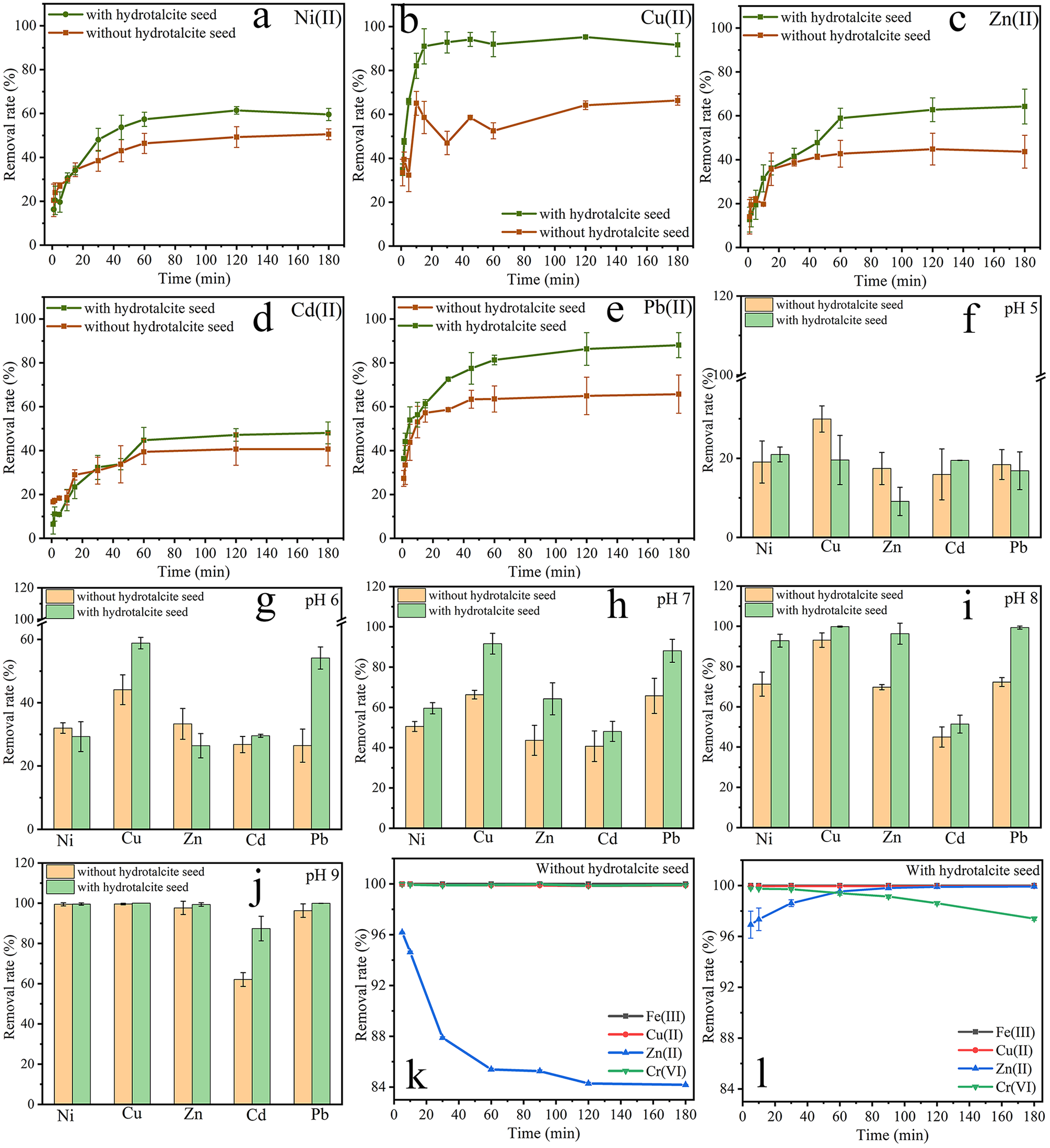
The impact of hydrotalcite crystal seeds on the removal of heavy metals from simulated wastewater and actual acid mine drainage was assessed. Simulated wastewater with mixed heavy metal ions (Cu2+, Pb2+, Ni2+, Zn2+ and Cd2+) was used to test whether the hydrotalcite crystal seed method is applicable to the wastewater with multiple heavy metals; additonaly, to reveal if the coexistent heavy metal cations would affect the removal of each other. Results indicated an improvement of heavy metal removal efficiency of pH ∼7–9 by using the crystal seed method (Fig. 1g–j; thus, pH ≥ 7 was selected in the following experiments). At pH 6, the removal of Cu, Cd and Pb was improved whereas Ni and Zn removal decreased. Under a more acid solution (e.g. pH 5), the removal of heavy metals was significantly lower than that of the seed-free system. The reasons for the above differences under acid solution (pH 5 and 6) should be that an acid condition would result in dissolution of the hydrotalcite. Additionally, hydrotalcite removes heavy metal cations mainly via ligand exchange with the H+ (on the surface hydroxyl groups of hydrotalcite), surface precipitation and isomorphic substitution (Liang et al., Reference Liang, Zang, Xu, Tan, Hou, Wang and Sun2013, He et al., Reference He, Qiu, Hu and Liu2018). Under an acid solution, the ligand exchange between heavy metal cations and surface hydroxyl groups (H+) would be suppressed by the free H+ ions and thus caused the decrease of removal rate. According to the experimental results, the addition of hydrotalcite crystal seeds can effectively improve the heavy metals removal efficiencies with an increase of 18%–47%, and for all heavy metals, the total heavy metal removal rate can be increased by 31.8% (Fig. 1a–e, under pH 7).
Simultaneous removal of multiple heavy metal ions from simulated wastewater and actual acid mine drainage in the systems with and without the hydrotalcite seed: (a)∼(e) removal kinetics under pH 7 from simulated wastewater; (f)∼(j) removal efficiencies under different pH from simulated wastewater; (k) and (l) removal kinetics of multiple heavy metal ions from actual acid mine drainage under pH 7. The concentration of each heavy metal in simulated wastewater is 1 mmol/L; the concentration of the hydrotalcite seed in all systems is 1 g/L; the contact time in all systems is 3 h.

An actual acid mine drainage with the coexistence of heavy metal cations (Fe3+, Cu2+ and Zn2+) and anion (Cr(VI)) (Table 1) was also employed to test whether the hydrotalcite crystal seed method is applicable to actual wastewater. Without addition of hydrotalcite crystal seeds, Fe3+, Cu2+ and Cr(VI) can be removed completely by pH neutralisation, but the removal rate of Zn2+ presented an abnormal decrease trend as reaction time increase (Fig. 1k). This abnormal decrease trend can also be found in the previous study about removal of Zn2+ by the Zn2+–Al3+ coprecipitation method (Laipan et al., Reference Laipan, Chen, Wang, Zhang, Yuan, Zhu and Sun2024). However, this abnormal decrease trend can be eliminated by the addition of hydrotalcite crystal seeds (Fig. 1l). Our previous research findings indicate that the precipitation of Zn2+ and the formation of Zn-LDH are not synchronous, leading to the re-release of Zn2+ back into the solution (Laipan et al., Reference Laipan, Chen, Wang, Zhang, Yuan, Zhu and Sun2024). Zn2+ may initially form precipitates and be adsorbed onto ferric hydroxide, then gradually evolves into Zn-LDH, during which the formation of positively charged Zn-LDH results in some Zn2+ being re-released into the solution. This phenomenon did not occur in simulated wastewater; we speculate that this may be due to the coexistence of five divalent metal ions in the simulated wastewater, including ions with a precipitation pH close to that of Zn2+, which easily leads to the coprecipitation of Zn, forming a multi-component LDH of Zn with one or more of Cu/Ni/Cd/Pb. In actual acid mine wastewater, only Cu2+ and Zn2+ are present as divalent metal ions, with Cu2+ being in a lower concentration (24 ppm for Cu and 53 ppm for Zn). The amount of Zn removed by coprecipitation with Cu2+ to form Cu/Zn-LDH should be relatively small. Additionally, the large difference in precipitation pH of Cu2+ and Zn2+ may inhibit the coprecipitation removal of Zn. Fe3+, Cu2+ and Zn2+ can be effectively removed in the presence of hydrotalcite seeds, however Cr(VI) removal decreased as time increased. This is because the removal of Cr(VI) by LDHs faces competition from water-soluble carbon dioxide. As indicated in Fig. 1l, reaction for 50–60 min should be an effective way for realising high removal efficiency for all the heavy metals.
Effects of crystal seed on heavy metal recovery product
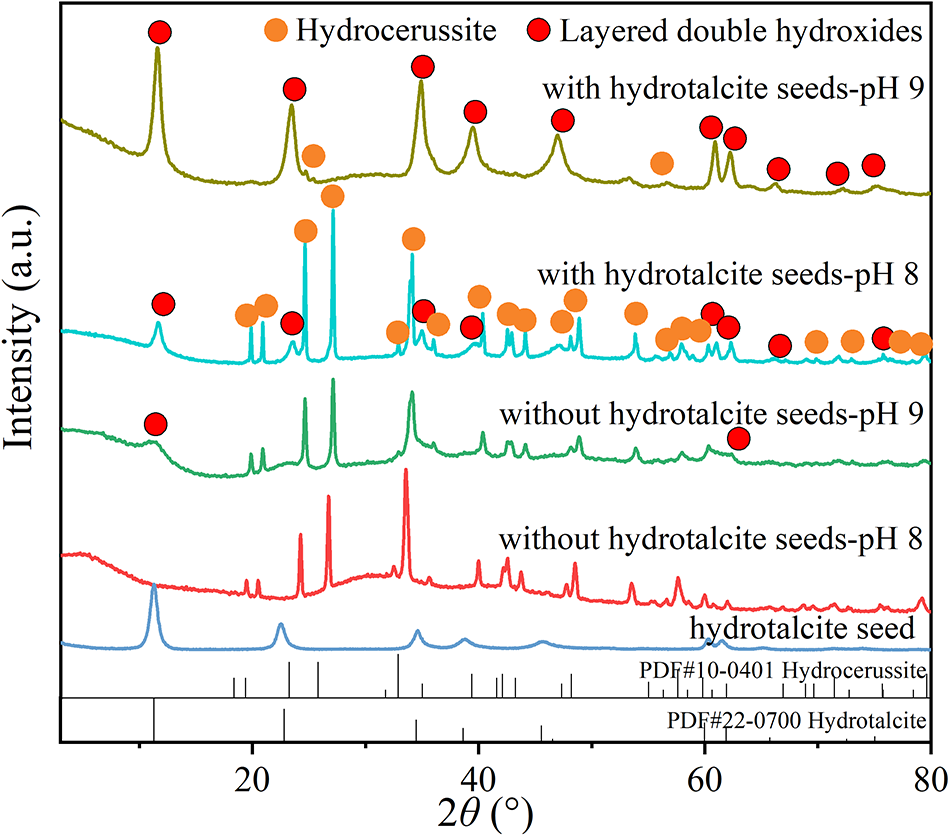
The solid products generated from simulated wastewater (with mixed heavy metals of Cu2+, Pb2+, Ni2+, Zn2+ and Cd2+) in the treatments with and without hydrotalcite seeds were characterised by XRD. The results show that there are two crystalline products of hydrotalcite and hydrocerussite (Pb3(CO3)2(OH)2) (Fig. 2). Without hydrotalcite seeds, the dominant product is hydrocerussite with a small amount of impurity phase of a LDH. However, when hydrotalcite seeds were added into the reaction system the dominant recovered product became the LDH phase at higher pH, with a small amount of the impurity phase of hydrocerussite. During the reaction, only the by-product of hydrocerussite was observed, and beneficially, the phase of the recovered products can be regulated by adjusting the reaction pH. The above results suggests that the use of crystal seeds can selectively induce the formation of certain kind of products of heavy metals.
XRD patterns of the recovered products from the simulated wastewater with mixed heavy metal ions (Cu2+, Pb2+, Ni2+, Zn2+ and Cd2+) with or without hydrotalcite seeds addition.

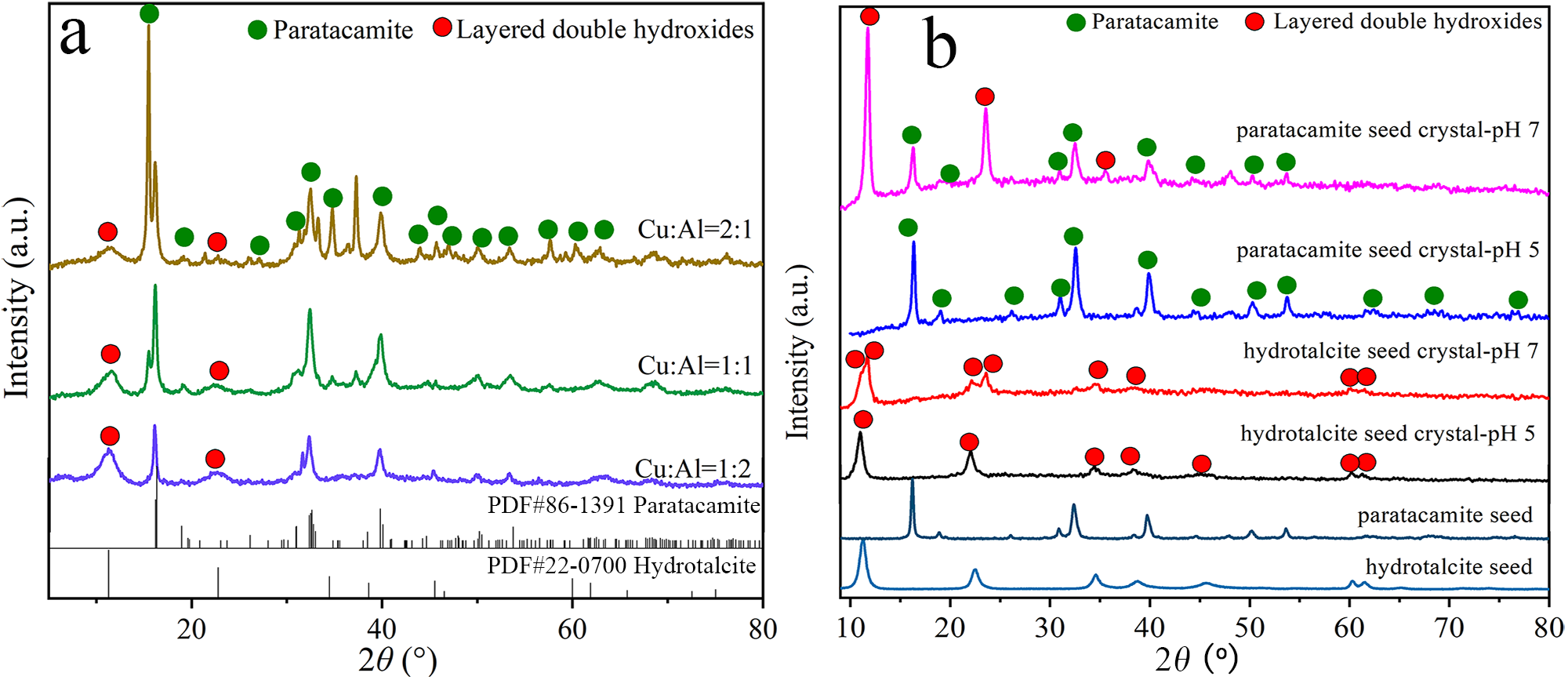
To further reveal the effect of crystal seeds on product selectivity, a simplified system of Cu2+–Al3+–Cl– with addition of different crystal seeds was used. Taking into account that copper ions can complete precipitation at low pH of generally <6.5, the experimental pH values were chosen as 5 and 7. For the Cu2+–Al3+–Cl– reaction system without crystal seeds, the products are mixtures of LDHs and paratacamite (Cu2(OH)3Cl) (Fig. 3a). When Cu2+ encountered both Cl– and Al3+, the dominant crystalline solids are paratacamite with a small amount of LDH at low Al3+ concentrations. However the proportion of LDH increased with increasing Al3+ concentration. As the LDH and paratacamite are products of the Cu2+–Al3+–Cl– system, the LDH (hydrotalcite) and paratacamite were employed as two different kinds of crystal seed. According to Fig. 3b, only paratacamite was formed at pH 5.0 when paratacamite had been applied as the crystal seed; but when pH increased to 7.0 the crystalline products reverted to a mixture of LDHs and paratacamite, and the LDH became the dominant product. Interestingly, when hydrotalcite seeds were added into the Cu2+–Cl––Al3+ system, the LDH became the only crystalline product at both pH 5.0 and 7.0. Notably, there are two kinds of LDH (i.e. hydrotalcite and CuAl-LDH) in the resultant solid of the hydrotalcite seeding system under pH 7.0, suggested by the two diffraction peaks (at 2θ of c.a. 11°, belonging to (003) of the LDH) and their corresponding secondary diffraction peaks (at 2θ of 23–24°, belonging to (006) of the LDH). Regarding the single diffraction peak belonging to (003) of the LDH for the product in the hydrotalcite seeding system at pH 5.0, the reason may be that the content or concentration of formed CuAl-LDH is low. The above results suggest that a crystal seed can change the fate of heavy metal ions by inducing formation of specific minerals. That is, the recovered products of heavy metal ions can be controlled by the addition of different crystal seeds.
XRD patterns of Cu–bearing minerals generated from different systems: (a) crystalline products from Cu2+–Cl––Al3+ systems at pH 7.0 with different Cu:Al molar ratios; (b) crystalline products from different crystal seeds (paratacamite and hydrotalcite) induced Cu2+–Cl––Al3+ systems at pH 5.0 and 7.0 with a Cu:Al molar ratio of 2. At pH 5.0, paratacamite induced Cu2+ to form paratacamite; at pH 7.0 the products are a mixture of paratacamite and LDH, with the LDH as the dominant product. However with hydrotalcite seeds, the products are only LDH at both pH 5.0 and 7.0.

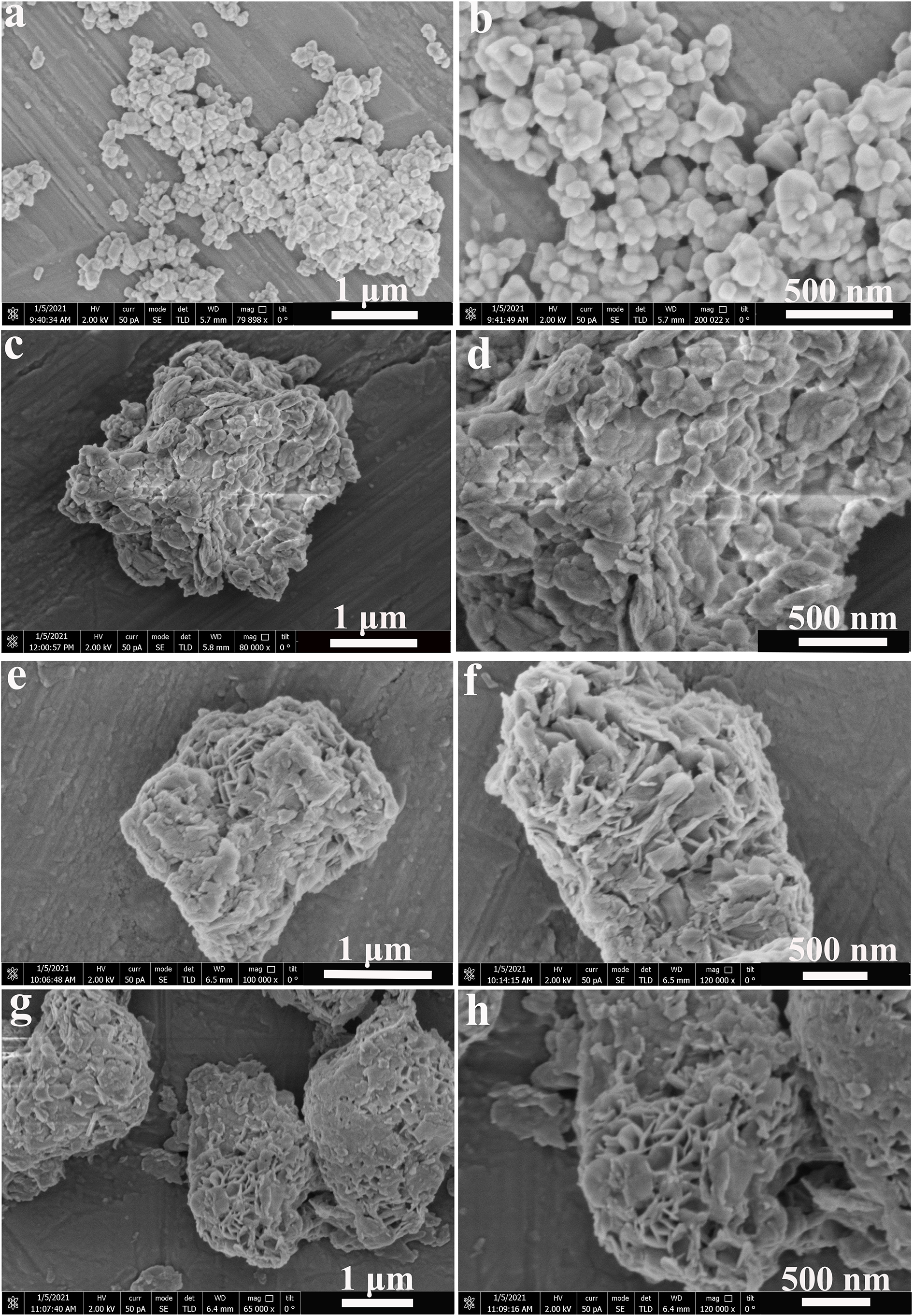
The products were further analysed by SEM and STEM. Products from the paratacamite seeding system at pH 5.0 show a poorly developed octahedral nanocrystals-like shape, which is similar with the reported shape of paratacamite particle (Liu et al., Reference Liu, Inoué, Zhu, H. and Hochella2017), further supporting evidence for the formation of paratacamite (Fig. 4a,b). Products from paratacamite seeding system at pH 7.0 show both flaky and nano-sized particle morphology, suggesting the coexistence of LDHs and paratacamite (Fig. 4c,d). When hydrotalcite was used as the crystal seed, only the flaky morphology of a LDH was observed (Fig. 4e–h), in good agreement with XRD results.
SEM images of the Cu-bearing solids produced from the paratacamite and hydrotalcite inducing Cu2+–Cl––Al3+ system at pH 5.0 and 7.0. (a, b) Products from paratacamite system at pH 5.0; (c, d) products from paratacamite system at pH 7.0; (e, f) products from hydrotalcite system at pH 5.0; (g, h) products from hydrotalcite system at pH 7.0.

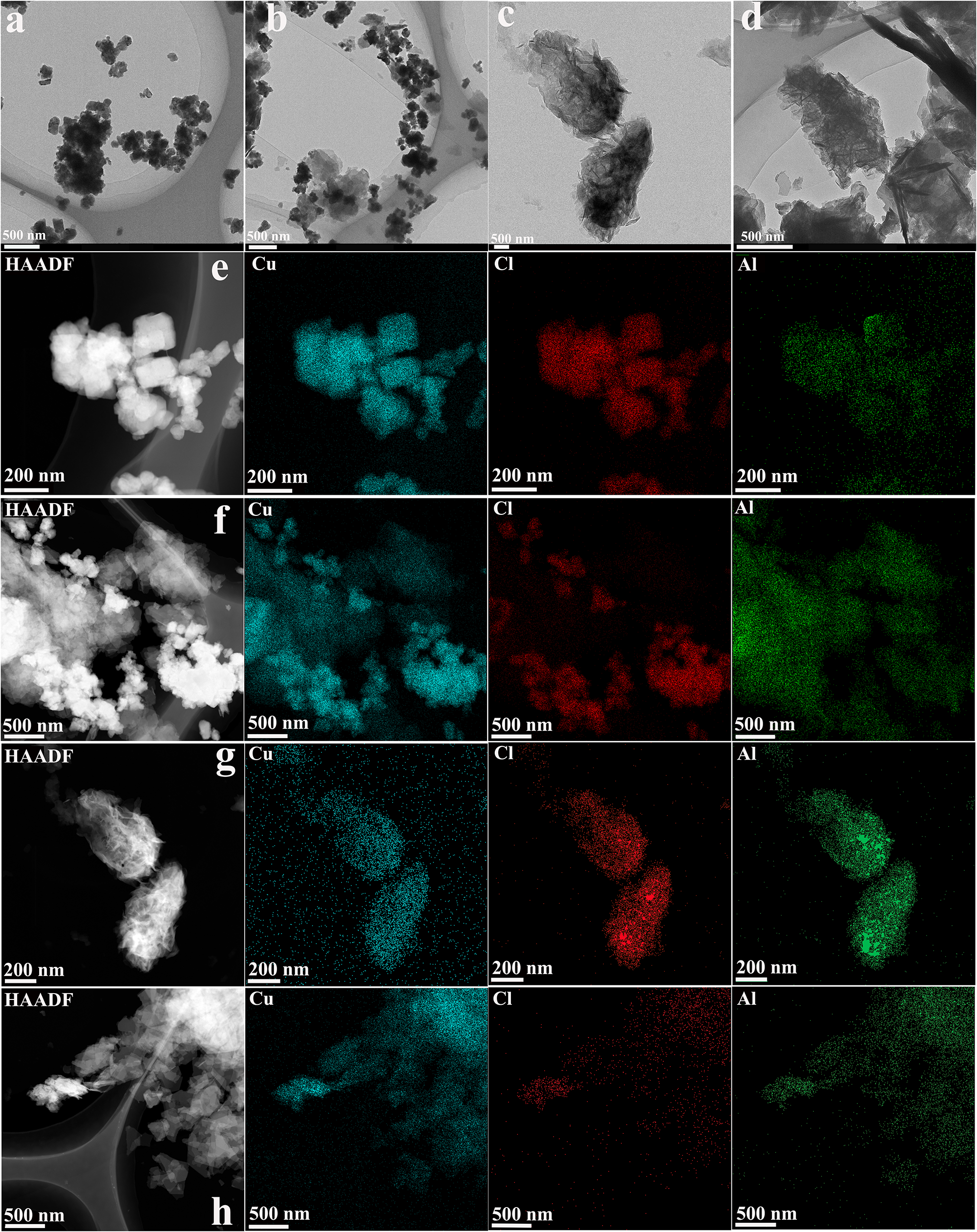
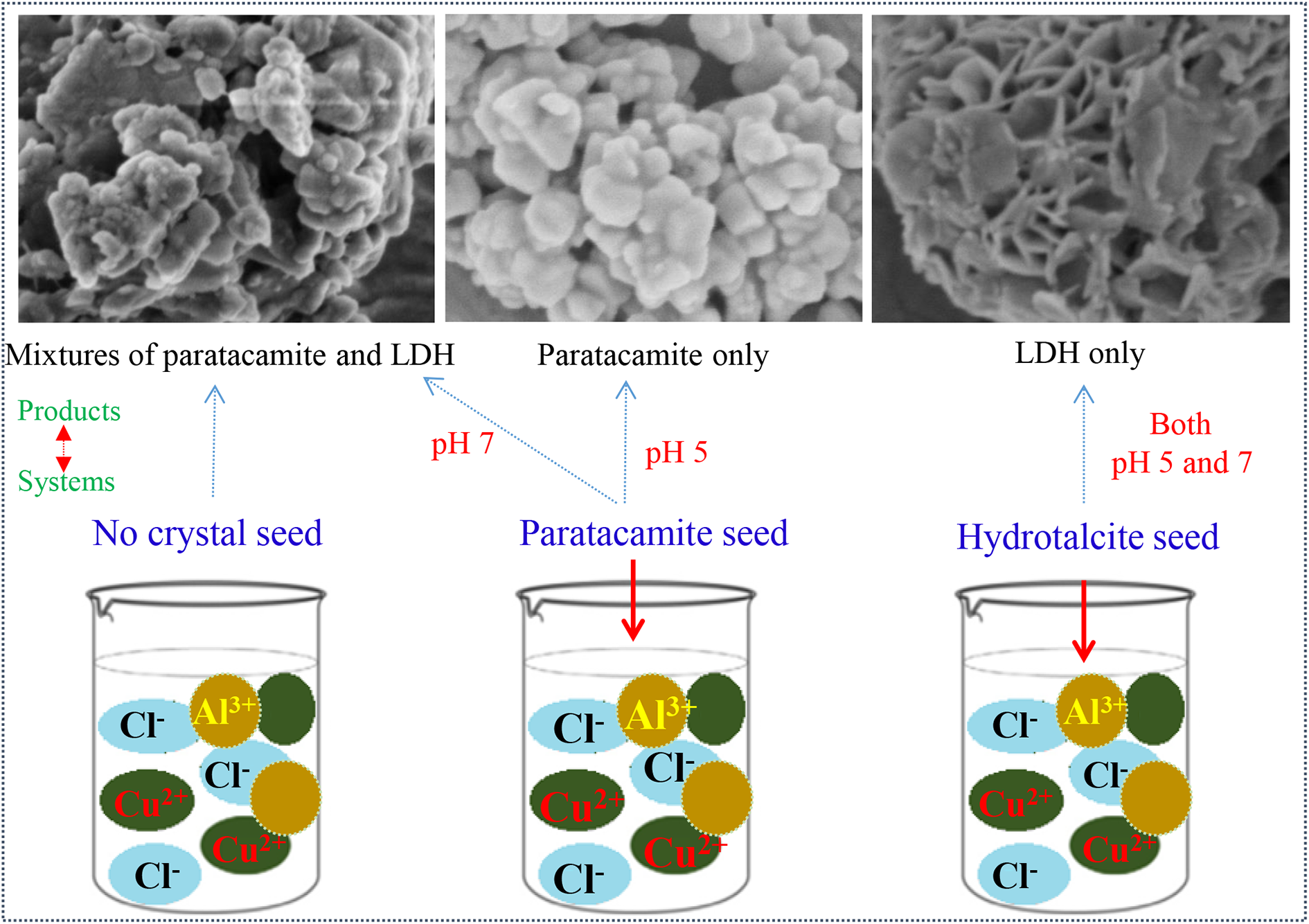
Transmission electron microscopy results also confirm only nano-sized particles in the products from the paratacamite seeding system at pH 5.0, whereas there was a coexistence of flaky and particle morphology in the products at pH 7.0 (Fig. 5a,b), further demonstrating the crystalline product of paratacamite and mixture of paratacamite and LDH at pH 5.0 and 7.0, respectively. The solely flaky morphology in the products from hydrotalcite seeding systems suggests the products are LDHs only (Fig. 5c,d). Additionally, elemental mapping results provide visual evidence for the formation of different Cu-bearing minerals at different systems. In the paratacamite seeding systems, the distributions of Cu and Cl are highly consistent in the products generated at pH 5.0 (Fig. 5e). However, in the products resultant from pH 7.0, though some of the distribution of Cu are highly consistent with Cl, more of the Cu distribution coincides with Al (Fig. 5f). These results further support the formation of a mixture of LDHs and paratacamite, with LDH as the dominant product. As for the hydrotalcite seeding systems, all of the Cu, Al and Cl are highly consistent in distribution in the products (Fig. 5g,h), indicating a single type of product. Based on the analysis of XRD, SEM, TEM and element-distribution mapping results, the product is CuAl-LDH with Cl– as a counterion in the interlayer in the hydrotalcite seeding systems. In summary, addition of crystal seeds during heavy metal removal/recovery by precipitation can change the product, and different crystal seeds present different induction effects on product selectivity, which is illustrated in Fig. 6.
TEM and element-distribution maps of the products of the mineral inducing Cu2+–Cl––Al3+ systems. (a, e) products from the paratacamite seed system at pH 5.0; (b, f) products from the paratacamite seed system at pH 7.0; (c, g) products from hydrotalcite seed system at pH 5.0; (d, h) products from hydrotalcite seed system at pH 7.0.

Reaction systems and their corresponding products.

The relationship between enthalpy of formation and crystallisation behaviour
Enthalpies of formation from the elements (∆f H° at 298.15 K) of different products were employed to reveal the different crystallisation behaviours of Cu2+ in the presence of ions and different crystal seeds. In general, thermodynamic properties can be estimated by treating a compound as a mixture of binary compounds in which the metal and anion have similar coordination environments (kumar Allada et al., Reference kumar Allada, Navrotsky, Berbeco and Casey2002). For example, for a LDH phase of M(II)1–xM(III)x(OH)2(An–)x /n·mH2O (anions, An–; divalent metal, M(II); trivalent metal, M(III)), previous studies indicated that the enthalpies of formation can be estimated as a weighted sum of the components (equation 1) (kumar Allada et al., Reference kumar Allada, Navrotsky, Berbeco and Casey2002, Evans and Slade Reference Evans and Slade2006). Therefore, the enthalpies of formation of CuAl-LDH (Cu1–xAlx(OH)2Clx·mH2O) and paratacamite (Cu2(OH)3Cl) can be estimated according to equations (1–3):
 \begin{align}
&{{\Delta _f}H{^\circ _{M{{\left( {II} \right)}_{1 - x}}M{{\left( {III} \right)}_x}{{\left( {OH} \right)}_2}{{\left( {{A^{n - }}} \right)}_{x/n}}m{H_2}O}}}\nonumber\\
&\quad = \frac{x}{n}\Delta {H_{M\left( {II} \right){A_{2/n}}}} + x\Delta {H_{M\left( {III} \right){{\left( {OH} \right)}_3}}}\nonumber\\
&\qquad+ \left( {1 - 2x} \right)\Delta {H_{M\left( {II} \right){{\left( {OH} \right)}_2}}} + m\Delta {H_{{H_2}O}}\end{align}
 \begin{equation}{\Delta _f}H{^\circ _{C{u_2}{{\left( {OH} \right)}_3}Cl}} = \frac{1}{2}\Delta {H_{CuC{l_2}}} + \frac{3}{2}\Delta {H_{Cu{{(OH)}_2}}}\end{equation}
 \begin{align}
{{\Delta _f}H{^\circ _{C{u_{1 - x}}A{l_x}{{\left( {OH} \right)}_2}C{l_x}\cdot m{H_2}O}}} &= \frac{x}{2}\Delta {H_{CuC{l_2}}} + x\Delta {H_{Al{{\left( {OH} \right)}_3}}}\nonumber\\
&\quad+ \left( {1 - \frac{{3x}}{2}} \right)\Delta {H_{Cu{{\left( {OH} \right)}_2}}} + m\Delta {H_{{H_2}O}}
\end{align}
For LDHs, according to the previous reports, the value of x is generally in the range 0.2∼0.33 (Evans and Slade, Reference Evans and Slade2006, Fan et al., Reference Fan, Li, Evans and Duan2014), and m = 1–(3x/2) (Miyata, Reference Miyata1980); the value of m should therefore, be in the range 0.51∼0.70. Accordingly, a range of enthalpies of formation of CuAl-LDH can be estimated. The enthalpies of formation of different compounds are given in Table 2 [the enthalpies of formation of the binary compounds are from ‘Lange’s handbook of chemistry’ (Dean Reference de Souza E Silva, de Mello, Menezes Duarte, Montenegro, Araujo, de Barros Neto and da Silva1999)]. According to the calculation, Cu2(OH)3Cl possess much lower enthalpies of formation (–778.6 KJ/mol) than that of Cu(OH)2 (–450.4 KJ/mol), indicating paratacamite is more stable and thermodynamically favourable. CuAl-LDH and paratacamite present close values of enthalpies of formation; this should be the reason for the fact that the product of Cu2+–Cl––Al3+ systems are a mixture of paratacamite and LDHs. Increasing the concentrations of Al3+ in Cu2+–Al3+–Cl– systems will generally increase the x value of CuAl-LDH (Cu1–xAlx(OH)2Clx·mH2O), and thus favours the formation of LDHs, in good agreement with XRD results (Fig. 3a).
Enthalpies of formation (298.15 K) from hydroxide and chlorate components, and elements

However, as enthalpies of formation of CuAl-LDH (–829.9 ∼ –793.0 KJ/mol) is slightly lower than that of paratacamite (–778.6 KJ/mol), the former has higher stability than the latter. Thus, the dominant product should be a LDH instead of paratacamite in Cu2+–Cl––Al3+ systems without crystal seeds. But it was suggested by the results that the paratacamite was the dominant product in these systems without crystal seeds. The following two reasons may be responsible for why the theory does not agree with the fact. On the one hand, it is widely believed that the metal hydroxide is formed first and subsequently crystalises into a LDH (Boclair and Braterman Reference Boclair and Braterman1999, Boclair et al., Reference Boclair, Braterman, Jiang, Lou and Yarberry1999, Evans and Slade Reference Evans and Slade2006, Yang et al., Reference Yang, Liu, Zhu, Chen, Wei, Chen, Xian and He2011, Chang et al., Reference Chang, Wu, Song, Kuang, Lei, Wang and Sun2013, Grégoire et al., Reference Grégoire, Ruby and Carteret2013, Paikaray et al., Reference Paikaray, Gomez, Hendry and Essilfie-Dughan2014). As suggested by the enthalpies of formation of Cu(OH)2 and Cu2(OH)3Cl, the latter is a more thermodynamic favourable product. Therefore, paratacamite will form first which prevents the formation of Cu(OH)2, and eventually prevents the formation of CuAl-LDH. On the other hand, the formation of CuAl-LDH may be controlled primarily by dynamics rather than thermodynamics, and paratacamite may be a more dynamically preferable product than CuAl-LDH. The fact that the addition of crystal seeds can change products may be because the hetero-surface of crystal seeds can act as crystal nucleus and provides active sites, so nucleation becomes energetically favourable and therefore will change the crystallisation behaviour and accelerate the crystallisation process (Yazdanpanah et al., Reference Yazdanpanah, Testa, Perala, Jensen, Braatz, Myerson and Trout2017).
Possible reason for the induction effect of crystal seed on heavy metal removal and product
According to the results of this work, the addition of hydrotalcite and paratacamite crystal seeds can both enhance the removal of heavy metals and crystallisation of products, and the type of the product is closely related to the types of the added crystal seed. It is believed that the following aspects may be the cause of the improvement of heavy metal removal efficiency by a crystal seed method. (1) The crystal seed is also an adsorbent with high surface reactivity that can rapidly accumulate ions on its surface (Zhang et al., Reference Zhang, Chen, Yu, Yu and Qiu2022a, Laipan et al., Reference Laipan, Yu, Zhu, Zhu, Smith, He, O’Hare and Sun2023, Li et al., Reference Li, Jing, Zhang, Zhu, Yu, Chen and Qiu2023); thus, local supersaturation may be easily reached, leading to interfacial precipitation or co-precipitation. As indicated in the introduction, adsorption, the commonly occurring process in Nature, can sufficiently enrich concentrations of ions around the solid surface, causing a local supersaturated state and formation of surface precipitates (Yan et al., Reference Yan, Yu, Yan, Wu, Ning, Qi and Han2017, Siebecker et al., Reference Siebecker, Li and Sparks2018, Deng et al., Reference Dean2019). (2) The addition of hydrotalcite seeds can promote the heterogeneous nucleation pathway of a crystal, increasing the crystallisation efficiency and growth process of a crystal (Sear, Reference Sear2006, Yazdanpanah et al., Reference Yazdanpanah, Testa, Perala, Jensen, Braatz, Myerson and Trout2017). Additionally, the seeds can also cause local oversaturation of a low concentration solution via its adsorption or other effects, and thus results in induced crystallisation (Li et al., Reference Li, Sun, Wang, Xu and Yan2015, Deng et al., Reference Dean2019). (3) Previous studies have demonstrated that under a solid–water interface the solid could induce the crystallisation of ions even under a low saturated or unsaturated solution environment (Qian and Botsaris, Reference Qian and Botsaris1998, Liu et al., Reference Liu, Xu, Huang, Cheng and Seo2021, Yang et al., Reference Yang, Zhao, Zhu and Zhang2023). This may be because adding crystal seeds can provide extra surface energy (Yazdanpanah et al., Reference Yazdanpanah, Testa, Perala, Jensen, Braatz, Myerson and Trout2017). The extra surface energy may also be the reason for the different crystallisation behaviours of systems with and without paratacamite and hydrotalcite seeds.
Conclusions
The results of this work demonstrated that the addition of crystal seeds can enhance heavy metal removal both in simulated and actual acid mine wastewater and possesses high potential in changing the fate of heavy metal ion. In mixed heavy metal wastewater, the removal rate of each heavy metal can be increased by 18–47% in the presence of a crystal seed, and for all heavy metals, the total heavy metal removal rate can be increased by 31.8%. Additionally, the addition of crystal seeds can also control the recovery products of heavy metals. In the reaction systems without crystal seeds, the recovery products are mixtures of two different crystalline phases, but one of the crystalline phases can be eliminated by the addition of crystal seeds, leading to the formation of a pure phase of product. For instance, in the Cu2+–Al3+–Cl– system, the crystalline products were mixtures of paratacamite and LDHs without a crystal seeds addition. But the products could be altered facilely by the hydrotalcite or paratacamite seeds. Paratacamite crystal seeds induced Cu2+ to form paratacamite at pH 5.0, but a mixture of LDHs and paratacamite at pH 7.0. In contrast, hydrotalcite crystal seeds induced Cu2+ to form LDHs at both pH 5.0 and 7.0. From the perspective of enthalpies of formation, the formation of CuAl-LDH may be controlled primarily by dynamics rather than thermodynamics, and paratacamite may be a more dynamics preferable product than CuAl-LDH. The addition of crystal seeds can change the reaction pathway of heavy metals, and it is believed that the crystal seeds can accelerate the dynamic process of LDH formation. This work suggests a potential controllable way for heavy metals removal, recovery and reuse.
Acknowledgements
M. Laipan thanks the financial support from Natural Science Basic Research Program of Shaanxi Province (2024JC-YBQN-0319). J. Guo thanks the financial support from the Shaanxi Province Science and Technology Innovation Team (2022TD-09) and the Key Industrial Chain Project of Shaanxi Province (2022ZDLNY02-02 and 2024NC-ZDCYL-02-15).
Competing interests
The authors declare none.
Author contributions
Ziyu Wang performed the experiment and wrote the manuscript. Minwang Laipan conceived and designed the experiments, analysed the data, and edited the manuscript. Min Zhang, Mengyao Yuan, and Xueya Wan performed the characterization section. Junkang Guo edited the manuscript.