INTRODUCTION
Emotions play important roles in the process of language learning and teaching. The study of learners’ emotional reactions, for instance, can account for differences between engaged and unengaged learners, explaining why some learners with motivational goals are not stimulated enough to take action (MacIntyre, Reference MacIntyre2002; also see Prior & Kasper, Reference Prior and Kasper2016). Moreover, teachers can benefit from the findings of such studies to devise strategies not only to address negative emotions that L2 learners may experience in the process of language learning but also to keep learners motivated by creating more positive and facilitative emotions (Arnold, Reference Arnold1999). Although previous studies have mostly focused on negative emotions and, in particular, language anxiety, this trend has shifted recently with some second language acquisition (SLA) scholars paying more attention to positive emotions (e.g., Dewaele & MacIntyre, Reference Dewaele and MacIntyre2014; MacIntyre & Gregersen, Reference MacIntyre and Gregersen2012). The inclusion of emotions in L2 motivation research, more specifically, in the L2 motivational self system, has also been recognized and highlighted by L2 motivation researchers (e.g., Dörnyei & Ushioda, Reference Dörnyei and Ushioda2009; MacIntyre, Mackinnon, & Clément, Reference MacIntyre, Mackinnon, Clément, Dörnyei and Ushioda2009). MacIntyre et al. (Reference MacIntyre, Mackinnon, Clément, Dörnyei and Ushioda2009), for instance, argues that exclusion of emotions in motivational research would leave possible L2 selves as simply cold cognitive representations of learners’ goals. MacIntyre and Gregersen (Reference MacIntyre and Gregersen2012) also attribute the major motivational forces of learners’ L2 selves to different types of emotions, arguing that the motivational drive of L2 possible selves cannot be fully captured without considering the emotional states arising from different types of self-discrepancies or congruencies.
In an attempt to extend the realm of emotion research in SLA, and as a response to calls for the inclusion of emotions in motivation research (e.g., Dörnyei & Ushioda, Reference Dörnyei and Ushioda2009; MacIntyre & Gregersen, Reference MacIntyre and Gregersen2012), the present study aims to investigate three important emotional states—anxiety, joy, and shame—within the L2 motivational self system (Dörnyei, Reference Dörnyei2005, Reference Dörnyei, Dörnyei and Ushioda2009). The study seeks to relate L2 learners’ affect to their L2 future self-guides. As noted, SLA research has traditionally been very interested in anxiety (e.g., Horwitz, Reference Horwitz2010), whereas joy, a type of positive emotion, has only recently attracted attention (e.g., Dewaele & MacIntyre, Reference Dewaele and MacIntyre2014), and shame has so far remained fully outside the scope of the disciplinary interest of SLA. Although the L2 motivational self system provides a solid theoretical framework for relating learners’ emotions to their motivation, there are still some critical issues pertaining to the model that remain unexplored (see Dörnyei, Reference Dörnyei, Dörnyei and Ushioda2009). Accordingly, the first section of the present article addresses those issues with a theoretical discussion of the model, its components, and the sources of ambiguities that have surfaced in past research. Next, a revision of the model is proposed, discussed theoretically, and tested empirically. Finally, potential links between different types of emotions and the learners’ L2 future self-guides are explored.
THE L2 MOTIVATIONAL SELF SYSTEM: THEORETICAL AND PRACTICAL CONCERNS
The L2 motivational self system (Dörnyei, Reference Dörnyei2005, Reference Dörnyei, Dörnyei and Ushioda2009) is the latest attempt to broaden the scope of L2 motivation by reforming and synthesizing our previous understandings of L2 learners’ motivation (e.g., Noels, Reference Noels and Dörnyei2003; Ushioda, Reference Ushioda, Dörnyei and Schmidt2001) within theories of possible selves in mainstream psychology (e.g., Higgins, Reference Higgins1987; Markus & Nurius, Reference Markus and Nurius1986). The findings of the extensive research using this model have lent strong support to its validity and applicability (e.g., Csizér & Kormos, Reference Csizér, Kormos, Dörnyei and Ushioda2009; Csizér & Lukács, Reference Csizér and Lukács2010; Kormos, Kiddle, & Csizér, Reference Kormos, Kiddle and Csiźer2011; Lamb, Reference Lamb2012; Papi & Teimouri, Reference Papi and Teimouri2012, Reference Papi and Teimouri2014; Ryan, Reference Ryan, Dörnyei and Ushioda2009; Taguchi, Magid, & Papi, Reference Taguchi, Magid, Papi, Dörnyei and Ushioda2009). The L2 motivational self system (Dörnyei, Reference Dörnyei2005, Reference Dörnyei, Dörnyei and Ushioda2009) consists of three constructs assumed to motivate language learners: ideal L2 self, ought-to L2 self, and L2 learning experience. The ideal L2 self is the representation of learners’ personal desires, aspirations, and ideals concerning language learning. The ought-to L2 self, by contrast, characterizes the image L2 learners believe their significant others (e.g., family members, friends, teachers) expect them to realize. This less-internalized future self-guide is the representation of L2 learners’ duties, responsibilities, and obligations. The third component, language learning experience, reflects the learner’s attitudes toward learning the target language and is amenable to the immediate learning context and environment (e.g., L2 course, L2 teacher, learning materials). Of the three motivational constructs of the L2 motivational self system, language learning experience has been found to be the strongest predictor of learners’ motivated behaviors (e.g., Papi & Teimouri, Reference Papi and Teimouri2012; Taguchi et al., Reference Taguchi, Magid, Papi, Dörnyei and Ushioda2009). Ideal L2 self has also been found to be a strong variable contributing to learners’ motivation and strongly associated with language learning experience (e.g., Papi & Teimouri, Reference Papi and Teimouri2012; Taguchi et al., Reference Taguchi, Magid, Papi, Dörnyei and Ushioda2009). However, the results concerning the relationship between ought-to L2 self and learners’ learning motivated behavior have been inconsistent. While some studies found a positive relationship, the strength of the relationship was negligible (e.g., Dörnyei & Chan, Reference Dörnyei and Chan2013; Islam, Lamb, & Chambers, Reference Islam, Lamb and Chambers2013; Papi, Reference Papi2010; Taguchi et al., Reference Taguchi, Magid, Papi, Dörnyei and Ushioda2009). Other studies found no relationship between learners ought-to L2 self and their motivated behaviors (e.g., Csizér & Kormos, Reference Csizér, Kormos, Dörnyei and Ushioda2009; Kormos et al., Reference Kormos, Kiddle and Csiźer2011; Papi & Teimouri, Reference Papi and Teimouri2012). Yet, in other studies, the ought-to L2 self was not even identified as a motivational construct (e.g., Csizér & Lukács, Reference Csizér and Lukács2010; Dörnyei & Chan, Reference Dörnyei and Chan2013; Kormos & Csizér, Reference Kormos and Csizér2008; Lamb, Reference Lamb2012).
These inconsistent findings have led researchers to cast doubts on the applicability of the ought-to L2 self in specific contexts or its construct validity. Taguchi et al. (Reference Taguchi, Magid, Papi, Dörnyei and Ushioda2009), for example, suggested that socioeducational factors related to the context of the study may play a role in the motivational effect of learners’ ought-to L2 self. They speculated that in some specific contexts (e.g., China, Japan, Iran) because the nature of foreign language education is examination oriented, or because possessing knowledge of the target language is considered to be closely associated with learners’ socioeconomic status within that society, the ought-to L2 self might regulate its effects on learners’ efforts and persistence toward language learning (Taguchi et al., Reference Taguchi, Magid, Papi, Dörnyei and Ushioda2009). However, in other contexts, such as Western countries, where the presence of such social pressures is not prominent, the effects of ought-to L2 self on learners’ motivation may diminish. Other researchers, nonetheless, have questioned the construct validity of the ought-to L2 self, and have called for its reformulation (e.g., Dörnyei & Chan, Reference Dörnyei and Chan2013; Lamb, Reference Lamb2012). They argued that L2 obligations and duties may have differential motivational impact due to their degree of internalization on the part of the learners. Dörnyei and Chan (Reference Dörnyei and Chan2013), for example, recommended distinct scales of learners’ ought-to L2 self, each accounting for different types of external motivational factors. Highlighting the interactive nature of learners’ L2 selves, Kim (Reference Kim, Dörnyei and Ushioda2009) also provided some evidence that learners’ ought-to L2 self can be transformed into ideal L2 self through the process of internalization if learners have successfully attached a personal meaning or value to learning the L2.
Although the level of internalization can serve as the theoretical ground to revise the construct of ought-to L2 self, it also poses another challenge regarding the general distinction between learners’ ideal L2 self and the ought-to L2 self. As Dörnyei and Ushioda (Reference Dörnyei and Ushioda2009) succinctly wonder, “[A]t what point can we claim with confidence that a desired possible self is ‘ideal’, that is, fully owned by the learner, rather than ‘ought-to’, that is, imposed on the learner by others?” (p. 352). Drawing on Higgins’s self-regulatory focus (Higgins, Reference Higgins1997, Reference Higgins1998, Reference Higgins2011), the following section is aimed at providing an answer to this question by giving a detailed discussion of motivational distinctions of learners’ ideal L2 self and ought-to L2 self.
MOTIVATIONAL DISTINCTIONS OF IDEAL L2 SELF AND OUGHT-TO L2 SELF: PSYCHOLOGICAL SENSITIVITIES, STRATEGIC INCLINATIONS, AND MOTIVATED BEHAVIORS
According to Higgins’s self-regulatory focus theory (1998, 2011), there are two types of self-regulation: promotion-focus and prevention-focus self-regulation. L2 learners with a predominant promotional self-regulation are focused on advancement, growth, and development, and they represent L2 goals as hopes, aspirations, or ideals. In a promotional focus, the concern is with gains and nongains. In contrast, L2 learners with a predominant preventional self-regulation are focused on protection, safety, and security, and they represent L2 goals as duties, obligations, or oughts. In a preventional focus, the concern is with losses and nonlosses. The ideal self has a promotional focus and represents the attributes learners ideally would like to possess. Thus, the psychological situations involved in the ideal self are related to the presence or absence of positive outcomes (i.e., gains vs. nongains). The ought self, in contrast, has a preventional focus and represents the attributes that learners are expected to meet as a sense of duty or responsibility. Thus the psychological situations involved in the ought self are related to the presence or absence of negative outcomes (i.e., losses vs. nonlosses). This distinction between ideal self and ought self suggests that in situations in which sensitivity to the presence or absence of positive outcomes is greater, the ideal self concerns predominate, and, in situations in which sensitivity to the presence or absence of negative outcomes is greater, the ought self concerns predominate (Molden, Lee, & Higgins, Reference Molden, Lee, Higgins, Shah and Gardner2008). Dörnyei also included this distinction between learners’ ideal L2 self and ought-to L2 self in his L2 motivational self system. The former was defined to have a promotional focus, while the latter has a preventional focus (e.g., Dörnyei, Reference Dörnyei2005, Reference Dörnyei, Dörnyei and Ushioda2009). However, the composite questionnaire items that measure the ought-to L2 self are mixed in regard to the positivity or negativity of end outcomes, such that the conceptual definition of the ought-to L2 self has been violated through the operationalization of the scale. While some of the items, such as “I must learn English, otherwise my parents will be disappointed in me” truly capture the sensitivity of the ought-to L2 self to the presence or absence of negative outcomes (i.e., disappointment), other items such as “I must learn English, so that people around me will respect me more” clearly pertain to the presence or absence of positive outcomes (i.e., respect) and are therefore more representative of the ideal L2 self than the ought-to L2 self. Yet other items, such as “I should learn English because my friends think it is important” are ambiguous in the sense that the valence of the psychological situation is not determined. Items of mixed valence cancel out each other’s effects. This might, therefore, be a good explanation for poor results regarding the validity of the scale reported in past studies (e.g., Lamb, Reference Lamb2012).
The second distinction between learners’ ideal L2 self and ought-to L2 self could be attributed to different strategic inclinations of the learners striving to reach their L2 desired end-states. L2 learners with a predominant promotion-focused system take an “eagerness” strategy to approach a match between their current self and their desired end-states, whereas L2 learners with a predominant prevention-focused system adopt “vigilance” as a strategy to avoid a match between their current self and their undesired end-states (Higgins, Reference Higgins2011). Within the L2 motivational self system, while the strategic inclination of avoidance concerning the presence of negative outcomes has been highlighted when defining the ought-to L2 self (e.g., Dörnyei, Reference Dörnyei2005, Reference Dörnyei, Dörnyei and Ushioda2009), the operationalization of the composite items of the scale assumed to measure the ought-to L2 self has not taken it into account in any of the existing questionnaires (e.g., Taguchi et al., Reference Taguchi, Magid, Papi, Dörnyei and Ushioda2009). Considering the previous examples, not only do those items fail to represent sensitivity toward the presence of negative outcomes, but they also fail to include the strategic inclination of vigilant avoidance.
Finally, the motivational distinctions of learners’ ideal L2 self and ought-to L2 self can also be accounted for by examining different types of learners’ motivated behaviors as criterion measures. Past research using the L2 motivational self system has mostly drawn on learners’ intended efforts as the criterion measure to examine the motivational effects of their ideal L2 self and the ought-to L2 self. Although the amount of time, effort, and energy L2 learners expend in the process of L2 learning is certainly representative of how motivated they are, such a measure fails to distinguish subtle motivational distinctions of ideal L2 self and ought-to L2 self. For example, it is not surprising to see L2 learners with either strong ought-to L2 selves or strong ideal L2 selves invest similar amounts of time and effort during their exams. In short, an all-effort measure of learners’ motivation excludes the quality of the sources of their motivation. Thus, in order to capture the motivational distinctions of learners’ ideal L2 self and ought-to L2 self, as two qualitatively different sources of motivation, we also need motivational measures (i.e., different types of motivated behaviors) that have the potential to represent such qualities. The present study assumes willingness to communicate in the second language (L2 WTC) as another yet qualitatively different form of motivation (see MacIntyre, Dörnyei, Clément, & Noels, Reference MacIntyre, Dörnyei, Clément and Noels1998). According to Dörnyei (Reference Dörnyei2005), L2 WTC is the outcome of the interplay of linguistic confidence and the ideal L2 self. Because the ideal L2 self represents a learner’s image of themselves engaging in interaction with others voluntarily using the target language, it should play a critical role in his or her willingness to communicate in the L2. In sum, examining learners’ willingness to communicate along with their efforts, as two different forms of motivation, through the lens of the L2 motivational self system seems likely to provide fruitful results insofar as giving us a better picture of the distinct motivational functions of their L2 selves.
So far, the distinct motivational functions of learners’ ideal L2 self and ought-to L2 self were discussed in terms of their predominant self-regulatory focus (promotion and prevention), sensitivity to different psychological situations (gains and losses), strategic inclinations (eager approach and vigilant avoidance), and qualitatively different motivated behaviors (effort and L2 WTC). Also, the possible sources of ambiguities concerning the construct of ought-to L2 self, as identified in findings of past research, were addressed in detail. In the next section, the theoretical framework for the revision of the L2 motivational self system, more specifically, the construct of ought-to L2 self, will be discussed by drawing on Higgins’s self-discrepancy theory (1987, 2011).
SELF-DISCREPANCY THEORY: THE THEORETICAL BASIS FOR THE EXTENSION OF L2 MOTIVATIONAL SELF SYSTEM
According to self-discrepancy theory (Higgins, Reference Higgins1987, Reference Higgins2011), when learners perceive a distance between their actual self and their desired future self, they feel discomfort. This discomfort triggers the incentive and direction to reduce the distance and match the current self with the desired self. The theory comprises four types of future self-guides: (a) ideal self/own, which represents the attributes one hopes or aspires to possess; (b) ideal self/others, which represents attributes one believes others would like him or her, ideally, to possess; (c) ought self/own, which represents attributes one should or ought to possess; and (d) ought self/others, which represent attributes one should or ought to possess because others expect them to do so. Of the four future self-guides, Dörnyei (Reference Dörnyei2005, Reference Dörnyei, Dörnyei and Ushioda2009) has incorporated only ideal self/own and ought-to self/others into the L2 motivational self system, excluding the other two future self-guides (ideal self/other and ought-to self/own). It seems that the reason for this exclusion has been simply to avoid the potential confusion that may arise regarding the distinction between learners’ ideal L2 self and ought-to L2 self; for example, how the learner’s ideal self from the view of others (i.e., ideal self/others) would be different from his or her ought-to L2 self (Dörnyei, Reference Dörnyei, Dörnyei and Ushioda2009, p. 13) or how the learner’s internalized oughts (e.g., ought-to self/own) would be different from his or her ideal self (Dörnyei & Ushioda, Reference Dörnyei and Ushioda2009, p. 352). However, as argued in the preceding text in detail, the motivational distinctions of learners’ ideal L2 self and ought-to L2 self are clear when we take into close account their self-regulatory foci, sensitivities to psychological situations, strategic inclinations, and motivated behaviors. The own versus other distinction of future L2 selves is also consistent with the findings of past research concerning the determinants of learners’ ideal L2 self and ought-to L2 self. While instrumentality promotion and attitudes toward target community and culture were found as two major constituents of learners’ ideal L2 self, instrumentality prevention and family influence were found to be the major factors leading to learners’ ought-to L2 self (e.g., Papi & Teimouri, Reference Papi and Teimouri2012; Taguchi et al., Reference Taguchi, Magid, Papi, Dörnyei and Ushioda2009). The learners’ attitudes toward the target community, or the influence of their significant others, such as family, can be interpreted as the social aspects of their desirable L2 future self-guides, whereas the instrumental or pragmatic reasons for learning an L2 can be translated into learners’ personal aspects of the desired future end-states. Ideal L2 self and ought-to L2 self thus represent future self-guides that are both personally and socially desirable for learners. As a result, it can be argued that ideal L2 self and ought-to L2 self from the perspective of “own” represent personal aspects of learners’ future self-guides, and ideal L2 self and ought-to L2 self from the perspective of others represent the social aspects of their future self-guides. It should be noted here that L2 learners’ ought-to L2 self/others or ideal L2 self/others are representative of L2-related goals that learners think or believe their significant others expect or would ideally like them to achieve.
In sum, the bifurcation of learners’ ought-to L2 self into ought-to L2 self/own and ought-to L2 self/others gains theoretical ground for its revision. Although the results of past research questioned only the theoretical validity of the ought-to L2 self, the same approach was adopted in this study toward the ideal L2 self to see if L2 learners’ L2 ideals can also be distinguished in terms of ideal L2 self/own and ideal L2 self/others. Overall, the four types of L2 future self-guides will represent a continuum of learners’ motives whose motivational effects can be examined based on their level of internalization (see Deci & Ryan, Reference Deci and Ryan1985; Dörnyei, Reference Dörnyei, Dörnyei and Ushioda2009). In the next section, language learners’ emotional states will be explored in relation to their L2 future self-guides. Three important emotional states, namely, anxiety, joy, and shame, and their relationships with different types of future self-guides are discussed. The inclusion of shame and anxiety, two negative emotions, and joy, a positive emotion, in the present study is based on the findings of past research in both SLA and social psychology concerning how learners’ perceived self-discrepancies or congruencies may generate different emotional reactions (Higgins, Reference Higgins1987; MacIntyre & Gregersen, Reference MacIntyre and Gregersen2012).
LANGUAGE LEARNERS’ EMOTIONAL EXPERIENCES AND THEIR L2 FUTURE SELF-GUIDES
Anxiety
Anxiety is by far the most researched emotion in the field of SLA. A review of the literature shows that most research in SLA has attributed a negative role to anxiety during the process of second language learning, impairing language learners’ cognitive process (MacIntyre & Gardner, Reference MacIntyre and Gardner1994), L2 WTC and L2 use (Hashimoto, Reference Hashimoto2002; MacIntyre & Charos, Reference MacIntyre and Charos1996), motivation (Papi, Reference Papi2010), and, consequently, language achievement (Aida, Reference Aida1994; Gardner, Smythe, Clement, & Gliksman, Reference Gardner, Smythe, Clement and Gliksman1976; MacIntyre & Gardner, Reference MacIntyre and Gardner1994; Young, Reference Young1986). Nevertheless, other studies (e.g., Chastain, Reference Chastain1975; Kleinmann, Reference Kleinmann1977) have found that anxiety may have some beneficial outcomes. The facilitative and debilitative distinction of anxiety has been offered as a solution to account for inconsistent results concerning the effects of anxiety on SLA (see Scovel, Reference Scovel1978). While this proposal is helpful, little is known about how anxiety exerts its positive and negative effects for different language learners. More specifically, why does anxiety function as facilitative for some specific learners while harming others? Adopting a motivational perspective, Papi and Teimouri (Reference Papi and Teimouri2014) related facilitative and debilitative aspects of anxiety to language learners’ motivational orientations—prevention and promotion systems—arguing that anxiety fits prevention-focused learners in stimulating them to expand more vigilant efforts to avoid the presence of negative outcomes. Thus, it is beneficial for their motivation; whereas, conversely, because promotion-focused students are concerned with advancement and progress and sensitive to the presence of positive outcomes, anxiety represents a misfit and thus is harmful to their motivation. The inclusion of anxiety in the present study is the attempt to test this claim.
Joy
Unlike negative emotions that are conceptualized based on their types (e.g., agitation vs. dejection), psychologists traditionally classify positive emotions based on their degree of intensity, or their level of activation or arousal (Ekman, Reference Ekman1992; Izard, Reference Izard1977). High-intense positive emotions are defined as joy or happiness, while low-intense positive emotions are referred to as pride or contentment (Averill & More, Reference Averill, More, Lewis and Haviland-Jones2000). Extensive research has shown that positive emotions play an important role in one’s success or well-being in life. Happy people, for instance, have been found to project more positive attitudes toward others (Lyubomirsky & Tucker, Reference Lyubomirsky and Tucker1998), judge people more favorably (Cooper, Okamura, & Gurka, Reference Cooper, Okamura and Gurka1992), experience fewer conflicts with others and do better at resolving issues in groups (Barsade, Ward, Turner, & Sonnenfeld, Reference Barsade, Ward, Turner and Sonnenfeld2000), engage more strongly in activities (Lucas, Reference Lucas2001), and perform better on complex mental tasks and in gaining new information (Staw & Barsade, Reference Staw and Barsade1993).
Recently, some SLA scholars have become interested in the study of positive emotions and shifted their attention toward exploring their motivational effects on second language learners (see Dewaele & MacIntyre, Reference Dewaele and MacIntyre2014). MacIntyre and Gregersen (Reference MacIntyre and Gregersen2012), for instance, argued for the motivational effects of positive emotions such as broadening learners’ attention and thinking, countering the effects of negative emotions, promoting resilience to stressful events, building personal resources, and leading toward greater well-being. The inclusion of joy in this study can also be interpreted as an attempt to continue this line of research in SLA. In the present study, joy refers to positive emotions that language learners experience in the process of learning or using the target language either within the boundary of a specific instructional context or in authentic real life situations. Because the ideal L2 self has a promotional focus and involves the presence and absence of positive outcomes, a congruency or a match between L2 learners’ present self and their desired self would induce a sense of elation, such as joy. As a result, in this study, it is assumed that learners with strong ideal L2 selves are more likely to experience the emotional state of joy while learning English.
Shame
A negative emotion that L2 learners are prone to experience in the course of learning a L2 is the painful and ugly feeling of shame. According to Lewis (Reference Lewis1971), upon the appearance of transgression or failure on the part of learners, the shame experience arises when the self is the focal center of negative criticism. The painful feeling of shame follows a sense of shrinking, which causes the learner to feel small and worthless. Consequently, the L2 learner would be more inclined toward seeking a way of escaping (Tangney & Dearing, Reference Tangney and Dearing2002). Depending on the focus of attention, thoughts, and behavior, shame can be experienced internally or externally (Gilbert, Reference Gilbert, Tarrier, Wells and Haddock1998, Reference Gilbert2003). Internal shame occurs when L2 learners hold negative judgments toward their personal attributes and characteristics that are related but not limited to the target language (Pinto-Gouveia & Matos, Reference Pinto-Gouveia and Matos2011). The focus of attention is inward, or self-critical of one’s deficits. External shame (or social shame), on the contrary, occurs when L2 learners are concerned with how their self is projected in the mind of others (Keltner & Harker, Reference Keltner, Harker, Gilbert and Andrews1998). The focus of attention is outward, related to how the learner is perceived as inferior, unattractive, or defective (Gilbert, Reference Gilbert2003; Kaufman, Reference Kaufman1996). The profound implications of shame on one’s motivation, interpersonal relationships, and moral behavior have been recognized and investigated thoroughly in mainstream psychology. The findings of past research have established links between shame and self-criticism and self-blame (Gilbert, Reference Gilbert, Tarrier, Wells and Haddock1998), inferiority (Allan & Gilbert, Reference Allan and Gilbert1997), helplessness, powerlessness, shyness, perfectionism (e.g., Gilbert, Reference Gilbert2014; Lutwak & Ferrari, Reference Lutwak and Ferrari1996), social anxiety, and fear of negative evaluations (e.g., Harder & Zalma, Reference Harder and Zalma1990).
The inclusion of shame into the L2 motivational self system sheds more light on our understanding of L2 learners’ emotional reactions to their L2 self-perceived discrepancies, and how those emotions affect their motivational behaviors. As mentioned previously, the L2 motivational self system assumes that when learners perceive a discrepancy between their current self and their desired L2 self (ideal L2 self and ought-to L2 self), they will feel a sense of discomfort that in turn creates the motivational force to reduce this discrepancy (Dörnyei, Reference Dörnyei2005, Reference Dörnyei, Dörnyei and Ushioda2009). However, the vague notion of discomfort, as the mediating emotion, has not been properly addressed in previous L2 motivation research. Such an ambiguity, as a result, might lead to the conclusion that the presence of discrepancies between L2 learners’ current self and their desired L2 self is always beneficial and motivating for them to learn a L2. This is partly true. On the negative side, self-discrepancies can also lead L2 learners to withdrawal and avoidance type of behaviors. It is intriguing to consider how the positive and negative implications of self-discrepancies have been depicted differently in Dörnyei’s L2 motivational self system and its theoretical underpinning: Higgins’s self-discrepancy theory. While the positive side of L2 learners’ self-discrepancies and how they act as sources of motivation and effort has been highlighted in L2 motivational self system, the negative side of self-discrepancies and how they relate to negative emotional syndromes (shame, guilt, anxiety, etc.) was originally emphasized in self-discrepancy theory. The incorporation of shame and guilt, as the mediating emotions, into the L2 motivational self system would improve our understanding of the model in terms of how L2 learners’ perceived discrepancies between their current self and their desired future L2 self-guides may translate into different types of behaviors (Tahmouresi & Teimouri, Reference Tahmouresi and Teimouri2016). When the negative affect or discomfort generated by L2 learners’ self-discrepancies is viewed as guilt, it can be argued that because guilt promotes reparative action (Tangney & Dearing, Reference Tangney and Dearing2002) it encourages learners to put more effort into learning the L2 in order to compensate for their shortcomings and reduce their self-discrepancies. However, when the negative affect or discomfort generated by L2 learners’ self-discrepancies is viewed as shame, it can be argued that, because shame involves negative evaluations of one’s global self, the self-discrepancies have been conceived of as a sense of inferiority, unattractiveness, or defectiveness/deficit on the part of the learners, leading them to withdrawal or avoidance types of behavior.
According to the self-discrepancy theory, a mismatch between a learner’s actual self and ideal self/other would result in a tendency to experience shame. Because the learner’s current self is different from the ideal state that (the learner thinks and believes) others hope or aspire the learner to possess, he or she would assume that others are disappointed in or dissatisfied with him or her, causing the learner to be susceptible to the emotional reaction of shame. However, Higgins’s (Reference Higgins1987) hypothesis on relating shame to ideal self/others was questioned theoretically and empirically by Tangney and her colleagues (Tangney & Dearing, Reference Tangney and Dearing2002; Tangney, Niedenthal, Covert, & Barlow, Reference Tangney, Niedenthal, Covert and Barlow1998). They argued that shame involves global negative evaluation of the self, and, as a result, all types of self-discrepancies should be associated with a tendency to feel shame, not restricted only to ideal self/others. This claim was supported empirically in the Tangney et al. (Reference Tangney, Niedenthal, Covert and Barlow1998) study in which shame was found to be positively correlated with all types of self-discrepancies.
THE CURRENT STUDY
Given the critical importance of L2 learners’ emotions in the process of language learning and inspired by exclusion of emotions in motivational research to date, the present study aims to examine L2 learners’ emotional experiences in relation to their L2 future self-guides. However, considering the inconsistent findings of past research on the role of ought-to L2 self, the study first seeks to revise the L2 motivational self system. Building on self-discrepancy theory (Higgins, Reference Higgins1987, Reference Higgins2011), as the cornerstone of the L2 motivational self system, a 2 × 2 model of learners’ L2 selves is proposed and tested empirically. Next motivational distinctions of the ideal L2 self and the ought-to L2 self from both standpoints on the self are investigated thoroughly in terms of language learners’ (a) general motivational orientations (promotion-focus and prevention-focus) and (b) two qualitatively different types of motivated behaviors (L2 WTC and intended effort). Finally, L2 learners’ emotional experiences (anxiety, joy, and shame) are examined in relation to their L2 future self-guides. More specifically, the present study attempts to answer the following research questions:
-
(1) Are language learners’ oughts, obligations, and duties distinguishable in terms of ought-to L2 self/own and ought-to L2 self/others?
-
(2) Are language learners’ ideals, hopes, and wishes distinguishable in terms of ideal L2 self/own and ideal L2 self/others?
-
(3) What are the motivational distinctions of learners’ ideal L2 self and ought-to L2 self?
-
(4) How are language learners’ emotional states related to their L2 future self-guides?
METHOD
Participants
A total of 524 adolescent learners of English as a foreign language in Iran participated in the study by filling out a questionnaire. They were recruited from five public junior and senior high schools. The students’ ages ranged from 12 to 18 with a mean of 15, and both sexes were well represented: 293 females and 339 males. The average self-reported language proficiency of the students fell below Intermediate Low (ACTFL, 2012).
Instrument
A questionnaire was developed in Farsi in order to be used in the context of Iran. The first part of the questionnaire included 56 items, measuring 11 motivational and emotional variables: ideal L2 self/own, ideal L2 self/others, ought-to L2 self/own, ought-to L2 self/others, promotional orientation, preventional orientation, shame, anxiety, joy, L2 WTC, and intended effort. Each variable was assessed by three to five items. All the item responses were elicited using a six-point Likert scale with 1 showing strongly disagree or not at all and 6 showing strongly agree or very much. The second part of the questionnaire elicited background information, such as age, gender, and perceived language proficiency. The questionnaire can be accessed by readers in the IRIS digital repository (http://www.iris-database.org). Following is a detailed description of the scales.
L2 Future Selves
The items of the scales for the self-guide constructs were developed through a two-phase pilot study. First, an open-ended questionnaire, similar to Higgins’s self-discrepancy questionnaire (Higgins, Klein, & Strauman, Reference Higgins, Klein and Strauman1985), was administered to 56 secondary and high school students. The students were asked to write down their desires or obligations for learning English in the two allocated boxes in the questionnaire. The first box asked the students to list their ideals, desires, or aspirations for learning English, whereas the second box requested that students state their obligations, responsibilities, and duties for learning English. From this phase of the pilot study, 20 items were generated, each measuring language learners’ ideal L2 self/own, ideal L2 self/others, ought-to L2 self/own, and ought-to L2 self/others. In a second pilot phase, a new pool of 112 secondary school students provided answers to these piloted items plus some additional items chosen from Taguchi et al. (Reference Taguchi, Magid, Papi, Dörnyei and Ushioda2009) (a total a 24 items). Having examined the psychometric properties of the items based on item response theory analyses, 16 items (four items for each L2 self) were selected to be included in the final questionnaire for the main study.
General Motivational Orientations
In order to determine distinct motivational functions of learners’ ideal L2 self (own vs. others) and ought-to L2 self (own vs. others), two scales measuring learners’ general motivational orientations (promotion-focus and prevention-focus) were adopted from Lockwood, Jordan, and Kunda (Reference Lockwood, Jordan and Kunda2002) and included into the questionnaire (four items measuring promotional focus and four items measuring preventional focus). Although there are some other instruments assessing regulatory focus in motivational psychology (e.g., Higgins, Shah, & Friedman, Reference Higgins, Shah and Friedman1997), Lockwood et al.’s scale was included for its focus on the positive and negative outcomes of individuals’ hopes and obligations as indicators of one’s promotional or preventional predilections.
Motivated Behaviors
L2 willingness to communicate and intended effort, argued to represent qualitatively different forms of motivation, were also included in the study as the criterion measures to shed light on motivational distinctions of learners’ ideal L2 self and ought-to L2 self. Four items measuring learners’ L2 willingness to communicate were adapted from Yashima (Reference Yashima2002) to represent an English as a foreign language (EFL) context. Three items were also taken from Taguchi et al. (Reference Taguchi, Magid, Papi, Dörnyei and Ushioda2009) to measure L2 learners’ intended effort, as traditionally used in L2 motivation research.
Emotional States
Concerning the scales measuring learners’ emotional states, four items were adopted from Taguchi et al. (Reference Taguchi, Magid, Papi, Dörnyei and Ushioda2009) to assess L2 learners’ anxiety; four items were developed to measure learners’ positive feelings of joy during language learning and use; and six items were developed to measure shame based on the theoretical definition of shame and its assessment in emotional studies in mainstream psychology (see Tangney & Dearing, Reference Tangney and Dearing2002).
Procedure
The questionnaires were administered to the students in a total of 18 classes, each including 20 to 35 students. Before administering the questionnaires, the students were given some general information about the purpose of the study and how to respond to the questionnaire items. They were also assured that their answers would remain confidential and would be used solely for research purposes. The full questionnaire was administered during their class time, and it took an average of 20 minutes to answer all the questions.
Data Analysis
Four types of statistical tests were employed to address the different research questions. First, Cronbach’s alpha of all the variables was calculated and reported. Next, factor analysis was run to test the construct validity of the proposed 2 × 2 model of L2 selves followed by a series of partial correlational analyses to explore the interrelationships between L2 learners’ general motivational orientations and their L2 selves. Finally, a set of multiple regression analyses were conducted to probe the interrelationship between L2 selves and different types of motivated behaviors and emotions. Before running the analyses, the major assumptions underlying each analysis were examined (see Supplementary Materials).
RESULTS
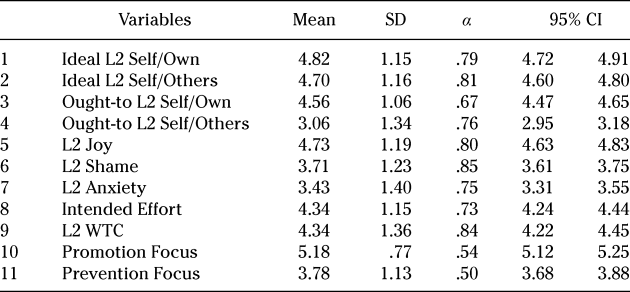
As shown in Table 1, the Cronbach’s alphas showed good reliability for all of the scales except promotion-focus and prevention-focus. Such moderately low reliabilities were surprising because the scales were adapted from a questionnaire whose validity and reliability had been well established in previous studies in social psychology (see Lockwood et al., Reference Lockwood, Jordan and Kunda2002). However, it should be noted that the original questionnaire consisted of 20 items (ten items measuring promotion-focus and ten items measuring prevention-focus), and, due to some logistical concerns, only four items for each motivational scale were chosen and randomly interspersed in the final questionnaire. As promotion- and prevention-focus items measure learner’s general motivational orientations, which are seemingly unrelated to learning English, the items might have acted as distractors, reducing the reliability of the scales. Nonetheless, the scales were retained in the analyses for their importance, and their measurement errors were also psychometrically corrected to account for their attenuation effects on the correlations (Osborne, Reference Osborne2003; Pedhazur, Reference Pedhazur1997). As we will see later, they shed some light on motivational distinctions of learners’ ideal L2 self and ought-to L2 self.
Reliability coefficients of the variables before the PCA

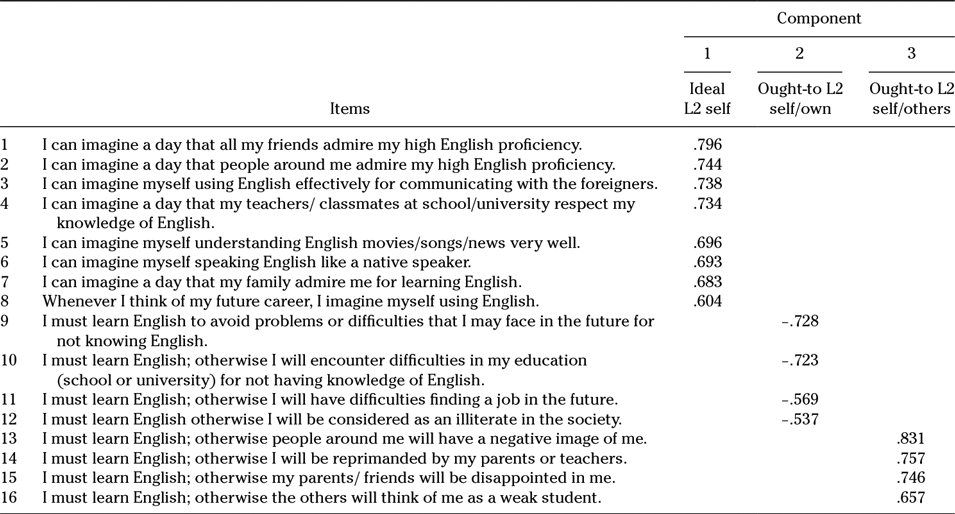
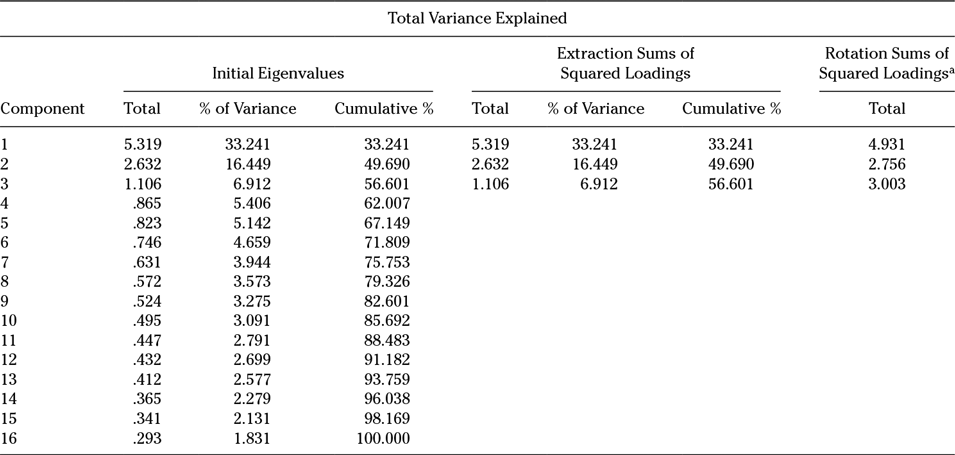
All of the 16 items assumed to represent four distinct L2 future selves were first submitted to factor analysis using Principal Component Analysis (PCA) with Oblimin rotation method. The scree plot and eigenvalues greater than one were the initial criteria examined to determine the number of components (see Appendix) (Plonsky & Gonulal, Reference Plonsky and Gonulal2015). The results were indicative of three components. Alternative solutions—two-component and four-component solutions—were also examined in terms of the interpretability of the additional components and content, item loadings and cross-loadings, the additional amount of variance accounted for, and the communalities. Overall, the results of PCA, as seen in Table 2, yielded a three-component solution as the optimal choice. Component 1 (eigenvalue = 5.32), component 2 (eigenvalue = 2.63), and component 3 (eigenvalue = 1.11) accounted for 33%, 16%, and 7% of the variance, respectively. In total, the three-component solution accounted for 56% of variance in the data. A close look at the composite items of each component revealed that the items representing the students’ ought-to L2 self/own and the ought-to L2 self/others were neatly loaded onto two distinct components (components 2, 3). By contrast, all the items assumed to represent different aspects of the students’ ideal L2 self (own vs. others) fell under one component (component 1), suggesting that the distinction between the students’ ideal L2 self/own and ideal L2 self/others is not warranted. In light of these results from the PCA, the two ideal L2 self variables were collapsed into one for the remainder of analyses reported in this study (α = .88; M = 4.76; SD = 1.07; 95% CI [4.67, 4.85]).
Results of PCA

Note. N = 532. All the component loadings > .40 are reported in the table. Component loadings are obtained using principal component extraction with Oblimin rotations.
In the next step, a series of partial correlational analyses was run to examine the unique nature of the relationships between the students’ L2 future selves, on the one hand, as well as their relations with promotion-focus and prevention-focus variables, on the other. Partial correlations are used to examine the relationship between any two variables while removing the effects of other related variables that might otherwise influence the results. Also, as mentioned previously, the measurement error of the scales was corrected to reduce their attenuation effects on the correlations. Footnote 1 Partial correlational analyses were run between each two L2 selves while controlling for the effects of the other L2 self. The results showed negative, negligible correlation between the students’ ideal L2 self and their ought-to L2 self/others (r = −.289, p = .10). However, the students’ ought-to L2 self/own was found to be strongly and positively related to both their ideal L2 self (r = .66, p = .000) and ought-to L2 self/others (r = .57, p = .000), respectively. Concerning the relationships between the students’ L2 selves and their general motivational orientations, the results showed that the ideal L2 self was robustly related to promotion-focus (r = .56, p = .000) and had no correlation with prevention-focus (r = −.14, p = .649). By contrast, the students’ ought-to L2 self/own showed a positive relationship with prevention-focus (r = .38, p = .000) and no correlation with promotion-focus (r = −.04, p = .247). Finally, the students’ ought-to L2 self/other was found to be associated positively with prevention-focus (r = .28, p = .000) but negatively correlated with promotion-focus (r = −.27, p = .015).
A series of multiple regression analyses using Enter method was run in order to examine the strengths of the students’ L2 future selves in predicting their motivated behaviors. Defining ideal L2 self, ought-to L2 self/own, and ought-to L2 self/others as independent variables, and, putting intended effort and L2 WTC as dependent variables in turn, the results in Table 3 showed that all three L2 future selves emerged as predictors of students’ intended effort. The motivational effects of the ideal L2 self on intended effort were the strongest among the variables. Interestingly, when a similar regression analysis was repeated this time with the students’ L2 WTC as the dependent variable, only the ideal L2 self emerged as the strong predicting factor.
Regression analyses of L2 future self-guides with intended effort and L2 WTC as criterion measures

Another set of multiple regression analyses using Enter method was conducted to examine the strengths of students’ L2 selves in predicting their emotional states. The results can be found in Table 4. Defining ideal L2 self, ought-to L2 self/own, and ought-to L2 self/others as independent variables, and by putting joy, anxiety, and shame as dependent variables in turn, it was found that (a) the students’ ideal L2 self and the ought-to L2 self/own acted as predictors of their emotional state of joy, with the former having the strongest effects; (b) the students’ ought-to L2 self/own and the ought-to L2 self/others acted as predictors of their emotional state of anxiety; and, finally, (c) the students’ ideal L2 self, the ought-to L2 self/own, and the ought-to L2 self/others were all predictors of their shame reaction, with the ideal L2 self having the weakest and the ought-to L2 self/others having the strongest effects.
Results of regression analyses of L2 future self-guides with joy, anxiety, and shame as criterion measures

DISCUSSION
In relation to research questions 1 and 2, the bifurcation of learners’ ought-to L2 self into the two standpoints of own and others was confirmed, whereas such a distinction was not found for the ideal L2 self. This suggests that, while learners’ obligations, duties, and oughts concerning learning a second language can be distinguished due to their degree of internalization, the same cannot be applied to learners’ hopes, aspirations, and ideals for learning the target language. This is probably because both social and personal aspects of learners’ ideal L2 self are highly internalized and so desirable that they do not lend themselves to separation.
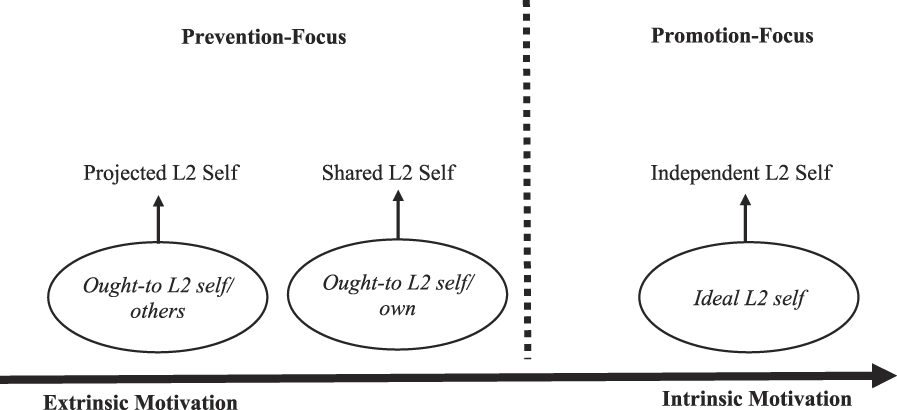
Research question 3 explores the motivational distinctions of learners’ ideal L2 self and the ought-to L2 self (own vs. other). Based on the findings of this study, learners’ ought-to L2 self/others represents the most extrinsic types of motivation involving external factors, such as parental pressures or course requirements, projected on the learners for learning a second language. Its lack of correlation with ideal L2 self suggests that learners with strong ought-to L2 self/others are less likely to have a clear vision of learning or using the target language in the near future. In fact, the main motivational drive for such learners is to put vigilant effort into the process of L2 learning so as to avoid negative outcomes related to their social, surrounding contexts that temporarily require them to do so (i.e., prevention-focus regulation). Learners’ ideal L2 self, however, represents the most intrinsic types of motivation involving personal and social desires, wishes, and hopes that are independent of others and set by L2 learners. L2 learners with strong ideal L2 selves have vivid visions of their desired language-related goals and are eagerly driven to approach them in order to satisfy their growth and advancement needs (i.e., promotion-focus regulation). Finally, learners’ ought-to L2 self/own represents the least extrinsic type of motivation involving external factors that L2 learners have successfully managed to internalize to varying degrees. Its positive correlation with ought-to L2 self/others suggests the extrinsic locus of causality of ought-to L2 self/own, and its stronger correlation with ideal L2 self reflects learners’ level of internalization. Ought-to L2 self/own represents externally imposed obligations and duties by significant others for learning an L2 that are ultimately internalized or shared by the learners for their personal meaning and value (Kim, Reference Kim, Dörnyei and Ushioda2009). Although learners with strong ought-to L2 self/own have partially developed a vision of their desired L2 goals, their major motivation is still to satisfy their security needs in the future by avoiding personal difficulties (e.g., finding a job) that they may encounter for not having a command of knowledge in the target language (i.e., prevention-focus regulation). Taken together, ought-to L2 self/others, ought-to L2 self/own, and ideal L2 self form a motivational continuum representing the process of internalization of learners’ L2 selves. It shows how imposed obligations and duties by significant others for learning an L2 (projected L2 self) can be internalized and shared for their personal value (shared L2 self) and, ultimately, fully owned by the L2 learners (independent L2 self) (Higgins, Reference Higgins2011). Figure 1 shows a schematic representation of the trichotomous model of L2 selves and their distinct motivational properties.
Schematic representation of a trichotomous model of L2 selves.

As noted, motivational distinctions of learners’ ideal L2 self and ought-to L2 self (own vs. others) can also be accounted for by examining their different types of motivated behaviors. As argued previously, conceptualization of learners’ motivation as an all-effort notion is problematic in that it fails to tease apart their qualitatively different sources of motivation. The lack of predictive power in the regression analyses for learners’ intended effort lent support to such an argument. The results showed that all three different types of learners’ L2 selves led to some increases in their intended effort. Consequently, learners’ L2 WTC was argued to represent another form of motivation that is qualitatively different from the quantitative notion of motivation as all-effort. The results confirmed such an assumption; learners’ L2 WTC was found to be strongly predicted only by their ideal L2 self. In sum, L2 learners with a strong ideal L2 self have a predominant promotional focus and not only expand energy and time on the process of language learning but also eagerly approach their ideal image of a competent language user by willingly and actively engaging in activities that involve the actual use of the target language. By contrast, L2 learners with strong ought-to L2 selves (own vs. others) have a predominant preventional focus and vigilantly invest efforts in learning the target language in attempts to meet the requirements set by themselves or significant others. Such learners, however, are more likely to avoid taking risks by voluntarily engaging in activities involving actual language use as long as their current situations or conditions don’t impose such a requirement.
Research question 4 aimed to investigate the relationships between the L2 learners’ emotional states and their L2 future self-guides. The results of this study showed that L2 anxiety was associated with students’ ought-to L2 self/own and ought-to L2 self/others but had no relationship with their ideal L2 self. In contrast, L2 joy was found to be robustly associated with students’ ideal L2 self and unrelated to their ought-to L2 self/others, although it showed a weak correlation with their ought-to L2 self/own. These findings lend empirical support to the hypothesis put forward in Papi and Teimouri (Reference Papi and Teimouri2014) about the facilitative and debilitative role of anxiety on students’ motivation. L2 anxiety fits the motivational orientation of learners with a predominant preventional focus and plays a facilitative role by keeping them alert to the presence of possible negative outcomes. However, because learners with strong ideal L2 self have a predominant promotional focus and are sensitive to the presence of positive outcomes, the emotional state of joy best fits their motivational orientation, and anxiety represents a misfit, having a debilitative effect on their motivation. Considering the relationships between shame and students’ L2 future self-guides, all three different L2 selves were found to be positively correlated with shame. This pattern of findings lends support to the claims by Tangney et al. (contra Higgins’s (1987) original hypothesis) that students’ ought-to self and the ideal self, irrespective of standpoint on the self, are both associated with the negative, conscious feeling of shame. However, because the strength of the relationships with shame increased from the students’ ideal L2 self (the most internalized types of motivation) to their ought-to L2 self/others (the most externalized types of motivation), the findings also corroborate to some extent Higgins’s prediction. That is, L2 learners with different types of self-discrepancies are all susceptible to some extent to the emotional reaction of shame, but learners with stronger preventional concerns seem to be more vulnerable to shame and experience it more intensely when compared to learners with a predominant promotional focus.
LIMITATIONS, RESEARCH DIRECTIONS, AND PEDAGOGICAL IMPLICATIONS
Although the findings of this study concerning the interrelationships between students’ predominant promotion-focus and prevention-focus and their different types of L2 selves were theoretically supported and consistent with the findings of past research in both L2 motivation research and social psychology (e.g., Dörnyei, Reference Dörnyei, Dörnyei and Ushioda2009; Higgins, Reference Higgins1997, Reference Higgins1998), the promotion-focus and prevention-focus scales that were partially adapted from Lockwood et al. (Reference Lockwood, Jordan and Kunda2002) exhibited limited reliability. Although the attenuation effects of these low alphas on correlations was psychometrically corrected in this study, future research may include the whole original questionnaire separately, or other reliable questionnaires to investigate their relations to different types of learners’ L2 selves. Moreover, the trichotomous model of learners’ L2 selves as well as the other patterns of findings in this study cannot be generalized to other settings until similar studies are conducted in different EFL/ESL contexts and sufficient empirical evidence is collected.
The inclusion of language learners’ general motivational orientations into future research using L2 motivational self system seems necessary. Although the promotional and preventional aspects of learners’ ideal L2 self and ought-to L2 self were originally mentioned while providing the conceptual definition of ideal L2 self and ought-to L2 self (Dörnyei, Reference Dörnyei2005, Reference Dörnyei, Dörnyei and Ushioda2009), subsequent research using the model solely focused on examining the motivational effects of future L2 selves. Learners’ predominant self-regulatory foci provide distinct contexts within which their future goals can be conceptualized as ideal L2 self or ought-to L2 self (see Molden et al., Reference Molden, Lee, Higgins, Shah and Gardner2008). The present study also introduced and incorporated shame as another type of emotion into the realm of SLA and investigated its relation with learners’ self-discrepancies. The inclusion of shame as well as other self-conscious emotions (e.g., guilt) into L2 motivational self system, as mediating emotions between learners’ future L2 self-guides and their motivational behaviors, will add more explanatory power and precision to the model to account for motivational behaviors of the learners (Tahmouresi & Teimouri, Reference Tahmouresi and Teimouri2016). Future research on shame, as an individual differences factor in and of itself, and its implications on learners’ motivation and interpersonal behavior, may bear fruitful results both theoretically and practically. Moreover, teachers and learners’ strategies to cope with the negative consequences of shame may open up a new line of inquiry with great pedagogical implications.
In a general sense, the findings of this study favor a promotional approach toward second language teaching and learning. The strength of L2 learners’ ideal L2 self plays a pivotal role within such an approach. It should be noted, however, that not all L2 learners share the same goals and motivational orientations. There are still many learners that do not entertain an independent ideal L2 self, and learning a second language may simply represent an obligation. Thus, teachers are recommended to create a balanced motivational practice by taking advantage of both promotion and prevention motivational strategies to maximize students’ motivational effectiveness (Dörnyei, Reference Dörnyei, Dörnyei and Ushioda2009; Dörnyei & Kubanyiova, Reference Dörnyei and Kubanyiova2014). While an accessible picture of an ideal L2 self will energize learners with a predominant promotional focus to eagerly approach it by engaging in different L2 learning activities and using the target language voluntarily, an elaborate account of the potential negative consequences of a failure to do so will keep leaners with a predominant preventional focus alert to vigilantly put more effort into avoiding them (Papi & Teimouri, Reference Papi and Teimouri2014; see also Dörnyei, Reference Dörnyei, Dörnyei and Ushioda2009, Dörnyei & Kubanyiova, Reference Dörnyei and Kubanyiova2014). Adopting such a balanced motivational practice, hopefully, may also lay the ground for L2 learners to gradually internalize their oughts and obligations and move toward forming fully-fledged ideal L2 selves. Regardless of their future L2 selves, all the learners are susceptible to experiencing shame to a lesser or greater extent. Depending on their L2 linguistic and communicative competence, the discrepancies between L2 learners’ current self and the self they would ideally like to present to others while using the L2 might induce a sense of shame. For instance, on the occurrence of a failure such as miscommunication or lack of comprehension during a social interaction (e.g., talking to a native speaker over the phone), some L2 learners are more likely to interpret the mishap as a defect of their global self and to avoid similar social interactions in an attempt to prevent their defective L2 self from being socially exposed. Considering the L2 classroom as a social context wherein failures are indispensable parts of learning, teachers should be cautious in using different strategies to provide learners with corrective feedback. Some types of corrective feedback are more shame provoking than others. For instance, while explicit corrective feedback facilitates learning through pointing out the source of an error to the learner directly, its provision in front of other learners might lead the learner to question his or her abilities, and, consequently, make the learners susceptible to shame reaction. Teachers may also want to consider the use of positive feedback, highlighting L2 learners’ strengths along with providing negative feedback. Learners might be less defensive and more willing to learn from their mistakes and failures if their strengths are also recognized and pointed out by the teacher.
CONCLUSION
This study aimed to investigate language learners’ emotional experiences through the lens of L2 future self-guides. The revision of the construct of ought-to L2 self (own vs. others) was an attempt to systematically address the sources of ambiguity concerning the construct in past research using the L2 motivational self system. The findings of the study provided a more nuanced picture of learners’ L2 selves, their motivational distinctions, and their dynamic nature during the process of internalization. Moreover, the results showed L2 learners’ self-discrepancies or self-congruencies result in distinct emotional experiences. All in all, the inclusion of learners’ emotions into the L2 motivational self system as mediating factors has great potential to broaden our understanding of learners’ motivational behaviors throughout the course of L2 goal-pursuit.
SUPPLEMENTARY MATERIAL
To view supplementary material for this article, please visit https://doi.org/10.1017/S0272263116000243.
APPENDIX
THE RESULTS OF PCA