Rudolf Martin's scientific career demonstrates that in the history of science the standardization of method or the implementation of technique can be more important than development of an original theory. Perhaps because of the practical orientation of his work, in addition to the fact that his influential anthropological textbooks were not translated into English, Martin has not been the focus of much scholarly interest. In the field of scientific photography this is particularly noticeable in comparison to his earlier counterparts, Francis Galton and Alphonse Bertillon, two other founders of scientific photography. Some of the standard accounts of racial photography fail even to mention him.Footnote 1 Yet Martin's anthropometric photography achieved great prominence, particularly in German-speaking countries. Furthermore, focusing on the history of anthropological method or technique more than on the history of ideas, larger tensions come to the surface in the history of German anthropology in the first decades of the twentieth century, such as between an international scientific ethos and nationalist impulses, or between anthropological method and national politics. An exploration of the central role of the liberal Martin in the standardization of anthropological method and technique, therefore, destabilizes the now well-entrenched description of a paradigmatic shift in German anthropology from liberalism to racism.Footnote 2
Born in Zürich and educated in Leipzig and Freiburg im Breisgau, Martin turned to anthropology under the influence of the prominent biologist August Weismann. Studying in some of the most important anthropological institutes in Europe, including the Ecole d'anthropologie in Paris, Martin completed his Habilitation in Zürich in physical anthropology in 1891, where he was appointed full professor in 1905. In 1911 he retired to Versailles, but left France with the outbreak of the First World War. In 1917 he succeeded anthropologist Johannes Ranke at the University of Munich.Footnote 3 Following the intellectual lead of Rudolf Virchow and Johannes Ranke, Martin believed in the malleability of ‘races’ and the inevitability of procreation among groups, which rendered the definition of races difficult, if not impossible. Similarly to Franz Boas, the German Jewish founder of American cultural anthropology and also a student of Virchow, Martin believed that races were affected by the environment, physical conditions and cultural history.Footnote 4 He played an important role in the biologization and scientific institutionalization of anthropology, particularly in the development, dissemination and standardization of the anthropological method and technique. Martin's professional trajectory, analysed below primarily through the history of anthropometric photography, not only sheds light on his own scientific career but also discloses some of the fundamental tensions in the history of anthropology between the turn of the twentieth century and the Weimar period.
Before I contextualize Martin and anthropometric photography, a short note about nomenclature is necessary. The field in which Martin operated is called Anthropologie, the closest English term for which is ‘physical anthropology’. Anthropologie once covered a wide territory and precisely during the period of Martin's professional activity broke down into several separate subdisciplines. In evaluating Martin's work in the field of photography, the distinction between the different photographic conventions at the end of the nineteenth century in German physical anthropology (Anthropologie), on the one hand, and ethnography (Ethnographie) or ethnology (Ethnologie or Völkerkunde), on the other, is essential.Footnote 5 In Ethnologie or Völkerkunde, which studied non-European cultures, photography was used for the visualization and illustration of racial types or aspects of material culture.Footnote 6 In Anthropologie, which dealt with the natural–physical aspects of the human body and circumscribed the species of Man (Homo sapiens) in its temporal and spatial extension, photography was used principally as a measuring device and as a means of reproduction of reality.Footnote 7 In practice, genres were sometimes mixed. Accordingly, current historians write of photographs carried out in ‘anthropometric style’, thus denoting that although they may look as though they belong to that genre, in fact these photographs were carried out without sufficient control and no numerical information could be derived from them.Footnote 8 The relevance of these distinctions will become apparent in the following.
The structure of the article is as follows. The first section of the article attempts to contextualize Martin historically and to bring to the fore the more general tensions that are involved in the study of his contributions to anthropometric photography. I do this by, first of all, attempting to situate Martin with regard to the form of objectivity associated with his photographic method and technique. I then discuss the issue of Martin's method and its potential politicization, a tension that underlies this chapter of the history of science. Third, I address the peculiar form of Martin's significance in the history of science arising from his creation of a network of students and his work in the standardization of method and technique. Finally, I present three chronologically ordered sections, each of which focuses upon key moments in Martin's photographic career. The first of these sections in fact precedes anthropometric photography because, as we shall see, Martin's motivation to standardize anthropometric photography grew not out of any special interest in photography as such, but from a more general concern to standardize anthropological measurements.
Photography and the two forms of objectivity
An examination of Martin's contributions to anthropometric photography connects the history of scientific photography with the history of physical anthropology. In this context it is possible to differentiate between attempts to develop photography as a form of science (in the production of data unavailable to the human eye) and photography as an auxiliary scientific instrument (for the sake of reproduction of reality).Footnote 9 In physical anthropology, photography is understood as an auxiliary instrument. Its scientific status can be further situated with regard to two notions elaborated in Lorraine Daston and Peter Galison's book Objectivity: ‘mechanical objectivity’ and ‘trained judgment’. However, while both are helpful in situating Martin historically and epistemologically, neither captures the status of anthropological photography in its entirety.
‘Mechanical objectivity’, according to Daston and Galison, designates the ambition to produce an objective representation with the aid of mechanical instruments (such as the camera), free from human interference and independently of any human observer. Mechanical objectivity is characterized by the insistent drive to repress the wilful interventions of the artist–author, and to put in their stead a set of procedures that would, as it were, move nature to the page through a strict protocol. Daston and Galison emphasize that behind this form of objectivity stands a determination to remove the personal tastes, commitments and ambitions of the human observer.
Martin's anthropometric photography involves the use of machines to record data in a more reliable way than by biased human observers. As will become apparent, the qualities of mechanical objectivity capture central aspects of Martin's photographic method.
Yet Martin never claimed that photographs speak for themselves without interpretation. Indeed, in certain senses he seems to approach what Daston and Galison refer to as ‘trained vision’ – a form of objectivity that in the 1920s and 1930s increasingly supplemented and succeeded mechanical objectivity. In this period, scientists increasingly acknowledged the need to employ trained judgement in making and using images; that is, seeing scientifically through an interpretative eye. Martin, I will show, recognized that photography by necessity distorts its reproduced object. In this sense he indeed departed from a naive form of mechanical objectivity. But he attempted to resolve this distortion by way of a formula rather than by any form of trained vision. Anthropologists in their sampling methods, however, employed trained judgement in this period. In any case, these two notions situate Martin's photography as a form of mechanical objectivity that also involves elements of trained vision.Footnote 10
The historical picture, however, is more complicated than this. On the one hand, Martin's anthropometric photography did not focus on visualization. In fact, in developing anthropometric photography the expressed aim of Martin and his colleagues was not so much to generate a corpus of racial ‘type’ photographs as to use the camera as a measuring device. Indeed, in this sense, production of photographs was not even viewed as an end in itself but as a means towards the generation of numerical data, which, in turn, would be used for the generation of statistical tables for the study of human and racial variation. What complicates the historical picture is the fact that in addition to these expressed aims, or side by side with them, the historian cannot but acknowledge the simultaneous existence of photographic practices that partook in and in turn generated certain visual patterns that not only are incongruent with Martin's liberal self-perception but also stand in opposition to his written account. From our contemporary perspective these practices appear astonishingly crude. The analysis of Martin from the perspective of his photographic method and practice, therefore, reveals a multifaceted, tension-riddled historical picture.
Martin's importance for the history of science
As one of the earliest holders of a full professorship in anthropology in a German university, Martin played a key role in the institutionalization of anthropology as an academic discipline in Swiss, German and Austrian universities. One of the central aims of this article is to demonstrate that Martin gained his centrality not through theoretical innovations, but rather socially and institutionally: through his building up of a network of students and through his contribution to the standardization of anthropological method and technique. Both activities occurred precisely during the years in which physical anthropology developed into a recognized academic field.
By way of the network of students who employed his methods and who then became prominent anthropologists, Martin was central to the development of the discipline in the German context. He was a devoted teacher, and many of his doctoral students later occupied professorships in German, Swiss and Austrian universities. Martin's students in Zürich included Bruno Oetteking, Theodor Mollison, Otto Schlaginhaufen, Jan Czekonowski and Adolph H. Schultz; in Munich they included Walter Scheidt, Wilhelm Gieseler and Karl Saller – a stable network, according to Uwe Hoßfeld, that held at least up to 1978.Footnote 11
But Martin also gained his centrality and scientific authority through standardizing key elements of anthropological method and measuring techniques.Footnote 12 This he accomplished through the introduction of standardized methods; the invention, improvement and dissemination of anthropological instruments; and the publication of the single most important German anthropological manual in the twentieth century: the Lehrbuch der Anthropologie in systematischer Darstellung (Textbook of Physical Anthropology in Systematic Presentation), the preparation of which lasted almost a decade. This book first appeared in 1914, and in revised form in 1928, in 1957–1966 and in 1988, edited by Martin, by Martin's second wife Stephanie Oppenheim, by his student Karl Saller and by Rainer Knußman respectively.Footnote 13
Martin's practical orientation was evident in his development of instruments and his minute discussions of their uses, in his emphasis on scientific control, and in his many references to specific instrument-makers.Footnote 14 Examples include his improvement of the standard Haartafel (hair-table) and Hauttafel (skin-table), which had been employed by Eugen Fischer, Felix von Luschan and other prominent anthropologists. Martin claimed that his eye-table was an improvement over Broca's, which was insufficiently accurate, and also over Bertillon's, which he found to be too complicated. His anthropological innovations were in use long after his death in 1925. In 1942, for instance, the eye colours of Jews from the Ghetto of Tarnow were noted according to Martin's Augentafel.Footnote 15 Anthropologists still employ his measuring techniques today, albeit no longer for living humans.
In both these aspects, the institutional centrality and the professionalization of method and technique, there is some similarity between Martin and Franz Boas, Martin's contemporary and the founder of American cultural anthropology. Boas revolutionized American anthropology by importing Virchow's liberal German anthropological tradition. As with Martin in Germany, virtually all of the most prominent American anthropologists of the first half of the twentieth century (including Alfred Kroeber, Robert Lowie, Ruth Benedict, Ruth Bunzel, Edward Sapir, Margaret Mead and Melville Herskovits) had studied with Boas. Furthermore, Boas also played a major role in the professionalization of anthropology, making mastery of language of the respective studied groups and minimal linguistic education mandatory, as well as knowledge of statistical methods.Footnote 16 But while these similarities aid us in pinpointing the peculiar nature of Martin's historical significance, the differences between them are equally important: Martin never turned to culture in the way that Boas did, nor did he explicitly commit himself to an anti-racist and anti-anti-Semitic agenda. And while Boas and Martin shared a similar international scientific ethos, Martin – with one important exception that occurred during the First World War (and which we shall discuss below) – was far more hesitant to counter nationalistic impulses by crossing over from scientific discourse to the public domain.
I will demonstrate Martin's significance for the standardization of anthropological method and technique through his role in the standardization of anthropometric photography. I will show that Martin demonstrated little interest in developing an original form of anthropometric photography (as opposed to, for example, Galton). Rather, he invested his energy, and was seminal, in transporting anthropometric methods that to a great extent already existed in a different context (criminology) and for quite different purposes (individual identification), adjusting and standardizing them for anthropological purposes. His concrete aim, in this respect, was to produce a minute protocol that could be followed by practising anthropologists and that guaranteed, he believed, the generation of scientifically valid data.
The larger context of Martin's endeavour to standardize method and technique is that of the narrative of scientific progress, of rationality, and of internationality. Standardization of technique was intended to create a unified international scientific language, which would allow anthropologists of all nations to communicate with each other based on agreed scientific conventions and procedures.Footnote 17 The tension between the internationalist and the nationalist impulses is integral to this chapter of the history of science.
It is also an essential feature of Martin's career and scientific ethos that he did not develop his anthropometric method in isolation. Rather, and as I will show, he improved his method in close collaboration with several of his students or former students. Being at the forefront of the standardization of anthropological technique, Martin was decisive in the process that professionalized the discipline, a process that garnered scientific prestige for the field. In fact, one of the ironies of this history is that Martin probably contributed to the scientific prestige of physical anthropology far more than any non-academic advocate of white, Aryan, or Nordic superiority could ever hope to have done.
Method and politics
Martin conceived of himself as an impartial scientist and adhered to the German liberal anthropological tradition. According to later accounts, he was deeply committed to humanist values and held a liberal outlook on life.Footnote 18 But some of these later accounts are themselves problematic, documents of a post-1945 pre-critical history of science.Footnote 19 A major thread in the following account, therefore, pertains to the relationship between Martin's anthropology and its potential politicization. It is possible, in this respect, to frame the following account through three alternative interpretations.
At one end of the spectrum we might find Uwe Hoßfeld. Hoßfeld belongs to a younger and critical generation of historians of German anthropology and biology, but nonetheless reiterated in 2005 the view, characteristic of earlier German scholarship, that the fate of Martin's method in Nazi Germany exemplifies the way a relatively neutral method was ideologically abused.Footnote 20 Somewhere within the spectrum we find the interpretation, developed in a different context by American Austrian historian of science Mitchell Ash, which argues that the relationship between science and politics is essentially contingent, as science and politics serve as mutual resources for each other.Footnote 21 A third interpretation, at the other end of the spectrum, developed in a historical context closer to that of Martin's contributions to anthropology than Ash's to the history of science, is that of French statistician and historian of statistics Alain Desrosières. Desrosières argues with regard to Francis Galton and Karl Pearson, the founders of eugenics who made major contributions to modern statistics, that their method (biometrics) cannot be separated from their political model (eugenics). That is, the relationship between the two is necessary.Footnote 22
Martin affords a particularly interesting and complex case in this context. Unlike Galton or Pearson in England, and unlike the generation of anthropologists and geneticists that succeeded him, including Eugen Fischer, Egon von Eickstedt, and Otto Reche in Germany, Martin was distant from nationalist, racist and anti-Semitic views. Hoßfeld's interpretation, neatly separating a ‘neutral’ method from its ‘ideological abuse’, simplifies the relationship between the anthropological method and the social and political grounds on which it was developed and implemented, grounds that underwent deep transformations in the first decades of the twentieth century. Martin did not conceive of scientific photography in the same way as did Hans F.K. Günther, the most prominent writer on race in the Weimar and Nazi periods. But nothing in Martin's method prevented Günther in the 1930s from using Martin's materials or adopting Martin's method to further his own goals.Footnote 23 Martin died before the Nazis rose to power, but after Günther's influential publications had already appeared in print. Their times and careers, therefore, do overlap.
Desrosières's interpretation, too, is of only partial help. Unlike Galton and Pearson, whose science and politics Desrosières likens to two closely connected pillars standing at the foundation of one project, Martin had no equivalent political agenda and it is not clear how he viewed science to be related to politics or vice versa. While he probably had no desire that his method be politicized, he nevertheless made no attempt to restrain its political use through the introduction of checks or qualifications.
Ash's interpretation, according to which science and politics stand in a mutual, dynamic and contingent relationship, leaves unresolved the question whether there is an inherent relationship between Martin's anthropological method and its politicization or whether it was merely coopted by a younger, more politically motivated, generation of anthropologists. Nonetheless, for the complex historical relationship between Martin's physical anthropology and the uses to which it was put it seems that Ash affords the most differentiated analytical framework.
The use of his method by his students exacerbates the inherent tension between Martin's method and its politicization. His students include Theodor Mollison, Josef Mengele's supervisor in Munich in the mid-1930s – the same Mengele who later conducted murderous experiments in Auschwitz-Birkenau. In 1904 Mollison conducted measurements on Herero prisoners during what is now recognized as the first genocide of the twentieth century.Footnote 24 Mollison took a keen interest in photography and played a key role in the development of Martin's photographic method. Rudolf Pöch, another student of Martin and one who enjoyed close cooperation with him, entered the debate on anthropometric photography following studies he conducted on prisoners of war during the First World War. When viewed from the perspective of anthropological praxis, therefore, the distinction between the ‘liberal’ and the ‘anti-humanist’, entrenched in recent scholarship, is somewhat destabilized.
Nevertheless, employing the perspective of praxis, in this article I argue that the core development of anthropometric photography comprises a specific form of inner-scientific progression that was to a great extent independent of politics. The progress of anthropometric photography is not a history of major differences of opinion, contrasting value systems, or conflicting versions of science. Rather, it was tied to technical considerations and questions of scientific control, and particularly to the question of how to produce scientifically valid photographs. In using the term ‘progression’, I refer to scientific progression as viewed by the scientists involved at the time. I will employ Marcelo Dascal's typology of polemic exchanges to characterize the specific form of exchange between Martin and his contemporaries. Dascal differentiates between ‘discussion’, which is a polemical exchange whose object is a well-circumscribed topic or object; a ‘controversy’, which begins with a specific problem but spreads to additional problems and disagreements, such as questions of methodology; and finally a ‘dispute’, which is a disagreement that may appear to revolve around a well-defined object but in fact turns upon differences of attitude, feelings, or preferences.Footnote 25 I will show that the polemical exchange between Martin and his colleagues was local and specified and did not involve major epistemological, methodological or ontological differences of value.
The notion of politics that underlies my analysis is not that of left and right but a more comprehensive and subtle one. Every science that studies nature may have political implications if its respective categories of classification and explanation have an (implicit or explicit) effect on society. In this sense, any science that deals directly with humans possesses perforce (implicitly or explicitly) a political aspect. Physical anthropology, the discipline of which anthropometric photography formed a part, was based on the assumption that in order to study the natural history of the human species it was necessary to study its different manifestations, subdivided into ‘races’. This natural-scientific version of anthropology was established as a recognized academic field only after the differentiation – in Germany associated with the work of Wilhelm Dilthey, Georg Simmel and particularly Wilhelm Windelband and Heinrich Rickert – between the methods employed in the study of culture (idiographic) and the study of nature (nomothetic).Footnote 26
The history of anthropometric photography cannot be separated, at least not in any non-reductive way, from the social and the political sphere. German physical anthropology viewed itself as a descriptive science (as opposed to a hypothetical one). ‘Race’, however, was a signifier that was already widespread in the nineteenth century, the meanings of which until at least the end of the nineteenth century were rather diverse. Race joined other biological terms of art in use within anthropology in functioning as a metaphorical link joining science and society in a shared discourse. Biologists and cultural anthropologists drew upon this category in an effort to make their work more scientific, that is to say more precisely descriptive. By doing so their work legitimated racial distinctions by underlining their allegedly real existence in ‘nature’. The anthropological discourse of race exemplifies, in this sense, the ‘looping effect’ of science; that is, the fact that scientific categories of classification may have a constitutive social effect.Footnote 27 The knowledge that this science produced was deeply infused with the language of race as a biological category, its categories and its signifiers. As a result, it reorganized the social field of inquiry, racializing individuals, groups and social and political questions.
It is clear, therefore, that Martin's ideas on race are indispensable for the analysis of this particular chapter in the history of anthropological photography. Martin's ideas on race underwent no significant change throughout his career. In an 1899 article, he argued that spiritual and moral capabilities were no less inherited than physical ones and that each race exhibited a specific degree of intelligence, abilities and tendencies. Despite actual mixture between peoples, Martin insisted, these tendencies remained within the genotype – giving the Jews as an example.Footnote 28 The anthropological task was urgent, Martin believed, because human types were on the verge of extinction.Footnote 29 And it could not be performed without recognition of the racial substratum.Footnote 30
Race, therefore, was integral to anthropology as a discipline in the natural sciences, but not as its organizing principle.Footnote 31 In the first part of his Lehrbuch, Martin defined elementary anthropological concepts and terms such as ‘kind’, ‘variety’, ‘type’, and ‘feature complex’ (Merkmalkomplex), and classified human races based on the schemes of Ernst Haeckel and Joseph Deniker. While he insisted that racial differences were prevalent already at birth, when compared with apes human proportions were nonetheless entirely specific.
Finally, the relationship between anthropology and politics can be further specified within the changing German context. Already by 1918, following a defeat in the war which left German society with unfulfilled ambitions of domination in Europe and in competition with the colonial powers, and until Germany's ultimate defeat in 1945, ‘race’ (along with increasingly deterministic notions of ‘race’) was reconfigured into a solution to social and political questions. Hence the scientific study of ‘race’ in this period interlocked with German political and military aspirations. In Ash's terms, sciences of race increasingly served as a political resource and a growing number of scientists viewed their scientific vocation as inseparable from their political outlook.
Martin and the standardization of anthropological method
Martin made use of photography throughout his entire career. Two different forms of photography and at least three stages in Martin's development of anthropometric photography can be discerned. Martin utilized photography for a number of purposes, but his discussion of photography centred on its standardization as a measuring device. In the following pages I reconstruct his major uses of photography, but my analysis centres on the anthropometric method. I will show that Martin's contributions to anthropometric photography did not derive from a particular interest in photography as such, but from a more general conclusion, which he arrived at during his early fieldwork, that anthropological measurement was scientifically worthless and was in dire need of standardization. Martin's scientific goals did not change, but, following objections levelled against his method by other anthropologists, he was forced to modify and sharpen his method and practice.
Pre-anthropometric photography
Martin's concern with measuring techniques originated from his experience of fieldwork. In his 1893 study in the ‘Feuerland’ (Tierra del Fuego, a group of islands at the southernmost tip of South America), which was based on measurements of several individuals, and his 1896 study of the skulls of old Patagonians, Martin noted deficiencies and inaccuracies in the then-current measuring techniques. Subsequently, from 1899 to 1904 he laboured to improve measuring devices and methods for fieldworkers and their professionalized application, thereby transforming contemporary anthropology.Footnote 32
In his 1905 inaugural address as full professor at Zürich University, in which he outlined his anthropological credo, Martin explained the logic behind his usage of measuring devices, such as cameras, for anthropological work. He noted that in many publications statistical generalizations were made on the basis of very few cases. Worse still, measurements were based on imprecise methods so that even the small sample was itself inaccurate. Martin claimed that the human eye often failed in precisely those cases in which differences were minute or difficult to discern. Thus the introduction of precise instruments to replace the eye was necessary: ‘where the eye and language can no longer grasp, there measurement is of technical help’.Footnote 33 In line with Daston and Galison's notion of ‘mechanical objectivity’, this conception of the advantage of the instrument over the eye was at the core of Martin's efforts to invent, produce and disseminate a number of measuring instruments. Instruments could also contribute to ‘training the senses through subtle observation of details’.Footnote 34 The logic underlying Martin's conception of photography was that devices are the means by which observation gained control.Footnote 35 Martin believed that anthropometric photography was not a means of visualization of racial differences, but rather a tool by which to generate visual data, which could then be transformed into valid statistics.
Instruments, Martin repeatedly stated, should be not only precise but also inexpensive, and sufficiently simple to operate to facilitate their widespread usage. These considerations were, in Martin's view, closely related to scientific control. As he asked, ‘what is the use of the measurement of thousands of skulls if each researcher chooses different points [Messpunkte] and uses different instruments?’Footnote 36 Only standardization of method and technique would allow anthropologists throughout the world to share their findings as an international community of scientists, and thereby transform anthropology into a creditable science. Indeed, Martin's Lehrbuch attempted to achieve precisely this form of standardization, being far more a manual than a research monograph. For Martin originality appears to have been unimportant in comparison to the more pressing task of creating a community of scientists employing the same methods and techniques.
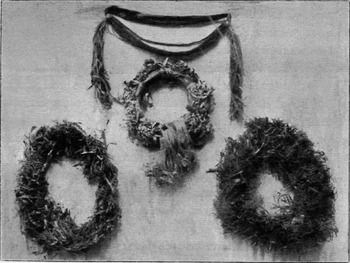
In a strict sense, therefore, Martin's use of photography in publications prior to his 1914 Lehrbuch was not anthropometric. In a comprehensive book on the inhabitants of the Malaysian islands published in 1905, Martin employed photography extensively and systematically. His uses of photography in this book were varied. To begin with, photographs were used in order to reproduce cultural objects such as costumes, embroidery, or cultural artefacts produced by members of the studied groups. Most artefacts were photographed laid on the ground or another flat and neutral surface, thereby removed from their cultural context (see Figure 1). Scientific control played no role in this use of photography.Footnote 37 But in this book Martin also included ‘racial type’ photographs (photographs of racial specimens for the illustration of specific racial types) of young women, teenage females or males, naked from the waist up, depicted facing the camera either frontally or in full profile.Footnote 38 In an ethnographic rather than anthropological vein, individuals were also photographed in their ethnic dress against a neutral background. After this early publication, however, Martin showed no interest in photography for the study of culture and limited his discussion to anthropometric photography designed to generate statistical information.
This image shows how photography was employed for the reproduction of material culture. Rudolf Martin, Die Inlandstämme der Malayischen Halbinsel: wissenschaftliche Ergebnisse einer Reise durch die Vereinigten malayischen Staaten, Jena: Gustav Fischer, 1905, p. 683.

Anthropometric photography, 1905–1914
The second stage in the development of Martin's photographic method also marks the advent of his use of anthropometric photography. This stage began in his 1905 inaugural address at Zürich University and culminated in the section on photography in his 1914 Lehrbuch. The core of the discussion on anthropometric photography consisted of minute technical protocol. Following the demise of physical anthropology as a science of contemporary human diversity, such protocol might today seem somewhat tedious; nevertheless, the particulars are indispensable for its interpretation.
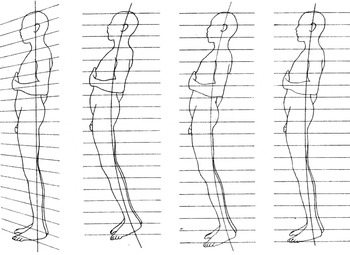
In 1910, as Martin was already working on the Lehrbuch, his student Theodor Mollison systematized the use of photography for the measurement of human proportions.Footnote 39 Mollison stressed that photographs could serve as anthropometric measurement only if executed with strict control.Footnote 40 At the same time, Mollison argued that photography afforded no parallel projection: by definition it distorted the reproduced object. Mollison described different forms of distortion (Fehler) caused by angle, distance, and size of object – points later repeated almost verbatim by Martin. He emphasized that this distortion is greater than had been previously estimated (Figure 2). His discussion did not disqualify photography from scientific usage, but rather indicated the flaws that need to be corrected in order to ensure its scientific validity.
Mollison's discussion emphasized the forms of photographic distortion which, based on meticulous control, had to be corrected. Theodor Mollison, ‘Die Verwendung der Photographie für die Messung der Körperproportionen des Menschen’, Archiv für Anthropologie (1910) 37, p. 307.

In his text, Mollison provided a detailed account of attempts to study human proportions throughout the history of art.Footnote 41 He linked this history to debates over the geometric approach versus the use of perspective in anatomical drawings. According to its proponents, perspective supplemented metric data, providing invaluable morphological insights. According to geometricians, however, perspective precluded the comparison of measurements.Footnote 42 Mollison attempted to bring together the geometric and the perspectivist approaches. Conceptually, such an attempt was destined to fail, but it contributed to the solidification of a certain visual code, exemplified in the concept of the ‘proportionate model’ (Proportionsfigur). Proportionate figures were three-dimensional dummies that were produced from photographs in order to produce measurements that would generate statistical data. Mollison used a picture previously published in Martin's 1905 book as an example of the proportionate model (Figure 3). Mollison warned that although such proportionate models were necessary for deriving ‘types’, measurements made from models were imprecise.Footnote 43 Nonetheless, despite distortions, photographs had the advantage over living material: measurements could be executed under strict control.Footnote 44
Through the development of proportionate figures, three-dimensional dummies that were produced from photographs, measurements could be made and statistical data could be generated. Theodor Mollison, ‘Die Verwendung der Photographie für die Messung der Körperproportionen des Menschen’, Archiv für Anthropologie (1910) 37, p. 315.

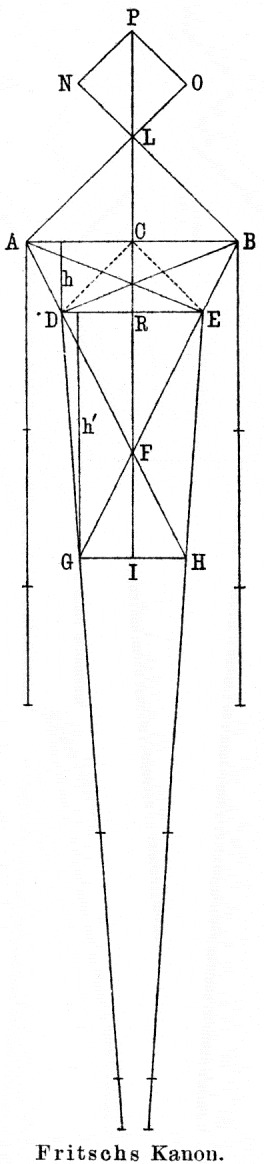
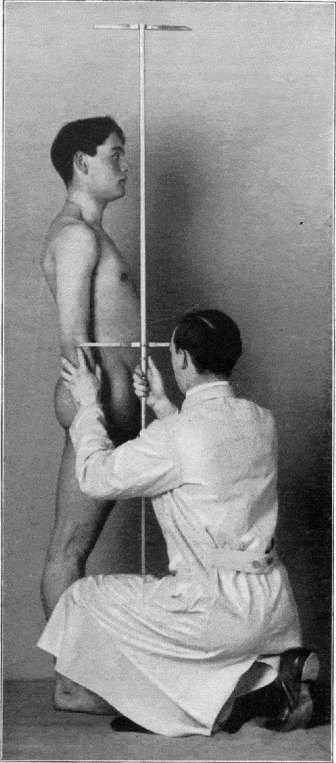
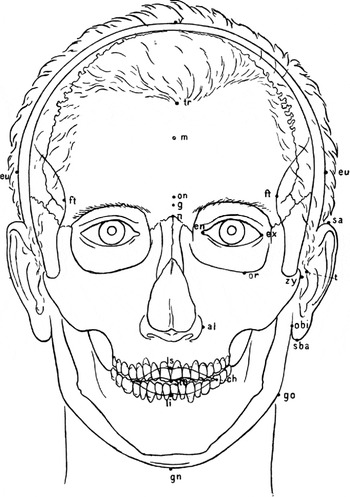
Martin incorporated Mollison's discussion of the distortion involved in anthropometric photography into his Lehrbuch – a manual intended, as indicated by the subtitle of the book, for students, physicians, and travelling scholars. In this practically oriented book, Martin presents photography as a form of anthropological reproduction, alongside drawing (Zeichnung), measurement and description, and statistics. Reproduction could be pictorial (bildlich) or plastic and, accordingly, the representation was either two-dimensional or corporal (körperlich).Footnote 45 Only few drawings, according to Martin, could compete with photographic reproduction.Footnote 46 In this book Martin employs photography also for the demonstration of measurement (Figure 4) accompanied by diagrams with exact measurement points (Figure 5).
In his anthropological manual Martin employed photographs for the demonstration of properly executed measurement. Rudolf Martin, Lehrbuch der Anthropologie. In systematischer Darstellung mit besonderer Berücksichtigung der anthropologischen Methoden. Für Studierende, Ärzte und Forschungsreisende, Jena: Fischer, 1914, p. 135.

Martin employed diagrams to standardize head measurement technique. Rudolf Martin, Lehrbuch der Anthropologie. In systematischer Darstellung mit besonderer Berücksichtigung der anthropologischen Methoden. Für Studierende, Ärzte und Forschungsreisende, Jena: Fischer, 1914, p. 126.

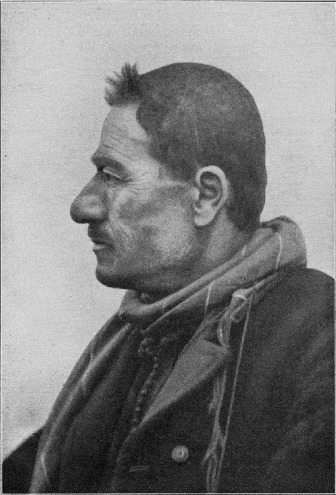
From 1914 Martin's discussions of photography were limited to anthropometrics. Racial type photographs and photographs of cultural artefacts, however, did not disappear from his book (Figure 6). Martin's highly specialized discussion was not intended for the general reader. His method is designed to ensure the least possible distortion in photographs, by addressing the angle from which the photograph is taken.Footnote 47 Martin was not the first to develop such a method. Already in the late 1860s, British biologist Thomas Henry Huxley and anthropologist J.H. Lamprey developed a system of performing scientific measurements directly on the photographs, but these endeavours ultimately failed.Footnote 48 Martin was not a naive realist with regard to photography. He did not believe that the camera reproduced an exact ‘parallel projection’ of reality, realizing that objects farther away from the negative appeared smaller. In response to Mollison's discussion of photography's distortion, Martin stressed that the bigger the distance between the object and the negative, the smaller the distortion; the bigger the distance, however, the smaller the image. To be useful for scientific research, the image must maintain a minimal size, Martin stressed, enabled by using a negative of a maximal size.Footnote 49
Although Martin developed photography primarily for anthropometric purposes, ‘type’ photographs and photographic reproduction of material objects did not disapear from his publications. Rudolf Martin, Lehrbuch der Anthropologie. In systematischer Darstellung mit besonderer Berücksichtigung der anthropologischen Methoden. Für Studierende, Ärzte und Forschungsreisende, Jena: Fischer, 1914, p. 740.

Martin stressed that few current photographs in the anthropological literature were scientifically useful.Footnote 50 To secure control, anthropologists must provide the exact distance between the object and the negative. He provided a table with object size, distance from camera, angle and negative plate size, and then specified appropriate kinds and manufacturers of camera, sizes of plate, kinds of lens, aperture, and light conditions, referring the reader to a 1909 publication by Bertillon and Chevrin for particulars (although he insisted on modifying some of Bertillon's specifications).Footnote 51
The best anthropological photographs, Martin stressed, were of living persons, naked when possible. Photographs should be taken from front and sides, and preferably from the back as well.Footnote 52 He offered specific instructions for execution, including angles, height and the form of gaze of the individual being photographed. His aim was to transport the accuracy of the scientific laboratory to the field, and to this end he developed a transportable ‘kit’ of instruments.
Martin's anthropometric method was designed for the study of distinct human groups or races. Bertillon, by contrast, had developed his method for the identification of individual recidivist offenders. But Bertillon's method provided the instruments, practices and epistemic underpinning for Martin's work. While the ends differed, interlocked with different statistical methods, Martin's practices can be seen as an extension of Bertillon's.
Martin provided minute instructions on various practical aspects of photography. He described, for example, how to avoid confusion between plates, how to study the asymmetries of anthropological objects, how to create neutral photographic background, and how to avoid reflection on the glass.Footnote 53 He also provided detailed instruction on how to photograph objects, such as cubes, that have volume. All these instructions were aimed at avoiding direct errors (direkte Fehler) that might lead anthropologists to misinterpret photographs. Martin provided particularly detailed instructions on how to photograph skulls. In no way, he stressed, were photographs to be retouched.Footnote 54
Martin spent far more time on practical descriptions of his method and technique, including the direction of the gaze of the photographed subject and the avoidance of blinding by strong lighting, than on an epistemic attempt to justify them in comparison with others. He discussed Röntgen's and Galton's competing methods only briefly, towards the end of the photographic section, ostensibly in order to undermine their scientific validity. His discussion of Röntgen's work emphasized its distortions in terms of size, absence of characters, and disproportions.Footnote 55 Similarly, Martin rejected Galton's composite method, first of all because of the sheer amount of control it required and, second, because he questioned whether the composite equals a middle-image (Mittelbild), as even the smallest differences in lighting might cause a deviation in the complete composite (Gesamteindruck).
The standardization of anthropometric photography, 1915–1925
Photography played a key role in the anthropological studies carried out on prisoners of war in German and Austrian camps during the First World War. The use of photography in these studies was based to a large extent on Martin's method and, in turn, also brought about certain modifications in anthropometric method.Footnote 56 The goals of such photography were already articulated in the Lehrbuch, but in the period between the book's publication in 1914 and up until his final publication in the field in 1925, Martin revised his method in light of discussions with other anthropologists.
One large anthropological study of prisoners of war was undertaken by Austrian anthropologist Rudolf Pöch, Wilhelm Doegen (an associate of Berlin psychologist Carl Stumpf) and prominent ethnologist and anthropologist Felix von Luschan. American historian Andrew Evans has studied this project within the framework of the postcolonial history of photography, and has emphasized the repressive power and the inherent forms of social control it entailed. Evans examined the racialization of the enemy in the war context – the concretization of the concept of ‘race’ as part of the construction of the wartime identity of the Central Powers.Footnote 57 He showed how the racialization of non-European soldiers was followed by the racialization of the European enemies of the Central Powers. He further analysed the political implications of these studies of various peoples, and the complex situation of Jews therein.Footnote 58 Jews, along with Russians and non-whites (but not English or French), were objects in this project. In the context of the history of scientific photography, it is interesting to note that anthropologists using anthropometric methods cooperated with artists in this project. Artist Hermann Struck, later famous for his drawings of Eastern European Jewish types, worked together with Luschan in the observation of prisoners of war.Footnote 59 Struck was an orthodox German Jew who was also committed to Zionism as well as to German nationalism. Racialization was not only or always externally imposed.
The inner-scientific dialectic involved in the development of scientific photography can be seen again in the specific form of scientific debate fired by the anthropological POW project. The debate involved several writers and branched out in several directions.Footnote 60 The fiercest discussion, which took place between Martin's Zürich student Otto Schlaginhaufen and R. Neuhauß, touched on questions of authorship and the limitations of the photographic method. Schlaginhaufen emphasized that photography was merely a tool for reproduction of reality and eschewed expectations that he believed photography could not possibly fulfil. He was willing to grant that in certain specific situations the observation of a photograph was preferable to that of a living being, but he found almost mystical the belief that photographic observation could replace living observation. He was opposed to the comparison of types derived from photographs, which he viewed as subjective.
Evans interprets as subjective and far from empirical the process of selection of individuals as ‘typical’ specimens to be photographed. But in light of the definitions of the two forms of objectivity presented above, ‘mechanical objectivity’ and ‘trained vision’, anthropologists and artists could certainly be interpreted as practising a form of the latter. Evans is correct, however, in stressing that the selection process in effect created the categories of respective racial ‘types’.Footnote 61
Another branch of the POW debate over anthropometric photography stemmed from Rudolf Pöch's suggestions for the modification of the standard method. Pöch, a devout social democrat, was by training a medical doctor who had completed his Habilitation dissertation with Martin. In 1913 he had been appointed associate professor in the University of Vienna, and in 1915 he had helped initiate the Austrian study of prisoners of war.Footnote 62 Pöch, who worked closely with anthropologist and ethnologist Luschan, had on an earlier medical expedition to India showed a great interest in photography. He relied on Martin's method but, following his own field experience, appealed for modifications, including changes to the sizes of plates and the addition of a third, semi-profile, angle, which he believed should be obligatory.Footnote 63 As previously mentioned, in response to Mollison's criticism Martin had insisted on the use of large plates in order to minimize photographic distortion. Pöch, however, wished to allow the use of smaller-format cameras because they were cheaper and easier to operate. Pöch also claimed that a third angle, in addition to the two required by Martin's method, should be mandatory. Martin responded by defending his method, claiming that with smaller plates details could not be observed. In response to the angle requirement, however, Martin developed a turntable (Drehscheibe) that enabled the camera to move around the photographed person in order to allow photographs to be taken from several fixed angles without having to move the subject. Martin incorporated these modifications in later publications.Footnote 64 Thus Martin secured his method and his scientific authority by incorporating Pöch's criticism.Footnote 65
Another debate in which Martin took part sheds light on the anthropometric debate and consolidates his liberal political view. According to historian of science Ash, already before the outbreak of the First World War a certain tension could be identified between the oft-repeated statements of scientists that science is by definition universally valid, and hence necessarily an international endeavour, and scientific competition along national lines.Footnote 66 According to the typology of polemic argument noted above, this exchange is closer to a controversy than to a debate. It may have begun with a specific problem, but it spread to additional problems and disagreements, concerning both values and methodology. At the height of the war, Martin responded to claims made both in France and in Germany that science was either specifically French or German. A 1915 report in the journal Umschau (a high-circulation popular-publication journal written for a broadly educated audience) claimed not only that Germans were superior to their French enemies, but that their science, too, was superior. In a similar vein, French publications claimed, on racial grounds, that French science was superior. Implicit in these arguments was the claim that science was nationally or racially specific, rather than universal. Martin viewed such claims as dangerous because they undermined science and the role of the scientist. In line with his effort to standardize anthropological method and technique, he stressed that science was by definition international and universal and claimed that no science was specifically national and that one could not distinguish between German, French or English anthropology.Footnote 67 Unlike the debate over photography, this controversy was not limited to technical or local questions but touched on the nature of science as such.
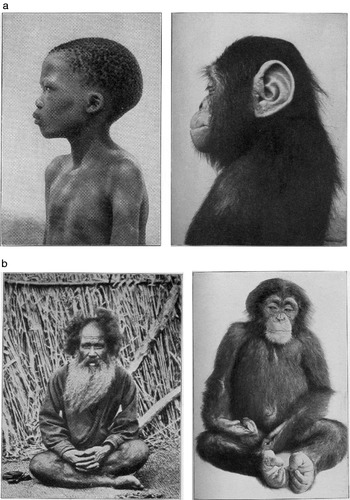
If the article in Umschau corroborates Martin's internationalist, humanist and anti-nationalist image, his photographic practice reveals a more complicated historical picture. His methodical contributions in the field of photography were focused on the standardization of the anthropometric method. But the reader of the first edition of the Lehrbuch cannot fail to observe that in visual terms the book expresses a crude form of racism. I illustrate this fact with two rather crude examples that are connected to the layout of the photographs. Martin lays on facing pages two carefully chosen photographs of a man of the Ainu people (a group indigenous to the island of Hokkaido, the northernmost island of Japan) and also a photograph of a chimpanzee. Again, on another two facing pages he places a picture of a Khoikhoi child (the group derogatorily named Hottentot native to south-west Africa) and another photograph of a chimpanzee. By way of a certain similarity in the respective poses of the depicted subjects, as well as the angles and compositions of the photographs, this layout creates a similarity between two photographs that have, in reality, nothing to do with each other. The layout suggests, although of course it does not state so explicitly, a connection between these forms of life and, consequently, the layout thereby visually indicates the inferiority of the pictured forms of human life as compared with a modern European one (Figure 7). Other examples that might be cited include differences between photographs of dressed Europeans and undressed non-Europeans, suggesting an inferior racial and cultural level of the latter.Footnote 68 This use of photographs stands in marked opposition to Martin's written text and to his humanist and liberal outlook. One interpretation might be that an underlying racism overrides Martin's liberal and humanistic views. But I would opt for a historically messier interpretation such that the two points of view coexist as components in one and the same multifaceted scientific compound.
By way of careful selection of photographs Martin created similarity between human and animal forms of life. The layout indicated visually the inferiority of the pictured forms of human life as compared with a modern European one. Rudolf Martin, Lehrbuch der Anthropologie. In systematischer Darstellung mit besonderer Berücksichtigung der anthropologischen Methoden. Für Studierende, Ärzte und Forschungsreisende, Jena: Fischer, 1914, pp. 370–371, 374–375).

Even before the extreme politicization of writing on race in the 1920s, the POW project, grounded to a great extent on Martin's method, could be viewed in terms of the two-directional exchange between science and society. The scientific photographs of prisoners racialized political enemies (Evans shows how racialization closely followed political considerations). These photographs joined images in the popular press in which, quite often, prisoners (and, in particular, colonial subjects) were photographed in anthropometric-style photographs. This is but one example of the reciprocal exchange between science and society, or, in Ash's terms, the way in which the two serve as mutual resources for one another.
By the beginning of the twentieth century, photography had long been an instrument of repressive social and political control. There were several levels of control involved in the POW project, from the power anthropologists held over the virtually powerless prisoners detained in the camps, through to the specific angles of photography that derived from criminology and were associated with criminals. In addition, for photographic measurement individuals were made to undress. Here the photographic act marked racial difference and social inferiority in one and the same act.
It is difficult to place Martin within the far more politicized discourse on race of the early 1920s.Footnote 69 He was, as has been stated, liberal in his political views, and his notion of race was not determinist, nor did it undergo any significant change; but unlike some contemporaries (most notably Franz Boas), he made no connection between race, prejudice and oppression. Martin declined an offer from the right-wing nationalist publisher Julius Lehmann to write a racial study of the German population modelled on William Ripley and Madison Grant's earlier books.Footnote 70 Lehmann then commissioned Hans F.K. Günther, in 1918 still an anonymous high-school teacher, to write the book, which became the most popular racial book in Weimar and Nazi Germany. In this politicized context, Martin questioned Günther's assumption of Nordic superiority and the presence of Nordic blood in every cultural production.Footnote 71
Shortly before his death in 1925, Martin presented in the first volume of the Handbook of Social Hygiene an elaborate version of his photographic method. This version incorporated both epistemic and technical modifications.Footnote 72 Here he discussed the tasks of the social hygienist and now practically incorporated anthropometrics into social hygiene.Footnote 73 He also praised the degree of precision that the anthropometric method had obtained, which he believed could hardly be further improved. In order to guarantee valid results, emphasized Martin, one needed only to employ faultless instruments, follow closely scientific provisions, and employ practised observers.Footnote 74 Martin also discussed in this book, perhaps as a result of experience gained in his study of prisoners of war, the question of resistance of subjects to being photographed. To overcome the subjects' resistance to undress, Martin suggested that the sequence of photographs be performed in a rushed manner (‘in rascher Folge hintereinander’).Footnote 75
Although in this essay Martin repeated many details of his earlier publications, he now presented a modified account of the epistemic status of the photographic method. Furthermore, the method was now discussed not as a method of reproduction of anthropological materials, but as the ‘display [Veranschaulichung] of anthropological results’. The newly conceived aim of anthropometry, he explained, was to map the characteristics of the human body in its totality. The procedure was inductive, proceeding from individual forms to analytic and synthetic analyses, and advancing by way of calculation. In order to display the results, Martin proposed three methods: photographic reproduction of the body from three angles, construction of proportionate figures and statistical patterns of deviation.Footnote 76 Martin collapsed the photographic and the numerical, from which a ‘numerical skeleton-picture’ emerged.Footnote 77
Even though it was not Martin's expressed intention to create specific visual patterns, the anthropometric form of photography nevertheless generated visual patterns and codes external to his strictly scientific aims. The relationship between anthropometric photography and police photography is well established.Footnote 78 From studying Martin's contributions to the development of the method, the centrality to his own work of Bertillon's photographic practices is unmistakable.Footnote 79 Bertillon's method was centred on maximal control. Precisely for that reason, however, it is of note that in Germany in the 1920s and 1930s police photographs were taken according to Bertillon's basic angles, yet nevertheless did not obey strict control. Carried out without control, such police photographs could be viewed as complying only with ‘anthropometric style’.
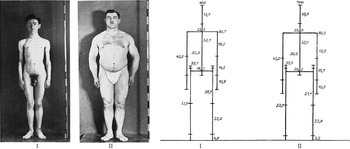
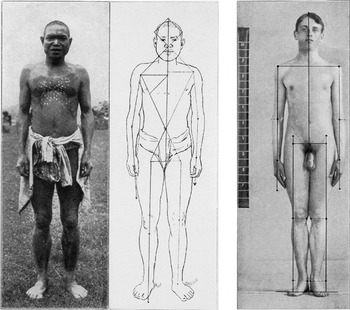
In his final publication on photography Martin placed photographs of two individuals next to each other. He then compared twenty-one of their physical features, arranged in three columns, which was followed by instructions for drawing the measurements on paper (Figure 8). Differing from Galton's influential understanding of the relationship between the typical and the average, Martin warned that there are ‘no general valid norms’; that is, that the average is not ‘normal’. These ‘abstract’ figures, comprising numbers, are ‘skeletal embodiments’.Footnote 80 Individuals are stripped of their flesh and replaced by what could be termed a ‘Röntgen image’ (Figure 9). Ultimately, these models allowed for the convenient representation of group features in a table in order to facilitate the study of their variability.Footnote 81 This method accomplished an extraction of photography from the ‘noise’ of visual idiosyncrasies. Analysed in terms of the relationship between racial surface and its deep structure, Martin sided photography with the former and what could be termed numerical-graphs – that is to say, numerical information abstracted from images – with the latter (Figures 10 and 11).
In his last publication on the subject Martin provided exact instructions on how what could be termed ‘numerical skeletons' could be abstracted from anthropometric photographs. Rudolf Martin, ‘Anthropometrie’, in A. Gottstein, A. Schlossmann and A. Teleky (eds.), Handbuch der Sozialen Hygiene und Gesundheitsfürsorge, Berlin: Lehmanns, 1925, pp. 298 (Figure 8) and 300 (Figure 9).

Abstracting numerical information from anthropometric photographs was intended to facilitate the statistical representation of the variability of various group features. In Figures 10 and 11 Martin placed such numerical information back on the photographic surfaces. Rudolf Martin, Lehrbuch der Anthropologie. In systematischer Darstellung mit besonderer Berücksichtigung der anthropologischen Methoden. Für Studierende, Ärzte und Forschungsreisende, Jena: Fischer, 1914, pp. 252–253.

In epistemic terms, Martin was a typical nineteenth-century natural scientist. He believed in the absolute neutrality and universality of science. Furthermore, he differed from theoreticians of race such as Hans F.K. Günther or Ludwig Ferdinand Clauss in his conception of science, in that he believed that normal science need not have any practical application or even relevance.Footnote 82 Anthropometric photography for Martin was not an end in itself, but a scientific tool or medium, an instrument of reason, similar in its epistemic status to other measurement instruments.
How does one know in the first place that an individual belongs to a certain class or type? As a practically oriented anthropologist, Martin never explicitly discussed the question of sampling. Rather, like many of his colleagues, he viewed that relationship as self-evident. But Martin did not seek typical specimens, preferring instead to measure individuals in order to elucidate the variability of racial populations.Footnote 83
Martin's Lehrbuch continued to be the principal German anthropological textbook through to its 1957 edition, and his discussion of photography underwent no fundamental change in the intervening period. The illustrating photographs were replaced, but followed the same model, and the discussion of instrument-makers was updated.Footnote 84 The discussion of race, however, underwent significant transformations.Footnote 85
Unlike Günther or Clauss, who were better versed in humanistic scholarship, particularly art history, Martin showed no particular visual sensitivity and was not guided by a concept of visual perception. Numbers, for him, always enjoyed analytical priority over images. But images, and particularly photographs, were interwoven into Martin's publications, creating visual patterns and establishing visual codes. As argued throughout this article, however, the significance of Martin's work was in developing, standardizing and disseminating particular photographic techniques towards anthropological ends. He was central in securing the scientific status of photography as a scientifically blind or neutral instrument. Yet just these characteristics allowed writers committed to racial determinism and to explicit racial and political agendas in the 1920s and 1930s – writers who were in fact far more sensitive to visual considerations and to their potential uses – to claim to be Martin's successors.
Concluding remarks
In this article I have attempted to describe Martin's role in the development of anthropometric photography between 1905 and his death in 1925, as physical anthropology gained its status as a distinct science. I argued that Martin's significance in this history of science was not due to scientific innovation but to his supervising of students and his standardizing of technique, and I showed the importance of the inner-scientific debate (centred on local questions of scientific control) in what Martin believed was the process by which anthropometric photography was perfected. Focusing on questions of method and technique, I have pointed to several tensions that are built into the history of German anthropology between 1900 and 1925: first, between the internationalist and rational endeavour to standardize anthropological technique and its nationalist uses; second, between Martin's liberal humanistic outlook and the increasingly politically and scientifically contested category of ‘race’; and, third, between Martin's anthropometric method, which in fact was not centred on visualization but intended to employ photographs for the generation of numerical information, and the crude racism of his photographic practice. Finally, I have suggested that there is a degree of historical irony in the fact that Martin, the liberal anthropologist, probably did more for the prestige of physical anthropology than any right-wing advocate of scientific racism could ever have hoped to do, and that he achieved this precisely in the period in which major parts of German society increasingly came to view ‘race’ as offering powerful, scientifically based answers to pressing social and political questions.