INTRODUCTION
Codices use a “graphic communication system” (Mikulska and Offner Reference Mikulska and Offner2019) that transmits messages by means of codes and consists of conventional signs. Most scholars consider these conventional signs to include graphic images and glyphs (Boone Reference Boone, Boone and Urton2011:385; Nicholson Reference Nicholson and Benson1973:2). Images are present in representations of the deities, in the ornaments and attributes they wore in divinatory almanacs, such as the codices of the Borgia group. The six pre-Columbian manuscripts that have been classified in this group (Codex Borgia (1976), Codex Cospi (Nowotny Reference Karl1968), Codex Fejérváry-Mayer (1971), Codex Laud (1966), Codex Vaticanus B (1972), and the unpublished MS Aubin no. 20 [Biliothèque Nationale de France, MS Mexicain 20]) indeed offer numerous representations of deities. These are also found in manuscripts from the Valley of Mexico called “manuscripts of the Aztec tradition” (Boone Reference Boone2007:239), made shortly after the Spanish conquest, such as the Codex Borbonicus, the Codex Tudela, and the Codex Telleriano-Remensis. For its part, the glyph is defined as “a sign in a script composed largely of pictorial elements” (Whittaker Reference Whittaker2009:54). Glyphs can codify either the semantic value (in which case they are called morphograms or logograms) or phonetic value (when they are referred to as phonograms). They were used to represent toponyms and anthroponyms intended to be pronounced, for example in the Codex Mendoza (Berdan and Anawalt Reference Berdan and Anawalt1997), an Aztec Colonial manuscript in which the pictographs are accompanied by glosses in Nahuatl and Spanish.
However, the dichotomy between the categories “image” and “glyph” has been questioned by authors such as Elkins (Reference Elkins1999:83) and Martin (Reference Martin, Quilter and Miller2006). “Rather than talking about glotographic, logographic, phonographic, syllabic, phonetic systems, etc., I think it would be more fertile to talk about systems that work using different operating principles, although in different proportions” (Mikulska Reference Mikulska2015a:351, my translation). Personally, when studying the costumes of the Water Goddess, Chalchiuhtlicue (Dehouve Reference Dehouve, Batalla Rosado and Ruz Barrio2018, Reference Dehouve2020), I discovered that most of the signs used to compose her divine representation were also present in Nahuatl toponymic signs, that is, in glyphs making up scripts. For example, the conventional sign for expressing raindrops (quiahuitl) hangs from the blouse of the Water Goddess and also composes a toponym like Quiauhteopan. The one for jade (chalchihuitl) covers the clothing of Chalchiuhtlicue and is also found in the toponymic glyph Chalco. The same representation of gold (teocuitlatl) adorns the deities and is present in the toponym Teocuitlapa (Dehouve Reference Dehouve2020:16–19). This led me to propose that there is a unique repertoire of signs operating in both the ritual and divinatory areas and in toponyms. Although the signs perform different functions, the existence of this repertoire shows that it is not relevant to make a drastic distinction between images and glyphs.
For this reason I will use the term “sign” to refer to the glyph intended to be pronounced, as well as to the attribute present in the array of a deity and composing his personality. I believe that the system of communication in use in the codices of central Mexico is a semiotic one, made up, like every semiotic system, “of stereotyped signs and norms, more or less binding, affecting the production, combination and interpretation of these signs” (Hébert Reference Hébert and Hébert2018:16, my translation). Deciphering the communication system of the codices thus consists in discovering the meaning of each of its signs.
The objective of this article is to open a new topic for reflection. So far I have deciphered each sign taken separately, looking for it successively in the divine ornaments and in the toponyms. However, this approach is insufficient because glyphs were not used alone but in connection with others. Mikulska (Reference Mikulska2010:126) recalled this by quoting Jansen (Reference Jansen1982:84) for whom the meaning of a sign was modified by the presence of the other signs surrounding it. She states:
This is precisely an aspect to which Panofsky's iconographic and iconological approach does not provide tools for analysis, since art history treats the relationships between signs as elements of style, so they are not attributed a greater role in the expression of the sign […]. On the contrary, in the code used in the Central American divinatory codices it is precisely these relationships between the signs that are sought, because it is these interpretations that form the final meaning and not the graphic signs separately (Mikulska Reference Mikulska2015a:474, my translation).
The possibility of constantly forming new combinations of signs has recently been deepened by Mikulska (Reference Mikulska and Mikulska2020a:396) who shows that the iconic code is made up of three elements—shapes, patterns, and colors—that can be associated in multiple ways, allowing the formation of a very large number of meanings using a small number of graphic elements. “[That] property […] demonstrates that the system is creative, or rather generative” (Mikulska Reference Mikulska and Mikulska2020a:396).
In this article, I will study the way in which several signs combine with each other to create meanings. The corpus on which this exercise will be conducted concerns the attributes of several deities in relation to human sacrifice and body opening. The objects studied—which are also signs—will be the smoking mirror, the flint knife, the down ball, and the skull. They will first be considered separately in order to define the forms in which they were represented and the meanings attributed to them. I will then highlight several combinations and propose a typology. It will appear in conclusion that the signs tended to group together by affinity and form networks.
THE BASIC SIGNS
The attributes I chose composed the array of several Aztec deities with warlike connotations. The smoking mirror characterized Tezcatlipoca, one of the most important deities of central Mexico, patron of royalty, war and justice, whose name meant Smoking Mirror (Baquedano Reference Baquedano2014; Boone Reference Boone2007:41–42; Olivier Reference Olivier2004). Several other deities with different names are considered avatars of Tezcatlipoca, in particular Tlatlauhqui Tezcatlipoca (Red Tezcatlipoca), Ixquimilli (Blindfolded Eyes), Itztli (Obsidian), Chalchiuhtotolin (Jade Turkey), and Tepeyollotl (Hill Heart). The Macuiltonalehqueh (Five Tonalehqueh) represented the deceased warriors and resembled small Tezcatlipoca. All of them carried smoking mirrors.
The flint knife was worn by some avatars of Tezcatlipoca and the Macuiltonalehqueh, but also by Huitzilopochtli (Hummingbird Left-handed), Xipe Totec (Flayer God), and the deities of death (Mictlantecuhtli, Death Lord and his feminine counterpart, Mictecacihuatl). The down balls were widely used to evoke ritual death. They also specifically referred to a group of sacrificial deities—Tezcatlipoca, Quetzalcoatl (Quetzal-Feathered Serpent), the Macuiltonalehqueh, Xipe Totec, Tlahuizcalpantecuhtli (Dawn Lord), and Mixcoatl (Cloud Serpent)—who wore the down turned into long white wigs and bracelets or scattered in several places on the body. Finally, the skull characterized the deities of death and more broadly evoked destruction.
These objects were also signs identified by terms in Nahuatl. Were they always free from interference from other signs? This is more difficult to say because of the generative nature of the system, which always produced derivations and variations, even in the simplest forms. However, I would define a basic sign as a sign that corresponds to an object, which can be named and has few variants.
The Smoking Mirror
Several scholars have highlighted the symbolic richness of the mirror in general. It was an instrument of divination and witchcraft, and it represented the surface of the earth (Olivier Reference Olivier2004). Taube (Reference Taube and Berlo1992a, Reference Taube1992b, Reference Taube, Evens and Webster2001, Reference Taube, Gallaga M. and Blaincy2016) listed its overlapping meanings as eyes, faces, flowers, cellars, portals, sun, and world. For Pereira (Reference Pereira2008), the mirror symbolized the sun and fire, communication with the deities, power and war, while Kindl (Reference Kindl, Gallaga M. and Blaincy2016) documented scrying operations using the mirror among the contemporary Huichols. Considered a smoking mirror, the object was carried by Tezcatlipoca, and this fact has guided the interpretations of several scholars, from Seler's astral hypothesis (Reference Seler and Frenk1963:vol. I, p. 114) to that of castration (Olivier Reference Olivier2004:476). For my part, I will explore the meaning of this object through a sign-based method, considering the shape, patterns, and colors of the smoking mirror, its resemblance to other signs, and its location on Tezcatlipoca's body.
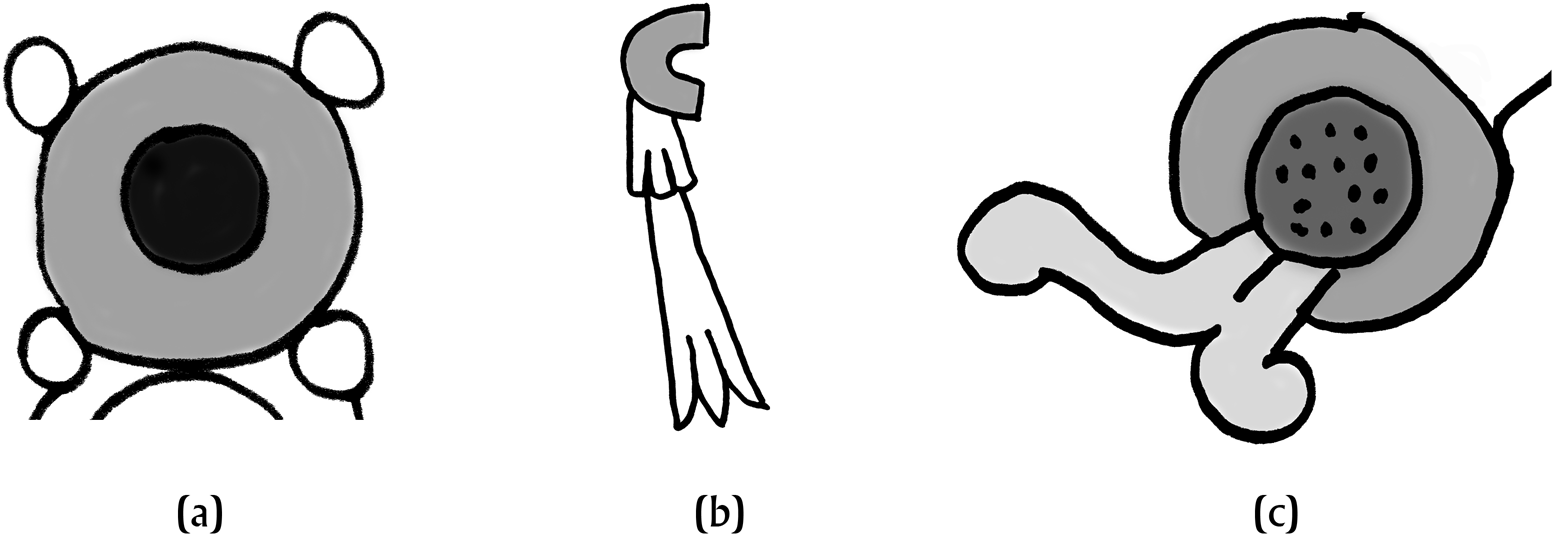
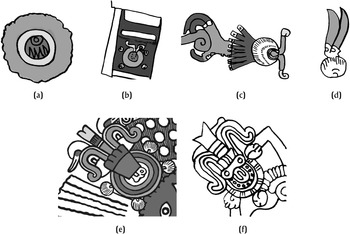
If we apply this method, we notice first of all that mirrors belong to a family that includes several basic signs: the simple mirror, the back mirror, and the smoking mirror (Vesque Reference Vesque2020; Dehouve Reference Dehouve2021). Let us first consider the simple mirror. Named tezcatl, it is one of the signs present both in toponymic signs of the Codex Mendoza (Berdan and Anawalt Reference Berdan and Anawalt1997) and in representations of the gods. In fact, it is used to form several toponyms, for example, Tezcatepetonco, “Little Mountain of the Mirror” (Figure 1a). It consists of a double circle with a black interior and a red rim, surrounded by four small white circles. In my opinion, the origin of this glyph is the black obsidian mirror, whose brightness is evoked by the red border. The small circles arranged in a square are also present in several glyphs constituting toponyms: jade (chalchihuitl; Codex Mendoza [Berdan and Anawalt Reference Berdan and Anawalt1997:vol. 3, Plate 41r]), turquoise (xihuitl; Codex Mendoza [Berdan and Anawalt Reference Berdan and Anawalt1997:vol. 3, Plate 7]), and a temporal unit based on days (ilhuitl; Codex Mendoza [Berdan and Anawalt Reference Berdan and Anawalt1997:vol. 3, Plate 19]). It seems, therefore, that they express the circular character of the object represented—in actuality in the case of the mirror and gemstones, and metaphorically in the case of the day conceived as a time wheel.
The mirror family: (a) the simple mirror in the toponymic glyph Tezcatepetonco, “Little Mountain of the Mirror” (Codex Mendoza [Berdan and Anawalt Reference Berdan and Anawalt1997:vol. 3, Plate 29r]); (b) the back mirror (Codex Laud 1966:Plate 13); (c) the smoking mirror in place of the foot of Tezcatlipoca (Codex Borgia 1976:Plate 21). Drawings by the author.

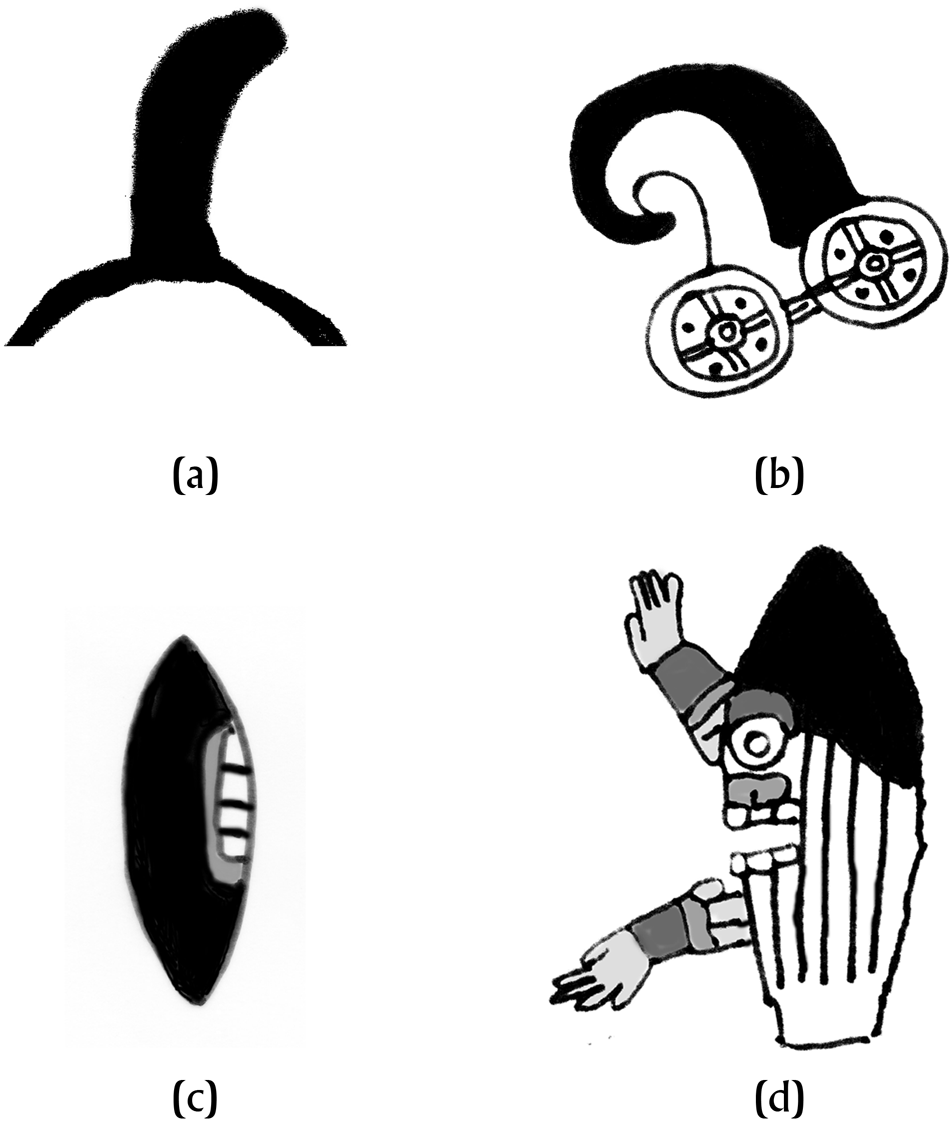
The back mirror is placed on the god's kidneys. Named tezcacuitlapilli and cuitlatezcatl in Nahuatl, it was worn on the lower back of warriors (Sahagún Reference Sahagún, Anderson and Dibble1950–1983:bk. XII, 11, 12, 15; Reference Sahagún1956:762), and one can count in the Codex Borgia about 20 deities who wear it in a warlike context. It is drawn like a bird's head in the Codex Borgia, and like a horseshoe in the Codex Fejérváry-Mayer and Codex Laud (Figure 1b).
These two mirrors are in turn different from the smoking mirror that specifically qualifies Tezcatlipoca (Figure 1c). In the Codex Borgia its sign consists of a black circle with a red rim to which two yellow volutes are added to indicate that “smoke” is escaping from it, while the four small white circles in a square are removed. The Tezcatlipoca smoking mirror is therefore characterized in the Codex Borgia by the color code black/red/yellow.
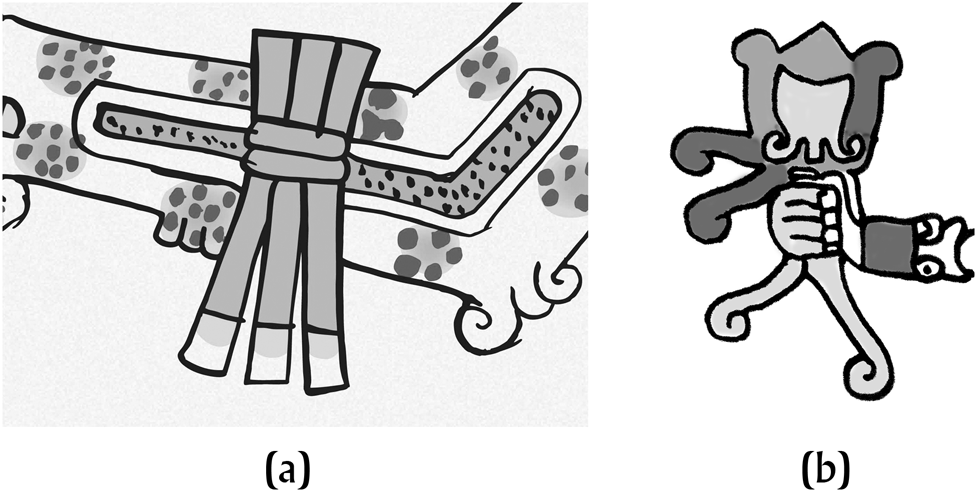
To become a smoking mirror, the glyph of the single mirror is combined with two other signs: first, the sign of night. The pattern of black dots on a dark background fills different shapes like the inside of the long bones of the Death God (Figure 2a). This pattern belongs to a conceptual set consisting of clouds, the night sky, the interior of the earth, the underworld, as well as the mythical places of creation, as shown by Mikulska (Reference Mikulska and Díaz2015b:110–114), who concludes: “The underworld is the same as the dark world, the rainy season and the night, something that has always existed” (Mikulska Reference Mikulska and Díaz2015b:114, my translation; see also Mikulska Reference Mikulska, Contel and Priotti2018:382–387). The symbolism of the central black pattern of the Tezcatlipoca smoking mirrors is thus clear: it connects them to night and death.

The second sign that combines with the single mirror is that of the double volute that escapes from the smoking mirror. In the absence of a specific and comparative study of the scrolls in the manuscripts of central Mexico, we can only specify that they show polysemy: the scroll designates the word when it comes out of the mouth, the mist when it accompanies the representation of a Rain God such as Tlaloc, and the smoke when it escapes from a flame or fire (Vauzelle Reference Vauzelle2018:225, 440, 677). An analysis by Batalla (Reference Batalla Rosado and Mikulska2021:411) focuses specifically on the heart of the sacrificed framed by two volutes (Figure 2b). He interprets these as jets of blood. We will see that this identification supports my hypothesis that the smoking mirror is associated with the opening of the human body. Indeed, Tezcatlipoca carries the smoking mirror in two main places: on his foot and on his skull.
The Foot Smoking Mirror
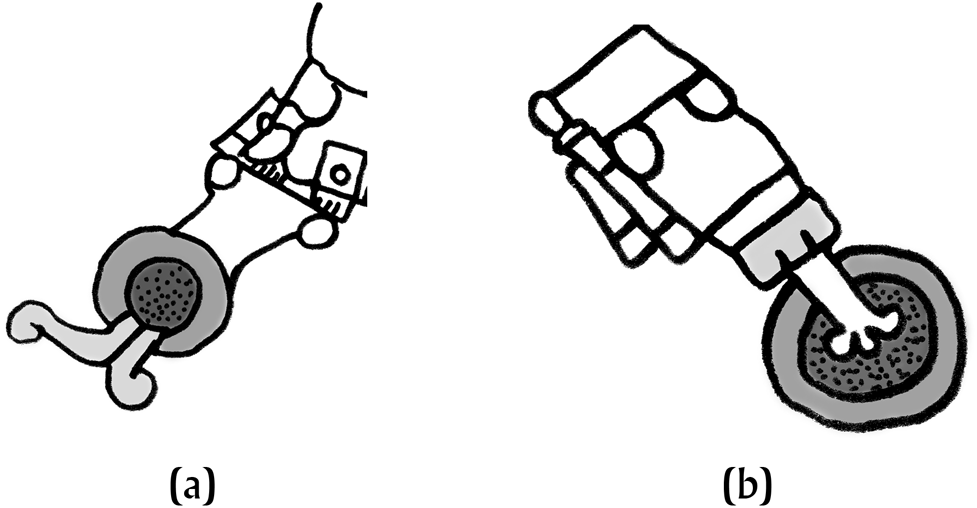
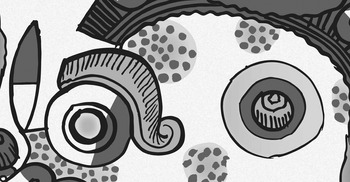
Tezcatlipoca carries the smoking mirror in place of his missing foot. In the Codex Borgia (Figure 3a) the smoking mirror, made of two concentric black and red circles from which two yellow volutes escape, replaces the foot and repeats the black/red/yellow color code of Tezcatlipoca. The center of the mirror is covered with black dots on a grey background that express night, death, and the underworld.

In my hypothesis, the smoking mirror represents the hole of the dismembered joint. It agrees with Seler's interpretation: “The clouds of smoke that gush from the stump of Tezcatlipoca's leg probably signify the smoking blood. In one of the other images mentioned, that of the Codex Fejérváry-Mayer, we see that the blood around the stump of the god's leg forms a circle, a kind of mirror, which perhaps gives us an idea of how the mirror of Tezcatlipoca was born” (Seler Reference Seler and Frenk1963:vol. I, p.114, my translation).
However, the representation of Tezcatlipoca's missing foot in the Codex Fejérváry-Mayer (Figure 3b) and the Codex Laud follows a slightly different graphic tradition from that of the Codex Borgia. The foot is cut off, as shown by the bone stump at the end of the leg and surrounded by the black and red mirror, free of smoke. The color code is then black/red/white. The attribute of Tezcatlipoca looks more like a severed limb than a smoking foot mirror. In my opinion, they are variants around the same idea—the dismemberment—expressed metaphorically by the smoking mirror, or more literally by the cut bone.
The Skull Smoking Mirror
The second smoking mirror of Tezcatlipoca is located on his skull. Many researchers have repeated, after Seler, that its location was the temple:
Bearing in mind that the origin of the smoking mirror is, in my opinion, the blood that forms a circle around the stump of the leg, we could suppose that the smoking mirror on the temple also symbolizes blood, the blood that here, above the ear, is very much in place, since in the self-sacrifice blood was extracted above all from the edge of the ear (Seler Reference Seler and Frenk1963:vol. I, p.114; my translation).
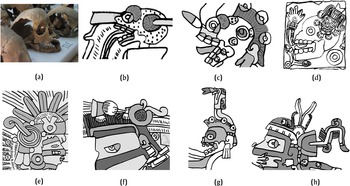
However, if we look carefully at the place where the smoking mirror of Tezcatlipoca is situated in the Aztec tradition (Figures 4d and 4e), it is the same as that of the hole made in the skulls of sacrificed victims (Figures 4a and 4b) to display them on a skull rack (Ragot Reference Ragot, Contel and Priotti2018:353), named in Nahuatl tzompantli, which means “row of hair or heads.” After a head-trophy hunt (Moser Reference Moser1973), followed by post-mortem decapitation, the heads were flayed and scraped, or boiled, to remove the flesh. The skull was then perforated laterally by percussion and the edges were enlarged to the desired shape (Chávez Reference Chávez Balderas, Luján and Olivier2010:330–331; Ragot Reference Ragot, Contel and Priotti2018:359–360). A stake was then inserted into the cavity and threaded onto a skull rack. This type of mortuary ritual was widely applied to captive warriors, but also specifically concerned the human impersonator of Tezcatlipoca, who was beheaded at the end of the month Toxcatl in order to place his skull on the tzompantli (Chávez Reference Chávez Balderas2007:117). The scrolls escaping from the smoking skull mirror could therefore refer to the blood, organic matter, and bone fragments extracted from the skull. In this case, as in the case of the foot mirror, the smoking mirror would refer to deficiency resulting from the cutting up of the body.
The skull smoking mirror of Tezcatlipoca: (a) a skull found in the embankments of the Tenochtitlan tzompantli; (b) a skull pierced by a tzompantli stake (Codex Borgia 1976:Plate 19); (c) the skull of Mictlantecuhtli showing the hole for the tzompantli stake (Codex Borgia 1976:Plate 13); (d) the sign “One Dead” (Teocalli de la guerra sagrada, lateral relief, detail, National Museum of Anthropology, Mexico City); (e) the skull mirror of the god Tezcatlipoca-Xipe Totec (Codex Borbonicus 1974:Plate 14); (f) the skull mirror of Tezcatlipoca (Codex Borgia 1976:Plate 14); (g) the exit of the tonalli animistic entity from the skull of the deceased (Codex Laud 1966:Plates 27–28); (h) the smoking mirror of the nape of the neck of Tezcatlipoca (Codex Fejérváry-Mayer 1971:Plate 44). Drawings and photograph by the author.

In the Aztec tradition, the smoking mirror is obviously located in the place occupied by the cavity of the tzompantli. This can be verified by comparing the representation of the skull of the god of Death thus pierced (Figure 4c) and the figuration of the date 1-Death on the monument named Teocalli de la Guerra Sagrada (Figures 4d and 10f). On the latter sculpture, the skull serves as a calendar sign (“Death”), accompanied by a triple circle that means the numeral “One” to form the date “One Death.” The representation of this smoking mirror is complex because it is the result of the combination of several basic signs and we will come back to this later. For the moment, it is only important to notice where it is located. It should be noted that the smoking mirror also adorns the sculpted head of the god Tezcatlipoca (Townsend Reference Townsend, Luján and McEwan2010:167) at the place of the parietal, as in the Aztec codex (Figure 4e).
In Borgia group manuscripts, the location of the smoking mirror may vary. It is most often located at the top of the skull (Figure 4f). In the latter case, it is possible that the sign evokes the exit of the animistic entity called tonalli, lodged in the top of the head, according to the analysis of López (Reference López Austin1980:vol. I, p. 361) of plates 27–28 of the Codex Laud (Figure 4g). According to López:
At the arrival of death, the different components of the body disintegrate. A dead body appears from which four serpentine figures separate […]. By way of suggestion it can be pointed out that the four snakes that separate seem to be integral elements of the human being. Thus the serpent that ascends from the crown of the head would be the tonalli (López Reference López Austin1980:vol. I, p. 361, my translation).
The animistic entity so named was, in fact, closely associated with the top of the skull named cuezcon, located at the place of the tonsure (López Reference López Austin1980:vol. I, pp. 108, 241–243). The lock of hair that grew there was the object of many ritual treatments: it was cut off at the beginning of the infant's life, then again on the corpse, and was kept in the home or temple of the neighborhood, in memory of the deceased (López Reference López Austin1980:vol. I, p. 368). Victorious warriors also seized their victims by this lock (for example, Sahagún Reference Sahagún, Anderson and Dibble1950–1982:vol. II, p. 3) and cut it off before the sacrifice (Sahagún Reference Sahagún, Anderson and Dibble1950–1982:vol. IX, p. 63).
According to Robles and colleagues (Reference Cortés, Lucero, Balderas, Molina, Luján and Balderas2019:220–221), the perforations of the skull from which volutes or snakes sometimes escape, whether they are represented in codices of Aztec tradition or not, must be related to the exit of the tonalli at the time of death. It is therefore possible that the different locations of the smoking mirror—at the top of the skull or on the parietal—are all related to the symbolism of tonalli.
Finally, in the Codex Fejérváry-Mayer, this object is located at the back of the skull (Figure 4h), which connects it to the symbolism of the neck. Named cuexcochtli, the nape was conceived as a vulnerable part of the body. Sacrificial victims could be killed with a single blow to the neck: according to a study in another part of Mesoamerica, a first blow to the nape with an instrument such as a polished stone axe caused death by dislocation of the vertebrae, before the head was severed with a thinner blade (Pereira Reference Pereira, Stresser-Péan and Pereira2017:325). Several deities related to sacrificial death wore a protective ornament called a “neck shield” (cuexcochtechimalli; for example, Sahagún Reference Sahagún and Anders1993:100, 108, 113, 123, 151), and others—Macuiltonalehqueh and Cihuateteoh—a dish conveying the idea of sacrificial offering (Codex Borgia: 1976:Plates 47–48). It is remarkable to note that the smoking mirror of Tezcatlipoca (Figure 4h) is not in the form of a circular hole as in the other manuscripts, but of a concave semicircle in the manner of the back mirror called tezcacuitlapilli (Figure 1b). As such, it indicates a vulnerable spot on the warrior's body and the protection that is given to it, and evokes death by percussion on the nape of the neck.
In summary, the variations in the location of the smoking mirror in the Borgia group thus refer, in my opinion, to a cluster of related notions associated with the exit of the tonalli at the time of the sacrificial death.
In short, it is necessary to differentiate three signs: that of the back mirror, which designates a warrior protection worn on the kidneys (Figure 1b); that of the simple mirror which has only two circles, black and red, surrounded by four small white circles in a square (Figure 1a); and the smoking mirror, which is a more complex sign obtained by adding two other signs to the simple mirror sign (Figure 2). There seem to have been several traditions associated with different symbolisms, in the codices of the Borgia group and among the Aztecs (Figure 3), but all related to the body opening, which will be confirmed by its associations with the other signs that will be presented later.
The Flint Knife
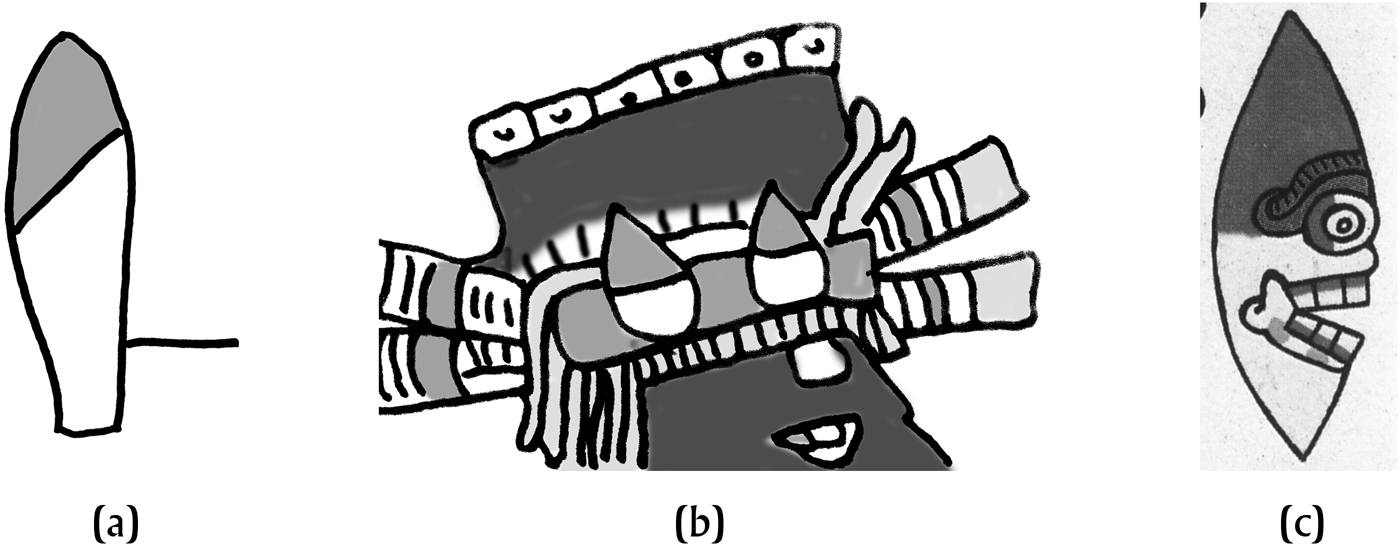
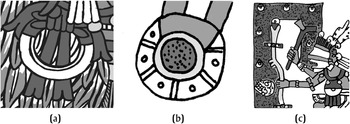
Named tecpatl, the flint or flint knife was represented by an oval and pointed shape covered with a white and red pattern. The glyph could be part of several toponyms, for example, Tecpatlan, “Among Flints” (Figure 5a). The sign also appeared in sacrificial scenes as a tool bearing the colors red and white (for example, Codex Borgia 1976:Plate 21). It was also used as an attribute of certain deities, including the avatars of Tezcatlipoca named Itztli (Obsidian), the Macuiltonalehqueh, Huitzilopochtli, Ixteocaleh—a sacrificed person wearing ornaments similar to the latter—Xipe Totec (Vauzelle Reference Vauzelle2018:584–585), and Tlahuizcalpantecuhtli (Figure 5b). The form of the flint in the latter cases was basic. This was the first way to represent flint. The second consisted of the flint anthropomorphized by the addition of a mouth, teeth, and eyes. This occurred when the flint was represented as one of the 20 signs of the 260-day calendar, which was also one of the four signs that could give their name to the years (Figure 5c).
The flint knife: (a) the glyph of flint in the toponym Tecpatlan, “Among Flints” (Codex Mendoza [Berdan and Anawalt Reference Berdan and Anawalt1997:vol. 3, Plate 16r); (b) the two flints in the headdress of Tlahuizcalpantecuhtli (Codex Borgia 1976:Plate 15); (c) the anthropomorphic flint knife as the calendar sign Flint (Codex Borgia 1976:Plate 10). Drawings by the author.

Apart from its representation in manuscripts, specimens of flint have been exhumed in an archaeological context in the Great Temple of Mexico-Tenochtitlan. The 1,000 flints found can be divided into two categories: flints used as tools that have no attributes and anthropomorphic flints (Bassett Reference Bassett2015:154; Vauzelle Reference Vauzelle2018:183). The first correspond to the simple flints. The latter were anthropomorphized by the addition of a mouth, teeth, and eyes; many were covered with the attributes of certain deities and are thought to have represented them (Chávez et al. Reference Chávez, Aguirre, Miramontes and Robles2012).
For the moment, we will consider only the flint as a basic sign. Indeed, I will show later on that the anthropomorphized flint is already the product of a combination with another basic sign. The representation of the simple flint is remarkably uniform, made of an oval and pointed shape covered with a half red/half white pattern in the codices of the Borgia group and the Mixtec codices, as well as those of central Mexico (Mikulska Reference Mikulska2010:127). It is generally considered that the red color on flint refers to blood, while white is the color of the stone, but Mikulska (Reference Mikulska2010:126–129) has shown more precisely that the red/white pattern is integrated with other sharp items, notably the teeth and self-sacrifice punches: “The two colors, white and red, would not necessarily refer to a specific material, but to a common characteristic of different objects” (Vauzelle Reference Vauzelle2018:584, my translation), and this common characteristic is the cutting edge.
Flint was a sharp material, like obsidian. At first glance, the two materials were well differentiated: while flint was called tecpatl, obsidian was called itztli. López Austin and López Luján (Reference López Austin and Luján2009:447) insisted on the symbolic opposition of the two materials. In warfare practices the Aztecs used both of them. In fact, they most often sacrificed prisoners of war by cardiotomy, then decapitated and dismembered them. The flint knife used to cut out the heart was large, powerful, and specially named ixcuahuac (Mikulska Reference Mikulska2010:127; Molina Reference Molina1977:vol. I, p. 88r; Vauzelle Reference Vauzelle2018:583). To detach the head from the body or dismember it, finer-edged instruments made of flint or obsidian were used (Pereira Reference Pereira, Stresser-Péan and Pereira2017:325–328). Two texts in Spanish mention obsidian blades for dismemberment: “And they came and laid the obsidian blades before him in a wooden vessel, so that by them they might be cut up” (Anales de Cuauhtitlan 1945:46, my translation). “They named him [Itztecuhtli, ‘Lord of the Obsidian’] because of a stone he carried with him and used to cut up the enemy Indians” (Relación de Tuscacuesco, Relaciones geográficas del siglo XVI [Acuna Reference Acuna1988:73], quoted by Olivier Reference Olivier2004:201, my translation)
Despite the first impression that the two materials were always clearly differentiated, tecpatl (“flint”) was a generic term for all sharp instruments for sacrificial use, used to open the chest as well as to cut up the limbs; there is a consensus among scholars about the term (for example, Mikulska Reference Mikulska2010:128; Olivier Reference Olivier2004:200; Pereira Reference Pereira, Stresser-Péan and Pereira2017:324–328). Consequently, the term tecpatl should be considered as “flint knife” by pure convention since it encompasses flint and obsidian instruments of different sizes and shapes. It is also by convention that it is represented as a knife, but it includes obsidian blades as well.
The Down Ball
Tezcatlipoca, but also many other deities and objects, wears down balls. The ball is circular in shape, decorated inside with a particular pattern (Figure 6a). There are down balls of two colors, white and black. The black down ball (Figure 6b) is used to decorate weapons, and therefore accompanies sets indicating war, warlike activities, and their deities. The white ball (Figure 6c) was typical of the sacrificed. It was called tlachcayotl, from the word ichcatl meaning spun cotton (Vauzelle Reference Vauzelle2018:501). It was represented alone, or at the base of a more complex ornament, made of two white feathers, called aztaxelli (from xelli, “divided thing,” and azta(tl), “white egret”; Figure 6c). In the Codex Borgia, this bifid ornament was worn by Tezcatlipoca, Xipe Totec, Tlahuizcalpantecuhtli, Itzpapalotl, and Mixcoatl, all of whom were linked to sacrificial death (Vauzelle Reference Vauzelle2018:485, 487). It also adorned the warriors who were prepared to be sacrificed. The ball of white down and the aztaxelli were, in fact, part of the body adornment of the victims. These were covered with a chalky substance (tizatl, “chalk”) on which white down (ihhuitl, “feathers”) was glued (Figure 6d), so that the “chalk-feather” pair designated the sacrificed being (Dehouve Reference Dehouve and Peperstraete2009; Mikulska Reference Mikulska2015a:441; Vauzelle Reference Vauzelle2018:489). Note that only the white bifid ornament named aztaxelli is present in the toponymic signs of the Codex Mendoza (Berdan and Anawalt Reference Berdan and Anawalt1997), but not the ball alone. Nevertheless, the down ball can be considered a basic sign, which complements or replaces the bifid ornament and has the same meaning: by metonymy, it designates the sacrifice and the sacrificed.
The down balls: (a) the pattern of the white down ball (Codex Borgia 1976:Plate 10); (b) black down on weapons (Codex Borgia 1976:Plate 17); (c) bifid ornament of white egret feathers named aztaxelli (Codex Borgia 1976:Plate 21 down); (d) down ornaments of the sacrificial victim (Codex Telleriano Remensis [Quiñones Keber Reference Quiñones Keber1995:Plate 40v]). Drawings by the author.

The Skull
The skull, designated by the term cuaxicalli (skull), appears in some toponymic signs, but to express words based on the presence of the mandible: cua (to eat) and tlan (teeth) (Codex Mendoza [Berdan and Anawalt Reference Berdan and Anawalt1997:vol. 3, Plate 40r]). It is also found to express malinalli, a calendar sign whose representation associated a certain plant with a mandible (Codex Mendoza [Berdan and Anawalt Reference Berdan and Anawalt1997:vol. 3, Plates 35r, 39r, 41r]). Conversely, other toponymic signs, like Tzompahuacan (“Place of They Who Possess Row of Heads”; Codex Mendoza [Berdan and Anawalt Reference Berdan and Anawalt1997:vol. 3, Plate 35r]), are built from tzontecomatl (head), represented as a perforated skull.
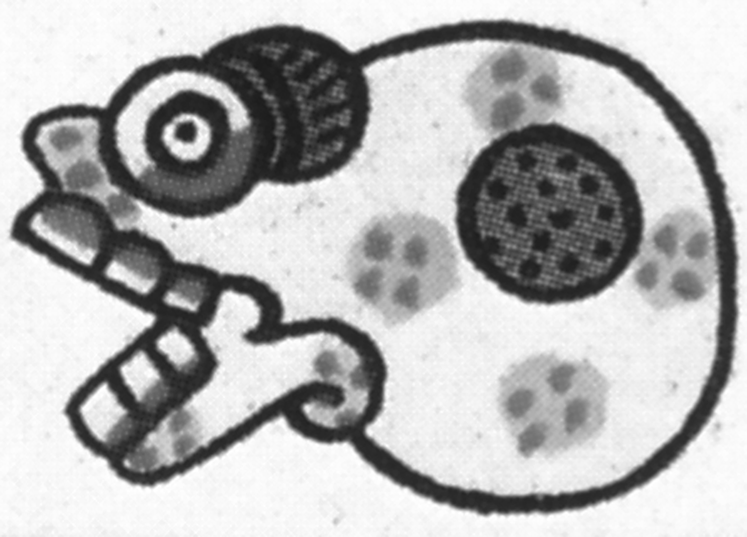
The skull was one of the 20 signs of the 260-day calendar called miquiztli (“Death”) (Figure 7), and, in general, it very frequently accompanied bones and hearts as ornaments of gods and objects referring to the realm of the dead or the forces of destruction (Boone and Collins Reference Boone and Collins2013:227). As both a calendar sign and an accompanying sign, the skull sign appears in a minimal form as a white human skull, possibly covered with small orange dots and perforated at the hole of the skull rack. The eye is round, painted in the manner of the sign known as “stellar eye,” made of concentric circles representing a half-closed eye, one half of which is red and the other white. In the Borgia group, stellar eyes frequently accompany the pattern of black dots on a black background that indicate darkness and the underworld (Mikulska Reference Mikulska and Díaz2015b:112), and consequently death and skeletons. The stellar eye is surmounted by a prominent dark grey eyebrow. The well-individualized mandible has the conventional shape reported by Olivier and colleagues (Reference Mikulska and Offner2019:50, Figure III 2, 83, Figure IV 18), and the teeth are of the red and white color that expresses the cutting edge.
The skull of the calendar sign Death (Codex Borgia 1976:Plate 7). Drawing by the author.

It should be noted that the red/white color code had two different meanings: sharpness when it was on cutting objects, and night and death when it covered round items such as stellar eyes.
We end here the presentation of these few basic signs. I have tried to capture their simplest form, although some have included patterns from other glyphs. This is particularly the case of the smoking mirror (which integrates volutes and a pattern of black dots), the skull (with its red and white eye like a stellar eye and its black dots), and the variant of the down ball called aztaxelli. As we can see, the generative system manipulates even the simplest signs. However, their basic character is recognizable by the fact that they combine with each other to form much more complex signs.
COMBINED SIGNS OR PAIRINGS
We will now show how basic signs enter a network of cross-interactions to vary their meaning.
Smoking Mirror and Flint
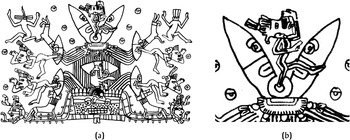
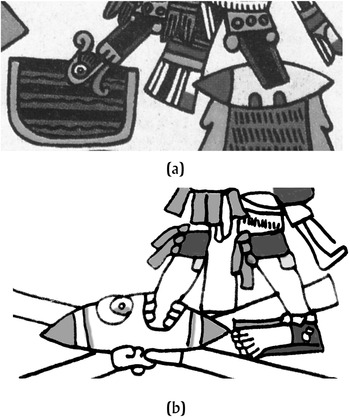
The smoking mirror-flint pair is staged in a magnificent representation of the birth myth of Tezcatlipoca (Codex Borgia 1976:Plate 32; Figure 8a). According to Boone (Reference Boone2007:183), the first part of a sequence devoted to creation myths ends with the birth of five diversely colored Tezcatlipoca and Quetzalcoatl. The parturient figure, who is a victim, as shown by his white and red stripes typical of the god Mixcoatl and the sacrificed victims (Olivier Reference Olivier, Contel and Priotti2018:298–299), sits on bones in the position of childbirth, signaling a process of creation. The central Tezcatlipoca, recognizable by its smoking mirror on his skull, is black and emerges from the decapitation hole, represented by a smoking mirror from which the god's foot is detached, between two flint knives. The other four Tezcatlipoca, black, red, white, and yellow, escape from the holes of the dismembered joints: in this case, there is no mirror, but only flint knives from which the feet of the gods emerge. As for Quetzalcoatl, it emerges from the knife carried in the pectoral by the parturient figure. On either side of the head of the latter, a naked decapitated body expresses, according to Boone, the beginning of the hunt for trophy heads.

On this plate, Tezcatlipoca really appears as the god of dismemberment, the patron of cutting the body into pieces. This act is evoked mainly by means of the flint knife, which is half white, half red, and anthropomorphic. The knife placed on the chest of the sacrificed being evokes, in my opinion, the extraction of the heart; those on the joints of the four limbs indicate dismemberment; and the two that replace the head express decapitation. In the latter case, the reference to the cutting is completed by the smoking mirror that represents both the hole in the neck of the big victim and the cut foot of the little outgoing Tezcatlipoca (Figure 8b). Small gods with skull smoking mirrors escape from each of the holes.
The smoking mirror-flint couple is also present in the two deities Tezcatlipoca (Smoking Mirror) and Itztli (Obsidian). Generally, Tezcatlipoca is covered with smoking mirrors that I believe evoke the holes of dismembered joints (Figure 1b), while his avatar Itztli, who is otherwise quite similar, wears flint knives. There are two variations in the representation of Itztli: in the first, the god carries a smoking mirror on one foot and a flint on the other (Figure 9a); in the second, he wears only a single-footed flint (Figure 9b). In my opinion, the couple of deities Tezcatlipoca/Itztli refers to the conceptual couple formed by the smoking mirror and the knife. The first evoked the dismemberment from the point of view of the sacrificed being, and the second from the point of view of the sacrificial tool. The smoking mirror was the sliced, while the knife was the cutting edge. Similarly, Tezcatlipoca represented the god of dismemberment from the point of view of the sacrificed being, and Itztli from the point of view of the sacrificer.

Smoking Mirror and Down
The down ball shows a strong propensity to substitute itself for other patterns within several attributes, first of all, of the smoking mirror. It has been said that the center of the smoking mirror was usually occupied by black dots expressing the night and the underworld. These can be replaced by the down pattern which, for the occasion, loses its white color to take on the hue of the night (Figure 10a). Another way to integrate the down into the smoking mirror is to frame the mirror with four white balls (Figure 10b). An even more radical way is to replace the mirror with a ball of white down: this is what happens when the turkey's leg is cut off. Instead of the cut leg, there is a large ball of down from which two volutes escape (Figure 10c). There is also a hybrid ornament on the skull of a god from the Macuiltonalehqueh series, recognizable by the hand painted on the lower part of his face, which embodied the warriors who died in battle. Where Tezcatlipoca places his smoking mirror, this god has a ball of down from which two scrolls escape (Figure 10d). We can also refer to Figure 8b, in which the smoking mirror expressing the hole in the neck after decapitation is bordered by down.
Association of smoking mirror and down: (a) the black center with the down pattern (Codex Borgia 1976:Plate 17); (b) the mirror framed with down balls (Codex Borgia 1976:Plate 17); (c) the down replacing the mirror (Codex Borgia 1976:Plate 64); (d) ornament of a god from the Macuiltonalehqueh series (Codex Borgia 1976:Plate 47); (e) the mirror framed with down balls (Codex Borbonicus 1974:Plate 17; drawing by Nicolas Latsanopoulos); (f) smoking mirror in the Sign 1-Flint in Teocalli de la Guerra sagrada, lateral relief (Alcina Franch Reference Alcina Franch1995:15). (a–d, f) Drawings by the author.

These cases come from the Codex Borgia. If we direct our attention to the Aztec manuscripts painted after the Spanish conquest, we will see that the down is systematically associated with the smoking mirror. This is what happens in the representation of Tepeyollotl, avatar of Tezcatlipoca in the shape of a jaguar (Figure 10e), and that of Tezcatlipoca himself (Codex Tudela [De la Orden 1980:Plate 15r]; Codex Telleriano-Remensis [Quiñones Keber Reference Quiñones Keber1995:Plate 3v]). A sort of “bifid tongue” emerges from the hole in the skull, surrounded by two volutes that represent, in my opinion, the blood and organic matter extracted from the parietal. The hole is surrounded by balls of down. It should be further noted that the mirror enclosed by four balls of down is part of the toponymic glyph Tezcatepec (Hill of the Mirror) in the Codex Mendoza (Berdan and Anawalt Reference Berdan and Anawalt1997:vol. 3, Plate 27r).
The reason why smoking mirror and down are likely to be associated is, of course, because of their respective meanings: body opening for the smoking mirror, and sacrifice for the down. Together, they designate sacrificial dismemberment.
Flint and Skull
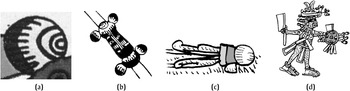
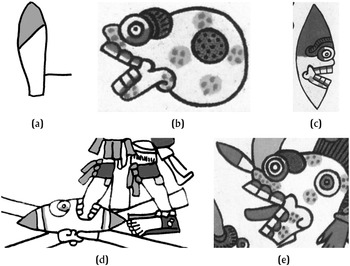
Anthropomorphized flint is, as previously stated, the result of a complexification of the basic form of the flint. It presents many variants, both in the codices (Mikulska Reference Mikulska2010:127) and in the personified artifacts found at the Great Temple of Mexico-Tenochtitlan (Chávez et al. Reference Chávez, Aguirre, Miramontes and Robles2012). But based on the simple versions of the anthropomorphic flint, as a sign of day (Figure 11c) and attribute of a god (Figure 11d), it appears that the knife was given a mouth, teeth, and an eye with an eyebrow on top. It can be seen that these organs do not belong to just any human head, but to skulls. The anthropomorphized knife is a blend of the basic sign of the flint (Figure 11a) and the basic sign of the skull (Figure 11b). Indeed, the eye of the anthropomorphized flint is represented by the sign known as “stellar eye,” surmounted by a prominent dark grey eyebrow which characterizes the skull. The generally red and white teeth of the skull are also shown on the flint knife.
Association of flint and skull: (a) the basic form of the flint (Codex Mendoza [Berdan and Anawalt Reference Berdan and Anawalt1997:vol. 3, Plate 16r]); (b) the basic form of the skull (Codex Borgia 1976:Plate 7); (c) an anthropomorphic flint knife (Codex Borgia 1976:Plate 22); (d) the flint replacing Itztli's foot (Codex Fejérváry-Mayer 1971:Plate 2); (e) the skull of Mictlantecuhtli and his flint knife (Codex Borgia 1976:Plate 13). Drawings by the author.

Note that there is another way to associate the skull and the flint. The skull of the Death God sometimes carried a flint stuck in the nasal septum (Figure 11e). In the archaeological context of the ritual deposits of the Great Temple of Mexico-Tenochtitlan, such flint skulls were frequently encountered (Olivier et al. Reference Olivier, Balderas and Santos-Fita2019:Figure IV 11, 80).
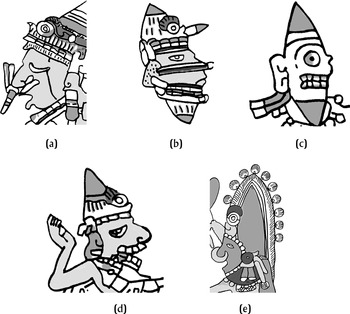
The blend between flint and skull may take another form in some representations of the gods Itztli (Figure 12c; see also Codex Vaticanus B 1972:Plate 68), Xipe Totec (Figures 12a and 12e), a god identified as Itztli-Xipe Totec by Mikulska (Reference Mikulska and Mikulska2020b:522–523; Figure 12b), and Mictecacihuatl (Figure 12d). The head of these deities appears to emerge from the mouth of an anthropomorphic knife, which bears the round eye topped by the prominent eyebrow typical of the Death God, and its row of red and white teeth.
Flint and skull as heads of the gods: (a) the head of Xipe Totec (Codex Borgia 1976:Plate 61); (b) the head of Itztli (Codex Vaticanus B 1972:Plate 19); (c) the head of Itztli (Codex Laud 1966:Plate 1); (d) the head of Mictecacihuatl (Codex Borgia 1976:Plate 52); (e) the head of Xipe Totec (Codex Borbonicus 1974:Plate 20). Drawings by the author.

The association between the flint (instrument of killing and dismemberment) and the skull (representation of death and evocation of destruction) again refers to ritual death.
Flint and Obsidian
The oscillation between the precise and broad meaning of the terms flint and obsidian discussed above explains the variants in their graphical representations. Generally, obsidian is represented by a black curved blade in the toponymic signs (Figure 13a), which is very different from the flint knives in Figure 5. The same was true for the attributes of the deities: for example, the headdress of Itztlacoliuhqui Ixquimilli (Curved Obsidian with Blindfolded Eyes), an avatar of Tezcatlipoca, is made of a curved blade of obsidian (Figure 13b). However, this was not always the case. In the toponym Ytzucan, “Obsidian Path,” the glyph of the obsidian (itz[tli]) is a blend between the flint knife anthropomorphized by red and white teeth and the black color of the obsidian (Figure 13c). The same blend between flint and obsidian is found in the figuration of the god Itzli (Obsidian) as the pattern of day 12-Flint (Figure 13d). This graphic fusion was made possible by the fact that the term flint encompassed all the sacrificial instruments, the flint knives that opened the breast, as well as the thin blades that were used to detach the limbs and heads during the cutting.
The obsidian: (a) the obsidian in the toponymic glyph Itztepec, “Obsidian Mountain” (Codex Mendoza [Berdan and Anawalt Reference Berdan and Anawalt1997:vol. 3, Plate 51r]); (b) the obsidian in the headdress of the god Itztlacoliuhqui Ixquimilli, avatar of Tezcatlipoca (Codex Borgia:1976:Plate 69); (c) the obsidian in the toponymic glyph Ytzucan, “Obsidian Path” (Codex Mendoza [Berdan and Anawalt Reference Berdan and Anawalt1997:vol. 3, Plate 42r]); (d) the god Itztli (Codex Borbonicus 1974:Plate 3). Drawings by the author.

Skull and Down
Finally, there is a skull with prominent grey eyebrows that are filled with the pattern of down. This takes on the usual grey color of the eyebrows (Figure 14). The combination of skull (death) and down (sacrifice) means sacrificial death.
Mictlantecuhtli's eyebrows filled with the down pattern (Codex Borgia 1976:Plate 56; drawing by Nicolas Latsanopoulos).

The Anahuatl Pectoral, Between Mirror, Stellar Eye, and Flint
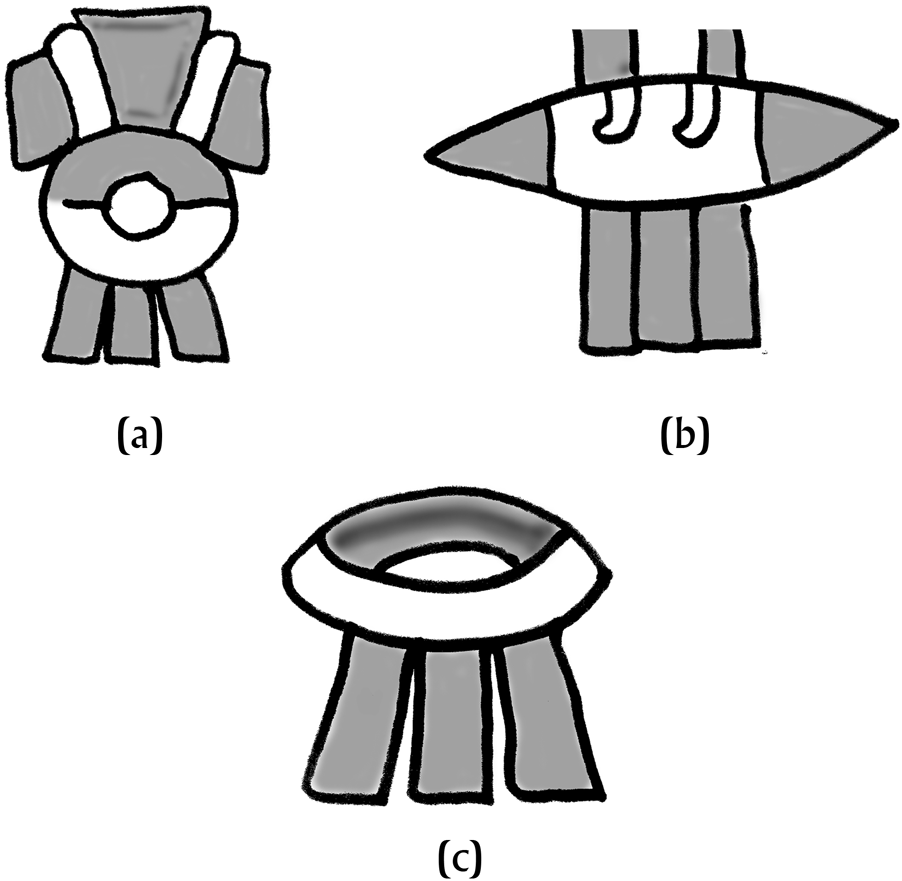
The pectoral named anahuatl is a complex sign that refers to several basic signs, which is why we examine it only now, after having presented other signs related to sacrifice and dismemberment. It was worn by Tezcatlipoca and several deities related to war and death: Tlahuizcalpantecuhtli, Tecciztecatl, Xipe Totec, Quetzalcoatl, and Mictlantecuhtli (Vauzelle Reference Vauzelle2018:740). Most of the specimens of this pectoral found in an archaeological context in the Great Temple of Mexico-Tenochtitlan were made from the shiny white shell of Pinctada mazatlanica, a species of mollusc that was harvested near the coast, in shallow waters or on sandy beaches (Vauzelle Reference Vauzelle2018:746, citing Valentín and Zúñiga Reference Valentín Maldonado and Arellano2007:67S). In the manuscripts made by the Aztecs after the Spanish conquest, the ornament is represented as a white ring with a red ribbon tied or wrapped around its upper half, which was probably made of leather (Figure 15a; Vauzelle Reference Vauzelle2018:739). The hollow circular surface reveals the clothes underneath, which must have been the case in reality.

Scholars generally recall that the Aztecs gave the name anahuatl to regions surrounded by water and, by extension, to central Mexico (Anahuatl) and the entire world (cemanahuatl), as Sahagún reports in various places (Vauzelle Reference Vauzelle2018:743). But this is only one of the meanings of this complex sign. Indeed, let us return to its representation. In the Codex Borgia, its central part is filled with black dots evoking the night, the underworld, and creation; it is surrounded by a thin yellow circle and surmounted by a red band. The three colors of Tezcatlipoca's smoking mirror, black/red/yellow, are thus united. The whole is surrounded by a white mother-of-pearl circle (Figure 15b). Now, anahuatl received, among the Aztecs, the name “chest mirror,” iel tezcatl (Sahagún Reference Sahagún1956:95; Reference Sahagún, Anderson and Dibble1950–1982:vol. I p. 3, quoted by Vauzelle Reference Vauzelle2018:747) and these elements bring it closer to the smoking mirror. However, the anahuatl of the Codex Borgia also presents features belonging to the stellar eye: like this one, it is round, with a red part and a white part.
In the Codex Laud and Codex Fejérváry-Mayer, anahuatl is represented in a way identical to the stellar eye (Figure 15c). In the latter image, the night sky in front of the god is strewn with red and white stellar eyes; their resemblance to the anahuatl worn on the pectoral can be appreciated. The anahuatl resembles the chest mirror only by its location.
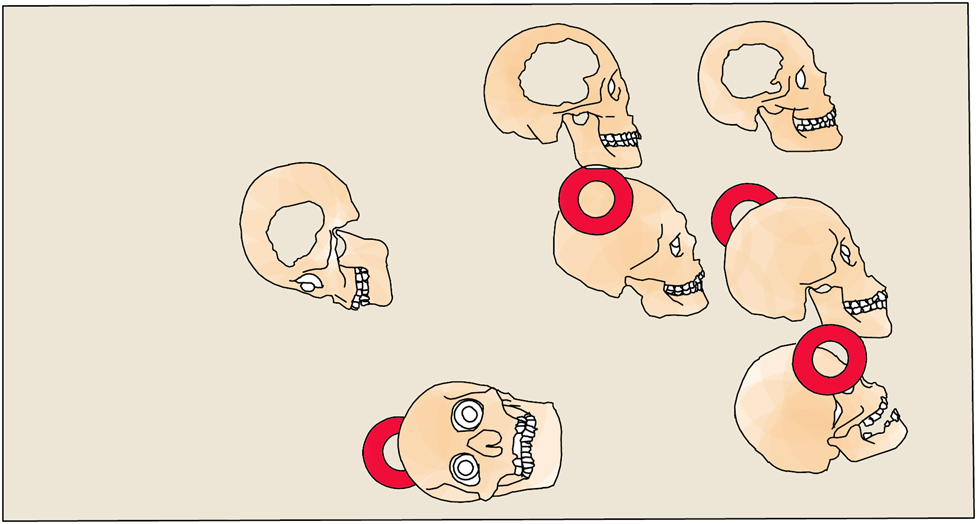
A study by the archaeologist Chávez (Reference Chávez Balderas2015) proves to be very suggestive. It recalls that 109 skulls have been exhumed to date from the ritual and foundation deposits made in the Great Temple of Mexico-Tenochtitlan before the Spanish conquest. These skulls often came from the tzompantli, and were reused after having remained exposed for some time. But this was not always the case, and other skulls were not pierced laterally, but had a “basal” perforation by percussion in the foramen magnum located at the base of the head. Study of the seven skulls exhumed in Offering 141 shows that four of them were perforated at the base and the other three are “tzompantli skulls,” with lateral openings. However, the four basally perforated skulls were each associated with an anahuatl, which was not the case with the tzompantli skulls (Figure 16). The author concludes: “Considering this distinction, it is possible that this ring was equivalent to the perforation of the tzompantli skulls, since none of them had this pectoral” (Chávez Reference Chávez Balderas2015:69, my translation). Indeed, considering the reconstruction of this ritual deposit (Figure 16), the resemblance between the hole of the tzompantli and the anahuatl is obvious, and it seems that the skulls bore one or the other, as if it were essential that they appear to have been pierced laterally. This meaning of the anahuatl relates to the symbolism of the skull mirror.
The seven skulls of Offering 141, Great Temple of Mexico-Tenochtitlan (Robles et al. Reference Cortés, Lucero, Balderas, Molina, Luján and Balderas2019:219, Figure 5; drawing by Michelle De Anda Rogel and Erika Lucero Robles, courtesy of the authors).

To sum up, the representations of anahuatl refer to two basic signs: the smoking mirror and the stellar eye. The smoking mirror identified various practices that resulted in the extraction of bodily substances, such as the splitting of the body, the piercing of holes in the skull, and the dismemberment of joints. The stellar eye evoked night, death, and the underworld, and had the same meaning as the black dots drawn in the center of the smoking mirrors of Tezcatlipoca.
If the anahuatl is an ornament that refers to these two basic signs, it is also linked to a third one: the flint knife. In Figure 17a, the anahuatl pectoral is represented as a round stellar eye, red and white in color. But on another occasion, it is a half red, half white flint that replaces it in the middle of the chest (Figure 17b). And it can happen that the two forms and the two colors merge to give a breast ornament of oval shape like the flint knife, but with the colors red and white superimposed like the anahuatl (Figure 17c; I thank Martine Vesque for this observation, quoted in Dehouve Reference Dehouve2021). We know that the red and white color code had two different meanings depending on the shape on which it was drawn: night and death in the stellar eye and sharpness on cutting objects. It is particularly interesting to note that in Figure 17c the blend between anahuatl and flint produces a blend between the meaning of their color code, which means both death and cutting edge.

Why this fusion of signs and meanings? Generally speaking, because of the conceptual proximity between the smoking mirror, the anahuatl, and the flint knife, as discussed above. But in the specific case of plates 38–43 of the Codex Fejérváry-Mayer (1971), the ornament is worn by an “opossum god” who defeats his opponent and decapitates him (Moser Reference Moser1973:28–31). In plates 38, 39, 40, and 43, he wears the ornament resulting from the fusion of the anahuatl and the sacrificial knife, probably to emphasize his appearance as a god of decapitation and severed heads.
TYPOLOGY OF COMPOSITIONS
The combinations of signs examined so far are many and varied. Can they be subdivided into different categories? A method of analyzing “visual rhetoric” will help us to do so (Groupe μ 1992). It presupposes the universality of rhetorical procedures, which it defines first of all in language. Rhetoric comes into play when “the referential function ceases to be primary, and [when] the user's attention is diverted to the factor that is the message itself [… for example] stop calling a cat a cat, but call it a clerk, the pride of the house, a hairball or a purr” (Groupe μ 1992:9, my translation). There is then a perceived degree (cat) and a conceived degree (clerk). The rhetoric consists of studying the rules that lead the receiver to make the link between the perceived degree and the conceived degree, in other words, “the different ways in which the conceived degree and the perceived degree can be brought together” (Groupe μ 1992:270, my translation). To do this, linguistic rhetoric has established a catalog of tropes and figures. Groupe μ, for its part, intends to treat the visual message in the same way and offer “a first classification of figures of visual rhetoric” (Groupe μ 1992:270, my translation).
We know that comparison and metaphor are among the most common tropes. When we say “Peter is like a lion,” the comparison is between the two entities that are Peter and the lion. In the sentence “Peter is a lion,” the two entities are mediated by a metaphor. These linguistic tropes are well known. But what happens in the visual field? How will we visually compare or merge Peter and the lion? Groupe μ has found a basic structure, comparable to linguistic tropes, that applies to all images, Western or not. It is composed of “four degrees of presentation of the entities to be mediated” (Groupe μ 1992:271, my translation). We will explain them in detail below, with a visual example for each one from the study of Western art chosen by Groupe μ, and cases from the above-mentioned pictographic manuscripts from central Mexico. The four degrees are based on two pairs of opposition: in praesentia/in abstentia (depending on whether the entities to be mediated are both present in the image), joint/disjoint (depending on whether each retains its integrity or is mixed).
Substitution or the Joint Mode in abstentia
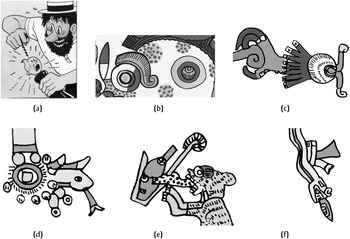
“The two entities are joint, that is, they occupy the same place in the statement, by total substitution of one for the other” (Groupe μ 1992:271, my translation). An example is Captain Haddock Eyes “with bottles where one would expect pupils” (Groupe μ 1992:273, my translation; Figure 18a). The image is completely preserved; only one of its elements is replaced by another. I propose to give this category the name “substitution,” or “Captain Haddock Eyes Type.”
Substitution or the joint mode in abstentia: (a) Captain Haddock (Hergé Reference Hergé1946:32); (b) two substitutions of down, in the center of the smoking mirror and in Mictlantecuhtli's eyebrows (Codex Borgia 1976:Plate 56; drawing by Nicolas Latsanopoulos); (c) substitution of a ball of smoking down for the mirror of the dismembered joint of the turkey's leg (Codex Borgia 1976:Plate 64); (d) substitution of a snake for the smoke scroll (Codex Telleriano-Remensis [Quiñones Keber Reference Quiñones Keber1995:Plate 3v]); (e) substitution of a skull for the head of the corn-eating animal (Codex Borgia 1976:Plate 27); (f) substitution of flint for the tongue of the snake (Codex Borgia 1976:Plate 27). (a, c--f) Drawings by the author.

Several images from our pictographic manuscripts correspond to it: for the sake of clarity, those presented above will be repeated below in Figure 18. The simplest is the smoking mirror composed of three black, red, and yellow circles on the skull of the Death God (Figure 18b). Recall that the outer yellow circle replaces the yellow scrolls. The inner circle of this smoking mirror should be grey with small black dots indicating darkness and the underworld. But the dots here are replaced by the down pattern, whose white color is replaced by grey. Similarly, in the eyebrow next to the smoking mirror hole, the hair is replaced by down dyed grey. The entire image is preserved; the substitution applies only to a part of the sign smoking mirror and a part of the eyebrows.
In the representation of the severed turkey leg, we should see the dismembered joint bone; this bone could have been substituted for a smoking mirror, but a second substitution replaced the mirror with a ball of white down. The two scrolls of smoke have been preserved and appear to be escaping from the down ball (Figure 18c).
In the image of Tezcatlipoca's severed foot (Figure 18d), I would like to draw attention to the transformation of the volutes escaping from the smoking mirror. The body and head of a snake are in fact substituted for the volutes of smoke that one would expect to find; they are decorated with two different signs indicating the liquid: red and blue protuberances above the snake's head, and raindrops below. Clearly, this “liquid snake” replaces the scrolls while returning to their original meaning: the blood stream that accompanies the cutting of the foot.
I add two substitute images. That of a skull symbolizing destruction that replaces the head of an animal eating ears of corn (Figure 18e), and that of a flint replacing the tongue of a snake that represents the lightning in the hands of the god Tlaloc (Figure 18f). These two substitutions use the skull and flint because they symbolize death and destruction. They clarify the harmful meaning of the overall compositions.
Interpenetration or the Joint Mode in praesentia
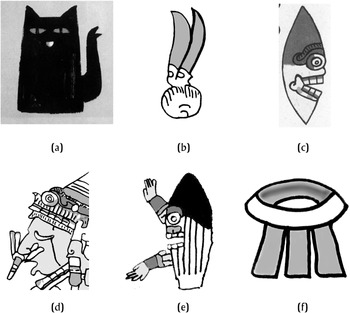
“The two entities are joint in the same place, but with only partial substitution” (Groupe μ 1992:271, my translation). The paradigmatic example is the “chafetière,” a French word that can be translated as “Catfee Pot,” showing a composite object, both “cat” and “coffee pot” (Figure 19a). This is an advertisement for Black Cat coffee, in which the coffee pot appears confused with a cat. The signifier has the mixed features of these two distinct entities. I propose that this category can be referred to as an interpenetration, a blend, a fusion, or the “Catfee Pot Type.”
Interpenetration or the joint mode in praesentia: (a) the “Catfee Pot,” Julien Key, advertisement for Black Cat coffee (Groupe μ 1992:illustration); (b) interpenetration of the signs of the smoking mirror and the down (Codex Borgia 1976:Plate 47, top left); (c) interpenetration of flint and skull in an anthropomorphic knife (Codex Borgia 1976:Plate 22); (d) interpenetration of flint and skull in the headdress of Itztli (Codex Borgia 1976:Plate 61); (e) interpenetration of flint and obsidian in the representation of Itztli (Codex Borbonicus 1974:Plate 3); (f) interpenetration between the anahuatl and the flint knife (Codex Fejérváry-Mayer 1971:Plate 38). Drawings by the author.

Many of our Mexican cases fall under this mode of presentation. A smoking mirror fuses entirely with the down, where the mirror is replaced by a white ball and the smoke volutes by feathers (Figure 19b). Anthropomorphic flints, as a day sign or in the headdress of a deity (Figures 19c and 19d), mix so closely the basic signs of flint and skull that they can no longer be separated. In Figure 19e, the sign of flint merges with the black color of obsidian to represent the god Itztli. Finally, the anahuatl represented in Figure 19f is the product of a total interpenetration between the stellar eye and the flint. It is left to the reader to classify all the other figures mentioned above in one or other of the categories presented.
One Next to the Other or the Disjoint Mode in praesentia
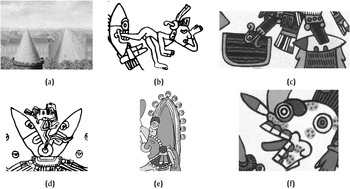
“The two entities occupy different places, without substitution” (Groupe μ 1992:271, my translation); in other words, they are both present (in praesentia) in the scene, but side by side (in disjoint mode). Thus, in Magritte's painting (Figure 20a), the eye perceives “two shaded cones (i.e., triangles, pointing upwards, of the same color and size), one of which corresponds to the conical roof of a turret, and the other to the perspective of a wide boulevard” (Groupe μ 1992:275, my translation). The two disjointed entities—the roof and the avenue—are thus perceived as having a relationship of similarity: the conical form.
Next to each other or the disjoint mode in praesentia: (a) Magritte, Les promenades d'Euclide (Groupe μ 1992:illustration, http://figuresambigues.free.fr/Peinture/euclide3.html#axzz6aT9lapil); (b) the smoking mirror next to the flint knife (Codex Borgia 1976:Plate 32); (c) the smoking mirror next to the flint knife in Itztli (Codex Borgia 1976:Plate 4); (d) the smoking mirror bordered with down (Codex Borgia 1976:Plate 2); (e) the flint bordered with down in Xipe Totec headdress (Codex Borbonicus 1974:Plate 20); (f) the skull and the flint of Mictlantecuhtli (Codex Borgia 1976:Plate 13). Drawings by the author.

Among the Mexican images presented above, one should note the presence of the smoking mirror (on the skull of the small Tezcatlipoca) and the flint knife from which its foot emerges (Figure 20b). The god Itztli, who is, it should be remembered, a Tezcatlipoca with a flint knife, can carry the flint knife on one foot and the smoking mirror on the other (Figure 20c). In Figure 20d, I would like to draw attention to the fact that the mirror showing the decapitation hole is lined with white down: the two signs, often associated in other ways, are shown here side by side in their entirety. Flint may also be represented bordered with down (Figure 20e). Finally, the skull and the flint, which we have seen above represented totally merged, may also appear side by side (Figure 20f): this is often the case of the representations of Mictlantecuhtli in the codices; such skulls have also been found in the archaeological context of the Great Temple of Mexico-Tenochtitlan.
The disjoint mode in praesentia associates images or signs in an overall picture. In Magritte's work, this is an urban landscape. In Mexican representations, it is an anthropomorphic body.
One in Place of the Other or the Disjoint Mode in abstentia
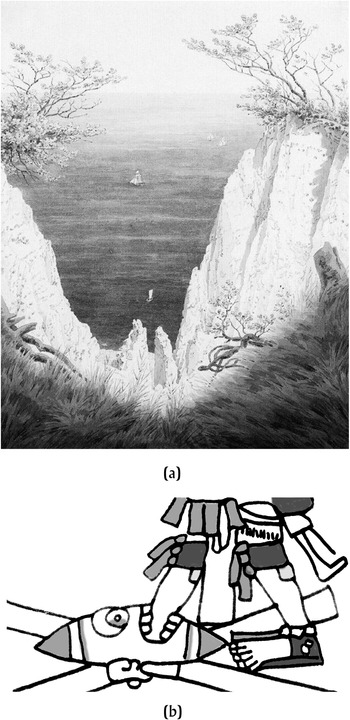
“Only one entity is manifested, the other being outside the statement, but projected onto it” (Groupe μ 1992:272–273, my translation). “In these figures, the types identified on first reading give a satisfactory meaning to the statement, but we tend to reinterpret this meaning in the light of the projected isotopies. These isotopies are often sexual” (Groupe μ 1992:275, my translation. Note that in semiotics “isotopy” is a repetition of a basic meaning-trait). One of the cases presented by the authors is a painting by Caspar David Friedrich, depicting a cliff on the Island of Rügen (Figure 21a). For art historians, these landscapes “had everything of female pudenda” (Groupe μ 1992:275). As this example proves, this mode is based on interpretations on the part of the receiving subjects: “The mechanism is [here] based on the inadmissible banality of the message, a banality that we try to deny by loading it with supposed meanings” (Groupe μ 1992:275, my translation, emphasis added).
In place of the other or the disjoint mode in abstentia: (a) Caspar David Friedrich, Rügen Island Cliff (Groupe μ 1992:illustration), https://fr.wikipedia.org/wiki/Falaises_de_craie_sur_l%27île_de_Rügen; (b) the flint in place of the smoking mirror in Itztli (Codex Fejérváry-Mayer 1971:Plate 2). Drawing by the author.

Our attempts to decipher pictographic manuscripts cannot be based on assumptions made by ourselves as receiving subjects. That would be far too risky. In this case, can we find examples of this mode? These are recognizable in comparison with the other modes. If two signs turn out to be very often coupled, the fact of finding only one of them isolated can be considered a disjoint mode in abstentia: one represented in the place of the other. This is the case when the god Itztli carries a flint in place of his severed foot (Figure 21b), whereas he usually carries a flint and a smoking mirror (Figure 9a). We can therefore assume that the flint in Figure 21b refers to the absent smoking mirror—which in this case is not an isotopy but the second member of a frequent pair.
SOME RULES OF COMPOSITION
The above analysis shows that the categories of mediation between images also apply to the coded signs of Mexican manuscripts. We must now ask ourselves if there were compositional rules that determined the choice of the modes joint/disjoint, in praesentia/in abstentia and their association in the four types that I have named “substitution,” “interpenetration,” “one next to the other,” “one in place of the other.”
Let's look again at the combinations of signs or pairings exposed above. Table 1 brings together elements from this corpus, which means that it is likely to be supplemented by combinations of signs from other sources. In the table, the smoking mirror-flint combination is performed in disjoint mode (one next to the other and one in place of the other). Smoking mirror-down is a frequent combination that corresponds to three types: substitution, interpenetration, and next to the other. Flint-skull exists in interpenetration and next to the other, flint-obsidian only in interpenetration. The down on the skull concerns the eyebrows, whose hairs are replaced by down feathers by substitution. Finally, the pectoral anahuatl is a truly composite sign: it associates mirror and stellar eye in interpenetration, and can be totally replaced by a flint (one in place of the other). Moreover, anahuatl and flint (one next to the other) are found in compositions that associate the god Tezcatlipoca with the 20 signs of the 260-day calendar. In this case, the sign Flint is often placed preferentially next to the anahuatl (Codex Borgia 1976:Plate 17).
Choice and accumulation of modes

This synthesis shows that some combinations were more common than others and used a wider range of types. This was the case for smoking mirror-down, which seems to have been very common, and corresponded to three types. Then came flint-skull (two types) and smoking mirror-flint (two types), flint-obsidian (one type) and skull-down (one type). In any case, accumulation of types seems to have been the rule. The pectoral anahuatl had the particularity of closely relating three basic signs instead of two.
What factors predisposed a combination to belong to a particular type? The resemblance of form was essential and two main basic forms could be distinguished: the circular form and the oblong form. For two signs to combine in joint mode (in abstentia/in praesentia, that is, substitution and interpenetration), it was preferable that they share one of these two forms. Thus, the round shape was shared by the smoking mirror, the down ball, the anahuatl, and the stellar eye—signs that interpenetrated each other in several ways. Conversely, the oblong shape was shared by the flint and the top of the human skull, which also combined in joint mode. The fact that the smoking mirror and the flint had distinct shapes—round for the former, oblong for the latter—seems to me to explain why they were combined in disjoint mode. However, this is not an impassable rule: indeed, the anahuatl was an ornament whose usually round shape was likely to merge with the oblong shape of the flint.
The conceptual proximity between these signs is probably the most important factor explaining their combinations. According to my analysis, they all belonged to the area of human sacrifice: the smoking mirror signified dismemberment and perforation from the victim's point of view, and the flint from the sacrificer's point of view; the flint and the obsidian were the two materials from which the instruments of sacrifice and body opening were made; the down signified the captive, because the victim was covered with white feathers before being immolated; the skull signified skeleton and death, the stellar eye signified darkness and the underworld. It is conceivable that the combinations of signs made it possible to target certain meanings: smoking mirror-flint (the dismemberment), smoking mirror-down (the dismemberment of the sacrificed), flint-skull (sacrificial death followed by dismemberment), flint-obsidian (all sacrificial instruments), skull-down (sacrificial death), stellar eye, smoking mirror and flint (sacrificial death). The combinations of signs ultimately allowed the same ideas to be expressed in many different ways and with particular nuances.
CONCLUSION
The communication system in use in central Mexico was made up of signs composed largely of pictorial elements, including glyphs (signs in a script) and graphic representations of the ornaments of the deities. This article dealt with the relationship between signs, and more specifically how several signs combined with each other to create meanings. I first targeted several “basic signs” corresponding to specific objects that could be named and with few variants—the smoking mirror, the flint, the down ball, and the skull—all belonging to the field of sacrifice and dismemberment of the human body. These basic signs were associated with each other and created the following codified and conventional combinations: smoking mirror-flint, smoking mirror-down, flint-skull, flint-obsidian, skull-down, and a composite pectoral called anahuatl.
The research group on the visual rhetoric of Western artworks (Groupe μ 1992) proposed a theoretical typology of the ways in which images could be combined. Its method of analysis is applicable to the combinations of signs in Mexican manuscripts, confirming that the processes of visual rhetoric are as universal as those of linguistic rhetoric. However, it also appeared that Mexican manuscripts used these procedures in an original way, first of all in their purpose: to express meanings related to ritual life, with the help of objects used in ceremonies. To achieve this goal, they respected certain rules concerning the plastic constraints: the forms—circular and oblong—played an important role in the cases examined in order to determine the way in which the association could be realized. In addition, they favored certain associations of signs, which are notable for their frequency and the accumulation of a large number of modes, such as smoking mirror-down, which appears to be a conventional combination that is totally stabilized. Finally, combinations were implemented when there were conceptual concordances between signs. Those studied here all belonged to the same conceptual domain, that of ritual death and opening of the human body. Their association was therefore used less to express new ideas—which would undoubtedly appear if another corpus were chosen—than to repeat the same idea in several different ways and to provide clarifications according to the context.
I will conclude that the system of communication used in the codices of central Mexico had a creative character that was expressed mainly in the fact that it was capable of combining basic signs. Therefore, it is in the combined signs that the key to its decipherment lies. The interest of the typology of combinations that I applied above to some signs related to dismemberment is that it offers a method to decipher a sign by taking into account its associations with other signs. This is mainly what allowed me to give to the smoking mirror a meaning that had not, to my knowledge, been proposed until now.
RESUMEN
El sistema de comunicación en uso en los códices del centro de México estaba constituido por signos compuestos en gran parte por elementos pictóricos, incluyendo los glifos toponímicos y las representaciones gráficas de los adornos de las deidades. Tenía un carácter creativo que se expresaba principalmente en el hecho de que combinaba signos básicos para crear nuevos significados. Este artículo trata de las combinaciones entre los siguientes signos: el espejo humeante, el cuchillo de pedernal, el plumón y la calavera, todos ellos pertenecientes al campo del sacrificio y desmembramiento del cuerpo humano. Los signos se asociaban entre sí y creaban las siguientes combinaciones codificadas y convencionales: espejo-pedernal, espejo-plumón, pedernal-calavera, pedernal-obsidiana, calavera-plumón y un pectoral compuesto llamado anahuatl.
El artículo propone una tipología de estas combinaciones basada en el método de análisis de la “retórica visual” del Groupe μ (1992), la cual se compone de cuatro grados de presentación de las entidades a mediar basados en dos pares de oposición: in praesentia/in abstentia (dependiendo de si las entidades a mediar están presentes o no en la imagen), separado/conjunto (dependiendo de si cada una conserve su integridad o esté mezclada). Analicé los cuatro tipos siguientes: el modo conjunto in abstentia, o sustitución, en el que la imagen se preserva íntegramente y sólo uno de sus elementos es sustituido por otro; el modo conjunto in praesentia, o interpenetración, que es una mezcla o fusión total entre los signos básicos; el modo separado in praesentia, o uno junto al otro, en el que dos signos se presentan íntegros y al lado uno de otro; el modo separado in abstentia, o uno en lugar del otro, en el que un signo representado aislado se refiere en realidad a otro signo conceptualmente unido a él.
Ciertas combinaciones de signos eran particularmente frecuentes y combinaban varios modos. Este es el caso del “espejo-plumón,” asociados por medio de tres tipos (sustitución, interpenetración y uno junto al otro), pedernal-calavera (interpenetración y uno junto al otro) y espejo-pedernal (uno junto al otro y uno en lugar del otro). El pectoral anahuatl era un atributo compuesto que reunía tres signos básicos: el espejo humeante, el ojo estelar y el cuchillo de pedernal.
La proximidad conceptual entre los signos estudiados es probablemente el factor más importante que explica sus combinaciones. De acuerdo con mi análisis, todos ellos pertenecían al área de los sacrificios humanos y del desmembramiento del cuerpo. Por lo tanto, su asociación servía menos para expresar nuevas ideas—que sin duda aparecerían si se eligiera otro corpus—que para repetir la misma idea de varias maneras diferentes y con matices según el contexto.
El sistema de comunicación utilizado en los códices de México central tenía un carácter creativo que se expresaba principalmente en el hecho de que era capaz de combinar signos básicos. Por lo tanto, en los signos combinados reside la clave para su desciframiento. El interés de la tipología de combinaciones que he aplicado a algunos signos es que ofrece un método para descifrar un signo teniendo en cuenta sus asociaciones con otros signos. Esto es principalmente lo que me ha permitido dar al espejo humeante un significado que, hasta donde yo sepa, no había sido propuesto hasta la fecha.