Surgical site infections (SSIs) double the length of hospitalization, increase US healthcare costs by $5–10 billion per year, and increase postoperative mortality at least twofold.Reference Noskin, Rubin and Schentag 1 – Reference Engemann, Carmeli and Cosgrove 4 Staphylococcus aureus (SA) is the most common etiologic agent, causing 30% of SSIs and 15% of all healthcare-associated infections (HAIs).Reference Hidron, Edwards and Patel 5
Carriers of SA, who constitute 25%–30% of adults, have a 2–14-fold greater risk than noncarriers of acquiring an SA SSI.Reference Perl and Golub 6 , Reference Wenzel and Perl 7 However, a ‘screen and decolonize’ approach for preventing SA SSIs has been adopted inconsistently by US hospitals,Reference Diekema, Johannsson and Herwaldt 8 , Reference Kline, Highness, Herwaldt and Perl 9 and surgical guidelines provide several different recommendations.Reference Botelho-Nevers, Gagnaire and Verhoeven 10 – Reference Berríos-Torres, Umscheid and Bratzler 14 Additionally, institutional protocols vary regarding which body sites to screen and decolonize and whether to target methicillin-susceptible SA (MSSA, an important cause of SSI) or only methicillin-resistant SA (MRSA).Reference Diekema, Johannsson and Herwaldt 8 , Reference Kline, Highness, Herwaldt and Perl 9 Notably, community-acquired MRSA (CA-MRSA) strains may colonize different sites (ie, throat) than hospital-acquired MRSA (HA-MRSA) strains (ie, nares). Thus, it may escape detection by nares-only screens,Reference Lautenbach, Nachamkin and Baofeng 15 , Reference Mody, Kauffman, Donebedian, Zervos and Bradley 16 and SA throat carriage may be unaffected by nares decolonization regimens.
Generic preoperative skin cleansing guidelines recommend 2 showers with an antiseptic soap.Reference Berríos-Torres, Umscheid and Bratzler 14 Additional agents that have been used specifically for SA or MRSA decolonization include nasal mupirocin,Reference van Rijen, Bonten, Wenzel and Kluytmans 2 , Reference Kalmeijer, Coertjens and van Nieuwland-Bollen 17 – Reference Bode, Klutymans and Wertheim 19 chlorhexidine gluconate (CHG) body soap,Reference Bode, Klutymans and Wertheim 19 CHG mouth rinse,Reference Segers, Speekenbrink, Ubbink, van Ogtrop and de Mol 20 nasal povidone iodine gel,Reference Phillips, Rosenberg and Shopsin 21 and nasal ethyl alcohol gel.Reference Steed, Costello, Lohia, Jones, Spannhake and Nguyen 22 , Reference Mullen, Wieland, Wieser, Spannhake and Marinos 23
Most surgery in the United States is done on a same-day basis, with patients admitted directly from home, leaving insufficient time for inpatient decolonization regimens.Reference Cullen, Hall and Golosinskiy 24 Accordingly, we designed and executed a randomized trial of a 4-body-site decolonization bundle that could be used on an outpatient basis to eradicate SA carriage prior to diverse elective surgical procedures.
Methods
Study design and participants
We designed a randomized trial to determine the relative efficacy in eradicating SA colonization by an outpatient self-administered decolonization bundle (chlorhexidine gluconate [CHG] soap, CHG mouthwash, and mupirocin nasal ointment) for 5 days versus 2 disinfectant soap showers. Enrollment began August 31, 2011, and clinical data collection concluded December 16, 2016. Participants were enrolled at the University of Minnesota Medical Center (UMMC) in Minneapolis, Minnesota. The University of Minnesota Human Subjects Protection Program approved the study protocol, which was registered with ClinicalTrials.gov (identifier: NCT02182115).
Outpatients in the UMMC orthopedic, urologic, neurologic, colorectal, cardiovascular, and general surgery clinics who were to undergo elective surgery were approached by study personnel and were offered study participation. All participants provided written informed consent.
Inclusion criteria included (1) anticipated surgery≥10 days after enrollment to allow completion of baseline cultures and the decolonization protocol, (2) age≥18 years, (3) ability to complete the decolonization protocol preoperatively as an outpatient, and (4) no antibiotic therapy within 7 days prior to the baseline cultures and no subsequent antibiotic therapy prior to the posttreatment cultures. Exclusion criteria included (1) inability to give informed consent, (2) surgery anticipated within 10 days after the baseline cultures, and (3) allergy to mupirocin or CHG.
Screening, randomization, and masking
Participants were screened for SA carriage at 4 body sites by culturing the nares, throat, axillae, and perianal area. Participants whose baseline cultures detected presumptive SA at any site and those who met the eligibility criteria were randomized (1:1) to the decolonization bundle or the disinfectant soap showers (hereafter called the control). Randomization was stratified by MSSA versus MRSA colonization status. Randomly permuted blocks of sizes of 2 and 4 were used for each SA status. Participants and clinical staff were not masked to the study arm, but the UMMC Infectious Disease Diagnostic Laboratory (IDDL) and Minnesota Department of Health (MDH) Public Health Laboratory (PHL) staff who performed initial and confirmatory testing, respectively, were masked to the treatment group. Also, SA-colonized participants were notified that they carried SA, but not at which site(s).
Cultures
For the initial SA screening (baseline cultures), 4 swab samples were collected per participant (BD BBL CultureSwab, Becton Dickenson, Franklin Lakes, NJ): 1 each from the bilateral nares, bilateral axillae, throat, and perianal area. Swab cultures and antimicrobial susceptibility testing of presumptive SA isolates were done at the UMMC IDDL (see Supplemental Appendix for culture methods).Reference Becher, Skov and VonEiff 25
Participants identified as presumptive SA carriers and who completed the assigned preoperative study regimen (described below) underwent follow-up SA screening (ie, posttreatment cultures) immediately prior to surgery. For this, swabs were collected from the same 4 body sites when participants were in the preoperative holding room, prior to receipt of perioperative antibiotics. All participants received the hospital’s standard perioperative antimicrobial therapy, unadjusted for the SA screening results.
Interventions
Participants randomized to the decolonization bundle were given decolonization supplies: CHG soap, mupirocin ointment, and (after October 3, 2013) CHG mouthwash. They were instructed to apply all the prescribed medications, irrespective of which site(s) demonstrated SA colonization, for 5 days immediately prior to the scheduled operation date, finishing the evening before surgery, regardless of the time interval between the initial screening and surgery. Instructions were as follows: (1) to shower with CHG soap once daily, (2) to apply intranasal mupirocin twice daily, and (3) after October 3, 2013, to gargle with CHG mouthwash twice daily. With the approval of the study steering committee, CHG mouthwash was added to the decolonization bundle after the first 109 participants had been screened and the first 35 SA carriers had been randomized: 18 to the decolonization bundle group and 17 to the control group. This change was undertaken due (1) to a higher-than-anticipated overall frequency of SA in baseline throat cultures and (2) to concerns that nasal mupirocin and CHG soap might not affect the throat, and (3) to a prior study showing that use of CHG oropharyngeal rinse and nasal ointment decreased hospital-acquired infections after cardiac surgery.Reference Segers, Speekenbrink, Ubbink, van Ogtrop and de Mol 20
Participants randomized to the control group received instructions from their surgeons for standard preoperative hygiene. These instructions included 2 preoperative showers with an antiseptic soap of the surgeons’ choice, 1 the night before and 1 the morning of surgery, which is the current standard of care at UMMC and recommended by Minnesota Hospital Association and by the US Centers for Disease Control and Prevention (CDC) for SSI prevention.Reference Berríos-Torres, Umscheid and Bratzler 14 , 26
Outcomes
Serious adverse events (SAEs) were collected for both treatment groups through medical record review. By contrast, adverse drug events (ADEs) were collected differently for each treatment group. Specifically, for the decolonization bundle group, to assess their adherence to each bundle component, participants received a drug diary in which they were to record, in real time, the number and timing of study medication doses applied. Complete adherence to the bundle was defined as reported application of all doses of all assigned medications. These participants also received a questionnaire regarding the occurrence and perceived severity (mild, moderate, or severe) of any suspected ADEs. Control group participants were asked on the day of surgery whether they had completed the 2 prescribed showers with the surgeon’s recommended soap and whether they had experienced any suspected ADEs.
Medical records of randomized participants were reviewed for 90 days postsurgery for development of SSI and device-associated infection, catheter-associated urinary tract infection (CAUTI), central-line–associated bloodstream infection (CLABSI), and ventilator-associated pneumonia (VAP). Standard hospital procedures were used to identify SSIs and other HAIs using definitions from the CDC National Healthcare Safety Network (NHSN). 27
Presumptive SA isolates (initial and posttherapy) from the UMMC IDDL were frozen in glycerol broth and shipped to the MDH PHL for identity confirmation and additional testing. Isolates that exhibited mupirocin resistance when screened with a 5-µg mupirocin disk underwent minimum inhibitory concentration (MIC) testing (Etest, bioMerieux, Marcy-l'Étoile, France) to detect high-level resistance (ie, MIC>256 µg/mL). We did not assess CHG resistance. SmaI pulsed-field electrophoresis (PFGE) was used to resolve distinct strains and to allow their classification to USA lineage. Furthermore, MRSA profiles resembling reference profiles USA100, 200, 500, 600, or 800 were classified as HA-MRSA, whereas those resembling USA300 or 400 lineages were classified as CA-MRSA.Reference McDougal, Steward, Killgore, Chaitram, McAllister and Tenover 28
Primary endpoint
The primary endpoint in this study was detection of SA colonization (MRSA or MSSA) at any of the 4 body sites by posttreatment cultures and confirmed by the MDH PHL. We report 1 minus these percentages and consider this to represent eradication of colonization.
Monitoring
An independent data monitoring committee was established after the receipt of funding. This committee oversaw the study and conducted 1 interim safety review after 83 participants had been randomized and 72 had completed the study.
Statistical analysis
This study was designed initially as a pilot trial involving 50 SA carriers to determine the number needed to screen to identify an eligible participant (ie, an SA carrier) and to assess adherence to the decolonization bundle. After 40 participants were randomized, preliminary results were encouraging, leading us to seek additional funding to randomize a total of 112 participants (56 per group). Due to funding delays, trial completion required 5.5 years.
For the control group, an expected prevalence of SA carriage posttreatment of 75% (or equivalently 25% eradication) was estimated from placebo-controlled trials of nasal ointment.Reference Kalmeijer, Coertjens and van Nieuwland-Bollen 17 , Reference Perl, Cullen and Wenzel 18 , Reference Konvalink, Erret and Fong 29 With 112 participants, power was excellent if SA eradication would be achieved in 50%–62.5% of the decolonization bundle group. (Details on sample size calculations are provided in the appendix.)
The primary analysis included randomized participants whose pretreatment screening isolates was confirmed as SA by the MDH PHL and who had had posttreatment cultures. The Fisher exact test was used to compare the 2 treatment groups for the primary endpoint of eradication of SA at all 4 body sites. Exact unconditional 95% confidence intervals (CIs) were calculated for the difference between the treatment group versus the control group for the primary endpoint (all 4 body sites). Analyses of posttreatment carriage by body site were also conducted using similar methods to compare the effectiveness of different bundle components. These analyses should be interpreted with caution because the study was not designed to assess the separate effects of each intervention.
Within each phase of the study, all participants assigned to a particular treatment group received the same intervention irrespective of the sites colonized. Because CHG mouthwash was added to the decolonization bundle part way through the study, a subgroup analysis was conducted for participants randomized before and after the addition of CHG mouthwash. For this part of our analysis, exact logistic regression was used to evaluate differences in the primary outcome for the treatment bundles with mouthwash versus without mouthwash using an interaction between treatment and subgroup. Safety comparisons were summarized for each treatment group. Because safety data were collected differently for each treatment group, no formal statistical comparisons were made. Analyses were performed using SAS version 9.4 software (SAS Institute, Cary, NC) and R version 3.3.1 software (R Foundation for Statistical Computing, Vienna, Austria).
Results
Study population
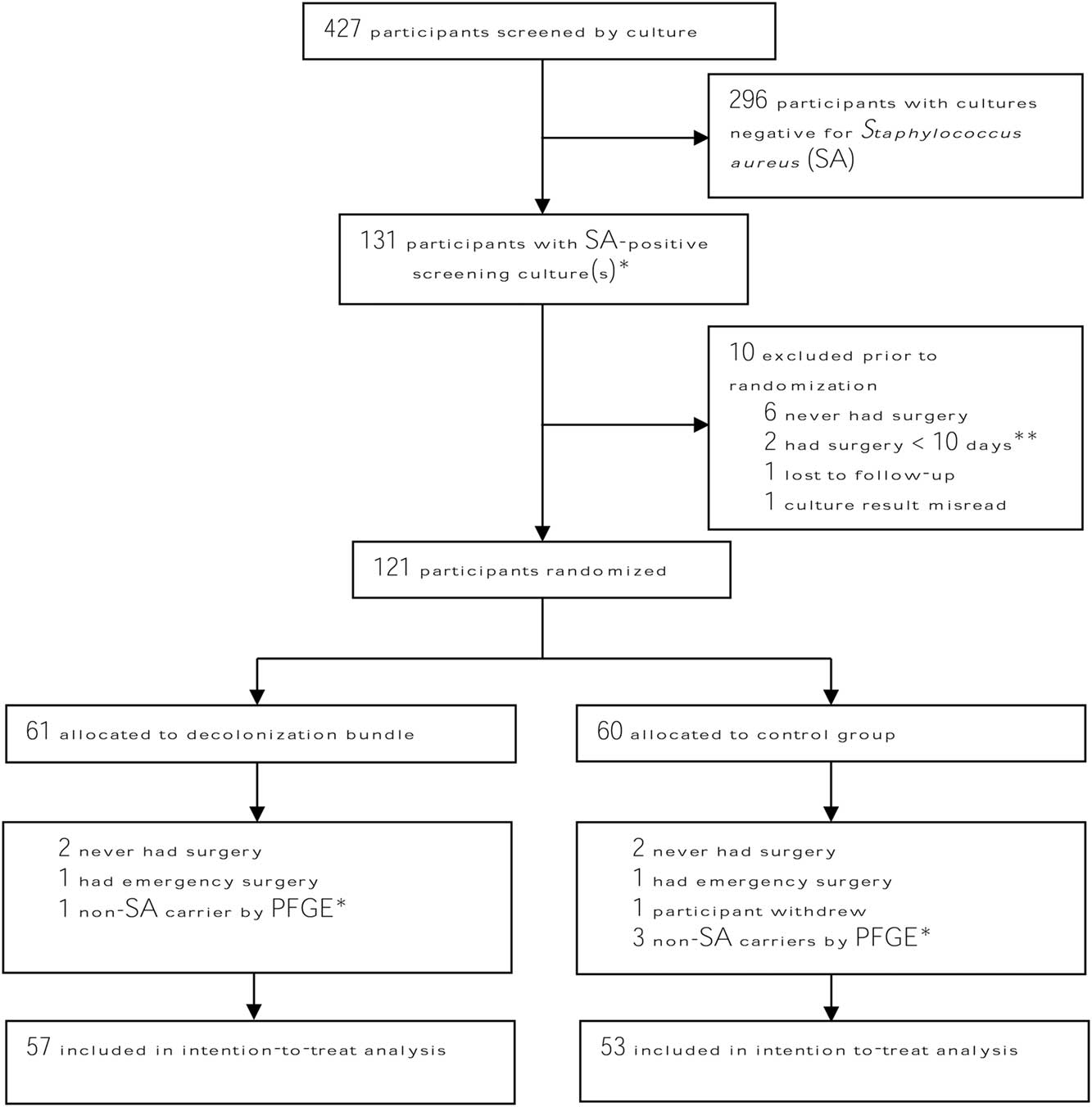
During the study period, 427 participants were screened at 4 body sites for SA carriage (Fig. 1). Of the 427 participants screened, 131 (30.6%) carried presumptive SA according to the UMMC IDDL. Of the 131 presumptive SA carriers, 121 (92.4%) were randomized. We subsequently excluded from analysis 11 randomized participants (9.1%), including 4 in the decolonization bundle group (3 for no posttreatment cultures and 1 for unconfirmed SA carrier status) and 7 in the control group (3 for no posttreatment cultures, 3 for unconfirmed SA carrier status, and 1 for withdrawal).
Trial profile. *Four participants were removed after randomization after pulsed-field electrophoresis (PFGE) analysis revealed that 5 presumptive MSSA isolates from 4 different participants were not Staphylococcus aureus spp: S. schleiferi (n=1), S. lugdunensis (n=2), and S. haemolyticus (n=2). Six instances of no posttreatment cultures were due to the individual never having the planned surgery (n=4) or undergoing emergency surgery (n=2). Exclusion of these 10 participants, plus 1 participant who withdrew, left 110 participants for the primary efficacy analysis. **Two participants had surgery scheduled sooner than 10 days postscreening prior to randomization and were excluded.

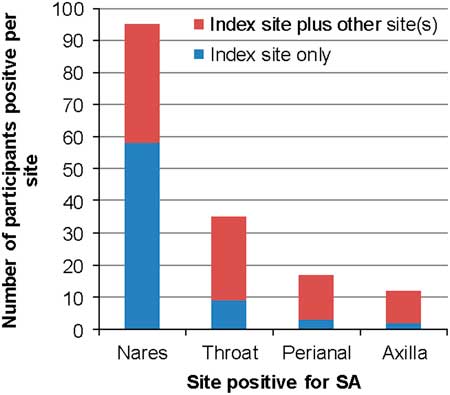
Baseline characteristics of participants were well balanced between the 2 treatment groups (Table 1). Overall, participants were predominantly white (86%), were evenly distributed by sex (48% female), had a mean age of 56 years (range, 20–94 years), and were scheduled predominantly for orthopedic surgery (56%). Of the 110 evaluable participants, 11 (10%) had MRSA at baseline. The most commonly detected site of SA colonization was nares (95 of 110, 86%) (Fig. 2). Of all SA carriers, 52 of 110 (47.3%) had at least 1 extra-nasal colonization site and 38 of 110 (35%) had multisite colonization (2 or more positive sites).
Baseline cultures positive for Staphylococcus aureus (SA) among the 110 evaluable participants. The number of participants positive at each sampled site and whether it was the only site positive for the participant or if other sites were positive as well.

Baseline Characteristics of Evaluable Participants

Note. MSSA, methicillin-susceptible Staphylococcus aureus; MRSA, methicillin-resistant Staphylococcus aureus; SA, Staphylococcus aureus. One patient was positive for both MSSA and MRSA.
a Unless otherwise specified.
b Other racial and ethnic groups were African American, American Indian/Alaskan Native, Asian, and Hispanic/Latino.
Treatment adherence data from drug diaries were available for 52 of the 57 participants (91%) in the decolonization bundle group; the other 5 did not return the completed diary (Supplemental Table 1). To summarize, for nasal mupirocin, 35 of 52 participants (67%) applied all doses; 45 (86%) applied >80% of the doses; and 2 (4%) missed >60% of the doses. For the CHG soap, 43 of 52 participants (81%) applied all doses; 48 of 52 (91%) applied >80% or more of the doses; and 3 of 52 (5%) missed>60% of the doses. For CHG mouthwash, 29 of 41 participants (71%) applied all doses; 34 of 41 (90%) applied >80% of the doses; and 2 of 41 (5%) missed >60% of the doses. Of the 52 evaluable participants, 31 (60%) reported 100% adherence with all assigned study medication doses. Complete adherence with the prescribed medications was 77% before the addition of CHG mouthwash and 54% afterward (P=.20).
Treatment adherence in the control group was assessed by verbal report. All participants (100%) reported taking 2 preoperative showers with an antiseptic soap. The prescribed soap’s antiseptic ingredient was para-chloro-meta-xylenol (PCMX) for 93% of participants and CHG for 7%.
Posttreatment cultures were collected a median of 41 days (interquartile range [IQR], 22–68 days) after the baseline cultures overall, and 40 days (IQR, 23–68 days) in the decolonization bundle group and 46 days (IQR, 22–68 days) in the control group. The Wilcox rank-sum test yielded P=.820.
Outcomes
Regarding efficacy, the primary outcome, SA eradication at all 4 body sites, was achieved by 41 of 57 participants (71.9%) in the decolonization bundle group and 13 of 53 participants (24.5%) in the control group, for a risk difference of 47.4% (95% CI, 29.1%–65.7%; P<.0001) (Table 2).
Staphylococcus aureus (SA) Eradication After Treatment

Note. MSSA, methicillin-susceptible Staphylococcus aureus; MRSA, methicillin-resistant Staphylococcus aureus; SA, Staphylococcus aureus.
Our analysis of treatment response in relation to methicillin phenotype suggested a larger effect among MSSA carriers than among MRSA carriers (Table 2). Specifically, in the control group, SA eradication rates were similar for carriers of MSSA (25.0%) and MRSA (20%), and in the decolonization bundle group SA eradication rates were higher for MSSA carriers (77%) than for MRSA carriers (33%). However, among the 99 MSSA carriers, the decolonization bundle’s efficacy was clear, with an absolute risk difference in decolonization (bundle vs control) of 51.5% (95% CI, 32.7–67.2; P<.0001) (Table 2). Among the 11 MRSA carriers, the decolonization percentage was only marginally higher with the decolonization bundle (33.3%) than control (20%) (absolute risk difference, 13.3%). However, the confidence interval of this efficacy estimate was large (95% CI, −45.1 to 66.7; P>.99) (Table 2).
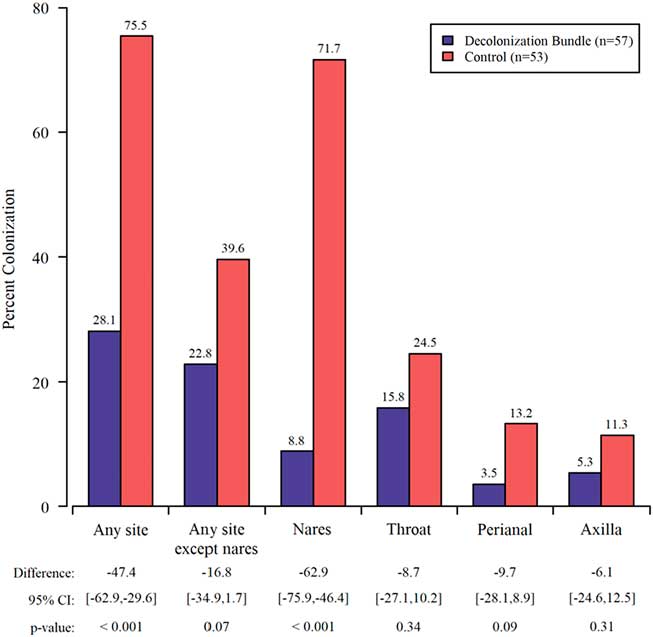
For each body site, posttreatment SA colonization was less frequent in the decolonization bundle group than in the control group (Fig. 3). The effect appeared greatest for nares, where the posttreatment SA colonization rate was 8.8% (5 of 57) in the bundle group versus 71.7% (38 of 53) in the control group (difference, −62.9%; 95% CI, −75.9 to −46.4; P<.0001) (Fig. 3). For all 3 nonnares sites jointly, the posttreatment colonization rates in the 2 groups were 22.8% for the bundle group versus 39.6% for control group (difference, −16.8%; 95% CI, −34.9 to 1.7; P=.07) (Fig. 3).
Posttreatment culture results, by treatment arm. For comparison, the percentage of participants with Staphylococcus aureus (SA) at any site (primary endpoint) and the percentage with SA at any no-nares site are also shown. This figure includes the percent of participants in each study group who were positive for SA at the indicated site posttreatment, including those who were negative at the site pretreatment. Some participants in each group were SA positive posttreatment but SA negative at baseline. See supplemental Table 2 for additional details.

For each of the 4 body sites, some participants lost or gained SA between the baseline and posttreatment culture (Supplemental Table 2). The only exception was that no participants in the decolonization bundle group converted from nares negative to nares positive. In the control group, conversion from SA negative (baseline) to SA positive (posttreatment) at a given site occurred more often for the throat (13.2%) than for other sites (3.8%, axilla and perianal; 1.9%, nares).
To assess the effect of the added CHG mouthwash, subgroup analyses comparing the SA carriage rate (in the decolonization bundle group vs the control group) for the periods before versus after addition of mouthwash were conducted for 2 outcomes: (1) decolonization overall, counting participants as still colonized if any site was positive, and (2) decolonization for the throat site alone. The proportions of SA carriers in the decolonization bundle and the control groups overall, and for the throat site alone, did not vary significantly between the 2 periods (before and after the addition of mouthwash to the decolonization bundle); the interaction P values for all sites and for the throat were .72 and .85, respectively (Supplemental Table 3).
Safety
No safety concerns were identified during the interim data safety monitoring review or subsequently (see the Safety report in the Supplemental Appendix and Supplemental Table 4).
Other outcomes
Only 1 SSI was documented among the 110 evaluable participants (a non-SA SSI in a decolonization bundle recipient). No episodes of CAUTI, CLABSI, or VAP occurred. The PFGE analysis showed considerable genetic diversity among the SA isolates. A condensed description of the subtypes is presented here (Supplemental Table 5). One decolonization bundle group member had a posttreatment MRSA nares isolate (USA300) that exhibited high-level mupirocin resistance (MIC≥1024 µg/mL). This isolate was indistinguishable by PFGE from the participant's mupirocin-susceptible pretreatment MRSA nares isolate (USA300).
Discussion
In this randomized trial, a novel 5-day home-administered decolonization bundle was superior to 2 preoperative showers with antiseptic soap for eliminating SA prior to surgery. Participants reported successfully self-administering the decolonization bundle and generally tolerated it well.
Although other studies have demonstrated that nasal mupirocin can reduce preoperative nasal SA carriage, most were conducted in a hospital.Reference Kalmeijer, Coertjens and van Nieuwland-Bollen 17 – Reference Bode, Klutymans and Wertheim 19 , Reference Rao, Canella and Crossett 30 – Reference Kluytmans, Mouton and Marjolein 32 Our study was notable for its use of a 3-component decolonization bundle, which was applied entirely by participants themselves at home. A large majority of participants reported successfully following instructions and executing a 5-day, multifaceted decolonization regimen; 86%–91% of participants reported applying 80% or more of the prescribed doses of each individual decolonization bundle medication. Because most US surgical procedures involve outpatients or same-day hospital admissions, which precludes the use of inpatient decolonization regimens, this outpatient decolonization intervention is potentially applicable to most surgical patients.Reference Cullen, Hall and Golosinskiy 24 Participants in a clinical trial may be more adherent than other patients. If adherence is worse in “real life,” the efficacy of the bundle could be adversely affected. The potential exists for decreased patient adherence with more complicated decolonization regimens, associated costs, and side effects.
The decolonization bundle’s effect was most evident for nares, the most common site of SA colonization (86% of participants). This finding, along with the results of other studies of nasal mupirocin for surgical patients, suggest that nasal mupirocin treatment likely is a critical component of SA decolonization interventions.Reference Kalmeijer, Coertjens and van Nieuwland-Bollen 17 , Reference Perl, Cullen and Wenzel 18 , Reference Konvalink, Erret and Fong 29 In this study, we did not include a study arm that employed universal decolonization (decolonization bundle for all) instead of the screen-and-treat approach. Universal preoperative use of mupirocin could select for more antibiotic resistant bacteria, which could limit mupirocin’s efficacy in the future. Additionally, universal mupirocin adds expense and increased side effects without benefit for non-SA carriers. The screen-and-treat SA carriers approach follows the more targeted therapy approach of antimicrobial stewardship.
Other topical nasal antiseptics such as povidone-iodine and alcohol-based gels have also shown efficacy in reducing nasal SA carriage.Reference Bode, Klutymans and Wertheim 19 , Reference Steed, Costello, Lohia, Jones, Spannhake and Nguyen 22 , Reference Mullen, Wieland, Wieser, Spannhake and Marinos 23 Nasal decolonization–only strategies are likely suboptimal for individuals with throat or gastrointestinal tract colonization. In that regard, we detected extra-nasal SA colonization in nearly half of all SA carriers. The high prevalence of SA at extra-nasal sites, and the decolonization bundle’s relatively benign side-effect profile, argue for the importance of using an intervention that addresses extra-nasal sites, especially the throat, which is the second most common site of colonization. The decolonization bundle used in our study did show a trend toward lower colonization at extra-nasal sites of SA colonization compared to the control group, but the bundle was less able to eradicate SA carriage at nonnares sites than at the nares site. The CHG mouthwash appeared to have a small positive effect in decreasing throat carriage compared to the control. But we cannot be certain of the CHG mouthwash’s efficacy in eradicating SA throat carriage because the numbers in the subgroups were small and the differences were not definitive.
We detected new SA colonization between baseline and posttreatment cultures in both study groups at all body sites except nares in the decolonization bundle group. A numerically greater fraction of control group than decolonization bundle group participants had SA newly detected in the throat on posttreatment cultures. This finding could be due to de novo acquisition of SA colonization or false-negative baseline cultures or from sampling error or insensitivity. Universal application of the decolonization bundle to all preoperative patients, not just identified SA carriers, presumably could more effectively reduce SA colonization (whether newly acquired or persistent) at the time of surgery.
The observed greater frequency of ADEs with the decolonization bundle than control could be due to ascertainment bias artifact resulting from more intensive assessment for ADEs in the bundle group, which involved ongoing real-time recording of side effects, compared with the control group’s single posttreatment report based on recall. Alternatively, the bundle's inclusion of more topical medications and its longer treatment duration might have yielded more actual ADEs. Future studies will need to assess the best drug combination and treatment duration for achieving decolonization while limiting ADEs. Additionally, efforts should be made to identify ways to improve patient adherence to the decolonization bundle.
This study was not designed to address the outcomes of SSIs and, as expected, too few SSIs occurred for an assessment of the decolonization bundle’s preventive efficacy against them. As such, evidence is still lacking that the studied 3-medication, 5-day outpatient decolonization bundle can prevent SA SSI or that it is more efficacious in preventing SA SSI than a 1- or 2-medication topical decolonization treatment or than a single application of a nasal antiseptic applied immediately preoperatively. Most previous studies of SA screening procedures and decolonization to prevent SA SSIs found favorable trends but were limited by insufficient power, absence of randomization, or restriction to inpatients.Reference Kalmeijer, Coertjens and van Nieuwland-Bollen 17 – Reference Segers, Speekenbrink, Ubbink, van Ogtrop and de Mol 20 , Reference Mullen, Wieland, Wieser, Spannhake and Marinos 23 , Reference Schweizer, Chiang and Septimus 33 Due to the lack of definitive outcome data with outpatient decolonization regimens, the inapplicability of inpatient decolonization regimens to current surgical practice in the United States, and uncertainty about the most cost-effective approach, SA screening procedures and decolonization protocols are still not used routinely before most surgeries in the United States, despite their potential benefit.Reference Kline, Highness, Herwaldt and Perl 9 , Reference Cullen, Hall and Golosinskiy 24 Further study is needed to support the importance of and need for these practices.
Screening for SA carriage prior to attempted decolonization, as presented here, allows decolonization to be targeted selectively to SA carriers, thereby sparing the 70% of patients who are non-SA carriers the cost, inconvenience, and potential hazards of a decolonization regimen. Alternatively, because screening itself is inconvenient and costly and entails logistical challenges to contact and arrange decolonization for detected SA carriers, it might be preferable to routinely prescribe decolonization bundle medications for all preoperative patients. A disadvantage of universal decolonization is the potential for resulting widespread selection for resistance to the agents used.Reference Irish, Eltringham and Teall 34 , Reference Hayden, Lolans and Haffenreffer 35 Notably, we did document the emergence of high-level mupirocin resistance in 1 participant’s nares-colonizing CA-MRSA USA300 strain after 5 days of nasal mupirocin use.
The study has limitations. First, the small number of participants with MRSA and with SA carriage at nonnares sites precluded definitive assessment of the efficacy of the decolonization bundle for MRSA and for sites other than nares and perianal area. Second, we were unable to determine the efficacy of individual bundle components, although the nares decolonization effect can be ascribed plausibly to nasal mupirocin. Third, we acknowledge that, in this open-label study, we asked questions of the participants in the 2 study groups differently regarding participant adherence with study medications and ADEs. Therefore, the numbers for adherence and ADEs could not be statistically compared. Fourth, the bundle composition changed mid-study, although this had no apparent impact on efficacy.
The study also has several strengths. First, the participants included a large proportion of MSSA carriers, who are understudied but are more representative of the general US population than are MRSA carriers.Reference Gorwitz, Kruszon-Moran and McAllister 36 Second, we used a 3-drug decolonization bundle, including CHG mouthwash, which also has received little study. Third, the entire screening and decolonization protocol was completed on an outpatient basis, thereby demonstrating feasibility for use as part of US surgical practice. Fourth, collection of cultures from multiple sites both before and after treatment allowed us to study the by-site effectiveness of the decolonization bundle and to identify likely conversion of a nasal USA300 MRSA strain from mupirocin-susceptible to mupirocin-resistant with the use of nasal mupirocin.
In summary, a self-applied study decolonization bundle was significantly more effective than the control at eliminating preoperative SA colonization, which was common in our study population (30%) and involved predominantly MSSA. Further study is required to determine the efficacy of this bundle in SSI prevention.
Supplementary material
To view supplementary material for this article, please visit https://doi.org/10.1017/ice.2018.151
Acknowledgments
The authors express their gratitude to the collaborating University of Minnesota Medical Center surgeons, research assistants, and the surgical clinics’ nursing staff. We also acknowledge advice offered by Drs Trish Perl and Loreen Herwaldt on study design and direction from Dave Boxrud at MDH on PFGE analysis. The study funders had no role in the study design, data collection, data analysis, data interpretation, or writing of the report. The content and opinions expressed in this document are those of the authors and do not reflect the official position or views of the Agency for Healthcare Research and Quality (AHRQ), the US Department of Health and Human Services (DHHS), the National Institutes of Health (NIH), the Veterans Administration (VA), or the authors’ respective institutions.
Financial support
This study was registered in the Clinical Trials.gov registry of the US NIH ClinicalTrials.gov identifier: NCT02182115 after receipt of a grant from the AHRQ of the DHHS (grant no. 1R03HS022912-01). The study was also supported by the National Center for Advancing Translational Sciences of the National Institutes of Health (award no. UL1TR000114). Matching funds and pilot study funds were provided by the University of Minnesota and the University of Minnesota Medical Center and by the Office of Research and Development of the VA.
Conflicts of interest
All authors report no conflicts of interest relevant to this article.