

Introduction
Obesity is a global challenge harming people’s health, wealth and well-being (The Lancet, 2025; Tremmel et al., Reference Tremmel, Gerdtham, Nilsson and Saha2017). The number of adults aged eighteen years and older with obesity in 2022 was roughly 880 million, 200 million more than in 1990 (Phelps et al., Reference Phelps, Singleton, Zhou, Heap, Mishra, Bennett, Paciorek, Lhoste, Carrillo-Larco, Stevens, Rodriguez-Martinez, Bixby, Bentham, Cesare, Danaei, Rayner, Barradas-Pires, Cowan, Savin and Ezzati2024). A study recently published in Lancet estimates that in 2050 there will be 3.8 billion adults and 746 million children with overweight or obesity (GBD, 2025a; GBD, 2025b). Obesity among children has increased significantly over the past several decades (Phelps et al., Reference Phelps, Singleton, Zhou, Heap, Mishra, Bennett, Paciorek, Lhoste, Carrillo-Larco, Stevens, Rodriguez-Martinez, Bixby, Bentham, Cesare, Danaei, Rayner, Barradas-Pires, Cowan, Savin and Ezzati2024), tripling in many countries (González-Álvarez et al., Reference González-Álvarez, Lázaro-Alquézar and Simón-Fernández2020). Globally, over 390 million children and adolescents were overweight, and 160 million were living with obesity in 2022 (WHO, 2024b), though there was significant variation among countries in rates of childhood obesity and overweight, and in diet and physical activity (WHO Regional Office for Europe, 2022). Obesity among children is a concerning public problem as it lowers school performance, raises unemployment risks and shortens life expectancy (OECD, 2019).Footnote 1 Because children’s diets and exercise are largely controlled by parents, at least during early childhood, obesity can be considered an issue of parental responsibility and thus possible negligence. Whether, how and/or when governments should intervene to address childhood obesity is a sensitive issue, as public policies may be perceived as intrusive and restrictive of parental freedom (Berrick et al., Reference Berrick, Skivenes and Roscoe2023). However, all governments in the OECD countries subscribe to the UN Convention on the Rights of the Child (CRC), except the USA, and hereunder children’s rights to health, development and protection from harm as core state obligations (see Articles 19 and 24 (CRC/C/GC/15 (2013); Cathaoir, Reference Cathaoir2016; Matji & Brero, Reference Matji and Brero2025). From a comparative welfare perspective, the CRC can be viewed as a shared international commitment implemented through national institutions and policy traditions. Yet, substantial variation exists in how states operationalise these commitments. There is an extensive research literature on public health interventions (e.g. Diepeveen et al., Reference Diepeveen, Ling, Suhrcke, Roland and Marteau2013; Hoffman & Tan, Reference Hoffman and Tan2015; Lang & Rayner, Reference Lang and Rayner2005; Masters et al., Reference Masters, Anwar, Collins, Cookson and Capewell2017), but few studies have examined international comparative public opinion on individual and government involvement for health behaviours. This creates urgent questions: does the public support government involvement? And do people see obesity as a structural or individual problem? These questions matter for the legitimacy and effectiveness of public policy. Research on comparative public attitudes remains limited. This study addresses that gap by examining representative samples of populations in forty OECD countries regarding governmental involvement in childhood obesity, including 39,746 respondents. Is an increase in children’s risk associated with rising support for government involvement? We conceptualise government involvement broadly as an arm of the welfare state and inquire whether respondents primarily view childhood obesity as a health issue, as environmentally/ structurally shaped, or as a reflection of parental action or inaction. We examine three key drivers that influence people’s views on government responsibility. First, the causal effect of risk to a child and public support for government intervention. Second, the correlation with general trust in government, assuming that high trust includes a belief that the government is capable and should tackle problems. Third, whether core political values are a factor in understanding support for government intervention. Thus, this study contributes to several research literatures, including a scarce international comparative literature on attitudes toward childhood obesity.
The structure of the paper is as follows: we first present theory on government responsibility, trust and political values, followed by a review of the literature on public attitudes toward obesity prevention efforts. We describe the methods used in conducting this study, present the findings and follow with a discussion of the implications of these findings for research and policy.
Theory – risk, trust, and political core values
Childhood risk and government intervention
Public acceptance of paternalistic policies rises when individuals face higher-risk situations, suggesting that risk perception drives tolerance for government intervention (Duan et al., Reference Duan, Jiang, Deng, Zhang and Wang2020; Lahat et al., Reference Lahat, Sharony, Abraham, Lev and Amit2025). When risk to a child increases, adults (Berrick et al., Reference Berrick, Skivenes and Roscoe2023) and youth (Berrick et al., Reference Berrick, Burns, Pösö, Roscoe and Skivenes2025a) also tend to support stronger restrictions on parental behaviour.
General trust and government involvement
Trust in government, societal institutions and fellow citizens is a key determinant of public attitudes toward state intervention. Rothstein et al. (Reference Rothstein, Samanni and Teorell2012) and Svallfors (Reference Svallfors2012) both argue that public support for welfare policies depends on citizens’ trust in the fairness and effectiveness of institutions governing public goods, which citizens must perceive as produced and distributed impartially and efficiently (Rothstein, Reference Rothstein1998). Where policies rely on reciprocal interaction, effective provision depends on both institutional quality and citizens’ willingness to contribute (Daniele & Geys, Reference Daniele and Geys2015). Such support may therefore reflect confidence that others share the collective burden of the welfare state (Rothstein, Reference Rothstein1998). Research consistently shows that institutional trust mediates the relationship between policy design and public compliance (Tankebe, Reference Tankebe2019; Tyler, Reference Tyler2003), shaping how citizens perceive the legitimacy of government action across domains (Diepeveen et al., Reference Diepeveen, Ling, Suhrcke, Roland and Marteau2013). Rothstein and Stolle (Reference Rothstein and Stolle2007) argue that trust in government develops particularly through citizens’ experiences with street-level bureaucracies – the primary interface between citizens and the state. Trust is highest where administrative institutions are effective, impartial and fair, as procedural fairness shapes trust more strongly than effectiveness alone (Hassan, Reference Hassan2025; Jackson, Reference Jackson2018). Evidence from the COVID-19 pandemic illustrates this dynamic clearly. A study of 102,627 individuals across multiple countries found that high government trust predicted greater compliance with health measures, especially restrictive ones (Pak et al., Reference Pak, McBryde and Adegboye2021). Similarly, Wellcome Global Monitor data from 149,014 respondents across 144 countries found that institutional trust correlates strongly with trust in medical advice and positive vaccine attitudes (Moucheraud et al., Reference Moucheraud, Guo and Macinko2021). Welfare state research reinforces this pattern: institutional trust helps shape attitudes toward government intervention (Edlund, Reference Edlund2006; Edlund & Lindh, Reference Edlund and Lindh2013; Svallfors, Reference Svallfors1997, Reference Svallfors2012), suggesting it may be equally relevant to public attitudes toward government responses to childhood obesity.
Three core political values
Individuals’ core political values as they relate to freedom, care and order, identified in prior research (see also Fischer & Schwartz, Reference Fischer and Schwartz2011; Schwartz, Reference Schwartz and Zanna1992, Reference Schwartz2012; Swedlow & Wyckoff, Reference Swedlow and Wyckoff2009), may also be important factors relevant to this issue.
Freedom is a foundational concept in political philosophy. It is closely tied to individual autonomy and self-determination. In the liberal tradition, freedom is often defined as having a range of external options – sometimes referred to as ‘option-freedom’ or ‘sociopolitical freedom’. Freedom can take several forms, including ‘negative freedom’ (freedom from interference) and ‘positive freedom’ (the ability to act on one’s own will or realise one’s potential). Contemporary debates also discuss ‘non-domination’, where freedom means not being subject to arbitrary power. For our purposes, freedom as a political value emphasises personal autonomy, protection from coercion, and the right to make choices within a legitimate framework.
Care as a political value centres on the responsibility to meet the needs of others, especially those who are vulnerable and dependent. Rooted in feminist ethics of care, it stresses relational interdependence and empathy over abstract justice. It supports policies that promote welfare, healthcare, education and equitable resource distribution.
Order values stability, security and predictability in society. It involves maintaining social norms, laws and institutions that ensure public safety and the smooth functioning of society (Morrow, Reference Morrow and Morrow1998). Order is often linked to the legitimacy of authority and the enforcement of rules. In political theory, order sometimes stands in tension with freedom, since maintaining it may require limiting certain liberties for collective security. Proponents argue that a stable social framework is essential for exercising other values, including freedom and equality.
Obesity policies and government authorities
Given the range and severity of its consequences, researchers, advocates and policymakers increasingly debate the appropriate role of the state in preventing and responding to this rapidly growing problem. International conventions reinforce this obligation. The CRC requires states to combat malnutrition (UNCRC, Article 24), and many national constitutions articulate explicit responsibilities toward children’s health (Berrick et al., Reference Berrick, Gloppen, Margarido and Skivenes2025b). Yet the problem continues to grow. UNICEF (2025) reports that more school-age children were obese than underweight in 2025 (9.4 vs. 9.2 per cent), with the fastest growth in low- and middle-income countries. Rates are also rising sharply among children aged 0–5 (WHO, 2024a), with significant consequences for verbal and social development (Cawley & Spiess, Reference Cawley and Spiess2008). The health effects are serious and lasting, affecting children’s heart, liver, kidneys, bones and brain (Lin et al., Reference Lin, Liao, Chao, Chen, Jeng, Lin, Tiao, Yang, Yeung, Chen and Ni2025; Tomasi & Volkow, Reference Tomasi and Volkow2024). Economic costs add further justification. Cawley (Reference Cawley2006) argues that because childhood obesity disproportionately affects low-income populations reliant on public services, the general public bears much of the financial burden, and that children cannot act as rational consumers in markets that give neither children nor parents enough information to make informed food choices (p. 69). Any intervention affecting children must work through parents. Children depend on parents for care and protection, and governments in most countries offer services, to varying degrees, to support parenting (Skivenes et al., Reference Skivenes, Falch-Eriksen and Hassan2024). More intrusive interventions are typically reserved for cases where parents cannot or do not meet their responsibilities. Analytically, we frame childhood obesity as a matter of health-related nutrition and activity; societal structures and poverty; or parental behaviour. Each points to a different system of response: health, social services or child protection. Each has its own benefits and limitations.
Childhood obesity is most commonly addressed through schools, primary care or specialist services (WHO, 2019). Some argue that healthcare systems are failing to meet this challenge (Wolfenden et al., Reference Wolfenden, Ezzati, Larijani and Dietz2019, p. 190). Part of the problem is a lack of recognition of obesity as a medical condition in its own right, leading many professionals to treat it as a side effect rather than a cause (WHO, 2019, p. 61). Childhood obesity also reflects social conditions, particularly poverty. Studies consistently show a strong association between low income and obesity in high-income countries, with food insecurity as a key pathway to excess weight gain (Kral et al., Reference Kral, Chittams and Moore2017; Min et al., Reference Min, Goodale, Xue, Brey and Wang2021). Across countries, the availability, affordability and aggressive marketing of ultra-processed foods – especially to children – is recognised as a major driver of the global obesity crisis (de-Regil et al., Reference De-Regil, Montez, Mahy, da Silva Gomes, Engelhardt, Engesveen, Ingenbleek and Yamamoto2025; Matji & Brero, Reference Matji and Brero2025; The Lancet, 2025). A third framing identifies parental behaviour as the primary cause. Child protection services in the U.S. and UK have occasionally removed children from homes on grounds of obesity-related neglect (Daily Mail, 2011; Los Angeles Times, 1998; Nelson et al., Reference Nelson, Bissell, Homer, Pollard and Powell-Hoyland2021; Reuters, 2007), and some U.S. states have expanded medical neglect statutes to cover morbid obesity (Darwin, Reference Darwin2008). Whether obesity alone warrants child protection involvement remains contested (Jones et al., Reference Jones, Gonzalez, Ward, Vaughn, Emunah, Miller and Anton2014; Murtagh & Ludwig, Reference Murtagh and Ludwig2011).
Public attitudes on government responsibility for obesity
Surveys show that the public largely attributes obesity to behavioural rather than environmental or genetic causes (Hilbert et al., Reference Hilbert, Rief and Braehler2007). One large U.S. study found that adults primarily attributed obesity to personal failure; while support for government intervention was limited overall, adults were more supportive of policies protecting children (Oliver & Lee, Reference Oliver and Lee2005). A British study found that adults attributed obesity to the availability of unhealthy food (61.3 per cent), lack of willpower (57 per cent), individual fault (57 per cent) and genetic inheritance (45 per cent) (Beeken & Wardle, Reference Beeken and Wardle2013). Across multiple countries, the public consistently views adult obesity as a matter of personal responsibility (Chambers & Traill, Reference Chambers and Traill2011 [UK]; Hilbert et al., Reference Hilbert, Rief and Braehler2007 [Germany]; Lund et al., Reference Lund, Sandøe and Lassen2011 [Denmark]; Mazzocchi et al., Reference Mazzocchi, Cagnone, Bech-Larsen, Niedźwiedzka, Saba, Shankar, Verbeke and Traill2015 [five European countries]). These views reduce public support for publicly funded obesity treatment (Lund et al., Reference Lund, Nielsen and Sandøe2015) and broadly point toward public preference for a light-handed government approach to adult obesity.
The public most strongly supports passive interventions, such as food labelling and educational campaigns – and is less supportive of taxes, regulations or behavioural bans (Beeken & Wardle, Reference Beeken and Wardle2013; Evans et al., Reference Evans, Finkelstein, Kamerow and Renaud2005; Farrell et al., Reference Farrell, Moore, Warin and Street2019; Hilbert et al., Reference Hilbert, Rief and Braehler2007). A Turkish study of 1,126 adults across twenty cities found that while respondents supported state responsibility for obesity management, they were skeptical of obesity-related taxes (Ayyildiz & Demirli, Reference Ayyildiz and Demirli2015). A South Australian survey similarly found concern about government overreach when taxes were proposed as a prevention strategy (Farrell et al., Reference Farrell, Moore, Warin and Street2019). In a representative Spanish sample, 60 per cent supported food policies to combat obesity, with the highest support for labelling (97 per cent) and the lowest for bans on soda refills (63 per cent) (Cavero Esponera et al., Reference Cavero Esponera, Fernández Sánchez-Escalonilla and Royo-Bordonada2022). Across studies, attitudes vary by education, income and gender (Ayyildiz & Demirli, Reference Ayyildiz and Demirli2015 [Turkey]; Cavero Esponera et al., Reference Cavero Esponera, Fernández Sánchez-Escalonilla and Royo-Bordonada2022 [Spain]; Evans et al., Reference Evans, Renaud, Finkelstein, Kamerow and Brown2006 [U.S.]; Farrell et al., Reference Farrell, Moore, Warin and Street2019 [South Australia]; Hilbert et al., Reference Hilbert, Rief and Braehler2007 [Germany]).
Studies of public attitudes toward childhood obesity are more limited. An Australian study attributed it to technology, sedentary behaviour, media marketing and insufficient parental responsibility (Hardus et al., Reference Hardus, van Vuuren, Crawford and Worsley2003). A U.S. study found that adults, both parents and non-parents, placed primary blame on parents (Wolfson et al., Reference Wolfson, Gollust, Niederdeppe and Barry2015). A UK systematic review found that children aged two through twelve attributed obesity to individual food choices and physical inactivity (Lorenc et al., Reference Lorenc, Burchett, Mendizabal-Espinosa, Stansfield, Sutcliffe and Sowden2026).
Public support for childhood obesity prevention is high in the UK (Chambers & Traill, Reference Chambers and Traill2011), across European countries (Suggs & McIntyre, Reference Suggs and McIntyre2011) and appears to be growing in the U.S. (Evans et al., Reference Evans, Renaud, Finkelstein, Kamerow and Brown2006). School-based nutrition and exercise programmes are widely regarded as the most politically feasible (Morain & Mello, Reference Morain and Mello2013) and among the most effective (Campbell et al., Reference Campbell, Waters, O’Meara and Summerbell2002) responses. Evidence points to age-differentiated interventions: home-based, parent-centred approaches for ages two through four (Phillips et al., Reference Phillips, Spiga, Moore, Dawson, Stockton, Rizk, Cheng, Hodder, Gao, Hillier-Brown, Rai, Yu, O’Brien and Summerbell2025); school-based diet and exercise programmes for ages five through eleven (Spiga et al., Reference Spiga, Davies, Tomlinson, Moore, Dawson, Breheny, Savović, Gao, Phillips, Hillier-Brown, Hodder, Wolfenden, Higgins and Summerbell2024a); and school-based physical activity programmes for ages twelve through eighteen (Spiga et al., Reference Spiga, Tomlinson, Davies, Moore, Dawson, Breheny, Savović, Hodder, Wolfenden, Higgins and Summerbell2024b). Notably, school-based interventions for primary-age children are more effective for boys than girls, because their physical activity programmes tend to appeal more to boys (Palmer et al., Reference Palmer, Davies, Spiga, Heitmann, Jago, Summerbell and Higgins2025). This matters because obese girls are more likely than obese boys to face stigma and bullying (Griffiths et al., Reference Griffiths, Wolke, Page and Horwood2006; Tang-Péronard & Heitmann, Reference Tang-Péronard and Heitmann2008).
Mazzocchi et al. (Reference Mazzocchi, Cagnone, Bech-Larsen, Niedźwiedzka, Saba, Shankar, Verbeke and Traill2015) argue that how the public attributes the cause of obesity – to individual behaviour, environment or structure – drives its preferred policy response. This attribution link may be less relevant for childhood obesity, however. Although parental behaviour is widely implicated, school-based education, nutrition and activity programmes remain the most broadly supported form of intervention (Suggs & McIntyre, Reference Suggs and McIntyre2011).
Hypotheses
Based on theory and empirical studies, we develop seven hypotheses:
H1: A majority of respondents will favour government involvement in childhood obesity.
H2: Increased risk to a child will result in increased support for government involvement.
H3: Respondents with higher levels of general trust will be more likely to favour government involvement.
H4: Respondents with political core value preferences in care will be more likely to favour government involvement compared to those preferring freedom.
H5: Respondents with political core value preferences in order will be more likely to favour government involvement compared to those preferring freedom.
H6: As risk to a child increases, the public will be more likely to suggest a child protection response.
H7: We expect heterogeneity on sociodemographic variables and between countries.
Methods
The survey is designed by the research team as part of the CPS-WORLD project, and YouGov Norway AS collected data across forty OECD countries between July 2023 and June 2024. To secure transparency in research, we provide an online appendix with detailed information (https://discretion.w.uib.no/appendix_2026_berrick_et_al_childhood_obesity_and_government_action/), with tables and figures marked ‘A’, and an online methodology report (https://discretion.w.uib.no/2024_40c-methodology-report/).
The survey is representative of adults aged eighteen and above, with representativeness operationalised through panelists’ age, gender and geographic location. All analyses use post-stratification weights provided by YouGov (methodology report, p. 2), unless otherwise specified. Approximately 1,000 respondents were recruited per country, yielding a total sample of n = 39,746 after excluding respondents who failed attention checks (methodology report, pp. 11–12). Survey questions were translated and tested by country experts prior to data collection (methodology report, pp. 4–6).
Design and randomisation
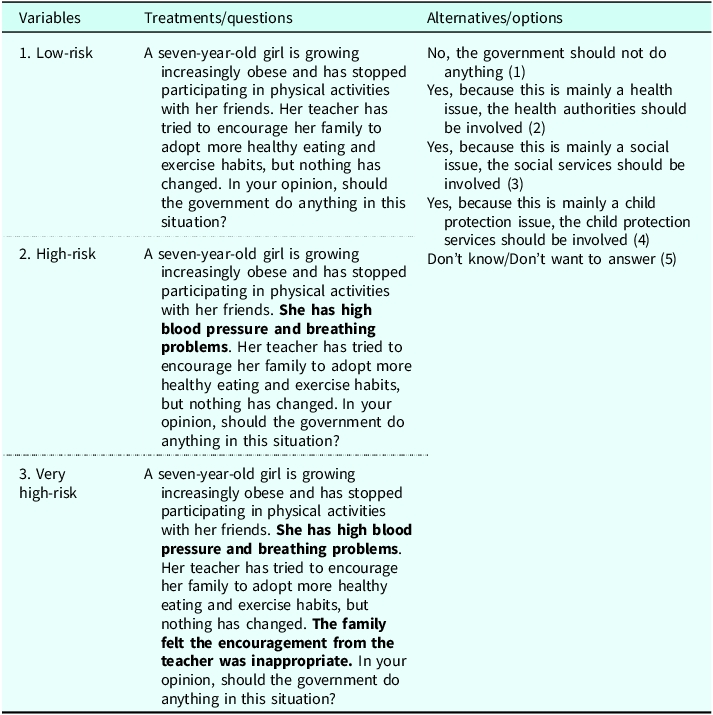
We designed a vignette experiment with three treatment conditions varying in the severity of risk to the child: Treatment 1 presents no notable risk (low-risk baseline); Treatment 2 adds severe health risks to the child (high-risk); and Treatment 3 adds parental objection to an external nudge (very high-risk). The three vignettes, with treatments in bold and response alternatives, are shown in Table 1. We identify a seven-year-old girl in the vignette for four reasons. First, research on childhood obesity documents both acute and chronic effects in young children, underlining the seriousness of the issue (Cawley & Spiess, Reference Cawley and Spiess2008). Second, young children’s eating patterns depend directly on the foods parents make available. Third, because the public most strongly supports school-based interventions, we selected an age at which children across the OECD are typically in primary school. Fourth, a fixed age and gender allow consistent comparison across respondents and countries. We do not define ‘obese’ or specify how it is measured, a contested area in the literature (Burkhauser & Cawley, Reference Burkhauser and Cawley2008; Puhl et al., Reference Puhl, Lessard, Foster and Cardel2022; Robinson & Kersbergen, Reference Robinson and Kersbergen2017). How a respondent conceptualises obesity may itself reflect their attribution of the problem. We capture this through response alternatives framing the situation as a health, social or child protection issue (see Table 1, right column).
Treatment variables

Table 1. Long description
A table comparing government intervention options for a seven-year-old girl’s obesity across different risk levels. The table has three rows and three columns. Column headers are Variables, Treatments/questions, and Alternatives/options. Row 1: Variables, Low-risk, A seven-year-old girl is growing increasingly obese and has stopped participating in physical activities with her friends. Her teacher has tried to encourage her family to adopt more healthy eating and exercise habits, but nothing has changed. In your opinion, should the government do anything in this situation? Alternatives/options, No, the government should not do anything (1); Yes, because this is mainly a health issue, the health authorities should be involved (2); Yes, because this is mainly a social issue, the social services should be involved (3); Yes, because this is mainly a child protection issue, the child protection services should be involved (4); Don’t know/Don’t want to answer (5). Row 2: Variables, High-risk, A seven-year-old girl is growing increasingly obese and has stopped participating in physical activities with her friends. She has high blood pressure and breathing problems. Her teacher has tried to encourage her family to adopt more healthy eating and exercise habits, but nothing has changed. In your opinion, should the government do anything in this situation? Alternatives/options, No, the government should not do anything (1); Yes, because this is mainly a health issue, the health authorities should be involved (2); Yes, because this is mainly a social issue, the social services should be involved (3); Yes, because this is mainly a child protection issue, the child protection services should be involved (4); Don’t know/Don’t want to answer (5). Row 3: Variables, Very high-risk, A seven-year-old girl is growing increasingly obese and has stopped participating in physical activities with her friends. She has high blood pressure and breathing problems. Her teacher has tried to encourage her family to adopt more healthy eating and exercise habits, but nothing has changed. The family felt the encouragement from the teacher was inappropriate. In your opinion, should the government do anything in this situation? Alternatives/options, No, the government should not do anything (1); Yes, because this is mainly a health issue, the health authorities should be involved (2); Yes, because this is mainly a social issue, the social services should be involved (3); Yes, because this is mainly a child protection issue, the child protection services should be involved (4); Don’t know/Don’t want to answer (5).
The three treatments were randomly assigned to respondents both within each country and across the total sample (see Table A2). Since the goal is to estimate treatment effects rather than maximise predictive fit, randomisation ensures the treatment coefficient remains unbiased. Randomisation checks were conducted on eight background variables: age, gender, education, presence of a partner, having children, employment status and income. A one-way ANOVA found no significant imbalance across treatment groups on six of the eight variables; minor differences were found for presence of a partner and employment status (see Table A3).
Dependent variable: The dependent variable is public support for government involvement in childhood obesity (yes/no). Values 2, 3, or 4 are coded as ‘yes’; value 1 is coded as ‘no’. Value 5 is treated as missing (NA).
Independent variables: The independent variables are level of risk to the child, general trust and political value preferences. Risk to the child is operationalised through the three experimental conditions (low-risk, high-risk and very high-risk).
General trust is a continuous variable scaled 0–1, where higher values indicate greater trust. It is constructed as an average of three subscales: trust in institutions (ten items; Trust1), trust in the child protection system (three items; Trust2), and trust in people and institutional actors (six items; Trust3) (see Tables A5–A9).
Political value preferences is a categorical variable with three categories: freedom, care and order, with freedom as the reference category. Operationalisation follows Swedlow and Wyckoff (Reference Swedlow and Wyckoff2009), presenting respondents with three pairs of contrasting political values and asking them to choose one from each pair (see appendix Tables A10–A11).
Sociodemographic control variables are age (reference: young), gender (reference: female), religiosity (reference: not religious), education (reference: lower-level), presence of a partner (reference: no partner), having children (reference: no children), employment status (reference: employed) and income (reference: lower-level) (see appendix section 2.1 ‘Background Variables’).
Analytic approach
We used RStudio (version 4.4.2, October 31, 2024) for all analyses except the multinomial logistic regression, in which Stata (version SE 18.5, April 2024) is used. We apply post-stratification weights unless otherwise mentioned. We conduct binary and multinomial logistic regressions. The binary analyses include five models. Model 1 examines the risk experiment, with high-risk as the reference, which is included in all subsequent models. Model 2 examines general trust; Model 3 examines political core values with freedom as the reference, and in Model 4, the risk experiment and background variables are examined. Model 5 includes all variables. Country fixed effects are included. We report the odds ratio in our regression analyses, as they are intuitively interpretable. Standard errors are reported in parentheses, significant differences are denoted as *p < 0.05, **p < 0.01, ***p < 0.001. We also provide binary regression with low-risk as the reference in Table A12 and model evaluations of the main binary logistic regression analyses in Table A13.
In the appendix, we present multinomial logistic regression analyses to understand the relationship between intervention alternatives (no intervention, health issue, social issue and child protection issue) (see Table 1). We performed two models based on Model 1 (Table A14) and Model 5 (Table A15) specifications from the binary logistic regressions, with respondents choosing the child protection issue as the reference outcome group. In Figure 2, descriptive country results are presented (see also Table A16).
Map of countries included in the survey (countries are listed in Table A1).

Share of respondents who favour government responsibility across risk treatments.
Notes: The figure shows the share of respondents who favour government responsibility for intervention per treatment for each country. Numerical values per country and per treatment can be seen in Table A16. Calculation excludes observations that answered the option ‘Don’t know’ and ‘Refused to answer’.

Limitations
This study’s key coverage of forty countries, its representative adult samples and its experimental comparative design are key strengths, but there are several limitations. As with all surveys, respondents may interpret questions differently, and some linguistic inconsistencies may remain despite careful translation and expert review. The ‘very high-risk’ condition, defined as parental resistance, is not a fully adequate expression of risk, which we recognise as a design flaw. The study presents each respondent with a single vignette featuring a seven-year-old girl in primary school, and focuses attention on a common, cross-nationally recognisable situation, consistent with vignette-based methods used in prior international comparative research (Barter & Renold, Reference Barter and Renold2000; Finch, Reference Finch1987; Soydan, Reference Soydan, Hantrais and Mangen1996). Prior research shows that public attitudes toward childhood obesity vary by the age and gender of the child described (Gollust & Lantz, Reference Gollust and Lantz2009; Puhl & Heuer, Reference Puhl and Heuer2009). The distinction between health, social and child protection issues is analytically motivated and does not reflect institutional organisation in the countries studied. These categories may also not fully capture whether respondents regard obesity as structural or individual. Finally, because respondents saw the vignette before the trust and values questions, post-treatment bias cannot be ruled out, though we believe this risk is limited, as such dispositions are stable and unlikely to shift in response to a brief vignette.
Findings
Descriptive results across all countries
In general, the data show strong public support (78 per cent) for a government response to childhood obesity. The results on each of the treatments show that 70 per cent of respondents favour government intervention in the low-risk scenario, 82 per cent favour intervention in the high-risk scenario and 82 per cent in the very high-risk scenario (see Table 2). The effect of risk is significant (p < 0.001) from low-risk to high-risk, but not from high-risk to very high-risk (p > 0.05) (see Table A4 for pairwise chi-square test). These findings support H1, and they partially support H2.
Public attitudes about a government response to childhood obesity

Table 2. Long description
The table presents data on public support for government intervention in childhood obesity across three risk scenarios: low-risk, high-risk, and very high-risk. It has two rows and five columns. The columns are labeled as Low-risk, High-risk, Very high-risk, and Pooled, with sub-columns for N and percent. The row labels are No government intervention and Government intervention. Row 1: No government intervention, Low-risk, N 3447, percent 30.33; High-risk, N 2144, percent 18.46; Very high-risk, N 2028, percent 17.57; Pooled, N 7619, percent 22.07. Row 2: Government intervention, Low-risk, N 7919, percent 69.67; High-risk, N 9472, percent 81.54; Very high-risk, N 9515, percent 82.43; Pooled, N 26906, percent 77.93.
Notes: The table shows the distribution of alternatives per treatment, along with the pooled total sample. Proportions calculation excludes observations that answered the option ‘Don’t Know’ and ‘Don’t want to answer’.
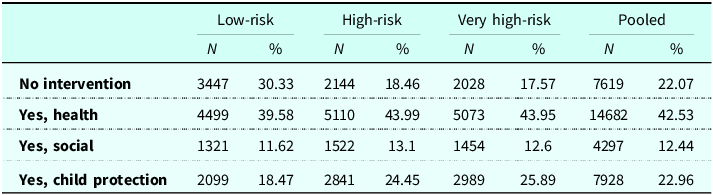
Respondents who favoured a government response typically regarded childhood obesity as a health issue (40–44 per cent from low- to high-risk). Fewer saw it as a child protection issue (18–24 per cent from low- to high-risk), and very few saw it as a social issue (12–13 per cent) (Table 3). With increased risk, significantly more respondents viewed the situation as a child protection issue (p < 0.001; Table A14) (see also multinomial regression analyses Table A14 and A15), confirming H6 (see Table 3).
How should the government respond to childhood obesity?

Table 3. Long description
The table presents data on how respondents view the government’s role in addressing childhood obesity, categorized by risk levels: low-risk, high-risk, very high-risk, and pooled. It has four columns: Low-risk, High-risk, Very high-risk, and Pooled, each with N and percent sub-columns. The rows are categorized into No intervention, Yes, health, Yes, social, and Yes, child protection. Row 1: No intervention, Low-risk: N 3447, 30.33 percent; High-risk: N 2144, 18.46 percent; Very high-risk: N 2028, 17.57 percent; Pooled: N 7619, 22.07 percent. Row 2: Yes, health, Low-risk: N 4499, 39.58 percent; High-risk: N 5110, 43.99 percent; Very high-risk: N 5073, 43.95 percent; Pooled: N 14682, 42.53 percent. Row 3: Yes, social, Low-risk: N 1321, 11.62 percent; High-risk: N 1522, 13.1 percent; Very high-risk: N 1454, 12.6 percent; Pooled: N 4297, 12.44 percent. Row 4: Yes, child protection, Low-risk: N 2099, 18.47 percent; High-risk: N 2841, 24.45 percent; Very high-risk: N 2989, 25.89 percent; Pooled: N 7928, 22.96 percent.
Notes: The table shows the distribution of alternatives per treatment for the total sample. Proportions calculation excludes observations that answered the option ‘Don’t Know’ and ‘Don’t want to answer’.
Binary logistic regression results on the total sample
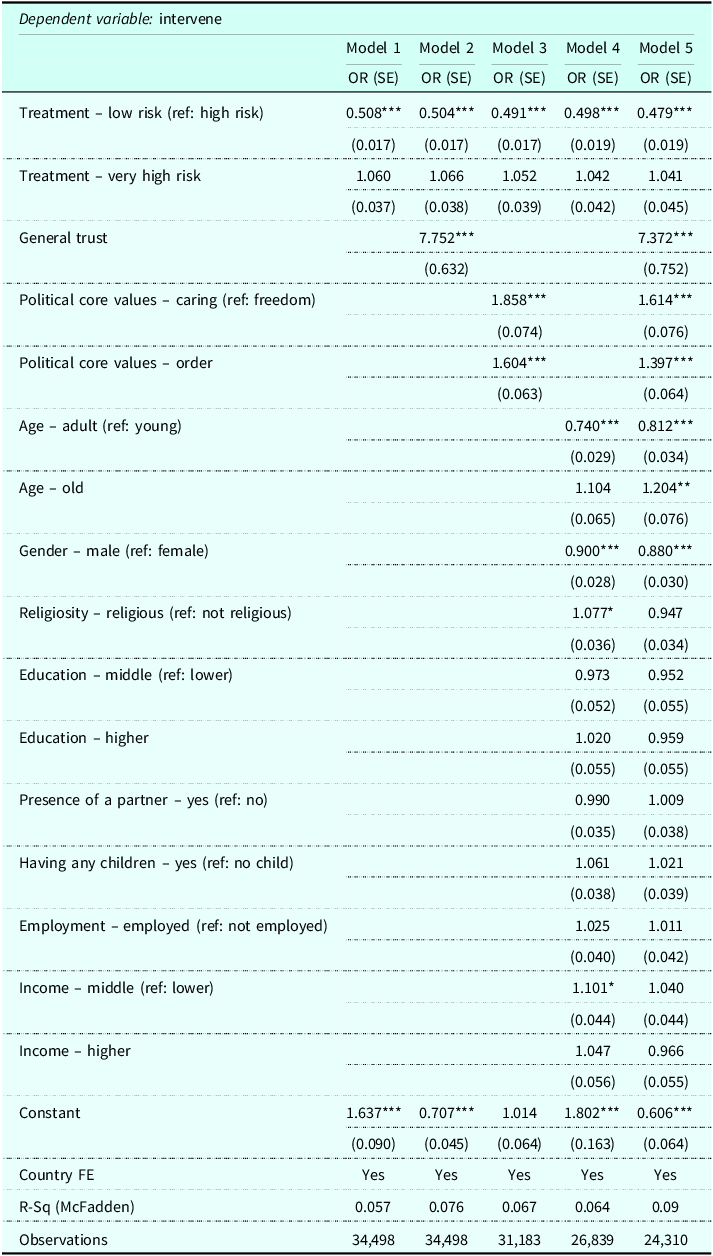
The stepwise binary regression results for five models on the dependent variable, support for government intervention, are shown in Table 4. Reporting on Model 5, the results show a strong effect of increased level of risk (OR = 0.479, p < 0.001) and no significant differences between the high and very high-risk groups. This confirms the chi-square results shown in Table A4. The analyses show that higher trust is associated with higher odds of supporting government intervention (OR = 7.732, p < 0.001). The result supports H3. Regarding political core value preferences, results indicate that respondents who are either care-dominant (OR = 1.614, p < 0.001) or order-dominant (OR = 1.397, p < 0.001) have higher odds of supporting government intervention. This supports both H4 and H5. Significant differences can also be found in some of the sociodemographic control variables, confirming H7. Adult respondents (aged —thirty-five to sixty-four years) have lower odds of supporting government intervention (OR = 0.812, p < 0.001) compared to younger respondents (aged —eighteen to thirty-four years). In contrast, older respondents (aged sixty-five years and above) have higher odds of supporting government intervention (OR = 1.204, p < 0.01) compared to younger respondents. Lastly, male respondents have lower odds of supporting government intervention compared to female respondents (OR = 0.880, p < 0.001). The model explains some variance in intervention support (McFadden’s R-squared = 0.09).
Binary logistic regression results

Table 4. Long description
The table presents binary logistic regression results for five models on the dependent variable, support for government intervention. It includes columns for Model 1 to Model 5, with each model showing odds ratios (OR) and standard errors (SE) for various predictors. Row 1: Treatment – low risk (ref: high risk) with OR values ranging from 0.508 to 0.479 and SE values around 0.017 to 0.019. Row 2: Treatment – very high risk with OR values around 1.060 to 1.041 and SE values around 0.037 to 0.045. Row 3: General trust with OR values around 7.752 to 7.372 and SE values around 0.632 to 0.752. Row 4: Political core values – caring (ref: freedom) with OR values around 1.858 to 1.614 and SE values around 0.074 to 0.076. Row 5: Political core values – order with OR values around 1.604 to 1.397 and SE values around 0.063 to 0.064. Row 6: Age – adult (ref: young) with OR values around 0.740 to 0.812 and SE values around 0.029 to 0.034. Row 7: Age – old with OR values around 1.104 to 1.204 and SE values around 0.065 to 0.076. Row 8: Gender – male (ref: female) with OR values around 0.900 to 0.880 and SE values around 0.028 to 0.030. Row 9: Religiosity – religious (ref: not religious) with OR values around 1.077 to 0.947 and SE values around 0.036 to 0.034. Row 10: Education – middle (ref: lower) with OR values around 0.973 to 0.952 and SE values around 0.052 to 0.055. Row 11: Education – higher with OR values around 1.020 to 0.959 and SE values around 0.055. Row 12: Presence of a partner – yes (ref: no) with OR values around 0.990 to 1.009 and SE values around 0.035 to 0.038. Row 13: Having any children – yes (ref: no child) with OR values around 1.061 to 1.021 and SE values around 0.038. Row 14: Employment – employed (ref: not employed) with OR values around 1.025 to 1.011 and SE values around 0.040 to 0.042. Row 15: Income – middle (ref: lower) with OR values around 1.101 to 1.040 and SE values around 0.044. Row 16: Income – higher with OR values around 1.047 to 0.966 and SE values around 0.056 to 0.055. Row 17: Constant with OR values around 1.637 to 0.606 and SE values around 0.090 to 0.064. The table also includes country fixed effects (Country FE) and McFadden’s R-squared values ranging from 0.057 to 0.09. The number of observations ranges from 24,310 to 34,498.
Notes: The table reports logistic regressions with weighted data for the total sample in odds ratios that asked respondents whether the government should intervene in child obesity cases or not (dependent variable: intervene). Independent variables included are the treatment allocation on which risk the vignette is associated with, value on general trust and political core values of prioritising freedom, care and order. On the other hand, control or background variables included are age, gender, religiosity, education, presence of a partner, having any children, employment status,and income level. The regression analyses exclude the observations that answered ‘Don’t Know/Don’t Want to Answer’ and ‘NA’. Standard errors are reported in parentheses. *p < 0.05, **p < 0.01, ***p < 0.001.
Country-level results
There are variations between countries in public acceptance of government intervention (see Figure 2; see Table A16 for numerical overview). Offered the low-risk scenario, for example, respondents from South Korea, Portugal and Turkey were most likely to suggest a government response (85–83 per cent supporting). In contrast, respondents from Hungary, Israel and the U.S. were least likely to favour government involvement (51–47 per cent supporting). Given the high-risk scenario, countries such as Hungary, Israel and the U.S. continued to be least likely to favour a government response (65–61 per cent supporting), while respondents from Finland, South Korea and England were the most likely to favour government involvement (around 92 per cent supporting).
Country distribution of supporting government intervention with chi-square tests displays significant differences between the low- and high-risk treatments (see Figure 3) in thirty-four countries, and for one country for high-risk and very high-risk treatment (see Figure A1). Logistic regression results overall confirm these results (see Table A17), and thus partially confirm H2 for most countries. When other independent and sociodemographic variables are included (see Table A18), the number of countries exhibiting an affirmation of government intervention decreases to eighteen out of forty countries. General trust and political core values appear to have stronger effects on increasing the likelihood of supporting government intervention compared to the effect of risk. This also confirms H3, H4 and H5 for some countries. In general, countries that do not exhibit significant differences have a very high degree of support for government intervention, regardless of risk.
Support for government obesity intervention. Percentage of agree for each country, with low- and high-risk treatment (95 per cent CI, Chi-Square Test Results).
Notes: The figure shows the share of support for government intervention in low- and high-risk scenarios for each country. A similar figure, which shows three treatment categories and chi-square results per country, can be found in Figure A1. Calculations exclude observations that answered the option ‘Don’t Know’ and ‘Refused to answer’. *p < 0.05, **p < 0.01, ***p < 0.001.

Discussion
This study examines how the public across countries views government responsibility for childhood obesity. The results reveal that a clear majority of country populations support government involvement in addressing childhood obesity, with some notable exceptions. A second key finding is the causal effect of perceived child risk. Support for government intervention increases as the perceived severity of risk to a child rises, consistent with prior research (Berrick et al., Reference Berrick, Skivenes and Roscoe2023, Reference Berrick, Burns, Pösö, Roscoe and Skivenes2025a; Duan et al., Reference Duan, Jiang, Deng, Zhang and Wang2020; Lahat et al., 2024; Skivenes et al., Reference Skivenes, Falch-Eriksen and Hassan2024; Skivenes, Reference Skivenes2021). In some countries, however, support is high even in low-risk contexts. Consistent with prior research on trust and compliance (Tankebe, Reference Tankebe2019; Tyler, Reference Tyler2003), higher general trust correlates with greater support for government involvement, shaping public preferences on matters affecting children (see also Loen, Reference Loen2025). Political core values also matter: respondents who prioritise care or order are significantly more supportive of government action than those who prioritise freedom – a finding consistent with theory and with recent research on Nordic populations (Skivenes & Križ, Reference Skivenes and Križ2026). Support varies notably between countries, with the U.S., Israel, Hungary and the Czech Republic standing out for comparatively low support in the scenario presented.
Consistent with prior research (Gollust et al., Reference Gollust, Niederdeppe and Barry2013; Wolfson et al., Reference Wolfson, Gollust, Niederdeppe and Barry2015), the vast majority of respondents in our study frame childhood obesity as a health issue. About one-fifth frame childhood obesity as a child protection issue and view child protection authorities as the appropriate response. This resonates with the literature implicating parental behaviour in childhood obesity (Wolfson et al., Reference Wolfson, Gollust, Niederdeppe and Barry2015), though child protection is rarely involved, mainly where obesity coincides with serious comorbidities and unmet support needs (Kersh et al., Reference Kersh, Stroup and Taylor2011).
Strikingly few identify structural or societal mechanisms as contributing causes. This individualisation of the problem has direct policy implications, made sharply clear by The Lancet’s 2025 article on ultra-processed foods (UPFs) (Matji & Brero, Reference Matji and Brero2025). The UPF industry shapes food environments through digitally targeted marketing to children, school and sports sponsorship, and strategies to weaken or delay regulation, including doubt-generating research and the co-opting of public health organisations (Baker et al., Reference Baker, Slater, White, Wood, Contreras, Corvalán, Gupta, Hofman, Kruger, Laar, Lawrence, Mafuyeka, Mialon, Monteiro, Nanema, Phulkerd, Popkin, Serodio, Shats, Van Tulleken, Nestle and Barquera2025). In a 2023 UNICEF survey across twenty-four countries, 70 per cent of officials and civil society representatives cited industry influence as a major barrier to food marketing restrictions for children (Matji & Brero, Reference Matji and Brero2025). When the public attributes obesity primarily to individual choices, it obscures this structural reality and reduces pressure on governments to confront industry power. In the U.S., for example, debate has long focused on parents: studies since the early 2000s consistently find that over 90 per cent of the public attributes childhood obesity to parental behaviour (Barry et al., Reference Barry, Brescoll and Gollust2013; Evans et al., Reference Evans, Finkelstein, Kamerow and Renaud2005). Framing obesity as individual failure increases stigma (Luck-Sikorski et al., Reference Luck-Sikorski, Riedel-Heller and Phelan2017) and reduces support for treatment (Lund et al., Reference Lund, Sandøe and Lassen2011), with a Danish study finding citizens less willing to fund obesity treatment than smoking-related disease (Lund et al., Reference Lund, Nielsen and Sandøe2015). Our finding that few respondents identify structural causes thus signals a significant obstacle for effective policy. Acceptability also varies by intervention type and respondent characteristics (Diepeveen et al., Reference Diepeveen, Ling, Suhrcke, Roland and Marteau2013): less intrusive measures attract broader support, while heightened risk, as during health crises, tends to raise support for restrictive measures (Banerjee et al., Reference Banerjee, Savani and Shreedhar2021).
Concluding remarks
This study examines how different welfare regimes translate children’s rights into policy and administrative practice. This rights-based framing situates national differences within a shared international standard. Under the CRC, states carry a duty to protect children’s rights, and childhood obesity falls squarely within the government’s responsibility to ensure children’s health under Article 24. Policies addressing food systems, advertising, affordability and access to healthy food can reduce the burden on parents and support obesity prevention (Matji & Brero, Reference Matji and Brero2025; The Lancet, 2025; UNICEF & GAIN, 2019; UNICEF, 2019). This shifts the focus from parental failure to the government’s responsibility to build healthier environments (Duramy, Reference Duramy2018; UNICEF & UNHRC, 2019). Researchers increasingly agree that childhood obesity is a serious public health concern, with causal mechanisms spanning environment, food availability, cost, advertising, human behaviours and genetics. For school-age children, school-based interventions promoting health behaviours are widely regarded as the most politically feasible approaches, with evidence of modest effects. Our study confirms public support for government-sponsored, health-focused interventions, particularly for higher-risk child populations. As childhood obesity remains a public health challenge, policymakers must keep testing approaches that balance public health goals with respect for family privacy.
Supplementary material
The supplementary material for this article can be found at https://doi.org/10.1017/S0047279426101627
Acknowledgements
We are grateful for the insightful comments from seminar participants and colleagues at the University of Bergen. Many thanks to reviewers and editors for very important feedback and comments.
Funding statement
This project has received funding from the European Research Council (ERC) under the European Union’s Horizon 2020 research and innovation programme (grant agreement no. 724460) and from the Research Council of Norway and University of Bergen under the Research Programme Large-scale Interdisciplinary Researcher Project (Fellesløft IV) (grant no. 324966).
Disclaimer: Publications from the project reflect only the authors’ views, and the funding agency is not responsible for any use that may be made of the information contained therein.
Competing interests
The author(s) declare none.





 Open access

