1 Introduction
The syntax and semantics of when is intriguing since when occurs in four different types of clause, as illustrated below (data extracted from the British National Corpus (BNC; Hoffmann & Evert Reference Hoffmann and Evert2018); corpus tags are given in square brackets).
First, when is the wh-word in a wh-question.
(1) When did you start acting? [A06 2313]
Second, when introduces a temporal adverbial clause.
(2) When the tap on the bar is operated, gas forces the beer to the bar. [A0A 62]
(3) It was when the semi-public nature of family matters became the subject of attention that the sources of the legitimacy of the state, the Irish nation, the church, democracy, were brought into conflict. [A07 950]
(4) We are obviously not there when someone is being tortured or killed. [A03 642]
Third, when introduces a free relative.
(5) I really hated when John lied like that. (Hall & Caponigro Reference Hall and Caponigro2010: 547)
(6) His hands were manacled behind his back except when he ate or slept. [A03 549]
Fourth, when introduces a headed relative clause, the head of which is a temporal noun phrase.
(7) He said there was never a day when he did not believe they would survive. [A1V 686]
(8) This is the occasion when a reader can visit the same show and make a personal assessment of how helpful the art critic has been. [A04 1215]
(9) We live at a time when reporters go to foreign countries where there is trouble and come back to write books in which they say that it was hard to make out what was going on. [A05 732]
Existing accounts of when-clauses distinguish when-interrogatives from other when-clauses (Bresnan & Grimshaw Reference Bresnan and Grimshaw1978) but argue that when-clauses as subjects, objects and adverbials are all free relatives (Grimshaw Reference Grimshaw1977; Bresnan & Grimshaw Reference Bresnan and Grimshaw1978; Hall & Caponigro Reference Hall and Caponigro2010). In this article we first focus on a puzzling type of when-clause, which is more like a headed relative than a temporal adverbial though it is substantially different from typical headed relatives. We will then formulate a novel account of headed when-relative clauses, when-adverbial clauses and when-free relatives. We leave out the when in interrogative clauses because it involves the issue of interrogation, which requires the space of another article. The description and preliminary analysis of newly discovered when-clauses will be presented in section 2. In section 3, existing accounts of the syntax and semantics of various types of when-clause are reviewed. In section 4, a formal account of the syntactic generation and interpretation of four types of when-clause is formulated in the framework of Dynamic Syntax (Kempson et al. Reference Kempson, Meyer-Viol and Gabbay2001; Cann et al. Reference Cann, Kempson and Marten2005). In section 5, the theoretical implications of this article are outlined by comparing the current account and the latest theoretical characterization of relatives with a double-head assumption (Cinque Reference Cinque2020). Section 6 is the conclusion of the article.Footnote 2
2 Newly discovered when-clauses
A headed relative clause in English has been defined in the literature as a clause that is embedded inside a nominal expression (DP) which it modifies (Alexiadou et al. Reference Alexiadou, Law, Meinunger, Wilder, Alexiadou, Law, Meinunger and Wilder2000), as illustrated in (10).
(10) the book [which John has read]
There is a relation of dependency between what is called the relative pronoun, e.g. which in (10), and the containing phrase, and this dependency is said to be instrumental in determining the interpretation of the construction, i.e. restrictive modification by the relative clause (Alexiadou et al. Reference Alexiadou, Law, Meinunger, Wilder, Alexiadou, Law, Meinunger and Wilder2000). The above definition of headed relatives is good enough to accommodate familiar headed relatives. The dependency between the head and the relative pronoun in a relative clause construction that matches this definition is also clear, the former being the latter's antecedent. Nevertheless, we note that there are some cases where the dependency between the head and the relative clause is not as clear as that shown above. These cases are illustrated by sentences (11)–(18). In these sentences, when-clauses immediately follow noun phrases, as marked in italics.
(11) I shall never forget his expression when he saw me arriving on my bicycle with its empty pannier bags. [G3B 1029]
(12) I remember my attitude when the Council of Europe recently passed a resolution calling for an armed intervention force in Yugoslavia under the aegis of the United Nations. [HHW 1235]
(13) One can imagine his dismay when he returned to the port and found the ship had gone, either earlier than planned or because the crew didn't want to be caught helping him. [A67 1064]
(14) The curve of her neck and throat and jaw for example, the look in her eyes when she was amused, her ability to crack all her knuckles simultaneously. [AD9 2180]
(15) Lineker also reveals his anger when Taylor criticized him after an international against the Republic of Ireland and when he was dropped 24 hours before a friendly with France. [CBG 8178]
(16) I remember my excitement when I had arrived there for the first time from St Aubyn's. [H0A 933]
(17) But, as she all at once realized that he thought, actually thought, that she had been pumping his secretary about him, so a tide of pink warmed her cheeks, and, Nothing! she exclaimed hotly, more startlement hitting her as it dawned on her that this then was the reason for his fury when he'd seen them together. [JYF 893]
(18) ‘I will never forget the sight and smell of the place when we arrived,’ said [gap:name]. [HRT 1628]
There is evidence, from interpretation, that the when-clauses in sentences (11)–(18) are restrictive modifiers of the noun phrases that immediately precede them, as shown below. Three natives speakers we consulted recognized the when-clauses as restrictive modifiers of the preceding noun phrases and provided paraphrases for the sentences in (11)–(18), listed correspondingly as (19)–(26), where the meanings of the when-clauses in (11)–(18) are paraphrased in three ways: an adverbial clause embedded in a relative clause, such as (19a, b, c), (20a, b, c), (21a, b), (22a), (24a, b, c), (25a, b) and (26a); a when-adverbial clause subordinate to a main clause, such as (23a) and (26c); an adjectival phrase plus a relative clause, such as (22c), or a prepositional phrase, such as (21c), (22b) and (23c).
(19)
(a) The speaker will not forget the expression he saw when he arrived on his bike.
(b) I will never forget the expression he had that time he saw me arriving on my bicycle with its empty pannier bags.
(c) I won't forget the expression that he made when I arrived.
(20)
(a) The speaker remembers the attitude he had when the Council of Europe passed the resolution.
(b) I remember the attitude that arose within me that time the Council of Europe passed a resolution calling for an armed intervention force in Yugoslavia under the aegis of the United Nations.
(c) I remember my attitude that time that the Council of Europe recently passed a resolution calling for an armed intervention force in Yugoslavia under the aegis of the United Nations.
(21)
(a) You can understand what he felt when he saw the ship was gone.
(b) You can imagine his pain from the time that he returned to the port and found the ship had gone.
(c) One can imagine the dismay of returning to port and finding the ship had gone.
(22)
(a) The curve of her neck and throat and jaw for example, how her eyes look when she is amused.
(b) The curve of her neck and throat and jaw for example, the look of her amused eyes, her ability to crack all her knuckles simultaneously.
(c) The curve of her neck and throat and jaw, the amused look she gave, her ability to crack all her knuckles simultaneously.
(23)
(a) Lineker was angry when Taylor criticized him and when he was dropped and he reveals that.
(b) Lineker also reveals his anger from Taylor criticizing him after an international against the Republic of Ireland and when he was dropped 24 hours before a friendly with France.
(c) Lineker revealed his anger with the situation where Taylor criticized him after an international against the Republic of Ireland and when he was dropped 24 hours before a friendly with France.
(24)
(a) The speaker remembers the excitement that he had when he arrived there.
(b) I remember the excitement I had arriving there for the first time from St Aubyn's.
(c) I remember the excitement that I felt arriving there for the first time.
(25)
(a) But, as she all at once realized that he thought, actually thought, that she had been pumping his secretary about him, so a tide of pink warmed her cheeks, and, ‘Nothing!’ she exclaimed hotly, more startlement hitting her as she realized this was why he was angry when he saw them together.
(b) But, as she all at once realized that he thought, actually thought, that she had been pumping his secretary about him, so a tide of pink warmed her cheeks, and, ‘Nothing!’ she exclaimed hotly, more startlement hitting her as it dawned on her that this then was the reason for his fury at seeing them together.
(c) But, as she all at once realized that he thought, actually thought, that she had been pumping his secretary about him, so a tide of pink warmed her cheeks, and, ‘Nothing!’ she exclaimed hotly, more startlement hitting her as it dawned on her that this then was the reason for the fury that he had upon seeing them together dawned on her.Footnote 3
(26)
(a) The speaker will never forget how the place smelled when he/she arrived.
(b) I will never forget the sight and smell the place had upon our arrival.
(c) When we arrived, the place had a particular smell and sight, and I will never forget that particular smell and sight.
Possibly, other native speakers may come up with more different paraphrases, but we believe that the three informants’ input suffices to show that the when-clauses are restrictive modifiers of the preceding noun phrases in (11)–(18); in this sense, they are relative clauses.
There is other evidence that the when-clauses are relative clauses rather than temporal adverbial clauses that restrict the main clauses.
First, they cannot be fronted as temporal adverbial clauses can. Examples (27a, b) show that when-adverbials can be fronted and (28a, b) demonstrate that the when-relatives are ungrammatical for the interpretation where the when-relative modifies the head noun those moments; similarly, sentences (29a, b, c), where when-clauses are fronted, are ungrammatical for the interpretation where the when-clauses are intended to modify the noun phrases given in italics.
(27)
(a) When someone is ill with AIDS they are often in pain. [A01 185] [when-adverbial]
(b) They are often in pain when someone is ill with AIDS. [when-adverbial]
(28)
(a) In those moments when a light was a dream or a miracle, you were light in that darkness. [A03 676] [relative]
(b) *When a light was a dream or a miracle, in those moments, you were light in that darkness.
(29)
(a) *When he saw me arriving on my bicycle with its empty pannier bags, I shall never forget his expression.
(b) *When the Council of Europe recently passed a resolution calling for an armed intervention force in Yugoslavia under the aegis of the United Nations, I remember my attitude.
(c) *When I had arrived there for the first time from St Aubyn's, I remember my excitement.
Furthermore, our informants indicate that even if the when-clauses in (29a, b, c) are intended to be interpreted as temporal adverbials, the sentences are still unacceptable in that the when-clauses do not meet the requirements of tense and aspect that familiar when-adverbial clauses meet (for a semantic account of the matching patterns of tense and aspect between main clauses and when-adverbial clauses, see Declerck Reference Declerck1991).
Second, when-relative clauses cannot be emphasized by the it-cleft construction as temporal adverbials clauses can be. Sentence (30) illustrates the case where a when-adverbial clause occurs in the it-cleft construction and (31)–(33) are examples of ungrammaticality caused by the occurrence of when-clauses in the it-cleft construction. In the latter three cases, the sentences are ungrammatical if the when-clauses are intended to be interpreted as adverbials that modify the main clauses because their tenses do not match; the sentences are still ungrammatical if the when-clauses are intended to be interpreted as modifiers of the noun phrases as they do in (11)–(18).
(30) It is when that figure falls below one-quarter that people begin to use the term ‘modular’, ‘unit-credit’, or its colloquial equivalents such as building-block, cafeteria, pick n'mix (or worse). [FA3 1424]
(31) *It is when he saw me arriving on my bicycle with its empty pannier bags that I shall never forget his expression.
(32) *It is when the Council of Europe recently passed a resolution calling for an armed intervention force in Yugoslavia under the aegis of the United Nations that I remember my attitude.
(33) *It is when I had arrived there for the first time from St Aubyn's that I remember my excitement.
To summarize, when-clauses can function as restrictive modifiers of noun phrases, which express either states of affairs or entities. This use of when-clauses is different from the use of when-clauses that modify temporal noun phrases, in which case the relative pronoun in the clause and the noun phrase are coreferential; it is also different from the use of when-clauses that restrict a main clause, in which case the when-clause functions as an adverbial clause. A question that arises is how the head noun phrase and the when-clause are semantically combined if the when-clauses at issue are restrictive relative clauses. We will propose an account of the semantic composition of the head noun phrase and the when-relative clause, where the two are semantically connected through temporal relatedness. To avoid confusion, we will dub the newly discovered when-relative described in this section the peculiar when-relative (henceforth whenp for brevity) and dub the when-relative that modifies a temporal noun phrase the familiar when-relative (henceforth whenf for brevity). Next, we review existing theories on temporal when-clauses, including when-adverbial clauses and when-relative clauses, so as to make clear in what sense our account advances theoretical understanding.
3 Existing theoretical accounts of when-clauses
Given fact that whenp-relative clauses can modify non-temporal noun phrases, we first consider existing work on how the syntactic connection between the relative clause and the head is constructed. Chomsky (Reference Chomsky, Culicover, Wasow and Akmajian1977) argues that there is a relationship of dependency between the head and a gap in the relative clause, while later research (for one of the most recent reviews, see Cinque Reference Cinque2020) on relatives debates whether the head is fronted from within the relative (Schachter Reference Schachter1973; Vergnaud Reference Vergnaud1974; Chomsky Reference Chomsky, Culicover, Wasow and Akmajian1977, Reference Chomsky, Hale and Keyser1993; Browning Reference Browning1991) or the head is base-generated where it appears and the relative is an adjunct to the head (Carlson Reference Carlson1977; Higgins Reference Higgins1979; Barss Reference Barss1986). One of the latest theoretical accounts of various types of relative clauses across languages suggests that both the relative and main clause involve the head, and, via either ‘raising’ or ‘matching’ and corresponding ‘deletion’ operations, different types of relative clauses are generated (Cinque Reference Cinque2020). However, the aforementioned whenp-relatives show that there is no explicit relationship of dependency between the heads and the relatives. Of course, there seems to be a way to fit the data in the theory. Some native speakers’ paraphrases, given as (19a, b, c), (20a, b, c), (21a, b), (22a), (23a), (24a, b, c), (25a, c) and (26a), seem to suggest that the relation of modification between the head noun phase and the whenp-relative like those in (11)–(18) can be accounted for by assuming a relative clause in which is embedded a when-adverbial clause. However, this analysis of whenp-relatives suffers from at least two problems, as far as we can see. First, assuming the presence of implicit relative clauses to account for how whenp-relative clauses and their non-temporal head nouns phrases are connected invites the question of how implicit relative clauses are recovered since they are not expressed. A solution to this puzzle comes from various theories of ellipsis formulated in the framework of generative grammar. But this solution is not quite appealing in that any syntactic and contextual conditions under which the implicit relative clauses can be recovered do not appear in the surface structure and neither have any such conditions been defined in the literature (see Aelbrecht Reference Aelbrecht2010; Merchant et al. Reference Merchant2001). Second, as can be seen in (19)–(26), different native speakers paraphrase whenp-relatives in different ways, some using relative clauses that subsume when-adverbial clauses but others not.
3.1 Existing work on the syntax of when-clauses
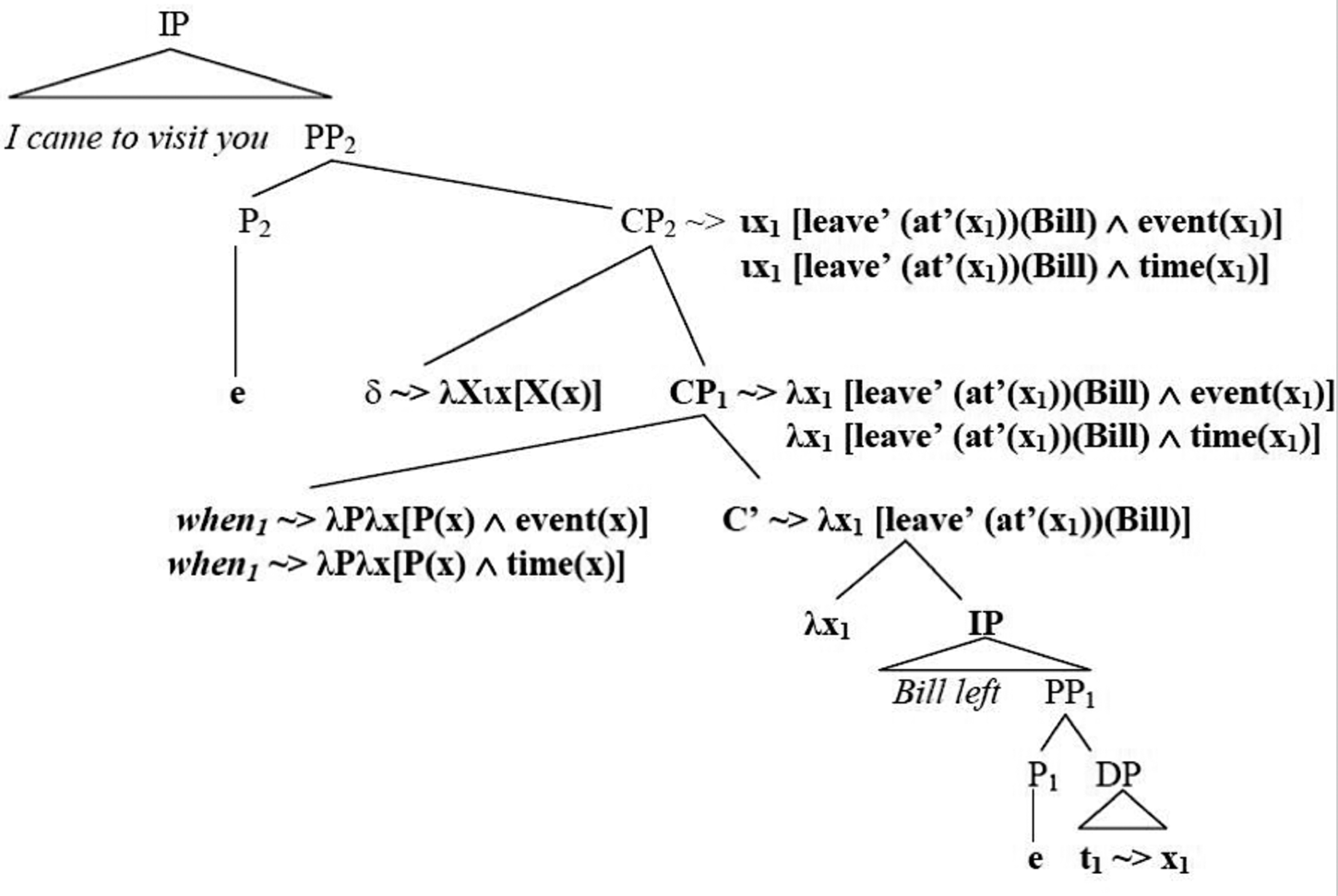
Hall & Caponigro (Reference Hall and Caponigro2010) propose an account of various temporal when-clauses, including when-adverbial clauses, whenf-relatives and when-free relatives. On this account, these different when-clauses are unitarily analyzed as referential expressions, which can be arguments of a verb or a preposition in the case where when-clauses appear as the subject or object complement of verbs or prepositions, while they are assumed to be the complement of a silent preposition in the case where they appear as a temporal adjunct. In addition, when itself, on this account, is assumed to be a referential expression which is fronted to the clause-initial position from the position of the complement of a silent preposition within the clause. The reason why they assume silent prepositions is that they want to explain the appearance of when as the complement of a verb or preposition and on the other hand they want this account of when to explain the similarity between when and prepositional phrases in terms of syntactic distribution. They base the assumption of a silent preposition within a when-clause on the fact that other expressions such as the other day, nice places and that way have been analyzed similarly in the literature (see Emonds Reference Emonds1976, Reference Emonds1987; McCawley Reference McCawley1988). Hall & Caponigro (Reference Hall and Caponigro2010) also argue that the assumption of a silent preposition is semantically motivated because without a preposition when cannot semantically combine with other expressions in the same sentence. Apart from assuming silent prepositions inside and outside the when-clause, Hall & Caponigro (Reference Hall and Caponigro2010) assume a silent syntactic operator ι, which has the function of a type shifter. ‘When ι applies to the denotation of CP1 (i.e. the set of time intervals or events when Bill left), it returns the maximal element of that set as the denotation of CP2’, as illustrated in (34) and figure 1 (Hall & Caponigro Reference Hall and Caponigro2010: 549).
(34) I came to visit you when Bill left.
I came to visit you when Bill left (Hall & Caponigro Reference Hall and Caponigro2010: 548)

As shown in figure 1, this account involves the assumption of two silent prepositions, one inside the relative clause and the other outside the relative clause. In spite of such theoretical cost, this account still suffers from two problems.
First, assuming implicit prepositions faces empirical challenges. Inserting a pronounced preposition in the syntactic position of the assumed silent preposition results in ungrammaticality, as shown in (35) and (36). While Hall & Caponigro (Reference Hall and Caponigro2010) suggest that this restriction may exist due to the recoverability of the content of the preposition from other elements in the sentence, they offer no theory about what the restriction is.
(35) I lived in Spain (*during/on/in/at) when I was five. (Hall & Caponigro Reference Hall and Caponigro2010: 550)
(36) I left the party (*during/on/in/at) when the band stopped playing. (Hall & Caponigro Reference Hall and Caponigro2010: 550)
Second, the assumption of silent linguistic elements is poorly restricted. This assumption predicts that other free relatives have similar behaviors, i.e. triggering the insertion of a silent preposition without which no interpretation can be achieved. This, apparently, is not empirically borne out. Consider the following examples.
(37)
(a) President Bush's recent pronouncements on what is just and moral during the Gulf war left me feeling empty and bitter. [A03 699]
(b) *President Bush's recent pronouncements what is just and moral during the Gulf war left me feeling empty and bitter.
(38)
(a) You'll find lists of publishers and what magazines look for in the Writers’ & Artists’ Yearbook (A & C Black, £7.95). [EFG 2292]
(b) *You'll find lists of publishers and what magazines look in the Writers’ & Artists’ Yearbook (A & C Black, £7.95).
(37a) and (38a) both involve a preposition; (37b) and (38b), however, are ungrammatical sentences because of the absence of the prepositions. These facts suggest that adverbial when-clauses are not free relatives although when-clauses as the complement of verbs or prepositions are. In other words, when-clauses as complements of verbs or prepositions and when-clauses as temporal adverbial clauses are not the same grammatically. As far as we can see, although Hall & Caponigro (Reference Hall and Caponigro2010) claim that assuming different types of when-clauses is not theoretically elegant, their theoretical account seems to achieve some presumed elegance at the expense of ignoring empirical facts. Furthermore, the fact that when-clauses function either like noun phrases or like prepositional phrases suggests that there are different types of when-clauses because noun phrases and prepositional phrases are grammatically different.
The syntax of when-relatives is also considered along with if-conditionals in the literature (Gregoromichelaki Reference Gregoromichelaki2006, Reference Gregoromichelaki, Kempson, Gregoromichelaki and Howes2011). The difference between when-clauses and if-clauses is mentioned but no account of them is provided. Furthermore, Gregoromichelaki (Reference Gregoromichelaki, Saka and Johnson2017) mentions that each predicate needs to be associated with an independent event/situation argument. This assumption can account for the data in (11)–(18) because the when-relatives therein can be analyzed as restricting an event/situation variable argument predicated by the modified noun phrase. However, as a consequence of that assumption, all DPs/NPs will come with event/situation arguments, which can be considered theoretically redundant. In the account we will propose and implement within the same theoretical framework, there is no need to make such an inflationary assumption.
3.2 Existing work on the semantics of when
Existing literature on the semantic properties of when-clauses considers two issues: one is the temporal relationship between the when-clause and the main clause; the other is the semantic contribution of when in establishing the temporal relationship between the two clauses. And the conclusions already drawn are based on English (see Isard Reference Isard1974; Ritchie Reference Ritchie1979; Declerck Reference Declerck1991; Hall & Caponigro Reference Hall and Caponigro2010) and other European languages, such as Italian (Bonomi Reference Bonomi1997), Danish, Swedish and Norwegian (Vikner Reference Vikner2004). What the existing accounts agree upon is that the when-clause sets up a temporal reference for specifying the temporal location of the event expressed by the main clause (Isard Reference Isard1974; Ritchie Reference Ritchie1979), but the specific temporal relation between the main clause event and the when-clause event depends on the tense and aspect properties of the two clauses (see Ritchie Reference Ritchie1979; Declerck Reference Declerck1991; Bonomi Reference Bonomi1997; Vikner Reference Vikner2004: for various temporal relationships between the two events in English, Italian and Danish). With respect to the semantic contribution of when, Bonomi (Reference Bonomi1997) and Vikner (Reference Vikner2004) treat when as an operator that takes two temporal meanings as its arguments and the sentence returns true if the two clauses/events have the temporal relationship of ‘overlap’ (in various ways). This operator account of when is criticized by Hall & Caponigro (Reference Hall and Caponigro2010), as we will explain immediately below. However, we will argue that the criticism is off target.
According to Hall & Caponigro (Reference Hall and Caponigro2010), the word when and the clause introduced by when are treated as syntactically and semantically different from all the other wh-words and wh-clauses in the previous accounts mentioned above, which do not provide alternative explanations for the strong evidence that leads to the opposite conclusion. Furthermore, the two authors argue that temporal when-clauses are taken to express a proposition/event in the very same way as the matrix clause although temporal when-clauses can be replaced and paraphrased with DPs or PPs, as illustrated in (39) and (40).
(39) I really hated [when John lied like that]/[DP the time(s) John lied like that]. (Hall & Caponigro Reference Hall and Caponigro2010: 547, ex. (17))
(40) I left [when Bill arrived]/[PP at the time Bill arrived]. (Hall & Caponigro Reference Hall and Caponigro2010: 547, ex. (18))
A second aspect of the operator account which Hall & Caponigro (Reference Hall and Caponigro2010) take to be a problem is that on this account when is not analyzed as a wh-word undergoing movement and leaving a trace. Therefore, no island-effects are expected while, as they argue, there are island-effects with when-clauses.
(41)
(a) I ate dinner [CP when Mary thought [CP that I should eat dinner]].
(b) I ate dinner [CP when1 Mary thought t1 [CP that I should eat dinner]]. Paraphrase: I ate dinner at a certain time and at that very same time Mary had the thought that I should eat dinner (at some later time).
(c) I ate dinner [CP when1 Mary thought [CP that I should eat dinner t1]].
Paraphrase: I ate dinner at a certain time and Mary had previously had the thought that I should eat dinner exactly at the time I did.
(d) *I ate dinner [CP when1 Mary made [DP the suggestion [CP that I should eat dinner t1]]].
According to Hall & Caponigro (Reference Hall and Caponigro2010), (41a) has two interpretations, i.e. when in (41a) indicates either the time of Mary's thinking that I should eat dinner or the time at which I should have dinner. Sentences (41b) and (41c) are two paraphrases of (41a) that make the two interpretations explicit. In (41b) and (41c), when, which appears in a higher clause, is assumed to have been moved from within a lower clause. Hall & Caponigro (Reference Hall and Caponigro2010) believe that the two interpretations of (41a) constitute the evidence that when undergoes a movement. In contrast, (41d) where the DP the suggestion intervenes is ungrammatical for the interpretation associated with (41b). Hall & Caponigro (Reference Hall and Caponigro2010) explain the ungrammaticality of (41c) with regard to the relevant interpretation by invoking the notion of a complex noun phrase island from within which no constituent can move out.
Additionally, Hall & Caponigro (Reference Hall and Caponigro2010) indicate that the temporal operator analysis incorrectly predicts that temporal arguments should freely occur inside the when-clause, which, they argue, is not borne out. According to their intuition, a temporal phrase cannot occur inside a when-clause, which they illustrate with the sentence given in (42).
(42) *I read [when you recommended at 5pm].
It can be straightforwardly argued that the first two problems are not real problems for the operator account of when. When-clauses behaving like either prepositional phrases or noun phrases suggests that there are distinct types of when-clauses, since prepositional phrases and noun phrases generally have different syntactic distributions and make different semantic contributions. Besides, although some temporal noun phrases can behave like when-clauses, not all noun phrases can be used in that way. For example, the location phrase the place cannot function as where does. This means that temporal noun phrases like the moment are peculiar in terms of function and it is the peculiarity of these temporal noun phrases that needs explanation. The theory that when is an operator that takes two clauses as its arguments does not exclude the possibility that the operator can have alternative underlying syntactic positions under the assumptions of the framework that Hall & Caponigro (Reference Hall and Caponigro2010) adopt; thus, the variable interpretation of sentences like (41a) and the ungrammaticality of (41c) can still be explained. In other words, the operator account can be intended as a way to just accommodate the semantic relationship between a main clause and a when-clause rather than cover every aspect of the behavior of when. The essence of the third problem, compared with that of the first two problems, is not so clear. If Hall & Caponigro's observation was reliable, what they notice would imply that when is in conflict with a temporal adverbial inside the clause it takes. Hall & Caponigro (Reference Hall and Caponigro2010) do take this observation to be evidence that when is part of a temporal adjunct inside the when-clause, and they assume that when is the complement of an implicit preposition, as indicated in the above review. Nevertheless, there is empirical evidence that Hall & Caponigro's observation is not sufficient to support the syntactic account that they propose. In some cases, a temporal adjunct can occur inside the when-clause even if there is no pause before the temporal adjunct, for example, John had left when Bill walked in at 3 p.m. (Hornstein Reference Hornstein1993: 63, ex. (48)). In this sentence, 3 p.m. is interpreted as modifying the clause Bill walked in. If Hornstein's observation is correct, Hall & Caponigro's claim is doubtable.
Although the operator account of when is not as problematic as Hall & Caponigro (Reference Hall and Caponigro2010) claim, it indeed requires some modification. The whenp-relative described in section 2 is a problem for this account because such relatives restrict a noun phrase rather than a clause. This fact cannot be directly captured in the operator account because whenp connects a noun phrase and a clause rather than connecting two clauses. In summary, the existing syntactic and semantic accounts of when-clauses are not sufficient to accommodate the facts that have been observed earlier in section 2.
4 At the syntax–semantics interface of various when-clauses
Having worked out the problems with the existing accounts of the syntactic and semantic properties of various whens, we now provide a lexicalist account of the generation of various when-clauses from a parsing perspective. This account is implemented in the framework of Dynamic Syntax (Kempson et al. Reference Kempson, Meyer-Viol and Gabbay2001; Cann et al. Reference Cann, Kempson and Marten2005; Gregoromichelaki & Kempson Reference Gregoromichelaki, Kempson, Mey and Capone2015; Kempson et al. Reference Kempson, Cann, Gregoromichelaki and Chatzikyriakidis2016), which provides sufficient and necessary theoretical tools and technical means to characterize complex lexical information. The work is to be carried out in two steps. The fundamental philosophy and theoretical tools of Dynamic Syntax are introduced first; then, a theoretical characterization of the syntactic and semantic properties of four whens is proposed.
4.1 The essentials of Dynamic Syntax
Using the Logic of Finite Trees (LOFT) (Blackburn & Meyer-Viol Reference Blackburn and Meyer-Viol1994), Dynamic Syntax aims to model the syntax of natural language from a parsing perspective, treating a sentence as a string of words that are processed one by one from left to right, triggering lexical rules. In addition, the application of universal and language-specific computational rules drives the binary growth of partial semantic tree-structures, enriches information inhabiting the nodes of the trees, and combines semantic information accumulated from online-parsing and context-based pragmatic inference so as to derive a propositional formula. In this approach to natural language syntax, the lexical information of words consists of a set of procedures which, in combination with the computational rules, account for syntactic structures of sentences.
4.2 Basic formal tools in Dynamic Syntax
The growth of the partial semantic tree (‘partial tree’ henceforth) is goal-driven. Setting goals and achieving goals are realized via applying general computational rules and lexically encoded operations (called lexical actions), which are part of lexical information. Lexical information can be represented as macros, which take the form of ‘IF…THEN…ELSE…’ statements. In these statements, the conditions under which some lexical actions will be executed are introduced by the ‘IF’ part. The lexical actions themselves are introduced in the ‘THEN’ part. ‘ELSE’ indicates the actions which are taken if the conditions in the ‘IF’-clause are not met. The action operators ‘make()’ and ‘go()’ respectively have the function of creating a new node that holds a tree-structural relationship to a current node, and move the pointer, which indicates the node currently under consideration, to another tree node. The operator ‘put()’ indicates how to annotate the current tree node with information, which consists mainly of requirements and/or semantic formulas. The zero-arity operator ‘abort’ has the function of terminating the parsing process if the ‘IF’ conditions are not met at the node where the pointer currently resides. DS also employs modalities from LOFT which, in combination with the LOFT tree-relations, function as operators which can indicate the tree-structural relationship between any two nodes on a partial tree. The existential modalities consist of an existential operator ⟨…⟩ combined with a tree-structural relation indicator. So does […], which is a universal operator. For example, the tree-structural modality operators ⟨↓0⟩ and ⟨↓1⟩ indicate a tree-structural relationship between the current node and another node, namely the argument daughter and function daughter respectively. In more detail, this is because the downward arrow, ↓, stands for a daughter node of the current node, and its reverse, ↑, stands for the mother node of a current node. The subscripted numerals ‘0’ and ‘1’ represent the argument type daughter and the functor type daughter respectively. Such operators can be applied recursively; for example, ⟨↑1⟩⟨↓0⟩, indicates the relationship between a functor-type tree node and its sister argument-type node. In addition, there are also inter-tree relationship connectors, i.e., the LINK operators ⟨L⟩ and ⟨L −1⟩. Their responsibility is to indicate information sharing between two partial trees that are growing in parallel. The LINK operators are used in the parsing of adjunct structures, relative clauses, coordination, discourse relations etc.
The information on a tree node varies but basically includes requirements, indicated by ‘?’, a logical type, such as ‘t’ (propositional type), ‘es’(event argument), ‘es→t’(event predicate), ‘e’(entity argument), ‘e→(es→t)’ (two-place functor) among others. As we've already said, there is also the pointer ‘♢’ that appears on a unique tree node to indicate that the node on which it appears is the current node in a parsing process. The pointer moves as a result of applying some general computational rules or applying the procedural actions contributed by an online-parsed word. Technically, each tree node is assigned a tree node address, indicated by the operator Tn(), the argument of which is a specific address defined relative to the address of the root node of a tree, conventionally Tn(0), with its argument-type daughter node having the address Tn(00) and its functor-type daughter node having the address Tn(01), with the address of any daughter node defined by adding ‘0’, if it is an argument node, or ‘1’, if it is a functor node, to the right of the address of its mother node.
4.3 A dynamic account of when-clauses
Now, we demonstrate how various types of when-clause are constructed and what different whens contribute to the generation and interpretation of when-clauses. Descriptively, there are four lexical entries associated with the phonological form when. One is whenp, e.g. (43), the other is whenf, which occurs within a familiar when-relative clause, e.g. (44). Another is whenad, which occurs in the when-adverbial clause, e.g. (45). The fourth is whenfree, as illustrated by (46).
(43) John remembers the smell when Mary arrived. (whenp-relative)
(44) John arrived on the day when Mary arrived. (whenf-relative)
(45) John arrived when Mary arrived. (whenad)
(46) John hates when Marry arrives. (whenfree)
Syntactically, whenp and whenf are rather similar, both immediately following an expression denoting an entity. But semantically, the two are not the same in that the former restricts a non-temporal expression while the latter restricts a temporal expression. Whenad is syntactically different from the former two because the clause in which it appears can appear in alternative syntactic positions, either preceding or following the main clause or even between the subject and predicate inside the main clause, although such when-clauses also provide temporal information. Free when-relative clauses behave as noun phrases do. Theoretically, as mentioned before, we take a lexicalist approach from a parsing perspective, assuming that there are four lexical entries associated with when and they carry different syntactic and semantic information, which we characterize in the form of macros of lexical information.
Our theoretical account of the four whens will be provided by demonstrating the processes of parsing the above four illustrative sentences. To save space, we omit the details in the process of parsing words within clauses and merely demonstrate the stages where when is parsed and how the semantic relationship between the when-clause and the main clause is established.
4.3.1 The dynamic syntax of peculiar when-relatives
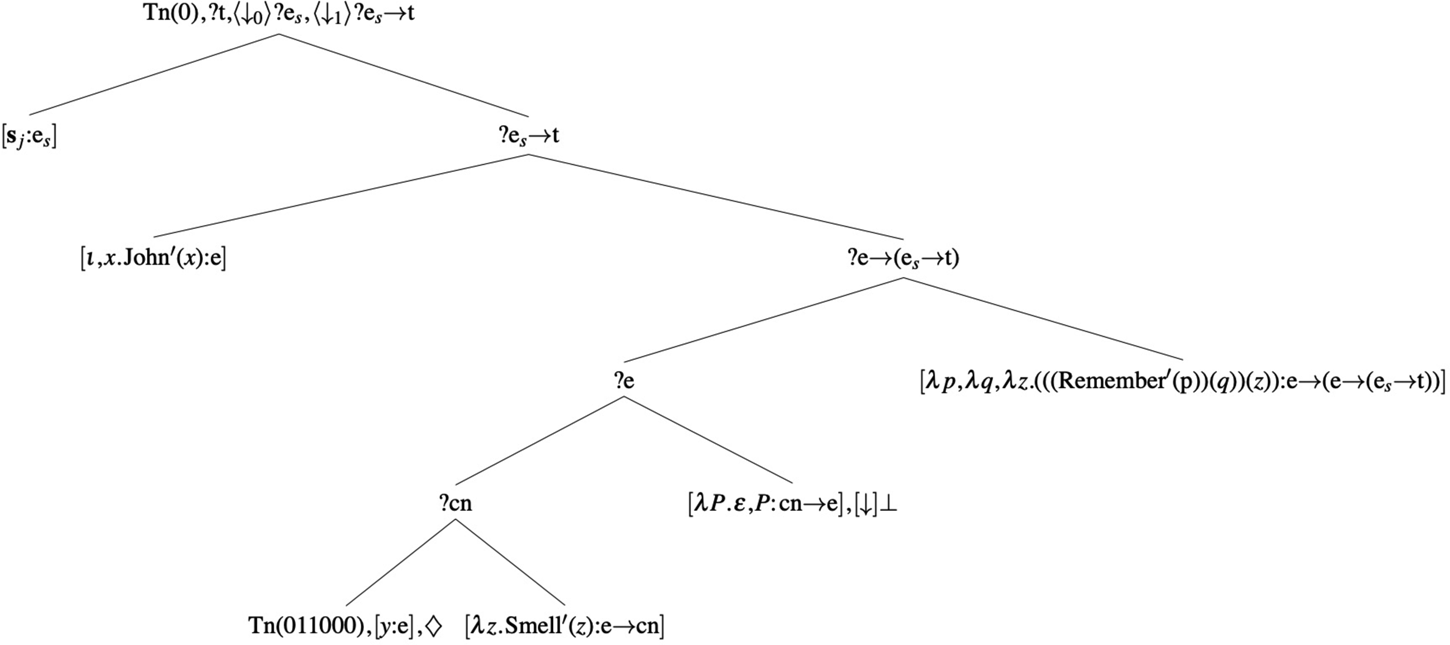
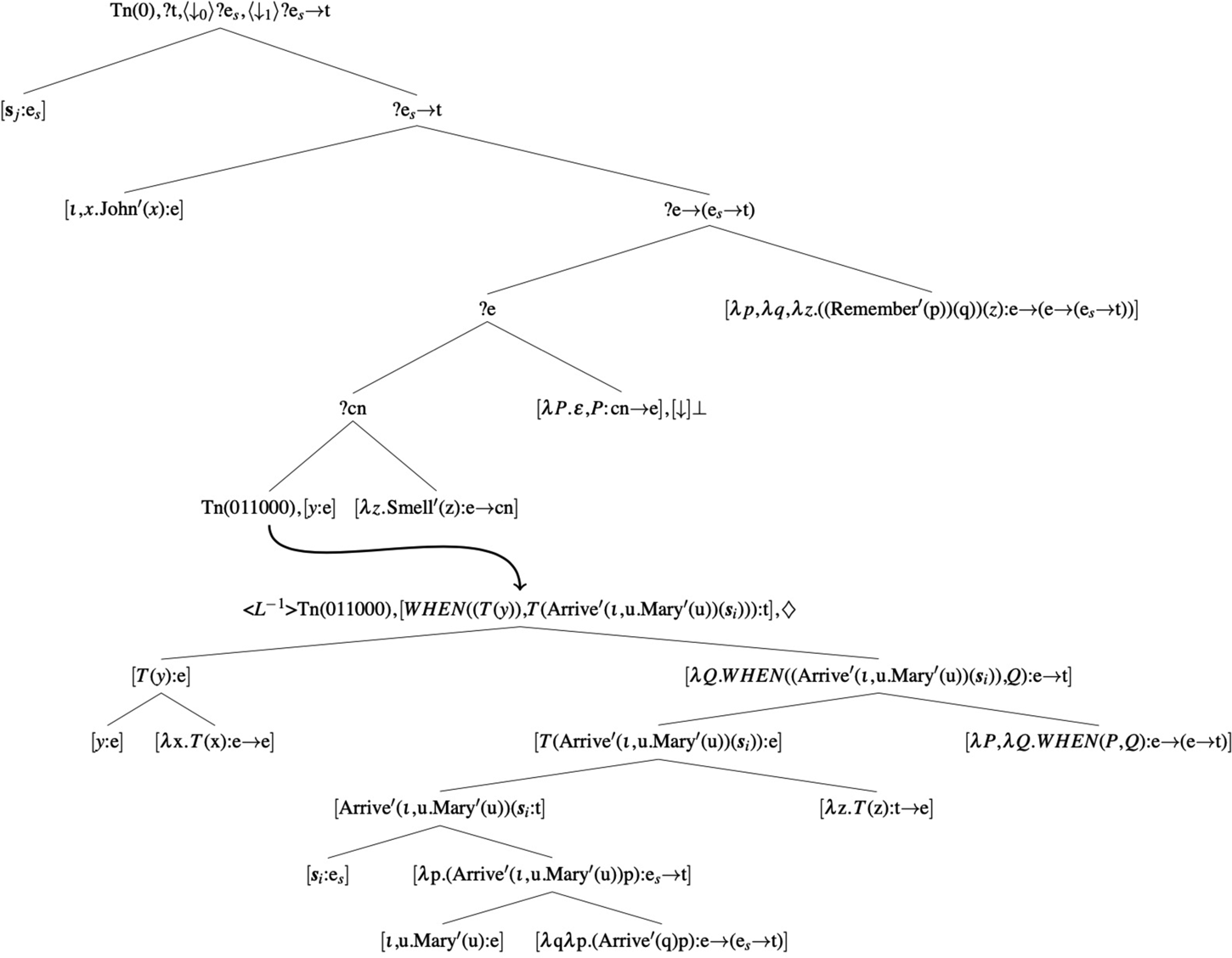
The process of parsing (43), represented as the growth of a binary semantic tree, starts with the axiomatic setting of an initial goal ?t on the root node of a growing binary semantic tree. The goal then splits into subgoals which are generated via applying some general parsing rules and satisfied by semantic content from online word parsing and pragmatic inference. After the lexical information from the parsed words has been processed, the partial tree grows into the state shown in figure 2.
After parsing John remembers the smell

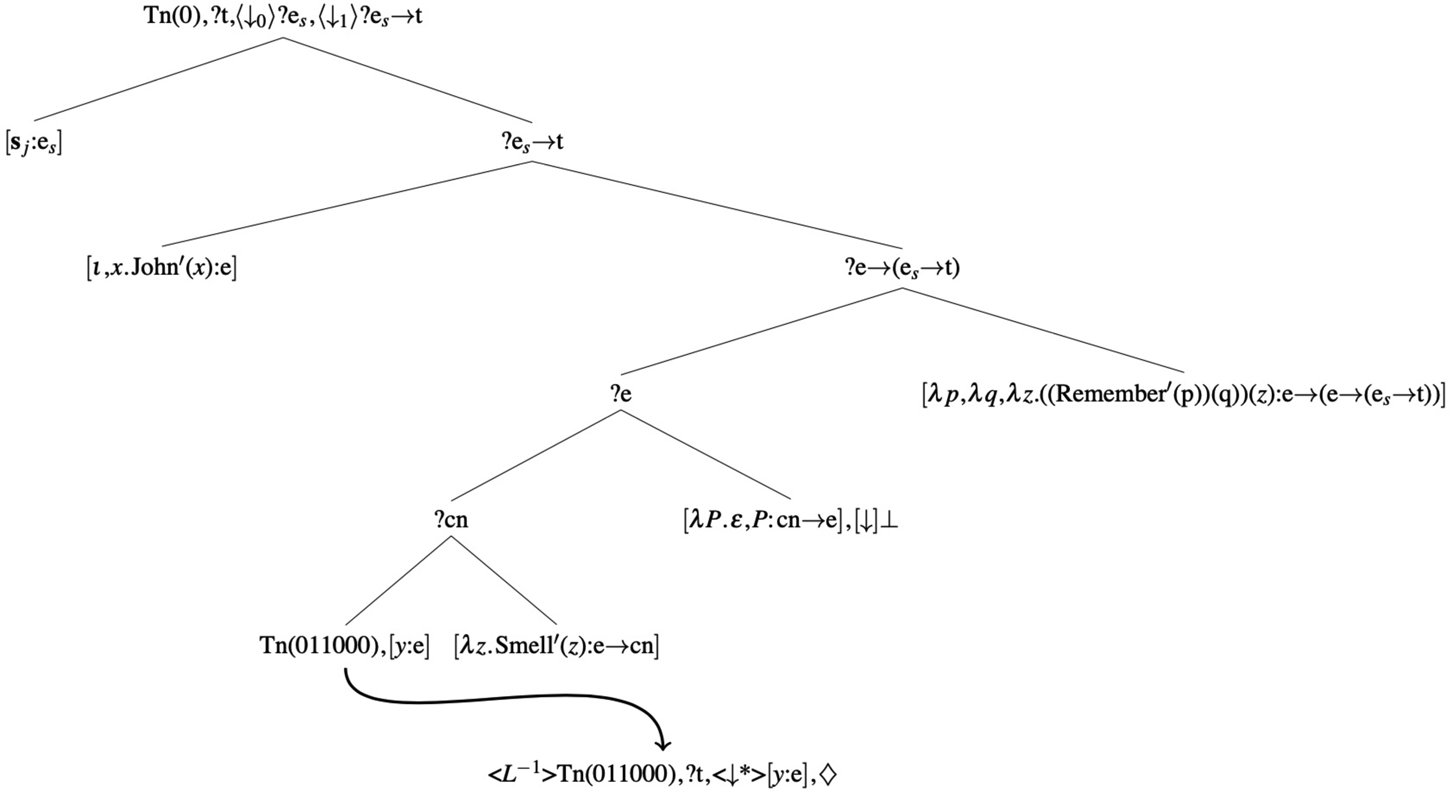
At this stage, the LINK ADJUNCTION rule is applied, which creates a LINK relationship between the current tree node and a tree node on another growing partial tree, which is to accommodate the semantic content of the relative clause (see figure 3).
The effect of applying LINK ADJUNCTION


At the current stage, whenp is parsed. The lexical information of whenp is defined below, which is a critical component of the current account of whenp-relatives. The lexical information of whenp consists of triggering conditions and lexical actions. The triggering conditions are that the pointer is located on the node LINKed to a node annotated with [y:e] and on the current node is a ?t and somewhere below the current node exists the formula [y:e]. Once these conditions are available, the actions in the ‘THEN’ clause are employed, updating the partial tree under construction; otherwise, the action in the ‘ELSE’ clause is applied, i.e. the parsing process is terminated.

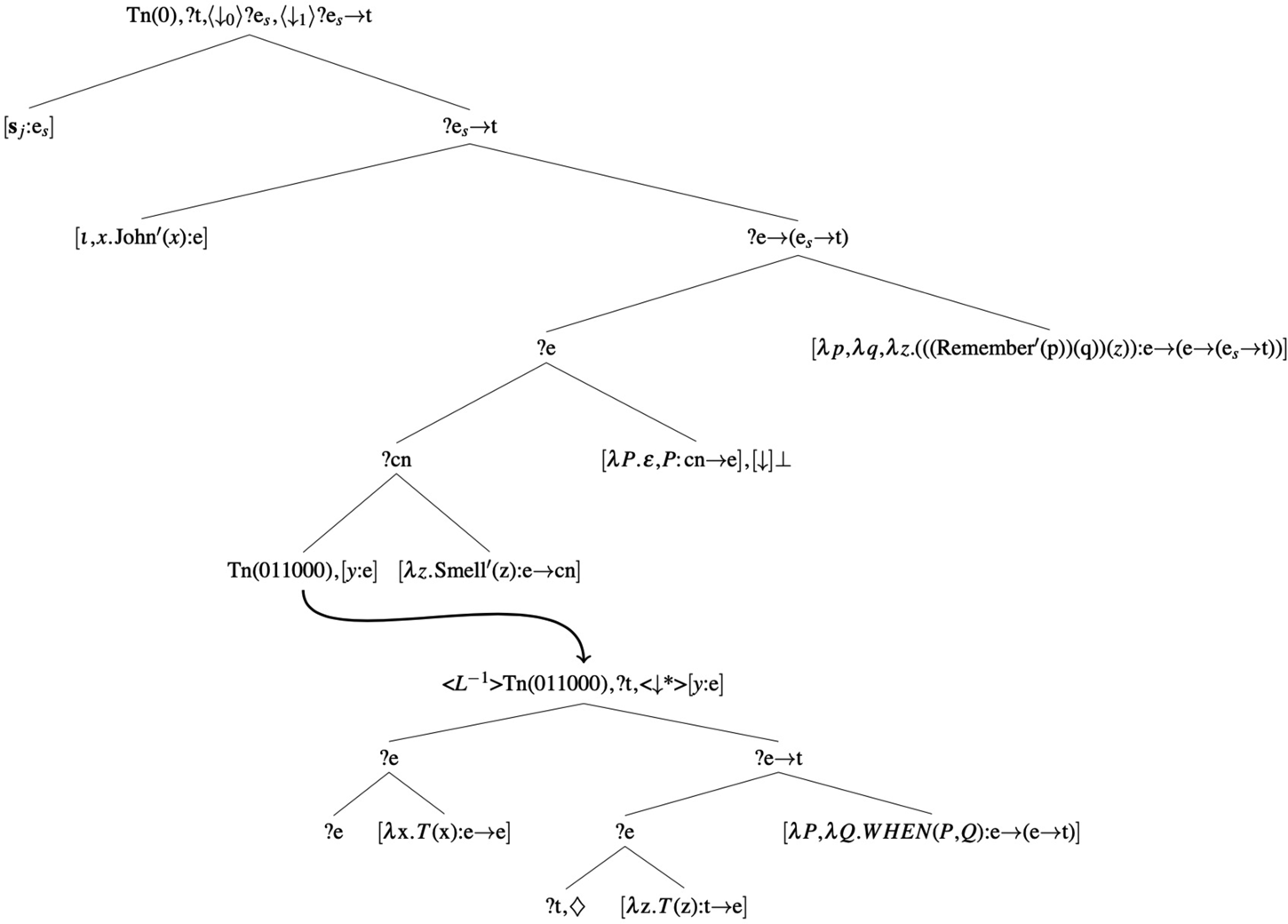
With the lexical actions in the ‘THEN’ clause in the lexical information of whenp applied, the LINKed tree is updated as shown in figure 4.
After parsing John remembers the smell when

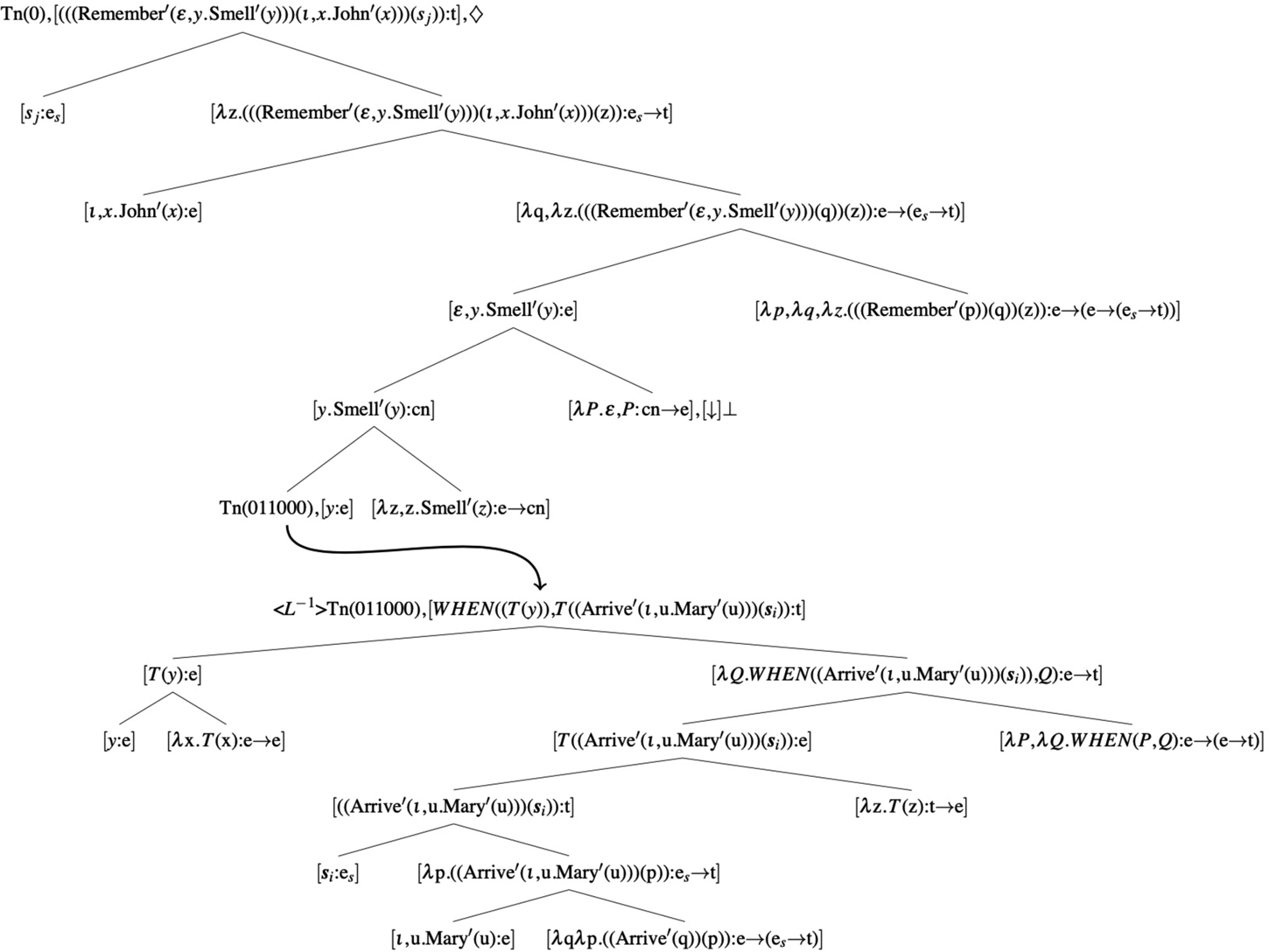
As shown in the definition of whenp and the updated tree, whenp contributes not only a package of lexical actions that drive the growth of the partial tree but also three functor- type formulas that are located on different tree nodes. The semantic content consists of two instances of the temporal operator T . The first instance takes an event and the other an entity to yield two temporal intervals. It also contributes the temporal-relationship predicate WHEN that identifies the temporal relationship between the two temporal intervals. With respect to the semantic function of T , we leave it open because, in some cases, a when-clause does not specify the event time but rather the reference time, as Hornstein (Reference Hornstein1993) and Demirdache & Uribe-Etxebarria (Reference Demirdache, Uribe-Etxebarria, Guéron and Lecarme2004) argue. Regarding the temporal relation that WHEN represents, we adopt the claim that it specifies sloppy simultaneity (see Declerck Reference Declerck1991: 48). Syntactically, the ?t that whenp contributes requires the parsing process to continue. With the pointer now located on a node with ?t, a series of events like those presented above take place, through which the string Mary entered is parsed. When no nodes on the two parallel trees have outstanding goals, the COMPLETION rule and the ELIMINATION rule, defined below, are applied in sequence. The COMPLETION rule is responsible for moving the pointer upward to the mother node and copying the information on the daughter nodes onto the mother node. The ELIMINATION rule is responsible for combining the semantic formulas on sister nodes through functional application as is usual in the λ-calculus.

The result of repeated application of these rules to the semantic formulas on the sister nodes on the LINKed tree is shown in figure 5.
After parsing John remembers the smell when Mary arrived

As the LINKed tree is completed, the pointer goes back to the main tree through applying the LINK COMPLETION rule.

Subsequently, the COMPLETION and ELIMINATION rules are applied repeatedly to the main tree to complete it (see figure 6).
After applying COMPLETION and ELIMINATION several times

With the two trees both completed, i.e. involving no unachieved goals, the LINK EVALUATION rule, defined below, is applied, combining the semantic formulas on the root nodes of the two trees as the conjuncts in a composite propositional formula, as given in (47).

(47) ((Remember′(ɛ,y.Smell′(y))(ι,x.John′(x)))(sj))∧(WHEN(T(y)),(T((Arrive′(ι,u.Mary′(u)))(si))))
It should be noted that the triggering conditions in the lexical information of whenp strictly restrict the syntactic distribution of this word, excluding the possibility that a whenp-relative clause is fronted, as illustrated by the sentences in (29), (31), (32) and (33).
4.3.2 The dynamic syntax of familiar when-relative clauses
The process of parsing (44) follows the same principles of parsing as shown above; but it differs from the latter at some critical parsing stages; more specifically, it involves a different when lexical entry. To save space, we only demonstrate the parsing stages where a difference from the process of parsing (43) can be clearly observed.
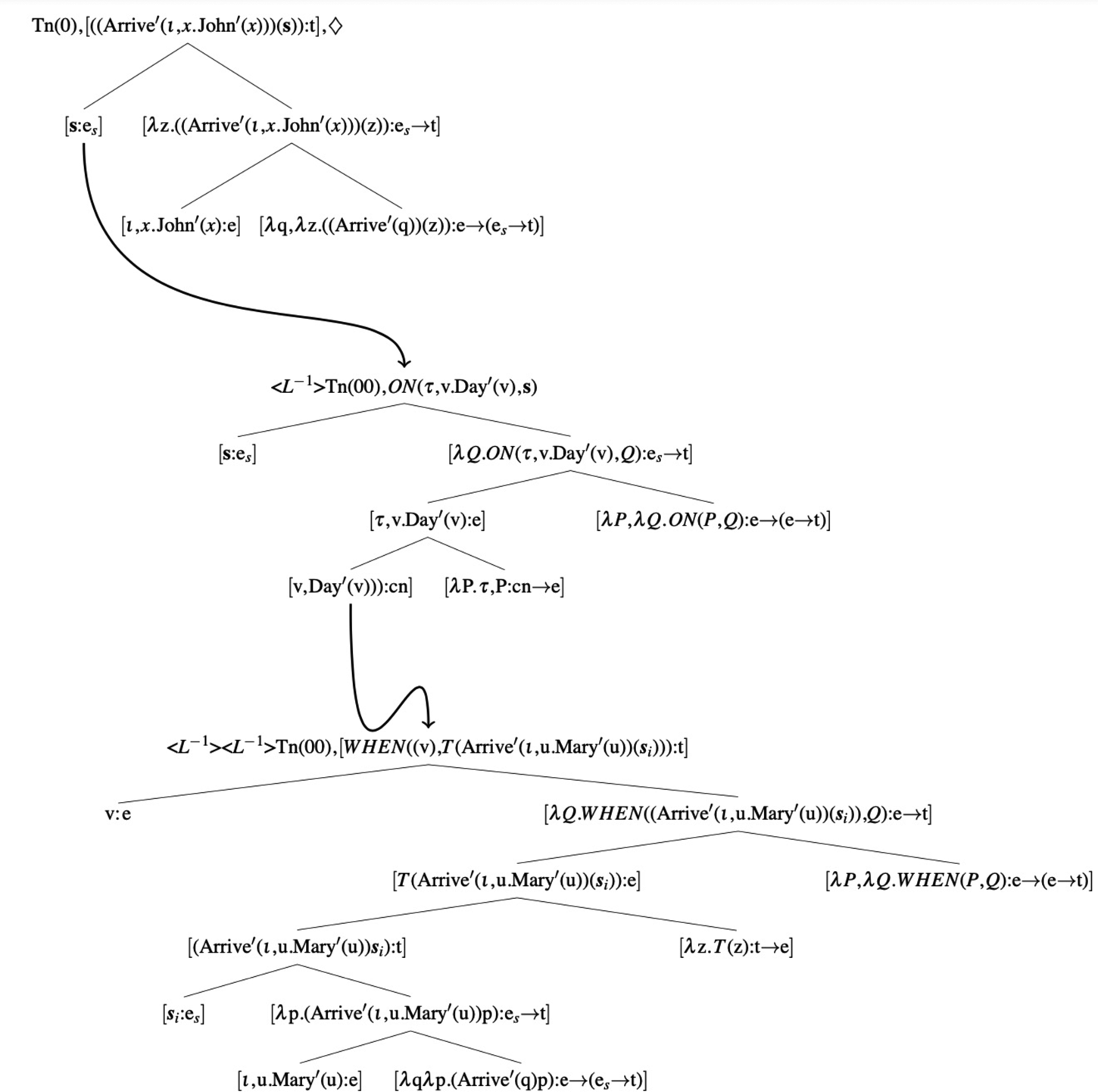
Through parsing (44), two LINK relations are established. One is that between the two partial trees that respectively accommodate the semantic content obtained from parsing John arrived and that obtained from parsing on the day; the other is that between the partial trees that respectively accommodate the semantic content obtained from parsing on the day and that from parsing when Mary arrived. What is shared among the three trees is an event variable, which captures the fact that on the day and when Mary arrived both provide temporal specification of the event of John arrived. In terms of syntax, the lexical information of whenf is quite similar to that of whenp since they both occur in restrictive relative clauses; for this reason, the triggering conditions for lexical actions in whenf are the same as those in the lexical information of whenp. The only difference between them is that the former takes a temporal variable as its argument while the latter takes a non-temporal variable as its argument. This difference is reflected in the semantic formulas that they contribute respectively. The result of parsing the sentence is shown in figure 7.
Parsing John arrived on the day when Mary arrived


After completing the three partial trees, the semantic formulas on the root nodes of the three trees are combined via applying the LINK EVALUATION rule to form a composite propositional formula. It should be reiterated that whenf is distinct from whenp because they have different though highly similar semantic content which restricts their syntactic distribution, one following a temporal expression, the other following a non-temporal expression.
4.3.3 The dynamic syntax of when-adverbial clauses
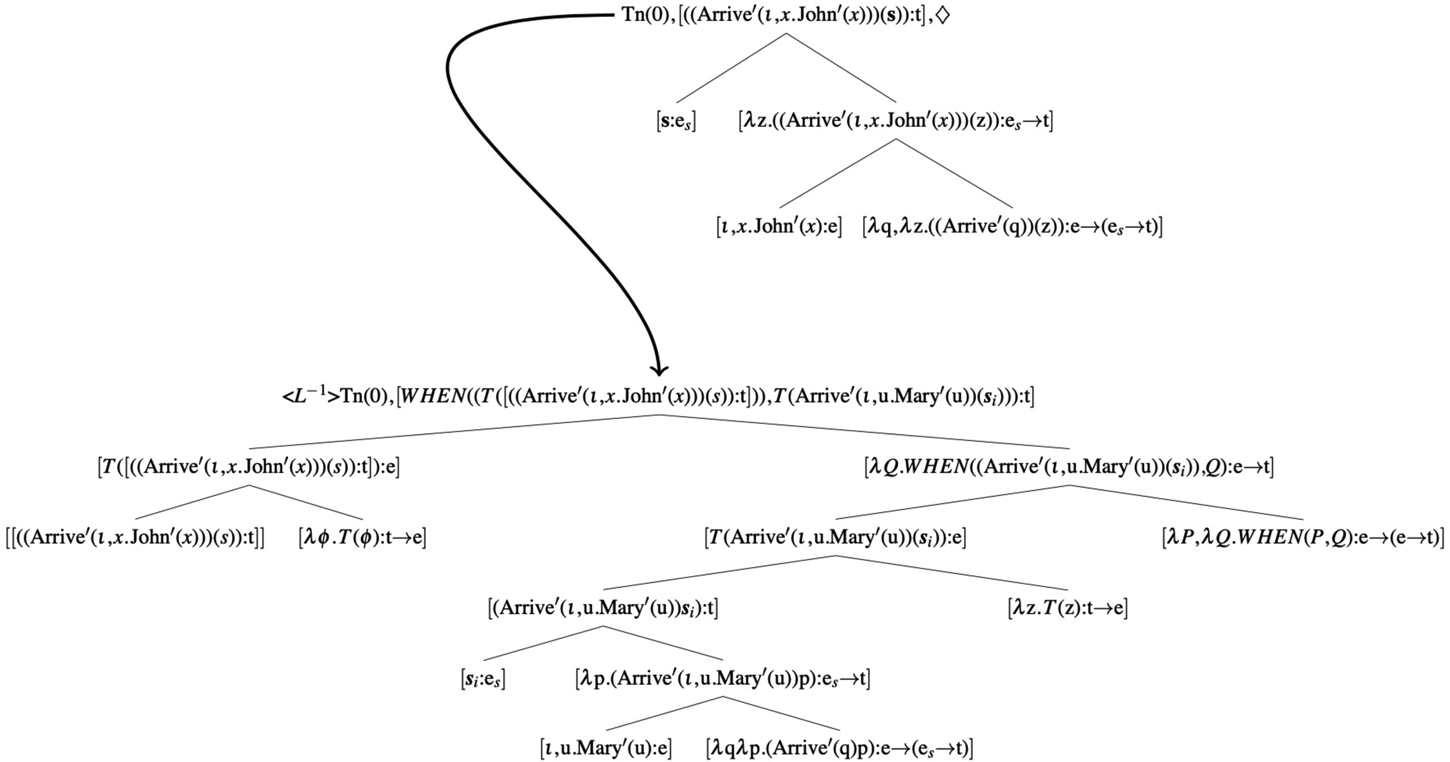
The when-clause in (45) is an adverbial clause. An important difference between the when-adverbial clauses and the previously mentioned two types of when-relatives is that the former can either precede or follow the main clause, while the latter two can only follow the head that they restrict. We still assume that the syntactic properties of whenad play a key role in determining the syntactic distribution of the when-adverbial clause. The lexical information of whenad involves alternative triggering conditions. One is that the pointer is located on a ?t node which does not have any fixed daughter nodes yet; this is a characterization of the case in which the when-adverbial clause precedes the main clause. The other is that the pointer is located on a node already annotated with a t-type node, which characterizes the case where the when-adverbial follows the main clause. The lexical information of whenad is defined as follows.

Parsing (45) yields the semantic trees shown in figure 8.
Parsing John arrived when Mary arrived

To reiterate, the when-adverbial clause is not syntactically restricted to the position following the main clause; it can also appear before the main clause, as illustrated by (48).
(48) When Marry arrived, John arrived.
But the process of parsing (48) is trivial theoretically because the only difference between (48) and (45) is that whenad is parsed under the triggering conditions that are alternative to those in the case of (45), as shown in the definition of the lexical information of whenad. What is shared between the two trees is initially a t-type metavariable, which is to be replaced by a contentful semantic formula of the same type, since the t-type formula is not available before the main clause is parsed. After the main clause is parsed, the formula that can be used to replace the metavariables, i.e. the placeholders for contentful formulas, is available and the substitution of the metavariables takes place, as a result of which the metavariables on the LINKed trees are replaced with the same semantic formula. Finally, the semantic formulas on the two trees get combined as was shown in the demonstration of the preceding two parsing processes.
What's more, the lexical information of whenad allows the ambiguity that arises in (41a), repeated as (49a), and disallows ambiguous interpretation in the case of (41d), repeated below as (49b).
(49)
(a) I ate dinner when Mary thought that I should eat dinner.
(b) I ate dinner when Mary made the suggestion that I should eat dinner.
(49a) can be parsed in two different ways. The t-type metavariable U which whenad con- tributes has an unfixed node initially, as indicated by ⟨↓*⟩. It will merge with either the current t-type node or some t-type node dominated by the current node. In other words, the metavariable will take content either from Mary thought … or just from I should eat dinner. Ambiguity does not arise in the case of (49b) because the tree-structural modality ⟨↓*⟩ that marks the potential structural status of [U: t] restricts the status of the formula within the current tree, while the semantics of the appositive clause, that I should eat dinner that follows the suggestion, different from that of an object clause, is, as can be assumed, accommodated on another partial tree that is connected to the current tree via the LINK relationship.
4.3.4 The dynamic syntax of free when-relative clauses
In this section, we consider whenfree in free relatives. When-free relatives can appear as a subject or object complement of a verb, just like a noun phrase. To capture this fact formally, we assume that whenfree contributes a temporal operator which takes a proposition to yield a temporal entity, i.e. an e-type formula in Dynamic Syntax terms. The lexical information of whenfree is defined as follows.

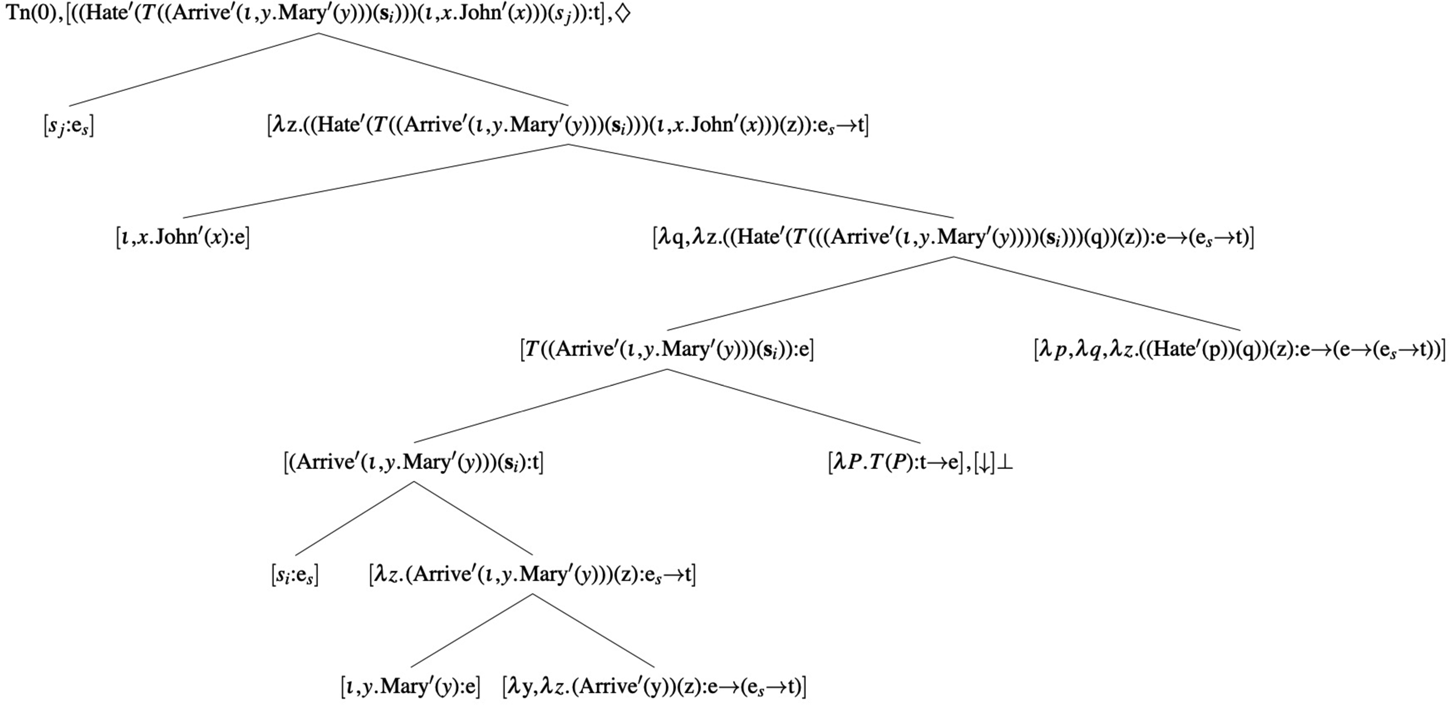
To save space, we merely demonstrate the final stage of the parsing of (46), as shown in figure 9.
Parsing John hates when Marry arrived

This treatment of the when-free relative does not make the grammar of English more complex than the treatment of when having a single lexical entry with many assumed syntactic structures and unpronounced prepositions. Seen from the parsing perspective that we take, different whens parsed under different syntactic conditions make different, though similar to some extent, semantic contributions.
5 Theoretical implications: from when-relatives to all relatives
The current study of when-clauses reveals a peculiar kind of when-relative the head of which is not interpreted as an argument or adjunct of some verb but rather as an argument of the relative operator when. The discovery of this kind of relative clause enriches the typological inventory of relative clauses across languages. Although it is unfeasible to look into all types of relatives described in the literature and all existing theoretical accounts of relatives ever proposed, we will reflect on the general theoretical line of thought along which the structural diversity of relatives is characterized in a mainstream account, by briefly comparing the current account with the work contributed by Cinque (Reference Cinque2020).Footnote 4
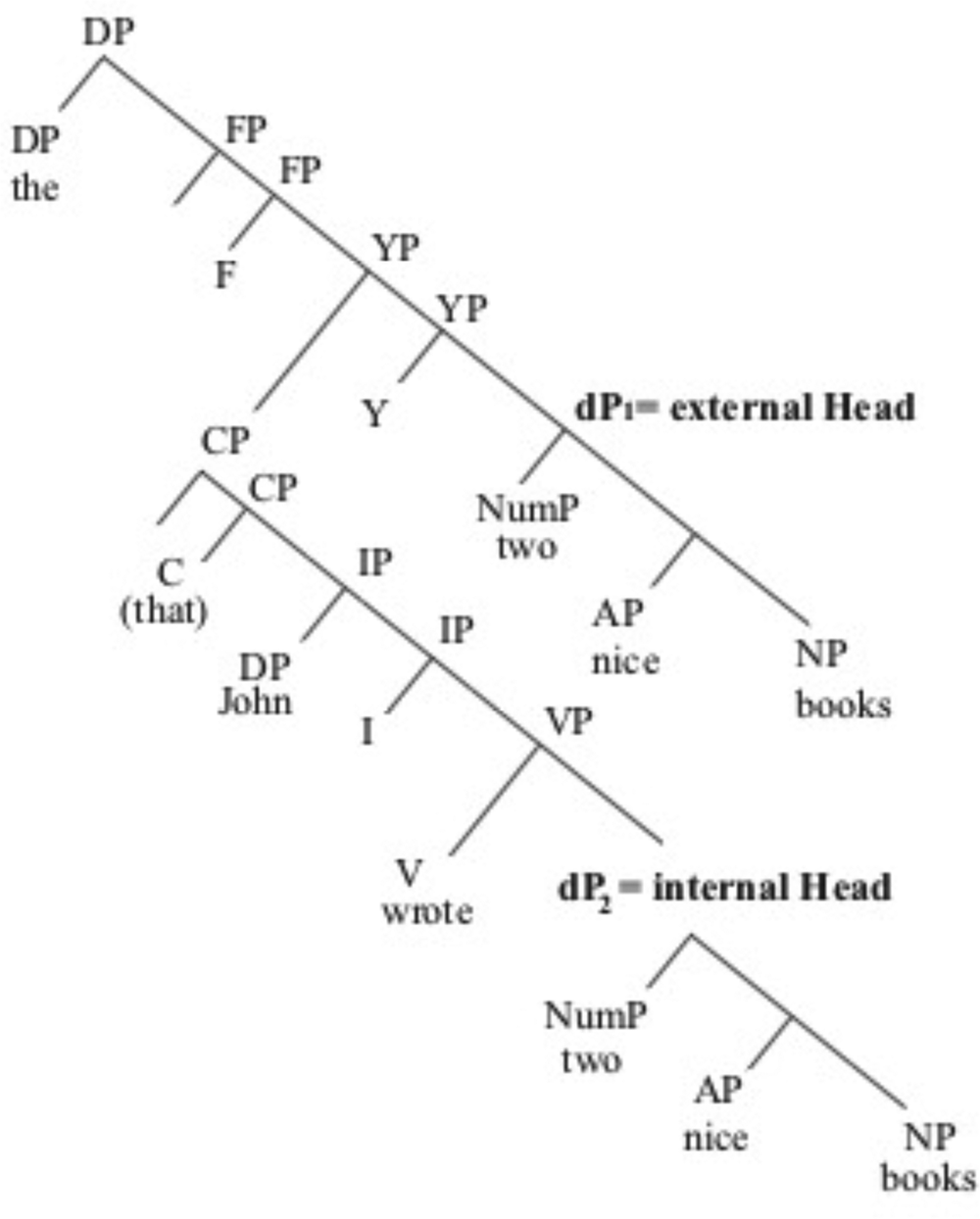
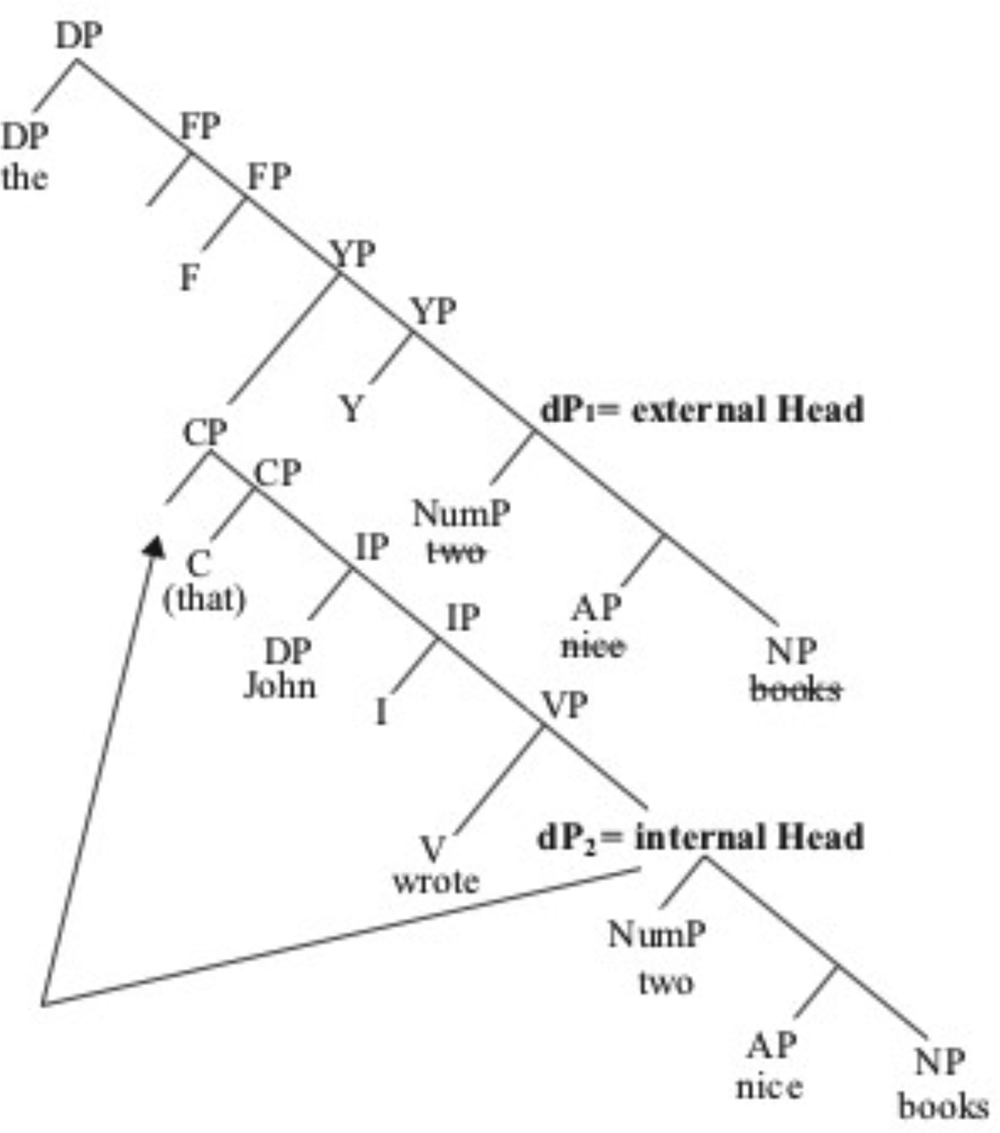
Motivated by the existence of double-headed relative clauses in some languages such as Kombai (de Vries Reference Vries1993), Cinque (Reference Cinque2020) assumes that most, if not all, relatives across languages have a basic double-headed structure. Specifically, a relative clause that modifies a noun phrase has two heads: one is the modified head, dubbed ‘the external head’, and the other a head inside the relative clause itself, dubbed ‘the internal head’. By assuming the application of syntactic-computational operations such as internal head raising, anaphoric matching or the internal head or external head's being unpronounced, Cinque (Reference Cinque2020) is able to account for the generation of a variety of structurally different relative clauses, whether pre-nominal or post-nominal, whether externally headed, internally headed, double-headed, headless, correlative or adjoined (see Cinque Reference Cinque2020: 4). The spirit of this approach to the structural diversity of relative clauses is that assuming a complex underlying structure can also ensure the generation of a variety of surface structures once some modification is applied to the underlying structure because no surface structure is more complex than the assumed underlying structure. Take the English phrase the two nice books that John wrote as an example. Cinque's account of its generation goes as shown in figures 10 and 11. In our view, one can raise doubts as to the theoretical parsimony and empirical tenability of this approach for the following reasons.
the base generation form (Cinque Reference Cinque2020: 15)

After internal head raising and deletion (Cinque Reference Cinque2020: 17)

Theoretically, in Cinque's double-head account, the relative clause includes an internal head, which is a repetition of the external head, which we take to be the real head of the relative clause. If a relative clause has an internal head inside itself, then it consists of two parts, the head and an (embedded) modifier clause; this implies that the embedded modifier clause still has its internal head. Along this line of thought, it can be inferred that a relative clause will involve an infinite number of hierarchically embedded modifier clauses, which, however, is short of an empirical foundation. This theoretical consequence cannot be avoided unless the term ‘internal head’ is not used seriously, in other words, simply meaning an expression that is referentially identical to the (external) head. Besides, the CP that dominates the syntactic structure of the relative clause is located on the specifier position of a phrase YP; but what the head of YP (see figures 10 and 11) accommodates is equivocal; in other words, it does not have a clear empirical foundation. The movement of the internal head to the higher position from its base-generation position is poorly motivated as well. In contrast, from our perspective, the fact that a relative clause and a main clause share some semantic content can be characterized as the sharing of a variable or a term which is restricted twice within the two clauses. The sharing of a variable can be achieved either through grammatical devices such as anaphors/relative pronouns, or by repeating an expression as in the case of double-headed relative clauses, or even by ungrammaticalized pragmatic inference as in the case where no relative pronoun is present, for example, John hated the dog Mary liked. Languages cannot be unified with respect to the formal means by which semantic sharing between the main clause and the relative clause is achieved .
Empirically, the double head theory is not sufficient to accommodate the varieties of relative clauses. Let's take the peculiar when-relative described in this article as an example. The head of such when-relatives can in no way appear inside the relative at all unless many unpronounced syntactic structures and syntactic categories are assumed, which are then faced with the question of how they are recovered. This fact, however, can be simply characterized as the sharing of a variable between two propositional formulas.
6 Conclusion
In this article, against the background of various when-clauses already investigated in the literature, we describe a new type of when-clause which restricts non-temporal noun phrases. It is argued that when-clauses of this new type are functionally similar to typical relative clauses. Based on the description of the new data and discussion of existing syntactic and semantic accounts of when-clauses, we propose a novel formal account of when, where four when lexical entries are recognized, having different syntactic properties and making different, though similar, semantic contributions. The descriptive work presented in this article is not only a classification of whens but a further illustration of the diversity of relatives, for the whenp-clause that modifies a non-temporal noun phrase, along with many other types of relatives described in the literature, suggests that the semantic connection between a main clause and a relative clause can be established via various grammatical mechanisms. From a theoretical point of view, the syntactic and semantic properties of the clauses initiated by different when lexical items are characterized as lexical procedural information formulated within the framework of Dynamic Syntax. This approach explains the properties of both the syntactic distribution and interpretation of different types of when-clauses without assuming a separate syntactic structure over strings or any operations on a syntactic level of representation independently of semantics/pragmatics.