INTRODUCTION
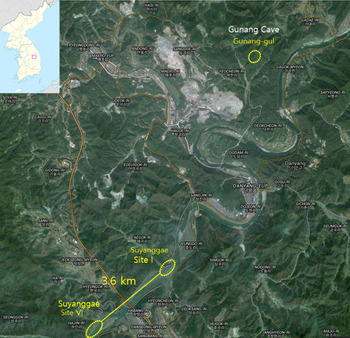
The northern area of South Korea is characterized by mountains with altitudes of 500–700 m. Since the first discovery in 1980, the Suyanggae archaeological complex has been investigated through 13 full-scale excavations carried out by the Chungbuk National University Museum and the Institute of Korean Prehistory. Except locality 2, all 5 localities belong to the Paleolithic ranging from the lower to upper. Among them, SYG-1 and SYG-6 are well recognized with exceptionally abundant lithic artifacts related and very early emergence of blade technology in the region in the Upper Paleolithic (Lee and Yoon Reference Lee and Yoon1992; Lee et al. Reference Lee, Ha and Yoon1996, Reference Lee, Woo and Lee2015). Along the Han River, two Paleolithic sites, SYG-1 and SYG-6 are located 3.5 km apart from each other (Figure 1) on fan alluvial landscape that was generated by flooding on the southern Han River. Gunnaggul (Gunang Cave) is located in a mountainous area, 7 km upstream of the Han River from the site SYG-1. The location of the SYG-6 site is southwest of a slope margin of the Mal-Mol Mt (710 m). SYG-1 is typified by slope sediments in the upper part of three layers and flooding muds and gravel lags in the lower part. In SYG-6 sedimentary deposits are characterized by fluvial sands and muds toward the present Namhan River. The intercalations of brownish red mudflows (layers 11 ∼ 16 of Figure 2) with gravel (layer 16 of Figure 2) are prevalent toward the slope. SYG-1 and SYG-6 were both formed either via fluvial or slope (colluvial) processes, so that both sites may have similar development along the northwestern slope margin of the Namhan River course (Kim et al. Reference Kim, Lee, Woo and Lee2018).
Locations of Suyanggae Sites I (SYG-1) and VI (SYG-6). Gunang Cave is located 7 km upstream from the Han River from the Suyanggae Site 1.

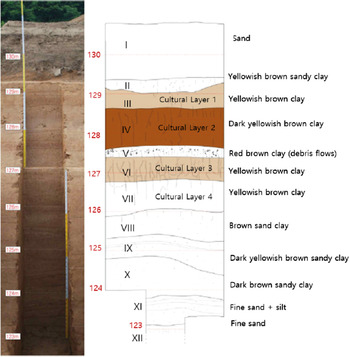
Four cultural layers of the 1E pit (north wall) of the SYG-6 are marked. Only a small portion of Cultural Layer 4 exists within the depth range of Cultural Layer 3 (Modified after Lee et al. Reference Lee, Woo, Lee, An, Yun, Park, Otani, Kim, Kim, Hang, Jang and Choi2018).

In the case of SYG-1, there is one Paleolithic cultural layer from a yellow-brownish sandy clay layer. In this layer, 2687 stone artifacts including raw materials and broken pieces of 502 have been obtained (Lee et al. Reference Lee, Woo, Lee, An, Yun, Park, Otani, Kim, Kim, Hang, Jang and Choi2018). SYG-1 also included a stratum with historical age artifacts. From this site 11 tanged points were found (Seong Reference Seong2015; Lee et al. Reference Lee, Woo, Lee, An, Yun, Park, Otani, Kim, Kim, Hang, Jang and Choi2018) and these could provide us knowledge of human behavior at that time (Lee and Kong Reference Lee and Kong2007a, Reference Lee and Kong2007b). The most important raw material from SYG-1 is siliceous shale, which could be found at a nearby archaeological site, and the most probable origin is San-jae-gol, 1.5 km away from the site. It was recognized that during the Upper Paleolithic period, stone tools were mostly made of shale. Common stone artifacts from these locations are represented by microblades, tanged points, and end-scrapers made of siliceous shale, tuff, and rhyolites.
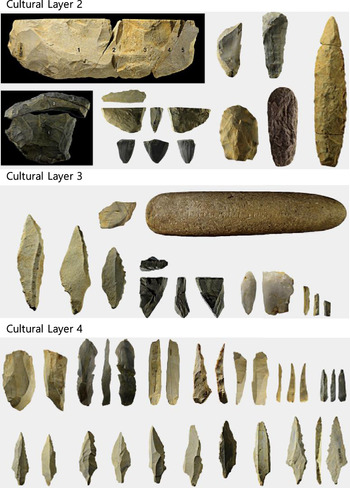
SYG-6 has 12 stratigraphic sedimentary horizons, and four cultural layers have been identified (Figure 2). The 1st, 2nd, 3rd, and 4th cultural layers were associated with the sedimentary layers of III, IV, VI ∼ VII, respectively (Figure 2). Cultural layer 4 was also associated with mostly sedimentary layers on the west side of SYG-6 (Figure 6). Cultural layer 4 was much more widely spread than cultural layer 3. The total number of stone artifacts collected from the 1st and 2nd cultural layers is 350 and 5200, respectively. From cultural layers 1 and 2, such stone artifacts as microblades and end-scrapers are dominant in number, and they are estimated to be older than 15,000 BP. Cultural layer 2 is identified in both SYG-1 and SYG-6 (Lee et al. Reference Lee, Woo, Lee, An, Yun, Park, Otani, Kim, Kim, Hang, Jang and Choi2018). There was a greater variety of stone artifacts excavated at SYG-6 compared to SYG-1 (Figure 3). In SYG-6, many stone artifacts such as a number of tanged points, together with blade-cores, are found in cultural layer 3 (Figure 3). Total number of stone artifacts of SYG-6 was reported as 21,744, including raw materials and broken pieces of 2638. A total number of 86 tanged points were obtained from SYG-6 (Lee et al. Reference Lee, Woo, Lee, An, Yun, Park, Otani, Kim, Kim, Hang, Jang and Choi2018). The oldest tanged point from cultural layer 4 of SYG-6 with an age of 46,360 ± 510 BP has been also reported recently. This age compares well with the OSL dates reported as 49,303 ± 4373 and 49,379 ± 3497 years old in the layers more than 1.5 m below cultural layer 4 of the -5D pit of SYG-6 (Oh and Kim Reference Oh and Kim2018). From the 3rd cultural layer, an unusual cobblestone artifact with regularly engraved lines was collected, and these types of stone artifacts are very rare in Korea. These could provide us with evidence of advanced techniques in the upper Paleolithic.
Comparison of stone artifacts from the three cultural layers found in SYG-6 (Lee et al. Reference Lee, Woo, Lee, An, Yun, Park, Otani, Kim, Kim, Hang, Jang and Choi2018).

METHODS
A total 31 charcoal samples were obtained from 18 excavation points, which are associated with stone artifacts found mostly in cultural layers 2 and 3. The charcoal samples were measured at four AMS facilities. Two facilities are in Korea: KIGAM (Korea Institute of Geoscience and Mineral Resources, lab code Tg) and CAL (Carbon Analysis Laboratory, lab code CWd, in Korea). Sample pretreatment was done by CAL at KIGAM’s pretreatment laboratory, and KIGAM produced the AMS measurements of the samples. The other two facilities are in Japan: IAAA (Institute of Accelerator Analysis Ltd, lab code IAAA) and USA: the NSF-Arizona AMS Laboratory (lab code AA).
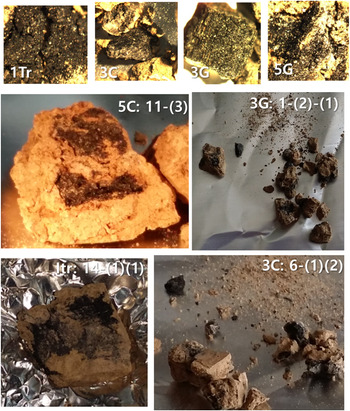
The photos taken via microscope and camera are shown in Figure 4. In the case of the NSF-Arizona AMS Laboratory, the samples were autoclaved first before examining due to regulatory requirements. The four AMS laboratories used the acid-alkali-acid (AAA) pretreatment process to clean the samples before combustion. As the first step, any soil part was removed as much as possible from a charcoal containing untreated sample, and also rootlets and granules were removed using tweezers. To eliminate carbonates and secondary organic acids, the sample underwent a thorough the AAA pretreatment. In the acid treatments of the AAA, the sample is treated with 1N HCl. In the alkaline treatment, the sample is normally treated with NaOH, by gradually raising the concentration level from 0.001M to 1 mol (IAAA Lab) and at 0.1M NaOH at other laboratories. After this treatment, the samples are neutralized with acid again and washed with ultrapure water until neutral, and dried. Then the samples are combusted to produce CO2 gas at 900°C (NSF-Arizona AMS Lab). The produced CO2 gas is purified in a vacuum line and reduced to graphite using iron as a catalyst. The produced graphite was pressed into an AMS target holder for the 14C AMS measurement using a hand-press machine. The graphite sample was measured against a standard of oxalic acid (HOxII) provided by the National Institute of Standards and Technology (USA), using a 14C-AMS system based on the tandem accelerator. A blank for the background check was also measured. Values are reported as pMC (percent Modern Carbon), which refers to a ratio of the 14C concentration in the sample relative to that of the year 1950 and reported as uncalibrated radiocarbon (14C) ages as discussed by Stuiver and Polach (Reference Stuiver and Polach1977). The calibrated calendar age is a range of age corresponding to 14C age via a calibration curve, which was produced from the 14C concentration of samples of known age. It is expressed by 1-σ error range (68.3% probability). The calibration in this report was conducted by OxCal v44.4. (Ramsey Reference Bronk Ramsey2021) based on IntCal20 database (Reimer et al. Reference Reimer, Austin, Bard, Bayliss, Blackwell, Ramsey, Butzin, Cheng, Edwards, Friedrich, Grootes, Guilderson, Hajdas, Heaton, Hogg, Hughen, Kromer, Manning, Muscheler, Palmer, Pearson, van der Plicht, Reimer, Richards, Scott, Southon, Turney, Wacker, Adolphi, Büntgen, Capano, Fahrni, Fogtmann-Schulz, Friedrich, Köhler, Kudsk, Miyake, Olsen, Reinig, Sakamoto, Sookdeo and Talamo2020). The values are corrected for its isotopic fractionation using the δ13C value. The δ13C value refers to a difference of the 13C concentration (13C/12C) of a sample from that of a standard. (Stuiver and Polach Reference Stuiver and Polach1977).
Microscopic (top) and camera (lower) images of four samples which were sent to the Arizona NSF AMS laboratory are shown.

Results
Radiocarbon Dating Results
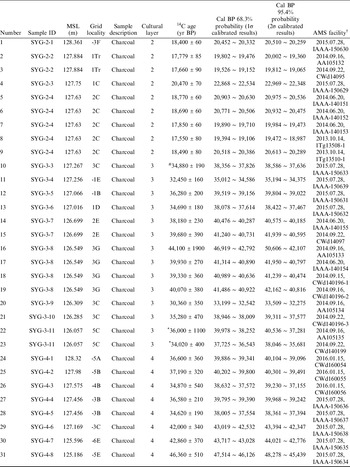
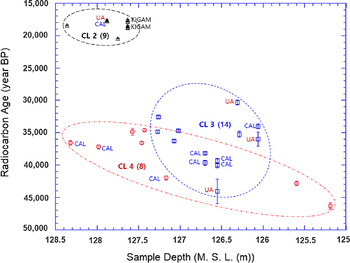
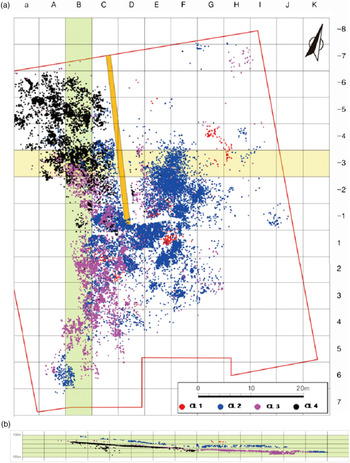
There were 31 charcoal subsamples from 18 sampling localities that were dated at four different AMS laboratories (Figure 2, Table 1). The duplicated samples were prepared for crosschecking of AMS dating results. The results of 14C ages of SYG-6 are listed in Table 1 and Figure 5. A diagram for collection points of stone artifacts at SYG-6 is shown in Figure 6. The 14C ages of SYG-6 converge into three cultural layers (Figure 3). Paleolithic layers are associated with cultural layers 2, 3, and 4. In the case of cultural layer 2, the 14C ages have a very narrow range between 17,550 ± 80 and 20,470 ± 70 BP. The results from the four different AMS laboratories are consistent. Figure 5 shows both the cultural layers 2 and 3 have rather concentrated occupation regions considering the associated 14C age and depth, whereas cultural layer 4 seems to have a wide range of both occupation depth and the associated 14C ages (Figure 5). Cultural layer 4 is northwest of the areas of cultural layers of 2 and 3 (Figure 6). The three cultural layers in SYG-6 are not directly related to the depth and age. This is because each layer could not have been horizontal, as there is an incline throughout the excavated space (Figure 6, Table 1).
Results of radiocarbon dating analysis for the Suyanggae Site VI.

Note: # and * indicate the associated ages for stone face and stone ruler, respectively. †AMS facilities: two of the listed facilities are in Korea: KIGAM (Korea Institute of Geoscience and Mineral Resources) and CAL (Carbon Analysis Laboratory associated with KIGAM). The others are in Japan (IAAA, Institute of Accelerator Analysis Ltd) and USA (NSF-Arizona AMS Laboratory). Sample shipping dates and some of the sample processing IDs are indicated with each AMS laboratory listing.
14C ages of charcoal samples for SYG-6. All 14C dates are listed within the three cultural layer groups. Three AMS facilities are indicated along with their results in Table 1.

Diagram showing collection points of stone artifacts at SYG-6 (Lee et al. Reference Lee, Woo, Lee, An, Yun, Park, Otani, Kim, Kim, Hang, Jang and Choi2018).

In Figure 5, there are three major Paleolithic cultural ages. One group (CL1) of younger age postdates the Last Glacial Maximum (LGM) is clearly seen in Figure 5. Also, two large groups age spanning from 30,000 years to 46,000 BP are shown in this figure as CL3 and CL4, which convinces us that human occupation continued in this area from 46,000 years until 30,000 years. The calibrated ages from IntCal20 for cultural layers 3 and 4 ranged from 33,509 ∼ 32,275 calibrated date (cal BP) to 48,278 ∼ 45,439 cal BP (OxCal v4.2.4. 95.4% probability with 2σ) (Table 1). The 14C age span of Paleolithic cultural layers 3 and 4 in SYG-6 is from 39,360 ± 350 to 46,360 ± 510 BP, which is quite similar to that for 14C ages of animal bones found in depths from 110 cm to 220 cm in the floor of Gunang Cave, where the 14C ages in the cave range from 28,910 ± 200 to 48,090 ± 1050 BP (Kim et al. Reference Kim, Hong, Park, Woo, Hodgins, Jull, Lee and Kim2011). There are some other dating results for the cave site that are also found to be in this range (Kim et al. Reference Kim, Krivonogov, Lee, Woo, Oh, Yang, Kim, Safonova and Yamamoto2013a).
Cultural Layers
SYG-6 has a wide time span of human occupation based on the number of cultural layers and their corresponding ages. When the chronological information of cultural layer 2 of SYG-6 is compared to that of SYG-1, the corresponding sedimentary layers (Figure 2) of SYG-6 can be correlated by similar site-forming process and age to SYG-1 (Kim et al. Reference Kim, Lee, Woo and Lee2018). The 14C age ranges of the cultural layer 2 for SYG-1 and SYG-6 are determined to be from 16,400 ∼ 18,630 BP (Lee Reference Lee2007) and 18,770 ± 60 ∼ 20,470 ± 870 BP, respectively. Because of the similarity in site-forming background and ages for these two sites, both Suyanggae sites must have been occupied by humans.
The time span of 17,000 ∼ 19,000 BP corresponds to the Last Glacial Maximum (LGM). It was found that the cultural layer 2 from these two Suyanggae sites have significantly many more stone artifacts than the cultural layers 3 and 4 for SYG-6. The total number of stone artifacts in only the cultural layer 2 and total number of stone artifacts in SYG-6 are 21,744 and 40,679, respectively. This implies that there might be expansion of human occupation in this location during the time period. There was one evidence of a stone artifact with a fish -shaped drawing collected in cultural layer 2 (Lee and Woo Reference Lee and Woo1998; Lee Reference Lee2016). The increase of population, shortage of animal food resources, and warmer climate might have brought a new situation that people began to take plants to eat and to catch fish for survival. As evidence, a fish-engraved art object in a fragment of aurochs (Bos primigenius) bone was found at the Suyanggae site (Lee and Woo Reference Lee and Woo1998). Also, the total number of micro-blades cores for cultural layer 2 and all layers in SYG-6 are 264 and 281, respectively. Both cases support the possibilities of fishing along the river in the time associated in cultural layer 2 of SYG-6.
The cultural layers 3 and 4 are found in SYG-6 with an age span from 30,360 ± 350 to 42,000 ± 340 BP. The range of 14C ages for the two cultural layers 3 and 4 are determined as 30,360 ± 350 ∼ 44,100 ± 1900, and 34,870 ± 540 ∼ 46,360 ± 510 BP, respectively. This might imply reoccupation of this location by early humans during the periods. It was found that the cultural layer 4 was identified in the location of the west side of SYG-6 (Figure 6). Therefore, vertical lining cultural layers based on M.S.L would not be appropriate and lateral comparison also needed to be considered as well as geomorphological feature of each cultural layer.
From SYG-6, a total of 40,679 stone artifacts were collected and four culural layers were identified. From cultural horizon 4, 10,883 stone artifacts were collected and mostly they are made of shale (94.8%). Large stone blades and tanged point artifacts were concentrated in stone -artifact production at this site (Lee et al. Reference Lee, Woo, Lee, An, Yun, Park, Otani, Kim, Kim, Hang, Jang and Choi2018). Based on Lee et al (Reference Lee, Woo, Lee, An, Yun, Park, Otani, Kim, Kim, Hang, Jang and Choi2018), there were many more tanged point artifacts found in cultural layer 4 than cultural layer 3. Also, the length, width, and thickness of the tanged points from cultural layer 3 are found to be longer, shorter, and thinner than those of cultural layer 4. In cultural layer 3, two interesting stones were excavated: one carved like a human face and the other featuring ruler lines (Figure 3) (Lee et al. Reference Lee, Woo, Lee, An, Yun, Park, Otani, Kim, Kim, Hang, Jang and Choi2018).
Age Comparison between Suyanggae Locality 6 and Gunang Cave and Its Significance
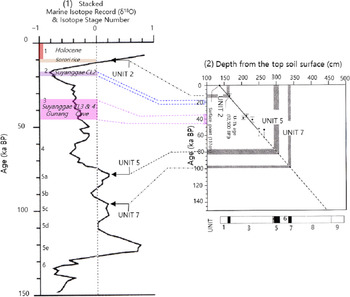
The significance of the Suyanggae archaeological sites allows us to understand human occupation and adaptation on paleoclimate change during the last glacial period after 50,000 BP in this region. This story gets much more interesting when we imagine the modern humans of the early Upper Paleolithic occupied the Gunang Cave in Danyang County (Kim et al. Reference Kim, Hong, Park, Woo, Hodgins, Jull, Lee and Kim2011). In the Korean Peninsula, Pleistocene hominid fossils were found at 36 sites. The ages of four homid bones found at the Gunang Cave in Danyang County, South Korea, were interpreted between 40,000 and 44,000 cal BP (Park et al. Reference Park, Kim, Lee and Woo2019) based on 14C ages of the associated animal bones. The 14C ages for the animal bones in the Gunang Cave ranged from 48,090 ± 1050 to 28,910 ± 200 BP, while those for the SYG-6 ranges from 46,360 ± 510 to 30,360 ± 350 BP. Figure 7 shows a comparison of 14C and U-Th ages between Suyanggae sites and Gunang Cave (Yum et al. Reference Yum, Kim, Cho, Kim, Lee and Kim2006). The three U-Th ages at the depth from 200 to 250 cm from topsoil surface are around 40,000 cal BP, which correspond to the 14C bone dating results of the pink colored area in Figure 7. Based on the uncertainty of AMS measurement, one can conclude that the time span for the modern human occupation in these two Paleolithic sites can be matched to the same time period.
Comparison of 14C and U-Th ages between Suyanggae sites and Gunang Cave: (1) cultural layers (2, 3, and 4) of SYG-6, compared with sedimentary units of the Gunang Cave (stacked marine isotope records of δ18O and isotope stage number are based on Martinson et al. (Reference Martinson, Pisias, Hays, Imbrie, Moore and Shackleton1987); (2) age model of Gunang Cave deposits (Yum et al. Reference Yum, Kim, Cho, Kim, Lee and Kim2006).

For Gunang Cave, a 5-m sediment pile with 9 defined horizons was investigated (Kim et al. Reference Kim, Lee, Cho and Yum2006). The 14C ages of Gunang Cave indicated a disturbance of sediment layer based on the 14C ages as a function of depth (Kim et al. Reference Kim, Hong, Park, Woo, Hodgins, Jull, Lee and Kim2011). From this site a total of 3800 pieces of 25 species of animal bones were collected (Yum et al. Reference Yum, Kim, Cho, Kim, Lee and Kim2006). This cave was listed as one of 5 cave sites with human bone excavated in Korea (Cho Reference Cho2006). This could imply a long term and possibly multiple modern human occupations made the sediment piles of the cave. The lowest sediment layer of Gunang Cave is dated as 130,000 BP or older based on U/Th dating method (Lee et al. Reference Lee and Cho2005; Kim et al. Reference Kim, Yang, Yi and Nahm2017). At this site, five pieces of hominid bones have been excavated (Park et al. Reference Park, Kim, Lee and Woo2019). Based on the 14C ages cultural layer 3 of Suyanggae Site VI, the averaged 14C age is dated as 39,500 cal BP (ranging 38,000 ∼ 41,000 cal BP), which may well be correlated to the age of the anatomically modern human of Gunang Cave (age range, 40,900 ∼ 44,900 cal BP) (Park et al. Reference Park, Kim, Lee and Woo2019).
When we investigate the time period of modern human occupation in both Gunang Cave and SYG-6, the period of ∼ 40,000 BP is much colder than the present, but much warmer than the LGM. It is known that the growth of the ice sheets in the polar region reached its maximum thickness 26,500 years ago and deglaciation commenced in the Northern Hemisphere approximately 19,000 years ago (Clark et al. Reference Clark, Dyke, Shakun, Carlson, Clark, Wohfarth, Mitrovica, Hostetler and McCabe2009; Lambeck et al. Reference Lambeck, Rouby, Purcell, Sun and Sambridge2014; Platt et al. Reference Platt, Haber, Dagher-Kharrat, Douaihy, Khazen, Bonab, Salloum, Mouzaya, Luiselli, Smith, Renfrew, Matisoo-Smith and Zalloua2016; Praetorius et al. Reference Praetorius, Condron, Mix, Walczak, McKay and Jianghui Du2020). These maximum glacial and deglacial ages compare very well with the human occupation time periods of the three archaeological sites in Danyang County, Korea. We assume that during warm periods, the population of early humans had increased, and their cultural remains were left behind in open sites like SYG-1 and SYG-6. The modern humans who lived in cultural layer 1 were the people who had survived from the cold climate. They are the people who settled beside the Han River and started to eat more plants and fish, as well as other animals because there were significantly fewer animals available for hunting. Cultural layer 1 indicated in Figures 2 and 6 is much younger than cultural layer 2. This layer could correspond to the cultural layer in which the oldest wild rice (12,500 ± 150 and 12,552 ± 90 BP) was found in Sorori, Chungju City, Korea (Kim et al. Reference Kim, Hong, Park, Woo, Hodgins, Jull, Lee and Kim2011, Reference Kim, Yang, Yi and Nahm2017). The humans could have started to consume the wild rice rather than only eating fish or other animals as a sort of substitute food. After the LGM, they could have started eating grains as this lifestyle changed. This might be due to a possible situation that living in organized settlements was easier than hunting and fishing.
However, interestingly, no cultural layer has been found in the time period during the ice age from 28,000 BP to nearly 19,000 BP for both the localities of Suyanggae and Gunang Cave. After the LGM, human occupation increased in the Chungbuk province, and the oldest ancient rice reported up to date has been found in this region from the time the Suyanggae modern humans had lived in this province (Kim et al. Reference Kim, Lee, Woo and Jull2013b). Figure 7 shows the summary of significant early human occupations in South Korea. This indicates how modern humans could have survived by adapting to climate change and migrating to find a warmer environment. Prior to the LGM, Korea was connected to China, and the movement of modern humans could have made it much easier to find a better place to live. Also, there was a study indicating that the Pleistocene population was established in Japan by early human movements from Korea to the Kyushu area of Japan and Ryukyu Island from South China as well as the Honshu and Hokkaido regions from the Russian Far East regions (Nakazawa Reference Nakazawa2017). Further investigation on modern humans’ movement in Korea and other neighboring countries could be suggested.
Conclusions
The recent investigation on 14C age dating results for SYG-6 found that the three cultural layers have 14C age ranges from 17,550 ± 80 ∼ 20,470 ± 70, 30,360 ± 350 ∼ 44,100 ± 1,900, and 34,870 ± 540 ∼ 46,360 ± 510 BP for cultural layers 2, 3, and 4, respectively. Based on comparative 14C dating results among the three Paleolithic sites (SYG-1, SYG-6, and Gunang Cave) of this area, it can be concluded that modern humans lived at both open sites and cave sites in the region of the Han River. Modern humans might have used the cave as a temporal hunting and sheltering place. After the deglacial commenced, modern humans started to settle along the Han River area, and it could be possible that each settlement had its own settlement pattern. The SYG-1 and SYG-6 sites along with Gunang Cave demonstrate a long archaeological record that can be correlated with climatic change.
Acknowledgments
We are very grateful to Prof. Yaroslav V. Kuzmin and two anonymous reviewers whose comments helped to improve the quality of the previous version of this paper. This study was partially supported by K-IODP project (21-9852) funded by the Ministry of Land, Transport and Maritime Affairs and by the Institute of Korean Prehistory for access to research materials.