Nomenclature
- CW
-
Clockwise
- CCW
-
Counter-clockwise
-
 $dL/dr$
-
lift per unit span
-
$N_r$
-
number of rotors
- RMAC
-
Rensselaer Multicopter Analysis Code
- RPM
-
revolutions per minute
- t
-
time
- W
-
force/moment weighting parameter


Greek symbols
-
$\theta$
-
rotor pitch inputs
-
$\nu_\beta$
-
non-dimensional flapping frequency
-
$\Phi$
-
rotor phase
-
$\psi$
-
rotor reference blade azimuth
-
$\Psi$
-
rotor azimuthal location
-
$\Omega$
-
rotor speed


Subscripts
- 0
-
collective input
- d
-
differential input
- ic
-
cosine at the ith harmonic
- is
-
sine at the ith harmonic
- P
-
pitch-aligned mode
- R
-
roll-aligned mode
- D
-
differential mode
- x, y, z
-
forces/moments on the x-, y- and z-axes
1.0 Introduction
While small multicopters have been in operation and in use by hobbyists and videographers for quite some time, there has been enormous and rapidly growing recent interest in scaling up to much larger electric multi-rotor aircraft for military use, commercial use including package delivery and even passenger transportation [Reference Holden and Goel1–Reference Swartz3]. Development of these large electric Vertical TakeOff and Landing (eVTOL) aircraft faces many challenges [Reference Johnson, Silva. and Solis4], and has led to significant investigation and new understanding in areas such as multi-rotor interactional aerodynamics [Reference Yoon, Lee and Pullinam5–Reference Healy, Gandhi, Mistry and Duffy10], acoustics [Reference Intaratep, Alexander, Devenport, Grace and Dropkin11–Reference Smith, Niemiec and Gandhi20] and handling qualities [Reference Walter, McKay, Niemiec, Gandhi and Jaran21–Reference Withrow-Maser, Malpica and Nagami27]. An area that has received much less attention so far, but that is equally important to operation, comfort and cost, is the vibration characteristics of eVTOL aircraft. A previous study by the authors [Reference Niemiec and Gandhi28] highlighted a beating phenomenon observed with the vibratory loads of a quadcopter due to the rotors operating at different rotational speeds.
Vibration on conventional helicopters has been widely studied for many years and on many platforms [29, Reference Loewy30]. Many approaches to vibration reduction have been taken, including higher harmonic control [Reference National and Space31, Reference Kessler32], where the rotor swashplate is actuated harmonically to achieve 2/rev and higher blade pitch, and individual blade control [Reference Kessler33, Reference Friedmann34], which actuates the blades directly, circumventing the swashplate in achieving high-frequency pitch inputs. More recent research includes the use of multiple swashplates [Reference Küfmann and Brillante35] or localised pitch control [Reference Küfmann, Bartels and van der Wall36]. Rotor chord morphing has also been studied for vibration reduction in helicopters [Reference Krishnamurthi and Gandhi37, Reference Majeti, van der Wall and Balzarek38].
On account of their tremendous simplicity and associated cost benefits, fixed-pitch, variable-RPM rotors have generally been the rotors of choice on eVTOL configurations. However, the increase in rotor diameter (and rotational inertia) with increasing gross weight can result in degradation in the eVTOL aircraft’s handling qualities for reasonable motor size [Reference Walter, McKay, Niemiec, Gandhi and Jaran21–Reference Bahr, McKay, Niemiec and Gandhi24, Reference Withrow-Maser, Malpica and Nagami27], and this has led to an interest in variable collective pitch on the rotors for improved flying qualities [Reference Malpica and Withrow-Maser25, Reference Niemiec, Gandhi, Lopez and Tischler26]. The presence of collective pitch control can also be beneficial for conditions such as climb [Reference McKay, Niemiec and Gandhi39]. Introduction of collective pitch control allows for RPM synchronisation and relative phase control of the rotors, which can further be exploited for noise reduction [Reference Schiller, Pascioni and Zawodny18–Reference Smith, Niemiec and Gandhi20] and vibration reduction [Reference Kopyt, Niemiec and Gandhi40].
Substantial vibratory loads have been observed on fixed-pitch, variable-RPM rotors in experimental work. Russell et al. [Reference Russell, Jung, Willink and Glasner41] performed wind-tunnel experiments on several multi-rotor vehicles, observing very large (on the same order as the rotor thrust) 2/rev in-plane forces on isolated rotors. For multi-rotor systems, much (but not all) of the 2/rev force cancelled out between the rotors, leaving the 4/rev dominant. A later experiment on the Multirotor Test Bed [Reference Russell and Conley42] found similarly large vibratory forces, dominated by the 2/rev. A computational effort [Reference Conley, Russell, Kallstrom, Koning and Romander43] sought to replicate the observations in Ref. 42, but there has been no validation of the vibratory loads to date. An unrelated effort by Staruk et al. [Reference Staruk, Butt, Hennig, Bonny, Gray, Represa and Toner44] observed significant 2/rev and 4/rev vibration in the fixed frame near the nominal operating speed, which was significantly under-predicted by RCAS analysis.
In Ref. 40, the authors consider relative rotor phase control on RPM-synchronised plus- and cross-configuration quadcopters with variable collective pitch, but the study made the simplifying assumption that the effects of elastic blade deformation were negligible. The present study seeks to expand the work of Ref. 40 by including the effect of elastic blade deformation on the vibratory loads, and examining the effect of relative rotor phasing on vibratory load reduction of both a quadcopter as well as an octocopter.
2.0 Modeling and validation
Simulations in this study are carried out using the Rensselaer Multicopter Analysis Code (RMAC [Reference Niemiec and Gandhi45]). RMAC offers both rigid- and elastic-blade modelling capabilities for the rotors. While the former is frequently utilised in flight simulation and handling qualities studies (e.g. Refs. 21; 22; 23; 24; 26), elastic blade models are the appropriate choice for studies on vibratory loads. In Ref. 28, blade elastic flap and lag deflections (but not torsion) were modelled, but RMAC was extended to include the fully coupled nonlinear elastic flap-lag-torsion equations based on Hodges and Dowell [Reference Hodges and Dowell46] in the present study. The blades are spatially discretised using a Ritz modal representation with two modes each in flapwise bending, lagwise bending and elastic torsion (bending and torsion modes shapes are shown in Fig. 1). The rotor aerodynamic loads are calculated using blade-element theory coupled to a ten-state Peters–He finite-state wake model [Reference Peters, Boyd and He47] to calculate the induced velocities. The blade periodic response is calculated using the harmonic balance method, and integration of the blade loads over the span and the azimuth and summation over both blades (for the two-bladed rotors used in the present study) yields the rotor hub forces and moments. The Peters–He model is restricted to estimating velocities in the rotor plane, so rotor–rotor and rotor–fuselage interference effects are absent from the model.
Summary of quadcopter parameters

Elastic bending and torsion modes.

The elastic blade model was validated against experimental results from Ref. 48. The rotor used in this study is taken from the DJI Phantom and made from Acrylonitrile Butadiene Styrene (ABS) plastic. Geometric and elastic properties of this rotor are listed in Table 1. The blade chord and twist distributions for the DJI rotor are taken from Ref. 7, and the mass distribution is assumed to scale with the area of the cross-section (uniform density).
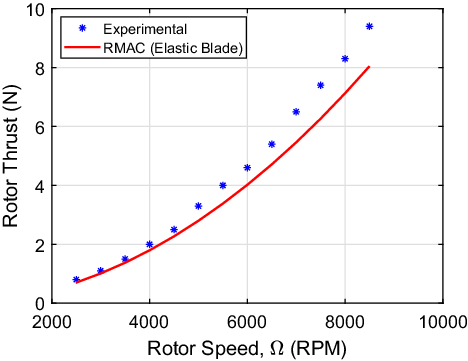
The static thrust of the DJI rotor predicted by RMAC is compared with the experimental data in Fig. 2. RMAC shows good agreement in the low-to-moderate thrust range. While greater difference is observed at higher thrust, the maximum difference is under 16%.
Predicted and experimental thrust – DJI rotor.

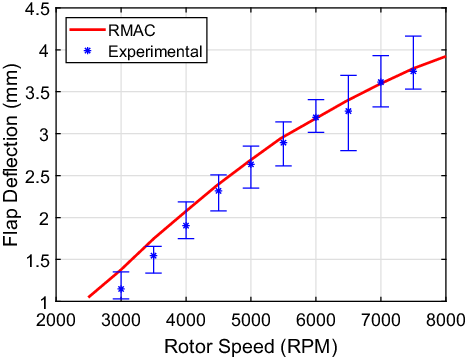
The RMAC-predicted values of the out-of-plane deflection and torsion are compared with the measurements of Ref. 48 in Figs 3 and 4. The trends of both flap and torsion are captured by the RMAC model, with predicted deflections in both flapwise and torsional deflection lying within the scatter of the experiment.
Predicted and experimental flapwise tip deflection – DJI rotor.

Predicted and experimental torsional tip deflection – DJI rotor.

The multicopters in this study are derived from the Straight-Up Imaging (SUI) Endurance quadcopter (Fig. 5). To emphasise the influence of rotor elasticity, the stiff carbon-fibre rotors that are normally used on the Endurance are replaced by ABS rotors with the same geometry. Additionally, to examine the effect of rotor phasing on vibration reduction, the rotor speed is locked at 3,626RPM (380rad/s), resulting in a tip Mach number of 0.2. This low tip Mach number is chosen because low rotor speeds generally result in lower power consumption [Reference McKay, Niemiec and Gandhi39] and noise. and the vehicle is controlled via variable-collective pitch on each rotor. Table 1 lists several parameters of the quadcopter, and the rotor chord and twist are given in Fig. 6.
Straight-Up Imaging (SUI) Endurance.

SUI rotor chord and twist distributions.

Quadcopter in edge-first configuration with zero relative phasing between rotors.

RMAC determines a trim condition for the Endurance derivatives at a given flight speed using the pitch and roll attitudes, as well as the four primary multi-rotor control inputs [Reference Niemiec and Gandhi49]. The collective pitch of any rotor is given by Equation (1), where
 $\theta_0$
is the mean rotor collective pitch (which regulates thrust),
 $\theta_{1s}$
and
 $\theta_{1c}$
are lateral and longitudinal control inputs, and
 $\theta_d$
is the directional input. The
 $\theta_{1s}$
and
 $\theta_{1c}$
control modes are defined using the azimuthal location of the rotor,
 $\Psi_k$
(Fig. 7).
 \begin{equation}\theta_k = \theta_0 + \theta_{1s}\sin \Psi_k + \theta_{1c} \cos \Psi_k + \theta_{d}(-1)^{k-1}\end{equation}
Individual phase modes are defined for the quadcopter using the same multi-rotor coordinate system as the collective pitch control. The phase of any individual rotor with respect to the phasing shown in Fig. 7 can be described in terms of a pitch (
 $\Phi_P$
), roll (
 $\Phi_R$
) and differential (
 $\Phi_D$
) phasing, as shown in Equation (2). The three phase modes of the quadcopter are illustrated in Fig. 8.
 \begin{align}\psi_k &= \text{sgn}(\cos \Psi_k)\Phi_P +\text{sgn}(\sin \Psi_k)\Phi_R + (-1)^{k-1}\Phi_D \nonumber\\[3pt] &\quad + \sum_{i=2}^{\frac{N_r-2}{2}}\bigg( \text{sgn}(\sin i\Psi_k)\Phi_{is} + \text{sgn}(\cos i\Psi_k)\Phi_{ic}\bigg) + \Omega t \end{align}
As
 $\Phi_P$
(Fig. 8(a)) changes, both of the front rotors lag the reference configuration (Fig. 7) by
 $\Phi_P$
, while the rear two rotors lead the reference configuration by the same amount. Evaluating Equation (2) for an arbitrary value of
 $\Phi_P$
(with other modes held to zero),
 $\psi_1=\psi_2$
because
 $\cos{\Phi_1},\ \cos{\Phi_2}<0$
. In the context of this study, these rotors will be referred to as ‘in-phase.’ Similar to the two front rotors, the two rear rotors are in-phase for all
 $\Phi_P$
(
 $\psi_3=\psi_4$
). As the rotors turn, rotors 1 and 2 will always pass one another tip-to-tip, as will rotors 3 and 4. The phase difference between the front and rear rotors is always
 $2\Phi_P$
. It is worth noting, for
 $\Phi_P=0^\circ$
or
 $90^\circ$
, the blades of the front rotor pass tip-to-tip, at the same time the blades of the aft rotors pass tip-to-tip, and the blades of the front rotors also pass the blades of the aft rotor tip-to-tip, but with a quarter-revolution phase delay. In contrast, for
 $\Phi_P=45^\circ$
, the tip-to-tip blade passage is phase lagged by a quarter revolution from the tip-to-tip blade passage of the aft rotors. Further, the blades of the front rotor never pass the blades of the aft rotors tip-to-tip (in fact, they have maximum separation).
Summary of octocopter parameters

Phasing modes of an edge-first quadcopter.

 $\Phi_R$
(Fig. 8(b)) operates in a similar manner but groups the rotors laterally. The blades of the left rotors (2 and 3) will always pass tip-to-tip, thus remaining in-phase for all
 $\Phi_R$
. Since the right rotors (1 and 4) will also remain in-phase,
 $\Phi_R$
effectively modulates a phase difference between the left and right rotor pairs.
Differential phasing
 $\Phi_D$
(Fig. 8(c)) groups the rotor pairs alternately (rotors 1 + 3 are paired, as are 2 + 4). As adjacent rotors also spin in alternate directions, this results in a clockwise (CW) rotor pair and a counter-clockwise (CCW) rotor pair. As
 $\Phi_D$
changes,
 $\psi_1 = \psi_3 = \psi_2+2\Phi_D = \psi_4 + 2\Phi_D$
.
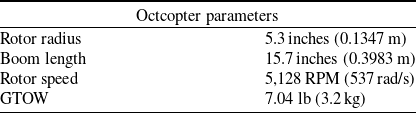
An edge-first octocopter (Fig. 9) of equal disc loading and gross weight is also considered in this study (properties are summarised in Table 2). Like the quadcopter, this vehicle is trimmed using collective pitch control on each individual rotor, with control modes as in Equation (1). In addition to the three phase modes defined on the quadcopter, four additional modes associated with higher harmonics of
 $\Psi$
can be defined, and are included in Equation (2).
Octocopter in edge-first configuration with zero relative phasing between rotors.

In addition to examining the vibratory forces and moments along each axis, it is also useful to consider integrated 2/rev force and moment vibration indices. A force and moment vibration index based on a 2-norm is used in this study, as defined below for a single harmonic:
 \begin{align}F_{\text{2P}} = \sqrt{F_{x,2s}^2+F_{x,2c}^2+F_{y,2s}^2+F_{y,2c}^2+F_{z,2s}^2+F_{z,2c}^2}\nonumber\\[3pt] M_{\text{2P}} = \sqrt{M_{x,2s}^2+M_{x,2c}^2+M_{y,2s}^2+M_{y,2c}^2+M_{z,2s}^2+M_{z,2c}^2}\end{align}
Equation (3) can be evaluated for any harmonic, and an overall vibration index for force and moment,
 \begin{equation}\begin{gathered}F = \sqrt{\sum_{k=1}^N F_{kP}^2} \qquad M = \sqrt{\sum_{k=1}^N M_{kP}^2} \end{gathered}\end{equation}
3.0 Results
3.1 Isolated rotor
In forward flight, the quadcopter will require a differential root pitch between the front and rear rotors [Reference McKay, Niemiec and Gandhi39] to counteract the nose-up pitching moment produced by each rotor, in addition to a nose-down attitude required to overcome aircraft drag. At 13m/s, the vehicle operates at
 $16.2^\circ$
nose-down pitch attitude (to overcome fuselage drag) and the front rotors operate at
 $9.3^\circ$
root pitch. The aerodynamic lift on the blade is plotted in Fig. 10. Due to the dynamic pressure variation, the lift is biased toward the advancing side of the disk, and due to the longitudinal inflow distribution, it is also biased toward the front of the disk.
Lift distribution of front-right rotor trimmed at 13m/s.

Isolated rotor deflections.

Blade root vertical shear for front right rotor trimmed at 13m/s (note that positive is defined as downward).

The aerodynamic lift is the dominant contributor to the flapwise deflection of the rotor blade, shown in Fig. 11. The flapwise deflection of the blade lags the blade lift by
 $15^\circ$
(
 $\nu_\beta = 1.28$
) due to the stiffness of the blades. Due to the highly twisted blade, the lift does not act along the principal axes of the aerofoil section, so the lag (in-plane) deflection is also dominated by the lift, and is in-phase with the flapwise deflection. The torsional deflection is also in-phase with the lift.
The flapwise deflection of the blades causes inertial vertical shears at the root of the blade, which are generally in-phase with the aerodynamic loads (Fig. 12); lead/lag motion will additionally produce a root shear. The vertical motion of the blades will also produce a flapwise root bending moment. Aerodynamic pitching moment and torsional acceleration will produce blade root torsional moments, though these moments are small compared with the flapwise moments. Summing the blade root shears and moments over the two blades results in 2/rev-dominant vibratory hub forces and moments.
This process can be repeated for the other rotors in the system. Rotor 2, for example, operates at an identical root pitch and nose-down attitude but rotates in the opposite direction from rotor 1. Thus, it will have a lift distribution similar to Fig. 10, except reflected about the
 $0^\circ$
–
 $180^\circ$
line. Thus, the 2/rev side force and roll moment will have identical magnitude but opposite sign, and the drag, thrust and pitching moment have equal magnitude and sign. For the phasing illustrated in Fig. 7, the forces and hub moments are plotted in Fig. 13. The magnitudes of the 2/rev forces and moments for the front rotors are also given in Fig. 14
Rotor hub loads at 13 m/s trimmed flight.

2/rev amplitude of hub forces and moments for front rotor trimmed at 13m/s.

3.2 Quadcopter
3.2.1 Pitch phasing
As
 $\Phi_P$
is varied, the two front rotors will always remain in-phase with each other, as will the two rear rotors. Each rotor within these pairs operates at identical root pitch, but they have opposite spin directions. Thus, the side force, as well as the hub rolling moment, will cancel, while the thrust, drag and hub pitching moments will compound. As the lateral forces and hub moments within each rotor pair cancel, these will not contribute to net 2/rev vibration at the aircraft level for any
 $\Phi_P$
. Further, because the rotor thrust in each rotor pair is in-phase, and these rotors are on opposite sides of the rolling axis, the 2/rev rolling moment that these rotors induce will also cancel. However, the pitching moment induced by thrust will compound.
The magnitude of the 2/rev net forces and moments about each axis of the quadcopter as
 $\Phi_P$
is varied from
 $0^\circ$
to
 $90^\circ$
(with all other modes held to zero) is plotted in Fig. 15. When
 $\Phi_P=0^\circ$
, all four rotors are in-phase with one another. Consequently, the 2/rev rotor drag and thrust are in-phase.
Quadcopter amplitude of 2/rev vibratory forces and moments at aircraft C.G. using pitch phasing (V = 13m/s).

As
 $\Phi_P$
increases from
 $0^\circ$
, the front rotor pairs become increasingly out-of-phase with the rear rotors. Thus, as shown in Fig. 16, the thrust produced by these pairs of rotors are increasingly out-of-phase. Consequently, the net 2/rev thrust on the aircraft decreases. At
 $\Phi_P=45^\circ$
, the phase between the front and rear rotors is exactly
 $90^\circ$
. In this case, the front rotors (which still pass each other tip-to-tip) will pass the rear rotors orthogonally (i.e. when the front rotors’ blades are aligned forward–backward, the rear rotors’ blades are aligned left–right), and the 2/rev forces are completely out-of-phase. The same argument holds for the 2/rev drag, which follows the same trend as thrust in Fig. 15. Thus, there is a minimum in force vibration on all axes at
 $\Phi_P=45^\circ$
, though the cancellation is not perfect, as the rear rotors are more heavily loaded than the front rotors in forward flight. Relative to the baseline case (
 $\Phi_P=0^\circ$
), the 2/rev thrust and drag are reduced by 97.3% and 93.3%, respectively.
Quadcopter 2/rev vertical forces at aircraft C.G. using pitch phasing (V = 13m/s).

The net 2/rev moments about the vehicle C.G. are also plotted versus
 $\Phi_P$
in Fig. 15. The pitch moment behaves very differently than thrust and drag, because the vehicle moment about any axis has two sources, namely the moments about each rotor’s hub, which are transmitted directly from the hub of each rotor to the vehicle, and force-induced moments (as each rotor has a moment arm). For no value of
 $\Phi_P$
do the pitching moments cancel entirely. This is due to the interaction between the hub and thrust-induced moments, illustrated in Fig. 17. When
 $\Phi_P=0^\circ$
, the thrusts of the front/rear rotor are in-phase, so the induced moments of the front and rear rotors are out-of-phase. However, at the same time, the hub moments are in-phase. Conversely, at
 $\Phi_P=45^\circ$
, the hub pitching moment is out-of-phase, while the thrust-induced moments are in-phase.
Quadcopter amplitude and phase of net 2/rev hub and force-induced pitching moments at aircraft C.G. using pitch phasing (V = 13m/s).

Comparing the results with those in Ref. 40, the inclusion of elastic blades does not significantly change the effect of relative rotor phasing. While each individual rotors load’s magnitude and phase may change, because both front rotors are affected identically, their relative behaviour is the same, so that, when the rotors are phased relative to one another, their overall effect on the vehicle vibration are similar.
3.2.2 Roll phasing
Similar to how the use of
 $\Phi_P$
left the front (and rear) two rotors in-phase with one another, the use of
 $\Phi_R$
will keep the two right (and two left) rotors in-phase. Like
 $\Phi_P$
, each rotor pair contains one CW rotor and one CCW rotor. As a result, the side forces and hub rolling moments will mostly cancel, but not entirely, since the two rotors are operating at different pitch settings. The drag, thrust and hub pitching moments will again compound within the rotor pair.
Consequently, the behaviour of the 2/rev drag and vertical forces on the vehicle are very similar, as shown in Fig. 18. However, the imbalance in the rotor side forces within each pair results in a small net 2/rev side force within each rotor pair, resulting in a small net 2/rev side force for
 $\Phi_R\ne0$
. Overall, the 2/rev forces can be reduced by 96.7%.
Quadcopter amplitude of 2/rev vibratory forces and moments at aircraft C.G. using roll phasing (V = 13m/s).

As the two rotors within each pair are on opposite sides of the pitching axis, the net 2/rev-induced pitching moment is very small for all
 $\Phi_R$
. As a result, the pitching moment can be entirely cancelled at
 $\Phi_R=45^\circ$
, where the phase between the left and right rotors is
 $90^\circ$
(when the left rotors’ blades are aligned forward–backward, the right rotors’ blades are aligned left–right). However, this results in a very large 2/rev thrust-induced rolling moment, similar to the induced pitching moment at
 $\Phi_P=45^\circ$
. It is also accompanied by a large yawing moment, due to the 2/rev moment induced by the rotors’ in-plane forces (both drag and side force).
3.2.3 Differential phasing
 $\Phi_D$
results in pairing of rotors by their spin direction. Counter-clockwise (CCW) spinning (and clockwise-spinning) rotors will always remain in-phase with one another. Unlike
 $\Phi_P$
and
 $\Phi_R$
, there is no cancellation of forces or hub moments within a rotor pair. However, as the rotors within each pair are on opposite sides of the centre of gravity, all force-induced moments cancel within each pair.
Similar to
 $\Phi_P$
and
 $\Phi_R$
,
 $45^\circ$
of
 $\Phi_D$
results in a minimisation of the 2/rev vertical and longitudinal forces (Fig. 19), as the CCW rotors’ thrust and drag are out-of-phase with those of the CW rotors. Unlike pitch and roll phasing, side forces compound, rather than cancel, within each rotor pair, resulting in a large 2/rev lateral force when
 $\Phi_D=45^\circ$
(when the CCW and CW rotors are
 $90^\circ$
out-of-phase). Relative to the baseline case, the overall force vibration can only be reduced by 63%, rather than the over 90% reduction using
 $\Phi_P$
and
 $\Phi_R$
.
Quadcopter amplitude of 2/rev vibratory forces and moments at aircraft C.G. using differential phasing (V = 13m/s).

Quadcopter 2-norm force and moment amplitudes for individual phase modes.

Because the force-induced moments of each rotor pair largely cancel for all
 $\Phi_D$
, only the rotor hub moments can contribute to the net moments acting on the vehicle. For
 $\Phi_D=0^\circ$
, the hub rolling and yawing moments of the CCW and CW rotors are out-of-phase, while at
 $\Phi_D=45^\circ$
, these moments compound. The opposite occurs for pitching moment, which behaves precisely like it did with
 $\Phi_R$
.
Using the 2-norm force and moment vibration indices from Equation (3), Fig. 20 shows the overall 2/rev force and moment vibration using each of the three phasing modes.
 $\Phi_P$
and
 $\Phi_R$
show similar 2/rev forces, and much greater reduction than
 $\Phi_D$
. From Fig. 20, it would appear that
 $\Phi_P=45^\circ$
results in the lowest overall vibration, with 2/rev forces nearly eliminated, and lower vibratory moment than either
 $\Phi_R$
or
 $\Phi_D$
, though none of the individual modes is capable of simultaneously reducing 2/rev forces and moments.
3.3 Octocopter
The octocopter has a total of seven phase modes. In addition to the three pitch, roll and differential modes described above for the quadcopter, one mode is associated with
 $\sin 2\Psi$
,
 $\cos 2\Psi$
,
 $\sin 3\Psi$
and
 $\cos 3\Psi$
. For brevity, only a subset of these modes (
 $\Phi_P$
,
 $\Phi_{2s}$
and
 $\Phi_{2c}$
, Fig. 21) will be presented, as these were most effective for aircraft-level vibration reduction.
Phasing modes of an edge-first octocopter.

3.3.1 Pitch phasing
As with the quadcopter,
 $\Phi_P$
on the octocopter (Fig. 21(a)) enforces a phase difference between the front rotors (1, 2, 3 and 8 in Fig. 9) and rear rotors (4–7). The 2/rev forces and moments at the C.G. of the octocopter are plotted versus
 $\Phi_P$
in Fig. 22. Qualitatively, the behaviour of each force and moment is similar to the quadcopter, with both 2/rev thrust and drag being cancelled at the aircraft level for
 $\Phi_P=45^\circ$
(when the front/rear rotors are
 $90^\circ$
out-of-phase). Similarly, the interaction between the thrust-induced and hub pitching moments prevents complete cancellation, as at the point where hub moments are minimised (
 $\Phi_P=45^\circ$
), the thrust-induced moments are maximised, and vice versa. All lateral forces/moments cancel within rotor pairs (rotors 1 + 2 cancel, as do rotors 3 + 8, 4 + 7 and 5 + 6) for all
 $\Phi_P$
, just as they did with the quadcopter. The similarities between the octocopter and quadcopter extend to
 $\Phi_R$
and
 $\Phi_D$
, as the similar definitions of the phase modes produce similar behaviour of the vibratory forces and moments.
Octocopter amplitude of 2/rev vibratory forces and moments at aircraft C.G. using pitch phasing (V = 13m/s).

3.3.2 2c phasing
 $\Phi_{2c}$
generates a relative phase between the longitudinally extreme rotors (1, 2, 5 and 6), and the laterally extreme rotors (3, 4, 7 and 8), as shown in Fig. 21(b). The 2/rev forces and moments are plotted versus
 $\Phi_{2c}$
in Fig. 23. As was the case with
 $\Phi_P$
, the side force cancels within rotor pairs (1 + 2, 3 + 8, 4 + 7 and 5 + 6), since these rotors are always in-phase and spin in opposite directions. Similarly, both the hub and force-induced rolling moments and yawing moments cancel within these same rotor pairs. Thrust and drag also behave similarly to the other phase modes, with a minimum at
 $\Phi_{2c}=45^\circ$
, where the longitudinally extreme rotors are out-of-phase with the laterally extreme rotors.
Octocopter amplitude of 2/rev vibratory forces and moments at aircraft C.G. using 2c phasing (V = 13m/s).

The only major difference between
 $\Phi_{2c}$
on the octocopter and the other phase modes examined thus far is in the pitching moment, which is broken down into its hub and force-induced components in Fig. 24. Because diametrically opposed rotors (1 + 5, 2 + 6, 3 + 7 and 4 + 8) are always in-phase, the thrust produced within these pairs are also in-phase. Since these rotors are also on opposite sides of the C.G., the pitching moment induced by these rotors mostly cancels for all
 $\Phi_{2c}$
(compare the radial scale on Fig. 24(b) with that on Fig. 24(a)). Thus, the total pitching moment is dominated by the hub moment, which will mostly cancel at
 $\Phi_{2c}=45^\circ$
. Thus, unlike the quadcopter, the octocopter is capable of simultaneously reducing both the forces and the moments substantially using rotor phasing, with maximum reductions of 99.8% and 91.1% for the vibratory forces and moments respectively, relative to the baseline phasing.
Hub and force-induced pitching moments on an octocopter at V = 13m/s at various
 $\Phi_{2c}$
.

3.3.3 2s phasing
 $\Phi_{2s}$
(Fig. 21(c)) creates a phase difference between the north-west/south-east rotors and the north-east/south-west rotors. The 2/rev forces and moments experienced by the octocopter as
 $\Phi_{2s}$
is varied (Fig. 25) are somewhat similar to
 $\Phi_{2c}$
, though there are some differences. In particular, the pitching moment completely cancels at
 $\Phi_{2s}=45^\circ$
, while there is a local maximum (still very low) in the rolling and yawing moment. The complete cancellation can occur because, at
 $\Phi_{2s}=45^\circ$
, both the thrust and hub pitching moments between rotors 1 and 2 (and 3 + 8, 4 + 7 and 5 + 6) are out-of-phase. Since these rotors are on the same side of the pitching axis, their thrust-induced pitching moments will cancel. Between the four pairs of rotors, the aircraft-level rolling and yawing moments mostly cancel, as well. Overall, the vibratory moments are reduced by 83.1% for
 $\Phi_{2s} = 45^\circ$
.
Octocopter amplitude of 2/rev vibratory forces and moments at aircraft C.G. using 2s phasing (V = 13m/s).

These three phase modes are compared using the 2-norm force and moment vibration indices in Fig. 26. All three modes are equally capable of reducing the overall 2/rev vibratory forces, but
 $\Phi_{2c}$
and
 $\Phi_{2s}$
are strictly superior to
 $\Phi_P$
in 2/rev vibratory moments, and can simultaneously reduce all forces and moments to near-zero levels, showcasing the octocopter’s superior potential for aircraft-level vibration reduction using relative rotor phasing as compared with the quadcopter, which does not have higher harmonic phase modes.
Octocopter 2-norm force and moment amplitudes for individual phase modes.

3.4 Speed variation
To examine the robustness of the effect of relative rotor phase, the above analysis was repeated at a wind speed of 5m/s. For the quadcopter, the variations in 2/rev forces and moments at the C.G. when varying
 $\Phi_P$
,
 $\Phi_R$
and
 $\Phi_D$
are plotted in Fig. 27. Comparing Fig. 27(a), (b) and (c) with Figs 15, 18 and 19, respectively, each component of force and moment behaves the same way in response to each mode of rotor phasing, which will hold as long as the lift and drag distributions on each rotor are similar (i.e., the rotor forces/moments behave similarly with individual rotor azimuth). The 2/rev C.G. loads of the octocopter trimmed at 5m/s are shown in Fig. 28 (similar to Figs 22, 23 and 25). Thus, it is clear that the vibration-minimising rotor phasing is independent of the flight speed of the vehicle.
Variation of 2/rev C.G. forces and moments of a quadcopter trimmed at 5m/s with different rotor phasing.

Variation of 2/rev C.G. forces and moments of an octocopter trimmed at 5m/s with different rotor phasing.

3.5 Multiple phase modes
Varying only individual phase modes explores only a small portion of the available design space. To understand the interaction of multiple phase modes used simultaneously, and to identify whether any additional vibration reduction is possible, the design space is explored systematically. A uniform grid of points is constructed, each of which represents a single set of rotor phases. For each point, the 2-norm force and moment vibration indices are evaluated. From this data, a set of Pareto-optimal rotor phases can be constructed, from which a designer can select based on the relative importance of force and moment vibration reduction.
Figure 29 shows the space of vibratory force and moment reachable using rotor phasing on the quadcopter. Included in the figure are curves corresponding to single phase mode variations. It can be seen that
 $\Phi_P$
strictly dominates both
 $\Phi_R$
and
 $\Phi_D$
, with the lower branch having both lower vibratory force and moment. In fact, the
 $\Phi_P$
curve coincides with the Pareto front in multiple places, including the minimiser associated with equal force and moment weighting (represented by the green cross). However, there is a substantial region of the Pareto front that is not reachable using any single phase mode.
Use of single and multiple phase modes for minimisation of the quadcopter’s composite vibration index

Force and moment vibration on a quadcopter.

If it were critically important to reduce the vibratory moment, even at the expense of increased vibratory forces, one could weight moment more heavily than force in the evaluation of a composite vibration index (Equation (5)), where W is a weighting factor emphasising either force or moment vibration.
 $W=0$
disregards moment entirely, whereas
 $W=1$
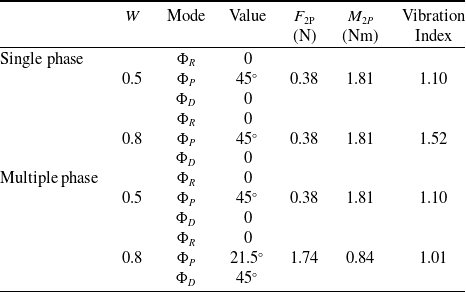
uses moment exclusively. The optimal rotor phasing using a single mode and multiple modes are listed in Table 3.
For
 $W=0.5$
, the individual mode (
 $\Phi_P$
) reaches the overall minimum at
 $45^\circ$
, but the system is unable to reduce the moment vibration without very large increases in the force vibration (the slope of the magenta curve in Fig. 29 is very small). For
 $W=0.8$
(4:1 moment–force weighting), however, using
 $\Phi_D$
in conjunction with
 $\Phi_P$
allows moment to be reduced by 54% while increasing the (lightly weighted) force vibration, for an overall vibration index reduction of 33%.
 \begin{equation}\text{Composite vibration index} = (1-W)F+W M \end{equation}
A similar exercise was conducted on the octocopter, and the space of vibratory force and moment is given in Fig. 30. As was seen in the single phase mode results, force and moment can be minimised simultaneously by either
 $\Phi_{2s}$
or
 $\Phi_{2c}$
, though none of the other phase modes can achieve this.
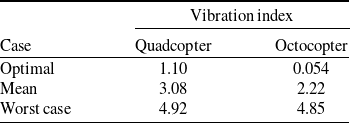
Absent a phase control system, the rotors would be randomly phased relative to one another (even with RPM synchronisation), with force and moment vibration falling somewhere in the blue space of Fig. 29 or 30. Table 4 compares the vibration levels for the
 $W=0.5$
(equal force–moment weighting) vibration index minimisers (black crosses in Figs 29 and 30) with the mean of all possible phase combinations (reasonably representative of random phasing) and the worst-case phasing.
Comparison of vibration-optimised phasing for
 $W = 0.5$

Force and moment vibration on an octocopter.

On average, the octocopter has overall lower vibration than the quadcopter, due to the presence of more rotors, increasing the likelihood that some rotors will be out-of-phase with the others, though the worst-case scenarios are very similar between the two aircraft. Both vehicles experience their worst-case vibration when all of the rotors are in-phase, or nearly in-phase. Compared with the mean vibration levels, the phase-optimised quadcopter has 62% reduced overall vibration, and the octocopter has 96% reduced overall vibration.
4.0 Conclusions
The relative phasing of synchronised flexible, fixed-RPM, variable-pitch rotors on a quadcopter and an octocopter was explored for vibration reduction. Several phase modes were defined for each aircraft with the multi-rotor coordinate transform, including a pitch mode which represents a phase difference between the front rotors and rear rotors, a roll mode which represents a phase difference between the left and right rotors, and a differential mode which represents the phase difference between CW and CCW rotors. Additional higher harmonic modes were defined on the octocopter.
From the single-mode analysis of the quadcopter, both pitch and roll phasing allowed for the greatest reduction in vibratory forces with maximum reductions of 95.9% and 96.7%, respectively, from the baseline phase when
 $\Phi_R$
or
 $\Phi_P = 45^\circ$
. Although minimised at the same point (
 $\Phi_D = 45^\circ$
), the differential phasing was less effective at reducing vibratory forces with a reduction of only 63.0% due to the introduction of significant 2/rev side forces not seen with
 $\Phi_R$
and
 $\Phi_P$
. The quadcopter results are similar to those in Ref. 40, since the inclusion of elastic blade effects affects each rotor in a similar manner.
However, this reduction of vibratory forces comes at the cost of an increase in vibratory moments. For both
 $\Phi_R$
and
 $\Phi_D$
, the vibratory moments are lowest when all rotors are in-phase (
 $\Phi = 0^\circ$
), and greatest at
 $\Phi_R=45^\circ$
or
 $\Phi_D=45^\circ$
. For
 $\Phi_P$
, pitch moment was never reduced to zero due to the interaction between thrust-induced moment and hub pitching moment.
The octocopter has four additional phasing modes which allow the vibratory forces and moments to be reduced simultaneously. Both
 $\Phi_{2s}$
and
 $\Phi_{2c}$
eliminate the vibratory forces at
 $45^\circ$
. At the same time, these modes reduce the vibratory moment about the C.G. by 83.1% and 91.1%, respectively.
To examine the robustness of the conclusions of the single-phase mode results, the study was repeated for a quadcopter and octocopter trimmed at 5m/s flight speed. Both the quadcopter and the octocopter exhibited very similar behaviour.
Simultaneously varying multiple phase modes created a comprehensive set of possible force and moment vibration levels, from which a Pareto front was constructed. On the quadcopter,
 $\Phi_P$
formed part of this Pareto front, though could not reach a Pareto-optimal solution for some moderate force-to-moment weighting. In this region, the use of multiple phase modes can reduce the overall vibration level by 33% (for a 4:1 moment-to-force weighting).
The search also allowed a comparison of the optimal solutions to the mean and worst-case vibration levels. Compared with vibration levels in forward flight that might, on average, be expected if the rotors were randomly phased, reductions of 62% and 96% in a composite vibration index (equally weighting vibratory forces and moments) were calculated for the quadcopter and octocopter, respectively, with appropriate rotor phasing.
Acknowledgements
This work is carried out at Rensselaer Polytechnic Institute under the Army/Navy/NASA Vertical Lift Research Center of Excellence (VLRCOE) Program, grant number W911W61120012, with Dr. Mahendra Bhagwat as Technical Monitor.