On 25 November 1830, John Benett, Tory MP for Wiltshire, met a group of “Swing” rioters approaching his property near Salisbury. Though their threat to break his agricultural machinery obviously disturbed him, Benett was also struck by their appearance. The leaders of the group were wearing what he described as “party-coloured sashes.” Benett warned one leader: “I am sorry to see you with that sash on. … Young man, that sash will hang you.” The rioters blankly refused to take off their adornments and continued toward his land. Benett called out the yeomanry but was unable to prevent his threshing machines from being destroyed.Footnote 1
The sashes carried potent layers of symbolism. The rioters may have worn “party-coloured sashes” in order to connect their campaign against the agrarian capitalist economy with the wider political agitation of the time. The incident took place only a week after Lord Grey became prime minister, a situation that encouraged renewed pressure for parliamentary reform.Footnote 2 Benett assumed that the leaders were expressing a radical political point through their attire. He later told Parliament that “the mob had been excited by the writings of Mr Cobbett and by the speeches of Mr Hunt” (the nationally prominent campaigners for parliamentary reform). Conversely, the leaders may have used parti-color, or pied, sashes merely as a means of identification. This was a bold gesture in itself, as previous forms of plebeian collective activity had often been enacted in disguise or at night. The rioters asserted their aims through a vestimentary symbolism usually seen at holidays and fairs: wearing carnivalesque adornments, they enacted their own interpretation of justice in a “world-turned-upside down.”Footnote 3 The law took a different view. As foreman of the grand jury for the special assizes, Benett ensured that justice was done, though the sashes led the Swing rioters not to hanging but to seven years’ transportation.Footnote 4
The Swing sashes were just one demonstration of the contested fabric of popular politics in England during the later Hanoverian era. Recent studies of popular movements in this period have emphasized the role of myriad means of political expression, including broadsides, music, and drinking toasts.Footnote 5 This article argues that clothing and material adornments were a prominent part of this rich and participatory culture. Political clothing existed in numerous types that enabled all classes to voice their opinions about their place within the constitution. Furthermore, symbolic clothing evolved in its uses and meanings during this period. Though many forms of dress shared a long history of political symbolism, the French Revolution and renewed debates about parliamentary reform and the “rights of man” gave new meanings to traditional emblems and colors. Access to, and opportunities to display, forms of political clothing expanded in this period, especially at the “mass platform” reform meetings from 1815 onward.
The first part of this article demonstrates how the middle and working classes appropriated well-established ways of political dressing from the elite. Collective clothing manifested a popular desire to “fit in” with the body politic. These forms extended from the cheap and easily accomplished (ribbons at elections) to the specialized and more difficult to produce (uniforms). Despite the sharing of fashions and emblems among classes, however, dress was still the most obvious indicator of one's social position and gender, and this affected how political adornments were used and perceived. The second part argues that the working classes could covertly express their own symbolism in customary activities, as a means to “stand out” or to subvert everyday norms as a means of protest. The “party-coloured sashes,” for example, were threatening in the context of Swing but were also a celebratory emblem of community in the context of festival customs.
Clothing was an optimum means of public communication. Colors, shapes, and styles of dress were more instantly recognizable to the illiterate or to mass crowds than the rhetoric of textual and oral propaganda was, although text, speeches, and symbolism were usually employed simultaneously to reinforce one another. Visual symbols were what Paul Pickering terms “class without words”: that is, emblems of popular discourse that encapsulated the principles and identities of social groups.Footnote 6 As Lynn Hunt identifies, emblematic clothing made “a political position manifest” and, in so doing, “made adherence, opposition, and indifference possible.”Footnote 7 Material adornments could serve as visual reminders to prove a political point or reinforce collective memory. Furthermore, such symbols had pliable meanings that political leaders could manipulate according to their current needs or circumstances.Footnote 8
Historians of the French Revolution would see nothing new in the idea of political clothing. Richard Wrigley, for example, has argued for “the ubiquitous and inescapable politicization of dress beyond the institutionalized forms of political life” in revolutionary France. This extended far beyond the obvious symbols of tricolor cockades, the “sans-culottes,” and the “Cap of Liberty.” The forms, colors, and positioning of dress and adornments were under heightened debate as successive revolutionary regimes attempted to refashion their visions of the new society and government. Dress in France shifted from a sumptuary designation of social status to a contested body of political identities.Footnote 9
This prominent role of vestimentary symbols in France made English opponents of the Revolution acutely sensitive to the wearing of political emblems, even if such items were well established or seemingly benign. Studies of popular politics in England have therefore focused on particular items of clothing that the government regarded as significant and politically dangerous. James Epstein and Paul Pickering have highlighted three iconic items used in extraparliamentary agitation for reform: the Cap of Liberty, the white hat, and the fustian jacket. British radicals from John Wilkes in the 1760s to the mass platform orators in the 1810s adopted the red Phrygian cap as a symbol of defiance against the unreformed state.Footnote 10 The white hat, sported by “Orator” Henry Hunt from 1816 onward, soon came to be taken up by his supporters as a mark of their commitment to the cause of reform. Fustian is a rough, piled cotton that formed an integral part of working-class clothing. In the 1840s, Chartist leader Feargus O’Connor wore a fustian jacket to identify with his audience, who embodied their class and politics in a collective identity of “fustian jackets and unshorn chins.”Footnote 11 One other study of the politicization of adornment in this period has concentrated on another single item: the powdered wig. John Barrell's account of William Pitt's controversial tax on hair powder in 1795 reveals how the French war intensified the connections that Pitt's opponents made between wigs, the economic capability required to powder them, and wider corruption in the body politic.Footnote 12
While not denying the importance of these specific symbols, this article argues that these items should be seen as just one part of a whole outfit of political clothing. Although not as iconic as the Cap of Liberty, other, seemingly mundane items formed a communicative code that both popular political leaders and many in the wider crowd understood. Participants in demonstrations and other forms of collective action drew from a long tradition of symbolism in clothing. Many of these emblems originated in popular festival customs; these had a carnivalesque function of temporarily overturning established modes of behavior. In other cases, types of clothing could be subtly displayed without the risk of violence or arrest that came with sporting something as obvious as a white hat or a sash.
This article furthermore calls for historians of clothing to engage with the history of popular politics. Textile historians usually focus on the economic and social aspects of fashion. Beverley Lemire, for example, has argued that types of dress filtered down the social scale more quickly in the later eighteenth century. The wider availability of cheaper cotton cloth enabled the lower classes to escape “a drab, unremarkable background” of dark woollens and to follow the light and clean dress of the rich.Footnote 13 This shift is relevant to political clothing. As we will see, shared forms of vestimentary emblems enabled the middle and working classes to venture further into a political foreground previously dominated by the elite. By examining the potent and often critical role of clothing and adornment in popular politics, both textile and political historians can (re)discover “the materiality of the sign.”Footnote 14
Symbolic clothing also offers a way of conceptualizing the nature of political engagement among social classes, especially before the enlargement of the electoral franchise in 1832. The predominant framework to describe political expression and debate outside Parliament remains Jürgen Habermas's idea of the “public sphere.” The term has widened to mean a space, as well as a flow of information through print media, and has expanded its social makeup beyond the bourgeois intelligentsia. Historians now search for a “plebeian public sphere” or, indeed, “multiple public spheres.” The concept arguably has become so ubiquitous as to encompass almost everything and thereby denote nothing.Footnote 15 It is difficult to apply the construct to forms of politics that were not bourgeois, textual, or “rational.” Indeed, clothing is the most common form of expression that does not fit easily within the latter three categories.
The “body politic,” a concept conceived by Richard Sennett and Judith Butler, provides a useful alternative model.Footnote 16 Whereas the public sphere relies on an individual's engagement with debate in text or discussion, the body politic suggests the formation of a group identity through collective expressions of self. Political clothing was an articulation of both individual self and collective identity. Through the performance of wearing symbolic items, individuals used their bodies to claim a part in the wider body politic.Footnote 17 Rousseau notably discussed this idea in Du Contrat Social (1762), though he warned of the damaging dissociation between external presentation and inner moral self. Dress could be a means of disguising political identity when under threat of suppression. This was a theme that resonated with radicals in both France and Britain, who were under increased government surveillance from the 1790s onward.Footnote 18
Caution must be raised about the limitations of surviving sources. Contemporary descriptions of the appearance of crowds could, of course, be as unreliable as misheard speeches or biased underestimations of attendance. Many newspaper reports of political activity made no mention of clothing but rather concentrated on the banners visible at events. The eyes of authorities (like those of later historians) therefore gravitated toward distinctive or unusual emblems. Admittedly, working men and women found it more convenient to attend demonstrations in their everyday wear than to purchase costly items purely for the occasion. This article draws on a wider range of pictorial sources and records of folk traditions to show that even the ordinary could become spectacular in particular contexts. Colored ribbons or “Sunday best,” otherwise unremarkable, could carry potent connotations when worn at political demonstrations.Footnote 19
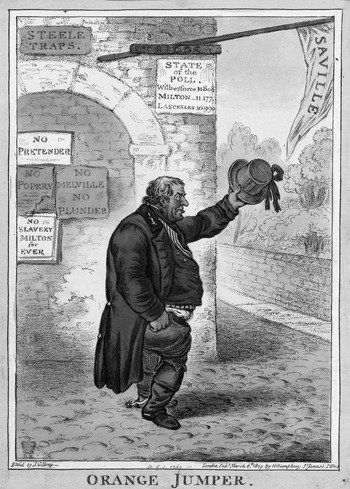
Electoral adornment was the most obvious form of political clothing in the eighteenth century. “Orange Jumper,” a print by James Gillray, caricatures a prominent Whig supporter during the Yorkshire election of 1807 (fig. 1). The corpulent figure wears a red coat and orange breeches and waves a hat adorned with orange ribbons in honor of his chosen candidate, Lord Milton.Footnote 20 The symbolism of orange had remained unchanged since the Whigs adopted the color in honor of William of Orange and the Glorious Revolution of 1688. Gillray's depiction of electoral symbolism hardly differs from the items in William Hogarth's 1754 series of election paintings, where Whigs and Tories are distinguishable by their orange and blue ribbons and banners, respectively.Footnote 21 The Tories were associated with “true” blue, although they did not have hegemony over the color. Whig-radical Charles James Fox wore a blue frock coat and buff waistcoat in Parliament from 1782
—James Gillray, “Orange Jumper” (1809). © Trustees of the British Museum.

onward, allegedly in emulation of the uniform of George Washington's regiment in the American Revolution.Footnote 22 Local party colors, determined by aristocratic patrons, complemented the preponderance of orange and blue. For example, Sir Francis Burdett's electoral color was purple, perhaps to differentiate himself from his plebeian followers during his contests for Middlesex and Westminster in 1802 and 1807. Hence his “beautiful, well-dressed women” supporters waved purple handkerchiefs and ribbons from the windows of houses in “respectable” parts of
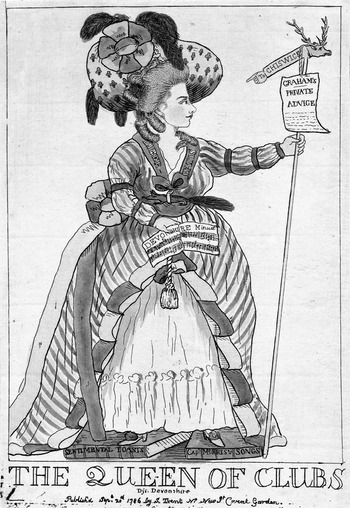
—Anon., “The Queen of Clubs” (1786), caricaturing the Duchess of Devonshire in “blue-and-buff.” © Trustees of the British Museum.

London while distancing themselves from the rabble processing in the streets below.Footnote 23
Electoral ribbons and cockades were easily made, displayed, and recognizable as symbols of political adherence. Once they adorned themselves with a ribbon, nonvoters as well as voters instantly participated in the extraparliamentary political process. Elite women went further by creating whole fashions from political colors (fig. 2). A Whig account of the tumultuous Westminster election of 1784 commented that “the ladies, in their rage for Mr Fox, have adopted a dress in compliment to him; it is to consist of a mixture of garter-blue and buff.”Footnote 24 In sharing the same colors—though diversified through the filters of gender, court fashion, and personal taste—these aristocratic women were able to partake in a common body politic. This was not simply window dressing. As Elaine Chalus has shown, female participation could consist of direct political influence through patronage and persuasion rather than mere display.Footnote 25
The working classes wore colors on a smaller, cheaper scale, but with the same sense of purpose. The “Old Chartist” and Halifax weaver, Benjamin Wilson, recalled that during the Reform Bill agitation of 1831, his friend “determined that ‘I should have a new cap with a yellow (the ‘Liberal’ colour) girdle around it’ of which I was proud and wore it a long time.”Footnote 26 Local elites had no doubts as to the necessity for such symbolism to be promoted as widely as possible, and material emblems distributed indiscriminately contributed to the enormous cost of many elections prior to the 1832 Reform Act. During the Chester election of 1784, for example, the Tory Grosvenor party alone spent up to £1,500 on colors, ribbons, and cockades. Furthermore, the wearing of colors often sparked partisan violence. An 1827 act of Parliament forbade the distribution of ribbons, cockades, and other emblems of partisanship at elections in order to prevent such disturbances. The custom was so entrenched, however, that the act remained unenforceable.Footnote 27
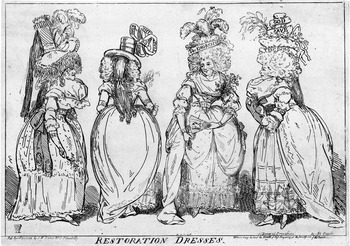
Similar adornments were displayed at patriotic events, a central feature of the reign of George III. Government and loyalists promoted patriotism as an acceptable (though not untroubled) means of allowing all classes some part in collective political expression.Footnote 28 As was the case with electoral symbolism, elites saw themselves as harbingers of fashion, though practices were quickly adapted by individuals lower down the social scale. A caricature from April 1789, “Restoration Dresses,” depicts fashions during the celebrations for George III's recovery from his illness (fig. 3). Four ladies wear elaborate headdresses decorated with ribbons, bracelets, and sashes bearing such loyal mottoes as “The King Restored” and “Long Live the King G. R.”Footnote 29 Although the print was satirical, contemporary accounts of the Hanoverian Court suggest the ubiquity of such adornment. The London Chronicle reported: “the ladies wore nearly the same kind of uniform caps. … In all head dresses were bandeaus of embroidered velvet with the motto of ‘God save the King.’” The emblems succeeded the “Regency caps” previously worn by the Prince of Wales's party during the Regency crisis of 1788.Footnote 30 Aristocratic funerary fashions
—Henry Kingsbury, “Restoration Dresses” (1789). © Trustees of the British Museum.

spread out to provincial society, encouraged by newspaper columns and private correspondence transmitting the exact details of current mourning dress in the court.Footnote 31 After the death of George III in 1820, Elizabeth Wadsworth, a gentlewoman from Halifax, Yorkshire, noted in her diary: “some in full mourning for the King.” A few days later, a seamstress arrived to make her a “gown trimmed with crape [sic] for mourning for our lamented King.”Footnote 32 The widespread practice of mourning the death of a monarch was fostered by a powerful expectation to join in its public symbolism, although the working classes could simply wear a black ribbon to spare the expense of full mourning dress.
The definitive mode of collective clothing was the uniform. Uniforms had two complementary purposes: to unite and to distinguish. This dual function was most evident during wartime, when patriotic propaganda fostered xenophobic opposition to “the other.” British military uniforms were arguably at their most semiotically potent during the Napoleonic Wars. Demand for increased manpower and home defense during the American and French wars meant that a large proportion of Britons either wore uniform or regularly saw it being worn.Footnote 33 During the American War of Independence, English caricaturist Matthew Darley satirized the recruits at Coxheath camp in London as sporting increasingly elaborate black and blue cockades in their hats.Footnote 34 Female fashion during wartime emulated such material emblems as a way of displaying patriotism; dresses were shaped in military styles and colors, and cockades featured prominently on ladies’ hats.Footnote 35 Local volunteer regiments had their uniforms provided either by their benevolent gentry officers or by public subscription. Their variations in color and adornment visualized a very British kind of patriotism, representing both civic pride and a sense of freedom from government compulsion.Footnote 36 In France, by contrast, the revolutionary governments conducted serial debates about enforcing standard uniforms for the National Guard and officials. Their explicit aim was a homogeneous national identity. This was, however, difficult to achieve in practice, partly because such uniforms had contested meanings but also owing to practical difficulties of cost and supply.Footnote 37 Whereas the French revolutionaries attempted to erase the past completely through decrees on dress, the British government relied on individual efforts to display what in effect became a patriotism variegated by locality. The Whig fear of a standing army no doubt contributed to this permissiveness.Footnote 38
Uniformed clothing in Britain and France also conveyed differing conceptions of class. During the early stages of the French Revolution, the sumptuary laws of the ancien régime were suppressed in an attempt to inaugurate the inception of social equality. In Britain, by contrast, sumptuary laws had long since lapsed. In his novel The Expedition of Humphry Clinker (1771), Tobias Smollett complained about the social confusion caused by female servants wearing their mistresses’ expensive castoffs.Footnote 39 Yet plenty of other displays of hierarchical identification persisted, especially at ceremonial events such as parades of judges at the opening of assizes.Footnote 40 Elite rank was marked more clearly than ever by the showy and expensive attire of the officers of the new volunteer regiments. Prints and newspapers frequently parodied the volunteers for an effeminate concern for the finery of their uniforms, especially when the costs of war began to bear down on the ordinary subject.Footnote 41 All classes remained acutely sensitive to the social distinctions displayed by silk, as opposed to woollen or worsted, clothing. Loyalist elites followed this stratifying trend, often serving as officers in their local volunteer corps. In the 1790s, some antiradical clubs designed their own uniforms to be worn on civic occasions. The privileged members of the central “Church and King” club in Manchester wore uniforms with buttons engraved with a picture of the “Old Church.” The emblem was inspired by the high Anglican Collegiate Church near the society's headquarters.Footnote 42
Elite practices influenced the symbolism of dress, but political fashions were also driven from below and were facilitated by an expanding commercial market. Historians of consumption single out the late eighteenth century as a period when the specialization of production and aggressive modes of marketing enabled the lower classes to access types of fashion on a previously unseen scale. The spread of fashion was further promoted by an expanding print media and increasingly packed calendars of national celebrations of royal and civic events.Footnote 43 The process was aided by improved technology, especially transfer printing on ceramics and ribbon weaving on narrow looms, which could generate appropriate messages in images and text.Footnote 44 Such trends shaped the spread of many forms of material propaganda, from John Wilkes pin badges to political banners.Footnote 45 The market arguably still had the most impact when sponsored by elite buying power. In 1792–93, the “principal inhabitants” of towns and villages across England wore blue sashes and cockades to demonstrate their loyalism at the burning of effigies of the radical writer Thomas Paine.Footnote 46 At a Paine burning at Failsworth near Oldham, Lancashire, participants displayed colors and ribbons “stamped in gild letters God Save the King—the Church—the Constitution.”Footnote 47 Though some Paine burnings were popularly inspired, many were sanctioned by local elites and suggest a level of prior organization that must have included coordinating the adornments. The wearing of specific loyalist mottoes, furthermore, was no localized idiosyncrasy. The same mottoes were embossed on blue and orange ribbons, sashes, and cockades worn at Paine burnings in Halifax and Heptonstall in Yorkshire and Kingswood in Bristol.Footnote 48 This commonality suggests, if not a national network of distribution, then at least a shared knowledge and emulation of material tropes.
The national commemorations of the death of Admiral Lord Nelson at the battle of Trafalgar in late 1805 illustrates the impact of the market on the visual expression of patriotism. James Weatherley, a Manchester bookseller, recorded in his autobiography: “I recollect the day of his funeral all the Mills and workshops stopt you could scarcly [sic] see that day a lad without a ribbon round his hat with a verse or something relating to the brave Nelson some of the ribbons were Paper and some Silk the one I bought was a blue Silk one I gave sixpence for it the letters on it gold Printed verse was May Nelson's Death and Britons Glory be Repeated in Future [hi]Story.”Footnote 49 Weatherley's recollections indicate an element of individual choice involved in the wearing of patriotic emblems. Nevertheless, it was a choice that was dictated by the market, by the expectation that individuals should join in a collective and public commemoration, and by the idea that silk facilitated social aspiration. Ribbons were an entirely familiar part of working-class dress, sold cheaply in chandler's shops and general stores. Yet however small, silk material still offered a nod to the clothes of the rich, and ribbons were given significance and special meaning by these occasions and mottoes. The commercial aspect was perhaps more common in large urban centers that had the production capability and the population to support a market for such goods. Another Manchester diarist, Absalom Watkin, noted the local celebrations for the restoration of the French monarchy in April 1814: “The street crowded with people, mostly wearing the blue and white cockade. Business, except the selling of cockades, transparencies, etc, at a stand.”Footnote 50
The same material emblems could conversely enable expression of alternative definitions of patriotism. During celebrations in 1820 for Queen Caroline, the radicals’ “heroine,” the market was able to respond rapidly to demand from all classes for appropriate symbols. The very means for expressing patriotism had ironically been set in place by previous royal events. In Liverpool, “The milliners’ shops were adorned with white ribbons, rosettes, mottoes and devices of every suitable description, for sale, which were bought up by an eager public with great avidity. In short, all classes provided themselves with ornaments of more or less values, according to their means: and the richness of gold and satin decorations were intermixed with the simple white rose and unadorned inscription of ‘God Save the Queen.'”Footnote 51 The crowd was able to subvert the meanings of patriotic rituals by using the same material symbols. Wrigley has found similar developments in revolutionary France, where “the misuse of what had become standard forms of signalling patriotism” merely reflected a more “general phenomenon whereby the currency of vestimentary norms, whether informally practised or officially instituted, actually had the effect of encouraging deviance and infringement.”Footnote 52
Political clothing could therefore act as a unifier in support of the constitution, yet in other forms and contexts it had dangerous political uses. Government and the law recognized and codified this distinction during this period. Common law determined that a person who encouraged riots by “wearing any particular badge, dress, or uniform” was equivalent to those committing violence and therefore liable to arrest.Footnote 53 This was applicable to the case of the Wiltshire Swing rioters. It also explains why, during the trial of Lord Gordon for treason in 1781, prosecutors meticulously questioned witnesses about whether certain individuals had been wearing blue cockades. The presence of the symbol was seen as proof enough that Gordon and members of his Protestant Association had fomented the anti-Catholic riots in London in 1780. The cockade was not merely a symbol of attachment to a cause: it determined the difference between life and death. Furthermore, death for the cockade retained conflicting interpretations right to the scaffold. Upon leaving Newgate prison, William Pateman was ordered to remove the blue cockade from his hat in order to avoid provoking a disturbance among the crowd observing his execution. He refused, “declaring that he died a martyr to the Protestant cause.”Footnote 54
Later statute laws highlighted the political potency of material adornment. Loyalist elites and the government were increasingly anxious about the influence from France and the growth of mass platform meetings as a form of protest. They channeled their anxiety onto what they saw as the revolutionary potential of radical emblems. Loyalist propagandists satirically portrayed radicals sporting the French revolutionary tricolor cockade in order to equate reform with sedition.Footnote 55 The Seditious Meetings Act of October 1819 (part of the legislative response to the “Peterloo Massacre” in Manchester that August) prohibited attendance at meetings “with any flag, banner or ensign, or displaying a device, badge or emblem.”Footnote 56 The government clearly regarded such items not just as political symbols but also as instruments of power. In November 1819, during the House of Commons debate on the prince regent's speech, Sir Francis Burdett defended the ribbons and banners at Peterloo as benign. For the Pittite George Canning, by contrast, they were as inflammatory as the symbols of Orangemen on 12 July: “Who did not know that banners, ribbons and other such devices, might be as clear indication of purpose as words? … Such things had great signification.”Footnote 57 Despite the prohibition of emblems, radicals, especially in northern England, continued to use material symbols as a means of political defiance into the 1820s and beyond.Footnote 58
Green was the established color of political dissent in England. It was originally associated with the Levellers and then with the Jacobites. Radicals in the later eighteenth century employed the color rather to connote the wearing of laurels in classical history and to denote political independence.Footnote 59 During the spectacular parade to celebrate Burdett's election for Middlesex in 1802, “several persons in the procession carried large bunches of laurel as emblems of victory.”Footnote 60 Laurels were also clearly identifiable symbols of leadership, displayed in the hats of those heading trade union parades and political processions, most notably to Peterloo.Footnote 61 Green favors and colors reiterated these associations in elections and reform meetings.Footnote 62 The 1832 Reform Act attempted to reduce the excesses of weeklong electoral festivities by cutting polling to a maximum of two days. Nevertheless, the tradition of colors at processions and hustings persisted, and middle-class radical candidates continued to employ green ribbons and banners in their campaigns.Footnote 63
The green of the Irish complicated the color's political meanings. A week before Peterloo, radicals paraded through the village of Lees, near Oldham. A loyalist informer reported to the government that they wore green and pink ribbons in their hats and were singing “Green Upon the Cape”: “Green is to be their Colors [sic]. This Song was the instigation of the Irish Rebellion twenty-one years ago.”Footnote 64 Green could no longer serve as a simple visual aid to remind its wearers of a radical English past because Irish Catholic immigrants used the color to represent their own identity and history of rebellion. This was particularly evident during Chartist agitation. In August 1840, Chartists held a mass rally to welcome the lecturers Peter McDouall and John Collins to Manchester after their release from prison. Women wore green and white scarves and favors in the traditional radical style, but the procession also included green flags showing the Irish harp.Footnote 65 The meaning of green in this case was therefore deliberately ambiguous, designed to appeal to both radical and Irish constituencies. By the late 1840s, green was predominantly associated with the Irish, a product of the influx of immigrants and heightened sectarian parading in many industrial towns.Footnote 66
Clothing could therefore be a powerful medium to unsettle as well as to conform. Radicals sported cockades and other items as deliberate and obvious ways of undermining or reclaiming loyalist symbolism. They promoted veneration of their own leaders instead of the “cult of Nelson” or George III: at the Manchester Radical Sunday School in 1819, for example, the monitors wore locket portraits of Henry Hunt around their necks.Footnote 67 Yet clothing could also undermine political norms in more subtle ways. The potential for subversion was also present in the wider culture of everyday life and folk customs.
Social historians are now familiar with a narrative of increasing elite control over popular leisure from the eighteenth century. Local elites sought to curb or sanitize the more vulgar aspects of plebeian customs.Footnote 68 One way they attempted this was to encourage carnivalesque display within the seemingly controllable confines of civic or patriotic events. No doubt the populace enjoyed such patronage. For example, the coronation of George III in September 1761 was celebrated by a national carnival of fancy dress. The civic procession around Manchester included each trade exhibiting exaggerated emblems of their identities and the extent of their commerce. Two hatters paraded “with gigantick hats on,” together with “two persons on horseback, dressed in Russian fur skins and caps of fur.”Footnote 69 From the early nineteenth century, Whit Monday processions were perhaps the most overt customary form patronized and regularized by local elites and trade societies and at which great shows of identifying costumes were displayed.Footnote 70
The potential for subversion within such civic events nevertheless endured. During times of tension, workers could employ their own collective dress as badges of identity and defiance against those in authority.Footnote 71 Trade processions such as the Guild Merchant in Preston, Lancashire, and the Bishop Blaize celebrations in Bradford, Yorkshire, ostensibly demonstrated the civic pride of commercial boroughs.Footnote 72 The Blaize procession of 1825 was regarded as the most elaborate of all. Although such events were intended to give the impression of communal solidarity, in effect they served merely to mask underlying social tensions. It is clear that the clothing marked the class differences between the masters, workers, and the other inhabitants of Bradford: “The apprentices and masters’ sons however, formed the most showy part of the procession; their caps being richly ornamented with ostrich feathers, flowers and knots of various coloured yarn: and their stuff garments formed of the gayest colours. Some of these dresses were very costly, from the profusion of their decorations.”Footnote 73 The artist George Walker included a representation of the Bishop Blaize procession in his Costume of Yorkshire (1814). Roger Young suggests that Walker took the ostensible harmony of the show for granted, regarding it as a quaint custom. In fact, the event hid the underlying current of class malaise in the West Riding woollen industry, as testified by other observers’ accounts of riotous proceedings occurring once the civic solemnities had finished.Footnote 74 A few months after the 1825 procession, the wool combers (20,000 strong) staged a bitter, drawn-out strike against their masters. The conflict culminated in the breakup of the wool combers’ union and the effective destruction of their prestige.Footnote 75 Rather than fostering class harmony, therefore, such civic processions gave both local elites and trade groups the opportunity to assert their divergent identities as well as express their sense of self.
The tradition of guild members wearing uniforms to elaborate processions, and freemasons with their aprons and sashes, was shared in more mundane forms by Sunday school children, friendly societies, and trade unions by the early nineteenth century.Footnote 76 The organizers of processions to political events therefore already had both established sources of adornments and the tradition of parading in emblematic clothing. Although political processions were still illegal under the Seditious Meetings Act of 1819, meetings of corporate bodies were exempt. Incorporated trades made the most of this loophole.Footnote 77 Identifiable clothing formed an essential part of the logistics of successful demonstrations, necessitated by their increased scale and complexity. Instructions from trade unions became highly detailed, including the exact form and position of material symbols.Footnote 78 In 1834, the Grand National Consolidated Trade Union instructed each “brother in union” to wear “a crimson riband, one inch wide, between the first and second button-hole, on the left side of his coat” at a London march in support of the “Tolpuddle martyrs,” the agricultural laborers transported for swearing oaths to a union.Footnote 79
Symbolic clothing and adornments made working men and women visible as members of distinct associations rather than as anonymous members of the crowd. They encouraged expression of group identities by referring to longer collective histories. A strong sense of trade identity was expressed through clothing in protests. Textiles and material goods provided the daily bread of textile workers in industrializing England; an intense association with cloth was fostered by the intricacies of making it daily. This could also be manifested by the choice of material items given to national figures by the unenfranchised. Among the gifts received by Queen Caroline in 1820 were a bonnet from the female straw plait weavers of the Midlands and a dress from the Loughborough lace makers.Footnote 80 These items powerfully combined representations of their group identity with that of their individual selves, their daily lives, bodies, skills, and incomes.
Clothing had an intimate relationship with the self; its wearing was simultaneously a form of concealment, display, and representation. As John Styles argues in his study of popular dress, “Issues of propriety, identity, and reputation were therefore inextricably bound up with clothing.”Footnote 81 The middle and working classes sought to elevate their situations, a desire that was reflected in their choice of such clothing. The Methodist and Evangelical preachers who ministered to industrializing England, as well as Sir Frederick Eden in his influential survey, The State of the Poor (1797), were among many contemporary commentators to make this connection.Footnote 82
These concepts can be applied to political clothing. Aileen Ribeiro notes the irony that French revolutionaries had been inspired by the relative simplicities of English country clothing to make the link between dress and democracy.Footnote 83 In England, the working classes wore clean white or black clothes or “Sunday best” to dramatic effect at demonstrations. Reform movements used such clothing to demonstrate their worthiness to participate in the constitution by dissociating themselves from the covert and seditious world of underground clubs and mob violence. The processions to the mass platform were infused with local community and trade traditions, which consciously expressed the dignity of labor. Radical Samuel Bamford was anxious to stress his followers’ respectability against charges of disorder in the procession he led to Peterloo: “I noticed not even one, who did not exhibit a white Sundays’ shirt, a neck-cloth, and other apparel in the same clean, though homely condition.”Footnote 84 This concern with decorum similarly featured in workers’ agitation for the legalization of trade unions in the following decade. In organizing a mass parade in London in 1821, trade union leader John Gast urged his supporters to make a “respectable appearance, with a White Favour on the left breast.”Footnote 85 Furthermore, the ways in which crowds used the color evolved from the mid-eighteenth century. White, as with green, originally had Jacobite connotations. Sporting the white rose was essentially an individual gesture of personal, rather than group, loyalty to the Stuart cause.Footnote 86 By contrast, wearing white shirts or dresses—that is, essential coverings rather than superficial adornment—in the cause of radical reform was a much more communal expression of collective identity.
White denoted purity and virtue, qualities that highlighted the apparent feminine characteristics of the color. Nicholas Rogers and Michael Bush have underlined the totemic significance of “women in white” at civic celebrations and at political demonstrations. Young women had long been expected to wear white to royal festivities. Hundreds of “young ladies, decorated with white ribbons” greeted George III at Honiton in Devon during his tour celebrating his recovery from illness in 1789.Footnote 87 White dresses alluded to the vestal virgins of ancient history. Female reform societies renewed this imagery in the new context by wearing white to demonstrate freedom from both moral and political corruption. After 1789, reports spread about French revolutionary women wearing white dresses in the ancient Greek style, decorated only by the tricolor.Footnote 88 Evidence for English emulation of this is rare, however; it is more likely that the main priority of the “women in white” at mass demonstrations was to be seen, visually and symbolically, as a united and respectable group. The turn-of-the-century fashion for plain muslin gowns, supplied at ever cheaper prices by the Lancashire cotton industry, also facilitated their popularity.Footnote 89 Furthermore, radical women had to use such symbolism to justify their unprecedented involvement in popular political activity, a move that men, and indeed other women, could otherwise denigrate as unbecoming of femininity.Footnote 90 Wearing white was a performance of the purity of self, which combined collectively into a vision of an uncorrupted body politic. The “martyrdom” of the “women in white” at Peterloo was an image that was propagated by newspaper reports and correspondence, and it resonated deeply with reformers across England.Footnote 91 A month after Peterloo, reformers held a mass meeting on Hunslet Moor, near Leeds, and “several of the younger Females were habited in white, with green ribands round the wrist and bunches of white crape.”Footnote 92 White dresses worn at reform meetings therefore bore this extra layer of association in collective memory and served to unite radical women in common symbolism even though they had not been present at the original event.
Women's capacity to embody their political ideas through dress was, however, always more problematic than that of men.Footnote 93 Fashionable dress represented wealth and social status but also sexuality and, conversely, moral probity. Critiques of female clothing therefore provided a channel for wider arguments concerning the evils of luxury, consumerism, and sexual mores.Footnote 94 The antiradical press derided women's attempts to display their purity at political events. The caricature “Much Wanted: A Reform Among Females!” (1819) satirized the “petticoat reformers” from female reform societies as using their newly found prominence on the public stage for sexual advantage.Footnote 95 Women could only go so far in political activity before transgressing the line of respectability, demonstrated even more sensationally the following year during the trial of Queen Caroline.Footnote 96 The uniform of men in official or trade union roles also had a long history of signifying women's exclusion from such sources of power.Footnote 97
Black was another indicator of a desire for respectability and reflected the influence of religion on collective clothing. Black mourning clothes were an essential part of political dress, particularly at commemorations of Peterloo. Indeed, the mock funeral procession was an essential part of the repertoire of protest. In the procession to the Hunslet Moor meeting in September 1819, “everyone wore some black crepe or ribband as a token of mourning for the recent calamities at Manchester.”Footnote 98 A demonstration on Skircoat Moor, Halifax, a fortnight later, was similarly acutely ceremonial. “With the same solemnity as at a funeral,” the processions ascended the moor, led by “mutes” of such a striking appearance that it was noted in detail by the newspaper reporters: “Of the male mourners, some wore white hats, with a bow of black riband pinned to the side of them; while others, who wore black hats, had either a piece of white riband tied round them, or a bow of the same colour attached to them. The female mourners were habited in black gowns and had a white scarf tied round them like a belt.”Footnote 99 The rich culture of symbolic dress displayed at these events must have required significant prior arrangement by individuals and the local community. Though organizing committees may have given broad instructions of how to dress in handbills advertising the demonstrations, individuals may also have drawn from the funerary rituals of their religions, in this case the “cottage communities” of northern Methodism.Footnote 100
Such customs in political demonstrations were paralleled by the politicization of funerals in this period. Friendly societies and trade unions wore their identifying emblems to funerals of their members as gestures of trade solidarity. In 1828, Canon Raines, of Saddleworth, Yorkshire, held “a funeral which was preceded by a band of music, colours, &c, and several hundred men walked in costume, being arrayed in the gay costume of ‘Forresters’ by which name the club is known.”Footnote 101 Radicals took up the practice to remonstrate silently against local authorities who they believed had unlawfully killed their compatriots. Samuel Hartley, a cropper from Halifax, was shot during the attack on William Cartwright's mill at Rawfolds near Huddersfield in 1812. The inquest returned a verdict of “justifiable homicide,” and rumors arose that he had died from torture. Large numbers of the aggrieved community wore mourning clothes in his funeral procession to the Methodist chapel, and, more boldly, the members of the St. Crispin Democratic Club wrapped “badges of white crepe” around their arms in protest.Footnote 102 By the 1830s, the practices and symbolism of trade union and political funerals were intertwined. The funeral of a linen weaver from Barnsley, organized by the Owenite Grand National Consolidated Trades Union, boasted a procession of 1,500 lodge brothers wearing rosettes.Footnote 103 Visual symbolism was most overt in sectarian groups, as among mourners wearing orange sashes processing to and from funerals of lodge members in Liverpool and other centers of Protestant Irish immigration in the 1830s.Footnote 104
An emphasis on respectable dress was the most visual reflection of radicals’ conscious efforts to promote moderate aims and tactics, although they did not always achieve these in practice. Attending public and mass platform locations during the day, reformers were meant to be seen; this was a stark and deliberate contrast to the inns’ dirty and secret back rooms of the republican “underworld” at night. Iain McCalman indicates that the Spencean republicans stood apart from the moderate London artisan reformers of the 1810s because the former “made no effort to mask roughness of speech, conduct, and appearance.” Indeed, one Spencean reported that anyone “finely dressed” who attended debates at the pub was accused of being a spy.Footnote 105 Radical leaders, conversely, were more individual in their choice of appearance. John Barrell notes that London radical Thomas Hardy wore a powdered wig because he had to keep up appearances as a prominent shopkeeper in the West End. John Thelwall, who made his living by lecturing to other radicals, by contrast wore his hair cropped in the Roman style to reinforce his preference for egalitarian principles.Footnote 106 Nor was “Sunday best” confined to moderate radicalism: the Swing agitation of 1830–31 also featured “a certain ceremonial” appearance when it occurred during the day. Hence at Winfrith in Dorset, the sister of a local justice described the Swing rioters “as being in general very fine-looking young men, and particularly well dressed as if they had put on their best do” for the occasion.Footnote 107 The “fustian jackets and unshorn chins” of followers of Chartist leader Feargus O’Connor in the 1840s were therefore an interesting reclamation of a more “natural” appearance, suggesting either an attempt to assert a “genuine” working-class identity or a subtle exploitation of the suggestion of physical over moral force in the Chartist movement. Despite moderate leaders’ protestations to the contrary, however, respectable attire was not incompatible with the politics of intimidation or the threat of violence at mass meetings.
So far, this article has shown how all classes shared in a common political clothing culture, although radicals and trade unions subverted the meanings of familiar items by wearing them as symbols of opposition. Yet shared symbols did not wholly replace a longer history of popular customs or their accompanying particular clothing and adornments. As E. P. Thompson emphasized, industrialization and urban migration in the early nineteenth century did not obliterate older popular practices, though they were perhaps confined to certain spaces within a town or held only at certain times of the year.Footnote 108 Local elites (mis)read vestiges of plebeian culture as either antiquarian and essentially harmless (such as morris dancing) or untamed and disreputable (hence attempts to ban bullbaiting and other blood sports). Our understanding of symbolic clothing at both traditional and political events should not be similarly blinded to subtle forms of social and political communication enacted in customary clothing.
Folklore historians have identified particular characteristics common to both popular custom and protests. Two elements involve dress: first, the clothing of disguise, especially masks, blackened faces, and men dressed in women's clothes; second, the clothing of adornment, special or unusual garb including ribbons, handkerchiefs, and a miscellany of colorful attachments to dress. These featured in most popular customs and festivals, including mumming plays and dances on May Day, Plough Monday, Whit Week, and wakes holidays.Footnote 109 Similar practices occurred across the country throughout the eighteenth century, so, as Graham Seal has argued in his study of folk customs, “we are not dealing with local eccentricities but … structural constants of traditional ritual.”Footnote 110 Notably, however, mumming customs were found most commonly in the textile districts of northern England in the early nineteenth century. It is perhaps no coincidence that these same places appear to show a concentration of popular political activity involving such rituals and costumes. Mass meetings and political processions borrowed certain elements from popular culture: the time of year (Whit Monday, wakes, and rush-bearing), their composition (friendly societies and trade groups), and their appearance (ribbons and scarves, morrismen “all in uniform white dress decorated with ribbons”).Footnote 111 Robert Poole identifies significant parallels with the white clothing and ribbons worn in the processions to Peterloo and the practices of rush-bearing and other popular festivals, as evidenced in Samuel Bamford's description of his community's detailed preparations for wakes: “Tinsel was purchased, hats were trimmed with ribbons and fanciful devices; shirts were washed, bleached snow-white, and neatly pleated; tassels and garlands, and wreaths of coloured paper, tinsel, and ribbon were designed and constructed.”Footnote 112 The Swing rioters mirrored the well-known tradition of chimney sweeps wearing parti-color ribbons on May Day.Footnote 113
The fact that popular protests shared a costume culture with folk customs may seem unremarkable. Yet clothing was just one sign of the complexity and deeper significance of both protest and carnival.Footnote 114 First, processions to mass meetings exhibited a combination of customary holiday celebration and trade union commemoration in their form and appearance because political processions were still technically illegal. Carnival customs were therefore neither ancillary nor an apolitical “release” from the “business” of political conflict but were rather integral to it. Popular politics included the whole range of workers’ performances and identities, from work to leisure and the life cycle, even if, as Eileen Yeo has indicated, “these did not seem directly relevant to their professed aims and objects.”Footnote 115 Friendly club nights, ceremonies, and anniversary feasts, often held on the holidays of Christmas, Good Friday, and Whit Week, were all part of same political calendar. Hence clothing was not reserved for specific political demonstrations but could be used across these varied contexts.
Second, E. P. Thompson most famously demonstrated that protests shared a common culture of charivari, community justice or “moral economy” against the removal of common rights.Footnote 116 Festive clothing was part of a performance of the “world turned upside-down” in carnival; it suggested an alternative world with alternative rules.Footnote 117 This tradition not only extended to food rioting but was also particularly prominent in other assertions of community justice, especially machine breaking and attacks on toll bars and the enclosure of common land.Footnote 118 These outbreaks shared common tactics, including the transvestitism of mythological leaders (“General Ludd's wife,” “Captain Swing,” and “Rebecca”), blackened faces, and other features of popular custom.Footnote 119 Yorkshire journalist Frank Peel recounted how, in the major Luddite attack on William Cartwright's mill at Rawfolds in 1812, the men “were nearly all disguised, some having their faces simply blackened, others wearing masks … and a few had actually dressed themselves partly in women's apparel.”Footnote 120 The similarities between the masks, ribbons, and transvestitism of mumming plays and the dress of machine breakers and other rioters therefore could hold deeper significance.Footnote 121
The adoption of symbolic clothing and ritual was a way of coping with social and political disruption. Protesters dealt with rapid change and external threats to their common rights by drawing on traditional symbols and rituals of community. Symbols offer a sense of continuity with the norms of everyday life when society is changing rapidly or is threatened by external forces. Often, such symbols exhibit qualities of opposition and reversal; in this case, black contrasted with white, male subverted into female, especially during nighttime and violent protests.Footnote 122 Rioters against turnpikes and the enclosure of commons in Gloucestershire and Hertfordshire in the mid-eighteenth century had the same appearance as the Sheffield file cutters at a riot during their strike in 1820, when “the men were all disguised with Masks and some of them in Smock Frocks.” These disguises had long been political: the infamous “Black Act” of 1723 legislated against poachers and arsonists “with their faces blacked, or in disguised habits.”Footnote 123 In one sense, blackened faces and dresses were designed to conceal an “authentic self.” The actors playing “Ludd's wife” or “Rebecca” abandoned their individuality and the accompanying constraints of action over self. The dress allowed them to transform themselves into “an instrument of the communal will,” enacting violence that was not normally acceptable in daily life but became legitimate within the bounds of the ritual framework of the moral economy.Footnote 124 In another sense, the clothing and blackened faces were masks, meant to represent. They could therefore be quite minimal or
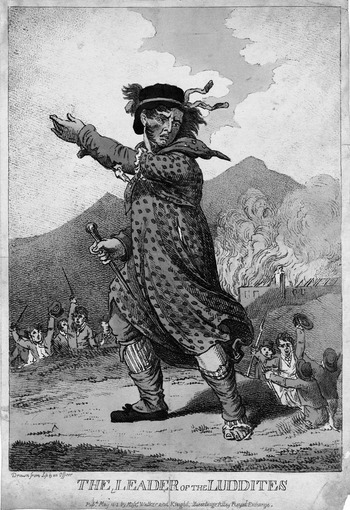
—Anon., “The Leader of the Luddites” (1812). © Trustees of the British Museum.

token because they were interpreted symbolically. Such masks revealed an alternative but equally “true” self normally hidden.Footnote 125 Thus while the Luddites practiced the imperatives of disguise, however thinly veiled, the Swing rioters enacted the politics of display, offering open defiance with little fear of identification.
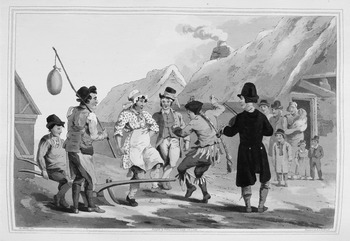
Customary clothing enabled groups to communicate without being understood by elites. Young highlights the similarities between a contemporary caricature, “The Leader of the Luddites,” and the central figure in the illustration “The Fool Plough” in George Walker's Costume of Yorkshire (figs. 4 and 5). In the latter, a man conspicuously wearing a dress and bonnet jumps over a plough, a custom enacted on Plough Monday at the start of the agricultural year. As in Walker's
—“The Fool Plough,” in George Walker, The Costume of Yorkshire (London, 1814), pl. 11. © The British Library Board. Shelfmark: 143.g.1.

antiquarian portrayal of Bishop Blaize, Young claims that the artist had “mistaken the ‘costume of dissent’ for the ‘costume of folklore.’”Footnote 126 Historians should therefore be wary of taking the external appearance of costume at face value. Judith Butler has argued that the most potent forms of collective action combine established repertoires of protest with more subtle means of communication—“the ones that … make us think that we have to renegotiate the way in which we read public signs.”Footnote 127 Nor should we focus solely on public forms of protest: recent studies have illustrated the importance of secrecy and folk violence in agrarian disturbances well into the nineteenth century.Footnote 128 The trades’ clothing worn at funerals of radicals, for example, was only the outer sign of a “matrix of ‘mysterious’ brotherliness.” Clive Behagg has suggested that trade union initiation ceremonies and the taking of oaths (again indicated in secret by ceremonial clothing or emblems) “expressed visually the separate and distinct nature of the values that characterized the working community.”Footnote 129 Although they were not unfamiliar with secretive forms of organization and communication (in freemasonry, military, and drinking clubs), local elites and magistrates misunderstood the customary cultures evolving in industrializing communities. This was one reason why their spies found it difficult to penetrate private meetings.Footnote 130 Transmitted visually or orally, such signs have been lost or remain inaccessible to the historian. Nevertheless, other forms, such as men in dresses, indicate that the working classes had access to repertoires of protest that were layered with rich and complex meanings.
Visual and material symbolism was integral to popular politics in Hanoverian England. Certain symbolic items and colors became national, a process that was aided by an expanding commercial market and media. Sharing in this dress allowed unrepresented groups to feel they were participating to some extent in a wider body politic. Other forms of clothing were based in seemingly parochial community traditions but paralleled those in other towns across the country by enabling individuals to act collectively to subvert social norms. Unlike other kinds of symbols and propaganda, however, clothing was not a language. Clothes were far less capable than words of sustaining tightly defined meanings; hence, perhaps, the fact that words were sometimes stamped on ribbons sold at patriotic events. Context and the law determined whether an orange sash was merely political (electoral hustings), sectarian (Protestant Irish), or potentially felonious (Swing rioters).
The mutable semiotics of clothing allowed different groups to adapt emblems to their own needs, arguably more immediately than language. James Epstein, for example, contends that radicals constructed the Cap of Liberty as a visual synecdoche of their legitimacy, using a “process of formalization and ritualization, characterized by reference to the past.”Footnote 131 Some historians and sociologists have denigrated this conscious manipulation of symbols as the “invention of tradition,” which reduced “the perception of community to an expression of political expedience.”Footnote 132 The everyday and customary forms of political clothing were part of long-established practices: protesters wore vestimentary symbols as a genuine expression of both individual self and collective identity rather than as a matter of expediency for purely political ends.
We must also be wary of assuming that political clothing simply reflected two homogeneous and dichotomous cultures of rich and poor. Rather, as Emma Griffin has argued in her review of the historiography of folk traditions, it is evident that “age, gender, religion, and locality fractured the unity of cultural practice.”Footnote 133 Clothing particularly vividly reflected gender divisions among all classes. Men alone carried out Luddism, Swing, and other forms of collective action that drew their clothes and disguise from mumming and morris.Footnote 134 This exclusion mirrored trade union culture, which was designed in part to restrict the inclusion of women into a skilled workers’ hierarchy. Gender divisions also translated into more explicitly political activities. Both the working-class “women in white” and the aristocratic Foxite ladies could not escape the mockery of the (male) press, no matter how hard they tried to prove their purity. Political clothing cultures, though similar across the country, also illustrated differences of locality. Young and Epstein suggest that overt symbolic clothing and the rituals of the moral economy survived longest in the industrial communities of northern England.Footnote 135 Indeed, many of the examples of subversive clothing found in this study originated in the north. This political culture was by no means directed from or by London fashions.
After Chartism in the 1840s, opportunities to display such a vibrant and evolving material symbolism rarified. Mass agitation was channeled into trade union activity and, in some areas, sectarianism, which is where collective emblems crystallized. The meanings of the ribbons and dresses of mumming may have been “tamed,” but the potential for subversion nevertheless remained in certain parts of industrial England. Symbolic clothing enabled the unrepresented to perform if not to participate in the body politic, an ideal composed of many, though unequal, parts.