Carbapenem-resistant Enterobacteriaceae (CRE) are difficult-to-treat multidrug-resistant organisms (MDROs) associated with high morbidity and mortality.Reference Xu, Sun and Ma1 Laboratory identification of CRE and determining whether CRE produce a carbapenemase (CP-CRE) are critical to controlling spread because they help facilitate timely implementation of infection control (IC) measures. Laboratory practices regarding CRE have evolved, with newer molecular techniques being more accurate for identifying CP-CRE compared to phenotypic tests; however, cost and limited availability of timely molecular testing limit widespread implementation.
Recently, the Department of Veterans Affairs (VA) distributed the VHA 2017 Guideline for Control of Carbapenemase-Producing Carbapenem-Resistant Enterobacteriaceae (CP-CRE).2 This guideline updates a prior 2015 guideline and addresses changes in the collection of surveillance specimens, specific microorganisms to be assessed, and definitions of resistance. The 2017 VA guideline also includes algorithms to standardize CRE screening, identification, and reporting. Although the VA 2017 guideline is similar to guidelines issued by the Centers for Disease Control and Prevention (CDC),3 key differences exist, most notably the CDC’s inclusion of ertapenem in the antibiotic susceptibility criteria for the CRE definition.Reference Fitzpatrick, Suda and Jones4 Few data exist on current laboratory practices for CRE/CP-CRE identification and reporting. This study describes findings from a national survey on laboratory practices regarding CRE in VA facilities after distribution of the 2017 guideline.
Methods
A cross-sectional electronic survey was distributed from June 26, 2017 to November 2, 2017, to laboratory and/or microbiology supervisors at 152 VA medical centers (VAMCs). Subsequent e-mail reminders were targeted to 129 VAMCs that provide inpatient acute care to veterans. Surveys were completed by laboratory personnel who were knowledgeable about the implementation of CRE guidelines at their facility. Respondents were encouraged to consult colleagues if needed.
The survey was developed by study team members using guidance from prior survey studies on CREReference Lin, Lyles-Banks and Lolans5 and with input from the VA Multidrug Resistant Organism Program Office. It was administered using VA’s Research Electronic Data Capture (REDCap) software.Reference Harris, Taylor, Thielke, Payne, Gonzalez and Conde6 The survey focused on laboratory CRE identification, reporting, screening, and guideline implementation, and it was pilot tested in 5 facilities to ensure clarity and reliability. Survey responses were summarized with descriptive statistics. VAMCs are classified into complexity levels determined partly by patient characteristics (levels 1a–c, 2, and 3). We defined high complexity facilities as levels 1a–c and low complexity facilities as levels 2 and 3. Dichotomous comparisons of survey responses by facility complexity and location were assessed using the Fisher exact test. The Consolidated Framework for Implementation Research (CFIR) Reference Damschroder, Aron, Keith, Kirsh, Alexander and Lowery7 was used to code responses to open-ended questions regarding barriers and facilitators to guideline implementation.
Results
The overall survey response rate was 93.0% (120 of 129 sites). Paralleling VA acute-care facilities in general, respondents were mostly urban (80.0%) with high complexity (64.9%). Most respondents reported that the incidence of new cases of CRE/CP-CRE was <1 per month at their facility (57.5%), whereas 34.2% reported that they had never seen a CRE/CP-CRE case. Only 1.7% described their facility as located in a region with high CRE/CP-CRE prevalence. However, 91.6% of facilities reported using VA guidelines; 20% also use the Centers for Disease Control and Prevention (CDC) guidelines; and 27.5% use state and/or local resources for additional guidance.
Overall, 79.2% of facilities reported using imipenem, meropenem, and/or doripenem minimum inhibitory concentration (MIC) ≥4 mcg/mL as the first step to identify CRE from clinical cultures, as recommended in the VA guideline. In addition, 8 facilities (6.7%) reported using other carbapenem MIC cutoffs with or without ertapenem. Furthermore, 91 facilities (75.8%) routinely perform additional testing to confirm that a CRE isolate produces a carbapenemase, of which 66 facilities (72.5%) use polymerase chain reaction (PCR) assay for confirmation. Confirmatory testing is performed on site at 47.3% of the responding facilities; the others send isolates to a reference laboratory. In 72.0% of facilities, a report of presumptive CRE is provided to either the infection control staff and/or the treating providers, and nearly 97.4% contact the infection control staff when CP-CRE are confirmed. Furthermore, 35.5% of facilities reported a 25–48-hour turnaround time for final confirmation of CP-CRE from a clinical culture, and 31% reported >72 hours to receive these laboratory results.
Moreover, 79.8% of respondents reported being involved in guideline implementation, being knowledgeable about the lab procedures in the guidelines, and being comfortable executing the guidelines (Fig. 1). Many respondents agreed or strongly agreed that they had the resources needed to follow the guidelines. However, only 55.9% agreed or strongly agreed that they had adequate staffing resources and only 44.9% agreed or strongly agreed that they had adequate physical resources. Common implementation barriers reported using CFIR constructs were the availability of resources (29%; eg, limited staffing), access to knowledge and information (12%; eg, adequate training), and costs (12%; eg, laboratory supplies).
Percentages of survey respondents expressing varying levels of agreement with statements about the Veterans Affairs 2017 carbapenem-resistant Enterobacteriaceae (CRE) guidelines. The different levels of agreement are indicated by shades of gray.

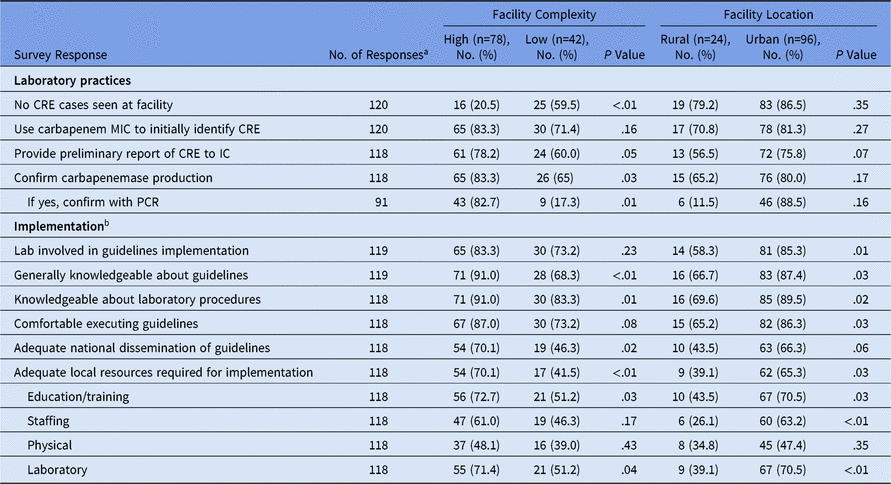
Differences in survey responses were observed according to facility complexity and location (Table 1). High-complexity facilities were more likely to report having had any CRE cases, to report presumptive CRE to infection control staff, to confirm carbapenemases, and to use PCR specifically for carbapenemase confirmation. Both high-complexity and urban facilities were more likely to be knowledgeable about the guidelines and laboratory procedures, to feel comfortable executing the guidelines, and to feel they had adequate local resources for guideline implementation.
Survey Responses

Note. CRE, carbapenem-resistant Enterobacteriaceae; MIC, minimum inhibitory concentration; IC, infection control; PCR, polymerase chain reaction assay.
a Number of facilities that answered that particular question of the 120 total facilities responding to the survey. Percentages were calculated using the number of facilities responding to a particular question.
b Responses considered positive for implementation questions were ‘strongly agree’ and ‘agree.’
Discussion
Laboratory diagnosis and reporting of CRE is critical to conducting surveillance, allocating infection prevention resources, and implementing timely infection control procedures. As strategies for identifying CRE and confirming CP-CRE have evolved and improved, national VA CRE guidelines have been updated accordingly. However, few data are available on laboratory practices for CRE identification and reporting. Prior surveys have focused only on adherence to revised CLSI break points for Enterobacteriaceae, Reference Humphries, Hindler and Epson8 and they did not use national dataReference Thibodeau, Duncan and Snydman9 or addressed only infection control strategies rather than laboratory practices.Reference Gohil, Singh and Chang10
Our survey found that most VAMCs have encountered CRE and use the 2017 VA guidelines, following recommendations for initial CRE identification using updated carbapenem break points. Most laboratories helped implement the CRE guidelines, reported being knowledgeable and comfortable with the guidelines, and received guideline training and information. Notably, both low-complexity and rural facilities described being less knowledgeable and reported inadequate local resources for guideline implementation. Low complexity facilities were also less likely to perform on-site confirmatory testing for carbapenemases and were less likely to use PCR for confirmation. This result may reflect low CRE prevalence at these facilities, less knowledge of the guidelines, and/or limited availability of laboratory resources. Overall, lack of onsite PCR testing was one of the most commonly cited barriers to full guideline implementation; only half of facilities confirm CP-CRE using PCR. Some facilities addressed this limitation by sending isolates to other labs; however, this raises issues regarding timeliness of reporting, as evidenced by the fact that more than one-third of facilities reported final confirmation turnaround time >72 hours.
A limitation of this study is that it was conducted within the VA, and survey respondents and laboratory practices may be different than non-VA hospitals. Furthermore, as with most survey studies, recall bias may have affected the accuracy of respondents’ answers. Our high survey response rate (93%) may have minimized the impact of isolated inaccuracies in survey responses due to recall bias in an individual respondent.
In summary, many VA laboratories have experience in identifying CRE, rapidly began following the 2017 VA guidelines, and reported active engagement in guideline implementation. However, many facilities do not confirm carbapenemases using PCR or send isolates to other laboratories for testing, with most respondents citing limited staffing, training, and financial/laboratory resources. These barriers must be addressed to support full and successful guideline implementation and to optimize identification, reporting, and control of CRE.
Author ORCIDs
Margaret A. Fitzpatrick, 0000-0002-1919-9238
Acknowledgments
The authors thank Dr. Michael Lin for guidance with the survey questions. The views expressed in this article are those of the authors and do not necessarily reflect the position or policy of the Department of Veterans Affairs or the US government.
Financial support
This work was supported by the Department of Veterans Affairs, Veterans Health Administration, Office of Research and Development, Health Services Research and Development Quality Enhancement Research Initiative (grant no. QUE 15-269).
Conflicts of interest
All authors report no conflicts of interest or financial disclosures relevant to this article.