Patients undergoing hemodialysis are at risk of dialysis-related bloodstream infection (DRBSI) and those who use a catheter for their dialysis have a higher risk than patients who use a fistula.Reference Brescia, Cimino, Appel and Hurwich 1 In Québec, a study on healthcare-associated bloodstream infections identified DRBSIs as the most frequent source in ambulatory patients.Reference Frenette, Meunier, Moore and Tremblay 2 The Surveillance provinciale des infections nosocomiales (SPIN) initiated a provincial surveillance of DRBSIs (SPIN-BAC-HD) on April 1, 2007, which became mandatory on April 1, 2011, for all facilities with a chronic dialysis unit. Since initial surveillance results were published, provincial and international initiatives have been developed to decrease DRBSI rates, including prevention guidelines and recommendations to increase the proportion of patients dialyzed with a natural fistula. 3 – 5 However, many factors may prevent the use of a fistula, including older age, cardiac diseases, peripheral vascular disease, quality of life issues, failed fistulas, access to a vascular surgeon, and/or patient preference after chronic dialysis with a catheter is initiated.Reference Woo and Lok 6 , Reference Xi, Harwood and Diamant 7
In this study, we aimed to describe the epidemiology of DRBSIs in Québec over the first 6 years of mandatory surveillance, from 2011 to 2017. Our objectives were (1) to describe time trends in the choice of vascular accesses, (2) to describe time trends in incidence rates of DRBSIs, and (3) to measure the association between the proportion of patients dialyzed using a fistula and DRBSI rates (ie, our 2 surveillance indicators).
Methods
Study design and population
This is a cohort study of patients undergoing chronic dialysis in nonpediatric facilities who participated in provincial surveillance without interruption from April 1, 2011, to March 31, 2017. Data on DRBSIs and patients on chronic hemodialysis were reported to SPIN-BAC-HD by facilities through a centralized web-based information system. The surveillance protocol is available online. 8 In Québec in 2017, 48 facilities were offering chronic dialysis: 2 were pediatric, 1 had interrupted its participation to SPIN-BAC-HD during the study period, and 9 dialysis units were created after April 1, 2011, leaving 36 facilities for this study. Of these, 13 were affiliated with universities and 7 were located in remote areas. The number of dialysis chairs per facility ranged from 4 to 68, with a median of 22.5. The number of patients per dialysis unit ranged from 11 to 389, with a median of 86. All patients included in the surveillance program were chronic outpatient hemodialysis patients. Patients hospitalized for any concomitant medical reasons but still dialyzed were kept in the cohort, and patients on acute hemodialysis were excluded.
Case definition
In this study, DRBSIs had to be confirmed either by one set of blood cultures positive for a known pathogen or by at least 2 sets of positive blood cultures for bacteria usually known as a skin contaminant, in accordance with the National Healthcare Safety Network (NHSN) definitions. 8 Blood samples had to be taken at different sites or at different moments, without any evidence of another site of infection.
Definition of variables
Surveillance years went from April 1 to March 31 and were each divided into thirteen 28-day “months.” Participating facilities reported total number of patients dialyzed for each month (patient months). Patient months were provided per type of vascular access (ie, natural fistula, graft, tunneled catheter, or nontunneled catheter). From April 2013 onward, patient months with a natural fistula were also provided according to the use of the buttonhole technique. If a patient had >1 vascular access, the access with the highest risk of BSI was selected (ranked nontunneled catheter > tunneled catheter > graft > natural fistula). No further information on the presence of additional accesses was available. Information collected on DRBSIs included type of vascular access used, place of acquisition, age, gender, isolated microorganisms, sensitivities, complications, admission to hospital, ICU requirement, and 30-day mortality.
Statistical analyses
The proportion of patient months using a fistula (natural fistula or graft) was computed per facility and per year. Binomial regression (using generalized estimating equations to account for repeated measurements within facilities) was applied to describe the evolution of this proportion over time. Years were treated in categories (ie, time trend was nonlinear) and the main analysis used the year 2011–2012 as the reference. Secondary analyses were also performed in which each year was successively used as the reference. The association of the proportion of patient-months using a fistula with facility characteristics (ie, academic status, region, and number of chairs) was explored.
The incidence rate of DRBSIs per 100 patient months was computed per facility, per year, and per type of vascular access. Poisson regression using generalized estimating equations was then applied to describe rates per year, per type of vascular access, and according to facility characteristics. Years were once again treated as categorical variables; 2011–2012 was the reference of the main analysis, and the other years were then successively used as the reference. A multivariate analysis adjusting for vascular access (fistulas vs catheters) was also done to verify whether any time trend could be due to variations in vascular accesses. An interaction term between year and vascular access was also tested to determine whether the relative difference between rates for catheters and rates for fistulas varied over time.
Finally, analyses were performed to describe the association between the proportion of patient months with a fistula and DRBSI rates. These are the 2 main indicators in SPIN-BAC-HD. A facility’s proportion of fistula use is believed to indicate the potential for improvement in choice of vascular access that could lead to lower DRBSI rates. High proportions are thus assumed to be associated with lower rates. In these analyses, the proportion of fistula was studied according to facilities’ quartile. Multivariate analyses were also performed to determine whether this association varied in time, including a potential interaction between the quartile of fistula proportion and year.
Results
Cohort description
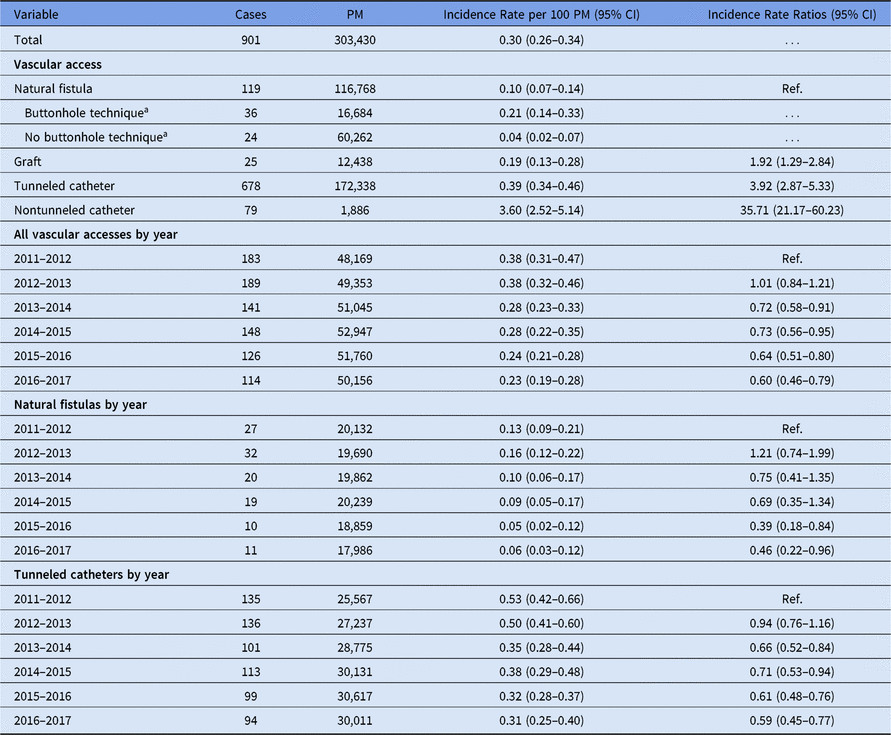
In total, 901 DRBSIs (815 patients) were reported for 303,430 patient months. The proportions of patient months of device use were as follows: natural fistula (38.5%), graft (4.1%), tunneled catheter (56.8%), and nontunneled catheter (0.6%). The corresponding DRBSI incidence rates of DRBSIs per 100 patient months for each device were as follows: natural fistula (0.10), graft (0.19), tunneled catheter (0.39), and nontunneled catheter (3.60). The median age of case patients was 67.3 years old, and 35.1% of cases were women. Overall, 774 cases (85.9%) occurred in ambulatory care, and 61.9% of these required hospital admission. Moreover, 10.7% of cases required a transfer to intensive care units, and the 30-day case fatality rate was 12.9%. Of all microorganisms isolated from blood cultures (n = 938), the most frequent was S. aureus (58.5%), followed by coagulase-negative staphylococci (13.0%) and Enterobacteriaceae (11.9%). Of 549 S. aureus strains, 74 (13.5%) were resistant to methicillin (no time trend was detected). Of 46 Enterococcus spp, 4 (8.7%) were resistant to vancomycin.
Time trends in proportions of fistulas
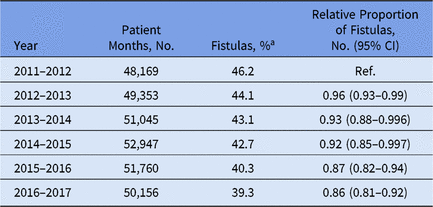
Table 1 presents the proportion of fistulas among the entire cohort of patient months over time. Over the 6-year study period, total patient months increased by 4%, while a relative reduction of 12% of patient months on fistula was observed (46.2% to 39.3%). The proportion decreased at 2 moments: it was significantly higher in 2011–2012 than in 2012–2015, when the proportion was also higher than in 2015–2017. Proportions of fistulas were statistically similar across the different facility characteristics, with the exception of facilities with 23–33 dialysis chairs (third quartile), in which lower proportions of fistulas were observed (ie, 34.6% compared to 50.3% in the first quartile; relative proportion, 0.72; 95% confidence interval [CI], 0.56–0.94]). The proportion of natural fistula-dialyzed patient-months using the buttonhole technique was significantly lower in 2015–2017 than in 2013–2015 (15.3% vs 27.5%, respectively; P < .0001).
Proportion of Patient Months, Proportion Using a Fistula and Relative Proportion per Year of Surveillance

a Including natural fistulas and grafts.
Time trends in incidence rates of DRBSIs
Rates of DRBSIs and rate ratios according to surveillance year and type of vascular access are presented in Table 2. Rates did not differ significantly across facility characteristics, except in remote area facilities, where rates were lower (rate ratio = 0.47; 95% CI, 0.28–0.79) than in facilities from the largest urban region (Montréal).
Incidence Rates of DRBSIs and Incidence Rate Ratios per Type of Vascular Access and Year of Surveillance

Note. DRBSI, dialysis-related bloodstream infection; PM, patient months; CI, confidence interval.
a Information on the use of the buttonhole technique was only collected starting in 2013–2014.
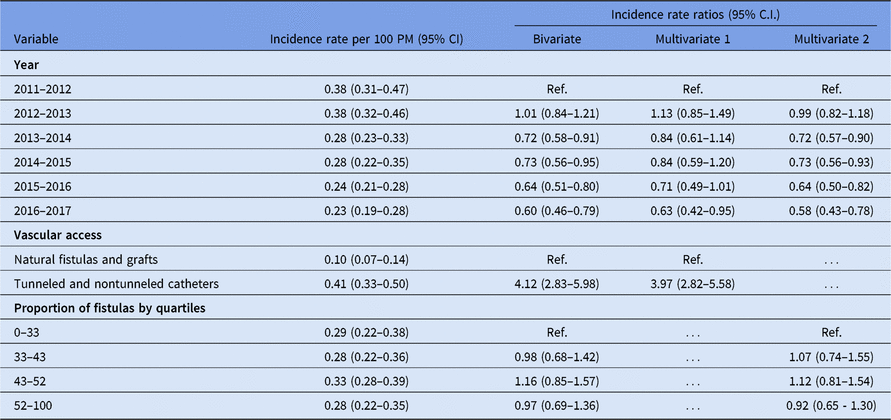
Rates were significantly higher in 2011–2013 than in the following years, and the 2013–2015 rates were also higher than the 2015–2017 rates. When the same analyses were performed for natural fistula patients only, a sustained statistically significant decrease was observed in 2015–2016; a similar result was observed for tunneled catheters only in 2013–2014 (Table 2). However, when adjusting for vascular access in regression analyses, the decrease in rates became statistically significant later, in 2016–2017 (Table 3, multivariate analysis 1). No effect modification was detected when adding interaction terms allowing for different time trends in fistulas and catheters; the relative difference between rates for catheters and for fistulas remained stable over the years. At the end of the study period, catheter rates for these devices had decreased as follows: all-access (40%), natural fistula (54%), and tunneled catheter (41%).
Association Between Vascular Access or Facilities’ Proportion of Patient Months Using Fistulas and DRBSI Incidence Rates, and Analysis of Potential Time Trends in These Associations

Note. DRBSI, dialysis-related bloodstream infections; PM, patient months.
Among patient months with a natural fistula, the DRBSI rate was 5 times higher when the buttonhole technique was used: 0.21 (95% CI, 0.14–0.33) versus 0.04 (95% CI, 0.02–0.07) when it was not used, for a rate ratio of 5.26 (95% CI, 3.23–8.33). A statistically significant decrease was detected in DRBSI rates in all patients using a natural fistula: 0.10 (95% CI, 0.06–0.15) DRBSIs per 100 patient months in 2013–2015 versus 0.06 (95% CI, 0.03–0.10) in 2015–2017, for a rate ratio of 0.59 (95% CI, 0.36–0.98).
Association between the proportion of fistulas and incidence rates
Table 3, multivariate analysis 2, suggests an absence of association between the proportion of patient months dialyzed with a fistula and DRBSI rates. Rate ratios per surveillance year are almost identical to those from the bivariate analyses, suggesting no effect of the proportion of fistula on DRBSI rate time trends. In addition, no effect modification (by quartiles of fistula proportion) was detected when adding interaction terms allowing for differing time trends.
Discussion
In this study, we describe the changing epidemiology of DRBSIs in Québec, a context in which recent published surveillance results on DRBSIs are scarce. Our study has highlighted the fact that, despite a continuous decline in the use of fistulas to perform dialysis, incidence rates of DRBSIs have decreased by 40% since 2011 (54% in natural fistulas and 41% in tunneled catheters). No association was found between facility proportion of patients using fistulas and the rate of DRBSI. At the patient level, however, the incidence of DRBSIs was higher for patients using a catheter, as expected. Québec’s DRBSI rates on catheters (0.41 DRBSIs per 100 patient months) were lower than rates reported by the United States (2.16 DRBSIs per 100 patient months), Western Australia (0.97 DRBSIs per 100 patient months), and France (0.57 DRBSIs per 100 patient months). 9 – Reference Nguyen, Shugart and Lines 11 All patients dialyzed in Quebec are dialyzed by registered nurses and many centers are directly linked to acute-care hospitals, which may explain these lower rates.
Possible explanations for the observed decrease in rates include the establishment of an active surveillance program in which dialysis units may benchmark themselves against each other and the publication of provincial guidelines to prevent central-line–associated BSIs and DRBSIs. A concomitant province-wide campaign was also launched to reduce central-line–associated BSIs. 5 , 12 Surveillance results were available in real time to all units, and reports with analyses and recommendations were published yearly. 13 , 14 Also, a survey on prevention measures applied in dialysis units was done in 2011–2012 and published in 2014.Reference Trépanier, Quach and Gonzales 15 We were first able to stratify rates of natural fistula-patient months depending on the use of the buttonhole technique in 2013–2014, thus documenting the increased risk of DRBSI associated with this technique. The publication of these new surveillance results and of the DRBSI guidelines in 2014 could explain changes observed in 2015–2017: decreased use of the buttonhole technique in patients using a natural fistula and decreasing rates on natural fistulas.
The DOPPS studies have already demonstrated the lower proportions of fistulas in Canada compared to other countries.Reference Ethier, Mendelssohn and Elder 16 , Reference Mendelssohn, Ethier, Elder, Saran, Port and Pisoni 17 More recent results from France and Western Australia confirm this conclusion, reporting proportions of fistulas >70%. 9 , 10 Our results show proportions even lower than the proportion reported for all of Canada in DOPPS III (50%), gradually decreasing to 39% in 2016–2017,Reference Ethier, Mendelssohn and Elder 16 despite feedback advising for the use of fistula throughout the network. 14 Reasons for the increasing use of catheters may include the increasing age of the dialyzed population, with complex medical care and poor vascular status of many patients leading to failed fistulas. The main indication for dialysis in our population remains end-stage renal disease from complicated diabetes, which is often associated with advanced peripheral vascular disease. Patient preference may also be a reason for low fistula frequency, particularly when acute dialysis is initiated by catheter.Reference Woo and Lok 6 , Reference Xi, Harwood and Diamant 7 , Reference Lata, Girard, Parkins and James 18 Unfortunately, SPIN-BAC-HD does not yet collect data on comorbidities nor on the justification of the choice of vascular access for non-cases.
Finally, no association was found between DRBSI rates and the proportion of fistulas. However, rates stratified per type of vascular access followed the expected relative magnitude; it was highest in nontunneled catheters, followed by tunneled catheters, grafts, and natural fistulas. This ranking suggests the presence of ecologic bias because the proportion of fistulas is a population indicator.Reference Morgenstern 19 The potential reasons listed to explain decreasing rates (eg, guidelines, surveillance results, survey on prevention measures) could be masking an association between proportions of fistulas and DRBSI rates. The facility-level proportion of fistulas might not be an ideal indicator of facility performance in the prevention of DRBSIs because it does not predict rates of DRBSIs, but it may reflect a unit’s patient population. For surveillance purposes, information about the proportion of catheter-dialyzed patients who could be dialyzed using a fistula might be helpful.
An important limitation of our study is that patients who have fistulas are likely different from those who have catheters, but a lack of information on non-cases and on the reasons for the choice of vascular access prevented us from estimating whether the decrease in rates was related to patient characteristics, to catheter locking solution, or to procedures such as implementation of best practice guidelines. This can only be corrected by supplementary data collection. Also, no information on the presence of additional accesses was available; however, consistent with the NHSH methodology, our surveillance protocol states that the vascular access with the highest risk of DRBSI should prevail, a practice aiming to standardize methods and to reduce misclassification. 8 We also lacked information regarding the duration of chronic dialysis in patients, and we did not collect data on incident patients; thus, we were unable to analyze the evolution of the risk of DRBSI through time while adjusting for changing patient characteristics. Finally, despite a population of nearly 8.4 million inhabitants, only ∼153 cases of DRBSIs occurred per year in 45 facilities. 20 Because our cohort included almost all patients undergoing chronic hemodialysis in Québec, small numbers and large variances reflect our reality rather than a lack of statistical power.
Our surveillance program has shown a steady decrease in DRBSI rates over a 6-year period. Despite the increasing use of catheters for dialysis, this general decrease was driven mainly by the tremendous decrease in incidence rates for catheters, likely related to improvement in central-line catheter insertion and care procedures that have been advocated in the last decade. This study, using provincial surveillance data, serves as the basis for quality improvement programs in hemodialysis, but reasons for the increasing use of catheters should be studied further with additional data collection.
Author ORCIDs
Élise Fortin, 0000-0001-6612-9091
Acknowledgments
We are grateful to infection control practitioners and infectious disease physicians/medical microbiologists who participate in the SPIN program. SPIN-BAC-HD members: Geneviève Caron, Simon Desmeules, Élise Fortin, Charles Frenette, Danielle Moisan, Natasha Parisien, Pascale Trépanier, Jasmin Villeneuve.
Financial support
This work was supported by SPIN, from the Institut national de santé publique du Québec, funded by the Québec Ministère de la Santé et des services sociaux.
Conflicts of interest
All authors report no conflicts of interest relevant to this article.