Introduction
One in four people in Australia are foreign-born (Australian Bureau of Statistics, 2012), a high figure when compared with other Western countries: 23% in New Zealand, 21% in Canada, 13% in the United States of America (USA) and 13% in the United Kingdom (UK) (OECD, 2013). Australia is also culturally and linguistically diverse with 20% of people born in Australia having at least one overseas parent (Australian Bureau of Statistics, 2012). Asian-born migrants constitute about 8% of the Australian population and are the fastest growing immigrant group (Australian Bureau of Statistics, 2011). They accounted for more than 40% of all the immigrants to Australia during 2011–12 (Department of Immigration and Citizenship, 2012).
Despite the significant and rapid increase of the Asian population in Australia, there have been few investigations of Asian chronic health conditions at the national level (Anikeeva et al., Reference Anikeeva, Bi, Hiller, Ryan, Roder and Han2010). Existing cross-sectional studies in Australia showed a lower prevalence of cancer (McCredie, et al., Reference McCredie, Coates and Grulich1994; Grulich et al., Reference Grulich, McCredie and Coates1995), and lower standardized mortality and hospital admission ratios due to cancer among Asian immigrants, relative to native-born Australians (Singh & de Looper, Reference Singh and de Looper2002). However, despite a lower overall prevalence of cancer among Asian immigrants, they may be more prone to certain types of cancers. For instance, nasopharyngeal cancer was more prevalent among Asian immigrants, particularly those from China, Taiwan and Hong Kong, than among native-born people (Grulich et al., Reference Grulich, McCredie and Coates1995). Cross-sectional studies on CVD, on the other hand, have mainly focused on CVD mortality rates among Asian subgroups (Young, Reference Young1987; Taylor et al., Reference Taylor, Chey, Bauman and Webster1999; Singh & de Looper, Reference Singh and de Looper2002; Gray et al., Reference Gray, Harding and Reid2007). One such study has shown a significantly lower standardized mortality ratio among Asians immigrants relative to native-born people (Singh & de Looper, Reference Singh and de Looper2002). Other studies showed significantly higher standardized mortality ratios due to CVD for immigrants from South Asia (Young, Reference Young1987) and the Middle East (Young, Reference Young1987; Taylor et al., Reference Taylor, Chey, Bauman and Webster1999) compared with native-born people. Cross-sectional studies on respiratory problems showed an increase in the prevalence of asthma with increase in duration of residence among Asian immigrants of Chinese origin living in Melbourne (Leung et al., Reference Leung, Carlin, Burdon and Czarny1994). Another study showed significantly lower standardized mortality and hospitalization ratios due to respiratory problems among Asian immigrants relative to native-born people (Singh & de Looper, Reference Singh and de Looper2002). Ibiebele et al. (Reference Ibiebele, Wattanapenpaiboon, Hsu-Hage and Wahlqvist2000) found that the prevalence of type 2 diabetes is about 11.1% among Asian Indians living in Melbourne, which is more than three times higher than the prevalence of diabetes in the general Australian population (Australian Bureau of Statistics, 2008). Another cross-sectional study showed higher standardized mortality ratios due to diabetes among Asian immigrants (Singh & de Looper, Reference Singh and de Looper2002).
These studies have made a major contribution to health statistics and the reporting of chronic conditions among Asian immigrants to Australia. However, duration of residence as a source of variation in health among the migrants has received limited attention (Anikeeva et al., Reference Anikeeva, Bi, Hiller, Ryan, Roder and Han2010). Apart from being cross-sectional, few of the above mentioned studies have measured temporal change in chronic conditions compared with native-born Australians (Leung et al., Reference Leung, Carlin, Burdon and Czarny1994; Gray et al., Reference Gray, Harding and Reid2007). Without this comparison, differences in health trajectories cannot be attributed to immigrant status. Also, many factors that influence health (e.g. smoking, drinking, diet and exercise) may change over time at an individual level, particularly for immigrants, and not taking these into account appropriately can produce biased estimates.
The present study advances the literature on Asian immigrant health by providing the first longitudinal estimates of differences in chronic health between Asian immigrants and native-born Australians based on an analysis of a nationally representative data set. Data were from waves 3, 7 and 9 of the Household, Income and Labour Dynamics in Australia (HILDA) survey, and group-mean-centred multilevel mixed models were used to investigate whether differences exist in the reporting of four chronic conditions (cancer, cardiovascular disease, chronic respiratory problems and diabetes mellitus) between Asian immigrants and native-born people. Differences in the post-migration persistence of these chronic conditions were also examined. These four chronic conditions were considered for this study as they are the leading causes of death and disability in Australia and are also part of the National Health Priority Areas (NHPA). Together they accounted for half of the total burden of disease and injury (TBDAI) in Australia (Begg et al., Reference Begg, Vos, Barker, Stevenson, Stanley and Lopez2007) during 2003. Cancer alone accounted for 19% of the TBDAI, of which 82% was fatal and 18% non-fatal. Cardiovascular disease (CVD) accounted for 18% of TBDAI, of which 78% was fatal and 22% non-fatal. Chronic respiratory problems and diabetes accounted for 7% and 5% respectively of the TBDAI, of which 38% and 22%, respectively, were fatal (Begg et al., Reference Begg, Vos, Barker, Stevenson, Stanley and Lopez2007).
This study addresses the following specific research questions:
-
(i) Do Asian immigrants have a health advantage relative to the native-born in terms of reporting cancer, CVD, respiratory problems and diabetes mellitus?
-
(ii) If Asian immigrants have a health advantage in terms of reporting cancer, CVD, respiratory problems and diabetes mellitus, does the advantage decrease as duration of residence increases, and is the decrease the same for all chronic conditions?
Methods
Data
The data for this study came from the HILDA survey, a nationally representative panel survey of Australian people occupying private dwellings. The survey commenced in 2001 with a large sample of 7682 households having at least one eligible person aged 15 years and above. All members of these households aged 15 years and over form the basis of the panel to be interviewed in subsequent waves. Information on chronic conditions was collected in waves 3 (2003), 7 (2007) and 9 (2009). To focus on ages when chronic conditions become increasingly prevalent the study sample was restricted to individuals aged 35 years or above (Newbold, Reference Newbold2006). The main exposure variables for this study were: nativity and duration of residence in Australia at wave 3 (henceforth DoR). Nativity status was divided into two groups: namely, native-born people and immigrants from Asia. The United Nations standard geographical country classification was followed to define Asian countries (United Nations Statistics Division, 2013). Duration of residence was categorized into less than 10 years, 10–19 years and greater than or equal to 20 years in Australia. The cut-points for DoR were chosen to: (1) reflect the empirical evidence suggesting that after 10 years an initial health advantage is lost (Gee et al., Reference Gee, Kobayashi and Prus2004); (2) ensure sufficient statistical power and allow reasonable estimates of uncertainty; (3) allow for the development of chronic diseases, e.g. related to lifestyle and diet.
This study used data on 5485 individuals aged 35 years or over who responded in wave 3 and in either or both of waves 7 and 9. Of these, 5149 (93.87%) were native-born (or Australian-born) and 336 (6.13%) were born in Asian countries. Amongst Asian-born respondents, 48 (14.29%) were born in India, 41 (12.2%) in the Philippines, 39 (11.61%) in Vietnam, 32 (9.52%) in China, 31 (9.23%) in Malaysia, 24 (7.14%) in Lebanon, 24 (7.14%) in Sri Lanka, 20 (5.95%) in Hong Kong and 12 (3.57%) in Indonesia. The remaining 65 (19.35%) were born in other Asian countries that individually contributed less than 2.40% to the Asian-born sample. Both Asian-born and native-born people responded on average about 2.9 times in waves 3, 7 and 9.
As part of the HILDA self-completion questionnaire, each respondent was asked whether he/she was ever told by a doctor or nurse that they had any chronic health conditions that lasted or were likely to last for six months or more. The chronic conditions included cancer, chronic bronchitis, asthma, heart/coronary disease, high blood pressure/hypertension, circulatory conditions (such as stroke, hardening of arteries) and diabetes mellitus. A respondent was considered to be suffering from CVD if he/she had one or more of the following problems: heart/coronary disease, high blood pressure/hypertension and circulatory conditions. Similarly, a respondent was considered to be suffering from respiratory problems if he/she reported asthma or chronic bronchitis. In waves 7 and 9 detailed information was collected from each respondent on type I and type II diabetes, but in wave 3 respondents were only asked if they had ever been diagnosed with diabetes. For consistency with information provided in wave 3, the information on type I and type II diabetes collected in waves 7 and 9 were combined to determine whether a respondent was suffering from diabetes (i.e. type I or type II).
Age at wave 3 (henceforth ‘age’) and sex were the main time-invariant control variables. Household-equivalized income (continuous), current marital status, level of education, employment status and wave (all categorical) were the time-varying control variables used in the regression analysis. Additionally, the number of times a respondent responded out of waves 3, 7 and 9 was included to help reduce health-selection bias. Physical activity, smoking and drinking (all categorical) were the health behaviour variables used in the regression analysis to test whether they mediated the relation between immigrant status and the health outcomes. Other potential mediators and confounders, such as diet and/or health insurance, which influence the relationship between (say) duration of residence and chronic conditions have not been included in the analysis since they were not available in waves 3, 7 and 9.
Statistical analysis
Multi-level group-mean-centred mixed regression (‘hybrid’) models were used to investigate the longitudinal association between Asian nativity, duration of residence and the prevalence of the selected chronic conditions (Allison, Reference Allison2005; Jatrana et al., Reference Jatrana, Pasupuleti and Richardson2014). Such models give better estimates for both time-varying variables and time-invariant variables than those obtained by using the conventional mixed-effects models (Allison, Reference Allison2005).
The main exposure variables in this study (nativity and DoR) are time-invariant. In this case hybrid (and conventional mixed) models give unbiased estimates for the effects of time-invariant exposures only when there is no unmeasured confounding. Once migration has taken place nativity is exogenous to the model, i.e. changes in other variables in the model cannot affect nativity and there can be no confounding of the relationship between health and nativity. Duration of residence, on the other hand, could be affected by economic success and better adjustment of Asian-born people in Australia. As a result, socioeconomic characteristics might be confounders of the DoR–health relationship.
Potential mediators of the exposure–outcome relation also need consideration. For example, nativity could influence socioeconomic characteristics and health behaviours, and these covariates might mediate the relation between nativity and chronic health outcomes. Thus household-equivalized income, employment status, marital status and level of education are potential mediators of the relationship. Health behaviour variables could also be affected by DoR and hence might mediate the relation between DoR and health outcomes. These possibilities were tested by either excluding or including them as covariates (Hafeman, Reference Hafeman2009).
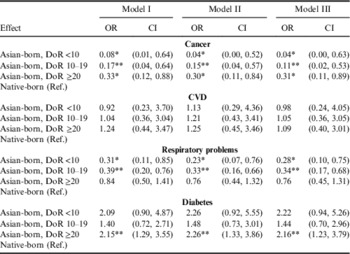
In the first model (Model I), the effects of country of birth (Table 3) and duration of residence (Table 4) on chronic health were determined after adjusting for age, sex, wave and the number of times a respondent responded out of waves 3, 7 and 9. In the second model (Model II), in addition to the explanatory variables in Model I, level of education, household-equivalized income, marital status and employment status were added. In the final model (Model III), health behaviour variables (physical activity, smoking and drinking) were added to the variables in Model II. Parameter estimates are provided in the form of odds ratios and their confidence intervals. Statistical significance and confidence limits were obtained using Wald statistics.
All analyses were carried out using SAS version 9.3. To guard against possible inconsistency in the choice of covariance structure, robust standard errors for parameters were computed using a sandwich estimator (Huber, Reference Huber1967; White, Reference White1980; Liang & Zeger, Reference Liang and Zeger1986; Diggle et al., Reference Diggle, Heagerty, Liang and Zeger2002) by selecting the empirical option in SAS Proc Glimmix.
Results
Characteristics of the study respondents
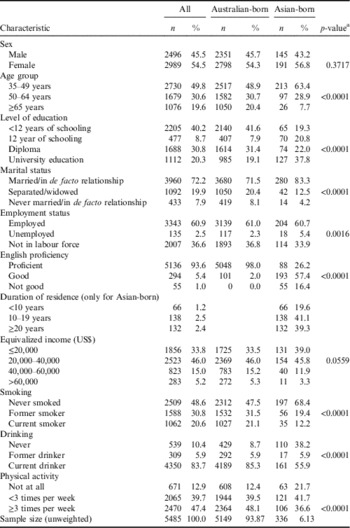
The baseline (wave 3) characteristics of the respondents are shown in Table 1. Overall, and by nativity, there were more females (n=2989; 54.5%) in the sample than males (n=2469; 45.5%). However, there was no significant difference in the proportion of males and females between the native-born and Asian-born groups. Native-born respondents were significantly older than Asian immigrants (48.9% of the native-born were between the ages of 35 and 49 compared with 63.4% of the Asian-born). The proportion having university education was significantly higher among the Asian-born (37.8%) than among the native-born (19.1%). Marital status varied significantly by nativity: respondents who were married or in a de facto relationship accounted for 83.3% of the Asian-born and 71.5% of the native-born. Employment levels were significantly different between Asian-born and native-born respondents, e.g. about 2.3% of the native-born but 5.4% of the Asian-born reported being unemployed. As expected, English language proficiency was significantly lower among Asian immigrants (26.2%) than among native-born respondents (98.0%). Most of the Asian-born respondents (41.1%) had a DoR of 10–19 years in Australia, though the proportion with a DoR of 20 years or above was not much smaller, at 39.3%. Asian immigrants had a slight but statistically non-significant disadvantage in terms of household-equivalized income. For instance, 39.0% of the Asian-born respondents had a household-equivalized income of US$20,000 or less, compared with 33.5% of the native-born respondents. The health behaviours of Asian-born respondents were significantly different from those of native-born respondents. For example, 12.2% of Asian immigrants were current smokers, compared with 21.2% of the native-born respondents. Similarly, while 55.9% of the Asian-born group were current drinkers, the corresponding proportion for the native-born group was 85.3%. In contrast, levels of physical inactivity were higher among Asian immigrants (21.7%) than among native-born respondents (12.4%).
Socio-demographic characteristics all the survey respondents, waves 3, 7 and 9 of the HILDA survey

Note: Sum of the column frequencies for the various characteristics need not be equal to the corresponding sample size because of missing values.
a Chi-squared tests were performed to test for statistically significant differences in the considered characteristics, between the Asian-born and the native-born respondents.
Trends in chronic conditions by nativity and duration of residence
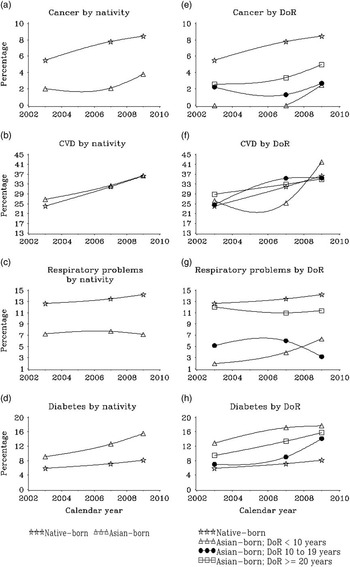
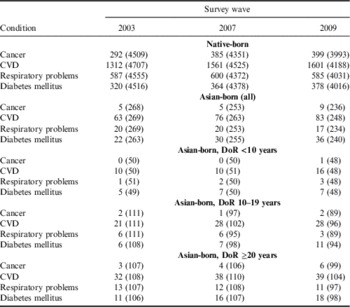
Table 2 shows the number of study respondents by their nativity and DoR in Australia who reported having cancer, CVD, respiratory problems and diabetes mellitus in waves 3, 7 and 9 of HILDA. Figure 1, on the other hand, shows age- and sex-adjusted trends in the prevalence of cancer, CVD, respiratory problems and diabetes mellitus, by wave, nativity and DoR. In particular, Fig. 1 graphs A–D show the temporal trends in the sample prevalence of chronic conditions by nativity. Figure 1 graphs E–H, on the other hand, show the trends in chronic conditions for native-born, and by duration of residence for Asian-born respondents. Smoothed lines have been fitted to the data using a cubic spline to identify general trends in the various health outcomes.
Age- and sex-adjusted prevalence of various chronic health conditions across the waves of HILDA, by nativity and duration of residence (DoR) for Asian-born respondents. Note that the trends for native-born people are identical in plots A and E, B and F, C and G, and D and H.

Number of respondents by nativity and duration of residence in Australia (DoR) who reported the presence of cancer, CVD, respiratory problems and diabetes mellitus in waves 3, 7 and 9 of the HILDA surveyFootnote a

a Numbers in parentheses indicate the total number of study respondents in each category for whom information was available on the specified chronic conditions.
Figure 1 graphs A–D suggest that irrespective of nativity status, there is an increase in the prevalence of all the chronic conditions during the study period, except for respiratory problems, which showed a slight decline for Asian immigrants. While the observed increase in the prevalence of these chronic health conditions can be partially attributed to increasing age, there are noticeable differentials in the prevalence of specific chronic condition by nativity status.
Regarding individual chronic conditions, at baseline (i.e. wave 3), 2.0% of the Asian-born reported having cancer and this proportion increased to 3.8% by wave 9. The corresponding change among native-born people was 5.5% to 8.5% (Fig. 1A). The prevalence of CVD increased from 26.8% to 36.5% among Asian-born people, and from 24.1% to 36.4% for the native-born between waves 3 and 9 (Fig. 1B). There was a slight decline in the prevalence of having respiratory problems from 7.3% to 7.1% for Asian-born people between waves 3 and 9, compared with an increase from 12.7% to 14.3% for native-born people during the same period (Fig. 1C). In contrast to cancer, CVD and respiratory problems, the prevalence of diabetes mellitus for the Asian-born was always greater than for the native-born, increasing from 9.1% to 15.5% and from 5.9% to 8.1% (respectively) between waves 3 and 9 (Fig. 1 graph D).
Figure 1 graphs E–H show changes over time in the sample prevalence of chronic conditions by DoR. At baseline, the sample prevalence of cancer was exactly 0% among Asian-born respondents living in Australia for less than 10 years. The corresponding estimate for Asian immigrants living in Australia for more than 20 years was 2.6%. However, by wave 9, the proportion of Asian-born respondents having cancer was 2.5% among those with a DoR less than 10 years, and 5.0% among those with a DoR greater than or equal to 20 years (Fig. 1E). The proportion of Asian-born respondents with CVD in the sample increased from 26.3% to 42.1% between waves 3 and 9 among those with a DoR less than 10 years, and from 28.9% to 35.2% among those with a DoR greater than or equal to 20 years (Fig. 1F). The sample prevalence of Asian-born people having respiratory problems increased from 1.9% to 6.4% between waves 3 and 9 among those with a DoR less than 10 years and decreased slightly from 12.1% to 11.4% among those with a DoR greater than or equal to 20 years (Fig. 1G). The proportion of Asian-born people suffering from diabetes mellitus in the sample increased from 12.9% to 17.7% between waves 3 and 9 among those with a DoR less than 10 years, and from 9.4% to 15.8% among those with a DoR greater than or equal to 20 years (Fig. 1H). Unlike other chronic conditions, sample prevalence of diabetes mellitus was generally the same or higher among Asian-born people relative to native-born people, even when their DoR was less than 10 years.
The above observations can be summarized as follows. (1) With one or two exceptions, the sample prevalence of various chronic conditions increased over time for Asian-born and native-born people, perhaps because of ageing. (2) The sample prevalence of various chronic conditions changed significantly by nativity and DoR. (3) Asian-born people in the sample were either better or on a par with native-born people with respect to reported chronic conditions, with the exception of diabetes mellitus, where they were disadvantaged relative to native-born people.
However, it is acknowledged that the differentials seen in levels and trends of various chronic conditions in Fig. 1 might have arisen from the influence of other variables associated with immigrant status, and length of stay in Australia. Hence, to control for the influence of other variables, regression models were used in the following section.
Results of regression analysis
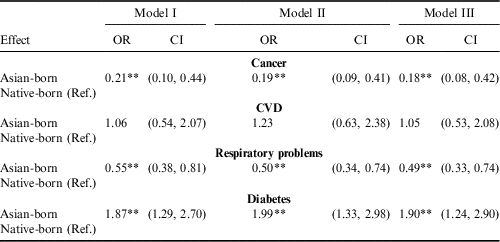
Tables 3 and 4 show the results from regression analysis for the presence of cancer, CVD, respiratory problems and diabetes mellitus, by nativity and DoR. Three models were used in each case.
Regression results with nativity as the main exposure variable
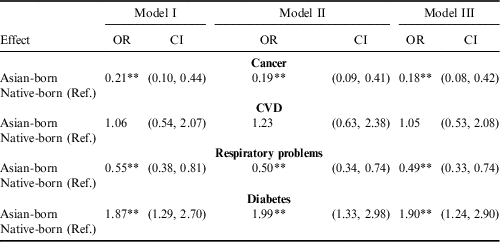
Model I includes age, sex, wave effects and number of responses out of three waves (waves 3, 7 and 9) as the covariates.
Model II adds household-equivalized income, marital status, level of education and labour force participation status.
Model III adds health behaviour variables to the covariates of Model II.
*p<0.05; **p<0.01.
Regression results with duration of residence in Australia (DoR) as the main exposure variable

Model I includes age, sex, wave effects and number of responses out of three waves (waves 3, 7 and 9) as the covariates.
Model II adds household-equivalized income, marital status, level of education and labour force participation status.
Model III adds health behaviour variables to the covariates of Model II.
*p<0.05; **p<0.01.
Model I results from Table 3 show that after adjusting for age, sex, wave effects and the number of times a person responded, the odds of having cancer (OR=0.21; CI 0.10–0.44) or a respiratory problem (OR=0.55; CI 0.38–0.81) were lower among Asian-born people compared with native-born people. In contrast, the odds of having CVD for Asian immigrants were not statistically different from the native-born (OR=1.06; CI 0.54–2.07). However, the odds of having diabetes mellitus were significantly greater among Asian-born people (OR=1.87; CI 1.29–2.70) compared with native-born people. Additionally, adjusting for potential mediators such as marital status, level of education, employment status and equivalized income levels (Model II) and the health behaviour (Model III) did not significantly change these estimates. This suggests that mediation of the relationship between nativity and the presence of chronic conditions by socioeconomic and health behaviour variables used in the analysis was unimportant.
After adjusting for age, sex, wave and number of responses over waves 3, 7 and 9 the odds of reporting cancer were smaller among Asian immigrants compared with native-born people, irrespective of DoR (Table 4, Model 1). For example, the odds ratio was 0.08 (CI 0.0–0.64) for Asian immigrants with DoR less than 10 years, 0.17 (CI 0.04–0.64) for DoR 10–19 years, and 0.33 (CI 0.12–0.88) for DoR greater than or equal to 20 years. Asian immigrants were not measurably different from native-born people in their odds of reporting CVD for any DoR. The odds of reporting respiratory problems, on the other hand, were smaller among Asian-born relative to native-born people for DoR less than 10 years (OR=0.31; CI 0.11–0.85) and 10–19 years (OR=0.39; CI 0.20–0.76), but was not significantly different from native-born people for DoR 20 years or longer (OR=0.84; CI 0.50–1.41). The odds of reporting diabetes mellitus for Asian-born people were not significantly different from the native-born for DoR less than 10 years (OR=2.09; CI 0.90–4.87) and 10–19 years in Australia (OR=1.40; CI 0.72–2.71), but was larger than the native-born for DoR of 20 years or longer (OR=2.15; CI 1.29–3.55). Additionally adjusting for time-varying confounders such as socioeconomic variables (Model II) and mediator variables such as health behaviour variables (Model III) did not substantially change the results, which suggests that confounding and/or mediation of the relationship between DoR and chronic conditions by these covariates was weak.
Discussion
This study expands upon previous cross-sectional research on the health of Asian immigrants compared with native-born Australians by using nationally representative longitudinal data and analysis and examining a wide range of specific chronic conditions (CVD, cancer, respiratory problems and diabetes mellitus). Additionally, the study examines how these relationships between Asian nativity and chronic conditions change with duration of residence in Australia in comparison with native-born Australians. The findings of the study clearly show that the existence of a health advantage, and changes in this with DoR, varied considerably by chronic health condition among Asian immigrants. For example, Asian immigrants were less likely to report cancer and respiratory problems, relative to native-born people. They were not significantly different in their reporting of CVD, while they were more likely to report diabetes relative to native-born respondents.
The results provide a longitudinal confirmation of conclusions from earlier cross-sectional studies, which showed lower odds of reporting cancer among Asian immigrants compared with native-born populations in Australia (McCredie et al., Reference McCredie, Coates and Grulich1994; Grulich et al., Reference Grulich, McCredie and Coates1995), the USA (Huh et al., Reference Huh, Prause and Dooley2008; Howlader et al., Reference Howlader, Noone, Krapcho, Garshell, Miller and Altekruse2013) and Canada (Chan et al., Reference Chan, Song, Mang, Ip and Au2011), and lower odds of respiratory problems among Asian immigrants compared with native-born populations in the USA and the UK (Netuveli et al., Reference Netuveli, Hurwitz, Levy, Fletcher, Barnes, Durham and Sheikh2005; Schiller et al., Reference Schiller, Lucas, Ward and Peregoy2012). However, unlike previous cross-sectional studies from the USA, the UK and Canada, which found mixed results (Anand et al., Reference Anand, Yusuf, Vuksan, Devanesen, Teo and Montague2000; Erens et al., Reference Erens, Primatesta and Prior2001; Klatsky et al., Reference Klatsky, Friedman, Sidney, Kipp, Kubo and Armstrong2005; Huh et al., Reference Huh, Prause and Dooley2008; Silbiger et al., Reference Silbiger, Stein, Roy, Nair, Cohen, Shaffer, Pinkhasov and Kamran2013) in the odds of reporting CVD among Asian immigrants relative their native-born people, the present study found no evidence for a difference in the odds of reporting CVD between Asian immigrants and native-born Australians. The higher odds of reporting diabetes among Asian immigrants relative to native-born Australians found in this study are also consistent with conclusions from earlier cross-sectional studies in Australia, the USA and the UK that showed a higher prevalence of diabetes among Asian immigrants or their subgroups (Erens et al., Reference Erens, Primatesta and Prior2001; Singh & de Looper, Reference Singh and de Looper2002; McBean et al., Reference McBean, Li, Gilbertson and Collins2004; Schiller et al., Reference Schiller, Lucas, Ward and Peregoy2012).
The better health of Asian immigrants found in this study with respect to cancer and respiratory problems may partly reflect indirect positive immigrant health selectivity (i.e. those migrating to Australia are a much healthier group than those who remain in their countries of origin, caused by voluntary positive selection of migrants with respect to health, immigrant selection policies favouring tertiary education, occupational skills and wealth) (Abraído-Lanza et al., Reference Abraido-Lanza, Dohrenwend, Ng-Mak and Turner1999; Franzini et al., Reference Franzini, Ribble and Keddie2000), or direct health selectivity through mandatory requirement that potential migrants undergo medical screening. Indeed, most migrants to Australia have to be free from disease or conditions that are considered to be a threat to public health or a danger to the Australian community, likely to result in significant health care and community service costs to the Australian community, or to require health care and community services that would limit the access of Australian citizens and permanent residents to those services as they are already in short supply (Department of Immigration and Border Protection, 2015). For example, cancer treatments are often expensive and many potential migrants with cancer would not meet Australian immigration health requirements for this reason (Department of Immigration and Border Protection, 2015).
The better health of Asian immigrants with respect to cancer and respiratory problems may also be due to natal variations in diet, solar exposure, air pollution, obesity and overall low cancer prevalence in the country of origin. Indeed, while cancer incidence and mortality rates vary greatly between countries (Jemal et al., Reference Jemal, Center, Desantis and Ward2010), incidence and mortality rates are relatively low for many cancers in South Asia (Parkin & Khlat, Reference Parkin and Khlat1996; Arnold et al., Reference Arnold, Razum and Coebergh2010). Studies have also noted that compared with the host population, migrants from non-Western countries had a lower risk of cancers that are assumed to be related to a Western lifestyle (e.g. breast, lung and colorectal cancer) but higher risk of cancers potentially related to infections (e.g. cervical and liver cancer; Arnold et al., Reference Arnold, Razum and Coebergh2010).
Other explanations related to better cancer and respiratory outcomes for Asian immigrants are possible. These include the effect of genetic makeup, early-life exposures and later-life environmental exposures in the aetiology of cancer and respiratory problems. Such explanations need further investigation. For instance, the hygiene hypothesis proposes that early childhood exposure to particular viruses, bacteria or parasites, infections and unhygienic contact with older siblings help the immune system develop and may protect from allergic diseases such as asthma and hayfever in later life (Strachan, Reference Strachan1989, Reference Strachan2000; Okada et al., Reference Okada, Kuhn, Feillet and Bach2010; Brooks et al., Reference Brooks, Pearce and Douwes2013), and may provide at least a partial explanation for lower prevalence of asthma among immigrants from less developed countries to more developed countries. Indeed, a study conducted in the USA on an Asian population showed a higher prevalence of asthma for children born in the US compared with those who were foreign-born, and the authors attribute this finding to exposure to childhood infection due to poor hygiene conditions in the origin countries (Brugge et al., Reference Brugge, Lee, Woodin and Rioux2007). However, the odds of reporting of asthma are found to increase with duration of residence among immigrants from less developed countries to more developed countries (as also found in this study for Asian immigrants to Australia), perhaps indicating the importance of environmental exposure throughout life to the prevalence of asthma (Cabieses et al., Reference Cabieses, Uphoff, Pinart, Antó and Wright2014).
Interestingly the prevalence of diabetes is also high among Asians living in Asian countries (Ramachandran et al., Reference Ramachandran, Wan Ma and Snehalatha2010), perhaps indicating genetic effects for a higher prevalence of diabetes among Asian immigrants in Australia. However, some landmark studies have also found high variability in diabetes prevalence among genetically similar populations living in different setting. Examples include Japanese immigrants and their offspring living in Hawaii and the Los Angeles area, and among Japanese living in Hiroshima (Hara et al., Reference Hara, Egusa, Yamakido and Kawate1994), and West African migrants to the Caribbean and Britain (Mbanya et al., Reference Mbanya, Cruickshank, Forrester, Balkau, Ngogang and Riste1999). These results suggest that environmental factors do influence the diabetes prevalence in populations of similar genetic origin. The fact that this study has found higher odds of reporting diabetes among Asians relative to native-born people after controlling for health behaviours may indicate that genetic effects, unobserved lifestyle factors, or diet could be important risk factors for diabetes for the Asian immigrant group. The lack of significant difference in the odds of reporting CVD between Asian immigrants and native-born people is also notable, particularly given mixed results from analyses in other countries. Possible explanations include differences in the study sample and design, different definitions of Asian immigrants and different methodologies.
This study also found that Asian immigrants maintained their health advantage relative to the native-born for cancer even after 20 years of residence in Australia. However, while advantaged with respect to the native-born in terms of reporting a respiratory problem for a DoR of less than 20 years, Asian immigrants were not significantly different from native-born people for a DoR of 20 years or more. In contrast, while they were not measurably different from the native-born for diabetes for a DoR of less than 20 years, they became disadvantaged for a DoR of 20 years or more. Reporting of CVD for Asian-born people was not measurably different from native-born people for any DoR. Thus, the findings from this research are in line with other longitudinal studies conducted in other part of the world, suggesting that the presence of a healthy immigrant effect, and changes in the health of immigrants with DoR, depend upon the specific health conditions being considered (Newbold, Reference Newbold2006; Setia et al., Reference Setia, Quesnel-Vallee, Abrahamowicz, Tousignant and Lynch2012). It also means that the healthy immigrant effect and changes in health by DoR apply to Asian immigrants as well.
The usual explanations offered for any decline in health with increase in DoR among immigrants include adoption over time of negative health behaviours (like increased intake of fatty foods, uptake of smoking and drinking) of the host culture (Morales et al., Reference Morales, Lara, Kington, Valdez and Escarce2002; Singh & Siahpush, Reference Singh and Siahpush2002; Abraído-Lanza et al., Reference Abraído-Lanza, Chao and Flórez2005; Lara et al., Reference Lara, Gamboa, Kahramanian, Morales and Hayes Bautista2005; Dey & Lucas, Reference Dey and Lucas2006), gradual erosion of social networks in the country of origin, acculturative stress, changes in values (Berry, Reference Berry1997; Lara et al., Reference Lara, Gamboa, Kahramanian, Morales and Hayes Bautista2005) and experience of discrimination (Gee et al., Reference Gee, Ryan, Laflamme and Holt2006, Reference Gee, Ro, Shariff-Marco and Chae2009). Specific health behaviours among Asian immigrants (smoking, drinking and physical activity) did not appear to be significant mediators of the relation between DoR and chronic health conditions among Asian immigrants. Hence the hypothesis that changes in the health behaviours of Asian immigrants lead to a decline in health with increasing DoR may not be true for the specific health behaviours used here.
The above-mentioned hypotheses may not be sufficient to explain the decline in health among Asian migrants over time. For example, the presence of certain pollutants and allergens in the Australian environment is suspected of contributing to an increasing incidence of respiratory problems (particularly asthma) among Asian immigrants as DoR increases. Additionally a strong familial (genetic) link has been found in the prevalence of asthma among Asian immigrants (Hill et al., Reference Hill, Smart and Knox1979; Leung & Jenkins, Reference Leung and Jenkins1994; Leung, Reference Leung1996). Hence the exact reasons for the increase in respiratory problems with increasing DoR among Asian immigrants are still unclear. Similar remarks apply to the increased odds of diabetes when DoR was at least 20 years, and to the persistence of the health advantage with respect to cancer among Asian immigrants relative to native-born Australians.
Nevertheless, the findings of the present study have important implications for at least three reasons: (1) increased flows of Asian migrants to Australia, (2) increasing treatment costs over time, and (3) cancer, diabetes and respiratory problems contribute significantly to the burden of disease and injury in Australia and are part of the NHPA. Failure to take findings from this study into account could mask areas of disparity and diversity of need among Asian immigrants. Since Asians are the fastest growing immigrant community in Australia, their good health is important in terms of maximizing the benefit of the Australian immigration programme. Additionally, better understanding of the protective factors for cancer, and the risk factors for respiratory problems and diabetes mellitus among Asian immigrants, would contribute to improving the health of everyone, including native-born Australians.
This study has several limitations. First, sub-group heterogeneity within Asian immigrants was ignored. In fact there is likely to be considerable variation between Asian countries in terms of health profiles, and it is also known that Asian countries are heterogeneous in terms of culture, race, food, social, economic, occupational, linguistic, political and living styles. However, sample size issues did not allow analysis at the Asian subgroup level. Second, measurement errors are ignored. For example, the results were based on the self-reported presence of chronic conditions. Third, this study assumed no unmeasured confounding of the DoR–health relationship, a necessary assumption given that the main exposures are time-invariant. If this assumption is invalid then the results may be biased, although perhaps less biased than those obtained from the conventional mixed-effects model. Fourth, the relatively small sample size of Asian immigrants was another limitation.
In spite of these limitations, the present study reduces the methodological limitations of previous studies by using a longitudinal dataset, and multi-level group-mean-centred logistic regression models to investigate the longitudinal association between nativity and chronic disease, and between duration of residence and chronic disease. This study provided the first longitudinal estimates of nativity and duration of residence effects for Asian-born immigrants compared with the Australian-born. In addition, it used objective measures of health (chronic conditions) instead of self-assessed health as an outcome health indicator. Potential bias from differential attrition was reduced by controlling for the number of responses within the three waves used for analyses. Misleading inferences due to the choice of covariance structure were reduced by obtaining robust standard errors using a sandwich estimator.
Further studies can build upon the findings of this study in a number of ways. First, gender differences and subgroup heterogeneity in the prevalence of various chronic conditions can be analysed in the same way as here. Second, the health of Asians at regional or state level in Australia could be studied to better understand contextual effects on their health. Third, the chronic health of Asians by immigration category (for example, refugee, economic or family re-union) could be investigated. Fourth, the role of age at arrival in the chronic health of Asian immigrants could be investigated. Fifth, factors affecting various chronic health conditions, within Asian migrants, could be studied using fixed-effects models. Sixth, given the relatively small size of the Asian immigrant sample used for this analysis, it would be desirable to have the results confirmed by future research.
In conclusion, Asian immigrants in Australia were found to have similar or better health as native-born Australians in terms of cancer, CVD and respiratory problems but were disadvantaged in terms of diabetes mellitus. The health advantage with respect to cancer persisted among Asians immigrants regardless of how long they had lived in Australia, while they eventually lost their initial health advantage with respect to respiratory problems after about 20 years in Australia. The odds of reporting diabetes were significantly higher among Asian immigrants than in native-born people, particularly after 20 years of residence in Australia. Unlike other chronic conditions considered in this paper, the odds of reporting CVD did not differ measurably between Asian-born immigrants and native-born people, irrespective of their length of stay. Based on longitudinal data and analyses, this study showed that the health advantage, and subsequent erosion of it with increasing duration of residence among Asian immigrants depends upon the chronic health condition. Further research is needed to better understand the underlying mechanisms associated with the persistent health advantage for cancer, and declining health with increasing in DoR for respiratory problems and diabetes mellitus, among Asian immigrants. Public health intervention strategies in Australia should recognize disparities in health and diversity of need among its people, including its immigrants, to reduce health disparities in the country and to improve the national health.
Acknowledgments
This paper is based on research conducted as part of the research project ‘Investigating the Dynamics of Migration and Health in Australia: A Longitudinal Study’. It is supported by an Australian Research Council Discovery Grant (DP DP120104604) to the second author. The funders had no role in study design, data collection and analysis, decision to publish or preparation of the manuscript. The paper uses the unit record data from the Household, Income and Labour Dynamics in Australia (HILDA) survey, which is funded by the Commonwealth Department of Families, Housing, Community Services and Indigenous Affairs (FaHCSIA) and is managed by the Melbourne Institute of Applied Economic and Social Research at the University of Melbourne. The research findings and views reported in this paper, however, are those of the authors and should not be attributed to either FaHCSIA or the Melbourne Institute. An earlier version of this paper was presented at the 2012 Australian Population Association Conference in Melbourne (5–7th December) and 2014 Population Association of America Meeting in Boston (1–3rd May). The authors wish to thank the participants for their useful comments that helped improve the manuscript. The authors are also very grateful to the reviewer for his/her insightful comments, which have improved the quality of the manuscript.