INTRODUCTION
Palliative care services in Tanzania, as in much of Sub-Saharan Africa (SSA), have been poorly integrated and are patchy, with heavy reliance on charitable and faith-based organizations (Harding & Higginson, Reference Harding and Higginson2005; Hartwig et al., Reference Hartwig, Dean and Hartwig2014; Nanney et al., Reference Nanney, Smith and Hartwig2010). Tanzania is among the six SSA countries categorized as having “preliminary integration” of its palliative care services, while only one SSA country (Uganda) has reached “advanced integration” of its palliative care services (Lynch et al., Reference Lynch, Connor and Clark2013). In most regions of the world, the majority of the population would prefer a home death (Gomes et al., Reference Gomes, Calanzani and Gysels2013); however, in SSA there is some evidence that a hospital death is to be preferred (Downing et al., Reference Downing, Gomes and Gikaara2014; Uwimana & Struthers, Reference Uwimana and Struthers2008). There is likely to be better access to morphine and symptom relief at inpatient institutions (Jang & Lazenby, Reference Jang and Lazenby2013), and there is evidence that hospital-based palliative care teams can also help to enable a home death in SSA, where that is the preferred place for end-of-life care (EoLC) (Desrosiers et al., Reference Desrosiers, Cupido and Pitout2014). Community palliative care services in Tanzania are few in number and overstretched (Hartwig et al., Reference Hartwig, Dean and Hartwig2014), and dispensing of morphine is limited to only a few hospitals with licenses (four in 2010). The views of healthcare professionals (HCPs) about providing palliative care has seldom been studied in SSA, yet HCPs at the hospitals in urban centers across SSA frequently care for patients who present with malignancies, HIV/AIDS, and end-stage organ failure (Jacinto et al., Reference Jacinto, Masembe and Tumwesigye2015). We aimed to explore the views about, and perceived challenges to, the delivery of palliative care at a busy tertiary referral hospital based on the perspective of the HCPs employed there.
METHODS
Research Team and Reflexivity
The first author (E.G.L.) is a white British female doctor with experience working in medical hospital settings in the United Kingdom. A Tanzanian female Ph.D. candidate (J.R.) facilitated the focus group discussions (FGDs) conducted in Swahili. She was selected both as a highly qualified and experienced qualitative researcher and as a woman of similar age and background to our nursing participants. In addition, as a trained nurse herself, she would be regarded as a peer who could be trusted to facilitate their engagement in the project. E.G.L. was the primary interviewer for FGDs conducted in English. There was no significant power imbalance that could have led to coercion to participate or skewing of the data.
Ethics
Ethical approval was granted by the Kilimanjaro Christian Medical College Research Ethics and Review Committee (certificate no. 897) and by the Tanzanian National Institute for Medical Research. Participants were given an information sheet in Swahili to read and digest before starting the interviews, and informed written consents were obtained.
Setting
The Kilimanjaro Christian Medical Centre (KCMC) is a busy tertiary referral hospital with beds for around 800 inpatients. The hospital serves a population of 11 million in the north of Tanzania. The majority of people in the Kilimanjaro region are rural-dwelling, and their main occupations are subsistence farming and running small businesses. The predominant ethnic group in the region are the Mchagga; however, the Mmaasai, Mpare, and Mmeru also live in the vicinity (among many others). The predominant religion is Christian, with the Lutheran and Catholic denominations being the most common. As a tertiary level hospital, one of the four in Tanzania, it receives patients from many other regions across the nation. For more details, Appendix 1 (see the Supplementary Materials) describes the results of a survey of the demographic characteristics of inpatients on the adult medical wards conducted by the authors. The KCMC is a Christian institution, with chaplaincy members representing both of the main denominations. Muslim patients are encouraged to make their own connections with their mosque for any spiritual support that they require, and Muslim faith leaders are welcomed to attend to patients on the wards. The hospital receives patients with many chronic and life-limiting illnesses, of which malignancies and HIV/AIDS are the most common conditions potentially requiring palliative care in this setting (Jacinto et al., Reference Jacinto, Masembe and Tumwesigye2015). According to hospital records, the average number of inpatient deaths per month in 2015 was 72 on the adult medicine wards. At the time of data collection, the palliative care team was inactive for both inpatient and outpatient care, largely due to resource limitations.
Participants
Participants were selected and interviewed in small groups according to profession and experience level. The two nursing heads of department were approached to assist in selecting appropriate participants and to excuse them from their usual ward duties in order to participate. FGDs were conducted until the point of data saturation was reached, when no new ideas were being expressed. Participants were purposively selected in order to represent healthcare workers of varying levels of experience and of different professional backgrounds at the two KCMC departments (Table 1). Participants were eligible for inclusion if they were currently employed at the KCMC hospital and working in the adult medical or pediatrics department. The most important reason for exclusion from the study was working in a role that involved no regular patient contact. The adult medicine and pediatrics departments were selected because the burden of palliative care need was thought to be greatest in these departments, based on data gathered from a similar tertiary referral hospital in Kampala, Uganda (Jacinto et al., Reference Jacinto, Masembe and Tumwesigye2015). The other data included were from a semistructured interview (SSI) with one of the chaplaincy members, a male Lutheran chaplain with three years of experience in his role at the KCMC who had previously received theological training at the Evangelical Lutheran Church in Arusha, Tanzania. His interview took 37 minutes. This participant was appointed as a representative by the other members of the chaplaincy, and the reason cited for his not participating in an FGD was his heavy workload. The fact that he was chosen by the other chaplaincy members suggests the authority and level of respect they accorded him, which may give additional weight to these data.
Summary of the sample characteristics

Data Collection
Interviews
Three interview guides were developed for each of the professional groups interviewed. These were translated by a professional Tanzanian linguist, Lucy Mariki, and then reviewed and edited by J.R. to ensure that the language used would be familiar and well-understood (Appendix 2; see the Supplementary Materials). The interview guides for the FGDs with doctors and nurses included vignettes based on anonymized cases observed by E.G.L. over a period of five months spent observing practice and behaviors on the wards and attending the daily medical department handover meeting where deaths and seriously ill patients were discussed. The vignettes were read aloud, and repeated if necessary. An opportunity was given for participants to ask questions for clarification, and prompts were employed to stimulate discussion about the issues raised by the cases.
Data Analysis
The interviews were transcribed verbatim from Swahili to English. The transcripts were thematically analyzed in the following stages: familiarization, generating initial codes, searching for themes, reviewing themes, defining and naming themes, and a final report (Braun & Clarke, Reference Braun and Clarke2006). The data were coded separately by two researchers (L.L.O. and E.G.L.). These codes and categories were reviewed and compared, which led to theme development. NVivo 11 Pro software (QSR International, London, UK) was utilized to input the developed codes, so that the data could be navigated by the authors when developing themes.
RESULTS
A total of 32 healthcare workers currently employed in the adult medicine or pediatrics wards of the KCMC were interviewed via 7 FGDs and 1 SSI. FGDs lasted between 37 and 85 minutes (average = 69 minutes), with a total recording time of 9 hours and 20 minutes. The four themes developed were “acceptance,” “barriers” to delivering palliative care in hospital, “breaking bad news,” and “place of EoLC.” Sample quotations for each of the themes discussed herein are provided in Table 2.
Focus group discussions, numbered with their details

Acceptance
Participants frequently referred to the need for acceptance of one's diagnosis and prognosis in order to both live well with a life-limiting illness and die well. Palliative care was conceptualized as a means of helping one through a process to achieve this state of acceptance:
When you talk about death, death happens in different situations. It can be that you die suddenly. Others pass through different stages of dying. For the ones who pass through these stages … our role is to help patients through those stages to acceptance, from denial, so that they can accept these stages and so that we help these patients to die well. — FGD6
Living in a state of acceptance allowed one to prepare for death by engaging with practical preparations (e.g., organizing one's inheritance), but it was also thought to improve one's quality of life. For example, achieving acceptance was thought to help patients living with HIV/AIDS to eat well, to take their medications as prescribed, to address stigma, and to help educate the community more widely:
In my opinion, HIV is a disease which needs palliative care because … when a patient receives palliative care, they will accept their problem, that it is this way, when they accept, [and] it will be easy for them to use the medicine … Also, when they get this care, they will be avoiding stigmatization in the family. Also, when the patient receives palliative care and accepts their situation, it will be easier for them to advise others, seeing themselves as different to others. So when they get this care well, they will also advise others that you are supposed to follow the treatment well, and because they are receiving good palliative care they can help those who are not ready to accept the situation. — FGD5
Importantly, a state of acceptance was required to prepare oneself spiritually for dying and was the goal of the process within which palliative care played an important role. Accepting one's situation meant not only an absence of “struggle” but also the presence of a “closeness” with God. Helping someone achieve acceptance was accomplished through psychological and spiritual counseling, emphasizing hope, and by remaining with the patient. These healthcare workers felt it was part of their professional role to accompany patients through the process:
Because when you are counseled spiritually, even the depression [of my brother] will go away, because you'll accept the situation. Then your sufferings will be relieved. That much I understand. — FGD2
Acceptance was also important for the family in order to prepare for the patient's death. Components of the acceptance theme of hope versus despair illustrate this, whereby involvement of the family early on was described as a way of avoiding despair through “closeness” and “counseling.” The need to communicate better and earlier with relatives was highlighted:
We were supposed to counsel the daughter to tell her, “The condition is like this, so the condition could get worse.” Then she could not cry loudly like that. Because she would be expecting something to happen. If the daughter was counseled before the death, she could accept that which will happens. — FGD1
Barriers
Having discussed the importance of “acceptance” in EoLC, healthcare professionals reflected that they often failed to enable this for their patients on the wards. All participants regularly cared for dying patients and bereaved families and were keen to highlight the many particular challenges, or “barriers,” that they faced in their workplace. “Barriers” can be broadly categorized into either problems of knowledge or attitude and those caused by a lack of resources. Nurses spoke frankly in raising concerns that they did not have up-to-date knowledge or always show the correct attitude when caring for dying patients:
So we are weak on this, that we do not care much when a person is dying … Even about respecting the dead body, we do not care for it as we are supposed to. Because sometimes you will find a patient's dead body lying down on the corridors, and all the relatives are passing, and we do not care. So this situation shows that we do not respect the body. So we do not have a private place for this. So we do not support the relatives and the patient so that they can die peacefully.
J.R.: Why do you think we do not respect the body?
Maybe it is lack of education and wrong attitude? A person can have knowledge, but it does not change their attitude. — FGD6
One particular identified barrier was a lack of knowledge of who should receive palliative care and when. Some patients believed that patients should be classified as requiring palliative care based on their diagnosis (e.g., cancer or HIV/AIDS), while others felt that those with symptoms should be offered palliative care regardless of whether their diagnosis was life-limiting (e.g., painful arthritis). In those with HIV/AIDS, there was disagreement about when palliation should begin: at diagnosis or when symptoms occurred:
Absolutely, HIV and AIDS is a condition which needs palliative care. The reason is that the illness itself is a lifelong illness with a lot of demands, and the fact that these people have no future in terms of being completely healed, and the fact that they look at this illness as a statement of death, that in the first place suggests that they need people to travel with them in this difficult time they are in. — SSI
In my opinion, I think HIV needs more psychological support and care because a patient with HIV, if you speak to them and advise them to follow guidance, exercise, a diet with fruit, and to take their medicine, they are not a sick person, and will live a normal life. A patient with a disease which cannot be healed like cancer is a patient who needs palliative care. — FGD6
Beliefs about morphine were also noted as being a barrier, despite the fact that most participants acknowledged that it was an important medication that could be used to effectively relieve symptoms. Some admitted that their main worries were about causing addiction and misuse:
Actually, that is our main concern, though it has some side effects as well, like itching and constipation, but the main thing that we are worrying about is addiction if they are keeping on using it for some time. — FGD3
Medical staff also admitted that they were often too late in recognizing that the patient was dying, which could lead to futile attempts at resuscitation. This was expressed particularly in response to a vignette describing a patient with a severe stroke who was resuscitated (Appendix 2; see the Supplementary Materials):
I mean, this is misconduct actually, using hydrocortisone [for resuscitation] in such types of cases. So maybe teachings should stress this also. Are we lacking curriculum in terms of resuscitating patients? In our training, maybe yes? People come in and are taught to treat hypertension, but they are not taught to treat patients who are approaching death. — FGD3
Another important barrier was lack of sufficient resources to be able to deliver palliative care. Such resources include an appropriate space, the time for nursing, a specialist palliative care team, and reliable access to essential palliative medications:
Here you can find a patient dying of pain, and at the same time morphine is not available, so surely the patient will die in painful condition. Also, we do not have the habit of letting the relative stay close to the patient; instead, we chase them away. So we don't have the culture of letting the relative be close while the patient is dying. — FGD6
Particularly relevant to this setting, we found that language and cultural barriers could occur between the HCPs and the patients and their relatives (see Table 3, cultural and language barriers).
The four major themes illustrated with example quotations
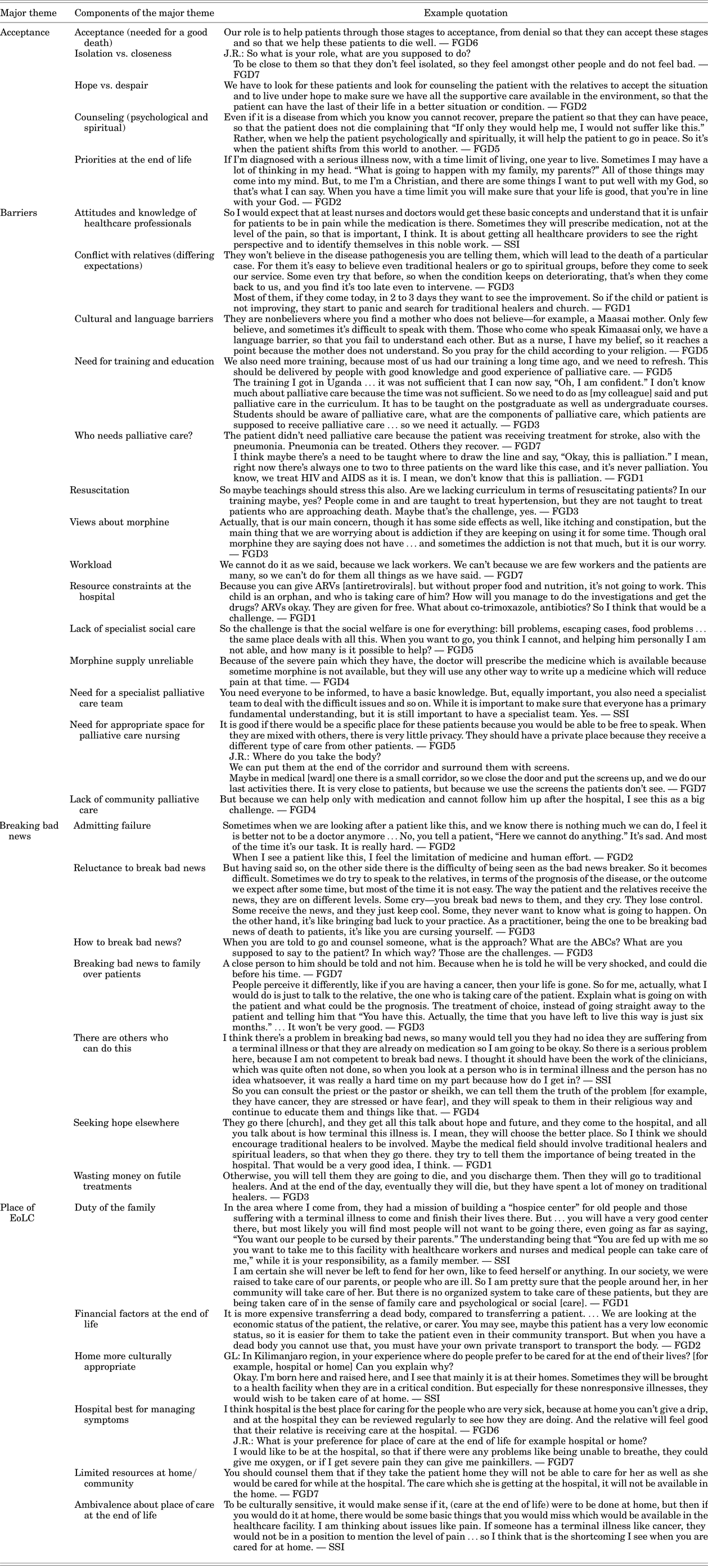
EoLC = end-of-life care; FGD = focus group discussion; SSI = semistructured interview.
Breaking Bad News
Breaking bad news, defined as the disclosure of “any information likely to alter drastically a patient's view of his or her future” (Buckman, Reference Buckman1984), was acknowledged to be important when receiving palliative care and could help to eventually achieve acceptance, the goal for living and dying well with a life-limiting illness. However, there was a lack of clarity about who should break the bad news, with all professional groups identifying others who they thought would best manage the task:
I think there's a problem in breaking bad news. So many would tell you they had no idea they are suffering from a terminal illness … I am not competent to break bad news. I thought it should have been the work of the clinicians, which was quite often not done, so when you look at a person who is in terminal illness and the person has no idea whatsoever, it was really a hard time on my part, because how do I get in? — SSI
Another reason given for avoiding breaking bad news was the concern that harm could come to the patient from the shock of the news, particularly if they were elderly or frail:
A close person to him should be told and not him. Because when he is told he will be very shocked and could die before his time. — FGD7
Doctors feared that harm could be caused to the patient and their family by them seeking second opinions from traditional and faith healers, and this was often cited as a reason for not disclosing a diagnosis or prognosis. Alternative healthcare practitioners are blamed for causing a delay in presentation to the hospital, for patients' deteriorating health and sometimes their death, and for wasting patients' and families' financial resources:
So you treat. First, if you say, “This is the end, we don't expect much,” they may abscond from the treatment and then come back worse. They may use local herbs, which are very toxic to the kidneys, so you may end up losing your patient who you would expect to live one or two years. That's why I think we don't [break bad news]. — FGD1
Doctors reported their discomfort with provoking emotional responses and expressed a lack of confidence in knowing how to break bad news empathically. Breaking bad news was even framed as an admission of failure. In this setting, doctors conceptualized it both as a personal failure and an admission of the failure of allopathic (also termed “modern” or “Western”) medicine:
Sometimes when we are looking after a patient like this, and we know there is nothing much we can do, I feel it is better not to be a doctor anymore … No. You tell a patient, “Here we cannot do anything.” It's sad. And most of the time it's our task … it's really hard. — FGD2
Because of our culture and the traditions we have, as I've said, we never speak about death. When you declare that the patient is going to die, it means you have declared that you have failed to use the modern medicine to help the patient. And because of our culture, most of the time, if you declare to have failed using the modern medicine, patients might think of being bewitched, most of the time. — FGD3
Place of Care
The preferred place of care was stated to be the traditional choice of the home, but these healthcare workers described the unacceptable choice between having symptomatic relief in the hospital and “struggling” at home with symptoms like pain and breathlessness:
So my preference would be … It's a tricky one. To be culturally sensitive it makes sense if it [EoLC] were to be done at home, but then if you would do it [EoLC] at home, there would be some basic things that you would miss which would be available in the healthcare facility. I am thinking about issues like pain … so I think that is the shortcoming I see when you are cared for at home. — SSI
Although home was usually reported to be the preferred place for EoLC, the hospital was preferred when there was a lack of resources at home or a high expected symptom burden, for example, in HIV/AIDS:
Especially patients with HIV are told to receive palliative care at home, so they feel “some people will isolate me,” and others might do whatever. But when the patient is at the hospital, they know that they are close to a healthcare worker, so when they need something they will be given it. — FGD5
The decision about the place of EoLC was often primarily a financial one, made by the family and HCPs. Examples were given where HCPs decided to discharge patients when they were expected to die within days in order to reduce the costs involved in transporting the body:
It is more expensive transferring a dead body, compared to transferring a patient. … We are looking at the economic status of the patient, the relative, or carer. You may see, maybe this patient has a very low economic status, so it is easier for them to take the patient even in their community transport. But when you have a dead body, you cannot use that. You must have your own private transport to transport the body. — FGD2
Bringing a patient to the hospital was often a demonstration of care on the part of the family, showing that they had not abandoned the patient. Therefore, the hospital was often not seen as the right place for EoLC but instead as a last gesture of seeking treatment, alongside or after attending to traditional or faith healers:
We had to discharge a Maasai lady who was severely in pain. But we had to tell the son that “You have to go home. We can't do anything.” She had stage four cervical cancer, and the son said, “It's okay because you have told me, and now I know I have done my best for my mother. Let her die.” It's very painful. — FGD2
DISCUSSION
Ubuntu, the African philosophy that can be understood as an ethos of solidarity and interdependence with others (Kamwangamalu, Reference Kamwangamalu1999), was found in our data within the themes. This philosophy accords others an inherent humanity and dignity through our interconnectedness and is often illustrated by the South African proverb “umuntu ngumuntu ngabantu,” meaning that a person is a person through their relationships with other people (Gade, Reference Gade2011). This philosophy could be found throughout our data. For example, it was expressed by one nurse in explaining how she attempted to overcome a cultural barrier:
Humanity is a valuable thing and a primary thing. This means that you cannot just treat them in a rough way or ignore them because they do not have religion. No. They have already been born. They are a human being in God's image, so there is humanity, and there is something of value there. — FGD3
The preferred place of care was the place where people could be close to the patient, whether this meant HCPs or family. The number one priority was to avoid isolation, stigmatization, and neglect, reflecting the solidarity associated with the philosophy of ubuntu. Talking through one's problems with family and religious leaders was also key to achieving a better quality of life and death through acceptance. In fact, according to our data, it would not be possible to achieve acceptance without the help of others, and this was the result of an active process. Acceptance was also a theme found among Kenyan patients with advanced cancer (Murray et al., Reference Murray, Grant and Grant2003), but it was framed as a more passive fatalism, which was contrasted with Scottish patients' anger at their cancer diagnosis. In the theme “breaking bad news,” the philosophy of ubuntu may also be present in the fact that some HCPs felt it was more appropriate to disclose and discuss life-limiting diagnoses with close family members first rather than with the patient. A Rwandan palliative care physician wrote about his experiences and explained succinctly that “When you are well, you belong to yourself, but when you are sick, you belong to your family/community,” even where the patient had capacity (Ntizimira et al., Reference Ntizimira, Ngizwenayo and Krakauer2016). Indeed, a street survey of views on EoLC in Nairobi found that concern for relatives and family and keeping a positive attitude were prioritized over pain control, while the converse was true in European countries (Downing et al., Reference Downing, Gomes and Gikaara2014; Higginson et al., Reference Higginson, Gomes and Calanzani2014), suggesting that increased family and carer involvement is needed to improve communication in palliative care (Selman et al., Reference Selman, Higginson and Agupio2009). Our findings highlight the need for more research into patient and family preferences, and to explore culturally appropriate communication at the end of life.
Interestingly, some of the “barriers” identified by our study participants echo recent discourse in the palliative care literature, particularly about the lack of clarity as to who should receive palliative care, and when. Our HCPs disagreed about whether patents with HIV, for example, required palliative care throughout the course of their disease, or only when they became symptomatic. It has been shown that patients' psychosocial concerns are better addressed by integrating palliative care into HIV/AIDS care (Lowther et al., Reference Lowther, Selman and Simms2015), lending weight to the calls to end the “false dichotomy” between disease-modifying and symptomatic treatment for HIV/AIDS (Selwyn & Forstein, Reference Selwyn and Forstein2003). Our study highlights that this topic remains a live issue, and a lack of palliative care training and lack of integration of services may be leading to reduced access to palliative care for HIV/AIDS patients in this setting.
Our data corroborate the findings of Hindley et al. (Reference Hindley, Kissima and Oates2016), where faith and traditional healers identified four causes of disease in Tanzania: biomedical diseases (which are treatable), bewitching, ancestral curses, and possession by devils. There is evidence to suggest that similar frameworks of belief are widely held in Tanzanian communities. In rural Mwanza, beliefs about the causes of HIV/AIDS included both sexual intercourse and witchcraft (Mshana et al., Reference Mshana, Plummer and Wamoyi2006). If we accept that this paradigm is widely held within communities in Tanzania, then we understand that by communicating a poor prognosis HCPs can lead patients and their families to conclude that one of the three other causes are to blame for this incurable illness. Thus, it is understandable that HCPs feel discomfort about breaking bad news, because, in addition to admitting to and feeling a sense of personal failure, this challenges their broader beliefs about health and disease. The ratio of traditional medical practitioners to the size of population is cited as 1 for every 350–450 in Tanzania, compared to 1 doctor for every 33,000 (Stangeland et al., Reference Stangeland, Dhillion and Reksten2008). Therefore, it was particularly uncomfortable for these HCPs to know that “false hope” could be gleaned elsewhere, and with more ease than that gained from allopathic medicine. In this region of Tanzania, many faith and traditional healers claim that they are able to cure HIV/AIDS and cancer, the two most common palliative diagnoses (Hindley et al., Reference Hindley, Kissima and Oates2016).
The picture from our study is largely one of suspicion and distrust of traditional and faith healers, with many giving examples of having witnessed harm to patients from delays in presenting to the hospital, the toxicities from herbal medicines, and/or financial exploitation. However, previous literature has suggested that the local expertise of traditional healers can be harnessed cooperatively by palliative care services to improve palliative care coverage for rural communities (Campbell & Amin, Reference Campbell and Amin2014; Graham et al., Reference Graham, Gwyther and Tiso2013) and to facilitate a “bridging of worldviews.” There are likely to be many shared values between allopathic and traditional medicine practitioners, as illustrated by South African traditional healers who expressed the importance of addressing psychological and spiritual problems at the end of life (Graham et al., Reference Graham, Gwyther and Tiso2013), a view also held by the HCPs in our present study. Indeed, the World Health Organization has called for the integration of traditional and complementary therapies within healthcare systems in order to help meet the goal of universal health coverage (World Health Organization, 2013). Our data highlight the significant challenge of achieving collaboration between allopathic and traditional healthcare in Tanzania. Future research should seek to establish the attitudes of traditional and faith healers and their willingness to collaborate with end-of-life and palliative care services in the region.
STRENGTHS AND WEAKNESSES OF OUR STUDY
All of our participants expressed a wish for more palliative care education, which in part may be due to a social desirability bias. This is unlikely to account for all of our findings, given that this arose in all FGDs and within the themes of “barriers” and “breaking bad news.” Additionally, staff felt able to frankly acknowledge their own failures to meet the ideals for palliative care and EoLC delivery, which would not have been the case if they had been seeking to impress the research team. Another weakness is that traditional and faith healers were not interviewed in order to triangulate these healthcare workers' opinions, but this was beyond the scope of our study. The perspectives of traditional and faith healers toward palliative care and exploration of opportunities for greater collaboration between allopathic and traditional health practitioners in this setting would be an important focus for future research. The importance placed on spiritual and psychological counseling by our respondents may reflect the sampling from a tertiary referral hospital that is also a Christian organization. It may be that our results are not applicable in other settings with different religious affiliations, or in poorer settings where practical concerns such as the need for food, shelter, and physical symptom relief might be prioritized (Kikule, Reference Kikule2003).
CONCLUSIONS AND IMPLICATIONS FOR CLINICAL PRACTICE AND FUTURE RESEARCH
The data presented herein paint a rich picture of the challenges facing the healthcare workers at the Kilimanjaro Christian Medical Centre in delivering high-quality palliative care to inpatients with life-limiting illnesses. This group of HCPs identified themselves with palliative care despite having received very little formal training in that area. They displayed a deep understanding of the multidimensional nature of palliative care, emphasizing their belief that spiritual and psychological counseling were just as much a part of their professional role as management of physical symptoms. This is concordant with previous research into the experiences and priorities of palliative care patients in Tanzania (Sepulveda et al., Reference Sepulveda, Habiyambere and Amandua2003) and across multiple sites in Uganda and South Africa (Selman et al., Reference Selman, Higginson and Agupio2011; Reference Selman, Speck and Gysels2013). Indeed, rural palliative care delivered by specialist nurses in Tanzania has been shown to improve symptom scores, even when morphine was not available (Hartwig et al., Reference Hartwig, Dean and Hartwig2014).
Our findings suggest that, although the development of palliative care services in Tanzania has been categorized as being at the stage of “preliminary integration” (Lynch et al., Reference Lynch, Connor and Clark2013), the experience of HCPs may not reflect this. Palliative care education and training is not yet integrated within the medical and nursing schools in Tanzania, as is the case for much of SSA (Rawlinson et al., Reference Rawlinson, Gwyther and Kiyange2014; Harding et al., Reference Harding, Selman and Powell2013). The lack of inclusion of palliative care in undergraduate and postgraduate curricula is in need of urgent remediation in order to meet the goals of universal health coverage (Worldwide Hospice Palliative Care Alliance, 2014). Communication training should be developed to reflect the special challenges faced by HCPs in this setting. In a snapshot view of the sociodemographic characteristics of inpatients on the adult medical wards at the KCMC, 20 different ethnic groups were represented (Appendix 1; see the Supplementary Materials). Therefore, communication training should particularly aim to equip doctors and nurses to deal with variations in culture, education, literacy, language, religious affiliation, and the health beliefs of patients, families, and the communities they serve across SSA. Cultural and linguistic diversity have also been reported as barriers to communication in studies addressing advanced care planning and communicating poor prognoses in South Africa (Stanford et al., Reference Stanford, Sandberg and Gwyther2013; Ganca et al., Reference Ganca, Gwyther and Harding2016). The philosophy of ubuntu could be employed to enhance palliative care communication training and practice in SSA, given that it is rooted in concepts of humanism and caring (Kamwangamalu, Reference Kamwangamalu1999), which are integral to palliative care.
DISCLOSURES
The authors hereby declare that they have no conflicts of interest to disclose.
ACKNOWLEDGMENTS
We would like to thank all the staff of the KCMC who participated in our study or who helped to facilitate data collection, particularly Drs. Kajiru Kilonzo and Grace Kinabo. We would also like to acknowledge the valuable contribution of Lucy Mariki in translating the question guides and transcripts.
SUPPLEMENTARY MATERIALS
To view supplementary materials for this article, please visit https://doi.org/10.1017/S1478951517000748.