Introduction
The response to mass casualties, from large-scale traffic accidents or natural disasters such as earthquakes, differs from the response to special disasters due to chemical agents, biological agents, radiation/nuclear attacks, or explosives (CBRNE). The most widespread disaster medical training in Japan today is in mass-casualty life support (MCLS). Mass-casualty life support was developed and is supported by the Japanese Association for Disaster Medicine (JADM; Tokyo, Japan). However, this training does not cover CBRNE disasters. The need to develop an MCLS-CBRNE that covers only CBRNE disasters as an advanced MCLS course was investigated, and the course content was designed.
Report
First, the current status and problems with education for CBRNE disasters in Japan are presented, and then an education program of the type thought to be needed in Japan is plotted out. The training content was created by a Ministry of Health, Labour, and Welfare (MHLW; Tokyo, Japan) research group, and a program was designed. The group comprised experts in disaster medicine, operations managers of Japanese Disaster Medical Assistance Teams (DMATs), and people associated with firefighting agencies. Advice from individual experts was incorporated as needed in each specialty. Twelve trials of the developed program were held from June 2013 through May 2015 for 230 participants, all of whom were MCLS instructors. Parts of the program that required further modification to develop the course were identified and improved.
The institutional review board of Fujisawa City Hospital (Kanagawa, Japan) judged that this study did not require IRB approval.
Current CBRNE Education in Japan and Problems in Related Organizations
Excluding training for responding to CBRNE disasters individually, CBRNE disaster response training in Japan consists of two training programs. One is National Disaster Life Support (NDLS), developed in the United States in 2003.Reference Anan, Otomo, Kondo, Homma, Koido, Morino, Oshiro, Harikae and Akasaka 1 , Reference Coule and Schwartz 2 National Disaster Life Support content includes training for radiation and explosion injuries, terrorism, and natural disasters. The course includes one day of classroom study and a two-day component that includes practical exercises and simulations. Doctors, nurses, firefighters, and police officers take the course individually. These courses have been offered in Japan since 2008 but are infrequent and some of the content is not applicable in Japan. The other is “NBC [nuclear attacks, biological agents, and chemical agents] disaster and terrorism response training” sponsored by the MHLW. This is offered twice a year, with 75 trainees attending each time. Trainees participate in teams of doctors, nurses, and logistics personnel from hospitals selected from among the Emergency Base Hospitals. Over three days that include classroom study and practical exercises, participants learn how to respond when taking in CBRNE disaster victims at medical institutions.
There are currently no standardized, national guidelines in Japan for relevant organizations when responding to CBRNE disasters. Fire departments (FDs), police, and DMATs act jointly at disaster sites, but the equipment and materials for their respective activities and activity guidelines differ. These organizations were not aware of this situation due to the lack of opportunities for them to learn about each other.
These individual organizations have the following characteristics. Fire departments are small organizations operating at the municipality level, but they include an emergency services department. Different FDs have different activity guidelines and possess varying types of equipment and materials. Police are organized at the prefectural level. In the case of terrorism, police also have the important task of apprehending criminals in addition to saving lives. Japanese DMATs are sent rapidly to disaster sites, but their training is centered on local disasters, such as large-scale traffic accidents and train derailments, and responding to massive earthquakes and other natural disasters. They are thus inadequately trained and ill-equipped to respond to CBRNE disasters.
Joint field exercises are conducted in Japan despite the lack of mutual understanding of the characteristics and differences of each organization. Most exercises are scenario-type training with limited time and so are not very realistic. These exercises are unlikely to lead to mutual understanding among related organizations or to identify problems.
MCLS-CBRNE Course Content
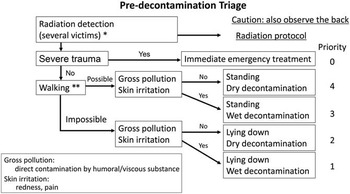
The course assumes an “all-hazard approach” for responding to all types of CBRNE disasters, without emphasizing responses according to the type of disaster (ie, chemical, biological, radiation/nuclear, or explosive). Contents and methods of responding to the respective individual CBRNE are minimized. Participants learn while discussing FD, police, and medical activities that constitute the first response on-site. The course can be taken by individuals and is intended for individuals who may work at disaster sites. Organizations need to conduct activities under common guiding principles related to decontamination, perimeter establishment, protection, and other activities. For that purpose, lectures and practical training on the concepts of two types of triage are incorporated. Pre-decontamination triage particularly is important, since this determines the need for decontamination, selection of methods, and priority level. A rapid and versatile decontamination system is needed to deal with mass casualties. With pre-decontamination triage, very few cases require wet decontamination. The majority of cases use dry decontamination with undressing and wiping of exposed sites only (Figure 1). When assuming a dirty bomb, it is taught that emergency treatment of severely injured patients should be given priority without decontamination of radioactive substances. In three tabletop simulations, disaster-site scenarios under a variety of conditions are presented. Participants come to understand the differences of related organizations in terms of how firefighters, police, and medical personnel conduct their activities, and through discussions, they learn how they should cooperate. Problems encountered during past incidents, such as the 1995 Tokyo subway sarin attack,Reference Dallas, Coule and James 3 , Reference Okumura, Suzuki and Fukuda 4 and new findings also are presented to trainees in lectures.
Flowchart for Pre-decontamination Triage. * Geiger-Mueller survey meter. ** Propriety of own undressing/decontamination.

Assessments of the trial course for MCLS instructors were good in terms of both composition and content. The multidisciplinary discussions during the tabletop simulations were considered particularly beneficial. Based on the assessments, the following modifications have been made. First, doctors, firefighters, and police officers are deemed as essential participants in order for discussions to be effective. To clarify the risks and response measures for radiation disasters, a lecture was added on the differences between internal and external exposure. To standardize the progression of tabletop simulations, a FD in a fictitious, normal-sized city in Japan was assumed.
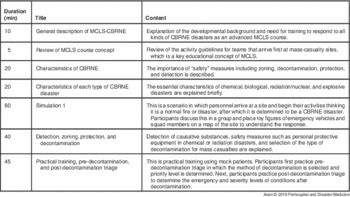
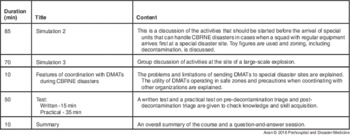
The finalized program (Table 1 and Table 2) is a one-day course including lectures, tabletop simulations, practical training, and a test.
The First Half Agenda of the MCLS-CBRNE Course

Abbreviations: CBRNE, chemical agents, biological agents, radiation/nuclear attacks, or explosives; MCLS, mass-casualty life support.
The Second Half Agenda of the MCLS-CBRNE Course

Abbreviations: CBRNE, chemical agents, biological agents, radiation/nuclear attacks, or explosives; DMAT, Disaster Medical Assistance Team; MCLS, mass-casualty life support.
Discussion
In Japan, DMAT member training is one of the most systematized training programs for disaster medicine. The material covered in Japanese DMAT education is characterized by responses to local disasters and widespread disasters, given the many earthquakes and other natural disasters that occur in Japan.Reference Okumura, Hisaoka and Yamada 5 This composition represents a major point of difference from the large number of hours allotted to CBRNE disasters in NDLS in the United States.Reference Anan, Otomo, Kondo, Homma, Koido, Morino, Oshiro, Harikae and Akasaka 1 , Reference Coule and Schwartz 2 The MCLS was developed as a training program for firefighters and police who work in collaboration with DMATs at disaster sites, to help them learn the educational philosophy and activity guidelines of Japanese DMATs from the perspective of disaster medicine. The one-day course incorporates tabletop simulations and practical triage exercises. Courses have been held since 2011, and more than 8,000 people have taken the course over four years. Attendees include both medical personnel and emergency response personnel. The MCLS uses tabletop simulations to teach disaster-site activities. Compared with general disasters, CBRNE disasters require more specialized crisis management, and unified codes of practice among related organizations are thus much more important. The MCLS-CBRNE is therefore very useful as an educational tool for CBRNE disaster response.
As internationalization progresses, international events are being held more frequently in Japan. The risk of a CBRNE disaster is increasing, and ensuring appropriate measures for disaster-site rescue and medical activities represents an urgent task. At the same time, unifying the thinking of related parties and building a workable system are not easy. In Japan, field training exercises have been held in each region, but many problems have been encountered. The respective organizations have different goals and guiding principles, and the lack of mutual understanding of these facts remains a major problem. In large-scale field exercises with scenario-type training, emphasis is on smooth operation. Efforts for viable guideline changes and coordination are not included. To facilitate these kinds of changes, it is important for individual firefighters, police officers, and medical personnel participating in on-site activities to have had convincing, realistic experiences. The tabletop simulations in MCLS-CBRNE help participants to discover areas of improvement for themselves through the experience of multiple failures together with group discussion. This is useful as an occasion for participants to assess the inadequacies of the activity guidelines of their own organization objectively.
The importance of decontamination in cases of contamination by chemical agents or radioactive materials is a widely taught concept. However, the criteria for selecting wet or dry decontamination are not recognized sufficiently. Because of this, training in wet decontamination only, which takes time and effort, is common. Assuming the recurrence today of an event such as the 1995 Tokyo subway sarin attack, over-emphasis on decontamination and protection runs a risk of resulting in an increased number of fatalities. In this course, dry decontamination is considered the fundamental form of decontamination, and emphasis is placed on selecting wet decontamination only under specific conditions. This judgment is essential in speeding up decontamination efforts.
Limitations
This program has two limitations. The content is insufficient for staff already specializing in CBRNE responses. For example, the characteristics and specific treatments associated with specific event types are not covered. As a result, activity guidelines for medical teams in the field are unclear. For example, whether to work in dangerous areas by wearing personal protective equipment and the question of full cooperation with the FD are issues that have not yet been settled in Japan.
Conclusion
Unifying the thinking of multiple organizations and formulating common guiding principles related to on-site activities has proved difficult in the past. The MCLS-CBRNE will be beneficial as a means to improve anti-disaster measures for international events and the disaster response competency of related organizations. The MCLS-CBRNE is planned to be offered in the future as training sponsored by JADM in Japan.